As a result of the passage of the 2018 Music Modernization act the federally designated Music Licensing Collective (MLC) will take over licensing, collecting and paying mechanical royalties from streaming services to songwriters January 2021. Previously these duties and services were performed by a variety private companies. One of the goals of the MMA was to streamline the process so that songwriters would benefit from increased efficiency and lower overhead. Incredibly the MLC appears to be establishing a system that will be less accurate and less efficient than the bad old system. Essentially it is an additional $60 million dollar layer of bureaucracy sitting atop the old system with many of the old players now hired as “vendors.”
But it gets worse…
It has now become apparent that the MLC plan for building a global database of songs and songwriter/publisher splits is this:
The MLC will (manually?)check this data against their shitty HFA data.
And then in the event of conflict…. <crickets>
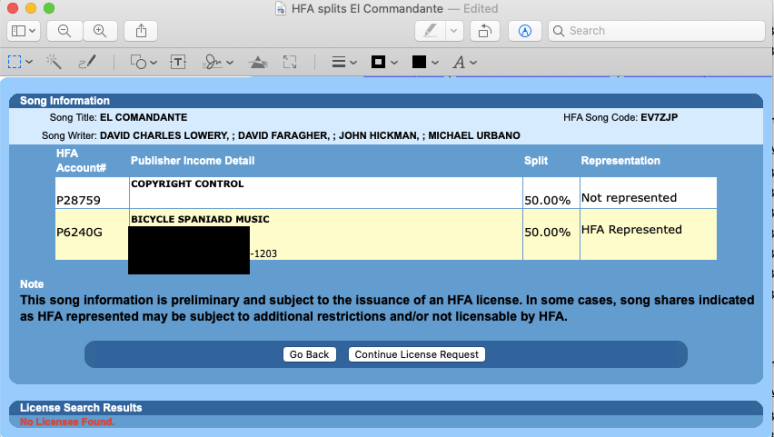
How bad is the data? I can only go by my catalog but nearly every song I co-wrote with another writer does not have the proper writer splits. This despite the fact the I am an affiliated HFA writer/publisher and I gave them the splits when I signed up. Look below. My co-writers shares are listed as “copyright control.” What does that even mean? Where does that money go?
I think a fair reading of this is “MLC forces songwriters to fix bad data they are buying from HFA.” So if songwriters are fixing the data, and the MLC is buying data from HFA, what exactly do all those highly paid music executives at the MLC do for the $60 Million? Asteroid mining?
A Nashville songwriter forwarded an email from the Nashville Songwriters Association International (NSAI). It concerns the oppressive and likely unconstitutional consent decrees that allow a single judge to (arbitrarily) set songwriter public performance organization royalties. For years the NSAI has claimed to oppose the consent decrees. Now that the DOJ is seriously considering eliminating the decrees and thus let the market dictate the rates, the NSAI has suddenly decided they like the consent decrees!
“After months and months “reviewing” the ASCAP and BMI consent decrees, the U.S. Department of Justice Anti-Trust Division may be winding toward final recommendations on the antiquated decrees imposed during World War II! NSAI, for years an advocate for eliminating or making radical changes in the decrees, took a different position after Congress adopted the Music Modernization Act (MMA) in 2018. The most important changes we wanted to the decrees were made in the MMA. Those were changes as to how the ASCAP and BMI rate courts set digital performance royalties. Now that those judges are required to approximate market value royalties, NSAI has advocated NOT to completely eliminate the decrees.”
Most organizations that purport to represent artists and songwriters are run by folks who are not the sharpest tools in the shed. Thus we’ve seen some stunningly stupid decisions by similar organizations. But this is the stupidest ever. Why do we need judges to approximate the market value of our songs? And how will they do that? There hasn’t been a free market for performance royalties since WWII. If the DOJ is willing to let songwriter organizations out of the consent decrees, why don’t we just get out of the consent decrees and let a true “willing seller/willing buyer” market set rate? No approximation needed. Why would an organization that purports to represent songwriters essentially give away songwriters’ fundamental right to price their songs? I am dumbfounded.
To be fair NSAI has an answer. Sort of.
“We instead want to first see how the new rules impact songwriter royalty payments AND because of concern Congress might undo all of the gains from the MMA when they replace the decrees with new copyright laws.”
Oh, I see. Congress has readied some legislation to replace the ad hoc consent decrees with new copyright laws. And these new laws *might* roll back gains made in the Music Modernization Act.
Bart Herbison is the Executive Director of the NSAI. I assume he wrote or approved the above email. This is so important I want to address him directly now.
Bart:
What the fuck are you smoking? There is no pending legislation. I asked everyone. DUDE, YOU CAN’T JUST MAKE SHIT UP. This is the most misleading shit ever. What kind of EO of a membership organization makes shit up to scare their members into limiting their rights?
Alright. Maybe that’s too harsh. Maybe what you meant to say is that “eliminating the consent decrees will possibly cause broadcasters to introduce copyright legislation that would gut songwriter pay to benefit some of the most hated corporations in America.”
In the middle of a pandemic.
In the worst financial crisis since the great depression.
I’d like to see them try.
JFC man you are supposed to fight for songwriters. Yet you seem afraid of that fight? This is your fucking job man. This is what you signed up for. If you can’t do that you need to give up your $275,000 a year salary. Step aside. Let a real songwriter advocate run the organization. Songwriters don’t need any more quislings.
The MLC announced an aspirational tool for publishers to confirm whether the MLC’s data is correct for their songs. Apparently this is planned to be a quality control check for song metadata that The MLC has already acquired. As far as we can tell, the tool doesn’t actually exist yet.
Here’s the press release language:
For Music Publishers, Administrators and CMOs: Data Quality Initiative (DQI)
The MLC created the Data Quality Initiative (DQI) to provide a streamlined way for music publishers, administrators and foreign collective management organizations (CMOs) to compare large schedules of their musical works’ data against The MLC’s data. Through the DQI, The MLC will provide participants with reports that highlight the discrepancies between the two sets of data so that they can more easily address those discrepancies and improve the quality of The MLC’s data.
The MLC has begun working directly with a number of music publishers and administrators to on-board them into the initiative. The MLC is also working with software vendors to help them enhance their platforms to enable users of their systems to participate in the initiative.The MLC looks forward to working with other music publishers, administrators, CMOs and software system vendors interested in participating in The MLC’s Data Quality Initiative.
“One of the biggest and most time-consuming challenges for music publishers, administrators and CMOs is checking the accuracy of their musical works’ data,” said Richard Thompson, CIO of The MLC. “We launched the Data Quality Initiative to help those parties increase the efficiency and effectiveness of this process. Participants in the initiative will be able to see where their musical works data does not match The MLC’s data, so that they can then take the necessary corrective action.”
Of course, The MLC has yet to permit songwriters (or anyone for that matter) to register their songs with The MLC at least not publicly. Neither have they given anyone access to whatever data they actually have ingested–and still won’t with the DQI tools. When you use the DQI tool, you sit outside The MLC’s database and they give you “reports” so you may take “the necessary corrective action”. At your own expense, of course. You know, “Play Your Part On Your Dime to Keep Us Relevant.”
So if the goal of the Data Quality Initiative is for “The MLC [to] provide participants with reports that highlight the discrepancies between the two sets of dataso that they can more easily address those discrepancies and improve the quality of The MLC’s data” we have to ask how did The MLC come to have any data to check for quality control in the first place?
Chances are pretty good that the source of The MLC’s data set is the Harry Fox Agency–if they’ve even bothered to copy the HFA data into The MLC’s database. (One reason they send you a “report” is so the source of that report is not disclosed as if it were just the HFA database being queried, it might raise some hackles among songwriters and especially the DLC who is paying millions for the whole show.)
As has been noted, The MLC’s Richard Thompson announced that The MLC was working with HFA since The MLC was first designated by the Copyright Office as the MLC. (even before they announced that HFA was their vendor) This is the HFA that services Spotify. Spotify has been sued…ahem…a number of times for failures to license songs in historic litigation that led to their latest get-out-of-jail-free goal-post-moving exercise also known as the Music Modernization Act. In fact, HFA is currently being sued alongside Spotify by Eminem’s publishers for all sorts of nasty things (which have yet to be proved). But make no mistake, HFA was picked as best of breed by everyone’s favorite MLC, The MLC.
So what The MLC is really saying here is that they want everyone to take the time to check your own data against the HFA database and then correct it. And who wants to bet that all those corrections–which could be a vast number of corrections and song-share updates–will end up back at HFA for HFA to use as it chooses (or its Rumblefish affiliate).
But wait, there’s more. Don’t forget: The reason for this exercise in data cleaning is to “improve the quality of The MLC’s data“. Why do you care about the quality of The MLC’s data? Very simple. The government makes you do it. What could be worse than a compulsory license? A compulsory license with a safe harbor for massive infringers like Spotify and an industry-wide market share black box controlled by the for-profit companies that most benefit from the market share black box.
So what The MLC is really saying is “play your part” to “improve the quality of The MLC’s data” or we will take your money and there’s sweet F-all that you can do about it. In the middle of a global pandemic. The truth doesn’t read quite so well, right? Oh, and by the way–you get to pay the costs of this data clean up job yourself even though it’s for the benefit of The MLC. And why are you compelled to cover those costs?
Because they’ll take your compulsory royalties if you don’t. And given the way these people work, maybe even if you do. How would you ever know?
But wait, there’s still more. Remember that the Eminem publisher’s case is about Spotify’s failure to match properly which is a condition of the MMA safe harbor that somebody decided was a good idea for the rest of us. Let’s say that those publishers are wrong and that the services have actually been matching like crazy to keep their safe harbor (albeit in the background because the sainted MMA does not have any oversight or transparency about matching).
We don’t believe this, of course. But let’s just say that they’re wrong for argument’s sake.
If The MLC got their data from the services instead of from HFA, then presumably all that matching being done by the biggest tech companies in human history would probably result in a greater match rate than HFA–particularly since HFA has been at the heart of many, many lawsuits against their clients for failing to match. Let’s face it–many, many publishers have already burned a huge amount of energy fixing Google’s weak Content Management System alone. Want to bet that CMS has a higher match rate than HFA?
So we don’t think that the song data that is being checked so you can “Play Your Part On Your Dime” is from anywhere but HFA. We also think that if no one stops them, The MLC will simply hand over all those corrections to HFA for use in its own database for unrelated clients, such as for bundled performance licenses. And who benefits from that besides HFA? If you said the publishers with direct deals on services that engage HFA or Rumblefish to handle their licensing, you probably would not be too far wrong.
Remember this?
Facebook Inc. has engaged HFA’s Rumblefish services to offer to publishers the opportunity to enter into a direct license agreement with Facebook for Facebook, Instagram, Messenger and Oculus. This opportunity is available to all publishers.
This license agreement will grant Facebook Inc. reproduction, display, synchronization, and public performance rights. As an HFA Affiliate you have already authorized HFA to act on behalf of your publisher with respect to licensing offers for the rights mentioned above other than performance, which means we need your written permission to accept this offer on your behalf.
So be sure to fire up that credit card and “Play Your Part”. And be quick about it. Your betters are waiting.
By now you are probably aware of the campaign to get brands to stop advertising on Facebook because of the prevalence of hate speech. The campaign has been endorsed by a number of civil rights organizations including The NAACP and Anti-Defamation League. The campaign owes much of it’s success to Sleeping Giants (twitter handle @slpng_giants) a largely anonymous social media activist group. Sleeping Giants was the force behind successful advertiser boycotts of Breitbart and Fox News. Facebook is now their biggest trophy.
Over the last decade, my fellow bloggers at the Trichordist have documented the prevalence of white nationalist and neo-nazi music on YouTube. Here are just a few examples:
YouTube advertisers have periodically reacted to these reports by pulling advertising. But YouTube continues to be loaded with hate rock. You can verify this yourself by checking the Southern Poverty Law Center list of white nationalist bands and then searching on YouTube. Here are some screenshots from my most recent search.
Fortress, Kill Baby Kill, The Bully Boys, Skrewdriver, Final War, etc. The gang is ALL there! And not all these videos were “user-generated content.” Many of these were official uploads by music distributors like CD Baby (Bully Boys). And of course, many of these videos were monetized by YouTube.
So if advertisers are concerned that their ads will end up next to hate speech shouldn’t the #StopHateForProfit boycott also include YouTube? Then again maybe some advertisers just don’t care? (See below).
We’ve been waiting for The MLC to show us how the best of breed solves the global rights database problem. Hopefully the smart people will solve that problem before the January 1 deadline when the MMA’s blanket license comes into effect. We’ve been told many times that HFA and ConsenSys were the elites and the smart people who would lead songwriters to the promised land. So we have all been waiting. And waiting. And waiting…. The deadline is less than six months away and we have seen no tech demonstrated at all despite all the hoopla and promises.
But this week we got a look at what the elites have come up with in the form of the “Music Data Organization Form” that The MLC wants songwriters to use to “Play Your Part”. Remember–The MLC got the tens of millions of dollars from the services and they want you to “Play Your Part” and “Eat Your Costs” to play your part for free. Remember–they are the ones with a paycheck and fringe benefits paid for by the services that rip off songwriters every day.
Whenever we want to read a press release from The MLC we always turn to Music Row Magazine where we can usually read it word for word. This is what Music Row “reports” about The MLC’s “Music Data Organization Form”:
The MLC created the Music Data Organization Form to help self-administered songwriters, composers and lyricists begin to organize their musical works’ data ahead of The MLC’s roll-out of The MLC Portal.
“The Music Data Organization Form is designed as a worksheet to help guide self-administered writers through the process of collecting the data they’ll need to register with The MLC,” said Kris Ahrend, CEO of The MLC. “The form essentially outlines the information self-administered writers will need to compile in order to register their musical works in The MLC Portal.”
The MLC intends to begin rolling out the first version of its user portal later this quarter. This version [of the portal,not the Music Data Organization Form] will enable users to set-up their accounts and then search, view and edit The MLC’s data for existing musical works and register new musical works.
So now it’s “later this quarter” which is a shift from what The MLC’s Richard Thompson said at the Copyright Office unmatched roundtable only last December when he said on the record: “So our current timeline has the first version of the portal going live late Q2, early Q3, of next year” meaning this year. We are in early Q3 now, but now it’s “later this quarter.” You know, Jesus is coming, look busy.
We can save you a trip–you don’t have a choice in participating in the blanket license because it’s even more compulsory than the old compulsory thanks to the Music “Modernization” Act. On the other hand, you may not have to use this form because this form has no use to you as we will see, particularly if you already have all your song data organized in a format that works for you.
If you use The MLC’s “Music Data Organization Form” it appears that you’ll just have to do the same work all over again which the last paragraph of the Music Row press release tells you if you read closely. (That’s the kind of daylight in the facts we expect journalists to catch.)
More importantly, entering your data in the Music Data Organization Form must be done manually. At this rate, it may be that entering your data in whatever “portal” The MLC cooks up certainly looks like it, too, will require manual entry from independents. Each of those manual steps will then be mistake-prone which could easily lead to…a bigger black box.
Just sayin.
The MLC’s “Music Data Organization Form” does not seem to serve much of a purpose and it surely can’t be a list of all the data fields that The MLC will require. Those fields are still being argued over at the Copyright Office. It seems to us that The MLC’s “Music Data Organization Form” is a make work step to mollify songwriters who are getting restless. Because looking busy.
Here’s some problems with The MLC’s “Music Data Organization Form” that we’ve identified. You may find others. If you do, leave a comment privately.
Problem #1: Once it is filled out, this form cannot be ingested by anyone for anything as far as we can tell. We think we’re safe in saying that you shouldn’t use this form if you think that you can just hand it over to The MLC and have them then use it to automatically upload your song data into the global rights database by ingesting the metadata you laboriously inputted in the form.
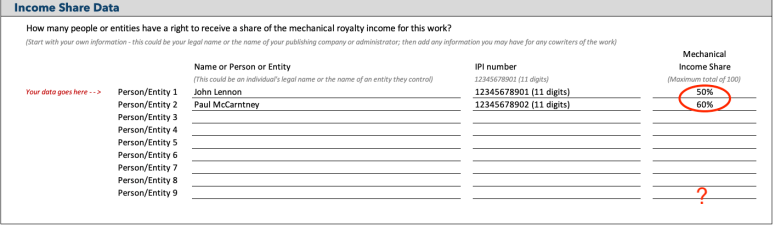
Problem #2: Even though the “Music Data Organization Form” is in Excel, it may as well be in WordStar–there are no formulas in any cell. We know this because we checked each cell, but here’s another way to find out:
Note that the Lennon and McCartney shares sum to 110%, but you wouldn’t know you had incorrect splits from the “Music Data Organization Form” because there is no formula in the cells that totals the splits for you. Which is, by the way, the most basic arithmetic in Excel. You can eyeball the splits in the easy case of 50/50 but if you had 9 writers, you might overlook if all the splits don’t sum to 100%. Which is why you have the machine do it for you!
Problem #3: You have to do a separate Excel file for each song in your catalog. So you’ll get lots of practice at filling out this form manually. That could lead to getting it right more often or getting tired and making more mistakes.
Problem #4: The MLC thinks you can use this to handwrite your metadata. Yes, you read that right. It’s already set up with print fields, so they got that printing thing right at least.
Problem #5: The writers are not tied to publishers in any permanent way. One wrong sort of the cells in the “Music Data Organization Form” at The MLC and there’s no telling how many mistakes there will be.
Problem #5A: There’s only an implication that The MLC will want you to send them these worksheets. They don’t actually say they want you to send them. Frankly, if you have to do a separate work sheet for each song, they probably don’t even want them. But–because The MLC’s “Music Data Organization Form” is not automatically inputted into The MLC’s systems, if The MLC did get their hands on the individual forms, there is nothing stopping The MLC from sending a copy to others, like, oh say HFA or another vendor. Nobody would ever know. And it would keep those interns busy with data entry.
We could go on, but let’s stop there.
Hey, DLC! This is what you get for $30 million? We think ya been robbed.
But seriously folks, you never get a second chance to make a first impression. What we expected was something just a tad more comprehensive and useful. Something befitting the best and brightest, the global elites in our business. Something that was smarter than what the average ConsenSys asteroid miner would come up with. We don’t rule out the possibility that this is some magical blockchain solution hiding in plain sight but we’re not smart enough to see how that works if that’s the secret.
But even so it still leads us back to the same conclusion.
If The MLC is getting paid to process our data then they should take our data in the format that’s convenient for us. If they don’t like that, then they should pay us to change the data into a format that’s convenient for them to build the core asset they are being paid millions to create. They already got the money to do this job.
It’s that simple. But please don’t pawn off this kind of manual solution on us and tell us that we just need to make copies of their lo-fi worksheet for each song in our catalogs. It can’t even add up the splits.
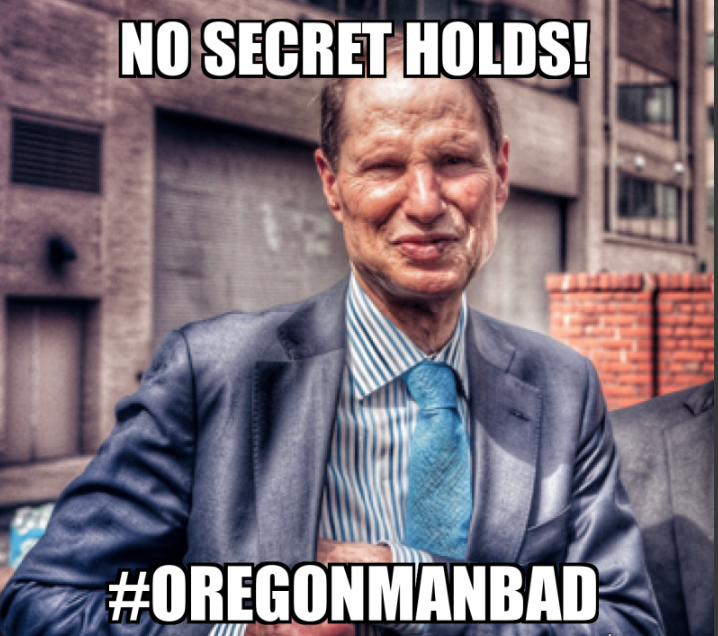
Oregon Senator Ron Wyden is still sneaking around in the shadows abusing the anti-democratic secret hold to stop the CASE Act from passing the U.S. Senate, the copyright small claims bill. And get this–the CASE Act is bipartisan legislation that has been in the works for years and years and has already passed the U.S. House of Representatives and his own Senate Judiciary Committee!
But Senator Wyden is abusing a little known procedural trick to stop the bill from coming to a vote in the Senate so it can bring relief to independent creators in a vast number of copyright fields like photographers, authors, illustrators, songwriters and recording artists. And it’s not like his constituents want him to oppose it, they want him to pass it!
Oregon Professional Photographers Association Billboards
Little Ronnie doesn’t like the nasty billboards. Do you think he thinks he can stomp his little foot and tell Senator Kennedy, Senator Durban and all his other colleagues to bark at the moon? Who does this guy think he is? Do you think he thinks he can get the billboards down if he holds his breath long enough? Did he ever consider that maybe we’re just getting started bringing heat to his butt?
He’s clearly in the pocket of Big Tech and has been for a very long time. This is a man who holds up every copyright bill that comes through the Congress and he does it the same way every time.
But this time he’s beginning to think he might actually get unelected because he underestimated the number of independent creators who are going after his job.
Say it like a mantra and share it with your friends–Oregon Man Bad!
A performance metric one hears from the digerati is the term “conversion rate.” “Conversion rate” for a streaming service usually means the rate at which users of an ad-supported free service are “converted” to paying users. That motivation is usually because they are so fed up with the advertising they are willing to pay. (This was one of the many failed pitches from Spotify before people stopped trying to justify hanging on until the IPO riches flowed in.)
YouTube, of course, has never been too terribly interested in anything that moves users away from advertising. That resistance (and potential internal competition between the massive ad sales team and the ever changing YouTube managers), may explain the many failed efforts at launching a YouTube subscription service by a company that knows more about user behavior than anyone in history. They just couldn’t seem to get it right for the longest time. You don’t suppose that YouTube’s apparent lack of interest in getting large numbers of users to substitute away from free to subscription was because YouTube made a lot more money from the ads than they ever would from the subscriptions?
One of the ways that YouTube (and Google) makes money from advertising is by taking money that is not theirs to take (sometimes called “monetizing” content). The civil law calls that act a claim of “conversion” and the criminal law calls it the crime of “theft”. Conversion and theft are two sides of the same coin and often one implies the other, albeit with different burdens of proof.
YouTube’s Content ID tool is a way for copyright owners to block or permit advertising on user-generated content that includes their copyrights, often music. Users of Content ID will tell you that it works just well enough that Google can say it is an effective tool, but even with Content ID music still gets through (and is often monetized by YouTube) for a variety of reasons. This requires time consuming and costly manual searches. Companies like AdRev make it a bit easier, but are essentially third party Content ID users. These companies are compensated with a commission on infringing works they find on YouTube that they convert–there’s that word again–from infringing to monetized, which means that YouTube now splits the advertising revenue with the copyright owners who in turn split their share with an AdRev.
But see what happened there? If you have Content ID, you can block on the upload some of the time, or you can do a search. If you don’t have Content ID (see Maria Schneider’s class action) then you can’t block on the upload only chase the infringements manually. But quite rightly from an economic perspective, companies like AdRev are not that interested in doing that work on a rev share basis if there’s no rev share when you block.
Here’s the point–you have a property right in your copyright. You have a property right to license that copyright. Any revenue derived from exploitations of that copyright is your money. YouTube uses its monopoly power to impose a deal to monetize your copyright (under duress, of course, due to whack a mole DMCA). That deal involves a revenue share. (Let’s just assume you decide to take the King’s shilling and accept Google’s deal under duress which you shouldn’t have to do and which may not even be enforceable.)
The question is, when should that revenue share attach–when they start exploiting your copyright in violation of your property rights or when you catch them doing it. And if (1) you catch them violating your property rights and (2) agree to monetize, when should they pay you your agreed upon share of the revenue from monetizing? Should they pay retroactively to the first exploitation? Or only prospectively after you catch them?
The correct answer is they should pay retroactively. But they don’t. They just keep the money. For millions of infringements. And they get away with it because of their monopoly power, which leaves one choice most artists won’t make, which is to sue them like Maria has.
Remember–Content ID operates largely like any other fingerprinting tool. (Psychoacoustic fingerprinting is old technology–remember Jonesy in “The Hunt for Red October”? That’s fingerprinting. A “fingerprint” is simply a mathematical rendering of the waveform of an audio file.)
There is a reference databases of recordings that are “known knowns” (which is why it is important to be included in the Content ID database as Maria Schneider correctly points out in her class action.) The fingerprinting tool encounters a new file, takes a fingerprint, then looks for a match in the reference database and reports a result that triggers an action. Typically, fingerprinting tools are binary: match or no match. What happens after the tool finds a match is entirely in the control of the operator. (So while the tool could have a match rate of 90%, the operator could report a random number of matches or a fixed number of matches, like one every ten, or one every 1000. That means 90% accuracy could turn into a much lesser percentage of reported matches. It’s important to know how many matches trigger an action.)
Having had some experience with audio fingerprints, I think you will find that once a fingerprint is in the reference database, the recognition tool (Content ID in this case) will spot the reference fingerprint a very, very high percentage of the time. The fingerprinting tool I’m most aware of caught matches over 90% of the time. I can’t imagine that a tool developed by the biggest technology company in commercial history would do less–unless they wanted it to. Remember, this is not taking into account re-records unless the re-record is itself in the database, or pitch bends. This is an exact match which is very common use of Content ID. (See Maria’s class action complaint, and Kerry Muzzey has a great description of this in his recent Senate testimony.)
If Content ID is actually missing matches to known knowns on the upload (assuming exact matching is possible), I find it very odd that Content ID is missing much. Maybe it’s not, but one way to find out is to force Google to reveal the inner workings through discovery in the class action case.
But if Content ID does miss exact matches, it would be interesting to know what percentage of those misses end up being monetized, and of those, what percentage end up getting caught later by a subsequent use of Content ID or a manual investigative process. This will give an idea of the scale of the retroactive payment issue.
As Maria rightly points out, it is virtually impossible for an artist or film maker without Content ID to catch YouTube monetizing infringing works. But I think the analysis has to go a step further–even if you have Content ID, at the moment you catch YouTube monetizing illegal versions, you are in no different position than the artist who lacks access to the Content ID tool.
Both have the same problem–YouTube is profiting from illegal copies. If when you catch them you then elect to monetize, YouTube will pay you going forward, i.e., prospectively. But I do not believe they will pay you retroactivelyfor the illegal use. (There is a rumor that some music publishers do get paid retroactively under some settlement, but that needs to be confirmed.)
That means that YouTube is directly profiting from piracy for the retroactive views which could total into the hundreds of millions per day given the massive number of daily views on YouTube. If you elect to monetize due to YouTube’s monopoly power, you are essentially releasing them from liability under duress. Ifyou catch them.
So YouTube takes your property, monetizes it, and refuses to pay you for how much they made before you caught them if you ever do catch them. They dare you to sue them because you would be taking on the biggest company in commercial history that controls 90% of the access to information in the world and routinely defies governments. Not everyone has the spine of Maria Schneider.
Failing to license at all or failing to pay retroactively means that YouTube profits from piracy by converting your property to their own. And as Maria rightly points out, Google scrapes user data through non-display uses in the background even if YouTube is not monetizing overtly which they then use to compile user profiles in “millions of buckets” (which dribbled out before Judge Koh in the Gmail litigation (In Re: Google, Inc. Gmail Litigation, Case No. 13-MD-02430-LHK, (U.S.D.C. N.D. California, San Jose Division, Sept. 26, 2013)).
In either case, the value of the amount converted or stolen should rightly include the value of these user profiles scraped in the background, as well as the advertising revenue.
And don’t forget that Google is controlled by Larry Page, Sergei Brin, and Eric Schmidt through their “supervoting” shares of stock. It’s hard to believe that this YouTube policy was created without their blessing.
The simplest move for Google would be to simply pay both retroactively and (if the copyright owner elects to monetize) prospectively. Otherwise, it seems like a huge number of crimes are going on in a very planned and organized way dreamed up by YouTube and Google employees. “Dreamed up” is also called a conspiracy, and if there’s an actual conspiracy it’s not a theory (which came up in an interesting trade secret misappropriation RICO case against Google they managed to wriggle out of, at least for the moment).
The law has another word for organized theft at scale–we sometimes call it “racketeering.”
Google and YouTube have managed to create a scam that has gone both largely undetected and largely unpunished for a decade–illicit activity that can be both seen and quantified through the sale of advertising and is also unseen and unquantified through data scraping in the background. (I leave it to you to speculate which is more valuable.)
Google has also faced down civil RICO claims for racketeering through the theft of intellectual property. The last reported RICO case against Google offers a checklist for how to make a civil RICO claim stick against the Leviathan of Mountain View. I like the YouTube case a lot better than the inventor’s case they beat back.
But most of the time Google just keeps the money when they get caught. A prime example is YouTube’s standard practice of refusing to pay a revenue share retroactively after you catch them infringing your work using Content ID. That unjust enrichment creates an incentive to sharply limit the number of artists or songwriters who get access to Content ID in the first place. I think this is why Google massively overreacted to Mississippi Attorney General Jim Hood’s Civil Investigate Demand and subpoena that they never did respond to. Maybe they were covering up the same crimes that got them prosecuted in Rhode Island and they did not want to go through that again.
And therein lies the rub and our topic today: If Google never gets caught, Google quietly keeps all the money. For our world, this happens because they’ve artificially limited the tools that independent creators can use to catch the massive infringements. And even if the majors and a handful of independents get the Content ID tool, YouTube still has the incentive to make Content ID just good enough that they can say it works, but not so good as to actually stop the infringement before it starts.
The majors using Content ID have to employ still other means to catch them, sometimes manually, at great cost. In fact, you have to wonder if net-net the total costs of administering the YouTube deals actually exceeds the minimum guarantee and royalty payable. Those tools are simply beyond the reach of the creators, even the few who YouTube grants access to Content ID.
And of course, any user of Content ID (big or small) has to sign up to the take-it or leave-it shakedown deal that limits what you can do about it when you catch them. Which is just another form of the protection rackets.
This criminal enterprise comes in two flavors (at least): Ad sales for illegal products (like the drugs, counterfeit tickets and the like), and selling legitimate advertising around content that Google knows or should have known was illegal (like YouTube’s monetization of infringing works). And, of course, Google scrapes data in the background on all these criminal activities to its great–and secret–profit.
As we saw with the drugs case, Google knew exactly what it was doing, and I’m not willing to believe their rudderless ad sales teams don’t also know exactly what they are doing (remember Google’s ad sales team gave credit terms to infringers, and the drugs sting operation also shows that they brainstormed many criminal dodges to deceive Google’s own best practices team).
What little evidence we can lay hands on in the open source demonstrates that Google must know very well that it engages in criminal behavior–why else was Eric Schmidt advised by then-counsel David Drummond to refuse to answer Senator John Cornyn’s questions regarding the drugs case when Schmidt testified before a 2011 Senate Antitrust Subcommittee hearing? (Also known as “taking the Fifth.”) After engaging in a weak attempt at misdirection. Did they think this question wouldn’t come up so didn’t prepare for it? I doubt that very much. (If they cooked up this story without the lawyers, this might well have been a conspiracy. Attorneys take note: Crime/fraud execution?)
Eric Schmidt Takes the Fifth on drugs case to Senator John Cornyn: ” I have been advised — unfortunately, I’m not allowed to go into any of the details and I apologize, Senator”
Now that the U.S. Senate is investigating the effectiveness of the safe harbors under DMCA, this would be a good time for the Department of Justice to investigate Google’s business practices and potential criminal activities. Smells like RICO to me.
My name is Kerry Muzzey, and I am a film and television and modern classical composer.
I am one of the very few independent artists who has access to YouTube’s Content ID system; and most of my experience with notice and takedown has been on YouTube. Content ID has become a core piece of my licensing business: it is the x-ray that reveals the theft of my music to me. This is why I am also nervous about speaking out today – because I fear retaliation by YouTube and Google. I am concerned that they may take Content ID away from me for raising my concerns publicly. The technology behind Content ID is nothing short of brilliant, and I don’t want to lose access to it.
Growing up, my mom always said: “You’re not allowed to complain unless you’re gonna do something about it.” Senators, my being here today is my “doing something about it.” Today, I have the most unique opportunity I have ever had in my lifetime. I have the opportunity to ask Members of my United States Senate to fix a broken law.
Let’s also not forget the way Google is governed (as is Facebook, Spotify and many others). Larry Page, Sergei Brin and Eric Schmidt hold a special class of “supervoting” shares, what SEC Commissioner Robert Jackson has called “corporate royalty”.
These insiders get 10 votes for every one share they own of a special class of supervoting stock. This means that the insiders control over 60% of the voting stock and win all shareholder votes—including votes to appoint the board of directors.
Supervoting shares give insiders absolute control of Google–one of the most successful public companies in commercial history. Because they control every aspect of Google’s operations, Google truly is their “alter ego.” One purpose of Google’s lobbying spend must be to keep the corporate royalty out of prison.
These supervoting Google Class B shares are not available to the public. The public can buy two classes of stock: GOOGL shares are Class A (one vote per share) and GOOG shares are Class C (no votes per share). (GOOG shares were issued in a dividend to GOOGL holders.) GOOGL shares typically trade slightly higher than GOOG which may demonstrate that the market has priced in a lack of meaningful voting rights in GOOGL.
It should not be surprising that Google shareholder meetings are a one-way communication event. The supervoting corporate royalty tell the other shareholders how things are going to be and vote down any move by GOOGL holders to change the status quo—like converting supervoting shares into one share one vote. As Floyd Norris reported in his New York Times “Economix” column, “Rarely has a shareholder vote been less suspenseful.”
So Google’s profit from evil is not an accident. If Congress wants to fix the DMCA, let’s fix all of it. And as U.S. Attorney Peter Neronha discovered ten years ago, that requires a grand jury.
Grammy award-winning composer-performer Maria Schneider has filed a class-action lawsuit against YouTube and parent companies Google and Alphabet. The lawsuit is brought on behalf of independent rights holders that do not have access to the Content ID system (most of us). As the complaint states:
Defendants Alphabet, Google, and YouTube reap billions of dollars annually from the online hosting of videos, including millions of works that infringe on the exclusive copyrights of Plaintiffs and the Class. Defendants permit and facilitate this infringement because it furthers their growth and revenue strategies and because they have determined that Plaintiffs and the Class— unlike YouTube’s preferred Content ID partners—lack the resources and leverage necessary to combat copyright infringement on the scale at which it is perpetuated on YouTube.
YouTube has consistently claimed that it protected by the DMCA safe harbor against copyright infringement lawsuits. The complaint argues that Youtube has behaved in a manner that disqualifies the company from seeking DMCA safe harbor protection. We look forward to this playing out in court!
Amended 8 Mile v Spotify complaint adds Harry Fox Agency as a defendant. The complaint states:
“HFA’s material contributions to and enablement of Spotify’s infringement through a joint conspiracy with Spotify to distribute fraudulent documents and misrepresentations designed to conceal and enable Spotify’s infringement of the Eight Mile Compositions.”
It continues
“2. As noted, this is, in part, an action for vicarious and contributory infringement brought by Plaintiff against HFA in connection with a scheme to conceal and materially enable Spotify’s copyright infringement by circulating knowingly fraudulent documents (e.g., untimely, and otherwise ineffective Notices of Intention to obtain compulsory mechanical licenses (“NOI’s”) that were intentionally and knowingly backdated to appear as though they were issued on a timely basis, and the fraudulent rendering of purported “royalty” statements) with knowingly false representations to Kobalt Music Services America Inc. (“Kobalt”), the entity authorized to collect royalties from licenses validly made for the Eight Mile Compositions, and to Eight Mile. As discussed herein, Kobalt is not authorized to enter into such licenses for the Eight Mile Compositions for the United States and Canada.”

 Here’s the press release language: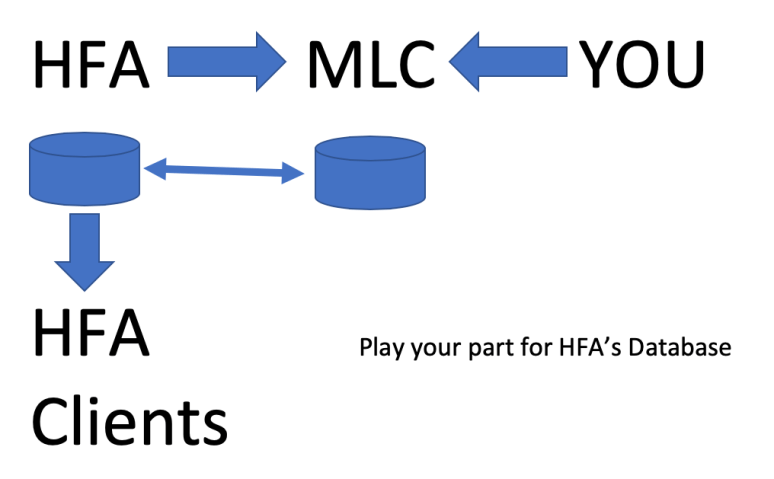









You must be logged in to post a comment.