
Tag: AI infrastructure
Yes, it really is a data center next to the Nashville Zoo
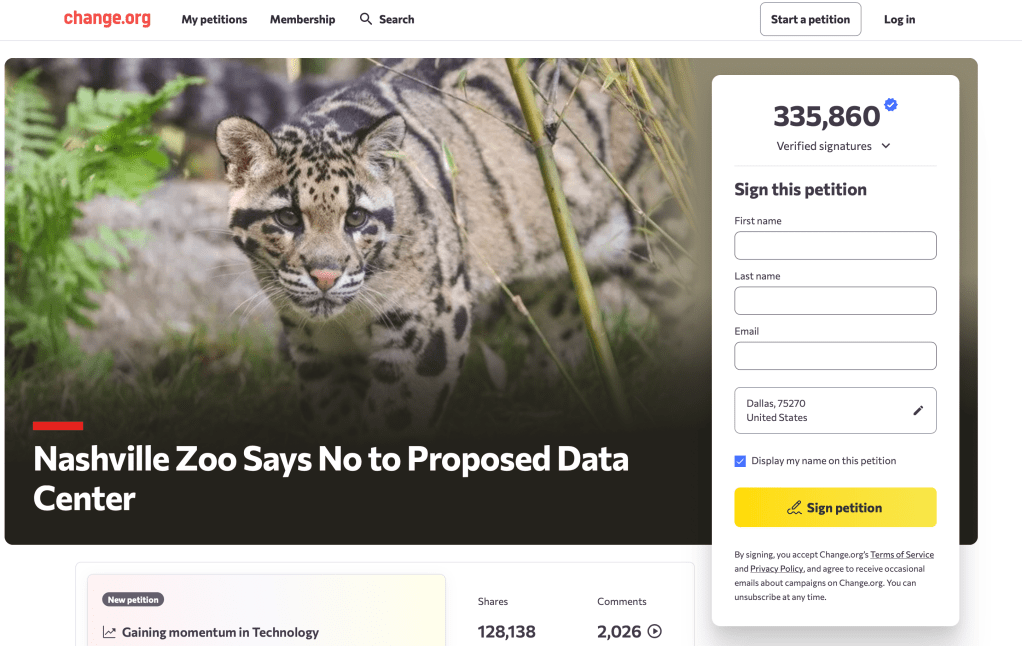
The proposal to build a massive data center adjacent to the Nashville Zoo raises a simple question: Have we completely lost our sense of priorities?
Nashville’s zoo exists to provide education, conservation, recreation, and a rare connection between people and animals. Families bring children to experience living animals, open space, and a respite from the relentless industrialization that increasingly consumes American communities. Yet now residents are being told that one of the city’s most treasured public assets should coexist with an industrial-scale computing facility whose primary purpose is to feed the endless demand for artificial intelligence, cloud computing, and speculative digital services. This is insane and it is exactly backward.
The burden of proof should not fall on citizens to explain why they do not want a hyperscale data center next to a zoo. The burden should fall on developers to explain why a project requiring enormous quantities of electricity, water, backup generation, transmission infrastructure, truck traffic, and round-the-clock industrial operations and both light and noise pollution belongs there in the first place.
The economic promises attached to these projects are increasingly difficult to take seriously as has been demonstrated by a recent study of data center job impact in Texas. Across the country, data center developers routinely advertise billions of dollars in investment while generating surprisingly few permanent jobs. Independent research has repeatedly found that many large data centers produce limited long-term employment relative to their physical footprint, utility demands, and public subsidies. Communities are often left with the costs while investors and distant technology companies capture the benefits.
Meanwhile, the impacts are immediate and local.
Residents face years of construction activity, noise, traffic, and visual blight. Wildlife habitats are disrupted. Open space disappears. Transmission lines, substations, backup generators, and supporting infrastructure permanently alter the character of surrounding neighborhoods. Once built, these facilities are effectively impossible to remove. They become permanent industrial fixtures.
The Nashville Zoo should not become collateral damage in the AI arms race.
Even more troubling is the uncertainty surrounding the long-term economics of artificial intelligence itself. Technology companies are spending hundreds of billions of dollars based on forecasts that extend years into the future. Yet many of the underlying assumptions remain unproven. No one can say with confidence what demand for AI services will look like five, ten, or twenty years from now. If those forecasts prove wrong, communities could be left staring at the digital equivalent of abandoned factories—massive, energy-hungry facilities built for demand that never materialized.
The risk is not theoretical. Economists have a name for this phenomenon: stranded assets.
A zoo is a long-term civic investment. It creates educational, environmental, and cultural value that can endure for generations. A speculative AI data center is a bet on future demand forecasts generated in corporate boardrooms and venture-capital presentations.
When those two visions collide, the choice should not be difficult.
Nashville should protect its zoo, its surrounding communities, and its quality of life. There are countless locations better suited for industrial-scale computing infrastructure. A zoo is not one of them.
Some places should remain places for people, families, wildlife, and conservation. Not every acre of land needs to be sacrificed to the next technological gold rush.
The Nashville Zoo deserves better than becoming the neighbor of a machine. And believe me, if they’ll do it in Nashville they’ll do it anywhere. The Zoo has a Change.org petition you can sign if you agree.
As Suno Celebrated a $5.4 Billion Valuation, Artists Took Their Message Directly to Wall Street
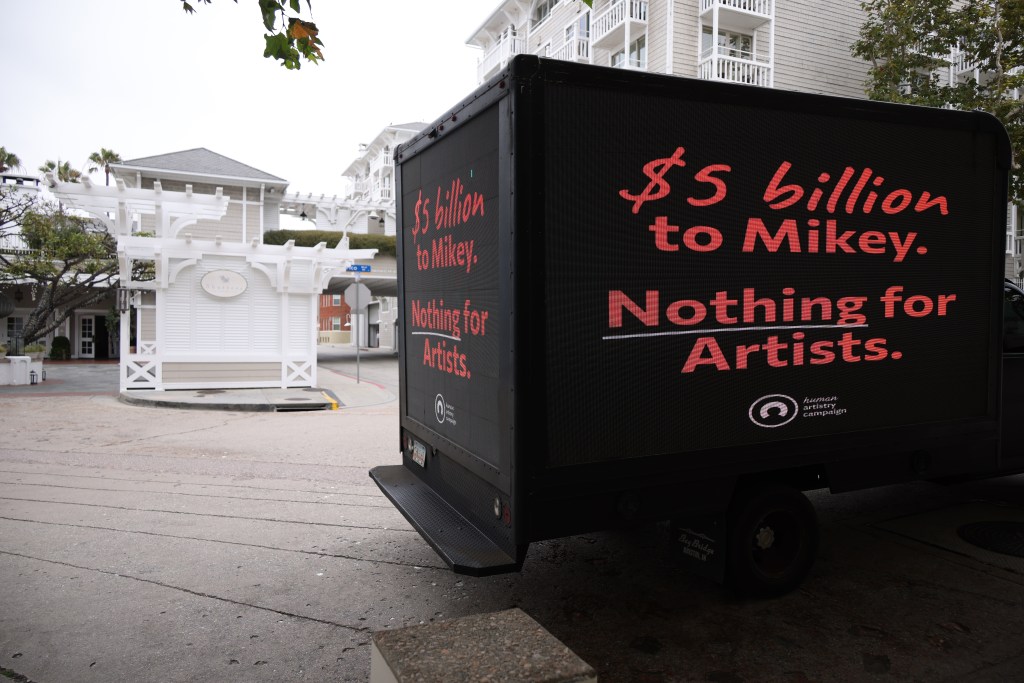
On June 3, 2026, as investors and technology executives gathered at the UBS AI in Entertainment Summit at Shutters on the Beach in Santa Monica, a plane circled overhead carrying a simple message: “SAY NO TO SUNO.” A second banner could just as easily have read, “Stealing Music Is Bad Karma.” The scene was more than a protest against a single AI music company. It was a reminder that technology itself is neither good nor evil; what matters is how humans choose to use it. Throughout history, some of the most transformative technologies have been driven by the same motivations that power every bully: greed and fear. Fear of being left behind. Fear of missing out. Greed for market share, dominance, and wealth and crushing anyone who gets in the way. The generative AI race increasingly appears to be driven—and corroded—by both.
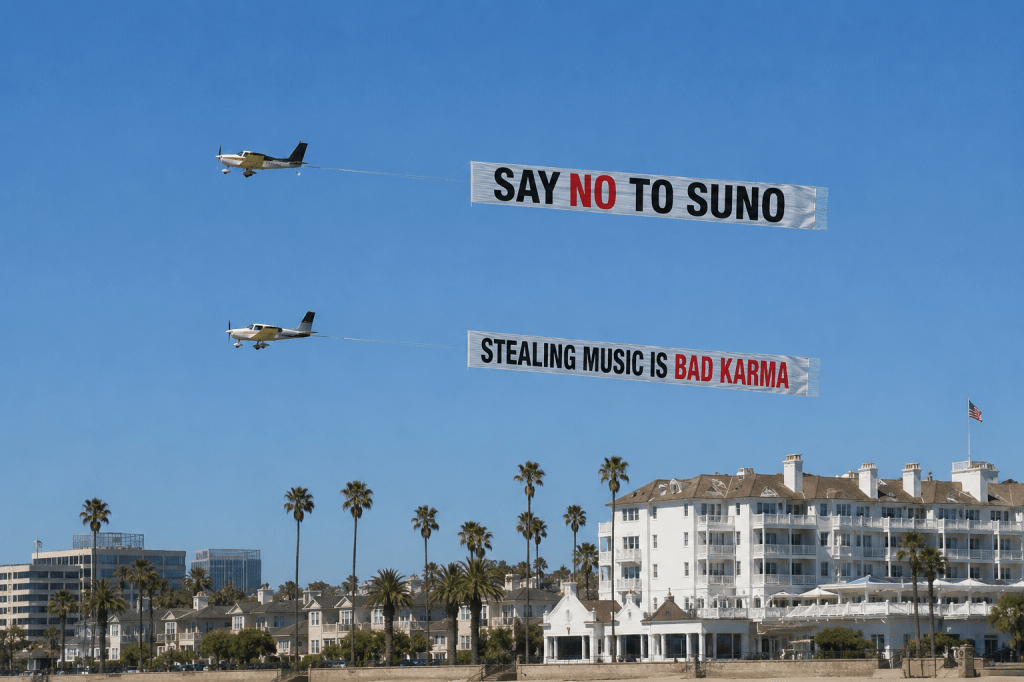
That is why the protest above Santa Monica was about more than music. It connected directly to a broader national backlash against the infrastructure being built to support the AI economy. Across the United States, communities are fighting data centers, transmission lines, water consumption, tax subsidies, and industrial development projects that many believe are being imposed without meaningful public consent. Residents from Texas to Georgia to Louisiana are asking the same basic question: who benefits, and who pays the price?
In the case of generative AI, artists argue that they are among those paying the price.
The Human Artistry Campaign demonstration took place on the same day that Suno announced a funding round exceeding $400 million at a valuation of approximately $5.4 billion. Let it not be said that music has no value and that Suno is not free riding on a thriving market to extract their absurd valuation.
While Silicon Valley investors celebrated another milestone in AI’s rapid expansion, the protest highlighted an uncomfortable reality: much of the value being created by generative AI companies originates from extracting human expression while paying no regard whatsoever to those humans. Whether the source material is music, visual art, photography, authors, voice performances, or other creative works, creators continue to ask how their contributions found their way into commercial AI systems and demand the right to say no to Suno.
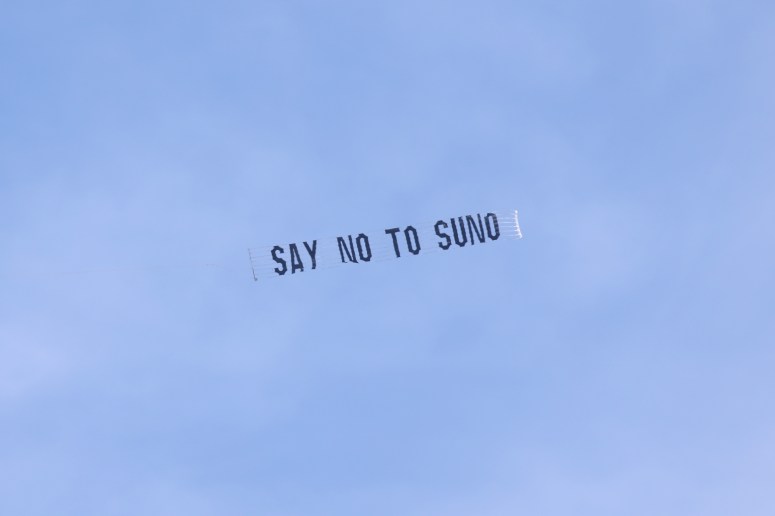
The narrative that the AI labs want you to focus on is often framed as a conflict between innovation and regulation. That framing misses the point. The real question is whether innovation requires the abandonment of consent, compensation, and accountability. Human Artistry’s message was not anti-technology. Rather, it was that technology should serve human beings rather than treating them as raw material for extraction.
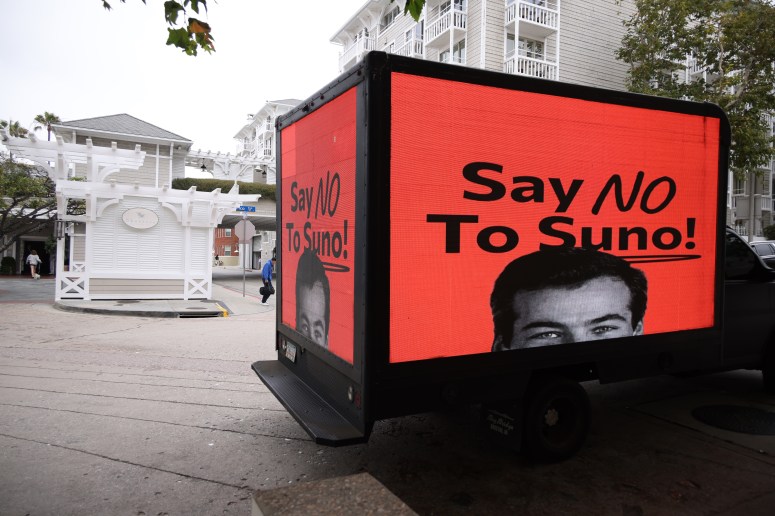
That concern increasingly links artist-rights advocates with communities opposing AI infrastructure projects using eminent domain powers to seize homes and compel residents to acept 765kV transmission lines. Both groups are confronting different manifestations of the same phenomenon: the concentration of economic gains among a relatively small number of companies while costs are dispersed across creators, workers, taxpayers, ratepayers, and local communities. One side sees its creative works absorbed into training datasets. The other sees land, water, energy resources, and public subsidies redirected toward facilities designed to power those systems.
Viewed through that lens, the protest at Shutters on the Beach becomes part of a much larger story. The controversy surrounding generative AI is no longer confined to copyright litigation or entertainment-industry politics. It now reaches questions of energy policy, infrastructure planning, local governance, environmental impact, and economic fairness.
The image of a protest banner flying above an investor summit captures that convergence perfectly. Below, financiers discussed the future of artificial intelligence and celebrated millions of dollars in new investment while licking their IPO chops in drooling anticipation of getting richer still on the backs of humanity. Above, artists and advocates posed a simpler question: if the future is being built on human creativity, shouldn’t the humans who created it have a meaningful voice in how that future is constructed?
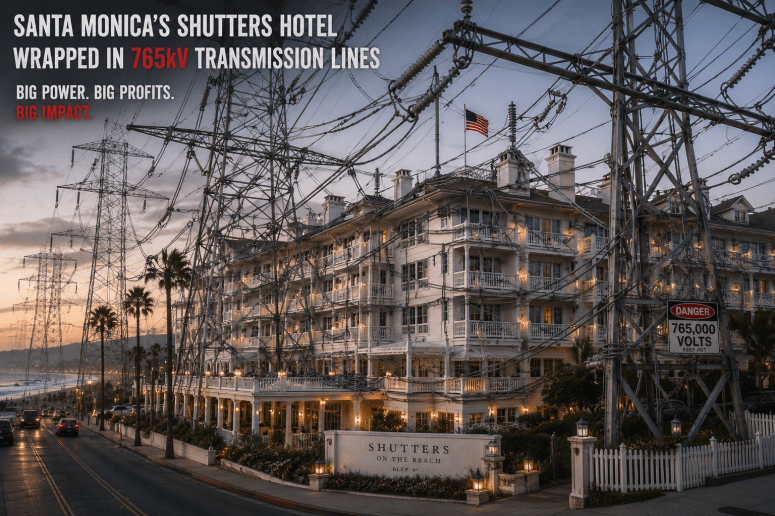
That question is impossible to ignore. As billions continue to flow into AI companies and the infrastructure supporting them, the debate is no longer merely about technology. It is about power, consent, and who gets to decide how the benefits of human creativity and expression are captured by the Big Tech kleptocrats.


You must be logged in to post a comment.