Gene Simmons and the American Music Fairness Act

Gene Simmons is receiving Kennedy Center Honors with KISS this Sunday, and is also bringing his voice to the fair pay for radio play campaign to pass the American Music Fairness Act (AMFA).

Gene will testify on AMFA next week before the Senate Judiciary Committee. He won’t just be speaking as a member of KISS or as one of the most recognizable performers in American music. He’ll be showing up as a witness to something far more universal: the decades-long exploitation of recording artists whose work powers an entire broadcast industry and that has never paid them a dime. Watch Gene’s hearing on December 9th at 3pm ET at this link, when Gene testifies alongside SoundExchange CEO Mike Huppe.

As Gene argued in his Washington Post op-ed, the AM/FM radio loophole is not a quirky relic, it is legalized taking. Everyone else pays for music: streaming services, satellite radio, social-media platforms, retail, fitness, gaming. Everyone except big broadcast radio, which generated more than $13 billion in advertising revenue last year while paying zero to the performers whose recordings attract those audiences.

Gene is testifying not just for legacy acts, but for the “thousands of present and future American recording artists” who, like KISS in the early days, were told to work hard, build a fan base, and just be grateful for airplay. As he might put it, artists were expected to “rock and roll all night” — but never expect to be paid for it on the radio.

And when artists asked for change, they were told to wait. They “keep on shoutin’,” decade after decade, but Congress never listened.

That’s why this hearing matters. It’s the first Senate-level engagement with the issue since 2009. The ground is shifting. Gene Simmons’ presence signals something bigger: artists are done pretending that “exposure” is a form of compensation.

AMFA would finally require AM/FM broadcasters to pay for the sound recordings they exploit, the same way every other democratic nation already does. It would give session musicians, backup vocalists, and countless independent artists a revenue stream they should have had all along. It would even unlock international royalties currently withheld from American performers because the U.S. refuses reciprocity.

And let’s be honest: Gene Simmons is an ideal messenger. He built KISS from nothing, understands the grind, and knows exactly how many hands touch a recording before it reaches the airwaves. His testimony exposes the truth: radio isn’t “free promotion” — it’s a commercial business built on someone else’s work.

Simmons once paraphrased the music economy as a game where artists are expected to give endlessly while massive corporations act like the only “god of thunder,” taking everything and returning nothing. AMFA is an overdue correction to that imbalance.

When Gene sits down before the Senate Judiciary Committee, he won’t be wearing the makeup. He won’t need to. He’ll be carrying something far more powerful: the voices of artists who’ve waited 80 years for Congress to finally turn the volume up on fairness.

Don’t Let Congress Reward the Stations That Don’t Pay Artists

As we’ve been posting about for years—alongside Blake Morgan and the #IRespectMusic movement that you guys have been so good about supporting—there’s still a glaring failure at the heart of U.S. copyright law: performing artists and session musicians receive no royalty for AM/FM radio airplay. Every other developed country (and practically every other country) compensates performers for broadcast use, yet the United States continues to exempt terrestrial radio from paying the people who record the music.

Now Congress is preparing to pass the AM Radio in Every Car Act, a massive government intervention that would literally install the instrument of unfairness into every new car at significant cost to consumers. It’s a breathtaking example of how far the National Association of Broadcasters (NAB) will go to preserve its century-old free ride—by lobbying for public subsidies while refusing to pay artists a penny. This isn’t public service; it’s policy cruelty dressed up as nostalgia.

Hundreds of artists have already spoken out in a letter to Congress demanding fairness through the American Music Fairness Act (AMFA). Their action matters—and yours does too.

👉 Here’s what you can do:

Don’t let Washington hard-wire injustice into every dashboard. Demand that Congress fix the problem before it funds the next generation of unfairness.

Dear Speaker Johnson, Leader Jeffries, Leader Thune, and Leader Schumer:

Earlier this year, we wrote urging that you take action on the American Music Fairness Act (S.253/H.R.791), legislation that will require that AM/FM radio companies start paying artists for their music. We are grateful for your attention to ensuring America’s recording artists are finally paid for use of our work.

As you may know, some members of Congress are currently seeking to pass legislation that will require every new vehicle manufactured in the United States come pre-installed with AM radio. The passage of the AM Radio for Every Vehicle Act (S.315/H.R.979) would mark another major windfall for the corporate radio industry that makes $13.6 billion each year in advertising revenue while refusing to compensate the performers whose songs play 240 million times each year on AM radio stations. Every year, recording artists lose out on hundreds of millions of dollars in royalties in the U.S. and abroad because of this hundred-year-old loophole.

This is wrong. In the United States of America, every person deserves to be paid for the use of their work. But because of the power held by giant radio corporations in Washington, artists, both big and small, continue to be overlooked, even as every other music delivery platform, including streaming services and satellite radio, pays both the songwriter and performer.

We are asking today that you insist that any legislation that includes the AM Radio for Every Vehicle Act also include the American Music Fairness Act. We do not oppose terrestrial radio. In fact, we appreciate the role that radio has played in our careers and within society, but the 100-year-old argument of promotion that radio continues to hide behind does not ring true in 2025.

When you save the radio industry by mandating its technology remain in cars, we ask that you save the musician too and allow us to be paid fairly when our music is played.

Thank you again for your consideration of this much-needed legislation.

Sincerely,

Barry Manilow

Boyz II Men

Carole King

Cyndi Lauper

Debbie Gibson

Def Leppard

Gloria Gaynor

Kool and the Gang

Lee Ann Womack

Lil Jon

Mike Love

Nancy Wilson

Peter Frampton

Sammy Hagar

Smokey Robinson

TLC

A New Twist in the AM Radio Debate: Why Tying AM Mandates to AMFA Is a Game-Changer #IRespectMusic

The latest twist in the long-running AM radio saga comes from a new alliance: cars and music. Automaker trade groups Alliance for Automotive Innovation, Consumer Technology Association, and Zero Emission Transportation Association are shoulder to shoulder with the musicFIRST Coalition and SoundExchange in urging Congress to link the “AM Radio in Every Vehicle Act” with the American Music Fairness Act (AMFA). If we’re going to mandate AM radios be placed in new cars then music played on those radios should pay the people who made that music. It’s unfair and fundamentally inconsistent to require one without the other, so broadcasters should pay artists.

What Is the American Music Fairness Act?

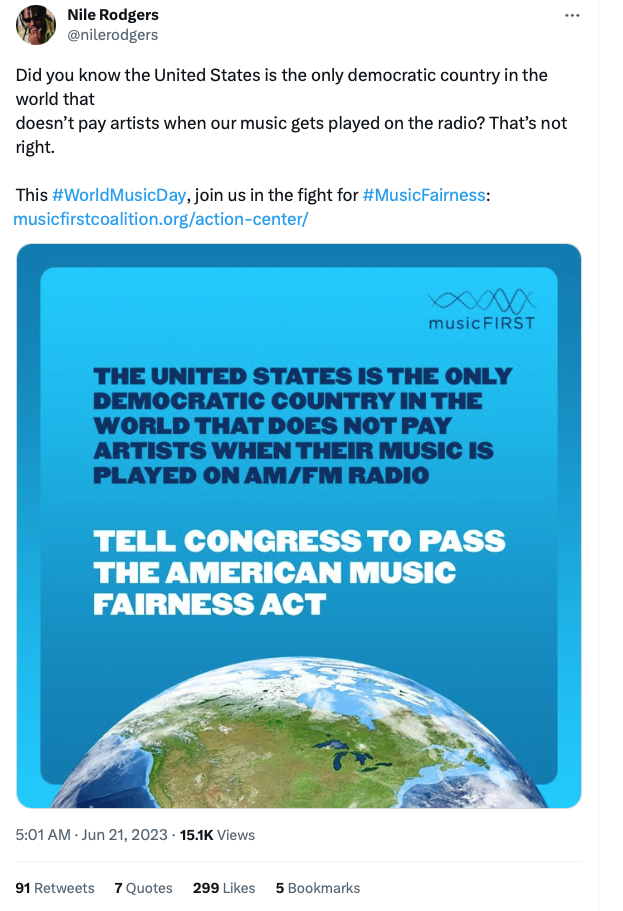
If you haven’t run across it yet, AMFA is bipartisan legislation sponsored by our champion Senator Marsha Blackburn in the Senate and our long-time ally Rep. Darrell Issa in the House of Representatives that would finally require AM/FM radio stations to pay performance royalties to recording artists and performers when their recordings are played over the air. Currently, the U.S. remains the only democracy that allows terrestrial radio to make billions from music without compensating performers.

Why Artists Get Left Out

As incredible as it may seem, under U.S. copyright law, terrestrial radio must pay songwriters and publishers—but not performers or sound recording rights holders. That means backup singers, session musicians, and producers receive zero compensation, even when their work drives–literally–billions in broadcast revenue. This is what allows the National Association of Broadcasters shillery to claim “we pay for music” and then try to pit artists against songwriters. That dog won’t hunt, but that never stops them from trying.

The musicFIRST Coalition, including SoundExchange and tons of artists and creators, has been front and center pushing Congress to close this loophole for years and we have been right there with them along with our friend Blake Morgan and his #IRespectMusic campaign.


“Mandating AM radio without addressing the performance royalty issue would perpetuate an inequity that denies hundreds of millions of dollars in compensation to countless recording artists every year. Congress should not pass a mandate for radio without ensuring appropriate royalties for artists… They deserve to have their hard work respected and valued with fair compensation — like they receive in every other industrialized country.”
SoundExchange CEO Michael Huppe


The Math on AMFA

  • U.S. radio plays over 240 million songs annually without compensating performers
  • The music industry could gain an estimated $200–300 million annually if Americans were paid for domestic and foreign broadcast plays 
  • Aligns U.S. copyright with global norms—terrestrial radio already pays performers in virtually every other developed nation.

What is to be done

If Congress is going to mandate AM radio in every car, it can’t ignore the rights of the very artists who create the content. By demanding performance royalties through AMFA, we can preserve public safety benefits while ensuring creators are paid for their work. This is a rare chance for Congress to get it right—fairness and infrastructure can go hand-in-hand.

If you believe artists deserve fairness when their music plays on the radio, now is the time to act:

  1. Sign the letter to Congress. The musicFIRST Action Center has made it easy—just a few clicks to add your name. 
  2. Call your Senator and Representative and tell them to support both:
    • American Music Fairness Act (H.R. 861 / S. 326)
    • AM Radio in Every Vehicle Act—(S. 315 / H.R. 979–but only inclusive of performance royalties
  3. Spread the word on social media with tags like #PassAMFA#FairPayForArtists#IRespectMusic

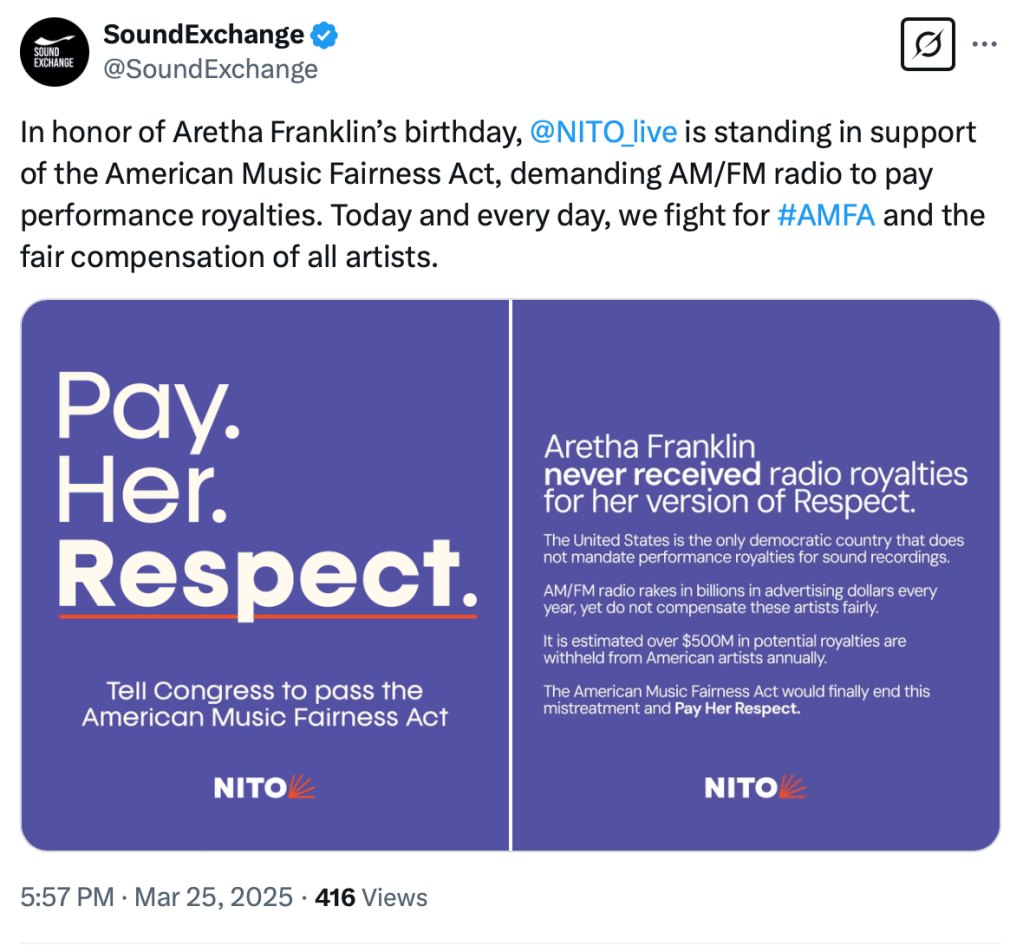
Tell Congress to Honor Aretha, Pass #AMFA #IRespectMusic

It’s time.

We join our friends Blake Morgan, #IRespectMusic, SoundExchange, the National Independent Talent Organization (NITO) and many, many others in asking you to join the fight to support artist pay for radio play by passing the American Music Fairness Act. Find out how you can help here, or find your representative in Congress here.

Press Release: @RandyTravis and @MikeHuppe to Testify on Capitol Hill June 26th on Artist Pay for Radio Play #IRespectMusic

House IP Subcommittee slated to hold American Music Fairness Act hearing on Wednesday, June 26th, watch at this link.

WASHINGTON D.C. (June 20, 2024) – Country music icon Randy Travis and SoundExchange CEO and President Michael Huppe will testify before the House Judiciary Committee’s Subcommittee on Courts, Intellectual Property, and the Internet, next Wednesday, June 26, for a hearing entitled, “Radio, Music, and Copyrights: 100 Years of Inequity for Recording Artists.” Travis and Huppe will take questions from lawmakers on the American Music Fairness Act (H.R. 791) – bipartisan, bicameral legislation that will close a century-old loophole and require AM/FM radio stations to pay artists royalties when their songs are played on the air. Travis will also be in Washington advocating for protecting music creators around the advancement of Artificial Intelligence (AI).

The two issues are especially relevant for Travis, who suffered a stroke in 2013 that has prevented him from continuing to keep up a rigorous touring schedule that had been a primary source of income for decades. Last month, Travis released his first new song since the stroke, “Where That Came From,” with the use of groundbreaking – and artist-sanctioned – AI tools.

“Royalties are critical for survival in today’s music industry, and that’s especially true for working class musicians and performers who are not able to tour,” said Travis. “The American Music Fairness Act will make a real difference in the lives of working musicians – not just big-name artists, but folks all around the country who play on albums or sing backup vocals on top of a nine-to-five job. I’m looking forward to this hearing and talking about the urgent need for Congress to pass this bill and level the playing field for creators.”

AM/FM radio remains the most popular music delivery platform in the U.S., reaching nearly 300 million people (88% of the country) each week while playing an estimated 967 million songs each year.

“I’m honored to testify alongside Randy Travis, a true legend in the history of American music,” added Huppe. “Randy has faced incredible challenges throughout his career, and his resilience in the face of adversity is a model to all of us. The American Music Fairness Act would end a 100 year era of unfair treatment to the creators of the music that feeds the most popular music delivery platform in our country.

The American Music Fairness Act was introduced in the U.S. House by U.S. Representatives Darrell Issa (R-CA) and Jerry Nadler (D-NY), and in the U.S. Senate by Senators Alex Padilla (D-CA) and Marsha Blackburn (R-TN). The legislation offers a balanced solution that ensures music creators are fairly compensated when their songs are played on AM/FM radio and that small, independent broadcasters are able to thrive. The legislation enjoys support from a diverse coalition of artists, broadcasters, labels, and music lovers:

• Broadcasters, such as the Alliance for Community Media, Common Frequency, Media Alliance, the National Federation of Community Broadcasters (NFCB), Prometheus Radio Project, and REC Networks – which represent a broad coalition of community broadcasters – also support AMFA.
• Artists from Gloria Estefan to Dionne Warwick to David Byrne to Common to Sammy Hagar – and thousands more – have voiced their support for AMFA.
• Every Democratic and Republican administration since President Carter has supported a performance right for sound recordings in the U.S.
• Americans support passing a law to give artists performance royalties for AM/FM radio plays by a 4:1 ratio.

Press Release: @MarshaBlackburn, @SenAlexPadilla Reintroduce Bipartisan Bill to Ensure Artists Are Paid for Their Music Across All Platforms #irespectmusic

The US is still the only Western democracy that stiffs artists on royalty payments for radio airplay. Let’s fix that!

[Editor Charlie sez: Anyone who tells you that artists can’t pass legislation to get fair pay for radio play is either a charlatan or full of shit and they are not on our side of the football.]

U.S. Senators Marsha Blackburn (R-Tenn.) and Alex Padilla (D-Calif.), along with Senators Thom Tillis (R-N.C.) and Dianne Feinstein (D-Calif.), introduced the bipartisan American Music Fairness Act to ensure artists and music creators receive fair compensation for the use of their songs on AM/FM radio. This legislation will bring corporate radio broadcasters in line with all other music streaming platforms, which already pay artists for their music. 

Congressmen Darrell Issa (R-Calif.) and Jerry Nadler (D-N.Y.) led the legislation in the U.S. House of Representatives.

“From Beale Street to Music Row to the hills of East Tennessee, Tennessee’s songwriters and artists have undeniably made their mark,” said Senator Blackburn. “However, while digital music platforms compensate music performers and copyright holders for playing their songs, AM/FM radio stations only pay songwriters for the music they broadcast. This legislation takes a long overdue step toward leveling the music industry playing field and ensuring creators are fairly compensated for their work.”

“California’s artists play a pivotal role in enriching and diversifying our country’s music scene, but for too long, our laws have unfairly denied them the right to receive fair compensation for their hard work and talent on AM/FM radio broadcasts,” said Senator Padilla. “As we celebrate the accomplishments of our musical artists at the Grammy Awards in Los Angeles this weekend, we must commit to treating them with the dignity and respect they deserve for the music that they produce and that we enjoy every day.”

“Protecting one’s intellectual property is the signature right of every American who dares to invent. Every artist who first picked up a drumstick, sang to their mirror, or wrote lyrics from the heart did so because they had a dream and wanted to share it with the world. I look forward to working with stakeholders and colleagues to achieve this overdue reform,” said Congressman Issa.

“The United States is an outlier in the world for not requiring broadcast radio to pay artists when playing their music, while requiring satellite and internet radio to pay,” said Chairman Nadler. “This is unfair to both artists and music providers. I’m proud to sponsor the American Music Fairness Act which would finally correct this injustice.  This is what music creators want and deserve.”

“It’s clear that the movement for music fairness continues to gain momentum, bringing us closer than ever before to ending Big Radio’s ability to deny artists the fair pay they deserve. This week’s House and Senate introductions of the American Music Fairness Act is evidence of that. We thank Senators Padilla and Blackburn and Representatives Issa and Nadler for their leadership in the effort to secure economic justice for our nation’s music artists and creators, and look forward to working together to drive continued progress in the coming months,”said Congressman Joe Crowley, Chairman of musicFIRST.

“Music creators have been forced to give away their work for far too long. It is time for Congress to demonstrate that they stand behind the hard-working Americans that provide the music we all love by finally passing the American Music Fairness Act. This bill has the broad support of artists, labels, small broadcasters, unions, and others because it strikes a fair balance by respecting creators for their work and protecting truly local broadcasters. No more excuses, no more waiting in line for their turn. Music creators demand the economic justice AMFA provides,” said Michael Huppe, President and CEO of SoundExchange.

“As we prepare to focus our attention on celebrating music this weekend at the GRAMMY Awards, the Recording Academy also renews its commitment to ensuring music creators are always compensated fairly for their work. We applaud Reps. Issa, Nadler, McClintock, and Lieu and Senators Padilla, Blackburn, Feinstein, and Tillis for reintroducing the American Music Fairness Act and look forward to working with them to build on the historic progress we made last year on this important legislation,” said Harvey Mason jr., CEO of the Recording Academy.

“The American Music Fairness Act is practical compromise legislation that has already passed the House Judiciary Committee with bipartisan support last Congress. It takes a smart, calibrated approach towards solving a decades old problem in the radio industry. When enacted into law, AMFA will ensure recording artists and copyright owners are paid fairly for recorded music regardless of the technology used to broadcast it while carefully protecting small and noncommercial stations to preserve truly local radio our communities depend upon,” said Mitch Glazier, Chairman and CEO of the Recording Industry Association of America.

“For far too long, our broken and unfair system has let AM/FM radio stations — many of which are owned by just a few massive media corporations — get away with refusing to pay artists when they play their music. While these big corporate broadcast companies gobble up billions upon billions in advertising dollars, the session and background musicians, whose work makes all of it possible, receive no compensation whatsoever for their creations. It’s time to right this wrong, and the American Music Fairness Act aims to do just that. It’s vital that Congress protects the livelihoods of those who create the music we know and love,” said Ray Hair, International President of the American Federation of Musicians.

“I want to thank Congressman Jerry Nadler, Congressman Darrell Issa, Senator Alex Padilla and Senator Marsha Blackburn for their leadership on this crucial legislation. When you consider the billions of dollars the big radio corporations generate in revenue and profits, it’s shocking that recording artists, vocalists and musicians don’t receive a penny when their work is played on AM/FM radio. Since when do workers in America get exploited without pay? This is an unfair and egregious loophole especially since both streaming and digital services pay for the use of artists’ work. AM/FM radio has had a free ride for decades and it’s time to put a stop to it! I urge Congress to fix this outdated practice by passing the American Music Fairness Act,” said Fran Drescher, President of SAG-AFTRA. 

“We are grateful that our champions are making it crystal clear that the fight for fairness continues in this new Congress. By reintroducing the American Music Fairness Act, Senators Blackburn and Padilla, along with Representatives Issa, Nadler, McClintock, and Lieu, as defenders of property rights and supporters of artistic expression, have put the mega broadcasting conglomerates on notice that it is time to erase their stain on America’s history,” said Dr. Richard James Burgess, President and CEO of the American Association of Independent Music.

Currently, the United States is the only democratic country in the world in which artists are not compensated for the use of their music on AM/FM radio. By requiring broadcast radio corporations to pay performance royalties to creators for AM/FM radio plays, the American Music Fairness Act would close an antiquated loophole that has allowed corporate broadcasters to forgo compensating artists for the use of their music for decades.

In recognition of the important role of locally owned radio stations in communities across the U.S., the American Music Fairness Act also includes strong protections for small, college, and non-commercial stations.

The American Music Fairness Act will positively impact artists and the music industry at large by:

  • Requiring terrestrial radio broadcasters to pay royalties to American music creators when they play their songs.
  • Protecting small and local stations who qualify for exemptions — specifically those that fall under $1.5 million in annual revenue and whose parent companies fall under less than $10 million in annual revenue overall — by allowing them to play unlimited music for less than $500 annually. 
  • Creating a fair global market that ensures foreign countries pay U.S. artists for the use of their songs overseas.

The American Music Fairness Act is endorsed by: the AFL-CIO, the American Association of Independent Music (A2IM), the American Federation of Musicians, the Recording Academy, the Recording Industry Association of America (RIAA), SAG-AFTRA and SoundExchange.

Full text of the bill is available here.

###

https://www.blackburn.senate.gov/2023/2/blackburn-padilla-reintroduce-bipartisan-bill-to-ensure-artists-are-paid-for-their-music-across-all-platforms

Press Release: @MarshaBlackburn, @SenAlexPadilla Reintroduce Bipartisan Bill to Ensure Artists Are Paid for Their Music Across All Platforms #irespectmusic — Artist Rights Watch–News for the Artist Rights Advocacy Community

San Antonio Musicians: Texas Public Radio Presents the Music Artist Forum TODAY

Get more info and materials here

TPR Music Artist Forum | In Partnership with SLATT Management

Musicians of all ages are invited to a networking workshop and panelist discussion dedicated to understanding the future of music technology, copyright law, entertainment law, obtaining royalties, and navigation of music streaming services.

Address:

321 W. Commerce St, San Antonio, TX 78205

Doors open at 6:30pm. 

Panelist discussion will take place at 7:00pm.

Guest Panelists:

Ondrejia Scott | 7:00pm – 7:10pm

Chris Castle | 7:10pm – 7:20pm

Krystal Jones | 7:20pm – 7:30pm

Dr. Steven Parker | 7:30pm – 7:40pm

Linda Bloss-Baum | 7:40pm – 7:50pm

Food and drinks will be provided.

Musicians are welcome to submit an original track to be featured on our TPR Music Artist Forum playlist:

Professional headshots will be offered free of charge by Oscar Moreno.

We will be ending out the night with a special live performance by J. Darius live in the Malú and Carlos Alvarez Theater.

RSVP here to reserve your spot for this free event!

@MartinChilton: ‘He made sure that she got nothing’: The sad story of Astrud Gilberto, the face of bossa nova — Artist Rights Watch

[Editor Charlie sez: When you read this cautionary tale for artists, remember that like so many other artists we look up to, Astrud never got a penny from radio performances of her records in the US which would have given her a direct payment outside of her recording agreement through SoundExchange.]

“The Girl from Ipanema” was one of the seminal songs of the 1960s. It sold more than five million copies worldwide, popularised bossa nova music around the world and made a superstar of the Brazilian singer Astrud Gilberto, who was only 22 when she recorded the track on 18 March 1963.

Yet what should be an uplifting story – celebrating a singer making an extraordinary mark in her first professional engagement – became a sorry tale of how a shy young woman was exploited, manipulated and left broken by a male-dominated music industry full, as she put it, of “wolves posing as sheep”.

Read the post on The Independent

@SoundExchange CEO @mikehuppe Nails NAB Hypocrisy on Artist Pay for Radio Play–#IRespectMusic — Artist Rights Watch

The hearing on Groundhog Day (Feb. 2) for the American Music Fairness Act (or “AMFA”) was a fantastic opportunity for artists to be heard on the 100 year free ride the government has given broadcast radio. We know it went well because the National Association of Broadcasters sputtered like they do when they’ve got nothing to say.

But what’s really hysterical was how they talked out of both sides of their mouths in two different hearings–which makes you think that NAB president Curtis LeGeyt was doing his impression of Punxsutawney Phil. Yes, when it came to broadcasters getting paid by Big Tech, the broadcasters wanted their rights respected and to be paid fairly. But when the shoe was on the other foot, not so much. In the Senate, the NAB asked for more money for broadcasters in a hearing for the Journalism Competition and Preservation Act–to protect the mega radio broadcasters from the mega tech oligarchs. And if broadcasters don’t get more money, they want to be exempt from the antitrust laws so they can pull their content. Just like artists do to them…NOT.

Then the NAB comes over to the House Judiciary Committee–on the same day being Groundhog Day–and asks the government to continue their 100 year free ride. We call bullshit.

SoundExchange CEO Mike Huppe nailed this in his Billboard post:

The AMFA witnesses didn’t ask for an antitrust exemption, like the broadcasters did. They simply asked that recording artists be granted similar copyrights as others.

They didn’t ask for more money, like the broadcasters did. They simply asked for at least some payment, since they now receive none when broadcast radio stations air their music.

They didn’t ask for special treatment, like the broadcasters did. Rather they asked that they be treated the same as all other artists around the world, and even the same as artists on virtually all other media platforms in the U.S.

And they didn’t ask for rigts to negotiate and withhold content, like the broadcasters did. Under AMFA, radio stations would still be allowed to play music as they please. Artist advocates simply asked that the biggest-of-the-big stations pay a modest royalty set according to market rates. Stations making less than $1.5 million per year would pay a flat, annual royalty of $500 (less than $1.40 per day) for as much music as they choose to air. And the smallest stations’ payments would drop all the way down to $10.

No station is going to go bankrupt over these royalties.

Huppe has a very strong point here. This legislation has been picked over for years. AMFA bends over backwards to protect community radio and small broadcasters and repects everyone’s contribution to radio’s success.

But that’s the point–it respects everyone‘s contribution.

You can watch the hearing here: