You Don’t Need to Steal Art to Cure Cancer: Why Ed Newton-Rex Is Right About AI and Copyright
Ed Newton-Rex said the quiet truth out loud: you don’t need to scrape the world’s creative works to build AI that saves lives. Or even beat the Chinese Communist Party.
It’s a myth that AI “has to” ingest novels and pop lyrics to learn language. Models acquire syntax, semantics, and pragmatics from any large, diverse corpus of natural language. That includes transcribed speech, forums, technical manuals, government documents, Wikipedia, scientific papers, and licensed conversational data. Speech systems learn from audio–text pairs, not necessarily fiction; text models learn distributional patterns wherever language appears. Of course, literary works can enrich style, but they’re not necessary for competence: instruction tuning, dialogue data, and domain corpora yield fluent models without raiding copyrighted art. In short, creative literature is optional seasoning, not the core ingredient for teaching machines to “speak.”
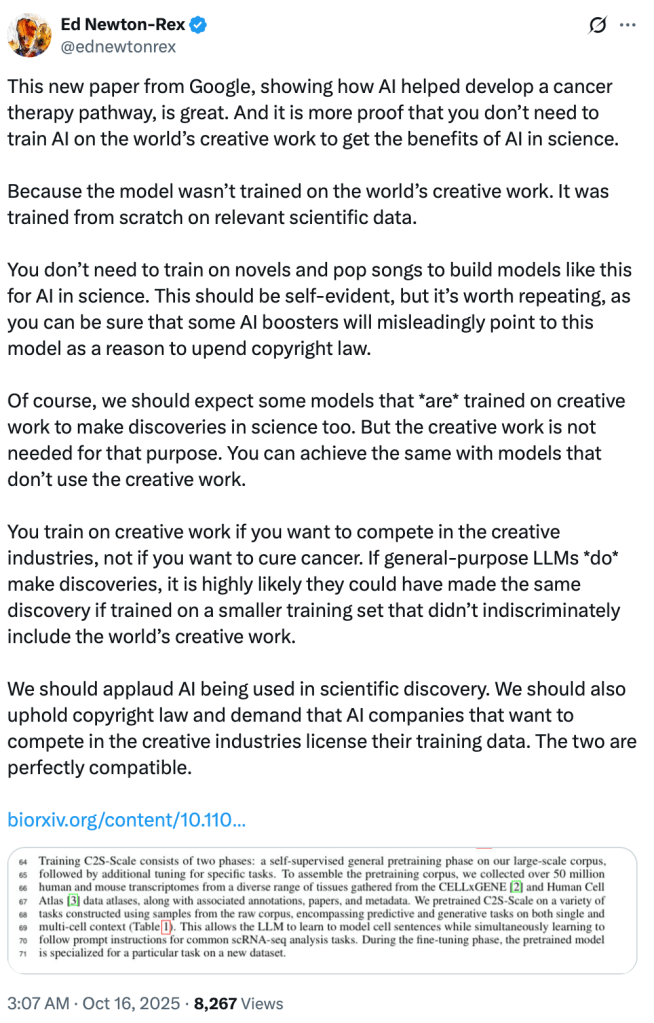
Google’s new cancer-therapy paper proves the point. Their model wasn’t trained on novels, lyrics, or paintings. It was trained responsibly on scientific data. And yet it achieved real, measurable progress in biomedical research. That simple fact dismantles one of Silicon Valley’s most persistent myths: that copyright is somehow an obstacle to innovation.
You don’t need to train on Joni Mitchell to discover a new gene pathway. You don’t need to ingest John Coltrane to find a drug target. AI used for science can thrive within the guardrails of copyright because science itself already has its own open-data ecosystems—peer-reviewed, licensed, and transparent.
The companies like Anthropic and Meta insisting that “fair use” covers mass ingestion of stolen creative works aren’t curing diseases; they’re training entertainment engines. They’re ripping off artists’ livelihoods to make commercial chatbots, story generators, and synthetic-voice platforms designed to compete against the very creators whose works they exploited. That’s not innovation—it’s market capture through appropriation.
They do it for reasons old as time—they do it for the money.
The ethical divide is clear:
AI for discovery builds on licensed scientific data.
AI for mimicry plunders culture to sell imitation.
We should celebrate the first and regulate the second. Upholding copyright and requiring provenance disclosures doesn’t hinder progress—it restores integrity. The same society that applauds AI in medical breakthroughs can also insist that creative industries remain human-centered and law-abiding. Civil-military fusion doesn’t imply that there’s only two ingredients in the gumbo of life.
If Google can advance cancer research without stealing art, so can everyone else and so can Google keep different rules for the entertainment side of their business or investment portfolio. The choice isn’t between curing cancer and protecting artists—it’s between honesty and opportunism. The repeated whinging of AI labs about “because China” would be a lot more believable if they used their political influence to get the CCP to release Hong Kong activist Jimmy Lai from stir. We can join Jimmy and his amazingly brave son Sebastian and say “because China”, too. #FreeJimmyLai
Universal Music Group’s CEO Sir Lucian Grainge has put the industry on notice in an internal memo to Universal employees: UMG will not license any AI model that uses an artist’s voice—or generates new songs incorporating an artist’s existing songs—without that artist’s consent. This isn’t just a slogan; it’s a licensing policy, an advocacy position, and a deal-making leverage all rolled into one. After the Sora 2 disaster, I have to believe that OpenAI is at the top of the list.
Here’s the memo:
Dear Colleagues,
I am writing today to update you on the progress that we are making on our efforts to take advantage of the developing commercial opportunities presented by Gen AI technology for the benefit of all our artists and songwriters.
I want to address three specific topics:
Responsible Gen AI company and product agreements; How our artists can participate; and What we are doing to encourage responsible AI public policies.
UMG is playing a pioneering role in fostering AI’s enormous potential. While our progress is significant, the speed at which this technology is developing makes it important that you are all continually updated on our efforts and well-versed on the strategy and approach.
The foundation of what we’re doing is the belief that together, we can foster a healthy commercial AI ecosystem in which artists, songwriters, music companies and technology companies can all flourish together.
NEW AGREEMENTS
To explore the varied opportunities and determine the best approaches, we have been working with AI developers to put their ideas to the test. In fact, we were the first company to enter into AI-related agreements with companies ranging from major platforms such as YouTube, TikTok and Meta to emerging entrepreneurs such as BandLab, Soundlabs, and more. Both creatively and commercially our portfolio of AI partnerships continues to expand.
Very recently, Universal Music Japan announced an agreement with KDDI, a leading Japanese telecommunications company, to develop new music experiences for fans and artists using Gen AI. And we are very actively engaged with nearly a dozen different companies on significant new products and service plans that hold promise for a dramatic expansion of the AI music landscape. Further, we’re seeing other related advancements. While just scratching the surface of AI’s enormous potential, Spotify’s recent integration with ChatGPT offers a pathway to move fluidly from query and discovery to enjoyment of music—and all within a monetized ecosystem.
HOW OUR ARTISTS CAN PARTICIPATE
Based on what we’ve done with our AI partners to date, and the new discussions that are underway, we can unequivocally say that AI has the potential to deliver creative tools that will enable us to connect our artists with their fans in new ways—and with advanced capability on a scale we’ve never encountered.
Further, I believe that Agentic AI, which dynamically employs complex reasoning and adaptation, has the potential to revolutionize how fans interact with and discover music.
I know that we will successfully navigate as well as seize these opportunities and that these new products could constitute a significant source of new future revenue for artists and songwriters.
We will be actively engaged in discussing all of these developments with the entire creative community.
While some of the biggest opportunities will require further exploration, we are excited by the compelling AI models we’re seeing emerge.
We will only consider advancing AI products based on models that are trained responsibly. That is why we have entered into agreements with AI developers such as ProRata and KLAY, among others, and are in discussions with numerous additional like-minded companies whose products provide accurate attribution and tools which empower and compensate artists—products that both protect music and enhance its monetization.
And to be clear—and this is very important—we will NOT license any model that uses an artist’s voice or generates new songs which incorporate an artist’s existing songs without their consent.
New AI products will be joined by many other similar ones that will soon be coming to market, and we have established teams throughout UMG that will be working with artists and their representatives to bring these opportunities directly to them.
RESPONSIBLE PUBLIC POLICIES COVERING AI
We remain acutely aware of the fact that large and powerful AI companies are pressuring governments around the world to legitimize the training of AI technology on copyrighted material without owner consent or compensation, among other proposals.
To be clear: all these misguided proposals amount to nothing more than the unauthorized (and, we believe, illegal) exploitation of the rights and property of creative artists.
In addition, we are acting in the marketplace to see our partners embrace responsible and ethical AI policies and we’re proud of the progress being made there. For example, having accurately predicted the rapid rise of AI “slop” on streaming platforms, in 2023 we introduced Artist-Centric principles to combat what is essentially platform pollution. Since then, many of our platform partners have made significant progress in putting in place measures to address the diversion of royalties, infringement and fraud—all to the benefit of the entire music ecosystem.
We commend our partners for taking action to address this urgent issue, consistent with our Artist-Centric approach. Further, we recently announced an agreement with SoundPatrol, a new company led by Stanford scientists that employs patented technology to protect artists’ work from unauthorized use in AI music generators.
We are confident that by displaying our willingness as a community to embrace those commercial AI models which value and enhance human artistry, we are demonstrating that market-based solutions promoting innovation are the answer.
LEADING THE WAY FORWARD
So, as we work to assure safeguards for artists, we will help lead the way forward, which is why we are exploring and finding innovative ways to use this revolutionary technology to create new commercial opportunities for artists and songwriters while simultaneously aiding and protecting human creativity.
I’m very excited about the products we’re seeing and what the future holds. I will update you all further on our progress.
Lucian
Mr. Grainge’s position reframes the conversation from “Can we scrape?” to “How do we get consent and compensate?” That shift matters because AI that clones voices or reconstitutes catalog works is not a neutral utility—it’s a market participant competing with human creators and the rights they rely on.
If everything is “transformative” then nothing is protected—and that guts not just copyright, but artists’ name–image–likeness (NIL), right of publicity and in some jurisdictions, moral rights. A scrape-first, justify-later posture erases ownership, antagonizes creators living and dead, and makes catalogs unpriceable. Why would Universal—or any other rightsholder—partner with a company that treats works and identity as free training fuel? What’s great about Lucian’s statement is he’s putting a flag in the ground: the industry leader will not do business with bad actors, regardless of the consequences.
What This Means in Practice
Consent as the gate. Voice clones and “new songs” derived from existing songs require affirmative artist approval—full stop.
Provenance as the standard. AI firms that want first-party deals must prove lawful ingestion, audited datasets, and enforceable guardrails against impersonation.
Aligned incentives. Where consent exists, there’s room for discovery tools, creator utilities, and new revenue streams; where it doesn’t, there’s no deal.
Watermarks and “AI-generated” labels don’t cure false endorsement, right-of-publicity violations, or market substitution. Platforms that design, market, or profit from celebrity emulation without consent aren’t innovating—they’re externalizing legal and ethical risk onto artists.
Moral Rights: Why This Resonates Globally
Universal’s consent-first stance will resonate in moral-rights jurisdictions where authors and performers hold inalienable rights of attribution and integrity (e.g., France’s droit moral, Germany’s Urheberpersönlichkeitsrecht). AI voice clones and “sound-alike” outputs can misattribute authorship, distort a creator’s artistic identity, or subject their work to derogatory treatment—classic moral-rights harms. Because many countries recognize post-mortem moral rights and performers’ neighboring rights, the “no consent, no license” rule is not just good governance—it’s internationally compatible rights stewardship.
Industry Leadership vs. the “Opt-Out” Mirage
It is absolutely critical that the industry leader actively opposes the absurd “opt-out” gambit and other sleights of hand Big Technocrats are pushing to drive a Mack truck through so-called text-and-data-mining loopholes. Their playbook is simple: legitimize mass training on copyrighted works first, then dare creators to find buried settings or after-the-fact exclusions. That flips property rights on their head and is essentially a retroactive safe harbor,
As Mr. Grainge notes, large AI companies are pressuring governments to bless training on copyrighted material without owner consent or compensation. Those proposals amount to the unauthorized—and unlawful—exploitation of artists’ rights and property. By refusing to play along, Universal isn’t just protecting its catalog; it’s defending the baseline principle that creative labor isn’t scrapable.
Consent or Nothing
Let’s be honest: if AI labs were serious about licensing, we wouldn’t have come one narrow miss away from a U.S. state law AI moratorium triggered by their own overreach. That wasn’t just a safe harbor for copyright infringement, that was a safe harbor for everything from privacy, to consumer protection, to child exploitation, to everything. That’s why it died 99-1 in the Senate, but it was a close run thing,,
And realize, that’s exactly what they want when they are left to their own devices, so to speak. The “opt-out” mirage, the scraping euphemisms, and the rush to codify TDM loopholes all point the same direction—avoid consent and avoid compensation. Universal’s position is the necessary counterweight: consent-first, provenance-audited, revenue-sharing with artists and songwriters (and I would add nonfeatured artists and vocalists) or no deal. Anything less invites regulatory whiplash, a race-to-the-bottom for human creativity, and a permanent breach of trust with artists and their estates.
Reading between the lines, Mr. Grainge has identified AI as both a compelling opportunity and an existential crisis. Let’s see if the others come with him and stare down the bad guys.
The White House has opened a major Request for Information (RFI) on the future of artificial intelligence regulation — and anyone can submit a comment. That means you. This is not just another government exercise. It’s a real opportunity for creators, musicians, songwriters, and artists to make their voices heard in shaping the laws that will govern AI and its impact on culture for decades to come.
Too often, artists find out about these processes after the decisions are already made. This time, we don’t have to be left out. The comment period is open now, and you don’t need to be a lawyer or a lobbyist to participate — you just need to care about the future of your work and your rights. Remember—property rights are innovation, too, just ask Hernando de Soto (Mystery of Capital) or any honest economist.
Here are four key issues in the RFI that matter deeply to artists — and why your voice is critical on each:
1. Transparency and Provenance: Artists Deserve to Know When Their Work Is Used
One of the most important questions in the RFI asks how AI companies should document and disclose the creative works used to train their models. Right now, most platforms hide behind trade secrets and refuse to reveal what they ingested. For artists, that means you might never know if your songs, photographs, or writing were taken without permission — even if they now power billion-dollar AI products.
This RFI is a chance to demand real provenance requirements: records of what was used, when, and how. Without this transparency, artists cannot protect their rights or seek compensation. A strong public record of support for provenance could shape future rules and force platforms into accountability.
2. Derivative Works and AI Memory: Creativity Shouldn’t Be Stolen Twice
The RFI also raises a subtle but crucial issue: even if companies delete unauthorized copies of works from their training sets, the models still retain and exploit those works in their weights and “memory.” This internal use is itself a derivative work — and it should be treated as one under the law.
Artists should urge regulators to clarify that training outputs and model weights built from copyrighted material are not immune from copyright. This is essential to closing a dangerous loophole: without it, platforms can claim to “delete” your work while continuing to profit from its presence inside their AI systems.
3. Meaningful Opt-Out: Creators Must Control How Their Work Is Used
Another critical question is whether creators should have a clear, meaningful opt-out mechanism that prevents their work from being used in AI training or generation without permission. As Artist Rights Institute and many others have demonstrated, “Robots.txt” disclaimers buried in obscure places are not enough. Artists need a legally enforceable system—not another worthless DMCA-style notice and notice and notice and notice and notice and maybe takedown system that platforms must respect and that regulators can audit.
A robust opt-out system would restore agency to creators, giving them the ability to decide if, when, and how their work enters AI pipelines. It would also create pressure on companies to build legitimate licensing systems rather than relying on theft.
4. Anti-Piracy Rule: National Security Is Not a License to Steal
Finally, the RFI invites comment on how national priorities should shape AI development and it’s vital that artists speak clearly here. There must be a bright-line rule that training AI models on pirated content is never excused by national security or “public interest” arguments. This is a real thing—pirate libraries are clearly front and center in AI litigation which have largely turned into piracy cases because the AI lab “national champions” steal books and everything else.
If a private soldier stole a carton of milk from a chow hall, he’d likely lose his security clearance. Yet some AI companies have built entire models on stolen creative works and now argue that government contracts justify their conduct. That logic is backwards. A nation that excuses intellectual property theft in the name of “security” corrodes the rule of law and undermines the very innovation it claims to protect. On top of it, the truth of the case is that the man Zuckerberg is a thief, yet he is invited to dinner at the White House.
A clear anti-piracy rule would ensure that public-private partnerships in AI development follow the same legal and ethical standards we expect of every citizen — and that creators are not forced to subsidize government technology programs with uncompensated labor. Any “AI champion” who steals should lose or be denied a security clearance.
Your Voice Matters — Submit a Comment
The White House needs to hear directly from creators — not just from tech companies and trade associations. Comments from artists, songwriters, and creative professionals will help shape how regulators understand the stakes and set the boundaries.
You don’t need legal training to submit a comment. Speak from your own experience: how unauthorized use affects your work, why transparency matters, what a meaningful opt-out would look like, and why piracy can never be justified by national security.
David Lowery sits down with John Patrick Gatta at Jambands for a wide-ranging conversation that threads 40 years of Camper Van Beethoven and Cracker through the stories behind David’s 3 disc release Fathers, Sons and Brothers and how artists survive the modern music economy. Songwriter rights, road-tested bands, or why records still matter. Read it here.
David Lowery toured this year with a mix of shows celebrating the 40th anniversary of Camper Van Beethoven’s debut, Telephone Free Landslide Victory, duo and band gigs with Cracker, as well as solo dates promoting his recently-released Fathers, Sons and Brothers.
Fathers, the 28-track musical memoir of Lowery’s personal life explored childhood memories, drugs at Disneyland and broken relationships. Of course, it tackles his lengthy career as an indie and major label artist who catalog highlights include the alt-rock classic “Take the Skinheads Bowling” and commercial breakthrough of “Teen Angst” and “Low.” The album works as a selection of songs that encapsulate much of his musical history— folk, country and rock—as well as an illuminating narrative that relates the ups, downs, tenacity, reflection and resolve of more than four decades as a musician.
🎙️ Artist Rights Roundtable on AI and Copyright: Coffee with Humans and the Machines
📍 Butler Board Room, Bender Arena, American University, 4400 Massachusetts Ave NW, Washington D.C. 20016 | 🗓️ September 18, 2025 | 🕗 8:00 a.m. – 12:00 noon
Hosted by the Artist Rights Institute & American University’s Kogod School of Business, Entertainment Business Program
🔹 Overview:
Join the Artist Rights Institute (ARI) and Kogod’s Entertainment Business Program for a timely morning roundtable on AI and copyright from the artist’s perspective. We’ll explore how emerging artificial intelligence technologies challenge authorship, licensing, and the creative economy — and what courts, lawmakers, and creators are doing in response.
☕ Coffee served starting at 8:00 a.m. 🧠 Program begins at 8:50 a.m. 🕛 Concludes by 12:00 noon — you’ll be free to have lunch with your clone.
🗂️ Program:
8:00–8:50 a.m. – Registration and Coffee
8:50–9:00 a.m. – Introductory Remarks by Dean David Marchick and ARI Director Chris Castle
9:00–10:00 a.m. – Topic 1: AI Provenance Is the Cornerstone of Legitimate AI Licensing:
Speakers: Dr. Moiya McTier Human Artistry Campaign Ryan Lehnning, Assistant General Counsel, International at SoundExchange The Chatbot Moderator Chris Castle, Artist Rights Institute
10:10–10:30 a.m. – Briefing: Current AI Litigation, Kevin Madigan, Senior Vice President, Policy and Government Affairs, Copyright Alliance
10:30–11:30 a.m. – Topic 2: Ask the AI: Can Integrity and Innovation Survive Without Artist Consent?
Speakers: Erin McAnally, Executive Director, Songwriters of North America Dr. Richard James Burgess, CEO A2IM Dr. David C. Lowery, Terry College of Business, University of Georgia.
Moderator: Linda Bloss Baum, Director Business and Entertainment Program, Kogod School of Business
11:40–12:00 p.m. – Briefing: US and International AI Legislation
Save the Date! September 18 Artist Rights Roundtable in Washington produced by Artist Rights Institute/American University Kogod Business & Entertainment Program. Details at this link!
Is it at thing or is it disco? Our fave Rick Beato has a cautionary tale in this must watch video: AI can mimic but not truly create art. As generative tools get more prevalent, he urges thoughtful curation, artist-centered policies, and an emphasis on emotionally rich, human-driven creativity–also known as creativity. h/t Your Morning Coffee our favorite podcast.
In a world where zero royalties becomes a brag, and one second of music is one second too far.
Let me set the stage: Cannes Lions is the annual eurotrash…to coin a phrase…circular self-congratulatory hype fest at which the biggest brands and ad agencies in the world if not the Solar System spend unreal amounts of money telling each other how wonderful they are. Kind of like HITS Magazine goes to Cannes but with a real budget. And of course the world’s biggest ad platform–guess who–has a major presence there among the bling and yachts of the elites tied up in Yachtville by the Sea. And of course they give each other prizes, and long-time readers know how much we love a good prize, Nyan Cat wise.
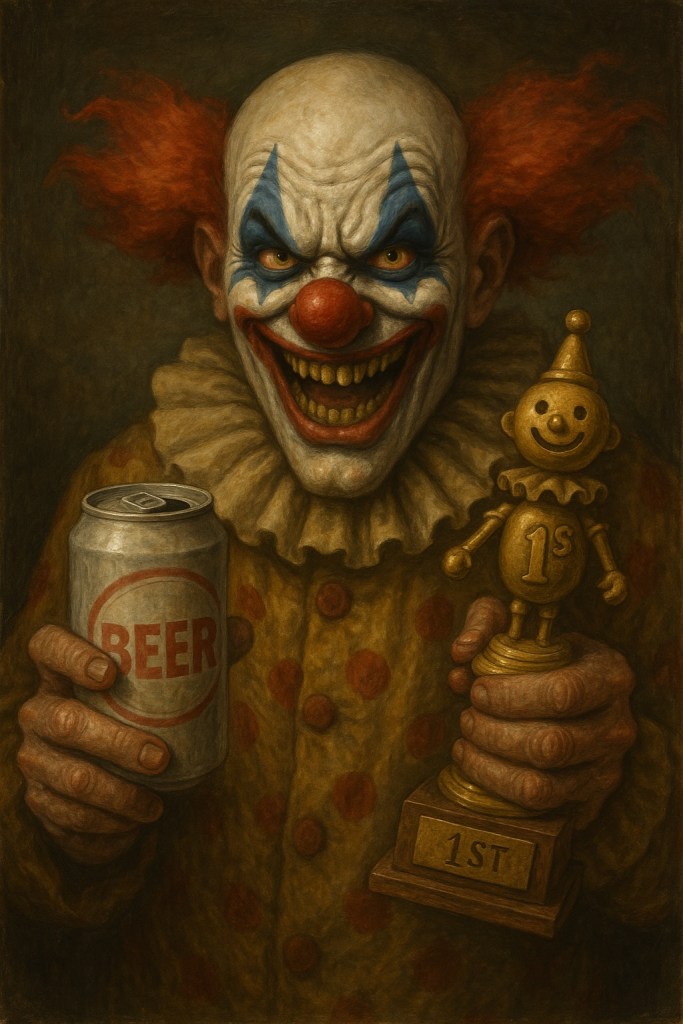
Enter the King of Swill, the mind-numbingly stupid Budweiser marketing department. Or as they say in Cannes, Le roi de la bibine.
Credit where it’s due: British Bud-hater and our friend Chris Cooke at CMU flagged this jaw-dropper from Cannes Lions, where Budweiser took home the Grand Prix for its “One‑Second Ad” campaign—a series of ultra-short TikTok clips that featured the one second of hooks from iconic songs. The gimmick? Tease the audience just long enough to trigger nostalgia, then let the internet do the rest. The beer is offensive enough to any right-thinking Englishman, but the theft? Ooh la la.
Cannes Clown
Budweiser’s award-winning brag? “Zero ads were skipped. $0 spent on music right$.” Yes, that’s correct–“right$”.
That quote should hang in a museum of creative disinformation.
There’s an old copyright myth known as the “7‑second rule”—the idea that using a short snippet of a song (usually under 7 seconds) doesn’t require a license. It’s pure urban legend. No court has ever upheld such a rule, but it sticks around because music users desperately want it to be true. Budweiser didn’t just flirt with the myth—it took the myth on a date to Short Attention Span Theater, built an ad campaign around it, and walked away with the biggest prize in advertising to the cheers of Googlers everywhere.
When Theft from artists Becomes a Business Model–again
But maybe this kind of stunt shouldn’t come as a surprise. When the richest corporations in commercial history are openly scraping, mimicking, and monetizing millions of copyrighted works to train AI models—without permission and without payment—and so far getting away with it, it sends a signal. A signal that says: “This isn’t theft, it’s innovation.” Yeah, that’s the ticket. Give them a prize.
So of course Budweiser’s corporate brethren start thinking: “Me too.”
As Austin songwriter Guy Forsyth wrote in Long Long Time, “Americans are freedom-loving people, and nothing says freedom like getting away with it.” That lyric, in this context, resonates like a manifesto for scumbags.
The Immorality of Virality
For artists and the musicians and vocalists who created the value that Budweiser is extracting, the campaign’s success is a masterclass in bad precedent. It’s one thing to misunderstand copyright; it’s another to market that misunderstanding as a feature. When global brands publicly celebrate not paying for music–in Cannes, of all places—the very tone-deaf foundation of their ad’s emotional resonance sends a corrosive signal to the entire creative economy. And, frankly, to fans.
Oops!… I Did It Again, bragged Budweiser, proudly skipping royalties like it’s Free Fallin’, hoping no one notices they’re just Smooth Criminals playing Cheap Thrills with other people’s work. It’s not Without Me—it’s without paying anyone—because apparently Money for Nothing is still the vibe, and The Sound of Silence is what they expect from artists they’ve ghosted.
Because make no mistake: even one second of a recording can be legally actionable particularly when the intentional infringing conspiracy gets a freaking award for doing it. That’s not just law—it’s basic respect, which is kind of the same thing. Which makes Budweiser’s campaign less of a legal grey area and more of a cultural red flag with a bunch of zeros. Meaning the ultimate jury award from a real jury, not a Cannes jury.
This is the immorality of virality: weaponizing cultural shorthand to score branding points, while erasing the very artists who make those moments recognizable. When the applause dies down in Yachtville, what’s left is a case study in how to win by stealing — not creating.
Songwriter and publisher Cyril Vetter is at the center of a high-stakes copyright case over his song “Double Shot of My Baby’s Love” with massive implications for authors’ termination rights under U.S. law. His challenge to Resnik Music Group has reached the Fifth Circuit Court of Appeals, and creators across the country are showing up in force—with a wave of amicus briefs filed in support including Artist Rights Institute. Let’s consider the case on appeal.
At the heart of Vetter’s case is a crucial question: When a U.S. author signs a U.S. contract governed by U.S. law and then later the author (or the author’s heirs) invokes their 35-year termination right under Sections 203 and 304 of the U.S. Copyright Act, does that termination recover only U.S. rights (the conventional wisdom)—or the entire copyright, including worldwide rights? Vetter argued for the worldwide rights at trial. And the trial judge agreed over strenuous objections by the music publisher opposing Cyril.
Judge Shelly Dick of the U.S. District Court for the Middle District of Louisiana agreed. Her ruling made clear that a grant of worldwide rights under a U.S. contract is subject to U.S. termination. To hold otherwise would defeat the statute’s purpose which seems obvious.
I’ve known Vetter’s counsel Tim Kappel since he was a law student and have followed this case closely. Tim built a strong record in the District Court and secured a win against tough odds. MTP readers may recall our interviews with him about the case, which attracted considerable attention. Tim’s work with Cyril has energized a creator community long skeptical of the industry’s ‘U.S. rights only’ narrative—a narrative more tradition than law, an artifact of smoke filled rooms and backroom lawyers.
The Artist Rights Institute (David Lowery, Nikki Rowling, and Chris Castle), along with allies including Abby North (daughter-in-law of the late film composer Alex North), Blake Morgan (#IRespectMusic), and Angela Rose White (daughter of the late television composer and music director David Rose), filed a brief supporting Vetter. The message is simple: Congress did not grant a second bite at half the apple. Termination rights are meant to restore the full copyright—not just fragments.
As we explained in our brief, Vetter’s original grant of rights was typical: worldwide and perpetual, sometimes described as ‘throughout the universe.’ The idea that termination lets an author reclaim only U.S. rights—leaving the rest with the publisher—is both absurd and dangerous.
This case is a wake-up call. Artists shouldn’t belong to the ‘torturable class’—doomed to accept one-sided deals as normal. Termination was Congress’s way of correcting those imbalances. Terminations are designed by Congress to give a second bite at the whole apple, not the half.
Stay tuned—we’ll spotlight more briefs soon. Until then, here’s ours for your review.





You must be logged in to post a comment.