Don’t Let Congress Reward the Stations That Don’t Pay Artists

As we’ve been posting about for years—alongside Blake Morgan and the #IRespectMusic movement that you guys have been so good about supporting—there’s still a glaring failure at the heart of U.S. copyright law: performing artists and session musicians receive no royalty for AM/FM radio airplay. Every other developed country (and practically every other country) compensates performers for broadcast use, yet the United States continues to exempt terrestrial radio from paying the people who record the music.

Now Congress is preparing to pass the AM Radio in Every Car Act, a massive government intervention that would literally install the instrument of unfairness into every new car at significant cost to consumers. It’s a breathtaking example of how far the National Association of Broadcasters (NAB) will go to preserve its century-old free ride—by lobbying for public subsidies while refusing to pay artists a penny. This isn’t public service; it’s policy cruelty dressed up as nostalgia.

Hundreds of artists have already spoken out in a letter to Congress demanding fairness through the American Music Fairness Act (AMFA). Their action matters—and yours does too.

👉 Here’s what you can do:

Don’t let Washington hard-wire injustice into every dashboard. Demand that Congress fix the problem before it funds the next generation of unfairness.

Dear Speaker Johnson, Leader Jeffries, Leader Thune, and Leader Schumer:

Earlier this year, we wrote urging that you take action on the American Music Fairness Act (S.253/H.R.791), legislation that will require that AM/FM radio companies start paying artists for their music. We are grateful for your attention to ensuring America’s recording artists are finally paid for use of our work.

As you may know, some members of Congress are currently seeking to pass legislation that will require every new vehicle manufactured in the United States come pre-installed with AM radio. The passage of the AM Radio for Every Vehicle Act (S.315/H.R.979) would mark another major windfall for the corporate radio industry that makes $13.6 billion each year in advertising revenue while refusing to compensate the performers whose songs play 240 million times each year on AM radio stations. Every year, recording artists lose out on hundreds of millions of dollars in royalties in the U.S. and abroad because of this hundred-year-old loophole.

This is wrong. In the United States of America, every person deserves to be paid for the use of their work. But because of the power held by giant radio corporations in Washington, artists, both big and small, continue to be overlooked, even as every other music delivery platform, including streaming services and satellite radio, pays both the songwriter and performer.

We are asking today that you insist that any legislation that includes the AM Radio for Every Vehicle Act also include the American Music Fairness Act. We do not oppose terrestrial radio. In fact, we appreciate the role that radio has played in our careers and within society, but the 100-year-old argument of promotion that radio continues to hide behind does not ring true in 2025.

When you save the radio industry by mandating its technology remain in cars, we ask that you save the musician too and allow us to be paid fairly when our music is played.

Thank you again for your consideration of this much-needed legislation.

Sincerely,

Barry Manilow

Boyz II Men

Carole King

Cyndi Lauper

Debbie Gibson

Def Leppard

Gloria Gaynor

Kool and the Gang

Lee Ann Womack

Lil Jon

Mike Love

Nancy Wilson

Peter Frampton

Sammy Hagar

Smokey Robinson

TLC

Creators Rally Behind Cyril Vetter’s Termination Rights Case in the Fifth Circuit

by Chris Castle

Songwriter and publisher Cyril Vetter is at the center of a high-stakes copyright case over his song “Double Shot of My Baby’s Love” with massive implications for authors’ termination rights under U.S. law. His challenge to Resnik Music Group has reached the Fifth Circuit Court of Appeals, and creators across the country are showing up in force—with a wave of amicus briefs filed in support including Artist Rights Institute.  Let’s consider the case on appeal.

At the heart of Vetter’s case is a crucial question: When a U.S. author signs a U.S. contract governed by U.S. law and then later the author (or the author’s heirs) invokes their 35-year termination right under Sections 203 and 304 of the U.S. Copyright Act, does that termination recover only U.S. rights (the conventional wisdom)—or the entire copyright, including worldwide rights?  Vetter argued for the worldwide rights at trial.  And the trial judge agreed over strenuous objections by the music publisher opposing Cyril.

Judge Shelly Dick of the U.S. District Court for the Middle District of Louisiana agreed. Her ruling made clear that a grant of worldwide rights under a U.S. contract is subject to U.S. termination. To hold otherwise would defeat the statute’s purpose which seems obvious.

I’ve known Vetter’s counsel Tim Kappel since he was a law student and have followed this case closely. Tim built a strong record in the District Court and secured a win against tough odds. MTP readers may recall our interviews with him about the case, which attracted considerable attention. Tim’s work with Cyril has energized a creator community long skeptical of the industry’s ‘U.S. rights only’ narrative—a narrative more tradition than law, an artifact of smoke filled rooms and backroom lawyers.

The Artist Rights Institute (David Lowery, Nikki Rowling, and Chris Castle), along with allies including Abby North (daughter-in-law of the late film composer Alex North), Blake Morgan (#IRespectMusic), and Angela Rose White (daughter of the late television composer and music director David Rose), filed a brief supporting Vetter. The message is simple: Congress did not grant a second bite at half the apple. Termination rights are meant to restore the full copyright—not just fragments.

As we explained in our brief, Vetter’s original grant of rights was typical: worldwide and perpetual, sometimes described as ‘throughout the universe.’ The idea that termination lets an author reclaim only U.S. rights—leaving the rest with the publisher—is both absurd and dangerous.

This case is a wake-up call. Artists shouldn’t belong to the  ‘torturable class’—doomed to accept one-sided deals as normal. Termination was Congress’s way of correcting those imbalances. Terminations are designed by Congress to give a second bite at the whole apple, not the half.

Stay tuned—we’ll spotlight more briefs soon. Until then, here’s ours for your review.

Tell Congress to Honor Aretha, Pass #AMFA #IRespectMusic

It’s time.

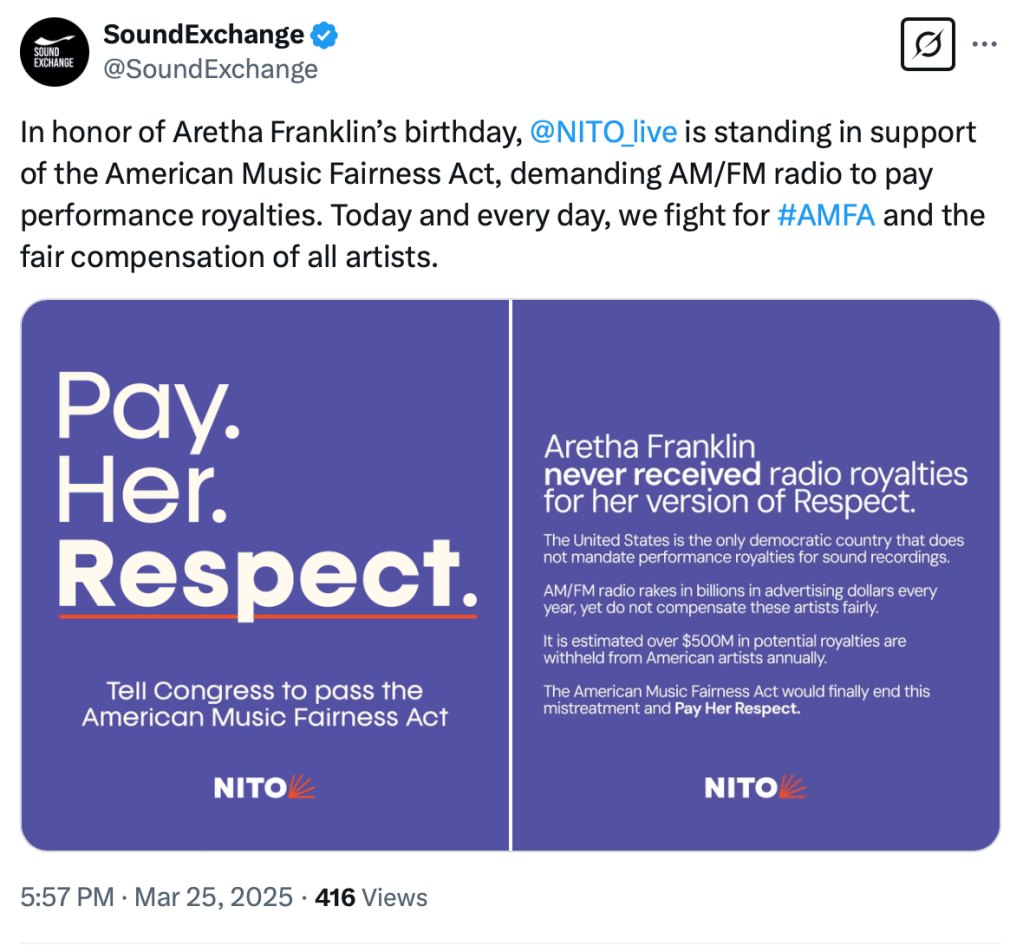
We join our friends Blake Morgan, #IRespectMusic, SoundExchange, the National Independent Talent Organization (NITO) and many, many others in asking you to join the fight to support artist pay for radio play by passing the American Music Fairness Act. Find out how you can help here, or find your representative in Congress here.

Guest post by @TheBlakeMorgan: A musician’s view of the TikTok legislation

Here’s a musician’s perspective on the TikTok legislation before Congress: I hope it passes, both as an American, and as a music maker. (The bill is “Protecting Americans From Foreign Adversary Controlled Applications Act, (HR 7521),” It was recently introduced by Representatives Mike Gallagher (R-Wi.) and Raja Krishnamoorthi (D-Ill.)The bill passed the House by a vote of 352-65, demonstrating deep bipartisan support)

First––this bill restricts TikTok, it does not “ban” the app. It forces the company to separate its ties to the Chinese Communist Party and prevents them from accessing the data of Americans. That’s a good thing.

The bill doesn’t mandate or regulate speech, it’s focused on national security: the FCC called TikTok “a clear and present danger” to our country.

Second––music makers already know what music lovers are just now learning: TikTok is the worst, most exploitative streaming platform for music, anywhere. The vast majority of music on TikTok generates virtually no revenue for the musicians who made it, and even more music on the platform is completely unlicensed (stolen), copied (stolen via AI), or pirated (stolen).

Simply put, TikTok is trying to build a music-based business without paying music makers fair value for the music.

Lastly––musicians (and Americans) are all too familiar with being underpaid and undervalued, with our data being scraped and sold, with platforms which promote hate speech, bigotry, and bullying.

But TikTok does all of this and more, while posing an existential national security threat to our country.

It’s rare to see independent musicians (like me) stand with major labels, and it’s rare to see Republicans and Democrats stand together about anything. But here we are. I hope it passes the Senate and that President Biden signs it.

Let’s #PreserveRockwood

New York City’s Rockwood Music Hall is one of the most important venues in the country, especially for independent artists. This is not just a dagger in the heart of New York, it’s a vital platform for artists to reach a New York audience on one of the three Rockwood stages. Like many venues, Rockwood is in financial trouble and is asking for help.

Our friend Blake Morgan has had tremendous support from Rockwood as a long-time artist in residence so this strikes close to home. Blake says “I grew up on the Lower East Side.” I remember when we lost CBGB’s, The Living Room, Luna Lounge, and so many others. Rockwood cannot meet the same fate, it’s the Ryman Auditorium of independent music in this country.”

If you’re not able to attend one of the Rockwood Benefit Concert series, please consider a contribution to the venue through their Go Fund Me page. Find out more about it at Preserve Rockwood.

Frozen Mechanicals Crisis: 2nd Comment of @helienne @davidclowery @theblakemorgan Opposing Conflict of Interest in Frozen Mechanicals–‘Let the future have a vote’

SECOND REOPENING PERIOD COMMENTS OF HELIENNE LINDVALL, DAVID LOWERY AND BLAKE MORGAN 

            Helienne Lindvall, David Lowery and Blake Morgan (collectively, the “Writers”) thank the Judges for the opportunity and respectfully submit the following comments responding to the Copyright Royalty Judges’ notice (“Second Notice”) soliciting comments on additional materials (“Reply”) received by the Judges[1] from the National Music Publishers Association, Nashville Songwriters Association International, Sony Music Entertainment, UMG Recordings, Inc. and Warner Music Group Corp. (collectively, the “Majors”)[2] regarding the so-called [frozen] “Subpart B” statutory rates and terms[3] relating to the making and distribution of physical or digital phonorecords of nondramatic musical works in the docket referenced above (“Proceeding”). 

The Writers previously submitted comments[4] (“Prior Comment”) responding to the Judges’ notice[5] (“First Notice”) soliciting comments on the Major’s proposed purported settlement (the “Proposed Settlement”)[6] of the Subpart B rates.  The Writers along with attorney Gwendolyn Seale[7] attempted to submit additional comments in response to the Majors’ filing but were not able to timely file that response.[8]  The Writers appreciate the Judges’ decision to reopen the comment period in order to afford the public, and those that would be bound by the rates and terms set by the Proposed Settlement,[9] an opportunity to comment on those additional materials filed by the Majors and to further participate in the rulemaking.[10]

I.  SUMMARY
            As a general comment on the record to date in Phonorecords IV, the Writers are mystified by the histrionics that have become associated with this Proceeding both on the record and in the press. A voluntary negotiation is just a deal, often made by people who are paid to always be closing. The Writers believe that Congress intended that voluntary negotiation produce a fair result on a reasonable timetable.  

 While not directly at issue in the reopened comment period, what is clearly the case is that the settlement of the Subpart B rates has unnecessarily become a major gating item for the streaming side of this Proceeding, geese and ganders being what they are.  Despite the extensive voluntary negotiation period for the Subpart B rates by the Majors, the Judges—and, frankly, songwriters around the world–are presented instead with a cornucopia of chaos across the board; the cherry on top is the frozen mechanicals crisis.  However, in this season of hope the Writers are confident that the Judges will lead us all out of this daunting situation.

The Writers are not interested in the personalities, the arm-waving or the finger-pointing.  They are interested in the results, particularly because neither they nor anyone they authorized had input into the negotiation that produced either the Proposed Settlement or the impasse.

There is at least one easy way to fix this and recognize the intrinsic value of songs:  Raise the statutory rate proposal for Subpart B configurations in at least some relation to the streaming rate increase.  A song is no less valuable because of the medium in which it is exploited.[11] 

As the Writers will argue, just like the voluntary agreement on Subpart B that led to this impasse was reached by the Majors, those same parties can go back to the drawing board to reach an appropriate conclusion with a higher Subpart B rate.  

Neither the public nor the songwriters are well served (and frankly neither are the Judges) by thrashing about and waiving arms. This may serve well the people who are paid by the hour but it hasn’t served people who are paid by the song.  At all.  “Victory” without winning may pass for success in Washington, but it does not in the writer room or at a songwriter’s kitchen table.

            The Proposed Settlement is a crystallization of everything that is wrong with the licensing and payment practices that have arisen under the compulsory license regime where no is yes, more is less and the Kool-Aid whispers “Drink Me.”  

While the Writers will focus in this comment on the frozen mechanicals issue that has become emblematic of the current crisis, it must be said that the decade-plus MOU [black box] agreements are a backward looking and inequitable insider arrangement that permits a mindset of sloppiness and a “kick the can down the road” mentality that debilitates the entire music publishing business.[12]  It’s no accident that the Mechanical Licensing Collective—run by largely the same cast of characters under a jaw-dropping Congressional governance mandate—has been sitting on $424,000,000 of other peoples’ money for nine months during a pandemic with no visible compliance with another Congressional mandate of paying songwriters correctly in Title I of the Music Modernization Act.[13]  

            The MLC and the sequence of MOUs are both descended from the same ancestors a generation ago.  Each have essentially the same business model and each are somehow inexplicably viewed as a “win” for the songwriters.  The irony of splicing the genetic code of the ancien régime MOU [black box insider settlements] to the future is not lost on anyone.  If the failure to match money and songs in the MOU process is still a problem after fifteen years as well as the much-trumpeted Title I of the Music Modernization Act, it’s not the horse’s fault.  It’s the rider’s.

            It would be a real pity for the CRB to perpetuate this unfairness by adopting the Proposed Settlement.  With respect, it is bad law, bad policy, and a failure to even try to bend the arc of the moral universe.  Conversely, rejecting the Proposed Settlement would provide the kind of steely oversight tragically lacking in the current regime.  Please let the future have a vote, just once.

            The Writers object to the Proposed Settlement for the following reasons and respectfully suggest constructive alternatives.  The gravamen of our objection is that (1) the Subpart B rates have already been frozen since 2006 and extending the freeze another five years is unjust; (2) no evidence has been publicly produced in the Proceeding that justifies or even explains extending the proposed freeze aside from the connection to the memorandum of understanding in the MOU4 late fee waiver (“MOU”), a document that the Majors only recently disclosed in their Reply; (3) very large numbers of songwriters and copyright owners of various domiciles around the world and national origins are unlikely to even know this Proceeding is happening and there still is no evidence that the unrepresented have appointed any of the participants to act on their behalf or were asked to consent to the purported settlement before the fact even if they were members of these organizations aside from the respective board of directors; (4) physical sales are still a vital part of songwriter revenue (which the Writers documented in the Prior Comment[14]); and (5) there are many just alternatives available to the Judges without applying an unjust settlement to the world’s songwriters who are strangers to the Proposed Settlement and in particular the MOU component (as the MOU will likely require membership in the NMPA to benefit consistent with prior MOUs).

[Read the full-length original filing here.]


[1] 86 FR 58626.

            [2] NMPA, NSAI, Sony Music Entertainment, UMG Recordings, Inc. and Warner Music Group Comments in Further Support of the Settlement of Statutory Royalty Rates and Terms for Subpart B Configurations, Determination of Royalty Rates and Terms for Making and Distributing Phonorecords (Phonorecords IV), Copyright Royalty Board (Aug. 10, 2021).

            [3] 37 C.F.R. §385.11(a).

            [4] Comments of Helienne Lindvall, David Lowery and Blake Morgan, Determination of Rates and Terms for Making and Distributing Phonorecords (Phonorecords IV) (July 26, 2021) available at https://app.crb.gov/document/download/25533.

[5] 86 FR 33601.

            [6] Motion To Adopt Settlement of Statutory Royalty Rates and Terms for Subpart B Configurations, Docket No. 21-CRB-0001-PR (2023-2027).

            [7]  Ms. Seale does not otherwise join in this comment.  We understand she is filing a separate comment regarding the additional materials.

            [8] The Writers’ reply was posted on The Trichordist website available at https://thetrichordist.com/2021/08/16/frozenmechanicals-crisis-unfiled-supplemental-comments-of-helienne-lindvall-davidclowery-theblakemorgan-and-sealeinthedeal/.  Parts of that unfiled comment are included in this comment.

[9] See 17 USC 801(b)(7)(a)(i).

                  [10]  As with the Writers prior submission in response to the First Notice, the Writers focus in this comment almost entirely on the Subpart B rates applicable to physical carriers under 37 C.F.R. §385.11(a).  

            [11] The Judges no doubt will be told many stories about how Subpart B configurations are not meaningful sales compared to streaming so rates deserve to be frozen.  This is a novel copyright argument without a statutory basis.  The theory is also not based on accurate facts as the Writers discuss extensively in the Prior Comment at paragraph 5 and will not repeat here.

            [12] There is a growing backlash to decades of delaying definitive action on song metadata and songwriter payments such as Credits Due campaign of the Ivors Academy and Abba’s Björn Ulvaeus.  See generally Chris Cooke, PPL Backs Björn Ulvaeus’s Credits Due Campaign, Complete Music Update (Oct. 4, 2021) available at https://completemusicupdate.com/article/ppl-backs-bjorn-ulvaeuss-credits-due-campaign/

            [13] See, e.g., H. Rep. 115-651 (115th Cong. 2nd Sess. April 25, 2018) at 5; S. Rep. 115-339 (115th Cong. 2nd Sess. Sept. 17, 2018) at 5 (“The Committee welcomes the creation of a new musical works database that is mandated by the legislation….Music metadata has more often been seen as a competitive advantage for the party that controls the database, rather than as a resource for building an industry on.” (emphasis added)).

            [14] See Prior Comment at 16.

@theblakemorgan: American middle-class musicians are worth fighting for #IRespectMusic–Artist Rights Watch

[Editor Charlie sez: Our friend and supporter Blake Morgan has an important opinion post on the bi-partisan American Music Fairness Act (AMFA) in The Hill, a long-time and influential DC insider journal. Blake tells the human story of why artists need the AMFA legislation and the #IRespectMusic campaign.]

This image has an empty alt attribute; its file name is amfa-156.jpeg
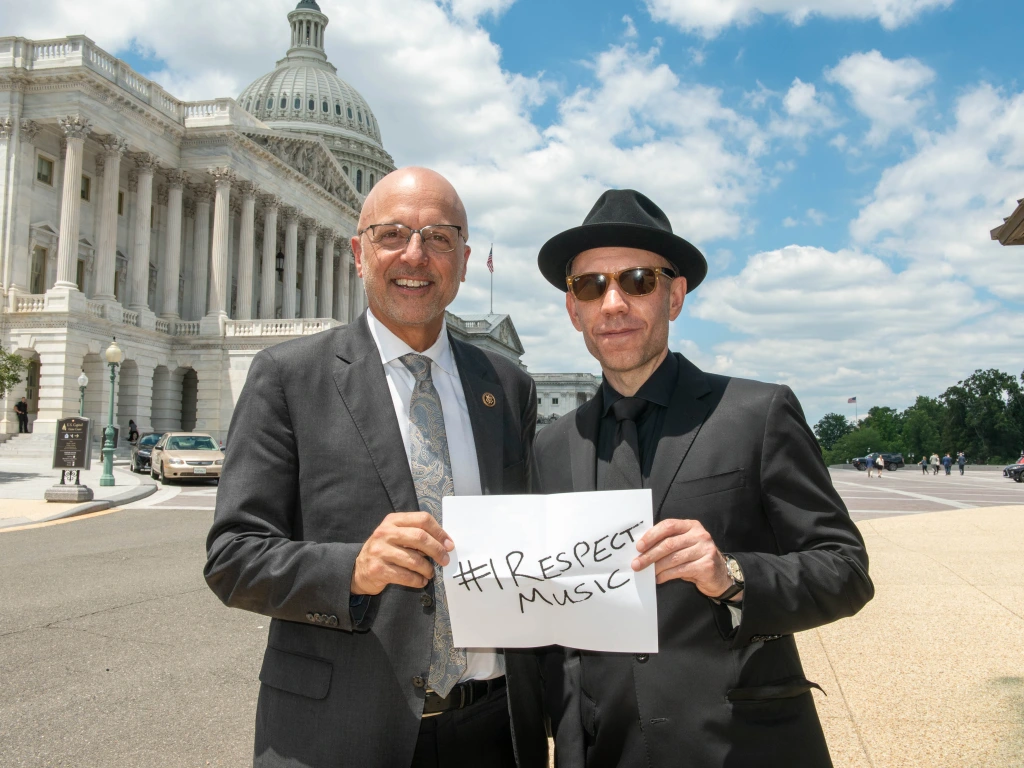
Rep. Ted Deutch and Blake Morgan

We musicians are used to fighting. For our livelihoods, our families, our dreams. In recent years we’ve fought battles we’ve neither sought nor provoked, against powerful corporate forces devaluing music’s worth. Streaming companies, music pirates, and AM/FM radio broadcasters who, in the United States, pay nothing––zero––to artists for radio airplay.

It’s shocking, but true: The United States is the only democratic country in the world where artists don’t get paid for radio airplay. Only Iran, North Korea, and China stand with the United States in this regard. ADVERTISEMENT

Broadcasters make billions of dollars each year off our music, and artists don’t earn a penny. This impacts not only the artist, but session musicians, recording engineers, songwriters. Virtually everyone in music’s economy. 

Isn’t being paid fairly for one’s work a bedrock American value?

Read Blake’s post on The Hill and sign the #IRespectMusic campaign and tell Congress you want fairness for artists!

#FrozenMechanicals Crisis: Unfiled Supplemental Comments of @helienne Lindvall, @davidclowery, @theblakemorgan and @sealeinthedeal

[Chris Castle says: Here’s the context of this post. As it turns out, the CRB extended the filing deadline for comments due to what they said was a technical difficulty, although we have yet to meet anyone who couldn’t file their comment on time. This extension seems contrary to the CRB’s February revised rules for filings by participants. The CRB procedures presciently have an email filing procedure in the case of technical problems arising out of their “eCRB” document filing system. It will not surprise you to know that the NMPA, NSAI, and major labels filed what is essentially a reply comment after the close of business on the last day of the extension, after at least our if not all commenter accounts were disabled, the practical effect of which was that no one could respond to their comments through the eCRB, i.e., on the record.

We tried, and drafted a reply to the most important points raised in the majors’ comment. We emailed our comment to the CRB during business hours on the next day in line with the CRB’s own “Procedural Regulations of the Copyright Royalty Board Regarding Electronic Filing System” (see 37 CFR §303.5(m)) or so we thought. But not so fast–we were told by an email from a nameless person at the CRB that we would need to file a motion in order to get approval to file the comment less than 24 hours late for good cause–which of course, we are not able to do since we are not “participants” in the proceeding. See how that works? According to this person’s email, we’d also need to contact CRB technical support to get our accounts reopened which would make the comment later still even if we were able to file a motion. Instead, we decided to just post our reply comment on the Internet. A wider audience. Unfortunately not part of the record, but we’ll see what happens.]

SUPPLEMENTAL COMMENTS OF HELIENNE LINDVALL, DAVID LOWERY, BLAKE MORGAN  AND GWENDOLYN SEALE OBJECTING TO PROPOSED SETTLEMENT OF SUBPART B RATES

            This comment is in reply to the comment[1] filed by the Copyright Owners and the Joint Record Company Participants (the “Majors”) time-stamped after the close of business on August 10, 2021 and made available on the CRB docket the morning of August 11, 2021, i.e., after the deadline established by the Judges in the Proposed Rule published at 86 FR 33601 that would codify the Proposed Settlement.[2] 

            We ask the Judges’ leniency in permitting our late-filed supplemental comment to be made a part of the record in hopes that our responsive discussion will be helpful to the Copyright Royalty Board in resolving the frozen mechanicals crisis.

            This comment is filed on behalf of Helienne Lindvall, David Lowery and Blake Morgan who timely filed their comment on July 26, 2021[3] in accordance with the proposed rule.  This comment is also filed by Gwendolyn Seale who timely filed her own comment[4] in accordance with the proposed rule.  Their respective biographical information may be found in their previously filed comments.

            We will briefly discuss what we think are the essential points the Judges should consider that the Majors have raised in their comment.

I. Discussion

            A.  Authority:  As multiple commenters have stated, it is unclear whether the NMPA and NSAI have been authorized by their respective memberships of over 300 music publishers and over 4,000 songwriters to propose and/or accept a settlement freezing the statutory rate for Subpart B configurations through 2027. Thus, we ask the Judges to seek out evidence demonstrating that self-published songwriters and independent publishers have authorized the NSAI and NMPA to accept this Proposed Settlement.  We do not question the integrity of the Majors, but we do have questions about the negotiation process that have yet to be answered. 

            References to a broad “consensus” must be questioned because there is both a lack of evidence of consensus and also evidence in the record that at least 12 international songwriter groups object to the Proposed Settlement.  Independent songwriters, including Ms. Lindvall, Mr. Lowery and Mr. Morgan, also object.  It seems simple enough for the Judges to require some evidence of consent to the Proposed Settlement given the awesome power of the government that the Judges are essentially asked by Congress to delegate to the Majors through a voluntary negotiation.  This seems to us to be good cause for further verification of authority to make the deal in the first place.

            B.  The Judges Predicted the Current Opposition in their Phonorecords III Determination

The Majors rely on a citation that both demonstrates the foresight of the CRB and on balance tends to support our position that the NMPA and the NSAI likely lack the requisite authority to negotiate on behalf of all the world’s songwriters.  The Majors invite the Judges to participate in a thought experiment[5] that actually serves quite well to highlight the issues we have raised in the respective comments regarding both the authority of the NMPA and NSAI and the implied below-statutory rates bootstrapped indirectly by means of the freeze:

As the Judges have noted, “NMPA and NSAI represent individual songwriters and publishers,” and would not “engage[] in anti-competitive price-fixing at below-market rates,” since they must “act[] in the interest of their constituents” lest their constituents “seek representation elsewhere.” [Phonorecords III] at 15298.[6]

Respectfully, the problem is way beyond seeking representation elsewhere—the problem is that there was likely no “representation” in the first place if you take “representation” in the legal sense (such as that of a common agent) which we gather is how the Judges intended the use of the word.  Likewise, there is a difference between an agent’s principal and a “constituent”, i.e., a difference between one who expressly authorizes an agent to represent them in certain circumstances and one who is allowed to vote on who that representative is to be.  Neither is the case for many songwriters who have commented in the record for the current proceeding.  We will leave their record to speak for themselves as to why they have sought “representation elsewhere” but it appears that it is for the same reason that they are not participants in the proceeding—they can’t afford the justice and this is why they ask the Judges to give special weight to their comments in the CRB’s deliberations.

            But the Major’s thought experiment and speculation continues in an interesting coda regarding below statutory licensing (generally not permitted as a matter of contract in likely tens of thousands of co-publishing and administration agreements):

And certainly it would not be in the interest of any major publisher to agree to extend a below-market mechanical royalty rate to the competitors of its sister record company.[7]

While the thought experiment and speculation sound innocuous, consider what is being said here.  First, the Majors identify their interest as that of “major publishers”; not all publishers, not all songwriters, but “major publishers.”  Then the Majors go on to say that it would not be in the interest of the major publishers to give a “below market” rate to their sister record company’s competitors

            Of course, there is no market rate in the U.S. and essentially never has been; the Judges have the unenviable task of divining a market rate to be made statutory.  We would therefore modify the thought experiment to include “below statutory”.  Now we are left with the assertion that major publishers use the statutory rate to protect their record company affiliates from competition—not that they fulfill their role as true blue fiduciaries for their songwriters by refusing to grant below-statutory rates (either directly or indirectly), but rather being hard on the competitors of their affiliates.   And they are using their market power to impose a rate on the world that they seem to say protects their affiliates.  Extending the frozen mechanical rate certainly doesn’t protect their songwriters—the Judges have ample evidence that many songwriters object to the extension.  But in the Majors’ own words we now know cui bono, and the benefit goes back to Phonorecords III and likely earlier.

            But let us extend the thought experiment a little bit further.  Who is an unrelated “competitor” of the three major labels and all their distributed labels, DIY operations like The Orchard, joint ventures and so on and on and on?  That must be a pretty small group of true independents who have cobbled together a distribution network for the Subpart B configurations to deal with the logistics of manufacturing, warehousing, shipments, returns, and the like—branch distribution is what makes a major label a major.  Perhaps the Majors could provide some examples of these “competitors”?  Clearly though, the citation demonstrates that the Judges sensed many years ago the very situation now unfolding on the record in the frozen mechanicals crisis.

            C.  Comparisons to Largely Unopposed Prior Rulemakings Compare Apples to Oranges:  We understand that the Majors claim to have proposed a similar settlement in Phonorecords III resulting in a freeze of the statutory rate for Subpart B configurations, and that the Judges then-adopted that settlement.  We also understand that there was little if any formal objection to that freeze in Phonorecords III at least by comparison to the number of objecting commenters in Phonorecords IV.  The Judges are now presented with a significant number of objectors who entirely reject the application of the Proposed Settlement to the world in a kind of bootstrapping move.  Respectfully, comparing the field in Phonorecords III to Phonorecords IV is comparing apples to oranges and creating a pomegranate.

            We also acknowledge the millions of dollars that the NMPA asserts that it spent litigating these rates some fifteen years ago, but this assertion perhaps proves too much.  The cost of participating in any of these proceedings is exactly the reason why objecting songwriters understandably rely entirely on the Judges to seek fairness and justice.  They cannot afford to participate in these proceedings themselves and trust the Judges to balance all the facts not just the arguments of rich people and corporations. 

Not only do the Majors gloss over the songwriters’ objections, but their reasoning is actually fallacious. Because both proceedings are called “Phonorecords” does not make them similar in regard to the frozen mechanicals crisis.  The facts on the ground are wildly different between III and IV.  Moreover, we hear a subtext in the Major’s argument that if a configuration experiences declining sales, that is a reason for the government to reduce the royalty rate.  Aside from a lack of statutory authority, this is also fallacious reasoning because the Majors have produced no evidence that the per-unit price for Subpart B configurations has declined, and if anything, we are informed that the dealer price has increased in the case of vinyl.[8] 

We respectfully ask that the Judges consider these flaws in the Majors’ positions and give them their due weight. 

            D.  The Elusive MOU:  The Majors tell the Judges that: 

The MOU entered into contemporaneously with the Settlement is irrelevant to the Judges’ consideration of the Settlement, and does not call into question the reasonableness of the Settlement.[9]

            Respectfully, if the MOU is “irrelevant” to the settlement, why did they bring it up at all?  Recall that we previously asked the Judges to question whether the MOU was additional consideration for extending the frozen mechanical rates.  While others may have, we did not concern ourselves with whether the MOU was a “sweetheart deal” as we knew nothing about it.  Rather our issue was whether the MOU was a quid pro quo of additional consideration for the frozen rates that was enjoyed by a limited group of participants in the settlement but was not enjoyed by strangers to the deal who were still subject to the frozen rate.  Indeed, it appears that this is exactly the case.  While we appreciate that the Majors have now disclosed the MOU as part of their Reply, nothing in the Majors’ comment ameliorates this fundamental concern.

            A significant reason why the concern still exists is language in the now-disclosed MOU that certainly has the ring of a quid pro quo directly related to extending the frozen Subpart B rates in Phonorecords IV:

This MOU4 is a separate, conditional agreement [the quid] that shall not go into effect until [the quo] NMPA, SME, WMG’s affiliate Warner Music Group Corp., and UMG submit a motion to adopt a proposed settlement of the Phonorecords IV Proceeding as to statutory royalty rates and terms for physical phonorecords, permanent downloads, ringtones and music bundles presently addressed in 37 C.F.R. Part 385 Subpart B (the “Subpart B Configurations”), together with (1) certain definitions applicable to Subpart B Configurations presently addressed in 37 C.F.R. § 385.2 and (2) late payment fees under Section 115 for Subpart B Configurations presently addressed in 37 C.F.R. § 385.3, together with certain definitions applicable to such late payment fees presently addressed in 37 C.F.R. § 385.2, for the rate period covered by the Phonorecords IV Proceeding, which the Parties anticipate happening promptly after this MOU4 has been signed by SME, UMG, WMG, RIAA, NMPA, Sony Music Publishing, Universal Music Publishing Group, and Warner Chappell Music, Inc. (the “Initial Signatories”).[10]

            To the contrary, a fair reading of the MOU suggests, and may even require, that the consideration for the MOU is tied directly to extending the frozen rates in the Proposed Settlement.

            Moreover, we can revisit the authority issue raised above given language in the MOU.  Consider the following post-closing condition imposed on the NMPA by the plain terms of the MOU:

It is understood that only the Initial Signatories will sign this MOU4 at the outset, and that NMPA shall use its best efforts to obtain the signatures to this MOU4 by all of the remaining Parties within two (2) weeks thereafter.[11]

            If the NMPA had the authority to bind these many publisher “Parties” to the MOU, why would there be a need to impose such a post-closing condition on the NMPA?  There may be an explanation for this structure, but it is not obvious to us.

            We also find it somewhat unusual that neither the Reply of the Majors nor the now-disclosed MOU reference a dollar figure that is changing hands as far as we can tell.  This could be a lot of cash.  In the 2009 Billboard article cited by the Majors, the MOU that was the subject of that reporting was valued at “up to $264 million.” [12] However “routine” the MOU process is, a $264 million payment in a “pennies business” is not routine.  We would appreciate a further disclosure of the amount at issue in the current MOU.  As they say, it is evidently not a secret.

            Respectfully, it does not appear that one can completely exclude the relevance of the MOU as consideration for extending the freeze on Subpart B royalties at least on the face of the documents provided.  As strangers to the deal do not have the opportunity to subject these assertions to the crucible of cross-examination, we hope the Judges can welcome the reliance on them of those who cannot afford to participate in this proceeding.

II.  Conclusion

            In conclusion, we respectfully ask the Judges to consider the foregoing comments along with the many heartfelt and well-reasoned comments by others in Phonorecords IV.  Unfortunately, as is too often the case in the music business, we think that the sum and substance of the Majors’ argument is that “we are the wealthy and therefore we win.”

            We do not have to remind the Judges that this is the antithesis of our Constitutional system of government.

                                                                         Respectfully submitted.

Christian L. Castle

Gwendolyn Seale


[1] Comments in Further Support of the Settlement of Statutory Royalty Rates and Terms for Subpart B Configurations,  Docket No. 21–CRB– 0001–PR (2023–2027) (August 10, 2021)(Reply).

[2] Motion to Adopt Settlement of Statutory Royalty Rates and Terms for Subpart B Configurations, Docket No. 21–CRB– 0001–PR (2023–2027) (May 25, 2021) (Proposed Settlement).

[3] Comment of Helienne Lindvall, David Lowery and Blake Morgan, Docket No. 21–CRB– 0001–PR (2023–2027) (July 26, 2021) available at https://app.crb.gov/document/download/25533

[4] Comment of Gwendolyn Seale, Docket No. 21–CRB– 0001–PR (2023–2027) (July 26, 2021) available at https://app.crb.gov/document/download/25534

[5] Reply at 5.

[6] Id. (emphasis added).

[7] Id.

[8] See, e.g., Samantha Handler, Copyright Panel Rethinking Song Royalties Streamers Pay, Bloomberg Law (Aug. 12, 2021) (“Royalties from downloads and CDs haven’t increased since 2006, but still make up a significant portion of income for independent songwriters.”) available at https://news.bloomberglaw.com/ip-law/copyright-panel-rethinking-song-royalties-streamers-pay

[9] Reply at 6 (emphasis added).

[10] Reply at 19, MOU-4 at 2 (emphasis added).

[11] Id. at 20, MOU-4 at 3.

[12] Ed Christman, NMPA, Major Labels Sign Terms of Agreement, Billboard (Oct. 7, 2009) available at https://www.billboard.com/articles/business/1264471/nmpa-major-%20labels-sign-on-terms-of-agreement.