
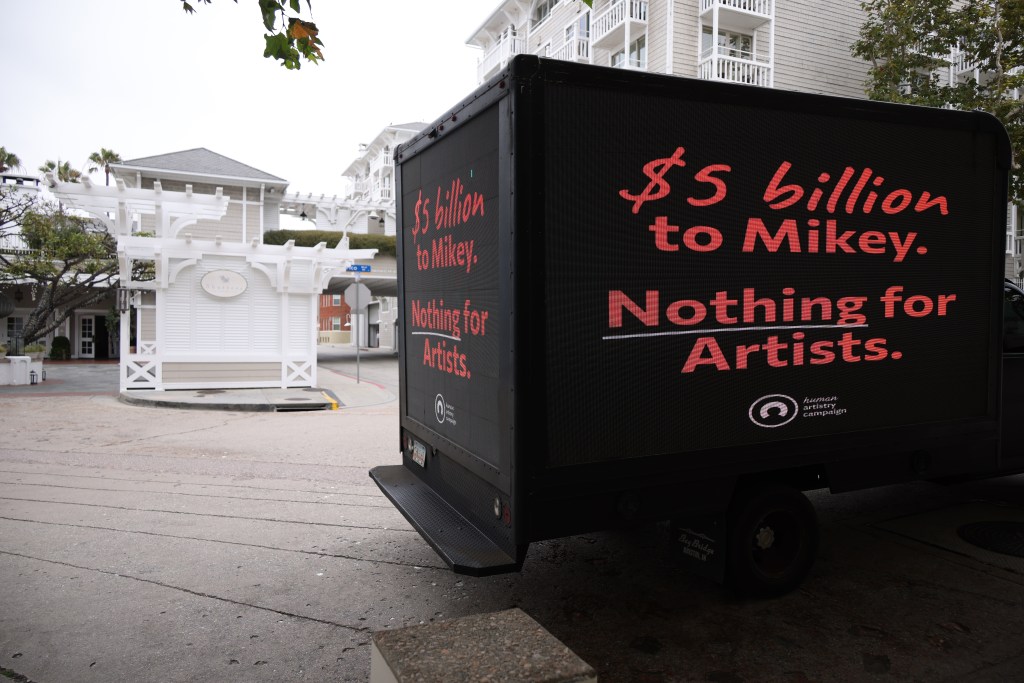
As Suno Celebrated a $5.4 Billion Valuation, Artists Took Their Message Directly to Wall Street

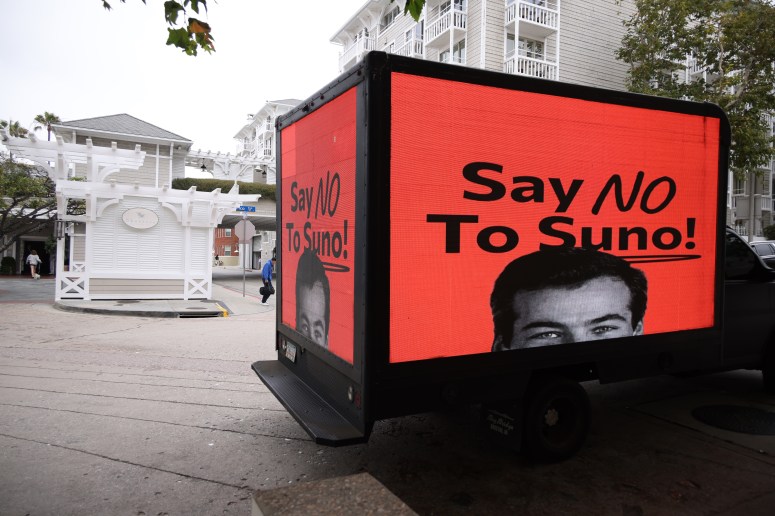
SANTA MONICA, CALIFORNIA – JUNE 03: A mobile billboard sponsored by Human Artistry protesting Suno’s use of AI is pictured on display during Suno’s annual meeting on June 03, 2026 in Santa Monica, California. (Photo by Anna Webber/Getty Images for Human Artistry Campaign)

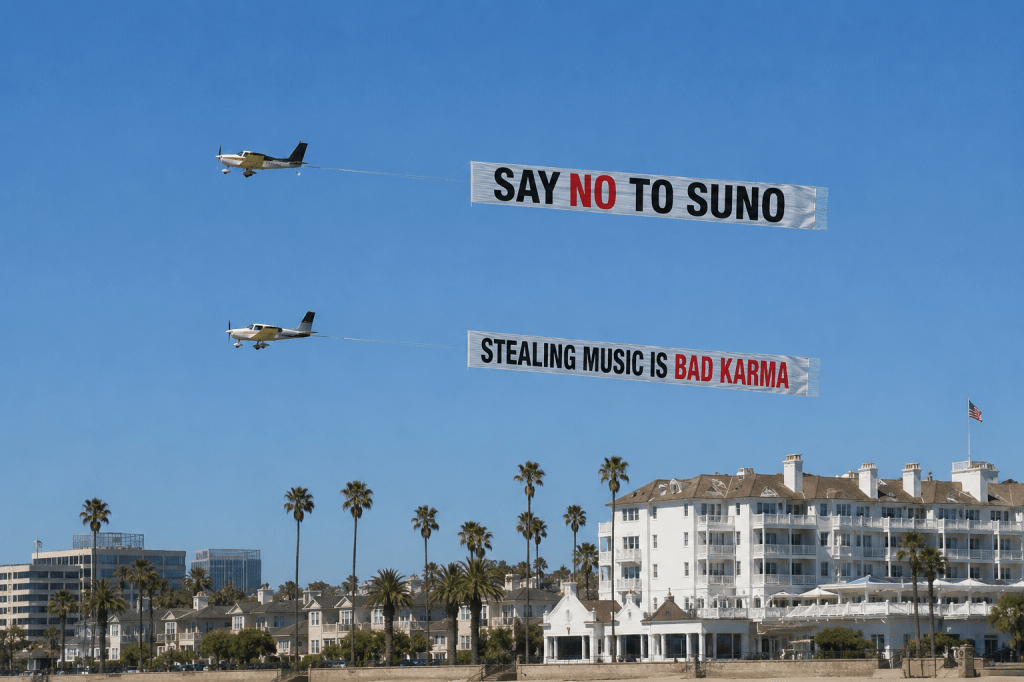
On June 3, 2026, as investors and technology executives gathered at the UBS AI in Entertainment Summit at Shutters on the Beach in Santa Monica, a plane circled overhead carrying a simple message: “SAY NO TO SUNO.” A second banner could just as easily have read, “Stealing Music Is Bad Karma.” The scene was more than a protest against a single AI music company. It was a reminder that technology itself is neither good nor evil; what matters is how humans choose to use it. Throughout history, some of the most transformative technologies have been driven by the same motivations that power every bully: greed and fear. Fear of being left behind. Fear of missing out. Greed for market share, dominance, and wealth and crushing anyone who gets in the way. The generative AI race increasingly appears to be driven—and corroded—by both.


That is why the protest above Santa Monica was about more than music. It connected directly to a broader national backlash against the infrastructure being built to support the AI economy. Across the United States, communities are fighting data centers, transmission lines, water consumption, tax subsidies, and industrial development projects that many believe are being imposed without meaningful public consent. Residents from Texas to Georgia to Louisiana are asking the same basic question: who benefits, and who pays the price?

In the case of generative AI, artists argue that they are among those paying the price.

The Human Artistry Campaign demonstration took place on the same day that Suno announced a funding round exceeding $400 million at a valuation of approximately $5.4 billion. Let it not be said that music has no value and that Suno is not free riding on a thriving market to extract their absurd valuation.

While Silicon Valley investors celebrated another milestone in AI’s rapid expansion, the protest highlighted an uncomfortable reality: much of the value being created by generative AI companies originates from extracting human expression while paying no regard whatsoever to those humans. Whether the source material is music, visual art, photography, authors, voice performances, or other creative works, creators continue to ask how their contributions found their way into commercial AI systems and demand the right to say no to Suno.

SANTA MONICA, CALIFORNIA – JUNE 03: A plane sponsored by Human Artistry protesting Suno’s use of AI is pictured on display during Suno’s annual meeting on June 03, 2026 in Santa Monica, California. (Photo by Anna Webber/Getty Images for Human Artistry Campaign)

The narrative that the AI labs want you to focus on is often framed as a conflict between innovation and regulation. That framing misses the point. The real question is whether innovation requires the abandonment of consent, compensation, and accountability. Human Artistry’s message was not anti-technology. Rather, it was that technology should serve human beings rather than treating them as raw material for extraction.
That concern increasingly links artist-rights advocates with communities opposing AI infrastructure projects using eminent domain powers to seize homes and compel residents to acept 765kV transmission lines. Both groups are confronting different manifestations of the same phenomenon: the concentration of economic gains among a relatively small number of companies while costs are dispersed across creators, workers, taxpayers, ratepayers, and local communities. One side sees its creative works absorbed into training datasets. The other sees land, water, energy resources, and public subsidies redirected toward facilities designed to power those systems.

Viewed through that lens, the protest at Shutters on the Beach becomes part of a much larger story. The controversy surrounding generative AI is no longer confined to copyright litigation or entertainment-industry politics. It now reaches questions of energy policy, infrastructure planning, local governance, environmental impact, and economic fairness.

The image of a protest banner flying above an investor summit captures that convergence perfectly. Below, financiers discussed the future of artificial intelligence and celebrated millions of dollars in new investment while licking their IPO chops in drooling anticipation of getting richer still on the backs of humanity. Above, artists and advocates posed a simpler question: if the future is being built on human creativity, shouldn’t the humans who created it have a meaningful voice in how that future is constructed?


That question is impossible to ignore. As billions continue to flow into AI companies and the infrastructure supporting them, the debate is no longer merely about technology. It is about power, consent, and who gets to decide how the benefits of human creativity and expression are captured by the Big Tech kleptocrats.

Guest Post: Honesty In Our Favor: HFA Loses Attempt To Exit Eight Mile Style Case–What Implications For MLC?

Guest post by Chris Castle

The Uniform Commercial Code defines “good faith” as “honesty in fact and the observance of reasonable commercial standards of fair dealing.”

Spotify was sued by Eight Mile Style and Martin Affiliated, two publishers that control rights in some of the early Eminem repertoire, including Lose Yourself. Remember that earlier this year, Spotify announced with great fanfare that Lose Yourself was streamed over 1 billion times on the platform. That’s just one measurement of Eminem’s dominance on Spotify. Turns out that Spotify had failed to license a good chunk of Eminem’s catalog.

The publishers eventually joined the Harry Fox Agency to the lawsuit as participating in the situation, adding claims of vicarious and contributory copyright infringement against the long-time publishing administrator to the industry. In fact, the Harry Fox Agency gave some people the impression that when it came to Section 115 of the Copyright Act, HFA thought they were the government. What ever is this venerable organization doing getting sued for copyright infringement instead of leading the charge against the infringer?

At one point a few years ago, quite a few years ago now, HFA decided to jump up on top of the wall. They started working for tech companies like Spotify and also administering publishing rights. That’s right–both sides. What could possibly go wrong?

Let me illustrate with an anecdote (one that does not involve HFA, or MRI for that matter). A highly ethical licensing administrator interviewed for a job handling music licensing for a big tech company. After several rounds of interviews, the administrator was told they weren’t getting the job. Asking for a reason, the tech company told the administrator that the company thought the administrator were likely going to flag and at least try to fix any problems they found in the tech company’s reporting. The administrator didn’t find this remarkable as this was the honest thing to do. The company said, we don’t want honesty when it’s not in our favor. The company hired someone else because they did not want “honesty in fact”.

There are serious allegations against the Harry Fox Agency in the Eight Mile Case. Remember, this is a defense motion to dismiss, so the plaintiff largely gets the benefit of the doubt in their favor. You may ask yourself what possible motivation could Spotify have for engaging in such risky behavior. In her order denying in part and granting in part HFA’s motion to dismiss, Judge Trauger puts her finger right on the most plausible explanation:

[I]t is undisputed that [Eminem, aka Marshall] Mathers is an artist who has enjoyed extraordinary commercial success and has built a large, dedicated fanbase, such that his omission from a major streaming platform might discourage some meaningful number of potential users from subscribing

In other words, they did it for the subscribers, they did it for the growth and they did it for the money.

While Eight Mile alleged both vicarious and contributory infringement, Judge Trauger dismissed the claim for vicarious infringement on technical grounds (with leave to amend). Not so with the claim for contributory infringement, however:

HFA objects that it was under no obligation to police Spotify’s in-house decisions regarding infringement. Whether that is true or not, the plaintiffs have not merely alleged that HFA failed to affirmatively police Spotify’s conduct; they have alleged both that HFA knew and, through the ordinary fulfillment of its duties, should have known that the infringement was occurring and that HFA was helping to conceal it.…There is little doubt, moreover, that those allegations of knowledge were pleaded sufficiently. Even when a claim is governed by the heightened pleading requirements of Rule 9(b), “[m]alice, intent, knowledge, and other conditions of a person’s mind may be alleged generally.” Fed. R. Civ. P. 9(b). The Supreme Court, moreover, has recognized a party’s “aiming to satisfy a known source of demand for copyright infringement” as evidence of an improper purpose in the contributory infringement analysis. Grokster, 545 U.S. at 939. That circumstantial evidence is only heightened when the defendant, knowing of the capacity for infringement, fails to take steps to avoid it. See id. (citing Groskter’s lack of “attempt[s] to develop filtering tools or other mechanisms to diminish the infringing activity using their software”).

The plaintiffs have plausibly alleged that HFA became aware of Spotify’s licensing predicament and offered services that directly filled its need to maintain an illusion of lawfulness while continuing to infringe. 

If these allegations turn out to be proven true, songwriters (and the Copyright Office for that matter) may well ask themselves if there are implications for HFA’s continued role as a vendor for The MLC, if not why they were selected in the first place.

This post first appeared in MusicTechPolicy