@ArtistRights Institute Newsletter 01/05/26: Grok Can’t Control Itself, CRB V Starts, Data Center Rebellion, Sarah Wynn-Williams Senate Testimony, Copyright Review

Artist Rights Institute logo - Artist Rights Weekly newsletter

Phonorecords V Commencement Notice: Government setting song mechanical royalty rates

The Copyright Royalty Judges announce the commencement of a proceeding to determine reasonable rates and terms for making and distributing phonorecords for the period beginning January 1, 2028, and ending December 31, 2032. Parties wishing to participate in the rate determination proceeding must file their Petition to Participate and the accompanying $150 filing fee no later than 11:59 p.m. eastern time on January 30, 2026. Deets here.

US Mechanical Rate Increase

Songwriters Will Get Paid More for Streaming Royalties Starting Today (Erinn Callahan/AmericanSongwriter)

CRB Sets 2026 Mechanical Rate at 13.1¢ (Chris Castle/MusicTechPolicy)

Spotify’s Hack by Anna’s Archive

No news. Biggest music hack in history still stolen.

MLC Redesignation

The MMA’s Unconstitutional Unclaimed Property Preemption: How Congress Handed Protections to Privatize Escheatment (Chris Castle/MusicTechPolicy)

Under the Radar: Data Center Grass Roots Rebellion

Data Center Rebellion (Chris Castle/MusicTechSolutions)

The Data Center Rebellion is Here and It’s Reshaping the Political Landscape (Washington Post)

Residents protest high-voltage power lines that could skirt Dinosaur Valley State Park (ALEJANDRA MARTINEZ AND PAUL COBLER/Texas Tribune)

US Communities Halt $64B Data Center Expansions Amid Backlash (Lucas Greene/WebProNews)

Big Tech’s fast-expanding plans for data centers are running into stiff community opposition (Marc Levy/Associated Press)

Data center ‘gold rush’ pits local officials’ hunt for new revenue against residents’ concerns (Alander Rocha/Georgia Record)

AI Policy

Meet the New AI Boss, Worse Than the Old Internet Boss (Chris Castle/MusicTechPolicy)

Deloitte’s AI Nightmare: Top Global Firm Caught Using AI-Fabricated Sources to Support its Policy Recommendations (Hugh Stephens/Hugh Stephens Blog)

Grok Can’t Stop AI Exploitation of Women

Facebook/Meta Whistleblower Testifies at US Senate

Copyright Case 2025 Review

Year in Review: The U.S. Copyright Office (George Thuronyi/Library of Congress)

Copyright Cases: 2025 Year in Review (Rachel Kim/Copyright Alliance)

AI copyright battles enter pivotal year as US courts weigh fair use (Blake Brittain/Reuters)

Who Will Get to the Bottom of The Hundreds of Millions of Black Box Money at MLC?

By Chris Castle

One of the most common questions we get from songwriters about the MLC concerns the gigantic level of “unmatched funds” that have been sitting in the MLC’s accounts since February 2021.  Are they really just waiting until The MLC, Inc. gets redesignated and then distributes hundreds of millions on a market share basis like the lobbyists drafted into the MMA?  

Not My Monkey

Nobody can believe that the MLC can’t manage to pay out several hundred million dollars of streaming mechanical royalties for over three years so far.  (Resulting in the MLC holding $804,555,579 in stocks as of the end of 2022 on its tax return, Part X, line 11.) The proverbial monkey with a dart board could have paid more songwriters in three years.  Face it—doesn’t it just sound illegal?  In my experience, when something sounds or feels illegal, it probably is.

What’s lacking here is a champion to extract the songwriters’ money.  Clearly the largely unelected smart people in charge could have done something about it by now if they wanted to, but they haven’t.  It’s looking more and more like nobody cares or at least nobody wants to do anything about it.  There is profit in delay.

Or maybe nobody is taking responsibility because there’s nobody to complain to.  Or is there? What if such a champion exists?  What if there were no more waiting?  What if there were someone who could bring the real heat to the situation?

Let’s explore one potentially overlooked angle—a federal agency called the Office of the Inspector General.  Who can bring in the OIG?  Who has jurisdiction?  I think someone does and this is the primary reason why the MLC is different from HFA.

Does The Inspector General Have MLC Jurisdiction?

Who has jurisdiction over the MLC (aside from its severely conflicted board of directors which is not setting the world on fire to pump the hundreds of millions of black box money back into the songwriter economy).  The Music Modernization Act says that the mechanical licensing collective operates at the pleasure of the Congress under the oversight of the U.S. Copyright Office and the OIG has oversight of the Copyright Office through its oversight of the Library of Congress.

But, hold on, you say.  The MLC, Inc. is a private company and the government typically does not have direct oversight over the operations of a private company.

The key concept there is “operates” and that’s the difference between the statutory concept of a mechanical licensing collective and the actual operational collective which is a real company with real employees and real board members.  Kind of like shadows on the wall of a cave for you Plato fans.  Or the magic 8 ball.

The MLC, Inc. is all caught up with the government.  It exists because the government allows it to, it collects money under the government’s blanket mechanical license, its operating costs are set by the government, and its board members are “inferior officers” of the United States.   Even though The MLC, Inc. is technically a private organization, it is at best a quasi-governmental organization, almost like the Tennessee Valley Authority or the Corporation for Public Broadcasting.  So it seems to me that The MLC, Inc. is a stand-in for the federal government.

But The MLC, Inc. is not the federal government.  When Congress passed the MMA and it charged the Copyright Office with oversight of the MLC.  Unfortunately, Congress does not appear to have appropriated funds for the additional oversight work it imposed on the Office.  

Neither did Congress empower the Office to charge the customary reasonable fees to cover the oversight work Congress mandated.  The Copyright Office has an entire fee schedule for its many services, but not MLC oversight.  

Even though the MLC’s operating costs are controlled by the Copyright Royalty Board and paid by the users of the blanket license through an assessment, this assessment money does not cover the transaction cost of having the Copyright Office fulfill an oversight role.

An oversight role may be ill suited to the historical role of the Copyright Office, a pre-New Deal agency with no direct enforcement powers—and no culture of cracking heads about wasteful spending like sending a contingent to Grammy Week.

In fact, there’s an argument that The MLC, Inc. should write a check to the taxpayer to offset the additional costs of MLC oversight.  If that hasn’t happened in five years, it’s probably not going to happen.  

Where Does the Inspector General Fit In?

Fortunately, the Copyright Office has a deep bench to draw on at the Office of the Inspector General for the Library of Congress, currently Dr. Glenda B. Arrington.  That kind of necessary detailed oversight is provided through the OIG’s subpoena power, mutual aid relationships with law enforcement partners as well as its own law enforcement powers as an independent agency of the Department of Homeland Security.  Obviously, all of these functions are desirable but none of them are a cultural fit in the Copyright Office or are a realistic resource allocation.

The OIG is better suited to overseeing waste, fraud and abuse at the MLC given that the traditional role of the Copyright Office does not involve confronting the executives of quasi-governmental organizations like the MLC about their operations, nor does it involve parsing through voluminous accounting statements, tracing financial transactions, demanding answers that the MLC does not want to give, and perhaps even making referrals to the Department of Justice to open investigations into potential malfeasance.  

Or demanding that the MLC set a payment schedule to pry loose the damn black box money.

One of the key roles of the OIG is to conduct audits.  A baseline audit of the MLC, its closely held investment policy and open market trading in hundreds of millions in black box funds might be a good place to start.  

It must be said that the first task of the OIG might be to determine whether Congress ever authorized MLC to “invest” the black box funds in the first place.  Congress is usually very specific about authorizing an agency to “invest” other people’s money, particularly when the people doing the investing are also tasked with finding the proper owners and returning that money to them, with interest. 

None of that customary specificity is present with the MLC.

For example, MLC CEO Kris Ahrens told Congress that the simple requirement that the MLC pay interest on “unmatched” funds in its possession (commonly called “black box”) was the basis on which the MLC was investing hundreds of millions in the open market.  This because he assumed the MLC would have to earn enough from trading securities or other investment income to cover their payment obligations.  That obligation is mostly to cover the federal short term interest rate that the MLC is required to pay on black box.

The Ghost of Grammy Week

The MLC has taken the requirement that the MLC pay interest on black box and bootstrapped that mandate to justify investment of the black box in the open market.  That is quite a bootstrap.

An equally plausible explanation would be that the requirement to pay interest on black box is that the interest is a reasonable cost of the collective to be covered by the administrative assessment.  The plain meaning of the statute reflects the intent of the drafters—the interest payment is a penalty to be paid by the MLC for failing to find the owners of the money in the first place, not an excuse to create a relatively secret $800 million hedge fund for the MLC.  

I say relatively secret because The MLC, Inc. has been given the opportunity to inform Congress of how much money they made or lost in the black box quasi-hedge fund, who bears the risk of loss and who profits from trading.  They have not answered these questions.  Perhaps they could answer them to the OIG getting to the bottom of the coverup.

We do not really know the extent of the MLC’s black box holdings, but it presumably would include the hundreds of millions invested under its stewardship in the $1.9 billion Payton Limited Maturity Fund SI (PYLSX). Based on public SEC filings brought to my attention, The MLC, Inc.’s investment in this fund is sufficient to require disclosure by PYLSX as a “Control Person” that owns 25% or more of PYLSX’s $1.9 billion net asset value. PYLSX is required to disclose the MLC as a Control Person in its fundraising materials to the Securities and Exchange Commission (Form N-1A Registration Statement filed February 28, 2023).  This might be a good place to start.

Otherwise, the MLC’s investment policy makes no sense.  The interest payment is a penalty, and the black box is not a profit center.

But you don’t even have to rely on The MLC, Inc.’s quasi governmental status in order for OIG to exert jurisdiction over the MLC.  It is also good to remember that the Presidential Signing Statement for the Music Modernization Act specifically addresses the role of the MLC’s board of directors as “inferior officers” of the United States:

Because the directors [likely both voting and nonvoting] are inferior officers under the Appointments Clause of the Constitution, the Librarian [of Congress] must approve each subsequent selection of a new director. I expect that the Register of Copyrights will work with the collective, once it has been designated, to ensure that the Librarian retains the ultimate authority, as required by the Constitution, to appoint and remove all directors.

The term “inferior officers” refers to those individuals who occupy positions that wield significant authority, but whose work is directed and supervised at some level by others who were appointed by presidential nomination with the advice and consent of the Senate. Therefore, the OIG could likely review the actions of the MLC’s board (voting and nonvoting members) as they would any other inferior offices of the United States in the normal course of the OIG’s activities.

Next Steps for OIG Investigation

How would the OIG at the Library of Congress actually get involved?  In theory, no additional legislation is necessary and in fact the public might be able to use the OIG whistleblower hotline to persuade the IG to get involved without any other inputs.  The process goes something like this:

  1. Receipt of Allegations: The first step in the OIG investigation process is the receipt of allegations. Allegations of fraud, waste, abuse, and other irregularities concerning LOC  programs and operations like the MLC are received from hotline complaints or other communications. 
  2. Preliminary Review: Once an allegation is received, it undergoes a preliminary review to determine if OIG investigative attention is warranted. This involves determining whether the allegation is credible and reasonably detailed (such as providing a copy of the MLC Congressional testimony including Questions for the Record). If the Office is actually bringing the OIG into the matter, this step would likely be collapsed into investigative action.
  3. Investigative Activity: If the preliminary review warrants further investigation, the OIG conducts the investigation through a variety of activities. These include record reviews and document analysis, witness and subject interviews, IG and grand jury subpoenas, search warrants, special techniques such as consensual monitoring and undercover operations, and coordination with other law enforcement agencies, such as the FBI, as appropriate.  That monitoring might include detailed investigation into the $500,000,000 or more in black box funds, much of which is traded on open market transactions like PYLSX.
  4. Investigative Outputs: Upon completing an investigation, reports and other documents may be written for use by the public, senior decision makers and other stakeholders, including U.S. Attorneys and Copyright Office management. Results of OIG’s administrative investigations, such as employee and program integrity cases, are transmitted to officials for appropriate action. 
  5. Monitoring of Results: The OIG monitors the results of those investigations conducted based on OIG referrals to ensure allegations are sufficiently addressed.

So it seems that the Office of the Inspector General is well suited to assisting the Copyright Office by investigating how the MLC is complying with its statutory financial obligations.  In particular, the OIG is ideally positioned to investigate how the MLC is handling the black box and its open market investments that it so far has refused to disclose to Members of Congress at a Congressional hearing as well as in answers to Questions for the Record from Chairman Issa.

This post previously appeared on MusicTech.Solutions

Save the Date: Artist Rights: The Future of the Copyright Royalty Board for Songwriters Webcast 4/7/23 at 1:45pm CT

More information here https://utcle.org/studio/ZAQ23/ and register here https://utcle.org/conferences/ZAQ23/order-form/

We are excited announce that Chris Castle will be moderating a panel on the future of the Copyright Royalty Board for songwriters (the “Phonorecords” proceedings) as part of the University of Texas School of Law Continuing Legal Education Artist Rights series.

The panelists are Mitch Glazier, RIAA, Clark Miller, Clark Miller Consulting, and Abby North of North Music Group.

The panel will be assessing both voluntary and statutory changes to make the Phonorecords process more representative and efficient and reprises the topic that David and Chris spoke on for the “Smartest People in the Room” series.

Will the Copyright Royalty Board approve Big Tech’s attempted cover-up? 

By Chris Castle

[This MusicTechPolicy post appeared on Hypebot]

There’s an old saying among sailors that water always wins. Sunlight does, too. It may take a while, but time reveals all things in the cold light of dawn. So when you are free riding on huge blocks of aged government cheese like the digital music services do with the compulsory mechanical license, the question you should ask yourself is why hide from the sunlight? It just makes songwriters even more suspicious. 

This melodrama just played out at the Copyright Royalty Board with the frozen mechanicals proceeding. Right on cue, the digital services and their legions of lawyers proved they hadn’t learned a damn thing from that exercise. They turned right around and tried to jam a secret deal through the Copyright Royalty Board on the streaming mechanicals piece of Phonorecords IV. 

To their great credit, the labels handled frozen physical mechanicals quite differently. They voluntarily disclosed the side deal they made with virtually no redactions and certainly didn’t try to file it “under seal” like the services did. Filing “under seal” hides the major moving parts of a voluntary settlement from the world’s songwriters. Songwriters, of course, are the ones most affected by the settlement–which the services want the CRB to approve–some might say “rubber stamp”–and make law.

To fully appreciate the absolute lunacy of the services attempt at filing the purported settlement document under seal, you have to remember that the Copyright Royalty Judges spilled considerable ink in the frozen mechanicals piece of Phonorecords IV telling those participants how important transparency was when they rejected the initial Subpart B settlement.  

This happened mere weeks ago in the SAME PHONORECORDS IV PROCEEDING.

Were the services expecting the Judges to say “Just kidding”? What in the world were they thinking? Realize that filing the settlement–which IF ACCEPTED is then published by the Judges for public comment under the applicable rules established long ago by Congress–is quite different than filing confidential commercial information. You might expect redactions or filings under seal, “attorneys eyes only,” etc., in direct written statements, expert testimony or the other reams of paper all designed to help the Judges guess what rate a willing buyer would pay a willing seller. That rate to be applied to the world under a compulsory license which precludes willing buyers and willing sellers, thank you Franz Kafka. 

When you file the settlement, that document is the end product of all those tens of millions of dollars in legal fees that buy houses in the Hamptons and Martha’s Vinyard as well as send children to prep school, college and graduate school. Not the songwriters’ children, mind you, oh no. 

The final settlement is, in fact, the one document that should NEVER be redacted or secret. How else will the public–who may not get a vote but does get their say–even know what it is the law is based on assuming the Judges approve the otherwise secret deal. It’s asking the Judges to tell the public, the Copyright Office, their colleagues in the appeals courts and ultimately the Congress, sorry, our version of the law is based on secret information.

Does that even scan? I mean, seriously, what kind of buffoons come up with this stuff?  Of course the Judges will question the bona fides and provenance of the settlement. Do you think any other federal agency could get away with actually doing this? The lawlessness of the very idea is breathtaking and demonstrates conclusively in my view that these services like Google are the most dangerous corporations in the world. The one thing that gives solace after this display of arrogance is that some of them may get broken up before they render too many mechanical royalty accounting statements.

To their credit, after receiving the very thin initial filing the Judges instructed the services to do better–to be kind. The Judges issued an order that stated:

The Judges now ORDER the Settling Parties to certify, no later than five days from the date of this order, that the Motion and the Proposed Regulations annexed to the Motion represent the full agreement of the Settling Parties, i.e., that there are no other related agrements and no other clauses. If such other agreements or clauses exist, the Settling Parties shall file them no later than five days from the date of this order.

Just a tip to any younger lawyers reading this post–you really, really, really do not want to be on the receiving end of this kind of order.

Reading between the lines (and not very far) the Judges are telling the parties to come clean. Either “certify” to the Judges “that there are no other related agreements and no other clauses” or produce them. This use of the term “certify” means all the lawyers promise to the Judges as officers of the court that their clients have come clean, or alternatively file the actual documents.

That produced the absurd filing under seal, and that then produced the blowback that led to the filing of the unsealed and unreacted documents. But–wait, there’s more.

Take a close look at what the Judges asked for and what they received. The Judges asked for certification “that there are no other related agrements and no other clauses. If such other agreements or clauses exist, the Settling Parties shall file them no later than five days from the date of this order.”

What the Judges received is described in the purportedly responsive filing by the services:

The Settling Participants [aka the insiders] have provided all of the settlement documentsand, with this public filing, every interested party can fully evaluate and comment upon the settlement. The Settling Participants thus believe that the Judges have everything necessary to “publish the settlement in the Federal Register for notice and comment from those bound by the terms, rates, or other determination set by the” Settlement Agreement, as required under 37 C.F.R. 351.2(b)(2). The Settling Participants respectfully request that the Judges inform them if there is any further information that they require.

Notice that the Judges asked for evidence of the “full agreement of the Settling Parties”, meaning all side deals or other vigorish exchanged between the parties including the DSPs that control vast riches larger than most countries and are super-conflicted with the publishers due to their joint venture investment in the MLC quango.

The response is limited to “the settlement documents” and then cites to what the services no doubt think they can argue limits their disclosure obligations to what is necessary to “publish the settlement”. And then the services have the brass to add “The Settling Participants respectfully request that the Judges inform them if there is any further information that they require.” Just how are the Judges supposed to know if the services complied with the order? Is this candor?

It must also be noted that Google and the NMPA have “lodged” certain documents relating to YouTube’s direct agreements which they claim are not related to the settlement to be published for public comment. These documents are, of course, secret:

[And] are not part of the settlement agreement or understanding of the settling participants concerning the subject matter of the settlement agreement, and do not supersede any part of the settlement agreement with respect to the settling participants’ proposed Phonorecords IV rates and terms. Further, the letter agreements do not change or modify application of the terms to be codified at 37 C.F.R. 385 Subparts C and D, including as they apply to any participant. Rather, the letter agreements simply concern Google’s current allocation practices to avoid the double payment of royalties arising from YouTube’s having entered into direct agreements with certain music publishers while simultaneously operating under the Section 115 statutory license.

You’ll note that there are a number of declarative statements that lets the hoi polloi know that the Data Lords and Kings of the Internet Realms have determined some information involving their royalties is none of their concern. How do you know that you shouldn’t worry your pretty little head about some things? Because the Data Lords tell you so. And now, back to sleep you Epsilons.

So you see that despite the statements in the group filing to the CRB that the “Settling Participants” (i.e., the insiders) claim to have provided all of the settlement documents required by the Judges, Google turns right around and “lodges” this separate filing of still other documents that they think might be related documents with some bearing on the settlement that should be disclosed to the public but they apparently will not be disclosing without a fight. How do we know this? Because they pretty much say so:

Because the letter agreements are subject to confidentiality restrictions and have each only been disclosed to their individual signatories, each such music publisher having an extant direct license agreement with Google, Google and NMPA are lodging the letter agreements directly with the Copyright Royalty Judges, who may then make a determination as to whether the letter agreements are relevant and what, if anything, should be disclosed notwithstanding the confidentiality restrictions in each of the letter agreements.

Ah yes, the old “nondisclosure” clause. You couldn’t ask for a better example of how NDAs are used to hide information from songwriters about their own money.

The Judges noted when rejecting the similar initial frozen mechanical regulations that:

Parties have an undeniable right of contract. The Judges, however, are not required to adopt the terms of any contract, particularly when the contract at issue relates in part, albeit by reference, to additional unknown terms that indicate additional unrevealed consideration passing between the parties, which consideration might have an impact on effective royalty rates. 

So there’s that.

What this all boils down to is that the richest and most dangerous corporations in commercial history are accustomed to algorithmically duping consumers, vendors and even governments in the dark and getting away with it. The question is, if you believe that sunlight always wins, do they still want to hide as long as they can and then look stupid, or do they want to come clean to begin with and be honest brokers.

As Willie Stark famously said in All the King’s Men, “Time reveals all things, I trust it so.”

A Response to A2IM’s Objection to the New Statutory Mechanical Rates: Part 1

By Chris Castle

This post first appeared on MusicTechPolicy

A2IM, the independent label trade association, filed comments with the Copyright Royalty Board opposing increasing the mechanical royalty to songwriters from the “frozen rates” to the 12¢ (plus cost of living adjustment) settlement rate of the participating record companies with the NMPA and NSAI. I wrote a reply to the A2IM comment that was timely filed with the CRB–barely. I will repost that comment in a few parts here on MTP. As I had about 10 minutes to write the comment due to the lateness of the A2IM filing, I will add some bracketed language to make it a bit less inside baseball.

Unfortunately, A2IM did not participate in the Phonorecords IV proceeding and came in a bit late to the party complaining of the check. Nobody stopped them from participating; it appears they put it all on red and it came up black.

As I told the Judges, I will focus on a few issues raised by the American Association of Independent Music regarding the CRB settlement process in general, the penny rate structure of the mechanical royalty system in the United States, and their proposal that mechanical licensing for physical configurations be handed over to the Mechanical Licensing Collective.

The Clean Slate

A2IM raises the idea of compensating songwriters on a percentage of wholesale basis which is how mechanicals are paid in many if not most other countries.  I understand why labels favor this structure but I also understand why publishers and songwriters do not.

First, I am of the view that a percentage of wholesale royalty is incompatible with a compulsory license.  [To my knowledge, the European countries operating on a percentage of wholesale basis do not have a compulsory licensing regime.] Imposing a compulsory obligation to have a third party set the “just compensation” for rights the government takes from the songwriter has that unconstitutional ring to it [see 5th Amendment and Takings by Prof. Richard Epstein, an oldie but goodie].

And that really is the problem with a percentage of wholesale royalty—it allows the conflicted record company to call the tune [for songwriters] which is the very definition of moral hazard.  Having said all that, I am happy to have a conversation about a clean slate and reimagining of the entire structure as long as it really is a clean slate.  Of course, that will mean throwing away the entire controlled composition structure.

It must be said that in countries with a percentage of dealer price mechanical royalty there [are] no controlled composition terms at all.  So if we are to have the discussion, let’s have all the discussion for all the record companies including catalog.  If we want to be like Europe, let’s be European.

We cannot overlook that changing that compensation system will throw royalty compliance examinations of every record company onto the table with great force.  How can songwriters be asked to give up a system that has been in place since 1909 without knowing whether they have gotten a straight count heretofore?

It must also be said that if A2IM members feel justified in changing the entire U.S. mechanical rate system, there is nothing stopping them from creating such terms in their new signings under controlled compositions clauses.  In fact, such arrangements might be a good laboratory to experiment with these alternative structures.

[To be continued.]

Survey Results: Physical and Download Mechanical Rates Survey–Artist Rights Watch

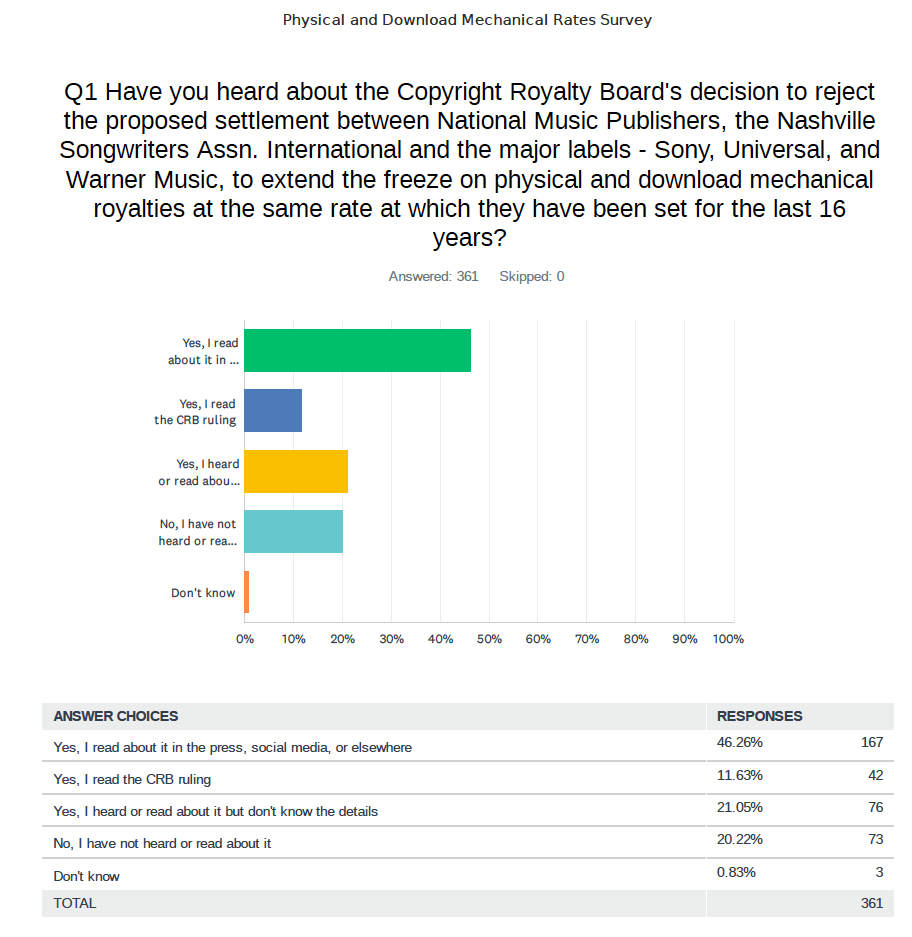
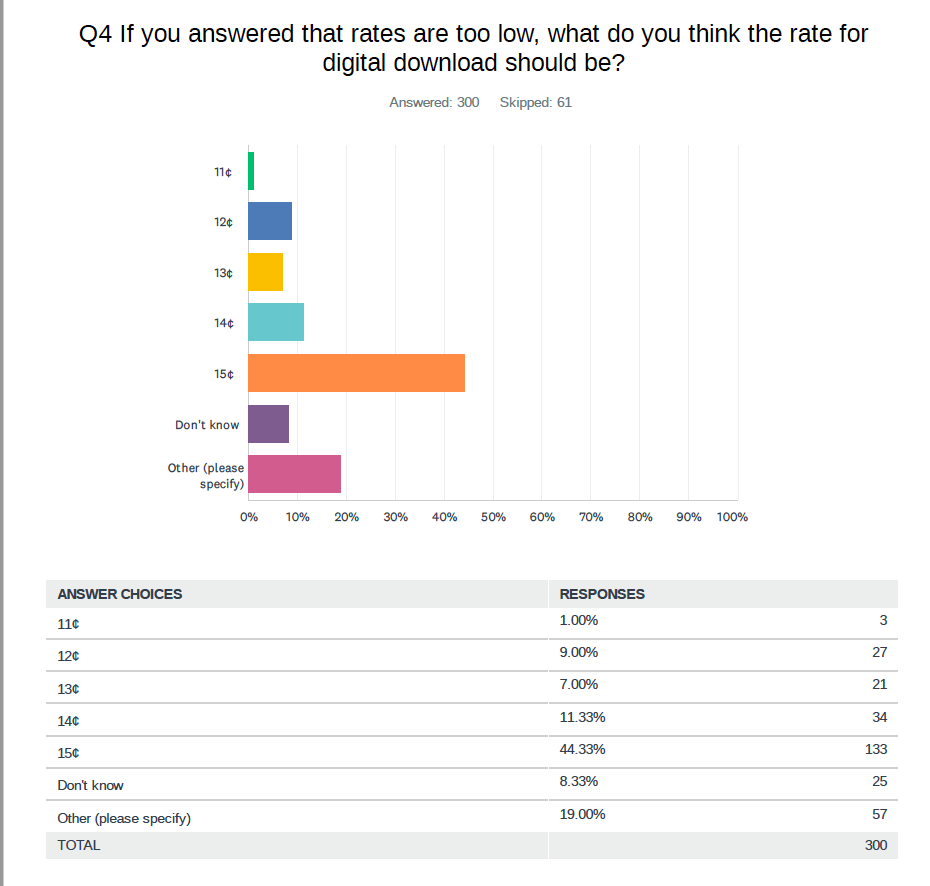
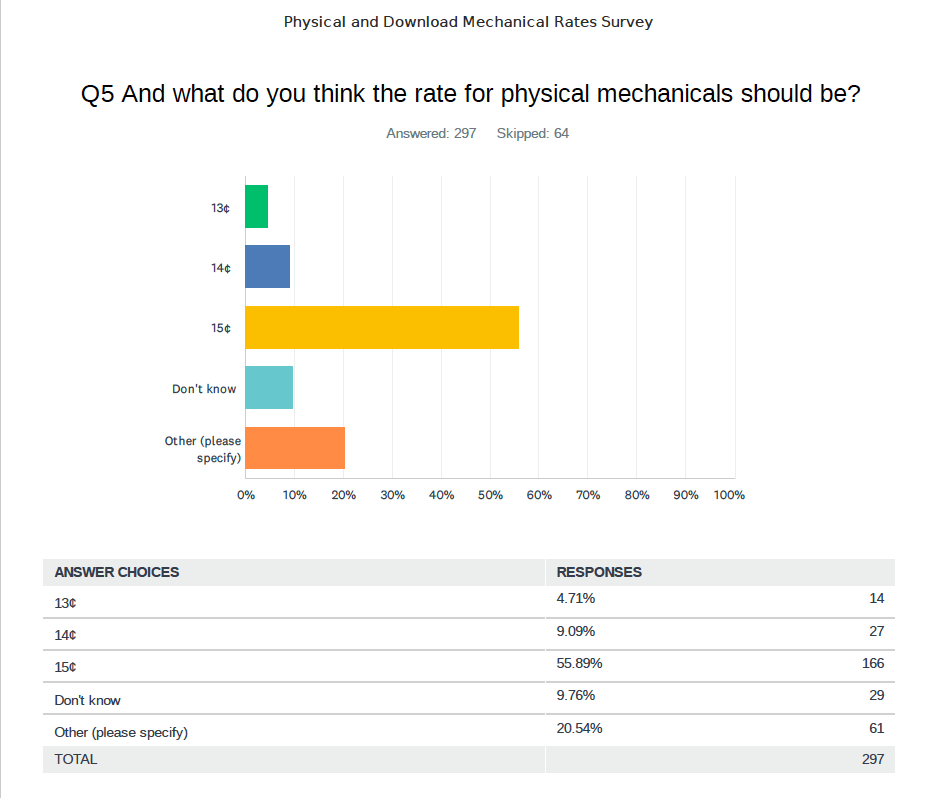
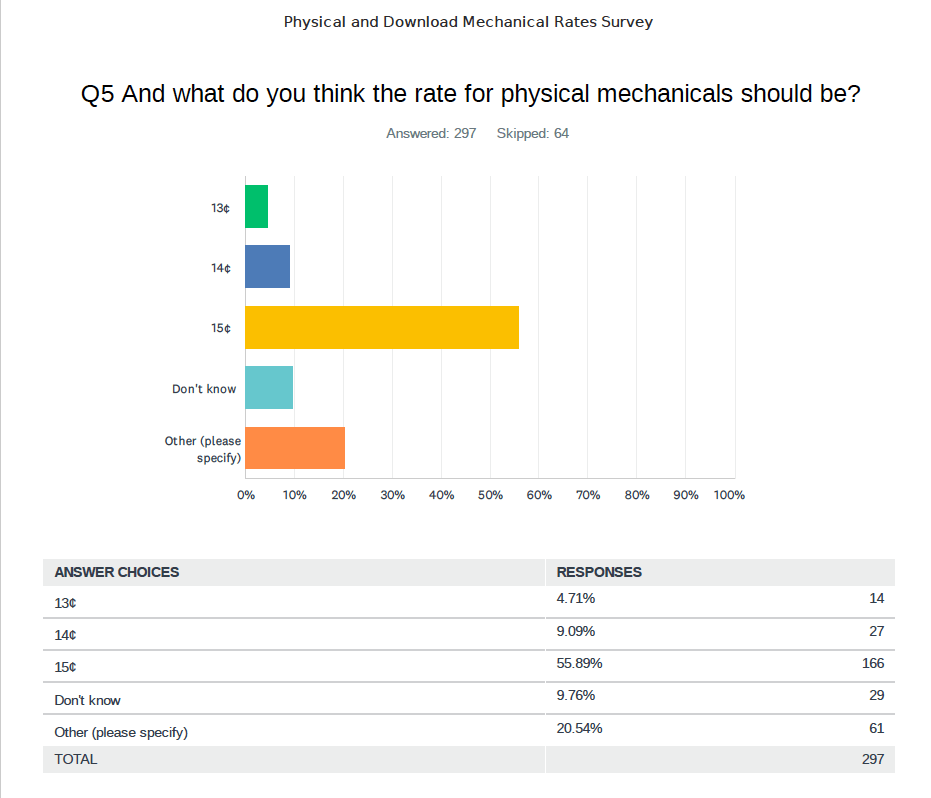
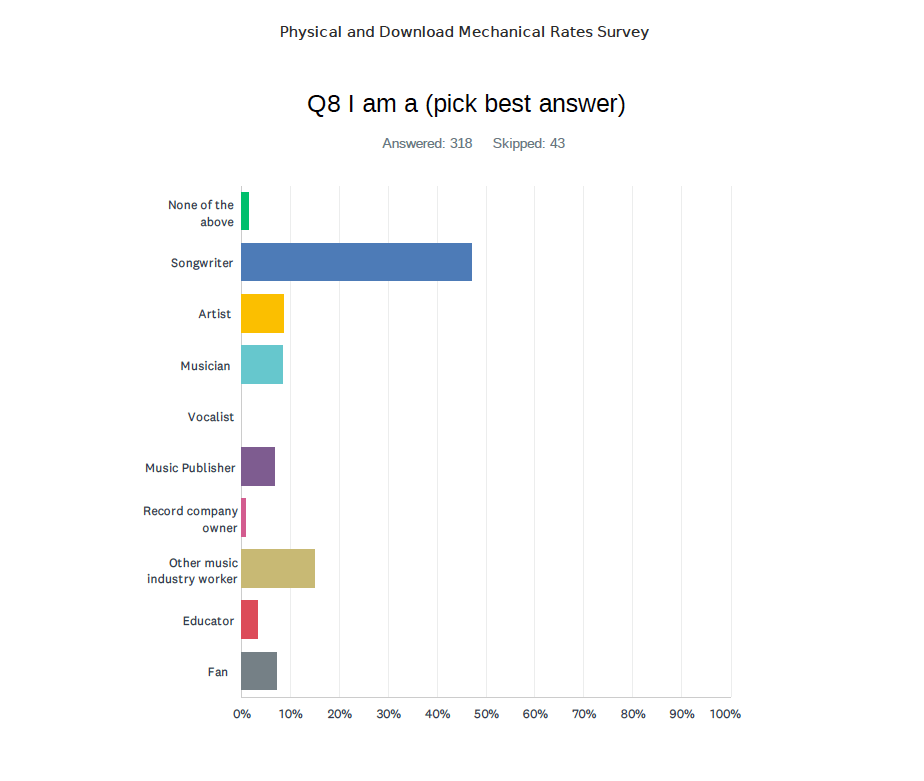
Many readers participated in the Physical and Download Mechanical Rates Survey that various organizations have sent to their members over the last few weeks. Here are the results of the main questions for which we had 361 respondents who self-selected their participation. (Other answers included comments which we chose not to publish for privacy reasons.). 

The results suggest that participants were mostly informed songwriters who had never been asked before what they thought about the issues in the Copyright Royalty Board. We would have to conclude that any of our regular readers would be a bit skewed toward knowledgeable because between the Trichordist, MusicTechPolicy, ARW, Hypebot and Celebrity Access we were probably carrying a very high percentage of the available information on the frozen mechanicals issues.

It also is striking how few respondents said they had ever been asked what they think about any mechanical rates (physical, download, streaming), an important and easily measurable issue. This is something to add to the learning from this episode. It may be that our data is skewed, but even so we didn’t expect that 68% would say they’d never even been asked their opinion. An easy way to find out what people think about something is to ask them. 

Please take our physical and download mechanical royalty rates survey and help decide the new rates!

We are participating in a survey being conducted by a number of songwriter groups around the world to ask our readers what you think the new un-frozen mechanical royalty rate should be since the Copyright Royalty Judges rejected the settlement that would have extended the 9.1¢ freeze. Trichordist readers have heard a lot about the frozen mechanicals but after the Judges rejected extending the freeze we have moved on now to a new phase–if the rate isn’t 9.1¢ anymore, what should it be?

This Survey Monkey questionnaire is anonymous and easy to take–3 minutes to complete–and you could really help a lot by giving your opinions on what you think the rate should be! We will post the results so everyone can see.

You can start the survey at this link. Thank you!

Is @UMG coming to the party on unfrozen mechanicals?

By Chris Castle

[This post first appeared on MusicTechPolicy]

I have it on good authority from someone close to the talks not authorized to speak on the record that Universal is taking the lead on solving the now un-frozen mechanicals crisis. This obviously needs to be confirmed and may not be final, but I think it’s well worth posting about.

Recall that the crisis pertains to the so-called “Subpart B” mechanical royalties paid by record companies for permanent downloads, vinyl and compact discs. The mechanical rate has been frozen at 9.1¢ since 2008 and the Copyright Royalty Judges recently rejected a settlement among the NMPA, NSAI, Sony, Universal and Warner to extend the freeze in the Phonorecords IV proceeding. Having rejected the proposed settlement, the next step could be knock down, drop dead, drag out litigation that would, in my view, be totally unnecessary. Or the next step could be the labels and publishers submitting a new proposed settlement and asking for the Judges’ approval. 

Also recall that the Judges hinted at a potential deal they would like to see in their rejection of the proposed settlement that would essentially uplift the current 9.1¢ rate by an inflation factor since the rate was set in 2008, bringing the minimum statutory rate for all “Subpart B” configurations to 12¢ that would be further uplifted by an annual cost of living adjustment based on the Consumer Price Index (CPI-U in this case).

We’ve written about this topic so much that you’re probably sick of hearing about it–but if this source turns out to be correct, it’s a real step in the right direction by Universal taking a leadership role that will no doubt be controversial.

As I understand it, Universal may propose a minimum statutory rate of 10¢ for permanent downloads and 12¢ for both vinyl and CD configurations. All three rates would be adjusted annually by the Consumer Price Index (in a similar way that the Judges just indexed the webcasting royalty in Webcasting V applicable to sound recordings). This rate would apply to all songs–not just to George Johnson–as one would expect.

There’s no way to know at this point today whether all the participants in the Phonorecords IV proceeding will accept these terms, including George Johnson who has held out for a much higher minimum statutory rate. Some may scratch their head over why the download rate is less, but my suspicion is that it’s because Apple and Amazon have been inflexible on increasing the wholesale price and I could understand why a label would give themselves some headroom on downloads going into what will surely be highly inflationary times but at the same time agreeing a cost of living adjustment. (When the dust settles, it may be worth a discussion in the artist rights community about whether to campaign against Apple and Amazon.)

I do think it’s commendable if Universal is taking the first step toward bringing fairness to a process that has been unfair for many years. We’ll see what happens, but it looks like it could be light at the end of the tunnel. Watch this space.