
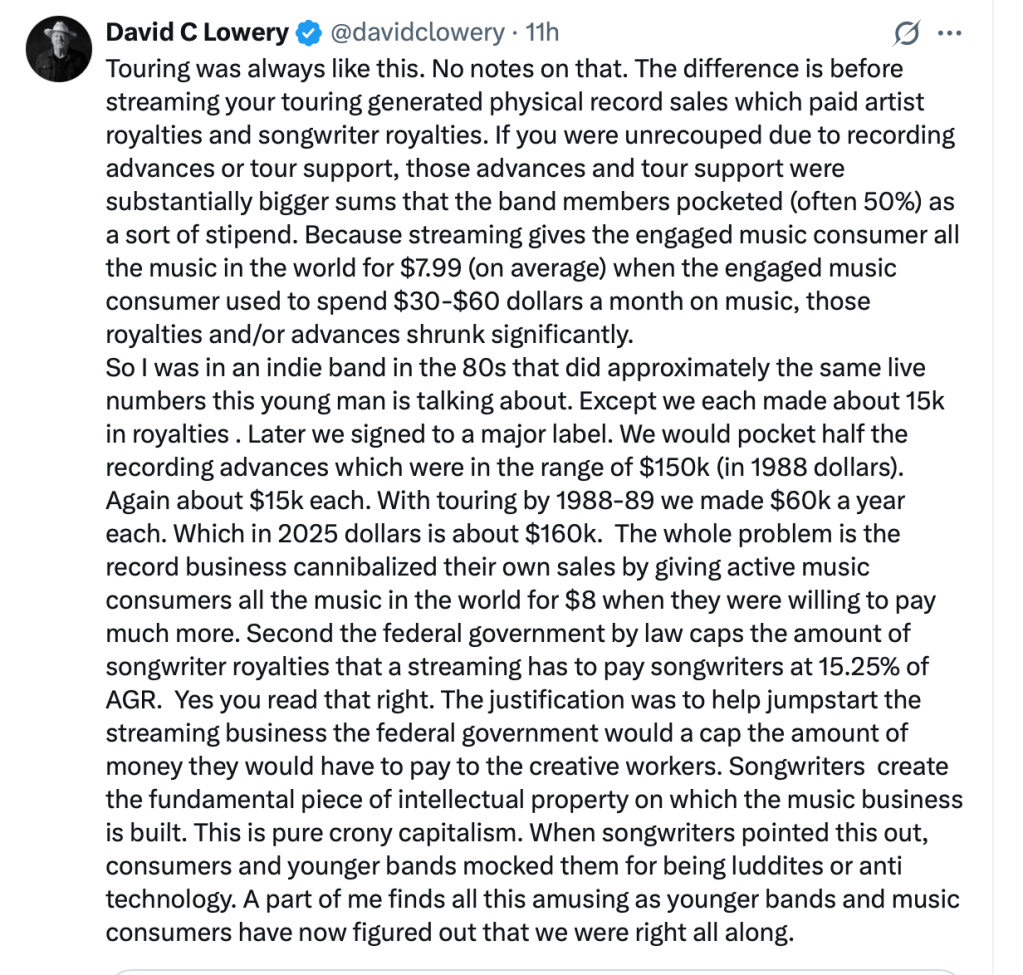
Something to think about during the Spotify earnings call.
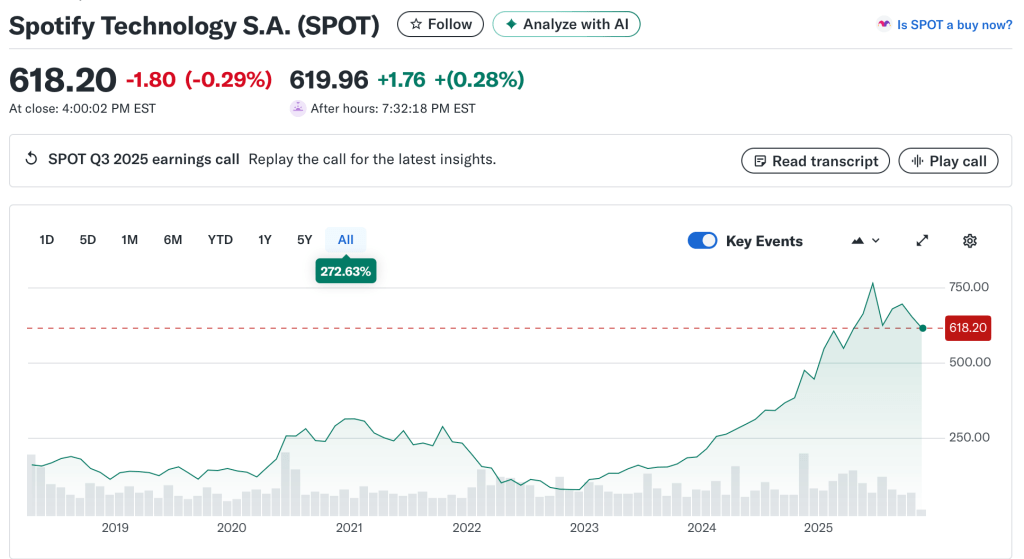
Something to think about during the Spotify earnings call.

Over the summer, a growing group of artists began pulling their catalogs from Spotify—not over miserable and Dickensian-level royalties alone, but over Spotify CEO Daniel Ek’s vast investment in Helsing, a European weapons company. Helsing builds AI-enabled offensive weapons systems that skirt international human rights law, specifically Article 36 of the Geneva Conventions. Deerhoof helped kick off the current wave; other artists (including Xiu Xiu, King Gizzard & the Lizard Wizard, Hotline TNT, The Mynabirds, WU LYF, Kadhja Bonet, and Young Widows) have followed or announced plans to do so.
Helsing is a Munich-based defense-tech firm founded in 2021. It began with AI software for perception, decision-support, and electronic warfare, and has expanded into hardware. The company markets the HX‑2 “AI strike drone,” described as a software‑defined loitering munition intended to engage artillery and armored targets at significant range—and kill people. It emphasizes resilience to electronic warfare, swarm/networked tactics via its Altra recon‑strike platform, and a human in/on the loop for critical decisions, and that limited role for humans in killing other humans is where it runs into Geneva Convention issues. Trust me, they know this.

Beyond drones, Helsing provides AI electronic‑warfare upgrades for Germany’s Eurofighter EK (with Saab), and has been contracted to supply AI software for Europe’s Future Combat Air System (FCAS). Public briefings and reporting indicate an active role supporting Ukraine since 2022, and a growing UK footprint linked to defense modernization initiatives. In 2025, Ek’s investment firm led a major funding round that valued Helsing in the multibillion‑euro range alongside contracts in the UK, Germany, and Sweden.
So let’s be clear—Helsing is not making some super tourniquet or AI medical device that has a dual use in civilian and military applications. This is Masters of War stuff. Which, for Mr. Ek’s benefit, is a song.
For these artists, the issue isn’t abstract: they see a direct line between Spotify‑generated wealth and AI‑enabled lethality, especially as Helsing moves from software into weaponized autonomy at scale. That ethical conflict is why exit statements explicitly connect Dickensian streaming economics and streamshare thresholds to military investment choices. In fact, it remains to be seen whether Spotify itself is using its AI products and the tech and data behind them for Helsing’s weapons applications.
There’s no official tally. Reporting describes a wave of departures and names specific acts. The list continues to evolve as more artists reassess their positions.
For Spotify, a handful of indie exits barely moves the needle. The reason is the pro‑rata or “streamshare” payout model: each rightsholder’s share is proportional to total streams, not a fixed per‑stream rate except if you’re “lucky” enough to get a “greater of” formula. Remove a small catalog and its share simply reallocates to others. For artists, leaving can be meaningful—some replace streams with direct sales (Bandcamp, vinyl, fan campaigns) and often report higher revenue per fan. But at platform scale, the macro‑economics barely budge.
Of course because of Spotify’s tying relationships with talent buyers for venues (explicit or implicit) not being on Spotify can be the kiss of death for a new artist competing for a Wednesday night at a local venue when the venue checks your Spotify stats.
Two practices make artist exits feel symbolically loud but structurally quiet—and they’re exactly what frontier AI should avoid:
1) Revenue‑share pools with opaque rules. Pro‑rata “streamshare” pushes smaller players toward zero; any exit just enriches whoever remains. AI platforms contemplating rev‑share training or retrieval deals should learn from this: user‑centric or usage‑metered deals with transparent accounting are more legible than giant, shifting pools.
2) NDA‑sealed terms. The streaming era normalized NDAs that bury rates and conditions. If AI deals copy that playbook—confidential blacklists, secret style‑prompt fees, unpublished audit rights—contributors will see protest as the only lever. Transparency beats backlash.
3) Weapons Related Use Cases for AI. We all know that the frontier labs like Google, Amazon, Microsoft and others are all also competing like trained seals for contracts from the Department of War. They use the same technology trained on culture ripped off from artists to kill people for money.
• HX‑2 AI Strike Drone: beyond‑line‑of‑sight strike profile, on‑board target re‑identification, EW‑resilient, swarm‑capable via Altra; multiple payload options; human in/on the loop.
• Eurofighter EK (Germany): with Saab, AI‑enabled electronic‑warfare upgrade for Luftwaffe Eurofighters oriented to SEAD/DEAD roles.
• FCAS AI Backbone (Europe): software/AI layer for the next‑generation air combat system under European procurement.
• UK footprint: framework contracting in the UK defense ecosystem, tied to strike/targeting modernization efforts.
• Ukraine: public reporting indicates delivery of strike drones; company statements reference activity supporting Ukraine since 2022.
Whether you applaud or oppose war tech, the ethical through‑line in these protests is consistent: creators don’t want their work—or the wealth it generates—financing AI (especially autonomous) weaponry. Because the platform’s pro‑rata economics make individual exits financially quiet, the conflict migrates into public signaling and brand pressure.
• Opt‑in, auditable deals for creative inputs to AI models (training and RAG) with clear unit economics and published baseline terms.
• User‑centric or usage‑metered payouts (by contributor, by model, by retrieval) instead of a single, shifting revenue pool.
• Public registries and audit logs so participants can verify where money comes from and where it goes.
• No gag clauses on baseline rates or audit rights.
The strike against Spotify is about values as much as value. Ek’s bet on Helsing—drones, electronic warfare, autonomous weapons—makes those values impossible for some artists to ignore. Thanks to the pro‑rata royalty machine, the exits won’t dent Spotify’s bottom line—but they should warn AI platforms against repeating the same opaque rev‑shares and NDAs that leave creators feeling voiceless in streaming.


@nickgillespie and @davidclowery: Streaming is a Regulated Monopoly (Reason Magazine/Nick Gillespie)
Spotify’s Royalty Threshold Is Conscious Parallelism Reshaping the Music Business—But Not in a Good Way (The Trichordist/Chris Castle)
Controversial ruling on US termination right fulfills the intention of Congress, say creators (Complete Music Update/Chris Cooke)
AI Frontier Labs and the Singularity as a Modern Prophetic Cult (MusicTech.Solutions/Chris Castle)
America Isn’t Ready for the Wars of the Future (Foreign Affairs/GEN Mark Milley and Eric Schmidt)
Spotify CEO Daniel Ek Named Chairman of Military AI Firm Following €600M Investment (Playy Magazine)
Eric Schmidt Is Building the Perfect AI War-Fighting Machine (Wired/Will Knight)
Souls for Sale: The Long Con Behind AI Weapons and Cultural Complicity (MusicTechPolicy/Chris Castle)
Eric Schmidt-led panel pushing for new defense experimentation unit to drive military adoption of generative AI(Defense Scoop/Brandi Vincent)
The Lords of War: Daniel Ek, Eric Schmidt and the Militarization of Tech (MusicTechPolicy/Chris Castle)
Daniel Ek is indifferent to whether the economics of streaming causes artists to give up or actually starve to actual death. He’s already got the tracks and he’ll keep selling them forever like an evil self-licking ice cream cone.

Kate Nash is the latest artist to slam Spotify’s pathetic royalty payments even after the payola and the streaming manipulation with the Orwellian “Discovery Mode” as discovered by Liz Pelly. According to Digital Music News, Kate Nash says:
“‘Foundations’ has over 100 million plays on Spotify — and I’m shocked I’m not a millionaire when I hear that! I’m shocked at the state of the music industry and how the industry has allowed this to happen,” said Nash. “We’re paid very, very, very poorly and unethically for our recorded music: it’s like 0.003 of a penny per stream. I think we should not only be paid fairly, but we should be paid very well. People love music and it’s a growing economy and there are plenty of millionaires in the industry because of that, and our music.”
But then she said the quiet part out loud that will get them right in their Portlandia hearts:
She added: “And what they’re saying to artists from non-rich privileged backgrounds, which is you’re not welcome here, you can’t do this, we don’t want to hear from you. Because it’s not possible to even imagine having a career if you don’t have a privileged background or a privileged situation right now.”
This, of course, comes the same time that Spotify board members have cashed out over $1 billion in stock including hundreds of millions to Daniel Ek personally, speaking of privilege.

Spotify responds with the same old whine that starts with the usual condescending drivel, deflection and distraction:
“We’re huge fans of Kate Nash. For streams of her track ‘Foundations’ alone — which was released before Spotify existed — Spotify has paid out around half a million pounds in revenue to Kate Nash’s rights holders,” reads Spotify’s statement.
“Her most streamed songs were released via Universal Music Group. Spotify has no visibility over the deals that Kate signed with her rights holders. Therefore, we have no knowledge of the payment terms that were agreed upon between her and her partners.”
This is a very carefully worded statement–notice that they switch from the specific to the general and start talking about “her rights holders”. That means no doubt that they are including the songwriters and publishers of the compositions, so that’s bullshit for starters. But notice how they are making Kate’s own argument here by trying to get you to focus on the “big check” that they wrote to Universal.
Well, last time I checked in the world of arithmetic, “around half a million pounds” (which means less than, but OK) divided by 100,000,000 streams is…wait for it…shite. £0.005 per stream–at the Universal level but all-in by the sound of it, i.e., artist share, label share, songwriters and publishers. This is why Spotify is making Kate’s argument at the same time they are trying to deflect attention onto Universal.
Then–always with an eye on the DCMS authorities in the UK and the UK Parliament, Spotify says:
“We do know that British artists generated revenues of over £750 million on Spotify alone in 2023 — a number that is on the rise year on year — so it’s disappointing to hear that Spotify’s payments are not making it through to Kate herself,” the company concluded.
Oh, so “disappointed.” Please spare us. What’s disappointing is that the streaming services participate in this charade where their executives make more in one day of stock trading than the company’s entire payments to UK artists and songwriters.
This race to the bottom is not lost on artists. Al Yankovic, a card-carrying member of the pantheon of music parodists from Tom Leher to Spinal Tap to The Rutles, released a hysterical video about his “Spotify Wrapped” account.
Al said he’d had 80 million streams and received enough cash from Spotify to buy a $12 sandwich. This was from an artist who made a decades-long career from—parody. Remember that–parody.
Do you think he really meant he actually got $12 for 80 million streams? Or could that have been part of the gallows humor of calling out Spotify Wrapped as a propaganda tool for…Spotify? Poking fun at the massive camouflage around the Malthusian algebra of streaming royalties gradually choking the life out of artists and songwriters? Gallows humor, indeed, because a lot of artists and especially songwriters are gradually collapsing as the algebra predicted.
The services took the bait Al dangled, and they seized upon Al’s video poking fun at how ridiculously low Spotify payments are to make a point about how Al’s sandwich price couldn’t possibly be 80 million streams and if it were, it’s his label’s fault. Just like Spotify is blaming Universal rather than take responsibility for once in their lives.
Nothing if not on message, right? As Daniel Ek told MusicAlly, “There is a narrative fallacy here, combined with the fact that, obviously, some artists that used to do well in the past may not do well in this future landscape, where you can’t record music once every three to four years and think that’s going to be enough.” This is kind of like TikTok bragging about how few children hung themselves in the latest black out challenge compared to the number of all children using the platform. Pretty Malthusian. It’s not a fallacy; it’s all too true.
I’d suggest that Al and Kate Nash were each making the point–if you think of everyday goods, like bacon for example, in terms of how many streams you would have to sell in order to buy a pound of bacon, a dozen eggs, a gallon of gasoline, Internet access, or a sandwich in a nice restaurant, you start to understand that the joke really is on us. The best way to make a small fortune in the streaming business is to start with a large one. Unless you’re a Spotify executive, of course.


THANK YOU, Justine Bateman.
Also read Associated Press “Former Bytedance executive says Chinese Communist Party tracked Hong Kong protesters via data” (Bytedance is the parent company of TikTok.)
Spotify follows bidding of tyrannical Chinese Communist Party while long time Hong Kong freedom fighter Jimmy Lai rots in prison after show trial.
[Chris sez: It is not enough for a Silicon Valley company to have a good idea or a compelling product or service. No, no–like Elizabeth Holmes the convicted felon, or Google, who probably should be convicted felons, these people have to convince themselves that they are saving the world. Literally. This is true no matter how ordinary their accomplishments.
Like the self-hypnotist, they convince themselves that their powers of commerce are transcendent and otherworldly. History begins with them. Never should their revelatory accomplishments be compared to building a better mousetrap.
Spotify is no different, and they will damn well prove that their mission statement has no less than the predictive power of the oracle of Balaam. But of course they fail, flesh and blood being what it is in this time before the Singularity.
Tim Ingham fries up Spotify’s “mission statement” in this must read expose. (Read the post on Music Business Worldwide.) But realize this–you can rest assured that if Daniel Ek didn’t write this claptrap himself, he definitely must have approved it. So if you ever wondered whether Ek had a grip on reality, it appears that his grip is weak. But you know, in the beginning was the word, et cetera, et cetera.]
In Spotify’s words, Loud & Clear exists for one reason above any other: “[To] provide a valuable foundation for a constructive conversation”.
Thing is, it’s not the surface-level data on Loud & Clear – the data that Spotify wants you to pay attention to – that makes for the most “constructive conversation” about the music industry and where it’s headed.
To get to the good stuff, you’ve got to dig a little deeper than that….
Taken at face value, these figures point to the ever-widening base of artists earning decent payouts from the world’s largest subscription streaming platform.
Spotify obviously likes that narrative a lot. As its Loud & Clear site boasts: “More artists are sharing in today’s thriving music economy compared to the peak of the CD era.”
Thing is, any half-credible analysis of these numbers has to take into account how they’ve changed over time.
And when we start treading this path, these figures begin to take on a different nature – one that flies in the face of Spotify’s wonderfully earnest, but laughably silly, mission statement.
[From ArtistRightsWatch: Editor Charlie sez: There are no words for the arrogance.]
Speaking on the company’s fourth quarter earnings call, Ek said certain mistakes were made after the company heavily invested in high-growth areas like podcasts, telling investors: “I probably got a little carried away and over-invested.”
Ek, who called out a shaky macroeconomic environment, emphasized the company will be tightening investments in 2023 across the board as the music streaming giant doubles down on streamlining efficiencies “with greater intensity.”
Read the post on Yahoo! Finance
Judge Trauger rejected Spotify’s theory of privilegium regale that would have protected Daniel Ek from being deposed in the Eight Mile Style case against Spotify and the Harry Fox Agency. His Danielness will now have to submit to deposition testimony under oath in the case that seeks to show Spotify failed to comply with their Title I of the Music Modernization Act as drafted by Spotify’s lobbyists and the regulations overseen by Spotify’s head DC government relations person.
The Judge ruled that Spotify was pushing a theory that the relevant rules applicable to the deposition should be more deferential to high level executives. As a matter of law. That hasn’t been true since Magna Carta. (In 1215 for those reading along at home.)
Oopsie.
Needless to say but I’ll say it, it will be an absolute side splitter if Spotify ends up losing the safe harbor they drafted into US Copyright Law to protect themselves from songwriters seeking justice. And then there’s the HFA issue–you know, the ones that are backend for the MLC that can’t match $500,000,000 of other people’s money.
Stay tuned kids.
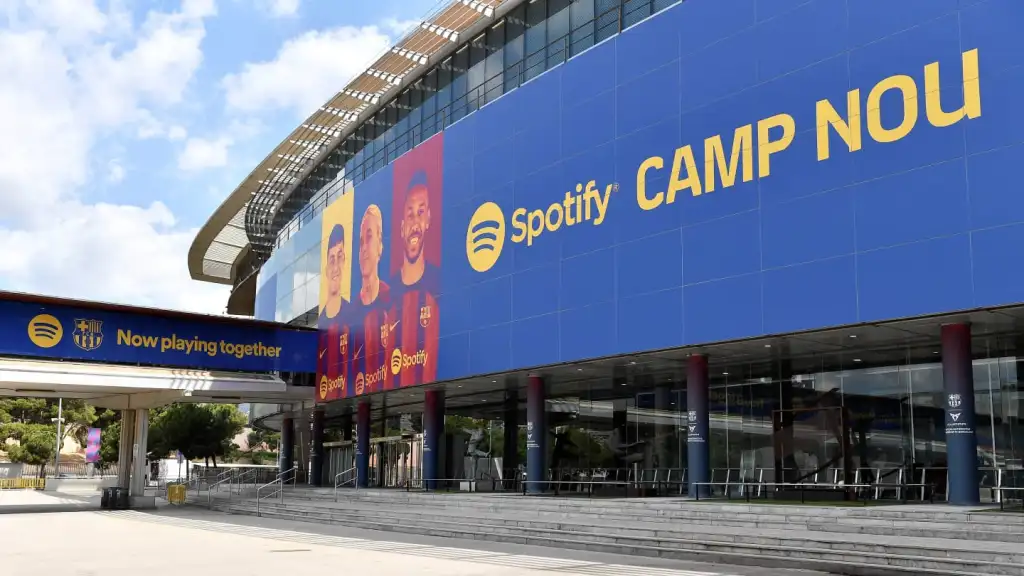
As we reported February 9, Spotify is using hundreds of millions of its supernormal stock market riches to acquire naming rights to the Barcelona soccer team. The latest manifestation of Daniel Ek’s monopolist edifice complex was confirmed by Music Business World Wide and Variety among others, as well as Spotify itself. Barcelona’s iconic Camp Nou stadium (largest football stadium in Europe) will now be known as Spotify Camp Nou.
I assume that when Netflix finds out about this, there will be an epilogue to their Edward Bernays-style epic corporate biopic that will ignore the Rogan catastrophe but will include the Barcelona deal with a tight shot on the Spotify Camp Nou and probably a t-shirt vendor.
Let us take one clear message from this navel-gazing naming-rights deal to assuage Daniel Ek’s psyche after a losing bid to acquire the Arsenal football club and join the International League of Oligarchs. That message is that we don’t ever want to hear again about how Spotify “can’t make a profit” or “pays out too much money for music.” Daniel Ek–who controls the company through his super voting stock–has been running that diversion play for way too long and it’s just as much BS spewing from his mouth as it is any of the Silicon Valley oligarchs who whinge about how poor they are when they appear in court.
Let us also agree that anyone who takes a royalty deal from any DSP that does not include an allocation for stock valuation is quite simply a rube who must be laughed at and mocked in the Spotify board room. This stock value allocation doesn’t require a grant of shares, but can include a dollar contribution that tracks share value and should be paid directly to both featured artists, session musicians and vocalists through their collective rights organizations on a nonrecoupment basis.
But don’t let me describe the bullshit, read it yourself directly from Spotify’s “Chief Freemium Business Officer” whatever the hell that means:
“We could not be more thrilled to be partnering with FC Barcelona to bring the worlds of Music and Football together. From July, our collaboration will offer a global stage to Artists, Players and Fans at the newly-branded Spotify Camp Nou. We have always used our marketing investment to amplify Artists and this partnership will take this approach to a new scale. We’re excited to create new opportunities to connect with FC Barcelona’s worldwide fanbase.
Spotify’s mission is to unlock the potential of human creativity, supporting artists to make a living off their art and connecting with fans. We believe this partnership creates many opportunities to deliver on this mission in unique, imaginative, and impactful ways.”
Yes, that’s right. Daniel Ek’s edifice complex is all about unlocking the potential of human creativity because it’s all for the artists, don’t you know.
These people continue to embarrass themselves with their insufferable 1999er BS without realizing that any artist whose name shows up on a single Barcelona jersey will extract a considerable additional payment that the artist will keep and the labels won’t save Spotify on that one. Even if they do, there are only certain artists who don’t mind their names appearing on Barcelona jerseys–for a price. The overwhelming majority will not only not want it but are insulted that the “Chief Freemium Business Officer” is so ignorant of their name and likeness rights that he would even remotely float the idea that Spotify had the right to do anything like that level of grift.
If Mr. Freemium is really serious about “supporting artists to make a living off their art”, forego the edifice stroke and just pay that money directly to featured artists, session folk, and songwriters that have made him rich. Until then, he should just say you’re damn right we used the stockholders money to soothe Daniel Ek’s wounded ego because he desperately wants to be accepted by the Party of Davos and the League of Extraordinary Dweebs. Because we’ve already established what kind of people they are, it’s just a question of negotiating the price.
But let’s face it–what the monopolist really wants is a branded Monopoly game.

 The Trichordist
You must be logged in to post a comment.