Weekly Recap Sunday September 16, 2012

Grab the coffee!

Recent Posts:
* Safe Harbor Not Loophole: Five Things We Could Do Right Now to Make the DMCA Notice and Takedown Work Better

Beck’s new album, you provide the labor!
Beck is a genius in choosing to release his new album as sheet music only. The implications of this gesture touch upon many of the current issues that musicians face from respect for their labor to addressing the illegal exploitation of their work and internet piracy. Critics of the story in Forbes by Will Burns don’t get it. Yes, Beck did not invent sheet music. And, we all know that sheet music can be pirated as easily as the music itself, if not more so. But the implications here are greater in the commentary of the act itself. If you want to hear the music from Beck’s new album you can either 1) invest your own labor and play/record it yourself and/or 2) you can buy a ticket to see him on tour. The irony of this gesture is lost on most. We often hear from critics that musicians pine for a return to the 90’s, an age of the past prior to the internet when things were different. What is truly astounding is that those same critics want to return artists and musicians to the 90s themselves… the 1890s. Beck’s unique and thoughtful commentary on our times is an acknowledgement of the current reality for musicians. You can pre-order his new album [here].

Google Pro-Artist Policy Changes Challenge Allegations of “Net Censorship”
In the latest in a series of practices Google removes “Pirate Bay” from auto complete. There is a saying that the journey of a thousand miles begins with but one step, and Google has begun to take that journey. These moves should be celebrated by artists, musicians and creators – however we’d suggest some cautious optimism given Google’s history of appearances over actual meaningful change. None the less, this recent move can’t be seen as anything less than positive.

In addition to this latest change, Google has:

1) Created a (relatively) easy to use web form for de-listing up 10,000 infringing links from Google Search in just one DMCA notice.

2) Begun to drop the rankings of sites identified as predominantly dedicated to infringing activity (as determined by the volume of accurate DMCA notices for de-listing).

3) Providing Content Management System (CMS) tools to individual artists, musicians, filmmakers and creators on YouTube.

The most important thing to take away from all of this is that these policies reinforce what we have always said, reducing online piracy is a question of will not capability. As Google implements more of these policies the shallow talking points of the freehadists become more diminished. Online piracy is about free beer, not free speech and we applaud Google for these early and hopefully meaningful baby steps towards an Ethical and Sustainable Internet for all citizens. And uhm, no Torrent Freak, it’s not censorship… let the screaming begin…

The other side of “Disruptive Technology” and “Permissionless Innovation”
Perhaps we’d be indulging in a little to much of wearing a tin foil hat as to suggest that the YouTube glitch effecting Michelle Obama’s DNC speech was somehow calculated, but you never know, right? We find it amusing that when “Disruptive Technology” and “Permissionless Innovation” are employeed to protect the rights of artists the amount of outrage there is to “control the machines.” But aren’t these the same machine and bots that we’ve been told repeatedly over the past decade can not be controlled by humans? That they are too complex to be managed? Well, funny how the shoe in on the other foot. The truth is pretty simple, the YouTube Content Management System flags content that has been claimed by rights holders. No doubt someone between Google, The DNC and YouTube could have easily preemptively waived those claims prior to broadcast. As with all the alleged complexities of the technological age of the internet the simplest answer is usually the most accurate one, human error, not rouge machines.

But it’s only Bits? The carbon footprint of free…
Unfortunately all of that allegedly free music could have a larger carbon footprint than CDs. Although this article from Paid Content specifically comments on streaming content, there is a large carbon footprint across the entire digital ecosystem. Anyone who thinks that Media Piracy has almost no cost isn’t paying the electric bills or maintenance costs to keep a server farm up and running. These costs specifically illustrate how the exploitation economy works. The internet does not operate on fairy dust, it does in fact require capital. We’ve heard it said, denial is not just a river in Egypt. There’s even a carbon footprint to spam. So the next time someone mentions that the internet is a post-scarcity economy, they might want to rethink that… and review this piece from Harper’s on “Google’s Addiction to Cheap Electricity.”

And finally, check out the Arts & Labs Podcast with David Lowery.

Dear American Express: Stop advertising on sites that illegally exploit my music.

Dear American Express:

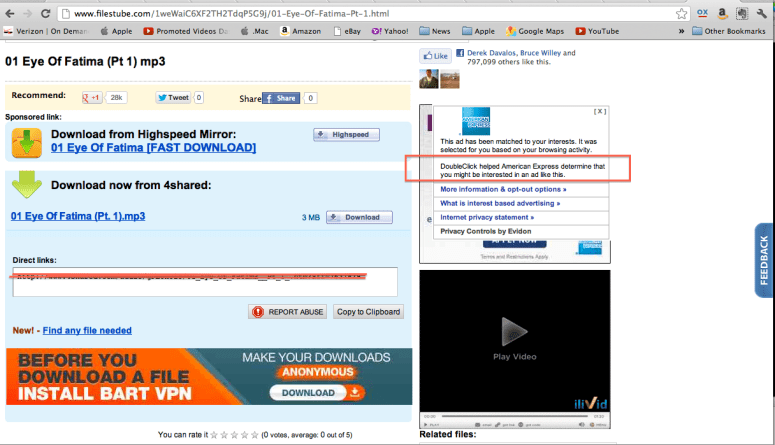
I write you today to ask why your ads are appearing on top rogue sites such as http://www.filestube.com? Sites like these are for-profit enterprise level organizations often with ties to organized crime. Sites like these appear to profit by illegally exploiting artists copyrights and monetizing their web traffic through advertising. Yes, advertising bought and paid for by American Express.

This is not an obscure site. Its Alexa ranking shows that it is one of the most popular websites in the world. I realize that you probably did not intend to have your ads appear on this site. However, I still hold you accountable for not properly auditing your advertising agency  Olgilvy & Mather  and your ad network DoubleClick. It should be noted that this site also links to some pretty prurient, possibly illegal videos; it’s entirely possible that I won’t be the only one holding you accountable.

I’m told that advertising agencies often hire companies to verify that their clients’ ads are being served to the approved websites. I am here to tell you that from what I have seen, these services are incompetent or worse. We have plenty of screenshots and source code showing major brands that surely use these services, advertising on illegal sites. (We’d be glad to share some of these screenshots and source code with you.)

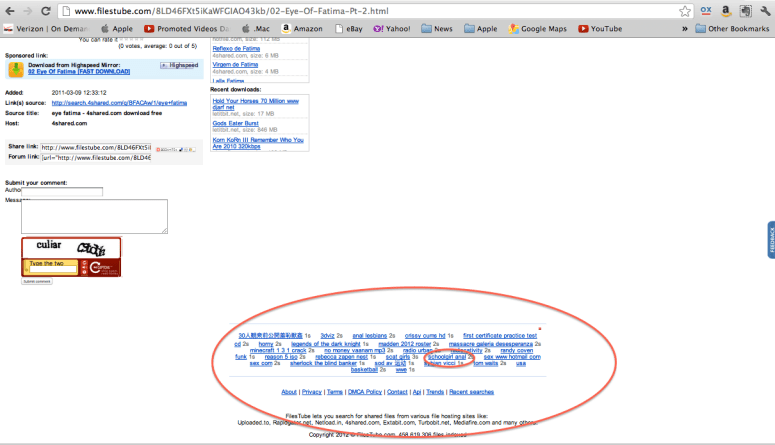
Here are screenshots that show an American Express advertisement on http://www.filestube.com apparently served by DoubleClick. This isn’t abstract to me–this page is a link to an illegal download of one of my songs. You should also note some of the other “suggested” searches on this same site are for some pretty nasty stuff.  I don’t like having my brand seen in these places and I’m sure you don’t either.

I suggest you do something I can’t do–audit everyone involved in this process . What’s the worse thing that could happen? Your brand not appearing on sketchy sites next to links to pornography?

Now that’s priceless.

The Trichordist Random Reader Weekly News & Links Sun Jul 15th

Grab the coffee!

This past (two) weeks posts on The Trichordist:
* Declaration Of Free Milk and Cookies
* CopyLike.Org – It’s Not Stealing, Are You Sure?
* Musician’s POV: Five Things Spotify (and others) Could Do Today to Level the Playing Field for Independent Artists
* Second Nyan Cat Award Goes To The Fake Thomas Jefferson And His Copyleft Creators
* PETm : People For The Ethical Treatment Of Musicians
* The Return of Orphan Works: A Review of the 2008 Shawn Bentley Orphan Works Act Part 1

The attempt for another land grab of creators rights is brewing again, this time in the UK. The video below is an introduction and explanation to get you up to speed. More in depth reporting from Music Tech Policy at the link below: http://musictechpolicy.wordpress.com/2012/07/15/history-of-orphan-works-legislation-corporate-theft-video/

DEADLINE FOR COMMENTS : Wednesday July 25 @ 5PM EST
Artists, Musicians, Creators – U.S. Intellectual Property Enforcement Coordinator Victoria Espinel is asking for you to “Help Us Shape Our Strategy for Intellectual Property Enforcement.” You can comment directly at this link:
http://www.regulations.gov/#!submitComment;D=OMB-2012-0004-0002

We’re very encouraged to see ethical practices by some corporate citizens. PayPal puts on the white hat in support of artist and creators right, denies payments to “File Hosting” site operators, Torrent Freak Reports:
http://torrentfreak.com/paypal-bans-major-file-hosting-services-over-piracy-concerns-120710/
Related from Torrent Freak:
http://torrentfreak.com/paypal-bans-bittorrent-friendly-vpn-provider-120622/
Could these policy changes be the result of one man? Torrent Freak Reports:
http://torrentfreak.com/one-man-army-on-a-mission-to-destroy-the-cyberlocker-market-120705/

Uh Oh… CNET Is Now Facing Hundreds of Millions In Piracy Infringement Penalties… Digital Music News Reports:
http://www.digitalmusicnews.com/permalink/2012/120714cnet

Why copyright matters. Beginning in 2013 individual artists become illegible to regain ownership of their masters via termination of transfer of copyrights. This issue alone illustrates the value of copyright to all musicians.
http://www.forbes.com/sites/richardbusch/2012/06/12/the-battle-over-copyright-termination-and-the-first-round-goes-to/

Forbes reports on Google’s Piracy Liability. Essential Reading:
http://www.forbes.com/sites/scottcleland/2011/11/09/googles-piracy-liability/

Google misled consumers about their privacy, the FTC’s investigation shows. Google may have to pay $22m fine, Ars Technica Reports:
http://arstechnica.com/tech-policy/2012/07/google-may-pay-22-5-million-penalty-for-ignoring-safari-do-not-track/

Fascinating post from 1709 Blog challenges the ISP “Dumb Pipe” and DMCA qualification as such. Contextual Advertising is based on informed knowledge of user behavior, hardly “dumb pipe.” Read more at 1709 Blog (which should be on your blogroll as well!):
http://the1709blog.blogspot.com/2012/07/mere-conduits-dumb-pipes-think-again.html

David Lowery interviewed by Andrew Orlowski in the UK’s Register, “Lowery: The blue-collar musician at the eye of the copyright storm.”
http://www.theregister.co.uk/2012/07/08/david_lowery_interview/

Copyright Alliance reports on the artists appearing and supporting the Trans Pacific Partnership which protects IP and Artists Rights:
http://blog.copyrightalliance.org/2012/07/no-two-artists-are-alike-2/

The Trichordist Random Reader Weekly News & Links Sun Jun 24

Grab the coffee!

We are humbled and overwhelmed as without a doubt the biggest story of the week for Artists was the debate inspired by David Lowery’s “Letter To Emily” in response to a post by an intern at NPR’s “All Songs Considered.” What followed was an out pouring of support by musicians, artists, creators of all kinds and music fans. We are grateful to everyone who took the time to read David’s thoughtful words, discuss, retweet and repost on Facebook. In a few short days the voice of artists sharing the response resulted in attention from major media news outlets such as Time Magazine, USA Today, The LA Times, The NY Times, MSNBC, Forbes and countless others. The point is not so much whether these outlets agreed or disagreed with David in part or in whole, but rather that the voice of artists uniting on the issue of fair compensation became unavoidable as a mainstream topic of conversation. Probably our favorite report of the week came from Digital Music News who stated, “Our Digital Innocence Just Died. And David Lowery Killed It…“.

We also want to thank all of the artists who also spoke their minds in the comments, Tweets and other posts.  We want to continue to support you and invite you to suggest posts if you’d like to write on the Trichordist as many of you have.

Of course there were some who disagreed, but that’s why it’s called debate, right? At least this time both sides were heard.  Although we had no idea that so many of you guys would pass it forward to your friends and fans—hundreds and hundreds of thousands of you—we were really impressed by your efforts and the overwhelmingly positive support you gave to David.

MORE NEWS!

Hypebot and WhoSampled present information and an inforgraphic on 30 years of Sampling which appears to directly contradict claims made by anti-artists rights groups about the benefits of innovation in copyright when all stakeholders are compensated fairly.
http://www.hypebot.com/hypebot/2012/06/stats-and-figures-on-30-years-of-sampling-infographic.html

Interesting reports from Japan passing a law that would jail illegal downloaders:
http://www.huffingtonpost.com/2012/06/22/japan-passes-jail-for-dow_n_1618479.html

Pirates really don’t like going to Jail…
http://www.forbes.com/sites/parmyolson/2012/06/21/pirate-bay-founders-pin-their-hopes-on-human-rights-court/

Pirates and Jail part two… Appears that Judge in Germany favors Fair and Ethical Internet:
http://www.hollywoodreporter.com/news/kinoto-founder-dirk-b-jailed-337795

Digital Music News reports on how Major Advertisers appear to support YouTube Piracy:
http://www.digitalmusicnews.com/permalink/2012/120620video

In related news Hypebot reports Google/YouTube to take legal action against YouTube to MP3 sites:
http://www.hypebot.com/hypebot/2012/06/google-looking-to-shut-down-youtube-to-mp3-conversion-sites.html

Amanda Palmer signs a distribution deal with the Cooking Vinyl Record Label:
http://www.billboard.biz/bbbiz/industry/indies/amanda-palmer-partners-with-u-k-indie-cooking-1007385352.story

Most artists sell less than 100 Downloads per year, probably not what TuneCore and Jeff Price want to hear. Digital Music News reports on the economic reality for most musicians:
http://www.digitalmusicnews.com/permalink/2012/120618download#YPz6TGC-qHVGRC1NdT04lw

Letter to Emily White at NPR All Songs Considered.

Recently Emily White, an intern at NPR All Songs Considered and GM of what appears to be her college radio station, wrote a post on the NPR blog in which she acknowledged that while she had 11,000 songs in her music library, she’s only paid for 15 CDs in her life. Our intention is not to embarrass or shame her. We believe young people like Emily White who are fully engaged in the music scene are the artist’s biggest allies. We also believe–for reasons we’ll get into–that she has been been badly misinformed by the Free Culture movement. We only ask the opportunity to present a countervailing viewpoint.

Emily:

My intention here is not to shame you or embarrass you. I believe you are already on the side of musicians and artists and you are just grappling with how to do the right thing. I applaud your courage in admitting you do not pay for music, and that you do not want to but you are grappling with the moral implications. I just think that you have been presented with some false choices by what sounds a lot like what we hear from the “Free Culture” adherents.

I must disagree with the underlying premise of what you have written. Fairly compensating musicians is not a problem that is up to governments and large corporations to solve. It is not up to them to make it “convenient” so you don’t behave unethically. (Besides–is it really that inconvenient to download a song from iTunes into your iPhone? Is it that hard to type in your password? I think millions would disagree.)

Rather, fairness for musicians is a problem that requires each of us to individually look at our own actions, values and choices and try to anticipate the consequences of our choices. I would suggest to you that, like so many other policies in our society, it is up to us individually to put pressure on our governments and private corporations to act ethically and fairly when it comes to artists rights. Not the other way around. We cannot wait for these entities to act in the myriad little transactions that make up an ethical life. I’d suggest to you that, as a 21-year old adult who wants to work in the music business, it is especially important for you to come to grips with these very personal ethical issues.

I’ve been teaching college students about the economics of the music business at the University of Georgia for the last two years. Unfortunately for artists, most of them share your attitude about purchasing music. There is a disconnect between their personal behavior and a greater social injustice that is occurring. You seem to have internalized that ripping 11,000 tracks in your iPod compared to your purchase of 15 CDs in your lifetime feels pretty disproportionate. You also seem to recognize that you are not just ripping off the record labels but you are directly ripping off the artist and songwriters whose music you “don’t buy”. It doesn’t really matter that you didn’t take these tracks from a file-sharing site. That may seem like a neat dodge, but I’d suggest to you that from the artist’s point of view, it’s kind of irrelevant.

Now, my students typically justify their own disproportionate choices in one of two ways. I’m not trying to set up a “strawman”, but I do have a lot of  anecdotal experience with this.

“It’s OK not to pay for music because record companies rip off artists and do not pay artists anything.” In the vast majority of cases, this is not true. There have been some highly publicized abuses by record labels. But most record contracts specify royalties and advances to artists. Advances are important to understand–a prepayment of unearned royalties. Not a debt, more like a bet. The artist only has to “repay” (or “recoup”) the advance from record sales. If there are no or insufficient record sales, the advance is written off by the record company. So it’s false to say that record companies don’t pay artists. Most of the time they not only pay artists, but they make bets on artists.  And it should go without saying that the bets will get smaller and fewer the more unrecouped advances are paid by labels.

Secondly, by law the record label must pay songwriters (who may also be artists) something called a “mechanical royalty” for sales of CDs or downloads of the song. This is paid regardless of whether a record is recouped or not. The rate is predetermined, and the license is compulsory. Meaning that the file sharing sites could get the same license if they wanted to, at least for the songs. They don’t. They don’t wanna pay artists.

Also, you must consider the fact that the vast majority of artists are releasing albums independently and there is not a “real” record company. Usually just an imprint owned by the artist. In the vast majority of cases you are taking money directly from the artist. How does one know which labels are artist owned? It’s not always clear. But even in the case of corporate record labels, shouldn’t they be rewarded for the bets they make that provides you with recordings you enjoy? It’s not like the money goes into a giant bonfire in the middle of the woods while satanic priests conduct black masses and animal sacrifices. Usually some of that money flows back to artists, engineers and people like you who graduate from college and get jobs in the industry. And record labels also give your college radio stations all those CDs you play.

Artists can make money on the road (or its variant “Artists are rich”). The average income of a musician that files taxes is something like 35k a year w/o benefits. The vast majority of artists do not make significant money on the road. Until recently, most touring activity was a money losing operation. The idea was the artists would make up the loss through recorded music sales. This has been reversed by the financial logic of file-sharing and streaming. You now tour to support making albums if you are very, very lucky. Otherwise, you pay for making albums out of your own pocket. Only the very top tier of musicians make ANY money on the road. And only the 1% of the 1% makes significant money on the road. (For now.)

Over the last 12 years I’ve watched revenue flowing to artists collapse.

Recorded music revenue is down 64% since 1999.

Per capita spending on music is 47% lower than it was in 1973!!

The number of professional musicians has fallen 25% since 2000.

Of the 75,000 albums released in 2010 only 2,000 sold more than 5,000 copies. Only 1,000 sold more than 10,000 copies. Without going into details, 10,000 albums is about the point where independent artists begin to go into the black on professional album production, marketing and promotion.

On a personal level, I have witnessed the impoverishment of many critically acclaimed but marginally commercial artists. In particular, two dear friends: Mark Linkous (Sparklehorse) and Vic Chesnutt. Both of these artists, despite growing global popularity, saw their total  incomes fall in the last decade. There is no other explanation except for the fact that “fans” made the unethical choice to take their music without compensating these artists.

Shortly before Christmas 2009, Vic took his life. He was my neighbor, and I was there as they put him in the ambulance. On March 6th, 2010, Mark Linkous shot himself in the heart. Anybody who knew either of these musicians will tell you that the pair suffered depression. They will also tell you their situation was worsened by their financial situation. Vic was deeply in debt to hospitals and, at the time, was publicly complaining about losing his home. Mark was living in abject squalor in his remote studio in the Smokey Mountains without adequate access to the mental health care he so desperately needed.

I present these two stories to you not because I’m pointing fingers or want to shame you. I just want to illustrate that “small” personal decisions have very real consequences, particularly when millions of people make the decision not to compensate artists they supposedly “love”. And it is up to us individually to examine the consequences of our actions. It is not up to governments or corporations to make us choose to behave ethically. We have to do that ourselves.

++++++++++++++++++++++++++++++++++++++++++++++

Now, having said all that, I also deeply empathize with your generation. You have grown up in a time when technological and commercial interests are attempting to change our principles and morality. Rather than using our morality and principles to guide us through technological change, there are those asking us to change our morality and principles to fit the technological change–if a machine can do something, it ought to be done. Although it is the premise of every “machines gone wild” story since Jules Verne or Fritz Lang, this is exactly backwards. Sadly, I see the effects of this thinking with many of my students.

These technological and commercial interests have largely exerted this pressure through the Free Culture movement, which is funded by a handful of large tech corporations and their foundations in the US, Canada, Europe and other countries.* Your letter clearly shows that you sense that something is deeply wrong, but you don’t put your finger on it. I want to commend you for doing this. I also want to enlist you in the fight to correct this outrage. Let me try to to show you exactly what is wrong. What it is you can’t put your finger on.

The fundamental shift in principals and morality is about who gets to control and exploit the work of an artist. The accepted norm for hudreds of years of western civilization is the artist exclusively has the right to exploit and control his/her work for a period of time. (Since the works that are are almost invariably the subject of these discussions are popular culture of one type or another, the duration of the copyright term is pretty much irrelevant for an ethical discussion.) By allowing the artist to treat his/her work as actual property, the artist can decide how to monetize his or her work. This system has worked very well for fans and artists. Now we are being asked to undo this not because we think this is a bad or unfair way to compensate artists but simply because it is technologically possible for corporations or individuals to exploit artists work without their permission on a massive scale and globally. We are being asked to continue to let these companies violate the law without being punished or prosecuted. We are being asked to change our morality and principals to match what I think are immoral and unethical business models.

Who are these companies? They are sites like The Pirate Bay, or Kim Dotcom and Megaupload. They are “legitimate” companies like Google that serve ads to these sites through AdChoices and Doubleclick. They are companies like Grooveshark that operate streaming sites without permission from artists and over the objections of the artist, much less payment of royalties lawfully set by the artist. They are the venture capitalists that raise money for these sites. They are the hardware makers that sell racks of servers to these companies. And so on and  so on.

What the corporate backed Free Culture movement is asking us to do is analogous to changing our morality and principles to allow the equivalent of looting. Say there is a neighborhood in your local big city. Let’s call it The ‘Net. In this neighborhood there are record stores. Because of some antiquated laws, The ‘Net was never assigned a police force. So in this neighborhood people simply loot all the products from the shelves of the record store. People know it’s wrong, but they do it because they know they will rarely be punished for doing so. What the commercial Free Culture movement (see the “hybrid economy”) is saying is that instead of putting a police force in this neighborhood we should simply change our values and morality to accept this behavior. We should change our morality and ethics to accept looting because it is simply possible to get away with it.  And nothing says freedom like getting away with it, right?

But it’s worse than that. It turns out that Verizon, AT&T, Charter etc etc are charging a toll to get into this neighborhood to get the free stuff. Further, companies like Google are selling maps (search results) that tell you where the stuff is that you want to loot. Companies like Megavideo are charging for a high speed looting service (premium accounts for faster downloads). Google is also selling ads in this neighborhood and sharing the revenue with everyone except the people who make the stuff being looted. Further, in order to loot you need to have a $1,000 dollar laptop, a $500 dollar iPhone or $400 Samsumg tablet. It turns out the supposedly “free” stuff really isn’t free. In fact it’s an expensive way to get “free” music. (Like most claimed “disruptive innovations”it turns out expensive subsidies exist elsewhere.) Companies are actually making money from this looting activity. These companies only make money if you change your principles and morality! And none of that money goes to the artists!

And believe it or not this is where the problem with Spotify starts. The internet is full of stories from artists detailing just how little they receive from Spotify. I shan’t repeat them here. They are epic. Spotify does not exist in a vacuum. The reason they can get away with paying so little to artists is because the alternative is The ‘Net where people have already purchased all the gear they need to loot those songs for free. Now while something like Spotify may be a solution for how to compensate artists fairly in the future, it is not a fair system now. As long as the consumer makes the unethical choice to support the looters, Spotify will not have to compensate artists fairly. There is simply no market pressure. Yet Spotify’s CEO is the 10th richest man in the UK music industry ahead of all but one artist on his service.

++++++++++++++++++

So let’s go back and look at what it would have cost you to ethically and legally support the artists.

And I’m gonna give you a break. I’m not gonna even factor in the record company share. Let’s just pretend for your sake the record company isnt simply the artists imprint and  all record labels are evil and don’t deserve any money. Let’s just make the calculation based on exactly what the artist should make. First, the mechanical royalty to the songwriters. This is generally the artist. The royalty that is supposed to be paid by law is 9.1 cents a song for every download or copy. So that is $1,001 for all 11,000 of your songs. Now let’s suppose the artist has an average 15% royalty rate. This is calculated at wholesale value. Trust me, but this comes to 10.35 cents a song or $1,138.50. So to ethically and morally “get right” with the artists you would need to pay $2,139.50.

As a college student I’m sure this seems like a staggering sum of money. And in a way, it is. At least until you consider that you probably accumulated all these songs over a period of 10 years (5th grade). Sot that’s $17.82 dollars a month. Considering you are in your prime music buying years, you admit your life is “music centric” and you are a DJ, that $18 dollars a month sounds like a bargain. Certainly much much less than what I spent each month on music  during the 4 years I was a college radio DJ.

Let’s look at other things you (or your parents) might pay for each month and compare.

Smart phone with data plan: $40-100 a month.

High speed internet access: $30-60 dollars a month. Wait, but you use the university network? Well, buried in your student fees or tuition you are being charged a fee on the upper end of that scale.

Tuition at American University, Washington DC (excluding fees, room and board and books): $2,086 a month.

Car insurance or Metro card?  $100 a month?

Or simply look at the  value of the web appliances you use to enjoy music:

$2,139.50 = 1 smart phone + 1 full size ipod + 1 macbook.

Why do you pay real money for this other stuff but not music?

++++++++++++++++++++++++++

The existential questions that your generation gets to answer are these:

Why do we value the network and hardware that delivers music but not the music itself?

Why are we willing to pay for computers, iPods, smartphones, data plans, and high speed internet access but not the music itself?

Why do we gladly give our money to some of the largest richest corporations in the world but not the companies and individuals who create and sell music?

This is a bit of hyperbole to emphasize the point. But it’s as if:

Networks: Giant mega corporations. Cool! have some money!

Hardware: Giant mega corporations.Cool! have some money!

Artists: 99.9 % lower middle class.Screw you, you greedy bastards!

Congratulations, your generation is the first generation in history to rebel by unsticking it to the man and instead sticking it to the weirdo freak musicians!

I am genuinely stunned by this. Since you appear to love first generation Indie Rock, and as a founding member of a first generation Indie Rock band I am now legally obligated to issue this order: kids, lawn, vacate.

You are doing it wrong.

+++++++++++++++++++++++++++++++++++++++++++++++++++++++++

Emily, I know you are not exactly saying what I’ve illustrated above. You’ve unfortunately stumbled into the middle of a giant philosophical fight between artists and powerful commercial interests. To your benefit, it is clear you are trying to answer those existential questions posed to your generation. And in your heart, you grasp the contradiction. But I have to take issue with the following statement:

As I’ve grown up, I’ve come to realize the gravity of what file-sharing means to the musicians I love. I can’t support them with concert tickets and t-shirts alone. But I honestly don’t think my peers and I will ever pay for albums. I do think we will pay for convenience.

I’m sorry, but what is inconvenient about iTunes and, say, iTunes match (that let’s you stream all your music to all your devices) aside from having to pay? Same with Pandora premium, MOG and a host of other legitimate services. I can’t imagine that any other legal music service that is gonna be simpler than these to use. Isn’t convenience already here!

Ultimately there are three “inconvenient” things that MUST happen for any legal service:

1.create an account and provide a payment method (once)

2.enter your password.

3. Pay for music.

So what you are really saying is that you won’t do these three things. This is too inconvenient.  And I would guess that the most inconvenient part is….step 3.

That’s fine. But then you must live with the moral and ethical choice that you are making to not pay artists. And artists won’t be paid. And it won’t be the fault of some far away evil corporation. You “and your peers” ultimately bear this responsibility.

You may also find that this ultimately hinders your hopes of finding a job in the music industry.  Unless you’re planning on working for free.  Or unless you think Google is in the music industry–which it is not.

I also find this all this sort of sad.  Many in your generation are willing to pay a little extra to buy “fair trade” coffee that insures the workers that harvested the coffee were paid fairly.  Many in your generation will pay a little more to buy clothing and shoes from manufacturers that  certify they don’t use  sweatshops.  Many in your generation pressured Apple to examine working conditions at Foxconn in China.  Your generation is largely responsible for the recent cultural changes that has given more equality to same sex couples.  On nearly every count your generation is much more ethical and fair than my generation.   Except for one thing.  Artist rights.

+++++++++++++++++++++

At the start of this I did say that I hoped to convert you to actively helping musicians and artists. That ultimately someone like you, someone so passionately involved in music is the best ally that musicians could have. Let me humbly suggest a few things:

First, you could legally buy music from artists. The best way to insure the money goes to artists? Buy it directly from their website or at their live shows. But if you can’t do that, there is a wide range of services and sites that will allow you to do this conveniently. Encourage your “peers” to also do this.

Second, actively “call out” those that profit by exploiting artists without compensation. File sharing sites are supported by corporate web advertising. Call corporations out by giving specific examples. For instance, say your favorite artist is Yo La Tengo. If you search at Google “free mp3 download Yo La Tengo” you will come up with various sites that offer illegal downloads of Yo La Tengo songs. I clicked on a link to the site http://www.beemp3.com where I found You La Tengo’s entire masterpiece album I Am Not Afraid Of You And I Will Beat Your Ass.

I also found an ad for Geico Insurance which appeared to have been serviced to the site by “Ads by Google”. You won’t get any response by writing a file sharing site. They already know what they are doing is wrong. However Geico might be interested in this. And technically, Google’s policy is to not support piracy sites, however it seems to be rarely enforced. The best way to write any large corporation is to search for the “investor’s relations” page. For some reason there is always a human being on the other end of that contact form. You could also write your Congressman and Senator and suggest they come up with some way to divert the flow of advertising money back to the artists.

And on that matter of the $2,139.50 you owe to artists? Why not donate something to a charity that helps artists. Consider this your penance. In fact I’ll make a deal with you. For every dollar you personally donate I’ll match it up to the $500. Here are some suggestions.

Nuci’s Space.   This is Athens Georgia’s home grown musician health and mental health charity.  This would be a nice place to donate money if you were a fan of Vic Chesnutt.

Home

Music Cares. You can also donate to this charity run by the NARAS (the Grammys). http://www.grammy.org/musicares/donate

Health Alliance for Austin Musicians.  Friends speak highly of this organization.

American Heart Association Memorial Donation. Or since you loved Big Star and Alex Chilton, why not make a donation to The American Heart Association in Alex Chilton’s name? (Alex died of a heart attack) https://donate.americanheart.org/ecommerce/donation/acknowledgement_info.jsp?campaignId=&site=Heart&itemId=prod20007

I’m open to suggestions on this.

I sincerely wish you luck in your career in the music business and hope this has been enlightening in some small way.

David Lowery

###

EDITOR’S UPDATE. 12:42 PM Central  6/19/2012 .  Trichordist does not allow any anonymous posting.  We generally like to verify people are using their real name or an identity that we can track back to a real person. We think think this keep the tone of the debate more honest and civilized.  But it takes a lot of work. This post has gone completely viral and we are getting thousands of visitors a minute.  While we normally enjoy our readers comments it’s not possible to verify and moderate this volume of comments.  We are just 4 guys doing this part time when we aren’t doing our other jobs.  If you feel like this somehow infringes your freedom of speech I would remind you that you have the entire world wide web to share your opinions about this article.  We will from time to time  continue to randomly select comments based on our personal whims for publication. We will also respond thoughtfully, nicely, rudely, absurdly or however we feel at the time. That’s our freedom of expression.

EDITOR’S UPDATE 11:12 PM Central 6/20/2012.  You realize we had over half a million visits to this site the last two days?   We will probably never get through the volume of comments.  However we are still from time time randomly selecting  comments and publishing. Especially people who’ve posted good, intelligent or funny comments before.  And many many of your comments have been great.  We especially enjoy those that maybe disagree but seek to find common ground.

Lately though we’ve adopted some totally random rules to cut down on the sheer volume.  If your IP address has “23” in it we immediately delete w/o reading.  If your wordpress handle has “girl” or “free” or “media” or “Tech” we delete immediately.  If you start with foul language or are extra angry we delete.  Unless of course we want you to look stupid then we publish your comments.   Today  we searched  for all comments that contained the words “market” “zero”  or  “marginal” and bulk deleted. This was specifically cause we don’t really want to explain that fixed costs really do matter and no matter what you heard from some idiot on the internet. If you play bass we delete.    Also “”McPherson”: bulk delete. The use of the words “consumer” , “ointment” , “dude”, “gatekeepers” and “dubstep” also resulted in a fair number of deletions. We are only joking about some of this.   If you feel that this somehow infringes your freedom  you have the whole free internet out there to express we’ve infringed your freedom.

The Trichordist Random Reader Weekly News & Links Sun Jun 17

Grab the Coffee!

This past weeks posts on The Trichordist:
* The Wall Of Shame Continues…
* CopyLike.Org – Pay Creators Like You Pay Everyone Else
* FarePlay.Org – An Open Letter
* Launch & Iterate, Google’s Permissionless Innovation
* Google Launches “Hot Trends”, The Pirate Bay Tops News Items…
* Artists Deserve To Be Compensated For Their Work by Mark Isham (Guest Post)

The biggest story of the week is no doubt the Pro-Creator/Copyright win in the court of public opinion which has the pro-piracy crowd tongue tied. Oatmeal Versus FunnyJunk is no doubt a case study for creators when looking at the illegal exploitation of their work. We applaud Matt Inman for turning the tables on those illegally exploiting his work in such a profound way. There’s much to be found on the Web this week about this story, and it deserves it’s own in depth post, until then this brief overview from Copyhype is our favorite:
http://www.copyhype.com/2012/06/oatmeal-v-funnyjunk-a-brief-observation/

21 Cents per stream? We’re watching this one with interest. New music streaming service Arena says, “101 Distribution has announced the launch of 101 Arena, the first and only free streaming music service to pay 100 percent of all advertising revenue generated directly to artists and film makers.” To put this in perspective, Spotify is only paying out .005 Cents per Stream according to most published accounts. More info at this link from PR Newswire:
http://www.prnewswire.com/news-releases/next-generation-streaming-app-puts-focus-on-artist-profit-148672305.html

Independent film distributor Kathy Wolf has launched a legal and legitimate online movie distribution and sharing platform. We’re always excited to see new models evolve that respond to the marketplace while respecting creators rights. The Huffington Post Reports:
http://www.huffingtonpost.com/kathy-wolfe/movie-file-sharing-goes-l_b_1575233.html
http://wolfeondemand.muvies.com/

Here’s a fun little post we found from Moses Avalon this week following a panel at the Music and Entertainment Industry Educators Association Summit. Nice plugs for both Robert Levine’s “Free Ride” and David Lowery’s “New Boss / Old Boss”. More here on the StumbleUpon Blog of Moses Avalon:
http://www.stumbleupon.com/su/18AuPZ/mosesavalon.com/free-ride/

There is a lot of debate over how search engines operate, including the filtering and ranking of search returns. The way search engines operate is suggested to effect everything from consumer choices to the aiding in the illegal exploitation of copyrighted works, SearchEngineLand.Com reports:
http://searchengineland.com/a-letter-to-the-ftc-regarding-search-engine-disclosure-124169

Think Social Media is a game changer? Maybe… Digital Music News Reports 93% of Americans still listen to Broadcast Radio…
http://www.digitalmusicnews.com/permalink/2012/120612radio#ipynIIM25jAuEyVZl53zA

Will Apple, Amazon and Google own .Love and .Music? Forbes is calling it the greatest land grab in history as tech and internet companies battle for the next generation of root level domain addresses.
http://www.forbes.com/sites/kashmirhill/2012/06/14/facebook-is-ignoring-the-greatest-internet-landgrab-in-history/

One of our favorite thinkers, Jaron Lanier gave a fantastic speech at the Personal Democracy Forum titled, “How to Not Create a New Cyber Plutocracy.” You can read more about Jaron and the Personal Democracy Forum at the link below, the YouTube video of his talk follows.
http://personaldemocracy.com/media/how-not-create-new-cyber-plutocracy


[ THE 101 ] [NEW BOSS / OLD BOSS ] [ SPOTIFY ] [GROOVESHARK ] [ LARRY LESSIG ]
[ JOHN PERRY BARLOW ] [ HUMAN RIGHTS OF ARTISTS ] [ INFRINGEMENT IS THEFT ]
[ THE SKY IS RISING : MAGIC BEAVER EDITION ] [SF GATE BLUNDERS PIRACY FACTS ]
[ WHY ARENT MORE MUSICIANS WORKING ] [ ARTISTS FOR AN ETHICAL INTERNET ]

You Can’t Have A Have A Healthy Market Economy Without Property Rights. Why Do So Many In Tech Blogosphere Want To Abolish Cyber Property Rights And Cripple The Cyber-Economy?- Part 2 of 2

You Can’t Have A Have A Healthy Market Economy Without Property Rights. Why Do So Many In Tech Blogosphere Want To Abolish Cyber Property Rights And Cripple The Cyber-Economy?- Part 2 of 2

By David Lowery

So why do so many in the tech blogosphere advocate the complete abolition of intellectual property rights?

The short answer is most don’t. Most of those in the tech blogosphere advocating abolition are knowing pawns in a cynical short term strategy to protect the profits of web and technology companies. There are many web and tech companies that have built their businesses on the intellectual property of others. They are afraid they may have to share some of their new found tech wealth with the“dinosaurs” that created the content that drives their traffic. It’s a handy distraction.

I believe most of these bloggers (and many of their readers) know that abolishing all intellectual property would cripple Silicon Valley and the tech industry. For example abolishing all intellectual property would allow Foxconn and others to just make their own identical versions of the iPhone and iPad.

When someone like myself points out the effect this would have on Silicon Valley these same bloggers begin to tie themselves in Gordian knots trying to protect some Intellectual Property rights while abolishing others. These people are fakes. They don’t really believe what they themselves write so I’m not gonna bother with them.

I’m more interested in the true believers. People like John Perry Barlow and Lawrence Lessig. These are not some isolated unknown radicals. These are are two of the most highly regarded voices on the web about the web. Often called visionaries or philosophers by their followers, Lessig is a former Harvard University Law professor and John Perry Barlow is the Co-Founder of the Electronic Frontier Foundation (and former Grateful Dead lyricist).

Barlow is very straightforward. Given the chance he will pound the table and shout “Intellectual Property is Not Property!”. At least he is honest about it. He doesn’t pretend that he is trying to “save” copyright from the “copyright maximalists” (apostates). Nevertheless he is a hypocrite in other ways. Barlow made his fortune from his intellectual property, his co-writes with the the Grateful Dead. If Barlow really believes that Intellectual Property is so terrible he should give away his earnings and relinquish all rights to these songs. This looks like another case of “Do as I say not as I do”.

Lessig is more complex. I could spend a week blogging about Lessig. He is a member of “The Internet is Different” faction and leader of one of the quasi religious factions (See his “Code is Law”). He’s also the philosophical leader of the Web 2.0 industry. For those of you who don’t know what is meant by Web 2.0 and what I find so sinister about it here’s Lessig’s appearance on The Colbert Report:

http://www.colbertnation.com/the-colbert-report-videos/215454/january-08-2009/lawrence-lessig

Watch from 0:44 to 1:25.

Colbert: Well let’s see (laughing)…so the hybrid economy is where everybody else does the work and Flickr makes all the money?

Lessig: (Mock voice and hand gestures) Don’t tell anybody! Don’t tell anybody!

The great thing about this exchange is that it appears that Lessig is genuinely surprised by Colbert’s one sentence smackdown of Web 2.0 companies. He didn’t have a ready answer to such an obvious observation. Like it has never occurred to him that the Web 2.0 is an “Architecture of Exploitation” as Danish internet theorist Søren Mørk Petersen describes it. Apparently Lessig lives in one of those internet genius bubbles with only occasional visits from Web 2.0 sycophants. No real criticism has ever reached this man. He’s never had to think through the IMMEDIATE moral and ethical consequences of his crackpot theories.

Lessig’s writings in sum total are contradictory and incoherent. He loves to be on both sides of an issue.  At one panel he angrily demanded that a critic name one time he “lauded the appropriation of intellectual property.”  This was after he wrote an essay entitled “In defense of Piracy.”  Like a true lawyer Lessig has a depends-what-the-definition-of-is-is defense at the ready.   Turns out his definition of piracy is different.

Some people point to Lessig’s political flexibility as a sign that he’s operating on a higher level than the rest of us. He was a clerk to Anton “corporations are people” Scalia and he works with Occupy Wall Street. He proposes a second constitutional convention (oh I’m sure that would never get hijacked by pro-corporate interests and oligarchs). When you dig into his pseudo philosophical tomes like “Code is Law” or “The Hybrid Economy” you realize they don’t say anything. They are empty slogans with a book surrounding them. His seemingly complexity is really just political opportunism.

What is absolutely clear is that Lessig wants to specifically screw entertainers and artists. He proposes limiting copyrights to as little as  5 years. Given that a copyright for a song begins when the lyrics are written down or hummed into your iPhone voice memo app, many copyrights would expire before the artist could commercially exploit the song. But that’s not even the worst of it. He would weaken copyright in ways that in practice would not be copyright at all and it would tilt the playing field towards giant internet corporate interests. Artists would not be able to commercially exploit their works anyway in Lessig’s world. So even those 5 years are meaningless. So Lessig is an abolish IP radical he just doesn’t have the balls to come out and say it. At least the cattle rancher Barlow is a man about it.

But the reason Lessig get’s my vote for most likely to be the manchurian candidate 2012?  He  is virtually silent when it comes to a web or tech company abusing the rights of an artist. He is supposedly all for the little guy and endlessly rails about corporate corruption yet strangely silent when it’s an Ellen Siedler vs Google. You’d think someone concerned with copyright AND the internet would have something to say on subjects like this.

I’ve tried with this guy. I’ve tried to read his stuff. I’ve tried to find some decent semi coherent vision here.  I’ve tried to see him as a visionary that stands for something.  This is the best I can muster:

“The internet is cool, Web/Tech corporations are people, Songwriters are serfs and Power to the people.”

I’m not the only one confused by what exactly this web visionary is envisioning. I urge you to check out his wikipedia entry. It seems that even his Web 2.0 biographers are confused by what he is for and against.

And now the rumor is this guy has political aspirations. God help us all.

**********************************************************

While Lessig et al espouse a pseudo-socialistic view towards intellectual property in Cyberspace a lot of the push to collectivize intellectual property is driven by those on the right that claim a fake Libertarian ideology. An ideology I like to distinguish from real Libertarianism by calling it Li-BRAT-arianism.

Li-Brat-arians are those who think that there are absolutely no limits to personal freedom. If you can do it, it is acceptable. To prevent someone from doing something even if it violates other’s rights is a dangerous throttling of “freedom”. They miss the more nuanced perspective of long time Libertarian thinkers who look at everyone’s individual freedoms and measure the kind and net loss of freedoms.

Take for instance industrial-scale-for-profit unlicensed file-sharing by the likes of MegaUpload or Mp3Tunes. Li-Brat-arians argue while it’s not cool to violate the rights of others to control and exploit their songs. While it’s not cool to expropriate and exploit songs without performers and writers permission, any attempts to stop a for-profit corporation from doing this is a dangerous infringement of the right to free speech. This ignores the violations of others private property rights and it is simply a bratty argument. Something I’d expect to hear from my pre-teens not fully grown college educated adults writing for a national Magazine.

Li-BRAT-arians need to go back and read Bastiat, (the father of all Liberalism, Libertarianism and Anarcho-Capitalism.) Bastiat argued clearly and convincingly that the protection of private property rights are a necessary condition of liberty. Even his rival the Left Anarchist Proudhon eventually modified his “Property is Theft” to “Property is Freedom” because he believed that workers had a right to the product of their labor as expressed in private property. Further he believed this was the very expression of freedom. He also made it clear that his “Property is theft” slogan was a little bit of bomb throwing.

In my first memorandum, in a frontal assault upon the established order, I said things like, Property is theft! The intention was to lodge a protest, to highlight, so to speak, the inanity of our institutions. At the time, that was my sole concern.

So Li-Brat-arians are more radical than either Proudhon and Bastiat. Li-Brat-arians are actually arguing the Communist point of view!

(Proudhon and Bastiat are both quite enlightening on the subject of how freedom, liberty and private property interact. Especially Proudhon’s distinction between his views and socialism. Contrary to the uniformed opinion of Proudhon he is very much in favor of private property.  I don’t do them justice here.  But I urge you to read both of them.)

In an attempt to avoid the whole property issue there is a related and overlapping group of fake legal scholars that make the mentally and morally challenged argument that because copying files leaves the original intact and hence nothing has “gone missing” that in fact no “theft” has occurred. This is a semantic distinction, a narrow technical argument. An argument that you expect to come from someone paid to be morally and ethically flexible like a criminal defense attorney. But not, as it was recently argued, by Rutgers law professor Seth Green in a guest Op Ed for the NY Times.

Okay I’ll take the bait. Let’s pretend this is a semantic argument that needs urgent resolution before we can all start behaving like decent human beings. Let’s pretend this argument is truly a four alarm semantic emergency that it requires New York Times Op Eds and stands in the way of us protecting our fellow citizens rights. Then indeed let’s come up with a new word!

Indeed, let’s re-classify this violation of personal property rights, constitutional rights and human rights (artist copyrights are spelled out in all major international human rights agreements), let’s re-classify these violations as artist rape or if you find this too honest I would also accept artist trafficking.

You Can’t Have A Healthy Market Economy Without Property Rights. Why Do So Many In Tech Blogosphere Want To Abolish Cyber Property Rights And Cripple The Cyber-Economy?- Part 1 of 2

You Can’t Have A Have A Healthy Market Economy Without Property Rights. Why Do So Many In Tech Blogosphere Want To Abolish Cyber Property Rights And Cripple The Cyber-Economy?- Part 1 of 2

By David Lowery

Can you imagine the outrage if leading voices in Corporate America started advocating that we abolish all individual private property rights? Citizens could no longer own any property. All property would be collectivized. Citizens could no longer profit by creating and owning things. Further what if these same corporate voices used the justification that private property rights were hindering their ability to innovate?

We’d all laugh. Or man the barricades. This would never happen, right?

Well it is happening. This is exactly what many in the tech blogosphere are arguing we should do in the cyber-economy. These faux revolutionaries are arguing that Intellectual Property and the Internet are incompatible so in the name of “freedom” Intellectual Property must go. In the cyber economy ALL property is intellectual property. This means these folks are advocating for no private property in cyberspace. What does that sound like? Depending on your political leanings this is either some sort of corporate feudalism or a radical form of socialism.

Humans have had a lot of experience with both systems. Feudalism and radical forms of socialism have been practiced in many countries all over the world. Neither of these systems fostered democracy, free speech or anything anyone would regard as freedom. But more importantly these two systems stifled innovation and crippled the economies of the countries that were subjected to these political systems. Generally in order to encourage innovation and wealth creation an economic system must reward and incentivize everyone involved in the process. For example you can’t just reward the distributors of a product and neglect to reward the manufacturer of the product. You would not build a system that incentivized and rewarded innovation in the distribution and servicing of cars but refused to allocate any revenue to the manufacturer of cars.* There would be nothing for the distributors to sell. The only way the system might work is if the distributors managed to steal cars from the innovative neighboring economy that incentivizes and rewards the car creators. BTW this is exactly how YouTube and File-sharing sites manage to survive.

Now I’ve read enough mystical pseudo revolutionary garbage about the web to know what the responses will be to what i’ve just said. They generally fall into three categories:

“The Internet is different”

“Old Economic laws do not apply to the cyber-economy”

“A magic beaver lives in a spaceship under the Googleplex”

The Internet is different than what? This is never satisfactorily explained. Seems like a funny point but no one has ever been able to convince me (or themselves ) once I press this point.

Old economic laws do not apply to the cyber-economy? Yes they do. There is nothing different or new about the cyber-economy. Goods with near zero marginal costs? We have those in regular-space. We’ve had them for hundreds of years. The list goes on and on. If it makes any difference Google’s Chief economist Hal Varian also thinks the old economic laws apply.

While it’s entirely possible that a magic beaver lives in a spaceship under the Googleplex other pseudo religious and mystical properties assigned to the technology industry and in particular the web are just not true. I will bet anyone $1,000 dollars that 5 years from today The Technological Singularity has not occurred.  The Technological Singularity is a Nerd reverse creation myth. Abolishing intellectual property is not gonna turn the web into a super intelligent being and usher in a new age of peace, prosperity and enlightenment.

There are many more quasi religious narratives about the web. Some milder and some stranger. I don’t mean to single out this one. They all need to be debunked and challenged. For all they do is empower demagogues and commence hunts for Apostates.

++++++++++++++++++++++++++++++++++++++++++++++++++++++++++++++

I realize that what I am saying about robust property rights and healthy economies is nothing new. It’s a rather elementary and banal critique of the Copyleft’s proposed cyber-economy. What is more interesting is why there are so few other voices out there challenging these wackjobs? Why is it left to the singer of a moderately successful cult rock band to challenge this nonsense? That’s the real story here. Where are the grown-ups?

It think it has something to do with those quasi religious narratives about the web. It encourages fanatics, nut jobs and unreasoned discussion. I mentioned last week that there is a mathematical argument to be made that the internet is making us stupider. Well there is also a very good argument to be made that the web is actually stifling free speech. It is certainly not always the place for reasoned discussion. It’s a land balkanized by ossified opinions and guarded by trolls.

The web is a place where people go to hear their own deeply held opinions parroted by others. There are few places that you may have a fair and balanced discussion. And If you say the wrong thing in the wrong neighborhood you find yourself in trouble. That’s why their are few “grown-ups” on the web. Most are not willing to endure the stream of hate mail, nasty Facebook comments, angry tweets and out-and-out threats that the tech blogosphere DELIGHTS in unleashing on anyone with which they disagree. That is why this rather radical idea of abolishing all intellectual property has taken hold. The grown-ups don’t wanna be called names by generation gimme.

Tomorrow Part 2. I examine specific individuals advocating for the abolition of private property in Cyberspace.

The Trichordist Random Reader News and Links Sun Apr 22

Grab the Coffee!

Here’s some interesting stories and links we discovered or were sent during the week. These may not be stories OF the week, as we share them as we find them.

German Court Rules Against YouTube in Copyright Case:
http://news.yahoo.com/german-court-rules-against-youtube-copyright-suit-115708414–sector.html

Supporting Copyright Is Not The Same as Opposing Free Speech:
http://www.guardian.co.uk/music/musicblog/2012/apr/19/copyright-freedom-speech

Rapidshare Writes Four Page Anti-Piracy Manifesto:
http://www.theregister.co.uk/2012/04/20/rapidshare_stop_piracy/

Interesting interview Between Ben Watt of Everything But The Girl and Journalist/Author Robert Levine:
http://www.buzzinfly.com/index-robert-levine-interviewed-by-ben-watt.html

Musician / Composer Mark Isham Launches ibuymymusic.org
http://ibuymymusic.org/I_Buy_My_Music_Dot_Org/Home.html

TechDirt Goes on the Defensive after Gearslutz thread asks, “Why does TechDirt hate musicians”:
http://www.techdirt.com/articles/20120415/02354118491/difference-between-nuanced-discussion-evil-underbelly-internet-is-apparently-fine-line-indeed.shtml
http://www.gearslutz.com/board/music-business/719114-why-does-techdirt-hate-musicians.html

The Chicago Reader Picked up On David Lowery’s “New Boss, Worse Than Old Boss” as posted at TheTrichordist.
http://www.chicagoreader.com/Bleader/archives/2012/04/17/the-good-old-bad-old-days

Another shout out to TheTrichordist, this time from The Cynical Musician:
http://thecynicalmusician.com/2012/04/recommended-reading-the-trichordist/