ADWEEK : “Ad Industry Takes Major Step to Fight Online Piracy”… Again…

Stop me, oh uh, stop me, if you think you’ve heard this one before…

The advertising industry took a major step Thursday in fighting rogue websites that steal copyrighted material and sell counterfeit goods. To cut off the financial support that keeps rogue sites alive, the nation’s two major ad industry associations recommended agencies and marketers take steps to keep brands’ ads off those sites.

While the debate remains contentious, there has been universal agreement that the key to shutting down rogue websites was to cut off the money that keeps them alive.

Recognizing advertising was the first line of attack, GroupM last year became the first ad shop to adopt a comprehensive anti-piracy policy, compiling last summer an updatable black list of some 2,000 websites that are cut off from ads from blue-chip clients like Ford, AT&T, Unilever and Dell.

READ THE ABOVE FULL ARTICLE HERE AT ADWEEK:
http://www.adweek.com/news/technology/ad-industry-takes-major-step-fight-online-piracy-140014

So the above is from May 3, 2013… and here’s an insightful article below from the advertising trade publication CLICKZ.COM on April 18, 2011… Yes, 2011…

What is the purpose of me bringing this up? To raise awareness and perhaps ask publicly that those involved in this industry become better corporate citizens. If you are running one of those exchanges or networks and feel that it’s only a “transparency” issue, please consider that you are funding not only these websites but organized criminal organizations that run them.

This is not a victimless crime, but instead one that is affecting musicians, programmers, artists, designers – and businesses of all sizes.

As an industry, here are some suggestions of what we can do:

1. Ensure every network that you work with has a no-warez/piracy/torrent policy. Ask around about the networks that do support this. Even if they claim that your ads aren’t going on there, be aware that many of these networks aren’t honest.

2. Put pressure on exchanges that you work with to ensure no network that has this type of inventory is on that exchange. If a few agencies call the exchanges and make it clear they won’t buy media until they are assured these sites are completely off the exchange, then maybe those in charge will consider it a serious issue.

3. Refuse to pay networks that you discover violate this policy and show your advertisements on those sites. Make it clear that you find this behavior not only illegal, but unacceptable for your agency, network, or product.

YOU CAN READ THE FULL ARTICLE HERE (FROM 2011) AT CLICKZ:
http://www.clickz.com/clickz/column/2041366/advertising-networks-supporting-piracy

Accountability?
Responsibility?
Transparency?
Anyone?
Hello?

Why I Was Banned From Speaking At San Francisco Music Tech #SFMUSICTECH

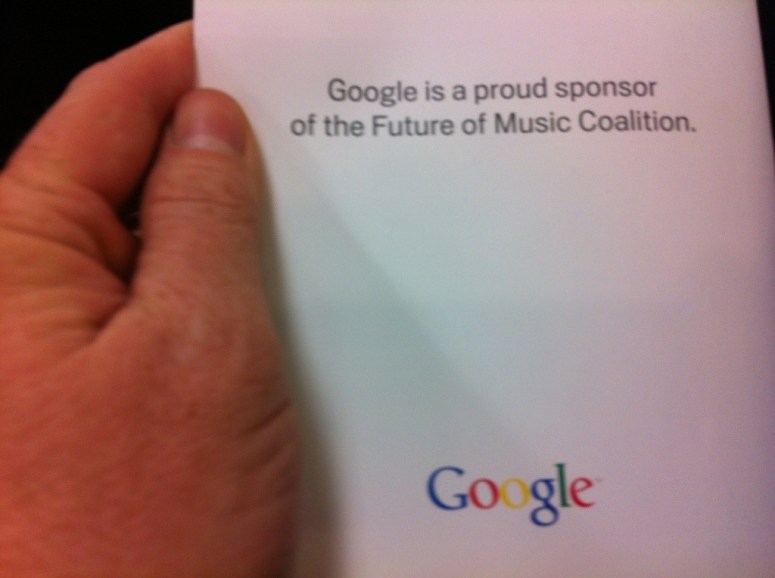
this photo says it all

“This says It all”

I was supposed to speak at the SF Music Tech Summit Feb 19th 2013.   A few days before my scheduled appearance I received a call from  SF Music Tech and Fututre of Music Coalition co-founder Brian Zisk explaining that I would not be allowed to speak because I tweeted/blogged the above picture with the following caption “this says it all.”   Further he noted that “certain sponsors” would not “appreciate” me speaking at this event.

I love the hypocrisy of the Silicon Valley. They are all for free speech until they aren’t.

The fundamental American right is Free Speech. SF Music Tech (and Silicon Valley in general) do not really respect this right. Especially when it begins to interfere with their bottom line.

So what do you say we just end the charade? SF Music Tech Summit is biased against creators/musicians and their rights. It’s a pro-tech industry event.  It’s held in the Kabuki Hotel in San Francisco.  Because it is a giant Kabuki.

Three times a year  you find Tech Industry “entrepreneurs” who’ve never turned a profit “debate” un-elected artists rights advocates who as it turns out work for opaque 501C  foundations and organizations  that are funded by technology companies like Google.

If it’s not clear I’m talking about you, Future of Music Coalition and Cash Music.  Sorry guys/gals you had your chance to do the right thing and  speak out publicly against me being banned and you didn’t.  That makes you at best quislings and at worst shills.

SF Music Tech and Brian Zisk have every right to do whatever they want with their #SFMUSICTECH summit but I just ask them to stop pretending it reperesents anything other than the technologists that wish to exploit artists.

Have a good SF Music Tech.  I’ll be off touring the UK.

Band Quiet Company says Internet Has Made Things Worse for Artists “New Boss is Worse Than Old Boss”

A decade into the snake oil and lies of the empowered internet musician the truth bares itself out over and over again. In a recent case study the band Quiet Company said of their promotional experiment with Grooveshark in an interview with Digital Trends,

“I think for years now, as far as back as [Quiet Company] has been together, people have been talking about how different the music industry is and how the Internet has changed everything and how we’re all looking for a new model.”

“After everything, I’m not sure there is a new model. The old model is still the model, it’s just that the Internet made it way worse.”

We’re not surprised in the least as we’ve previously noted how Grooveshark’s infringement based business model could easily be described as “Notice and Shakedown.” Even tech progressive artists such as Zoë Keating have struggled with the service. Zoë could not get her music removed from the site after issuing at least six DMCA notices to Grooveshark.

So it’s strange to us despite there being near universal agreement on just how bad this service is for artists that some people still don’t get it. Of course these always seem to be the same people that defend every other service that rips off musicians and pays them nothing like The Pirate Bay.

One tech blog actually said after the Pirate Bay verdict, “The folks this will hurt the most are those content creators who actually do value The Pirate Bay.” But we doubt that as it’s not like there aren’t tons opportunities for artists to give away their work willing, with consent, should they so chose. What we find most disturbing is why the choice of consent to give away one’s work should be forcefully take from them by companies who are profiting from advertising revenue?

It’s all pretty simple. Artists need to get paid and so many of these so called “new models” seem to be built on the “new model” of not paying artists anything at all, or next to nothing at all. Again, from Digital Trends,

But now the contract is up and not being renewed, because – you guessed it – a monetization strategy couldn’t be found for Grooveshark. “We were the test monkeys,” says Osbon.

Once again we see that The New Boss is Worse Than The Old Boss, indeed. We’re not surprised, we know there’s a lot of money being made on the internet in music distribution, it’s just not being “shared” with musicians. So once again we ask where are all of these self empowered, independent new middle class musicians? The answer is, like most things where the truth is self evident, they just don’t exist.

Trichordist Picks #SXSW Panels Of Interest @ SXSW South by Southwest 2013

Here’s a quick look at what may be panels of interest during music… some because we agree with them, some because we really, really don’t… but we’d like to think we remain open minded, teachable and in search of common solutions and goals to benefit artists rights in the digital age… and, you never know what kind of BS will be peddled and spilled…

### TUESDAY MARCH 12 ###

Tuesday March 12 – 11:00AM -12:00PM

Constructive Disruption for the Music Biz

After the record industry and the live music industry, it’s time for innovation and constructively disrupting how the music industry operates. It’s time to open up the shop and see what outside influences can bring to th…

Brooke Parrott, Finian Murphy, Jim Carroll

###

Tuesday March 12 – 11:00AM -12:00PM

Downloaded: The Digital Revolution

This session presented by SXSW Film and is open to all badge types. Join a round table discussion of the Digital Revolution; how we got here, how the world has changed and what are the best ways forward in these content…

Alex Winter, Chuck D, Eugene Hernandez, John Perry Barlow, Sean Parker, Shawn Fanning

###

Tuesday March 12 -5:00PM – 6:00PM

Fair Play: Music Tech Startups and Artists

It’s a complicated new music world for both tech entrepreneurs and artists, one fraught with anachronistic copyright, byzantine royalty structures, and perhaps most importantly, a cultural divide between the two business…

Doug Freeman (Austin Chronicle), Daniel Senyard (Vivogig), Jean Cook (Musician/Future of Music Coalition) and Brian Zisk (SF MusicTech)

###

### WEDNESDAY MARCH 13 ###

Wednesday March 13 -12:30PM – 1:30PM

The Anatomy of Amanda Fucking Palmer: An Inside Look

Look at the inner workings of a multi-million dollar global recording, touring and merchandise business that is 100% artist controlled. Amanda Palmer raised a record-breaking $1,192,793 on Kickstarter from 24,883 fans —

Kendel Ratley, Kevin Wortis, Martin Goldschmidt, Nicole St Jean, Vickie Starr, Amanda Palmer

###

Wednesday March 13 – 2:00PM – 3:00PM

Artists Staying Afloat in the Digital Revenue Stream

As new business models of digital music consumption grow and new services keep launching where does the artist fit in? The headlines all scream about what the artist makes on this service or that. But does the artist hav…

Eric Garland, Jeff Price, Trevor Skeet, Scott Reilly

###

Wednesday March 13 -2:00PM – 3:00PM

Music Subscription & Artist Revenue

Heated discussions in the music business surround the topic of subscription music, and the effect on the bottom line of the rights holder, artist and songwriter. One side of the aisle claim that on-demand streaming serv…
Adam Rabinovitz, Brian Slagel, Christina Calio, Dan Kruchkow, Steve Savoca, Antony Bruno

###

Wednesday March 13 -5:00PM – 6:00PM

The Fight for Fair Fees in the Music Industry

Once upon a time, terrestrial radio was the only game in town and they do not pay performance royalties. With the advent of online and satellite services, we’ve amassed a patchwork of legacy policies that create a compl…

Chris Harrison, Julia Betley, Patrick Reynolds, Patrick Laird, Erin Griffith

###

### THURSDAY MARCH 14 ###

Thursday March 14 -12:30PM – 1:30PM

Music Curation in 2013

As was predicted from the earliest days of the internet, curation is becoming a bigger factor in the music marketplace both on and off line. Explore the process in which specific associations and gatekeeper on the landsc…

Daniel Seligman, Johanna Rees, Ryan Schreiber, Steve Blatter, Mark Kates

###

Thursday March 14 -12:30PM – 1:30PM

Silicon Valley Isn’t the Enemy Anymore

Beyond Spotify and Pandora, a new group of digital music companies are emerging. These companies are bringing together artists, content carriers and labels to create new user experiences, business models and opportunitie…

Michael Cerda, Paul Resnikoff, Phil Lang, Tyler Lenane, Mike McGuire

###

Thursday March 14 -12:00PM – 3:00PM

Big Data: The New Oil or the New Snake Oil?

Mobile technologies have enabled music executives to understand as never before how people are consuming music. What people are listening to is just the tip of the iceberg – now, labels can see where they are and even wh…

David Lowery, Alex White, Jon Vanhala, Marie-Alicia Chang, Will Mills

###

Thursday March 14 -3:30PM – 4:30PM

Infamous Band Disputes and How To Avoid Them

Hear about the trials, tribulations and aftermath of band warfare from defendants and plaintiffs willing to share behind-the-scenes details of their high profile legal battles with former band mates. Discover the ramific…

Anita Rivas Gisborne, Esq, East Bay Ray, Joe Escalante, Neville Johnson, Matthew Belloni

###

Thursday March 14 -3:30PM – 4:30PM

The Artists’ Copyright Conundrum

Artists make difficult choices in deciding where they fall in the copyright debates. They must strike their own balance between seeing copyright as a way to make money and not wanting to alienate their fans. What measure…

Andrew Bridges, Karen Thorland, Kristelia Garcia, Wendy Seltzer, Margot Kaminski

###

Thursday March 14 -5:00PM – 6:00PM

Downloaded: The Music Industry in the Digital Age

In 1998 Shawn Fanning, a teenage hacker and programmer, created the code that would become the basis for all peer-to-peer file sharing. Shortly after, Fanning and his business partner, fellow teenage hacker Sean Parker, …
Alex Winter, Bill Flanagan, Chuck D, Ian Rogers, J Keyes, Paul D Miller (aka DJ Spooky)

###

Thursday March 14 -5:00PM – 6:00PM

Songs and Recordings: How They Make Money Worldwide

Songwriters, recording artists, publishers, record companies, musicians and performers share in the billions of dollars being generated from music being performed and sold worldwide. Royalty and deal making experts take …

Jeffrey Brabec, John Simson, Todd Brabec

###

### FRIDAY MARCH 15 ###

Friday March 15 -11:00AM -12:00PM

Selling Albums in a Spotify World: Non-Traditional Strategies

Is the subscription music business model ultimately a positive or negative for music industry revenues, compared to the purchase model? Whichever side of the argument you land on, it’s agreed that maintaining a healthy b…
Amanda Palmer, Darius Zelkha, JT Myers, Thaddeus Rudd

###

Friday March 15 – 2:00PM – 3:00PM

Album Release Strategies for the 21st Century

With all of the tools that are available via the web, artists and labels are making more mistakes than ever in the planning of their release strategies. Find out about effective, yet affordable, marketing, sales, and dis…

Adam Pollock, Joe Esposito, Rey Roldan, Sarah Landy, Vinny Rich

###

Friday March 15 – 3:30PM – 4:30PM

CLE 4: Digital Distribution – Where the Future Money Is

The status of the law and business of the non-physical retail, commercial and licensing recording world.……

Bryan Calhoun, Christine Pepe, Cindy Charles, John Simson

###

Friday March 15 – 5:00PM – 6:00PM

Streaming Music: A River of Cash or Up the Creek

Many artists, managers and labels see streaming as stripping away the already beleaguered retail sales and leaving them with only fractions of pennies for their work. Meanwhile streaming services believe holdout artists …

Emily White, Jon Maples, Richard Jones, Simon Wheeler

###

Friday March 15 – 5:00PM – 6:00PM

Who’s Ripping Me Off Now?

In June 2012, a blog post by musician David Lowery set off a firestorm. Written to an intern at NPR who admitted to not having paid for the 11,000 tracks in her collection, the post generated more than a million views in…

David Lowery, East Bay Ray, Daryl Friedman

###

### SATURDAY MARCH 16 ###

Saturday March 16 -11:00AM -12:00PM

CLE 5: The Politics of Music, and Future Copyright Battles

A dissection of the political interests and energy regarding music policies and law.……

Barry Slotnick, Colin Rushing, Lee Knife, Jay Rosenthal

###

Saturday March 16 – 12:30PM – 1:30PM

So We Won SOPA: Turning a Moment into a Movement

The fight over SOPA/PIPA was a Washington watershed: 15 million Americans contacted Congress and stopped laws that would have harmed online culture and innovation. Learn how to transform this victory into a strong, self-…
Jayme White, Julie Samuels, Laurent Crenshaw, Michael Petricone

###

Saturday March 16 – 3:30PM – 4:30PM

CLE 8: The Crystal Ball: Divining The Future of Music Law

Experienced music lawyers ponder, predict and pontificate on the future of music and music law.……

Kenneth Anderson, Tim Mandelbaum, Ken Abdo

###

Artists Rights Watch – Monday March 11, 2013 #SXSW @SXSW South by Southwest Edition

FASTER LOUDER:
* The Freeloading Generation: Are we loving our music to death?

“I saw that freeloading was no victimless act, nor was it simply a matter of beating up on bloated corporate media entities.

It is a potent combination of laziness and selfishness, concealed under a thin superficial haze of digital idealism and anti-corporate bitterness.”

NPR / ON THE MEDIA :
* Meet the New Boss, Worse Than the Old Boss

David Lowery of bands Cracker and Camper Van Beethoven thought the internet would become a vibrant new marketplace for creators. Instead, he says, the internet era is worse for artists than the infamously unfair record company system. Brooke talks to Lowery about what’s wrong and how to fix it.

THE WALL STREET JOURNAL:
* As Pirates Run Rampant, TV Studios Dial Up Pursuit
* Movie Sales Increased With Shutdown of Piracy Sites

THE ILLUSION OF MORE:
* New Reports on Piracy
* Another Must Read
* Why is it either/or?

we are blessed to have a society that produces both the Amanda Palmers and the John Irvings; and I don’t understand why anyone thinks we need to choose a system that would favor one over the other. Believe it or not, the one unifying principle that supports these two artists, as well as all others, is copyright.

FOX NEWS:
* Washington must get serious about protecting intellectual property

The desire to see the Internet remain free and open does not mean, however, that we should countenance lawlessness. A balance must be struck between the needs of content creators and the advocates of a free and open Internet. The “rules of the road” are still to be written and, when they are, the need to protect U.S. generated intellectual property should be foremost in the minds of legislators.

The Internet and the world of e-commerce will not continue to grow and thrive either in an environment of overbearing regulation or in one which turns a blind eye to theft and other forms of lawlessness. Freedom and safety are complementary; the American people deserve both. The Internet must not become a haven for hackers and foreign criminals.

TRUST ME I’M A SCIENTIST:
* Input\Output Podcast: David Lowery and the Future of Artists’ Rights

MUSIC TECH POLICY:
* Joe Kennedy Departs Pandora
* The Google Whistle Speaks Its Mind–and it’s worse than you thought

FOX BUSINESS:
* Microsoft Establishes Cybercrime Center to Combat Piracy, Malware

The new center will consolidate Microsoft’s digital crimes and Internet piracy units into one advanced operations center on its Redmond, Wash., campus. It will give the company one center to coordinate investigations with governments and law enforcement agencies. A staff of 30 there will work with 70 other Microsoft investigators world-wide to focus on malicious software crime, technology-facilitated child exploitation and piracy.

THE VERGE:
* Radiohead, Nine Inch Nails, and other digital pioneers sour on ‘pay what you want’ music

Not long ago, many hoped the Internet would emerge as a music fan’s Shangri-la, a utopian world where any track, no matter how obscure, was available for free, record labels were extinct and artists made a good living because their fans chose to reward them. Acts like Radiohead and Nine Inch Nails championed this brave new world.

But that dream has turned into a nightmare…

COPYHYPE:
* Shutting Down Megaupload Did Impact Digital Movie Sales

This week, Brett Danaher and Michael Smith, working at the Initiative for Digital Entertainment Analytics (IDEA) at Carnegie-Mellon University, have released another study looking at this question. The study, Gone in 60 Seconds: The Impact of the Megaupload Shutdown on Movie Sales, found that digital movie revenues from online sales and rentals increased by 6-10% following the January 2012 shutdown of the popular cyberlocker site (Megaupload execs, including Kim Dotcom, are of course currently facing criminal charges in the U.S. for copyright infringement).

ALL THINGS D:
* YouTube’s Show-Me-the-Money Problem

The bigger question is whether YouTube will be able to generate enough ad money for content makers to support the “premium” programming it has been trying to attract so it can compete with traditional TV.

“It’s hard, given YouTube’s low [revenue-sharing] numbers and lack of marketing infrastructure to make the unit economics for premium programming work,” says Steve Raymond, who runs Big Frame, a YouTube network/programmer that says it has generated 3.2 billion views.

VANITY FAIR:
* You Say You Want a Devolution?

For most of the last century, America’s cultural landscape—its fashion, art, music, design, entertainment—changed dramatically every 20 years or so. But these days, even as technological and scientific leaps have continued to revolutionize life, popular style has been stuck on repeat, consuming the past instead of creating the new.

THE PHILADELPHIA INQUIRER:
* Internet piracy getting worse

Artists deserve to be compensated for their efforts, and so should the companies that take risks to promote and distribute their work. Stealing songs and movies to pass among friends or to sell in a black market robs the originators of their incomes.

THE NEW YORKER:
* Aaron Swartz was brilliant and beloved. But the people who knew him best saw a darker side.

BILLBOARD:
* Pandora Opens Up Audience Data to Media Buyers
* Facebook Announces Dedicated Music Tab in News Feed Redesign

THE ORION:
* Punk legend shares insight on file-sharing

INTERNATIONAL MUSIC SOFTWARE TRADE ASSOCIATION:
* What do the numbers say?

THE REASON:
* A Free-Market Fix for Music Copyrights

DIGITAL MUSIC NEWS:
* American Tax Dollars Are Now Assisting Pirate Sites…
* I Teach Guitar to Students Aged 10-24. And This Is How They Consume Music…
* iTunes is ‘Exclusively Streaming David Bowie’s The Next Day,’ Yet It’s Already On Grooveshark…

VOX INDIE:
* Takedown of Megaupload had Positive Result on Movie Sales
* 12 Stepping Through Piracy’s Takedown Maze of Madness
* Spinning Straw Movies Into Gold on YouTube

MUSIC ALLY:
* Can YouTube’s ad revenues support premium video content?

TORRENT FREAK:
* Megaupload Shutdown Boosted Digital Movie Revenues
* French Govt Reports Large Increase in Three Strikes Piracy Warnings

THE REGISTER UK:
* Congratulations, freetards: You are THE FIVE PER CENT

Conspiratorial thinking – such as imagining media barons in secret meetings, perhaps involving the “MAFIAA” – abounds. In America, activists have created a Batman-inspired cat signal, to be beamed to other paranoiacs in distress, whenever The Man is suspected of spoiling their fun. Persecution fantasies abound.

ARS TECHNICA:
* Blues Highway Blues: You can’t separate murder from music

The soundtrack for Blues Highway Blues isn’t meant to be played as you read; there are no in-text notes about tracks fading in or out. Instead, the soundtrack corresponds to events that unfold throughout an entire chapter, making listening a parallel experience, not a simultaneous one.

But this is only the first installment in the Crossroads series, with more on the way. The next installment, Rock Island Rock, will be out in June of this year. That novel will not have its own soundtrack but instead will include lyrics sheets in the appendix (how very Beck Song Reader of him, right?). For now Blues Highway Blues is available—for your eyes and ears.

MUSIC WEEK:
* Warner signs licensing deal for Google subscription streaming services – report
* Hadopi report turns anti-piracy attention to streaming

THE COPYRIGHT ALLIANCE:
* The Curious Case of Cell Phone Unblocking and Copyright
* Innovation and Piracy

I am sure the Wall Street Journal article will generate the predictable commentary about how the solution to online theft lies in developing new business models.  Wolfe Video did just that, and the results do not bear out the claims that piracy is all about failure of imagination.  Moreover, I have yet to hear anyone explain what is innovative or new about stealing the creative work of another and monetizing it through ad sales.

CNN:
* Apple and Google’s huge streaming music gamble

YAHOO:
* Warner Music owner, Bass, Packer finance Beats’ music service

BUSINESS INSIDER:
* Apple Just Met With A Spotify Rival That Has Raised $60 Million

Hypebot Have No Defense of Ad Supported Piracy So They Resort To Name-Calling.

East Bay Ray of The Dead Kennedys  and I had an informal bet going.  Well maybe not a bet,  just a sort of prediction that once Ray spoke against ad supported piracy at SF Music Tech,  the music tech bloggers would start with the usual name calling. 
 
 Sure enough right on cue we see Bruce Houghton’s Hypebot giving Mike Masnick (see the “Google Shill List”) a platform to bash Ray and other  artists. “Whining” “Old” “Grumpy” and “Rant” were some of the unfair and unbalanced terms  that Ray and I predicted they would use in the de rigueur  postSF Music Tech cyber bullying. And they did.
 
This is pretty sad since ending ad supported piracy is a no-brainereven Google and Yahoo! fall over themselves to try to explain their unexplainable connection (see USC Annenberg Innovation Lab report).   Both artists and the legitimate music tech firms are negatively affected by ad supported piracy.  For instance legitimate music streaming services have to compete against these same unlicensed services for ad revenue.   Why the music tech space bloggers fail to grasp this is a mystery.
 
Bruce Houghton also owns the talent agency  Skyline Agency.   This agency tends to have a lot of “Old” and “Grumpy” artists that would probably go on a “Rant” if they were to see that their agency head is tacitly defending this practice.  So we prepared a few screenshots.  
 
Any comment Bruce?  Do you think that this practice is acceptable?  How do our “future” music models like streaming compete with the  guys that don’t pay any royalties to artists?   We’re all ears. 

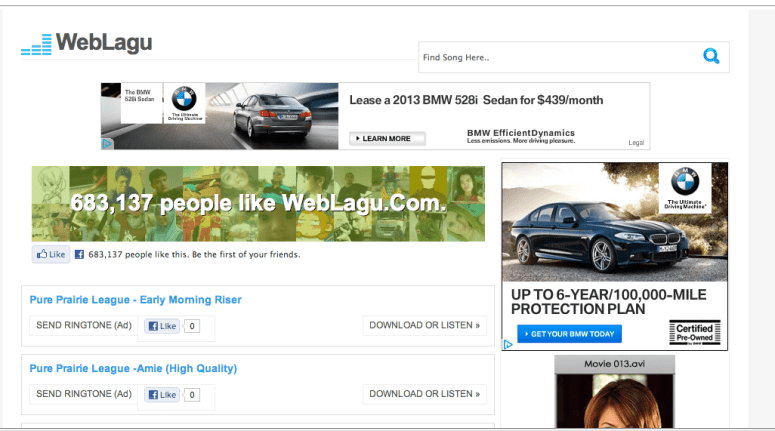
Pure Prairie League piracy brought to you by BMW.

Screen Shot 2013-02-22 at 3.57.36 PM

Al Stewart By Celestion and zZounds.

Screen Shot 2013-02-22 at 7.23.02 PM

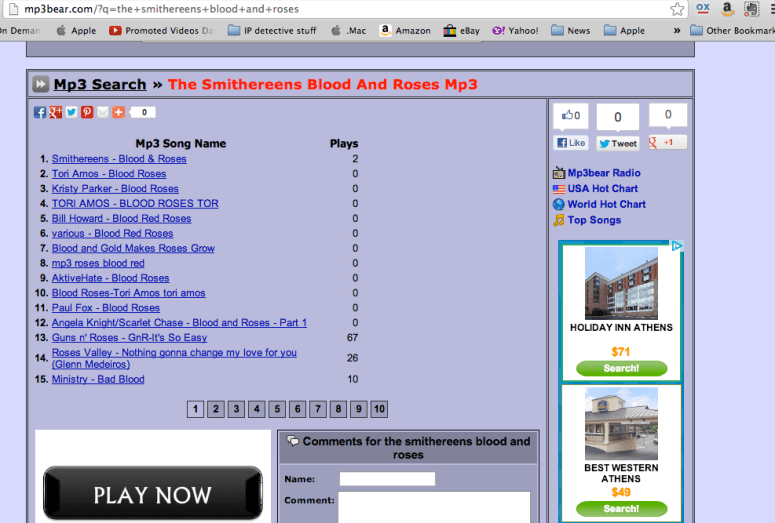
The Smithereens By Priceline

Screen Shot 2013-02-22 at 7.29.48 PM

Grand Funk Railroad By Banana Republic, Amazon and others. 

Screen Shot 2013-02-22 at 7.32.59 PM

Final Recap, News and Last Links of 2012…

Grab the coffee!

Recent Posts:
* What Can Songwriters Do: Copyright Office Comment Period Ends Today for Mechanical Royalty Statements of Account
* The Return of Orphan Works: A Review of the 2008 Shawn Bentley Orphan Works Act Part 1
* Ending Decade Old Arguments : How the Promise of the Internet has Failed Artists and Musicians…
* Billy Corgan Exploited By… Citi Bank, AT&T, Target, Virgin Atlantic, Mazda, Neiman Marcus, Musicians Friend, Hertz, BMW, Audi, Boston Market, Urban Outfitters, Williams Sonoma
* Songwriter comments on Section 115 Rulemaking
* FTC Treats Google With Kid Gloves and No Transparency
* Fair Pay for Air Play, Terrestrial Radio Performance Royalties for Musicians
* The Piracy-Pandora Connection: Can the Super Bowl, Oscars and Grammys Move the Needle on Brand Supported Piracy?
* The Return of Orphan Works: Trojan Horse: Orphan Works and the War on Authors by Brad Holland

FROM AROUND THE WEB

Seattle Weekly:
* It’s Time for Artists to Fight Piracy as Vigorously as They’ve Challenged Pandora

“…it’s time for artists to band together to set the story straight. Don’t leave it to the few brave enough to speak strongly on the matter. There needs to be a large, coordinated effort by bands big and small to tell their story–to sign a letter to fans explaining how devastating piracy is to their ability to make music for a living (or at all).”

Vox Indie:
* IP and Instagram–a Teaching Moment Perhaps?
* Should More Artists Speak Out Against Piracy?
* Creative Commons Celebrates 10 Years

CNN Money:
* Instagram can now sell your photos for ads
* Instagram says it won’t sell your photos to advertisers

Copyhype:
* Freeloading: How Our Insatiable Hunger for Free Content Starves Creativity, by Chris Ruen

The Guardian UK:
* Intellectual property crime unit to be set up by City police

Torrent Freak:
* U.S. and Russia Announce Online Piracy Crackdown Agreement
* Anti-Piracy Chief Patents “Pay Up or Disconnect” Scheme

Mashable:
* “T-Shirts and Touring” as Revenue for Artists just took a left Turn (YOLO)

Brian Pickings:
* The Best Music Books of 2012

Digital Music News:
* 10 People That Totally Changed the Industry In 2012…

(11) Oh, there’s one more guy…In one fiery and insanely-viral post, performer and professor David Lowery somehow managed to reframe the entire debate over technology, piracy, and the plight of the artist. And, draw attention from seemingly every corner of both the tech and creative communities. It was the biggest post of the year for the music industry, and potentially, the start of a very different type of discussion in 2013.

* Major Label Lobbying vs. Google Lobbying, 2012…
* The State of Music Subscription, December, 2012…
* USC Is Now Researching the Amount of Advertising Flowing Into Pirate Sites…
* Google Exec: If You Really Want to Kill Piracy, Then Kill the Advertisers Who Support It…

Ad Land:
* Senate passes a resolution asking Backpage.com to drop adult classifieds
* Adland booted from Google Adsense due to PETA’s misogynist ads

Copyright Alliance:
* Capitalist Copyrights: A Republican Reply to “Three Myths about Copyright”
* MUSIC Act introduced
* YouTube Moves for Safe Harbor Against Viacom

Daily Dot:
* YouTube strips Universal and Sony of 2 billion fake views

The Cynical Musician:
* Copyright and Scarcity

The Internet Radio Fairness Act’s Attack on Free Speech

In case you missed it: yesterday, the Future of Music Coalition held its annual summit, a full day’s worth of varied speakers and varied topics. The primary topic was the Internet Radio Fairness Act (IRFA) — Pandora’s Tim Westergren led off the summit with a “conversation panel” designed to drum up support for the bill. Senator Ron Wyden, sponsor of the Senate’s version of the bill, had the honor of keynoting the event, and his remarks centered around the legislation.

The Trichordist’s own David Lowery participated on a panel in between the two devoted to the bill. He was joined by General Counsel of the American Federation of Musicians Patricia Polach, SoundExchange General Counsel Colin Rushing, Consumer Electronics Association lobbyist Michael Petricone, and AccuRadio founder Kurt Hanson.

Lowery had earlier challenged Westergren on the free speech implications of Section 5 of IRFA. Westergren deflected: “I’m not going to get into a back and forth over legislative language.”

During the panel discussion, Lowery focused again on the chilling effect that Section 5 would pose to artists and artist organizations. The AFM’s Polach echoed his concerns.

When Senator Wyden took the podium, he attempted to address these concerns. With his voice raised, he conceded that “If the consensus in the legal community is that this restricts the First Amendment, it will be a very short-lived provision.” Techdirt’s Mike Masnick jumped to Wyden’s defense:

As we noted in our prior post, IRFA’s chilling effect on free speech is not a bizarre interpretation.

Satellite radio provider Sirius XM is currently suing SoundExchange and the American Association of Independent Music (A2IM) primarily because of blog posts expressing their opinion on direct licenses pursued by Sirius. It is seeking monetary damages, a permanent injunction, the dissolution of SoundExchange, and the invalidation of all copyrights licensed by SoundExchange — copyrights involving over 70,000 performers — because these organizations representing artists engaged in speech that Sirius disagrees with.

These groups have explicitly raised the First Amendment in defense. As A2IM argues in its memorandum supporting its motion to dismiss, filed last June, “a trade association’s mere recitation of facts and its opinion on an issue or standard cannot constitute an antitrust violation.”

Instead, such a recitation is protected free speech. … Sirius pleads nothing more than just such protected expressions of A2IM opinion.

Artists and artist advocates should not need to run things by their lawyer whenever they want to communicate to other artists their thoughts and opinions on deals offered by Sirius, Clear Channel, or any other business that relies on their music.

We don’t have to wonder if there is a free speech concern with Section 5 of IRFA — there is. We don’t have to guess if corporations will sue artist organizations for speaking up — they already are.

Section 5 would only codify and set in stone this suppresion of dissent.

That IRFA’s own authors, self-described defenders of the First Amendment, weren’t aware of the definite chilling effect of the bill until yesterday only reinforces the idea that Congressional tampering with artists’ royalties is not yet ready for prime time.