Trump’s Historic Kowtow to Special Interests: Why Trump’s AI Executive Order Is a Threat to Musicians, States, and Democracy

There’s a new dance in Washington—it’s called the KowTow

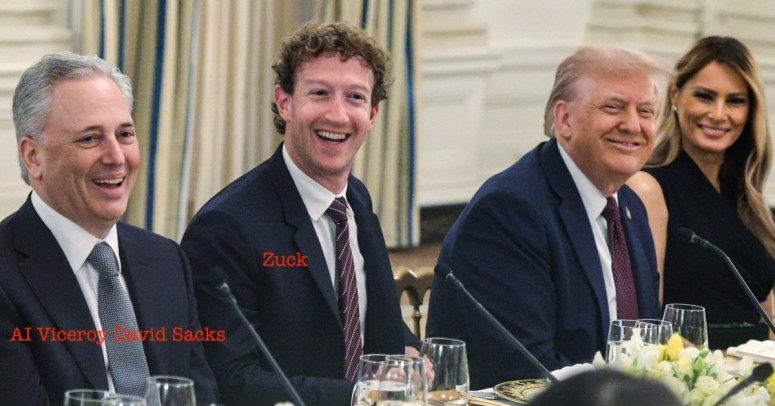
Most musicians don’t spend their days thinking about executive orders. But if you care about your rights, your recordings, your royalties, or your community, or even the environment, you need to understand the Trump Administration’s new executive order on artificial intelligence. The order—presented as “Ensuring a National Policy Framework for AI”—is not a national standard at all. It is a blueprint for stripping states of their power, protecting Big Tech from accountability, and centralizing AI authority in the hands of unelected political operatives and venture capitalists. In other words, it’s business as usual for the special interests led by an unelected bureaucrat, Silicon Valley Viceroy and billionaire investor David Sacks who the New York Times recently called out as a walking conflict of interest.

You’ll Hear “National AI Standard.” That’s Fake News. IT’s Silicon valley’s wild west

Supporters of the EO claim Trump is “setting a national framework for AI.” Read it yourself. You won’t find a single policy on:
– AI systems stealing copyrights (already proven in court against Anthropic and Meta)
– AI systems inducing self-harm in children
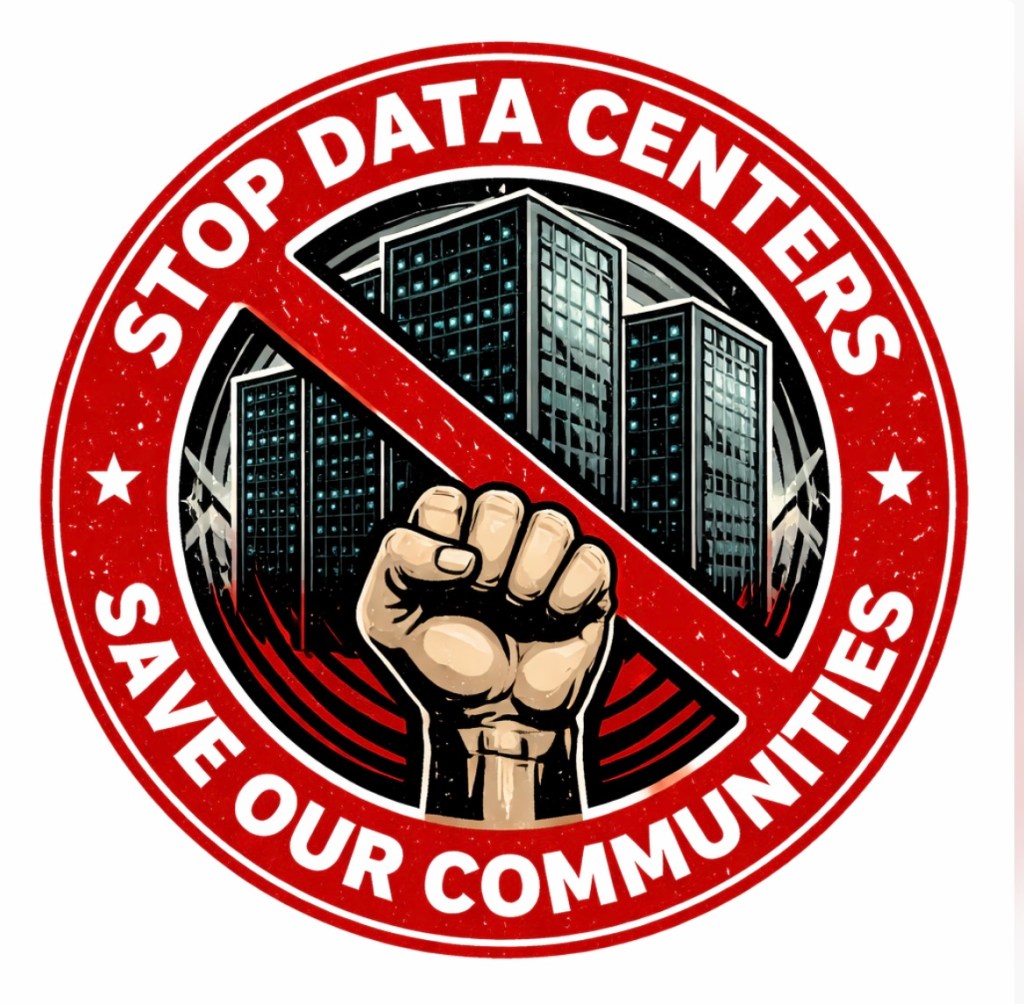
– Whether Google can build a water‑burning data center or nuclear plant next to your neighborhood 

None of that is addressed. Instead, the EO orders the federal government to sue and bully states like Florida and Texas that pass AI safety laws and threatens to cut off broadband funding unless states abandon their democratically enacted protections. They will call this “preemption” which is when federal law overrides conflicting state laws. When Congress (or sometimes a federal agency) occupies a policy area, states lose the ability to enforce different or stricter rules. There is no federal legislation (EOs don’t count), so there can be no “preemption.”

Who Really Wrote This? The Sacks–Thierer Pipeline

This EO reads like it was drafted directly from the talking points of David Sacks and Adam Thierer, the two loudest voices insisting that states must be prohibited from regulating AI.  It sounds that way because it was—Trump himself gave all the credit to David Sacks in his signing ceremony.

– Adam Thierer works at Google’s R Street Institute and pushes “permissionless innovation,” meaning companies should be allowed to harm the public before regulation is allowed. 
– David Sacks is a billionaire Silicon Valley investor from South Africa with hundreds of AI and crypto investments, documented by The New York Times, and stands to profit from deregulation.

Worse, the EO lards itself with references to federal agencies coordinating with the “Special Advisor for AI and Crypto,” who is—yes—David Sacks. That means DOJ, Commerce, Homeland Security, and multiple federal bodies are effectively instructed to route their AI enforcement posture through a private‑sector financier.

The Trump AI Czar—VICEROY Without Senate Confirmation

Sacks is exactly what we have been warning about for months: the unelected Trump AI Czar

He is not Senate‑confirmed. 
He is not subject to conflict‑of‑interest vetting. 
He is a billionaire “special government employee” with vast personal financial stakes in the outcome of AI deregulation. 

Under the Constitution, you cannot assign significant executive authority to someone who never faced Senate scrutiny. Yet the EO repeatedly implies exactly that.

Even Trump’s MOST LOYAL MAGA Allies Know This Is Wrong

Trump signed the order in a closed ceremony with sycophants and tech investors—not musicians, not unions, not parents, not safety experts, not even one Red State governor.

Even political allies and activists like Mike Davis and Steve Bannon blasted the EO for gutting state powers and centralizing authority in Washington while failing to protect creators. When Bannon and Davis are warning you the order goes too far, that tells you everything you need to know. Well, almost everything.

And Then There’s Ted Cruz

On top of everything else, the one state official in the room was U.S. Senator Ted Cruz of Texas, a state that has led on AI protections for consumers. Cruz sold out Texas musicians while gutting the Constitution—knowing full well exactly what he was doing as a former Supreme Court clerk.

Why It Matters for Musicians

AI isn’t some abstract “tech issue.” It’s about who controls your work, your rights, your economic future. Right now:

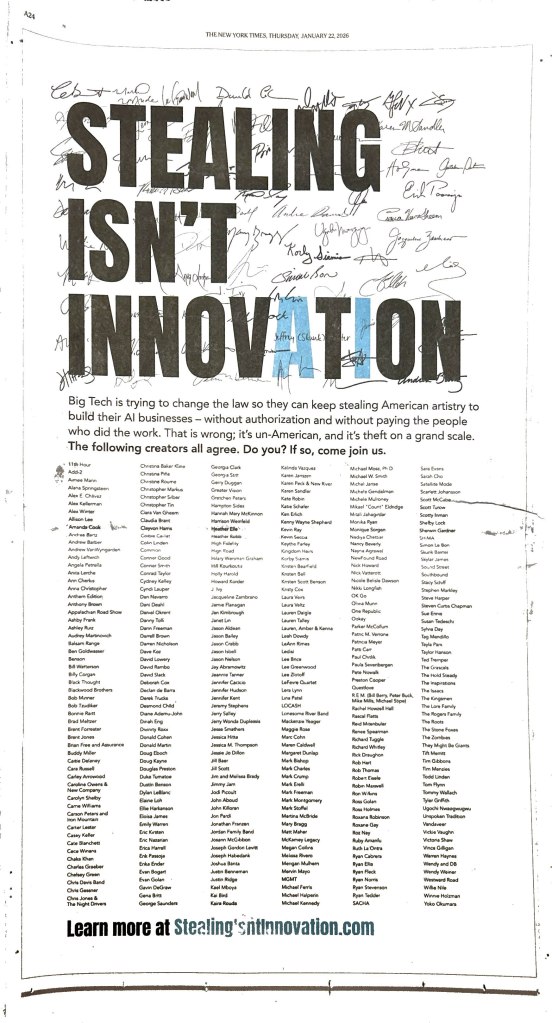
– AI systems train on our recordings without consent or compensation. 
– Major tech companies use federal power to avoid accountability. 
– The EO protects Silicon Valley elites, not artists, fans or consumers. 

This EO doesn’t protect your music, your rights, or your community. It preempts local protections and hands Big Tech a federal shield.

It’s Not a National Standard — It’s a Power Grab

What’s happening isn’t leadership. It’s *regulatory capture dressed as patriotism*. If musicians, unions, state legislators, and everyday Americans don’t push back, this EO will become a legal weapon used to silence state protections and entrench unaccountable AI power.

What David Sacks and his band of thieves is teaching the world is that he learned from Dot Bomb 1.0—the first time around, they didn’t steal enough. If you’re going to steal, steal all of it. Then the government will protect you.


NYT: Silicon Valley’s Man in the White House Is Benefiting Himself and His Friends

This image has an empty alt attribute; its file name is image-9.png

The New York Times published a sprawling investigation into David Sacks’s role as Trump’s A.I. and crypto czar. We’ve talked about David Sacks a few times on these pages. The Times’ piece is remarkable in scope and reporting: a venture capitalist inside the White House, steering chip policy, promoting deregulation, raising money for Trump, hosting administration events through his own podcast brand, and retaining hundreds of A.I. and crypto investments that stand to benefit from his policy work.

But for all its detail, the Times buried the lede.

The bigger story isn’t just ethics violations. or outright financial corruption. It’s that Sacks is simultaneously shaping and shielding the largest regulatory power grab in history: the A.I. moratorium and its preemption structure.

Of all the corrupt anecdotes in the New York Times must read article regarding Viceroy and leading Presidential pardon candidate David Sacks, they left out the whole AI moratorium scam, focusing instead on the more garden variety of self-dealing and outright conflicts of interest that are legion. My bet is that Mr. Sacks reeks so badly that it is hard to know what to leave out. Here’s a couple of examples:

This image has an empty alt attribute; its file name is image-10.png

There is a deeper danger that the Times story never addresses: the long-term damage that will outlive David Sacks himself. Even if Sacks eventually faces investigations or prosecution for unrelated financial or securities matters — if he does — the real threat isn’t what happens to him. It’s what happens to the legal architecture he is building right now.

This image has an empty alt attribute; its file name is sacks-american-flag.jpg

If he succeeds in blocking state-law prosecutions and freezing A.I. liability for a decade, the harms won’t stop when he leaves office. They will metastasize.

Without state enforcement, A.I. companies will face no meaningful accountability for:

  • child suicide induced by unregulated synthetic content
  • mass copyright theft embedded into permanent model weights
  • biometric and voiceprint extraction without consent
  • data-center sprawl that overwhelms local water, energy, and zoning systems
  • surveillance architectures exported globally
  • algorithmic harms that cannot be litigated under preempted state laws

These harms don’t sunset when an administration ends. They calcify. It must also be said that Sacks could face state securities-law liability — including fraud, undisclosed self-dealing, and market-manipulative conflicts tied to his A.I. portfolio — because state blue-sky statutes impose duties possibly stricter than federal law. The A.I. moratorium’s preemption would vaporize these claims, shielding exactly the conduct state regulators are best positioned to police. No wonder he’s so committed to sneaking it into federal law.

The moratorium Sacks is pushing would prevent states from acting at the very moment when they are the only entities with the political will and proximity to regulate A.I. on the ground. If he succeeds, the damage will last long after Sacks has left his government role — long after his podcast fades, long after his investment portfolio exits, long after any legal consequences he might face.

The public will be living inside the system he designed.

There is one final point the public needs to understand. DavidSacksis not an anomaly. Sacks is to Trump what Eric Schmidt was to Biden: the industry’s designated emissary, embedded inside the White House to shape federal technology policy from the inside out. Swap the party labels and the personnel change, but the structural function remains the same. Remember, Schmidt bragged about writing the Biden AI executive order.

This image has an empty alt attribute; its file name is of-all-the-ceos-google-interviewed-eric-schmidt-was-the-only-one-that-had-been-to-burning-man-which-was-a-major-plus.jpg

So don’t think that if Sacks is pushed out, investigated, discredited, or even prosecuted one day — if he is — that the problem disappears. You don’t eliminate regulatory capture by removing the latest avatar of it. The next administration will simply install a different billionaire with a different portfolio and the same incentives: protect industry, weaken oversight, preempt the states, and expand the commercial reach of the companies they came in with.

The danger is not David Sacks the individual. The danger is the revolving door that lets tech titans write national A.I. policy while holding the assets that benefit from it. As much as Trump complains of the “deep state,” he’s doing his best to create the deepest of deep states.

Until that underlying structure changes, it won’t matter whether it’s Sacks, Schmidt, Thiel, Musk, Palihapitiya, or the next “technocratic savior.”

The system will keep producing them — and the public will keep paying the price. For as Sophocles taught us, it is not in our power to escape the curse.

@ArtistRights Newsletter 8/11/25: @DavidCLowery on Streaming, SX v. Sirius, AI the Cult and “Dual Use AI” Culture is Upstream of War

Save the Date! September 18 Artist Rights Roundtable in Washington produced by Artist Rights Institute/American University Kogod Business & Entertainment Program. Details at this link!

Artist Rights Institute logo - Artist Rights Weekly newsletter

Save the Date! September 18 Artist Rights Roundtable in Washington produced by Artist Rights Institute/American University Kogod Business & Entertainment Program. Details at this link!

Streaming Economics

@nickgillespie and @davidclowery: Streaming is a Regulated Monopoly (Reason Magazine/Nick Gillespie)

Spotify’s Royalty Threshold Is Conscious Parallelism Reshaping the Music Business—But Not in a Good Way (The Trichordist/Chris Castle)

SoundExchange v. SiriusXM

Did the Court Misread Congress? Rethinking SoundExchange v. SiriusXM Through the Lens of Legislative Design

Copyright Terminations Vetter v. Resnik

Controversial ruling on US termination right fulfills the intention of Congress, say creators (Complete Music Update/Chris Cooke)

Amicus Brief Supporting Cyril Vetter of Artist Rights Institute (David Lowery, Nikki Rowling), Blake Morgan, Abby North, and Angela Rose White (Chris Castle)

Cult of the AI Singularity

AI Frontier Labs and the Singularity as a Modern Prophetic Cult (MusicTech.Solutions/Chris Castle)

AI Czar David Sacks Shortcut to Nowhere: How the Seven Deadly Since Keep Him From Licensing Solutions

Dual Use AI

America Isn’t Ready for the Wars of the Future (Foreign Affairs/GEN Mark Milley and Eric Schmidt)

Spotify CEO Daniel Ek Named Chairman of Military AI Firm Following 600M Investment (Playy Magazine)

Eric Schmidt Is Building the Perfect AI War-Fighting Machine (Wired/Will Knight)

Souls for Sale: The Long Con Behind AI Weapons and Cultural Complicity (MusicTechPolicy/Chris Castle)

Eric Schmidt-led panel pushing for new defense experimentation unit to drive military adoption of generative AI(Defense Scoop/Brandi Vincent)

The Lords of War: Daniel Ek, Eric Schmidt and the Militarization of Tech (MusicTechPolicy/Chris Castle)

Big Beautiful AI Safe Harbor asks If David Sacks wants to Make America Screwed Again?

In a dramatic turn of events, Congress is quietly advancing a 10-year federal safe harbor for Big Tech that would block any state and local regulation of artificial intelligence (AI). That safe harbor would give Big Tech another free ride on the backs of artists, authors, consumers, all of us and our children. It would stop cold the enforcement of state laws to protect consumers like the $1.370 billion dollar settlement Google reached with the State of Texas last week for grotesque violations of user privacy. The bill would go up on Big Tech’s trophy wall right next to the DMCA, Section 230 and Title I of the Music Modernization Act.

Introduced through the House Energy and Commerce Committee as part of a broader legislative package branded with President Trump’s economic agenda, this safe harbor would prevent states from enforcing or enacting any laws that address the development, deployment, or oversight of AI systems. While couched as a measure to ensure national uniformity and spur innovation, this proposal carries serious consequences for consumer protection, data privacy, and state sovereignty. It threatens to erase hard-fought state-level protections that shield Americans from exploitative child snooping, data scraping, biometric surveillance, and the unauthorized use of personal and all creative works. This post unpacks how we got here, why it matters, and what can still be done to stop it.

The Origins of the New Safe Harbor

The roots of the latest AI safe harbor lie in a growing push from Silicon Valley-aligned political operatives and venture capital influencers, many of whom fear a patchwork of state-level consumer protection laws that would stop AI data scraping. Among the most vocal proponents is tech entrepreneur-turned White House crypto czar David Sacks, who has advocated for federal preemption of state AI rules in order to protect startup innovation from what he and others call regulatory overreach also known as state “police powers” to protect state residents.

If my name was “Sacks” I’d probably be a bit careful about doing things that could get me fired. His influence reportedly played a role in shaping the safe harbor’s timing and language, leveraging connections on Capitol Hill to attach it to a larger pro-business package of legislation. That package—marketed as a pillar of President Trump’s economic plan—was seen as a convenient vehicle to slip through controversial provisions with minimal scrutiny. You know, let’s sneak one past the boss.

Why This Is Dangerous for Consumers and Creators

The most immediate danger of the AI safe harbor is its preemption of state protections at a time when AI technologies are accelerating unchecked. States like California, Illinois, and Virginia have enacted—or are considering—laws to limit how companies use AI to analyze facial features, scan emails, extract audio, or mine creative works from social media. The AI mantra is that they can snarf down “publicly available data” which essentially means everything that’s not behind a paywall. Because there is no federal AI regulation yet, state laws are crucial for protecting vulnerable populations, including children whose photos and personal information are shared by parents online. Under the proposed AI safe harbor, such protections would be nullified for 10 years–and don’t think it won’t be renewed.

Without the ability to regulate AI at the state level, we could see our biometric data harvested without consent. Social media posts—including photos of babies, families, and school events—could be scraped and used to train commercial AI systems without transparency or recourse. Creators across all copyright categories could find their works ingested into large language models and generative tools without license or attribution. Emails and other personal communications could be fed into AI systems for profiling, advertising, or predictive decision-making without oversight.

While federal regulation of AI is certainly coming this AI safe harbor includes no immediate substitute. Instead, it freezes state level regulatory development entirely for a decade—an eternity in the technology world—during which time the richest companies in the history of commerce can entrench themselves further with little fear of accountability. And it likely will provide a blueprint for federal legislation when it comes.

A Strategic Misstep for Trump’s Economic Agenda: Populism or Make America Screwed Again?

Ironically, attaching the moratorium to a legislative package meant to symbolize national renewal may ultimately undermine the very populist and sovereignty-based themes that President Trump has championed. By insulating Silicon Valley firms from state scrutiny, the legislation effectively prioritizes the interests of data-rich corporations over the privacy and rights of ordinary Americans. It hands a victory to unelected tech executives and undercuts the authority of governors, state legislators, and attorney generals who have stepped in where federal law has lagged behind. So much for that states are “laboratories of democracy” jazz.

Moreover, the manner in which the safe harbor was advanced legislatively—slipped into what is supposed to be a reconciliation bill without extensive hearings or stakeholder input—is classic pork and classic Beltway maneuvering in smoke filled rooms. Critics from across the political spectrum have noted that such tactics cheapen the integrity of any legislation they touch and reflect the worst of Washington horse-trading.

What Can Be Done to Stop It

The AI safe harbor is not a done deal. There are several procedural and political tools available to block or remove it from the broader legislative package.

1. Committee Intervention – Lawmakers on the House Energy and Commerce Committee or the Rules Committee can offer amendments to strip or revise the moratorium before it proceeds to the full House.
2. House Floor Action – Opponents of the moratorium can offer floor amendments during debate to strike the provision. This requires coordination and support from members across both parties.
3. Senate “Byrd Rule” Challenge and Holds – Because reconciliation bills must be budget-related, the Senate Parliamentarian can strike the safe harbor if it’s deemed “non-germane” which it certainly seems to be. Senators can formally raise this challenge.
4. Conference Committee Negotiation – If different versions of the legislation pass the House and Senate, the final language will be hashed out in conference. There is still time to remove the moratorium here.
5. Public Advocacy – Artists, parents, consumer advocates, and especially state officials can apply pressure through media, petitions, and direct outreach to lawmakers, highlighting the harms and democratic risks of federal preemption. States may be able to sue to block the safe harbor as unconstitutional (see Chris’s discussion of constitutionality) but let’s not wait to get to that point. It must be said that any such litigation poses a threat to Trump’s “Big Beautiful Bill” courtesy of David Sacks.

Conclusion

The AI safe harbor may have been introduced quietly, but there’s a growing backlash from all corners. Its consequences would be anything but subtle. If enacted, it would freeze innovation in AI accountability, strip states of their ability to protect residents, and expose Americans to widespread digital exploitation. While marketed as pro-innovation, the safe harbor looks more like a gift to data-hungry monopolies at the expense of federalist principles and individual rights.

It’s not too late to act, but doing so requires vigilance, transparency, and an insistence that even the most powerful Big Tech oligarchs remain subject to democratic oversight.