There Is No ‘Right to Train’: How AI Labs Are Trying to Manufacture a Safe Harbor for Theft

Every few months, an AI company wins a procedural round in court or secures a sympathetic sound bite about “transformative fair use.” Within hours, the headlines declare a new doctrine of spin: the right to train AI on copyrighted works. But let’s be clear — no such right exists and probably never will.  That doesn’t mean they won’t keep trying.

A “right to train” is not found anywhere in the Copyright Act or any other law.  It’s also not found in court cases on fair-use that the AI lobby leans on. It’s a slogan and it’s spin, not a statute. What we’re watching is a coordinated effort by the major AI labs to manufacture a safe harbor through litigation — using every favorable fair-use ruling to carve out what looks like a precedent for blanket immunity.  Then they’ll get one of their shills in Congress or a state legislature to introduce legislation as though a “right to train” was there all along.

How the “Right to Train” Narrative Took Shape

The phrase first appeared in tech-industry briefs and policy papers describing model training as a kind of “machine learning fair use.” The logic goes like this: since humans can read a book and learn from it, a machine should be able to “learn” from the same book without permission.

That analogy collapses under scrutiny. First of all, humans typically bought the book they read or checked it out from a library.  Humans don’t make bit-for-bit copies of everything they read, and they don’t reproduce or monetize those copies at global scale. AI training does exactly that — storing expressive works inside model weights, then re-deploying them to generate derivative material.

But the repetitive chant of the term “right to train” serves a purpose: to normalize the idea that AI companies are entitled to scrape, store, and replicate human creativity without consent. Each time a court finds a narrow fair-use defense in a context that doesn’t involve piracy or derivative outputs (because they lose on training on stolen goods like in the Anthropic and Meta cases), the labs and their shills trumpet it as proof that training itself is categorically protected. It isn’t and no court has ever ruled that it is and likely never will.

Fair Use Is Not a Safe Harbor

Fair use is a case-by-case defense to copyright infringement, not a standing permission slip. It weighs purpose, amount, transformation, and market effect — all of which vary depending on the facts. But AI companies are trying to convert that flexible doctrine into a brand new safe harbor: a default assumption that all training is fair use unless proven otherwise.  They love a safe harbor in Silicon Valley and routinely abuse them like Section 230, the DMCA and Title I of the Music Modernization Act.

That’s exactly backward. The Copyright Office’s own report makes clear that the legality of training depends on how the data was acquired and what the model does with it.  A developer who trains on pirated or paywalled material like Anthropic, Meta and probably all of them to one degree or another, can’t launder infringement through the word “training.”

Even if courts were to recognize limited fair use for truly lawful training, that protection would never extend to datasets built from pirate websites, torrent mirrors, or unlicensed repositories like Sci-Hub, Z-Library, or Common Crawl’s scraped paywalls—more on the scummy Common Crawl another time. The DMCA’s safe harbors don’t protect platforms that knowingly host stolen goods — and neither would any hypothetical “right to train.”

Yet a safe harbor is precisely what the labs are seeking: a doctrine that would retroactively bless mass infringement like Spotify got in the Music Modernization Act and preempt accountability for the sources they used.  

And not only do they want a safe harbor — they want it for free.  No licenses, no royalties, no dataset audits, no compensation. What do they want?  FREE STUFF.  When do they want it?  NOW!  Just blanket immunity, subsidized by every artist, author, and journalist whose work they ingested without consent or payment.

The Real Motive Behind the Push

The reason AI companies need a “right to train” is simple: without it, they have no reliable legal basis for the data that powers their models and they are too cheap to pay and to careless to take the time to license. Most of their “training corpora” were built years before any licenses were contemplated — scraped from the open web, archives, and pirate libraries under the assumption that no one would notice.

This is particularly important for books.  Training on books is vital for AI models because books provide structured, high-quality language, complex reasoning, and deep cultural context. They teach models coherence, logic, and creativity that short-form internet text lacks. Without books, AI systems lose depth, nuance, and the ability to understand sustained argument, narrative, and style. 

Without books, AI labs have no business.  That’s why they steal books.  Very simple, really.

Now that creators are suing, the labs are trying to reverse-engineer legitimacy. They want to turn each court ruling that nudges fair use in their direction into a brick in the wall of a judicially-manufactured safe harbor — one that Congress never passed and rights-holders never agreed to and would never agree to.

But safe harbors are meant to protect good-faith intermediaries who act responsibly once notified of infringement. AI labs are not intermediaries; they are direct beneficiaries. Their entire business model depends on retaining the stolen data permanently in model weights that cannot be erased.  The “right to train” is not a right — it’s a rhetorical weapon to make theft sound inevitable and a demand from the richest corporations in commercial history for yet another government-sponsored subsidy of infringement by bad actors.

The Myth of the Inevitable Machine

AI’s defenders claim that training on copyrighted works is as natural as human learning. But there’s nothing natural about hoarding other people’s labor at planetary scale and calling it innovation. The truth is simpler: the “right to train” is a marketing term invented to launder unlawful data practices into respectability.

If courts and lawmakers don’t call it what it is — a manufactured, safe harbor for piracy to benefit some of the biggest free riders who ever snarfed down corporate welfare — then history will repeat itself. What Grokster tried to do with distribution, AI is trying to do with cognition: privatize the world’s creative output and claim immunity for the theft.
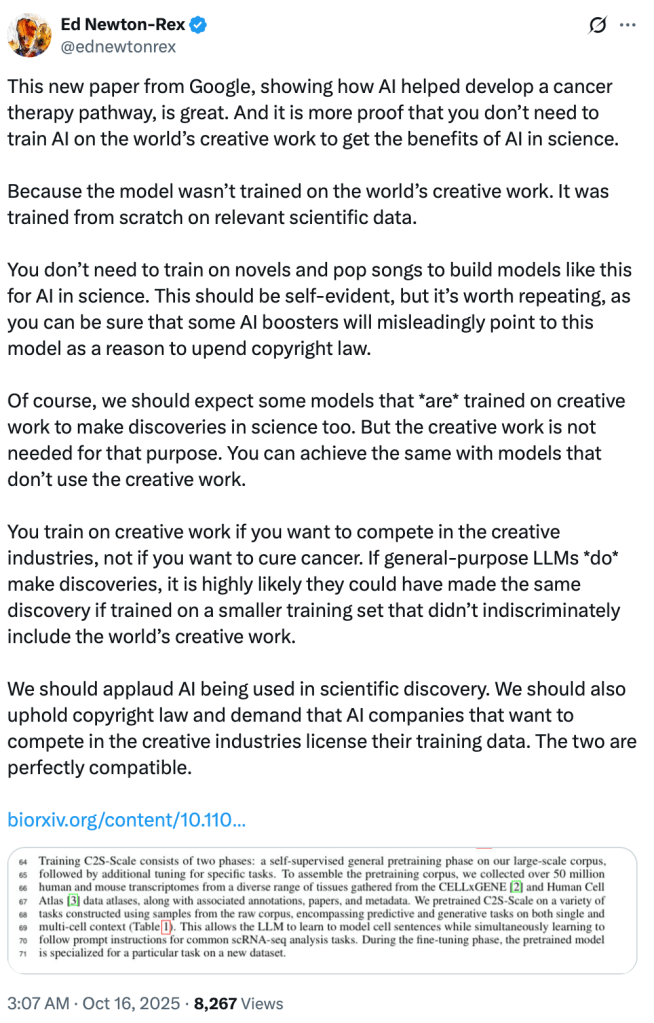
“You don’t need to train on novels and pop songs to get the benefits of AI in science” @ednewtonrex


You Don’t Need to Steal Art to Cure Cancer: Why Ed Newton-Rex Is Right About AI and Copyright

Ed Newton-Rex said the quiet truth out loud: you don’t need to scrape the world’s creative works to build AI that saves lives. Or even beat the Chinese Communist Party.

It’s a myth that AI “has to” ingest novels and pop lyrics to learn language. Models acquire syntax, semantics, and pragmatics from any large, diverse corpus of natural language. That includes transcribed speech, forums, technical manuals, government documents, Wikipedia, scientific papers, and licensed conversational data. Speech systems learn from audio–text pairs, not necessarily fiction; text models learn distributional patterns wherever language appears. Of course, literary works can enrich style, but they’re not necessary for competence: instruction tuning, dialogue data, and domain corpora yield fluent models without raiding copyrighted art. In short, creative literature is optional seasoning, not the core ingredient for teaching machines to “speak.”

Google’s new cancer-therapy paper proves the point. Their model wasn’t trained on novels, lyrics, or paintings. It was trained responsibly on scientific data. And yet it achieved real, measurable progress in biomedical research. That simple fact dismantles one of Silicon Valley’s most persistent myths: that copyright is somehow an obstacle to innovation.

You don’t need to train on Joni Mitchell to discover a new gene pathway. You don’t need to ingest John Coltrane to find a drug target. AI used for science can thrive within the guardrails of copyright because science itself already has its own open-data ecosystems—peer-reviewed, licensed, and transparent.

The companies like Anthropic and Meta insisting that “fair use” covers mass ingestion of stolen creative works aren’t curing diseases; they’re training entertainment engines. They’re ripping off artists’ livelihoods to make commercial chatbots, story generators, and synthetic-voice platforms designed to compete against the very creators whose works they exploited. That’s not innovation—it’s market capture through appropriation.

They do it for reasons old as time—they do it for the money.

The ethical divide is clear:

  • AI for discovery builds on licensed scientific data.
  • AI for mimicry plunders culture to sell imitation.

We should celebrate the first and regulate the second. Upholding copyright and requiring provenance disclosures doesn’t hinder progress—it restores integrity. The same society that applauds AI in medical breakthroughs can also insist that creative industries remain human-centered and law-abiding. Civil-military fusion doesn’t imply that there’s only two ingredients in the gumbo of life.

If Google can advance cancer research without stealing art, so can everyone else and so can Google keep different rules for the entertainment side of their business or investment portfolio. The choice isn’t between curing cancer and protecting artists—it’s between honesty and opportunism. The repeated whinging of AI labs about “because China” would be a lot more believable if they used their political influence to get the CCP to release Hong Kong activist Jimmy Lai from stir. We can join Jimmy and his amazingly brave son Sebastian and say “because China”, too. #FreeJimmyLai

Don’t forget tomorrow—Artist Rights Roundtable on AI and Copyright at American University in Washington DC

Artist Rights Roundtable on AI and Copyright: 
Coffee with Humans and the Machines     

Join the Artist Rights Institute (ARI) and American University’s Kogod’s Entertainment Business Program for a timely morning roundtable on AI and copyright from the artist’s perspective. We’ll explore how emerging artificial intelligence technologies challenge authorship, licensing, and the creative economy — and what courts, lawmakers, and creators are doing in response.

This roundtable is particularly timely because both the Bartz and Kadrey rulings expose gaps in author consent, provenance, and fair licensing, underscoring an urgent need for policy, identifiers, and enforceable frameworks to protect creators.

 🗓️ Date: September 18, 2025
🕗 Time: 8:00 a.m. – 12:00 noon
📍 Location: Butler Board Room, Bender Arena, American University, 4400 Massachusetts Ave NW, Washington D.C. 20016

🎟️ Admission: Free and open to the public. Registration required at Eventbrite. Seating is limited.

🅿️ Parking map is available here. Pay-As-You-Go parking is available in hourly or daily increments ($2/hour, or $16/day) using the pay stations in the elevator lobbies of Katzen Arts Center, East Campus Surface Lot, the Spring Valley Building, Washington College of Law, and the School of International Service

Hosted by the Artist Rights Institute & American University’s Kogod School of Business, Entertainment Business Program

🔹 Overview:

☕ Coffee served starting at 8:00 a.m.
🧠 Program begins at 8:50 a.m.
🕛 Concludes by 12:00 noon — you’ll be free to have lunch with your clone.

🗂️ Program:

8:00–8:50 a.m. – Registration and Coffee

8:50–9:00 a.m. – Introductory Remarks by KOGOD Dean David Marchick and ARI Director Chris Castle

9:00–10:00 a.m. – Topic 1: AI Provenance Is the Cornerstone of Legitimate AI Licensing:

Speakers:

  • Dr. Moiya McTier, Senior Advisor, Human Artistry Campaign
  • Ryan Lehnning, Assistant General Counsel, International at SoundExchange
  • The Chatbot

Moderator: Chris Castle, Artist Rights Institute

10:10–10:30 a.m. – Briefing: Current AI Litigation

  • Speaker: Kevin Madigan, Senior Vice President, Policy and Government Affairs, Copyright Alliance

10:30–11:30 a.m. – Topic 2: Ask the AI: Can Integrity and Innovation Survive Without Artist Consent?

Speakers:

  • Erin McAnally, Executive Director, Songwriters of North America
  • Jen Jacobsen, Executive Director, Artist Rights Alliance
  • Josh Hurvitz, Partner, NVG and Head of Advocacy for A2IM
  • Kevin Amer, Chief Legal Officer, The Authors Guild

Moderator: Linda Bloss-Baum, Director, Business and Entertainment Program, KOGOD School of Business

11:40–12:00 p.m. – Briefing: US and International AI Legislation

  • Speaker: George York, SVP, International Policy Recording Industry Association of America

🎟️ Admission:

Free and open to the public. Registration required at Eventbrite. Seating is limited.

🔗 Stay Updated:

Watch this space and visit Eventbrite for updates and speaker announcements.

Press Release from @AmericanPublish: Appeals Court Affirms Decision Against Internet Archive for Copyright Infringement

[The defeat of Big Tech and the Internet Archive is one of the most important copyright cases in the last ten years. This press release is a good summary of the ruling from our allies at the Association of American Publishers.]

Today the United States Court of Appeals for the Second Circuit affirmed the District Court’s March 2023 opinion in favor of publishers Hachette Book Group, HarperCollins, John Wiley & Sons, and Penguin Random House, finding Internet Archive liable for copyright infringement and rejecting all four factors of Internet Archive’s fair use argument.

The Court squarely addressed the question of whether it is “fair use” for a nonprofit organization to scan copyright-protected print books in their entirety, and distribute those digital copies online, in full, for free, subject to an asserted one-to-one owned-to-loaned ratio between its print copies and the digital copies it makes available at any given time, without any authorization from the copyright owner.  In the Court’s words, “[a]pplying the relevant provisions of the Copyright Act, as well as binding Supreme Court and Second Circuit precedent, we conclude the answer is no.”

The following is a statement from Maria A. Pallante, President and CEO, Association of American Publishers:

“Today’s appellate decision upholds the rights of authors and publishers to license and be compensated for their books and other creative works and reminds us in no uncertain terms that infringement is both costly and antithetical to the public interest. Critically, the Court frontally rejects the defendant’s self-crafted theory of “controlled digital lending,” irrespective of whether the actor is commercial or noncommercial, noting that the ecosystem that makes books possible in fact depends on an enforceable Copyright Act.  If there was any doubt, the Court makes clear that under fair use jurisprudence there is nothing transformative about converting entire works into new formats without permission or appropriating the value of derivative works that are a key part of the author’s copyright bundle.”

Key Quotes the Court’s decision:

  • Within the framework of the Copyright Act, IA’s argument regarding the public interest is shortsighted. True, libraries and consumers may reap some short-term benefits from access to free digital books, but what are the long-term consequences?
  • If authors and creators knew that their original works could be copied and disseminated for free, there would be little motivation to produce new works. And a dearth of creative activity would undoubtedly negatively impact the public. It is this reality that the Copyright Act seeks to avoid.
  • Because IA’s Free Digital Library functions as a replacement for the originals, it is reasonable and logical to conclude not only that IA’s digital books currently function as a competing substitute for Publishers’ licensed editions of the Works, but also that, if IA’s practices were to become “unrestricted and widespread,” it would decimate Publishers’ markets for the Works in Suit across formats.
  • Were we to approve IA’s use of the Works, there would be little reason for consumers or libraries to pay Publishers for content they could access for free on IA’s website. . .Thus, we conclude it is ‘self-evident’ that if IA’s use were to become widespread, it would adversely affect Publishers’ markets for the Works in Suit.
  • IA does not perform the traditional functions of a library; it prepares derivatives of Publishers’ Works and delivers those derivatives to its users in full…Whether it delivers the copies on a one-to-one owned-to-loaned basis or not, IA’s recasting of the Works as digital books is not transformative.
  • [B]ecause IA’s Free Digital Library primarily supplants the original Works without adding meaningfully new or different features that avoid unduly impinging on Publishers’ rights to prepare derivative works, its use of the Works is not transformative.
  • Digitizing physical copies of written work is not transformative, because the act ‘merely transforms the material object embodying the intangible article that is the copyrighted original work.’
  • The Copyright Act protects authors’ works in whatever format they are produced.
  • IA’s Free Digital Library does not “improv[e] the efficiency of delivering content” without unreasonably encroaching on the rights of the copyright holder; it offers the same efficiencies as Publishers’ derivative works while greatly impinging on their exclusive right to prepare those works.
  • While IA claims that prohibiting its practices would harm consumers and researchers, allowing its practices would―and does―harm authors.

The full decision can be found here.

Guest Post: The Supreme Court Should See Through Google’s Industrial-Strength Fair Use Charade

[This post first appeared on Morning Consult. The US Supreme Court will hear oral argument in the Google v. Oracle case on October 7]

Google’s appeal to the U.S. Supreme Court of two Federal Circuit decisions in Oracle’s favor is turning into the most consequential copyright case of the court’s term — if not the decade. The appeal turns in part on whether the Supreme Court will uphold the Federal Circuit’s definition of fair use for creators and reject Google’s dubious assertion of “industrial strength” fair use.

I co-wrote an amicus brief on the fair use question on behalf of independent songwriters supporting Oracle in the appeal. Our conclusion was that the Supreme Court should affirm the Federal Circuit’s extensive analysis and hold for Oracle because Google masks its monopoly commercial interest in industrial-strength fair use that actually violates fair use principles.

The story begins 15 years ago. Google had a strategic problem. The company had focused on dominating the desktop search market. Google needed an industrial-strength booster for its business because smartphones, especially the iPhone, were relentlessly eating its corporate lunch. Google bought Android Inc. in 2005 to extend its dominance over search — some might say its monopoly — to these mobile platforms. It worked — Android’s market share has hovered around 85 percent for many years, with well over 2 billion Android devices.

But how Google acquired that industrial boost for Android is the core issue in the Oracle case. After acquiring Android, Google tried to make a license deal for Sun Microsystems’ Java operating system (later acquired by Oracle). Google didn’t like Sun’s deal. So Google simply took a verbatim chunk of the Java declaring code, and walled off Android from Java. That’s why Google got sued and that’s why the case is before the court. Google has been making excuses for that industrial-strength taking ever since.

Why would a public company engage in an overt taking of Oracle’s code? The same reason Willie Sutton robbed banks. Because that’s where the money is. There are untold riches in running the Internet of Other People’s Things.

Google chose to take rather than innovate. Google’s supporters released a study of the self-described “fair use industries” — an Orwellian oxymoron, but one that Google firmly embraces. Google’s taking is not transformative but it is industrial strength.

We have seen this movie before. It’s called the value gap. It’s called a YouTube class-action brought by an independent composer. It’s called Google Books. It’s called 4 billion takedown notices for copyright infringement. It’s called selling advertising on pirate sites like Megaupload (as alleged in the Megaupload indictment). It’s called business as usual for Google by distorting exceptions to the rights of authors for Google’s enormous commercial benefit. Google now positions itself to the Supreme Court as a champion of innovation, but creators standing with Oracle know that for Google, “innovation” has become an empty vessel that it fills with whatever shibboleth it can carelessly manipulate to excuse its latest outrage.

Let’s remember that the core public policy justification for the fair use defense is to advance the public interest. As the leading fair use commentator Judge Pierre Leval teaches, that’s why fair use analysis is devoted to determining “whether, and how powerfully, a finding of fair use would serve or disserve the objectives of the copyright.” You can support robust fair use without supporting Google’s position.

Google would have the court believe that its fair use defense absolves it from liability for the industrial-strength taking of Oracle’s copyright — because somehow the public interest was furthered by “promoting software innovation,” often called “permissionless innovation” (a phrase straight out of Orwell’s Newspeak). Google would have the court conflate Google’s vast commercial private interest with the public objectives of copyright. Because the internet.

How the Supreme Court rules on Google’s fair use issue will have wide-ranging implications across all works of authorship if for no other reason than Google will dine out for years to come on a ruling in its favor. Photographers, authors, illustrators, documentarians — all will be on the menu.

Despite Google’s protestations that it is really just protecting innovation, what is good for Google is not synonymous with what is good for the public interest — any more than “what’s good for General Motors is good for America,” or more appropriately, “what’s good for General Bullmoose is good for the USA.”

What’s Good for Google is Not What’s Good for the USA: Supreme Court Brief of @davidclowery, @helienne, @theblakemorgan and @sgawrites in Google v. Oracle, Part 6

Google’s appeal of its major loss to Oracle on fair use is shaping up to be the most important copyright case of the year, if not the decade.  It could set fair use standards for years to come.  We’re going to be posting installments from the friend of the court brief that David, Helienne, Blake and The Songwriters Guild filed in the U.S. Supreme Court supporting Oracle in the Google v. Oracle fair use case.  This is the last installment.  We decided to omit the footnotes for this posting, but you can read the whole brief here.

Cover Page

Moreover, Amici believe that Google’s fair use expansion campaigns are designed to serve as a honeypot for Google’s data scraping business model that feeds its outsized profits from ads. Google likewise seems to promote expansion of the fair use doctrine as way to easily keep more videos on YouTube, while providing material support to its partners that allows them to outlast any songwriter or artist in the game of whack-a-mole under its copyright strike policies. No one is giving creators a shadowy milliondollar fund to defend against the misapplication of fair use.

Amicus Mr. Lowery summed it up in his 2014 testimony to the House Judiciary Committee:

I am not concerned with parody, commentary, criticism, documentary filmmakers, or research. These are legitimate fair use categories. I am concerned with the illegal copy that masquerades as fair use, but is really just a copy. This masquerade trivializes legitimate fair use categories and creates conflict where there need be none.

Scope of Fair Use at 22.

Unfortunately, Google manipulates fair use to extract value by monetizing verbatim  copies to the great disadvantage of creators who can little afford to fight back against the multi-national, trillion dollar corporation, and usually do not. Thus, independents
are caught without leverage in cases that rarely get to court.

The end result is that even where its use is “free,” Google’s interests are steadfastly commercial. Accordingly, the Federal Circuit was correct in finding that the nature and purpose of Google’s use was entirely commercial in nature.

III. GOOGLE’S PRIVATE INTERESTS ARE
NOT THE PUBLIC INTEREST.

The ultimate question in a fair use analysis is “whether, and how powerfully, a finding of fair use would serve or disserve the objectives of the copyright.” Leval at 1110–1111; see also Harper & Row, 471 U.S. at 546 (noting purpose of copyright is to give creators
“a fair return for their labors”).

Google’s only response to whether its use furthers the public interest—i.e., in promoting an effective system of copyright—is that allowing it to copy verbatim Oracle’s declaring code and structure would be “promoting software innovation.” Such verbatim copying is a “facile use of the scissors.” Folsom v. Marsh, 9 F. Cas. 342, 345 (C.C.D. Mass 1841) (Story, J.).

Yet what is good for Google is not synonymous with what is good for the public—no more than “[w]hat’s good for General Bullmoose is good for the USA.” Johnny Mercer and Gene De Paul, Li’l Abner (1956).  In fact, a ruling for Google would be “promoting” software innovation only in that the purported “innovation” would be furthering Google’s private
interest—i.e., using works without permission or a license fee.

This case again appears to be the latest in Google’s long-term strategy to use its market dominance and overwhelming commercial power to continually distort copyright exceptions, thereby artificially depressing the market price of copyrighted works.  Google’s proposed outcome would be yet another distortion. Were Google to prevail here, Amici expect Google (and its proxies) to throw its full weight behind such a ruling, far beyond the confines of its text. This case would become another totemic faux license or safe harbor that Google could use as a cudgel against creators and copyright owners.

Left unchecked, eventually the copyright distortions they seek—including in the case at bar—could nullify copyright, particularly for those who cannot afford to fight back or fear retaliation for doing so. Under the Google anti-copyright regime, exceptions would devour the rules of protection in whole, digesting art and culture along with them.

CONCLUSION

Amici respectfully suggest that the Court should consider whether a decision in favor of Google would merely “unleash” yet another weapon for Google’s private benefit, and whether Google’s infringement of Oracle’s declaring code and structure constitutes
“simple piracy” for which the company should most certainly be held accountable.

This Court should affirm the decision of the Federal Circuit below.
Respectfully submitted,
CHARLES J. SANDERS
Counsel of Record
29 KINGS GRANT WAY
BRIARCLIFF, NEW YORK 10510
(914) 366-6642
cjs@csanderslaw.com

CHRISTIAN CASTLE
CHRISTIAN L. CASTLE, ATTORNEYS
9600 GREAT HILLS TRAIL
SUITE 150W
AUSTIN, TEXAS 78759
(512) 420-2200
asst1@christiancastle.com
Counsel for Amici Curiae


How Google Treats Copyright as an Inconvenience: Supreme Court Brief of @davidclowery, @helienne, @theblakemorgan and @sgawrites in Google v. Oracle, Part 5

Google’s appeal of its major loss to Oracle on fair use is shaping up to be the most important copyright case of the year, if not the decade.  It could set fair use standards for years to come.  We’re going to be posting installments from the friend of the court brief that David, Helienne, Blake and The Songwriters Guild filed in the U.S. Supreme Court supporting Oracle in the Google v. Oracle fair use case.  This is part 5.  We decided to omit the footnotes for this posting, but you can read the whole brief here.

Cover Page
Cover Page of Friend of the Court Brief

ARGUMENT

B. Google Benefits Commercially from Weaker Copyright Protection.

Amici, as creators in the digital age, are largely beholden to the whims of distributors. As romantic the notion is of solitary artists laboring over their works, the fact remains that they will ultimately need to distribute their creative expression. That means going
through Google far more often than not.

Artists like Amici have a tense relationship with Google and its subsidiaries. On the one hand, Google controls access to the market directly or indirectly. On the other hand, Google has consistently abused or outright ignored copyright when it comes to
interactions with creators and their intellectual property.

For example, when YouTube rolled out its subscription service, it reportedly warned independent artists and labels that if they refused YouTube’s licensing terms, their music would be blocked on YouTube’s free service, and YouTube would keep any advertising revenue. Ben Sisario, Independent Music Labels Are in a Battle with YouTube, N.Y. Times
(May 24, 2014) https://www.nytimes.com/2014/05/24/business/media/independent-music-labels-are-in-abattle-with-youtube.html.

In Amici’s experience, Google has a long history of leveraging copyright exceptions for its enormous profit at creators’ expense. Through YouTube, Google profits directly from verbatim copies of Amici’s own works. These copies are often unauthorized, unlicensed, and severely undermonetized. See Jonathan Taplin, Do You Love Music? Silicon Valley Doesn’t, L.A. Times (May 20, 2016).

Google is able to artificially lower the floor for the market for music and other copyrighted works by strategically leveraging a variety of copyright exceptions and loopholes across all of its platforms, particularly YouTube and search.

As discussed above, in order to maximize user engagement with its ads, Google needs a constant influx of creative content. Copyright is treated as an imposition, and Google avoids liability through an abuse of exceptions such as the safe harbor provisions
in the Digital Millennium Copyright Act. See 17 U.S.C. § 512(a)–(d). Google frequently argues that these provisions immunize Google from liability for infringing content, while also making it very easy for Google to restore content with the check of a box.

Google has cobbled together a system of copyright “strikes” based on DMCA notices received from copyright owners against infringing YouTube channels. With sufficient strikes, YouTube blocks public access to the channel. The channel operator, however, can easily restore content by filing a counternotification with YouTube often attesting without firm legal grounds to a good faith belief that their unauthorized use of the material is non-infringing.

Such an assertion frequently mimics Google’s general assertions that the fair use doctrine is malleable enough to accommodate any use no matter how damaging, non-transformative, commercially based or unnecessarily broad. See 17 U.S.C. § 512(g)(3)(C).
Assuming the copyright owner does not seek relief in court—and very few do because of the prohibitive costs and time required—then YouTube restores the content, and Google has another video to monetize.

Thus, assertions of fair use (real or imagined) play a critical role in this scheme, and therefore ultimately Google’s advertising inventory. YouTube’s counternotification
webform, in fact, arguably encourages a channel operator to claim a good-faith belief that its infringing video was fair use under the broadest of circumstances. See Lenz v. Universal Music Corp., 801 F.3d 1126 (9th Cir. 2015).

These channel operators are rarely represented by counsel, meaning their claims of fair use are more folk wisdom and internet legend than law. Five-time Grammy Award winner and independent composer and band leader Maria Schneider gave an example of this culture in comments to the Copyright Office:

“As just one small example, just put in the YouTube “search” bar the phrases “fair use” and “full CD.” There are literally countless whole albums digitally uploaded by users who state that it is “fair use” (which it obviously isn’t).

YouTube knows there is infringement of epic proportions broadly across its platform, and . . .certainly makes it possible, and easier, for infringement to occur.”

Coupled with its porous repeat infringer policy, YouTube has leveraged counternotifications into a broad-based fair use business strategy—truly an attempt to fashion its non-existent “fair use industries” entirely out of whole cloth.

Google overamplifies fair use in other ways. For example, since 2015, YouTube has  sponsored an initiative to subsidize legal fees for certain fair use cases that it decides are “some of the best examples of fair use on YouTube by agreeing to defend them in
court if necessary.”34 YouTube announced that it intended to “indemnify creators whose fair use videos have been subject to takedown notices for up to $1 million of legal costs in the event the takedown results in a lawsuit for copyright infringement.”

Google tells us “[they] believe even the small number of videos [Google] are able to protect will make a positive impact on the entire YouTube ecosystem, ensuring
YouTube remains a place where creativity and expression can be rewarded.”

The promise of Google’s million-dollar fair use indemnity promotion effectively provides a faux license against copyright liability without the consent of the copyright owner, and purports to protect YouTube partners for fair use cases that Google judges worthy, i.e., cases that promote Google’s private interests in protecting and expanding YouTube’s advertising inventory. It is unclear which, if any, cases Google or YouTube have taken on under this indemnity or what the criteria would be because Google does not disclose
when or if they get involved. One can easily discern through market behavior, however, that the threat alone more than satisfies Google’s imputed aims to dissuade creators from even attempting to enforce their rights.

[To be continued…]

Google’s Fair Use Industries Part 2: Supreme Court Brief of @davidclowery, @helienne, @theblakemorgan and @sgawrites in Google v. Oracle

Google’s appeal of its major loss to Oracle on fair use is shaping up to be the most important copyright case of the year, if not the decade.  It could set fair use standards for years to come.  We’re going to be posting installments from the friend of the court brief that David, Helienne, Blake and The Songwriters Guild filed in the U.S. Supreme Court supporting Oracle in the Google v. Oracle fair use case.  This is part 2.  We decided to omit the footnotes for this posting, but you can read the whole brief here.

Cover Page
Cover Page of Friend of the Court Brief

ARGUMENT

I. INDEPENDENT ARTISTS AND SONGWRITERS RELY ON COPYRIGHT
PROTECTION AND CLEAR FAIR USE STANDARDS TO DEFEND THEMSELVES
IN THE MARKET.

Copyright is of critical importance to independent creators and artists. It is not empty rhetoric to say that without the statutory and constitutional protections of copyright, professional creators could not earn their livings and simply would not produce new works, and the world would be poorer for it.  The reason is simple but profound: copyright protection allows for a vibrant creative environment in which artists can predictably recover the gains of their creative labors. See U.S. Const. Art. I, § 8, cl. 8; see also Harper & Row Publishers, Inc. v. Nation Enters., 471 U.S. 539, 558 (1985) (“By establishing a marketable right to the use of one’s expression, copyright supplies the economic incentive to create and disseminate ideas.”). Because Congress has codified this incentive structure through centuries of copyright legislation, independent artists
and songwriters regularly rely on the exercise of their exclusive rights by creating, reproducing, distributing and publicly performing their works.

Importantly, these rights are not just abstractions.  They tangibly alter the licensing negotiations vital to a modern creative ecosystem. An exclusive right to exploit a creative work (such as a musical composition or a sound recording) can be the only backstop against markets where the marginal cost to digitally create perfect copies of an original is nil. See Metro-Goldwyn-Mayer Studios Inc. v. Grokster, Ltd., 545 U.S. 913, 928 (2005) (noting “digital distribution of copyrighted material threatens copyright holders as never before, because every copy is identical to the original [and] copying is easy”). These burdens do not fall solely on creators of sound recordings or musical compositions, but extend across copyrightable subject matter, including visual arts, motion pictures, and literary works such as novels or software. See 17 U.S.C. §§ 101, 102(a).

To be sure, independent creators may also benefit from uses that fall under the category of fair use. Fair use helps disseminate the artist’s work to the larger culture, and increases the amplitude and quality of discourse within and surrounding the work—all without compromising the work’s value. See Campbell v. Acuff-Rose Music, Inc., 510 U.S. 569, 578 (1994) (noting fair use must be analyzed “in light of thepurposes of copyright”); Pierre N. Leval, Toward a Fair Use Standard, 103 Harv. L. Rev. 1105, 1107 (1990). (“[f]air use should be perceived . . . as a rational, integral part of copyright, whose observance is
necessary to achieve the objectives of that law.”). It is therefore not surprising that a significant number of fair use cases arise in the music business. See, e.g., Campbell v. Acuff-Rose Music, 510 U.S. 569 (1994); Estate of Smith v. Graham, No. 19-28 (2d Cir. Feb. 3,
2020); Capitol Records, LLC v. ReDigi Inc., No. 16-2321 (2d Cir. Dec. 12, 2018); Lennon v. Premise Media Corp., 556 F. Supp. 2d 310 (S.D.N.Y. 2008); Fisher v. Dees, 794 F.2d 432 (9th Cir. 1986); Elsmere Music, Inc. v. Nat’l Broad. Co., 482 F. Supp. 741 (S.D.N.Y.), aff’d, 632
F.2d 252 (2d Cir. 1980).

Yet these fair use benefits only accrue when the analysis is predictable, consistent, and respectful of the underlying existing copyright incentives for original creation. Under such market conditions, independent creators nearly always stand ready to license their works at a fair market rate to those who respect their rights. This is how fair use works effectively within the creative industries. On the other hand, the more amorphous and unreasonably expansive the analysis and application of the fair use doctrine, the harder it becomes to establish the value of the copyrighted work during licensing negotiations that are the lifeblood of the creative ecosystem.

In the modern music business, such licensing negotiations are intricate and delicate. The exclusive rights guaranteed by the U.S. Copyright Act have allowed independent songwriters, recording artists and labels to contract with distributors such as Audiam, CD
Baby, INgrooves, Merlin Network, The Orchard and TuneCore. These aggregators in turn sublicense collectively to interactive, on-demand digital delivery services like Amazon Music, Apple Music, Deezer, iTunes, Google Play Music, Pandora, and Spotify in return for royalties that the aggregators pay to their songwriter or artist licensees.

SoundExchange, for example, administers the limited statutory performance license for
noninteractive exploitations of sound recordings. See 17 U.S.C. § 114. Through this statutory scheme, SoundExchange oversees the statutory license of sound recordings used by many noninteractive services such as Pandora, SiriusXM, iHeart Radio and other Internet radio services as well as business establishments. Meanwhile, performing rights organizations like ASCAP, BMI, Global Music Rights and SESAC collectively license the public performance of the corresponding compositions.

Artists and songwriters rely on this intricate market system of licensing that is entirely based on the exclusive rights of copyright owners and the traditionally reasonable application of the fair use doctrine. These market practices have, over the past two decades, undergone a metamorphosis, as new customs evolved in the digital age, emerging once again into a predictable licensing landscape. The exclusive rights that independents enjoy as copyright owners allow them to compete with the licensing, distribution and marketing operations of major labels and music publishers—when those rights are respected.

And that is where Google’s seemingly perpetual campaign for fair use expansion becomes a major hindrance in the equitable and efficient functioning of
the marketplace.

[To be continued]

The Fair Use Industries: Supreme Court Brief of @davidclowery, @helienne, @theblakemorgan and @sgawrites in Google v. Oracle

Google’s appeal of its major loss to Oracle on fair use is shaping up to be the most important copyright case of the year, if not the decade.  It could set fair use standards for years to come.  We’re going to be posting installments of the friend of the court brief that David, Helienne, Blake and The Songwriters Guild filed in the U.S. Supreme Court supporting Oracle in the Google v. Oracle fair use case.  You can read the whole brief here.

Cover Page
Cover Page of Friend of the Court Brief

SUMMARY OF ARGUMENT
Independent creators rely on copyright protection to safeguard their works. This is true not just of songwriters and composers, but of countless creators, including recording artists, photographers, filmmakers, visual artists, and software developers. Copyright is,
in fact, of existential importance to such creators, who would be utterly lacking in market power and the ability to earn their livings without it.

Google’s business model is a prime example of the need for strong copyright protection. Since Google’s founding, Amici have experienced, observed and believe that Google has used its unprecedented online footprint to dictate the terms of the market for creative works.  By tying together a set of limited exceptions and exclusions within the U.S. Copyright Act and analogous laws in other countries, and then advocating for the
radical expansion of those exceptions, Google has amplified its own market power to the great detriment of copyright owners. Thus, where fair use is meant to be a limited defense to infringement founded on the cultural and economic good for both creators and the public, Google has throttled it into a business model: what its amicus brazenly refers to as the bedrock on which rests the fictitious “fair use industries.”

There is no shortage of amici exhorting this Court to weigh carefully the implications of this case’s fair use issues, and their resolutions. Amici today simply join the chorus of those seeking to illustrate Google’s longstanding pattern of integrating willful copyright
infringement into its business model. Google does so, as it did here, by advocating for fair use exceptions so broad as to include its wholesale, verbatim copying of Oracle’s declaring code and structure without a license.  Google’s flagrant disregard of original expression in order to make a larger profit—by taking without authority the works belonging to others—compromises any argument that its use is non-commercial,
transformative, or in any sense “fair.”

Accordingly, the Federal Circuit was correct in finding that the nature and purpose of Google’s unlicensed use of Oracle’s code and program organization was to create a commercial substitute in the form of Android. It is abundantly clear that this
unauthorized substitution is not in the public interest. Here, Google’s claim to be, “promoting software innovation” is just a code word for promoting Google’s
interest in extracting higher profit margins out of the pockets of creators. Given that its interest in doing so is antithetical to incentives to create original works, finding fair use would clearly not serve the constitutional and statutory purposes of copyright.

[Tomorrow: Independent Artists and Songwriters rely on copyright protection and clear fair use standards to defend themselves in the market.]

YouTube’s DMCA decision and the campaign to morph victims into villains | Vox Indie

YouTube will pay copyright court costs for a few users–not because it’s right–but to protect Google’s bottom line

According to a story in today’s NY Times, the folks at YouTube are ready to pony up cash to support some of its users “fair use” claims in court.

“YouTube said on Thursday that it would pick up the legal costs of a handful of video creators that the company thinks are the targets of unfair takedown demands. It said the creators it chose legally use third-party content under “fair use” provisions carved out for commentary, criticism, news and parody.”

You’ve probably read a lot about “fair use” lately.  It’s the Electronic Frontier Foundation’s mantra and if the folks there had their way, pretty much everything and anything would be considered “fair use.”  Fair use an important legal doctrine and when applied properly (criticism, comment, news reporting, teaching, scholarship, or research) is not an infringement of copyright.  However, these days, too often is used as a disingenuous defense for copyright theft.

READ THE FULL STORY AT VOX INDIE:
http://voxindie.org/youtube-covers-legal-costs-for-some-users/