StubHub’s FIFA Ticket Debacle Is Different This Time

For years, critics of the secondary ticketing industry (including us) have warned about the dangers of speculative ticket sales, hidden fees, and platforms that profit whether fans ultimately get through the gate or not. Those warnings were often dismissed as the complaints of disgruntled consumers.

The FIFA World Cup ticket controversy suggests those critics may have been right all along. As reported in Business Insider:

Countless World Cup fans are discovering that their tickets have gone poof, and they’re left scrambling to decide whether to buy new, pricier ones or simply give up on their World Cup dreams. They’re asking themselves how this could happen, since many people don’t realize it’s even a possibility.

The answer lies in the peculiar structure of secondary ticket marketplaces. Sites such as StubHub don’t actually sell tickets, much like eBay or Facebook Marketplace, they just connect buyers and sellers. This setup relies on sellers to come through with the tickets they say they have, essentially rendering it an honor system. Companies often don’t require sellers to upload their tickets immediately or provide proof of purchase. Many platforms give sellers until the day of the event to hand over the tickets.

It’s impossible to know the explanation for each individual situation, but one potential culprit is speculative ticketing, which I coined “ghost ticketing” last year. In these scenarios, resellers list tickets on StubHub or SeatGeek that they don’t yet have, hoping they’ll eventually secure them (for a lower price than they offered) and send them along.

FIFA warns fans about such practices:

You can transfer your tickets using the Ticket Transfer feature on the FIFA Resale/Exchange Marketplace. The marketplace is accessible via FIFA.com/tickets.

Please note: Transferring tickets to third-party platforms or accounts is discouraged as it may result in issues, including the inability to cancel or accept transfers. To ensure a secure and valid transfer process, please use the Ticket Transfer feature between FIFA accounts.

Fans reportedly purchased World Cup tickets through StubHub, booked flights, hotels, and vacations around those purchases, only to discover that tickets never arrived, could not be transferred, or could not be honored. In many cases, the offered remedy was a refund.

Business Insider reports that:

A SeatGeek spokesperson said in an email that [a fan’s] letdown “fell short” of the experience the company aims to provide and said they’d apologized to him and were working on a resolution. “We continue to invest significant resources in monitoring World Cup orders and supporting fans attending matches,” they said.

But a refund is not a remedy when the one-time event is over. An “apology” maybe very Internet (“we said we were sorry [for fill in the blank obvious scummy and shady behavior]”) but it ain’t going to cut it.

A World Cup match is not a toaster. Consumers are not merely purchasing a product; they are purchasing an experience tied to a specific place and time. Once the match is over, no amount of reimbursement can recreate the opportunity, no apologies will make the fan whole.

The deeper problem is that these incidents expose the fundamental flaw in speculative ticketing. In many cases, tickets appear—to be more fair than they deserve— to have been offered for sale before sellers possessed transferable inventory or before they could demonstrate a present ability to deliver what they were selling. Consumers were effectively asked to assume the risk that the ticket would eventually materialize. This kind of thing is often called “fraud” in the trade.

Imagine a securities market where brokers could freely sell commodities they did not possess and buyers discovered on settlement day that the shares or options never existed. Regulators would never tolerate such a system. Yet in secondary ticketing markets, similar concerns have persisted for years and nobody has gone to jail.

Longtime critics of the speculative ticketing industry may experience a sense of déjà vu.

As recently as 2024, plaintiffs in Kaiser v. StubHub advanced allegations that sound remarkably familiar: tickets to Hotspurs game allegedly offered for sale that sellers did not possess, consumers induced to purchase based on representations about availability, and a platform collecting fees while bearing relatively little delivery risk. The complaint included civil RICO allegations before being referred to arbitration, meaning many of the underlying claims were ruled on in private (secret) arbitration and never tested through a public merits determination.

The significance of Kaiser is not whether every allegation was ultimately proven. The significance is that the core complaints sound strikingly similar to those now emerging from the FIFA World Cup controversy. If the allegations prove accurate, critics will understandably ask why the same concerns appear to be resurfacing only two years later on a much larger stage.

Another uncomfortable question concerns StubHub’s longstanding reliance on mandatory arbitration clauses and class-action waivers contained in its consumer terms of service. Historically, those provisions have helped channel disputes into private proceedings, limiting public discovery and reducing the risk of large-scale class litigation. Indeed, in Kaiser, the court referred even the plaintiffs’ civil RICO claims to arbitration—a result that many consumer advocates viewed as troubling public policy because allegations involving potentially systemic marketplace practices were removed from public judicial scrutiny.

It must be said that StubHub is hardly alone in trying to stretch consumer arbitration provisions beyond what most consumers would reasonably expect. Disney drew national criticism when it initially sought to invoke a Disney+ arbitration clause in a wrongful-death case arising from an allergic-reaction death at Disney Springs. The Happiest Place on Earth later backed down, but the episode illustrates the same broader problem: companies increasingly treat arbitration clauses as all-purpose liability shields, even when the dispute bears little resemblance to the ordinary consumer transaction that supposedly created consent.

The FIFA controversy may test the limits of that strategy. When alleged consumer harm spans multiple countries, major sporting events, and potentially thousands of affected purchasers, the practical, political, and regulatory pressures become much harder to contain through private arbitration. More importantly, arbitration clauses do not bind government regulators. A consumer may be forced into arbitration, but the FTC is not. Nor are state attorneys general, foreign regulators, or other enforcement authorities. In that sense, arbitration may reduce private litigation exposure, but it provides little protection against the type of regulatory scrutiny that often follows high-profile consumer failures.

The larger the FIFA controversy becomes, the less likely it is that StubHub can resolve it behind closed doors. Plus, it makes America look bad and we can think of at least one person who might get really pissed about that.

The FIFA controversy is also notable because the underlying conduct is not universally accepted as a legitimate market practice. In the United Kingdom, the unauthorized resale of football tickets is heavily restricted and, in many circumstances, prohibited outside approved channels established by clubs and governing bodies. That issue surfaced in Kaiser, where plaintiffs alleged sales occurring outside authorized distribution systems and when the plaintiff showed up at Hotspurs World, it became apparent that the plaintiff was the only one not in on the joke. In other words, at least some jurisdictions have already concluded that unrestricted secondary-market sales of football tickets create risks significant enough to warrant legal restrictions.

The timing could hardly be worse for StubHub.

The company recently resolved an FTC enforcement action involving allegedly deceptive pricing practices and so-called “junk fees.” The FTC accused StubHub of using drip-pricing tactics that advertised one price while revealing mandatory fees later in the purchasing process. The resulting settlement required changes to pricing disclosures and a $10 million payment.

But hidden fees were only part of the story.

The FTC’s broader rulemaking record also discussed speculative ticketing as a potentially deceptive practice under the same rule. In fact, commenters specifically raised concerns that platforms were facilitating the sale of tickets that sellers did not actually possess or could not yet transfer. The Commission cited those concerns in its rulemaking discussion, recognizing that speculative ticketing may present consumer-protection issues distinct from hidden fees alone. Numerous states have outlawed speculative ticketing outright, concluding that selling tickets you do not possess is not innovation—it’s such serious consumer harm they outlaw the practice.

That point deserves emphasis. Critics of speculative ticketing were not simply complaining on social media or filing isolated lawsuits. They participated in the federal rulemaking process itself. The concerns raised in litigation such as Kaiser and in comments submitted to the FTC were sufficiently significant that the Commission expressly addressed them when adopting its junk-fee framework. The FIFA controversy therefore does not emerge from nowhere. It arrives against a backdrop of years of consumer complaints, litigation, regulatory comments, and public warnings that the industry has largely resisted.

If a platform represents inventory as available when the seller lacks the present ability to transfer or deliver it, the issue extends beyond pricing disclosures and into the integrity of the marketplace itself. That distinction is significant because it supports expansion of available legal prosecutions.

A civil RICO plaintiff would likely argue that repeated electronic communications marketing unavailable or non-transferable tickets constitute a pattern of wire fraud. And that puts you squarely in racketeering land. Whether such a claim could succeed would depend heavily on evidence of knowledge, intent, and the scale of the conduct. But the FIFA controversy inevitably invites the question raised in Kaiser: at what point does a recurring business practice stop looking like isolated misconduct and start looking systemic?

No one should assume that a criminal RICO case is around the corner. Federal prosecutors would need far stronger evidence and proof of knowing participation in criminal conduct. Yet once allegations involve recurring speculative inventory, consumer deception, electronic communications, and a potentially nationwide pattern of conduct, the discussion inevitably broadens from customer service to compliance and governance. The FTC has been partway down this path before with StubHub—while FTC can’t bring a criminal prosecution, it’s a short stop to a Department of Justice referral, Especially if you know who gets involved.

And that is what makes this episode different.

For years, StubHub could treat these controversies as disputes with unhappy customers. Today, StubHub is a public company. It has benefited from access to public capital markets and the confidence of public investors. With that status comes heightened expectations regarding compliance systems, risk management, internal controls, and regulatory oversight.

Angry fans are one thing. Invited guests in our country are another thing entirely, as are regulators, institutional investors, securities lawyers, and the SEC.

The problem for StubHub is not merely that critics predicted these issues. The problem is that critics raised them in court, raised them before federal regulators, and saw those concerns acknowledged in the FTC’s own rulemaking record—yet the complaints continue to surface.

The problem for StubHub is not that critics are saying something new. The problem is that critics appear to be saying the same thing they were saying in Kaiser—only now the whole world is watching.

If the FIFA complaints ultimately prove as widespread as it appears, investors may begin asking uncomfortable questions that go well beyond customer service. Is speculative ticketing a disclosed business risk? Is it primarily a compliance problem? Or is it so deeply embedded in the economics of the marketplace that meaningful reform would materially affect revenue and growth? And, as they say, “have a materially adverse affect on StubHub’s business.”

Those are not questions typically asked by disappointed fans on social media. They are the kinds of questions asked by regulators, analysts, institutional investors, auditors, and securities lawyers.

The secondary ticketing industry has spent years arguing that it provides efficiency and liquidity. Governor Polis defended the practices as an “innovative online ticket waiting service” (yes, he really said that). The FIFA fiasco suggests something different: a system that privatizes gains, socializes risk, and too often leaves consumers holding the bag.

For a public company operating under the gaze of both the FTC and the SEC, that should no longer be good enough.

Because the real risk for StubHub may not be the next user lawsuit, the next consumer arbitration demand, or even the next FTC inquiry. The real risk is that investors begin to conclude that what defenders have long described as isolated incidents are, in fact, permanent features of the unsavory business model itself.

Meet the New AI Boss, Worse Than the Old Internet Boss

Congress is considering several legislative packages to regulate AI. AI is a system that was launched globally with no safety standards, no threat modeling, and no real oversight. A system that externalized risk onto the public, created enormous security vulnerabilities, and then acted surprised when criminals, hostile states, and bad actors exploited it.

After the damage was done, the same companies that built it told governments not to regulate—because regulation would “stifle innovation.” Instead, they sold us cybersecurity products, compliance frameworks, and risk-management services to fix the problems they created.

Yes, artificial intelligence is a problem. Wait…Oh, no sorry. That’s not AI.

That’s was Internet. And it made the tech bros the richest ruling class in history.

And that’s why some of us are just a little skeptical when the same tech bros are now telling us: “Trust us, this time will be different.” AI will be different, that’s for sure. They’ll get even richer and they’ll rip us off even more this time. Not to mention building small nuclear reactors on government land that we paid for, monopolizing electrical grids that we paid for, and expecting us to fill the landscape with massive power lines that we will pay for.

The topper is that these libertines want no responsibility for anything, and they want to seize control of the levers of government to stop any accountability. But there are some in Congress who are serious about not getting fooled again.

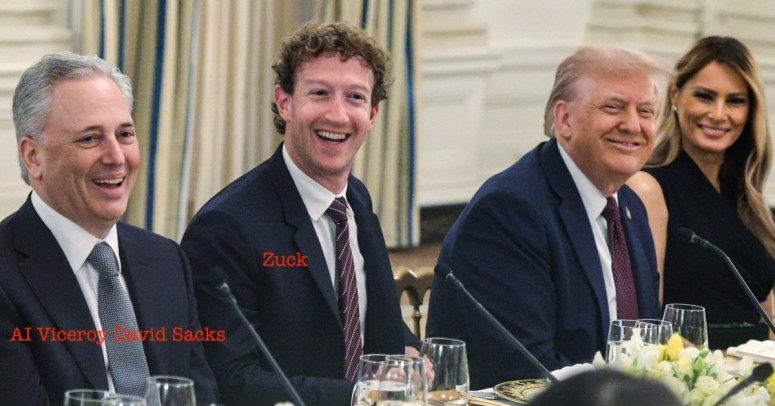
Senator Marsha Blackburn released a summary of legislation she is sponsoring that gives us some cause for hope (read it here courtesy of our friends at the Copyright Alliance). Because her bill might be effective, that means Silicon Valley shills will be all over it to try to water it down and, if at all possible, destroy it. That attack of the shills has already started with Silicon Valley’s AI Viceroy in the Trump White House, a guy you may never have heard of named David Sacks. Know that name. Beware that name.

Senator Blackburn’s bill will do a lot of good things, including for protecting copyright. But the first substantive section of Senator Blackburn’s summary is a game changer. She would establish an obligation on AI platforms to be responsible for known or predictable harm that can befall users of AI products. This is sometimes called a “duty of care.”

Her summary states:

Place a duty of care on AI developers in the design, development, and operation of AI platforms to prevent and mitigate foreseeable harm to users. Additionally, this section requires:

• AI platforms to conduct regular risk assessments of how algorithmic systems, engagement mechanics, and data practices contribute to psychological, physical, financial, and exploitative harms.

• The Federal Trade Commission (FTC) to promulgate rules establishing minimum reasonable safeguards.

At its core, Senator Blackburn’s AI bill tries to force tech companies to play by rules that most other industries have followed for decades: if you design a product that predictably harms people, you have a responsibility to fix it.

That idea is called “products liability.” Simply put, it means companies can’t sell dangerous products and then shrug it off when people get hurt. Sounds logical, right? Sounds like what you would expect would happen if you did the bad thing? Car makers have to worry about the famous exploding gas tanks. Toy manufacturers have to worry about choking hazards. Drug companies have to test side effects. Tobacco companies….well, you know the rest. The law doesn’t demand perfection—but it does demand reasonable care and imposes a “duty of care” on companies that put dangerous products into the public.

Blackburn’s bill would apply that same logic to AI platforms. Yes, the special people would have to follow the same rules as everyone else with no safe harbors.

Instead of treating AI systems as abstract “speech” or neutral tools, the bill treats them as what they are: products with design choices. Those choices that can foreseeably cause psychological harm, financial scams, physical danger, or exploitation. Recommendation algorithms, engagement mechanics, and data practices aren’t accidents. They’re engineered. At tremendous expense. One thing you can be sure of is that if Google’s algorithms behave a certain way, it’s not because the engineers ran out of development money. The same is true of ChatGPT, Grok, etc. On a certain level of reality, this is very likely not guess work or predictability. It’s “known” rather than “should have known.” These people know exactly what their algorithms do. And they do it for the money.

The bill would impose that duty of care on AI developers and platform operators. A duty of care is a basic legal obligation to act reasonably to prevent foreseeable harm. “Foreseeable” doesn’t mean you can predict the exact victim or moment—it means you can anticipate the type of harm that flows to users you target from how the system is built.

To make that duty real, the bill would require companies to conduct regular risk assessments and make them public. These aren’t PR exercises. They would have to evaluate how their algorithms, engagement loops, and data use contribute to harms like addiction, manipulation, fraud, harassment, and exploitation.

They do this already, believe it. What’s different is that they don’t make it public, anymore than Ford made public the internal research that the Pinto’s gas tank was likely to explode. In other words, platforms would have to look honestly at what their systems actually do in the world—not just what they claim to do.

The bill also directs the Federal Trade Commission (FTC) to write rules establishing minimum reasonable safeguards. That’s important because it turns a vague obligation (“be responsible”) into enforceable standards (“here’s what you must do at a minimum”). Think of it as seatbelts and crash tests for AI systems.

So why do tech companies object? Because many of them argue that their algorithms are protected by the First Amendment—that regulating how recommendations work is regulating speech. Yes, that is a load of crap. It’s not just you, it really is BS.

Imagine Ford arguing that an exploding gas tank was “expressive conduct”—that drivers chose the Pinto to make a statement, and therefore safety regulation would violate Ford’s free speech rights. No court would take that seriously. A gas tank is not an opinion. It’s an engineered component with known risks and risks that were known to the manufacturer.

AI platforms are the same. When harm flows from design decisions—how content is ranked, how users are nudged, how systems optimize for engagement—that’s not speech. That’s product design. You can measure it, test it, audit it, which they do and make it safer which they don’t.

This part of Senator Blackburn’s bill matters because platform design shapes culture, careers, and livelihoods. Algorithms decide what gets seen, what gets buried, and what gets exploited. Blackburn’s bill doesn’t solve every problem, but it takes an important step: it says tech companies can’t hide dangerous products behind free-speech rhetoric anymore.

If you build it, and it predictably hurts people, you’re responsible for fixing it. That’s not censorship. It’s accountability. And people like Marc Andreessen, Sam Altman, Elon Musk and David Sacks will hate it.

@ArtistRights Newsletter 8/18/25: From Jimmy Lai’s show trial in Hong Kong to the redesignation fight over the Mechanical Licensing Collective, this week’s stories spotlight artist rights, ticketing reform, AI scraping, and SoundExchange’s battle with SiriusXM.

Save the Date! September 18 Artist Rights Roundtable in Washington produced by Artist Rights Institute/American University Kogod Business & Entertainment Program. Details at this link!

Artist Rights

JIMMY LAI’S ORDEAL: A SHOW TRIAL THAT SHOULD SHAME THE WORLD (MusicTechPolicy/Chris Castle)

Redesignation of the Mechanical Licensing Collective

Ex Parte Review of the MLC by the Digital Licensee Coordinator

Ticketing

StubHub Updates IPO Filing Showing Growing Losses Despite Revenue Gain (MusicBusinessWorldwide/Mandy Dalugdug)

Lewis Capaldi Concert Becomes Latest Ground Zero for Ticket Scalpers (Digital Music News/Ashley King)

Who’s Really Fighting for Fans? Chris Castle’s Comment in the DOJ/FTC Ticketing Consultation (Artist Rights Watch)

Artificial Intelligence

MUSIC PUBLISHERS ALLEGE ANTHROPIC USED BITTORRENT TO PIRATE COPYRIGHTED LYRICS(MusicBusinessWorldwide/Daniel Tencer)

AI Weather Image Piracy Puts Storm Chasers, All Americans at Risk (Washington Times/Brandon Clemen)

TikTok After Xi’s Qiushi Article: Why China’s Security Laws Are the Whole Ballgame (MusicTechSolutions/Chris Castle)

Reddit Will Block the Internet Archive (to stop AI scraping) (The Verge/Jay Peters) 

SHILLING LIKE IT’S 1999: ARS, ANTHROPIC, AND THE INTERNET OF OTHER PEOPLE’S THINGS(MusicTechPolicy/Chris Castle)

SoundExchange v. SiriusXM

SOUNDEXCHANGE SLAMS JUDGE’S RULING IN SIRIUSXM CASE AS ‘ENTIRELY WRONG ON THE LAW’(MusicBusinessWorldwide/Mandy Dalugdug)

PINKERTONS REDUX: ANTI-LABOR NEW YORK COURT ATTEMPTS TO CUT OFF LITIGATION BY SOUNDEXCHANGE AGAINST SIRIUS/PANDORA (MusicTechPolicy/Chris Castle)

FTC Cracks Down on Ticket Scalpers in Major BOTS Act Enforcement

The wheels of justice turn slowly, but they do turn.

In what appears to be a response to NITO’s complaint filed last year with FTC, pressure from Senator Marsha Blackburn and President Trump’s executive order on ticket scalping, Hypebot reports that the Federal Trade Commission is going after large-scale ticket resellers for violating the Better Online Ticket Sales (BOTS) Act (authored by Senators Blackburn and Richard Blumenthal). 

The enforcement action seeks tens of millions of dollars in damages and signals that federal regulators are finally prepared to tackle the systemic abuse of automated tools and deceptive practices in the live event ticketing market.

According to Hypebot, the FTC alleges that the companies used bots and a web of pseudonymous accounts to bypass ticket purchasing limits—snagging prime seats to high-demand concerts and reselling them at inflated prices on platforms like StubHub and SeatGeek. The case represents one of the largest BOTS Act enforcement efforts to date. 

“The FTC is finally doing what artists, managers, and fans have been asking for: holding scalpers accountable,” said Randy Nichols, artist manager for Underoath and advocate for ticketing reform. “This sends a message to bad actors that the days of unchecked resale are numbered.”

As Hypebot reports, this enforcement may just be the beginning. The case is likely to test the limits of the BOTS Act and could set new precedent for what counts as deceptive or unfair conduct in the ticket resale market—even when bots aren’t directly involved.

Read the full story via HypebotFTC Goes After Ticket Scalpers, Seeks Tens of Millions in Damages

@FTC to AI (and other) Companies: Quietly Changing Your Terms of Service Could Be Unfair or Deceptive

An important position paper from the Federal Trade Commission about AI:

You may have heard that “data is the new oil”—in other words, data is the critical raw material that drives innovation in tech and business, and like oil, it must be collected at a massive scale and then refined in order to be useful. And there is perhaps no data refinery as large-capacity and as data-hungry as AI. 

Companies developing AI products, as we have noted, possess a continuous appetite for more and newer data, and they may find that the readiest source of crude data are their own userbases. But many of these companies also have privacy and data security policies in place to protect users’ information. These companies now face a potential conflict of interest: they have powerful business incentives to turn the abundant flow of user data into more fuel for their AI products, but they also have existing commitments to protect their users’ privacy….

It may be unfair or deceptive for a company to adopt more permissive data practices—for example, to start sharing consumers’ data with third parties or using that data for AI training—and to only inform consumers of this change through a surreptitious, retroactive amendment to its terms of service or privacy policy. (emphasis in original)…

The FTC will continue to bring actions against companies that engage in unfair or deceptive practices—including those that try to switch up the “rules of the game” on consumers by surreptitiously re-writing their privacy policies or terms of service to allow themselves free rein to use consumer data for product development. Ultimately, there’s nothing intelligent about obtaining artificial consent.

Read the post on FTC