Stubhub & Co. Launch Stealth state-by-state legislative offensive strategy for Astroturf “Model” State Ticketing Laws

By Chris Castle

Yes, it’s kismet in the legislature–the sketchy ticket resellers are redoubling their efforts to normalize “speculative tickets.” They have found a willing partner in gaslighting with an organization called “ALEC”.

The American Legislative Exchange Council (hence “ALEC“) is a nonprofit organization that brings together private sector representatives and relatively conservative state legislators to draft (and pass) “model legislation” that pushes a particular narrative. (That private sector representation is led by Netchoice, aka, Big Tech.) Unlike other model legislation with a social benefit like say the Uniform Partnership Act, ALEC’s “model legislation” pushes a particular agenda. Examples would be “stand your ground” gun laws, Voter ID laws, and “right to work” laws.

Netchoice Members (Netchoice leads ALEC’s Private Enterprise Advisory Council)

ALEC’s many successfully-passed “model” laws are intended to be passed by state legislatures as-written. Like Al Capone’s green beer, it ain’t meant to be good it’s meant to be drunk. A cynic–not mentioning the names of any particular cynics–might say that the ALEC strategy is an end-run around federal legislation (like the fake library legislation that was shot down in New York). If ALEC can get a critical mass of states to pass one of their “model bills” as-drafted on any particular subject, then the need for federal legislation on that topic may become more muted. In fact, if federal legislation becomes inevitable, the ALEC model bills then provide guidance for federal legislation, or new federal legislation has to draft around the states that adopt the model bill.

So much for Justice Louis Brandeis’ concept of states as laboratories of democracy (New State Ice Co. v. Liebmann, 285 U.S. 262 (1932)), unless that lab belongs to Dr. Frankenstein. ALEC’s mission claims to promote principles of limited government, free markets, and federalism; I will leave you to decide if it’s more about checkbook federalism.

Ticketing Panel, Artist Rights Symposium 11/20/24, Washington DC
L-R: Chris Castle (Artist Rights Institute), Dr. David Lowery (Univ. of Georgia, Terry College of Business), Mala Sharma (Georgia Music Partners), Stephen Parker (National Independent Venue Association), Kevin Erickson (Future of Music Coalition)

Like so many of these bills, ALEC’s Live Event Ticketing Consumer Protection & Reform Act disguises its true objective with a bunch of gaslighting bromides that they evidently believe to be persuasive and then when you’re not looking they slip in the knife. Then when the knife is protruding from your back you discover the true purpose. I think this section of the bill is the true purpose:

This is an odd construct. The model bill starts out by requiring positive behavior of a primary seller (which would be the band on fan club sales or other direct to fan sales). That positive behavior immediately turns to using the ticket purchaser into an enforcer of the values beneficial to the ticket reseller. This is done by forcing a purchaser to be able to resell their ticket without regard to any restrictions placed on reselling by the artist. 

And you know that’s the intention because the section also requires there to be no maximum or minimum price. While the model bill doesn’t require any particular restriction on the platforms, it has enough in it that it can look like a consumer protection bill, but what it is really doing and apparently was designed to accomplish is eliminate an artist’s a ability to set prices.

ALEC is serious about violations of the act, including civil penalties. Their model ticketing legislation can be enforced by both the Federal Trade Commission and state attorneys general. Penalties can include fines of up to $15,000 per day of violation and $1,000 per event ticket advertised or sold. One problem with the model bill is that it appropriates jurisdiction already available to federal agencies like the FTC which is already failing to enforce the existing BOTS Act and other property theft laws.

The main targets seem to be Stubhub’s competitors like “Primary Ticket Merchants,” These are the original sellers of event tickets, such as event organizers or venues. “Secondary Ticket Merchants” may also be prosecuted as well as individuals.

We continue to study the proposed model legislation, but I tend to agree with Stephen Parker (NIVA) and Kevin Erickson (Future of Music) on my Artist Rights Institute panel in DC yesterday. The better model bill may be their bill passed in Maryland, recently signed into law by Maryland governor Wes More.

Key differences between Maryland and the ALEC bill I could spot:

  • Scope of Penalties: The Maryland bill specifies fines for speculative ticket sales, while the ALEC bill includes broader penalties for various violations.
  • Refund Policies: The Maryland bill explicitly requires refunds for counterfeit tickets, canceled events, or mismatched tickets, whereas the ALEC bill focuses more on transparency and restrictive practices.
  • Study on Resale Impact: The Maryland bill includes a provision for studying the impact of resale price caps, which is not present in the ALEC bill.

    It appears that the Live Event Ticketing Consumer Protection & Reform Act will be introduced at the ALEC meeting on December 5, 2024. This is where ALEC members, including state legislators and private sector representatives, will discuss and vote on the model policy. 

    Watch this space.

Updates for Nov. 20 @ArtistRights Symposium at @AmericanU @KogodBiz in Washington DC

We are announcing the time schedule and speakers for the 4th annual Artist Rights Symposium on November 20. The symposium is supported by the Artist Rights Institute and was founded by Dr. David C. Lowery, Lecturer at the University of Georgia Terry College of Business.

This year the symposium is hosted in Washington, DC, by American University’s Kogod School of Business at American’s Constitution Hall, 4400 Massachusetts Avenue, NW, Washington, DC 20016.  We are also pleased to have a Kogod student presentation on speculative ticketing as part of the speaker lineup.

Admission is free, but please reserve a spot with Eventbrite, seating is limited!

The symposium starts at 8:30 am and ends with a reception at 4:30pm. The symposium will be recorded as an audiovisual presentation for distribution at a later date, but will not be live-streamed. If you attend, understand that you may be filmed in any audience shots, questions from the floor or still images. The symposium social media hashtag is #ArtistRightsKogod.

Schedule

8:30 — Doors open, networking coffee.

9:00-9:10 — Welcome remarks by David Marchick, Dean, Kogod School of Business

9:10-9:15 — Welcome remarks by Christian L. Castle, Esq., Director, Artist Rights Institute

9:15-10:15 — THE TROUBLE WITH TICKETS:  The Challenges of Ticket Resellers and Legislative Solutions:

Kevin Erickson, Director, Future of Music Coalition, Washington DC
Dr. David C. Lowery, Co-founder of Cracker and Camper Van Beethoven, University of Georgia
  Terry College of Business, Athens, Georgia
Stephen Parker, Executive Director, National Independent Venue Association, Washington DC
Mala Sharma, President, Georgia Music Partners, Atlanta, Georgia

Moderator:  Christian L. Castle, Esq., Director, Artist Rights Institute, Austin, Texas

10:15-10:30: NIVA Speculative Ticketing Project Presentation by Kogod students

10:30-10:45: Coffee break

10:45-11:00: OVERVIEW OF CURRENT ISSUES IN ARTIFICIAL INTELLIGENCE LITIGATION: Kevin Madigan, Vice President, Legal Policy and Copyright Counsel, Copyright Alliance

11:00-12 pm: SHOW ME THE CREATOR – Transparency Requirements for AI Technology:

Danielle Coffey, President & CEO, News Media Alliance, Arlington, Virginia
Dahvi Cohen, Legislative Assistant, U.S. Congressman Adam Schiff, Washington, DC
Ken Doroshow, Chief Legal Officer, Recording Industry Association of America, Washington DC 

Moderator: Linda Bloss-Baum, Director of the Kogod School of Business’s Business & Entertainment Program

12:00-12:30: Lunch break

12:30-1:30: Keynote: Graham Davies, President and CEO of the Digital Media Association, Washington DC.

1:30-1:45: Coffee break

1:45-2:45: CHICKEN AND EGG SANDWICH:  Bad Song Metadata, Unmatched Funds, KYC and What You Can Do About It

Richard James Burgess, MBE, President & CEO, American Association of Independent Music, New York
Helienne Lindvall, President, European Composer & Songwriter Alliance, London, England
Abby North, President, North Music Group, Los Angeles
Anjula Singh, Chief Financial Officer and Chief Operating Officer, SoundExchange, Washington DC

Moderator:  Christian L. Castle, Esq, Director, Artist Rights Institute, Austin, Texas

2:45-3:15: Reconvene across street to International Service Founders Room for concluding speakers and reception

3:15-3:30: OVERVIEW OF INTERNATIONAL ARTIFICIAL INTELLIGENCE LEGISLATION: George York, Senior Vice President International Policy from RIAA.

3:30-4:30: NAME, IMAGE AND LIKENESS RIGHTS IN THE AGE OF AI:  Current initiatives to protect creator rights and attribution

Jeffrey Bennett, General Counsel, SAG-AFTRA, Washington, DC
Jen Jacobsen, Executive Director, Artist Rights Alliance, Washington DC
Jalyce E. Mangum, Attorney-Advisor, U.S. Copyright Office, Washington DC

Moderator
John Simson, Program Director Emeritus, Business & Entertainment, Kogod School of Business, American University

4:30-5:30: Concluding remarks by Linda Bloss-Baum, Director of the Kogod School of Business’s Business & Entertainment Program and reception.

NAME, IMAGE AND LIKENESS RIGHTS: New Speaker Update for Nov. 20 @ArtistRights Symposium at @AmericanU @KogodBiz in Washington DC

We are announcing more topics and new speakers for the 4th annual Artist Rights Symposium on November 20, this year hosted in Washington, DC, by American University’s Kogod School of Business at American’s Constitution Hall, 4400 Massachusetts Avenue, NW, Washington, DC 20016.  The symposium is also supported by the Artist Rights Institute and was founded by Dr. David Lowery, Lecturer at the University of Georgia Terry College of Business.

We’re pleased to add an overview of artificial intelligence litigation in the US by Kevin Madigan, Vice President, Legal Policy and Copyright Counsel from the Copyright Alliance and an overview of international artificial intelligence-related legislation by George York, Senior Vice President International Policy from RIAA. We’re also announcing our fourth panel and speaker line up:

NAME, IMAGE AND LIKENESS RIGHTS IN THE AGE OF AICurrent initiatives to protect creator rights and attribution

Jeffrey Bennett, General Counsel, SAG-AFTRA, Washington, DC
Jen Jacobson, Executive Director, Artist Rights Alliance, Washington DC
Jalyce E. Mangum, Attorney-Advisor, U.S. Copyright Office, Washington DC

Moderator
: John Simson, Program Director Emeritus, Business & Entertainment, Kogod School of Business, American University

Panels will begin at 8:30 am and end by 5 pm, with lunch and refreshments. More details to follow. Contact the Artist Rights Institute for any questions.

Admission is free, but please reserve a spot with Eventbrite, seating is limited! (Eventbrite works best with Firefox)

Previously confirmed panelists are:

Keynote: Graham Davies, President and CEO of the Digital Media Association, Washington DC.  Graham will speak around lunchtime.

CHICKEN AND EGG SANDWICH:  Bad Song Metadata, Unmatched Funds, KYC and What You Can Do About It

Richard James Burgess, MBE, President & CEO, American Association of Independent Music, New York
Helienne Lindvall, President, European Composer & Songwriter Alliance, London, England
Abby North, President, North Music Group, Los Angeles
Anjula Singh, Chief Financial Officer and Chief Operating Officer, SoundExchange, Washington DC

Moderator:  Christian L. Castle, Esq, Director, Artist Rights Institute, Austin, Texas

SHOW ME THE CREATOR – Transparency Requirements for AI Technology:

Danielle Coffey, President & CEO, News Media Alliance, Arlington, Virginia
Dahvi Cohen, Legislative Assistant, U.S. Congressman Adam Schiff, Washington, DC
Ken Doroshow, Chief Legal Officer, Recording Industry Association of America, Washington DC 

Moderator: Linda Bloss-Baum, Director of the Kogod School of Business’s Business & Entertainment Program

THE TROUBLE WITH TICKETS:  The Economics and Challenges of Ticket Resellers and Legislative Solutions:

Kevin Erickson, Director, Future of Music Coalition, Washington DC
Dr. David C. Lowery, Co-founder of Cracker and Camper Van Beethoven, University of Georgia
  Terry College of Business, Athens, Georgia
Stephen Parker, Executive Director, National Independent Venue Association, Washington DC
Mala Sharma, President, Georgia Music Partners, Atlanta, Georgia

Moderator:  Christian L. Castle, Esq., Director, Artist Rights Institute, Austin, Texas

CHICKEN AND EGG SANDWICH:  Bad Song Metadata, Unmatched Funds, KYC and What You Can Do About It: Speaker Update for Nov. 20 @ArtistRights Symposium at @AmericanU @KogodBiz in Washington DC

We’re pleased to announce additional speakers for the 4th annual Artist Rights Symposium on November 20, this year hosted in Washington, DC, by American University’s Kogod School of Business at American’s Constitution Hall, 4400 Massachusetts Avenue, NW, Washington, DC 20016.  The symposium is also supported by the Artist Rights Institute and was founded by Dr. David Lowery, Lecturer at the University of Georgia Terry College of Business.

The Symposium has four panels and a lunchtime keynote. Panels will begin at 8:30 am and end by 5 pm, with lunch and refreshments. More details to follow. Contact the Artist Rights Institute for any questions.

Admission is free, but please reserve a spot with Eventbrite, seating is limited! (Eventbrite works best with Firefox)

Keynote: Graham Davies, President and CEO of the Digital Media Association, Washington DC.  Graham will speak around lunchtime.

We have confirmed speakers for another topic! 

CHICKEN AND EGG SANDWICH:  Bad Song Metadata, Unmatched Funds, KYC and What You Can Do About It

Richard James Burgess, MBE, President & CEO, American Association of Independent Music, New York
Helienne Lindvall, President, European Composer & Songwriter Alliance, London, England
Abby North, President, North Music Group, Los Angeles
Anjula Singh, Chief Financial Officer and Chief Operating Officer, SoundExchange, Washington DC

Moderator:  Christian L. Castle, Esq, Director, Artist Rights Institute, Austin, Texas

Previously confirmed panelists are:

SHOW ME THE CREATOR – Transparency Requirements for AI Technology:

Danielle Coffey, President & CEO, News Media Alliance, Arlington, Virginia
Dahvi Cohen, Legislative Assistant, U.S. Congressman Adam Schiff, Washington, DC
Ken Doroshow, Chief Legal Officer, Recording Industry Association of America, Washington DC 

Moderator: Linda Bloss-Baum, Director of the Kogod School of Business’s Business & Entertainment Program

THE TROUBLE WITH TICKETS:  The Economics and Challenges of Ticket Resellers and Legislative Solutions:

Kevin Erickson, Director, Future of Music Coalition, Washington DC
Dr. David C. Lowery, Co-founder of Cracker and Camper Van Beethoven, University of Georgia
  Terry College of Business, Athens, Georgia
Stephen Parker, Executive Director, National Independent Venue Association, Washington DC
Mala Sharma, President, Georgia Music Partners, Atlanta, Georgia

Moderator:  Christian L. Castle, Esq., Director, Artist Rights Institute, Austin, Texas

SHOW ME THE CREATOR – Transparency Requirements for AI Technology: Speaker Update for Nov. 20 @ArtistRights Symposium at @AmericanU @KogodBiz in Washington DC

We’re pleased to announce more speakers for the 4th annual Artist Rights Symposium on November 20, this year hosted in Washington, DC, by American University’s Kogod School of Business at American’s Constitution Hall, 4400 Massachusetts Avenue, NW, Washington, DC 20016.  The symposium is also supported by the Artist Rights Institute and was founded by Dr. David Lowery, Lecturer at the University of Georgia Terry College of Business.

The four panels will begin at 8:30 am and end by 5 pm, with lunch and refreshments. More details to follow. Contact the Artist Rights Institute for any questions.

Admission is free, but please reserve a spot with Eventbrite, seating is limited! (Eventbrite works best with Firefox)

Keynote: Graham Davies, President and CEO of the Digital Media Association, Washington DC.  Graham will speak around lunchtime.

We have confirmed speakers for another topic! 

SHOW ME THE CREATOR – Transparency Requirements for AI Technology:

Danielle Coffey, President & CEO, News Media Alliance, Arlington, Virginia
Dahvi Cohen, Legislative Assistant, U.S. Congressman Adam Schiff, Washington, DC
Ken Doroshow, Chief Legal Officer, Recording Industry Association of America, Washington DC 

Moderator: Linda Bloss-Baum, Director of the Kogod School of Business’s Business & Entertainment Program

Previously announced:

THE TROUBLE WITH TICKETS:  The Economics and Challenges of Ticket Resellers and Legislative Solutions:

Kevin Erickson, Director, Future of Music Coalition, Washington DC
Dr. David C. Lowery, Co-founder of Cracker and Camper Van Beethoven, University of Georgia
  Terry College of Business, Athens, Georgia
Stephen Parker, Executive Director, National Independent Venue Association, Washington DC
Mala Sharma, President, Georgia Music Partners, Atlanta, Georgia

Moderator:  Christian L. Castle, Esq., Director, Artist Rights Institute, Austin, Texas

Future of Music Coalition Warns Against Vendor Lock-in in Copyright Office Comments

[The Future of Music Coalition joins the chorus of concern about shenanigans at The MLC, Inc. with special access and treatment of its vendors regarding the “public” database. As others have pointed out, there’s a real question as to whether The MLC, Inc. is actually building its own database or is just building up the data muscle of its vendor the Harry Fox Agency (formerly owned by MLC promoter and nonvoting board member NMPA. The MLC is prohibited by law from licensing other than the narrow window of streaming mechanicals, but HFA is not.]

[I]t’s important that MLC’s chosen vendors not be able to leverage their
status with the MLC to advantage themselves in other business activities not covered under the MMA. If a vendor was able to leverage its status with MLC to the detriment of competitors in other kinds of licensing activity (even informally), that wouldn’t serve competition, consumers, or creators. Additionally, the Office needs to ensure that provisions about database vendors being replaceable are meaningful.

We see no reason to expect that the MLC’s chosen vendors aren’t up to the task, but songwriters and composers need assurance that if a vendor ends up having problems and a change is necessary, that change will really be possible.

The Office can require the MLC to disclose what it is doing to prevent any vendor from being too operationally enmeshed with the MLC that it either enjoys an unfair advantage through that relationship, or that it would be practically impossible for another vendor to step in.

Read the entire post here.

Future of Music Coalition Suggestions to US Copyright Office on MLC Oversight Regulations

In our continuing review of comments on the Mechanical Licensing Collective, the Future of Music Coalition’s filing is an instructive read.  FOMC has put its finger on two core issues for Copyright Office regulations–the importance of trust in the MLC and the cost to independent publishers and songwriters of handing over all their data to the MLC for the celestial database.

The question of who will pay for these data costs is one of the issues that’s most confusing about the MLC’s messaging as well as the messaging from many groups who encouraged songwriters to support both the blanket compulsory and the “industry consensus” MLC now in control.  Originally, we were all told that “the services will pay for it,” and indeed the services are paying millions for something.  So far, however, we have not seen any budget allocated to compensating the songwriters who will be contributing data at their own expense to MLC’s core asset.

Although FOMC didn’t bring this up directly, they certainly got that thought process going.  If a publisher already has invested substantial resources in cleaning and normalizing their data, participating in MLC may not be a high cost of admission.  But if a publisher has invested in data that is sufficient for them to operate before MMA (say Excel spreadsheets), but is not reasonably exportable to MLC, then the publisher’s choice is find the money to cover these transaction costs or don’t participate. And not participating leads to the black box.

In a streaming economy where per-stream royalties start three or four decimal places to the right if  you’re lucky, the cost of the ticket may well exceed the revenue.  That will weaken the system, so those who benefit from the millions invested in MLC should arguably pay for those transaction costs.

We should also all be mindful of the CISAC and BIEM comment and remember that non-US songwriters could be in a similar position or may simply not be aware that they have to comply with the formalities of registering with the MLC (possibly separately from their own home country collecting society) or even separate from registering for copyright in the US (which will be some but not all non-US songwriters by any stretch).  Even if songwriters don’t register for copyright with the Copyright Office they will still have to register their works with the MLC unless there’s some reliable work around that presents itself in the future.

With that in mind, this passage from the FOMC comment is particularly illuminating:

The success of the new mechanical royalty system created by MMA is dependent on broad participation, and participation is dependent on trust. Unfortunately, cultivating trust can be challenging in the music industries, where old stories of exploitation and bureaucratic failure are plentiful. Different stakeholders may have vastly different levels of legal sophistication, technical skill, and access to resources.  The Copyright Office’s task in its rulemakings is to optimize for trust and accountability for all parties, and should give special consideration to the needs of creators who might otherwise lack leverage. This outcome would not be to the sole benefit of creators, but would benefit all stakeholders. The more accountability, detailed guidance, and ongoing oversight the Office empowers itself to offer the MLC, the more successful the entire endeavor will be.

You should really spend a little time reading the FOMC submission.  It’s not that long but filled with nuggets.

What comes from the Copyright Office in the regulations governing the MLC may be the most important part of this entire process given the flawed parts and omissions from MMA.

New Adventures in Copyright Enforcement @SXSW #SXSW

Friday, March 14 | 2:00PM – 3:00PM
New Adventures in Copyright Enforcement
Austin Convention Center | Room 17B | 500 E Cesar Chavez St

lthough debates about how to protect copyright online might seem so 2010, they certainly haven’t abated. The current conversations aren’t as contentious as the SOPA skirmishes, but that doesn’t necessarily mean consensus. Current attempts to address piracy are taking place outside of Congress, and include efforts to establish “best practices” between stakeholders. From the recently-minted Copyright Alert System to voluntary agreements meant to curb unauthorized activity within ad networks and payment processors, new experiments in rights protection abound. What’s the thinking behind the various approaches? What does a “win” look like, and what are the parameters for oversight? How can artists get involved?

MMODERATOR
Casey Rae
Interim Exec Dir – Future of Music Coalition

Sherwin Siy
VP, Legal Affairs- Public Knowledge

Jill Lesser
Exec Dir- Center For Copyright Information

David Lowery
Musician/Internet Content Provider – Cracker

Two Sincere Questions for The Future Of Music Coalition #SFMUSICTECH

We notice that Future of Music Coalition has submitted testimony to congress asking that they “represent” artists in the Copyright Reform process begun by Congress.

So since they’ve  volunteered to represent us.  We feel it only fair that they answer these two questions:

1. Who selects your advocacy positions?  
AFM, AFTRA, NARAS, Nashville Songwriters Assn, and ASCAP all have democratically elected boards who set the organizations’ positions.  Do you have members who vote for leadership?  If not, who is making those decisions?

2. Who funds your organization?
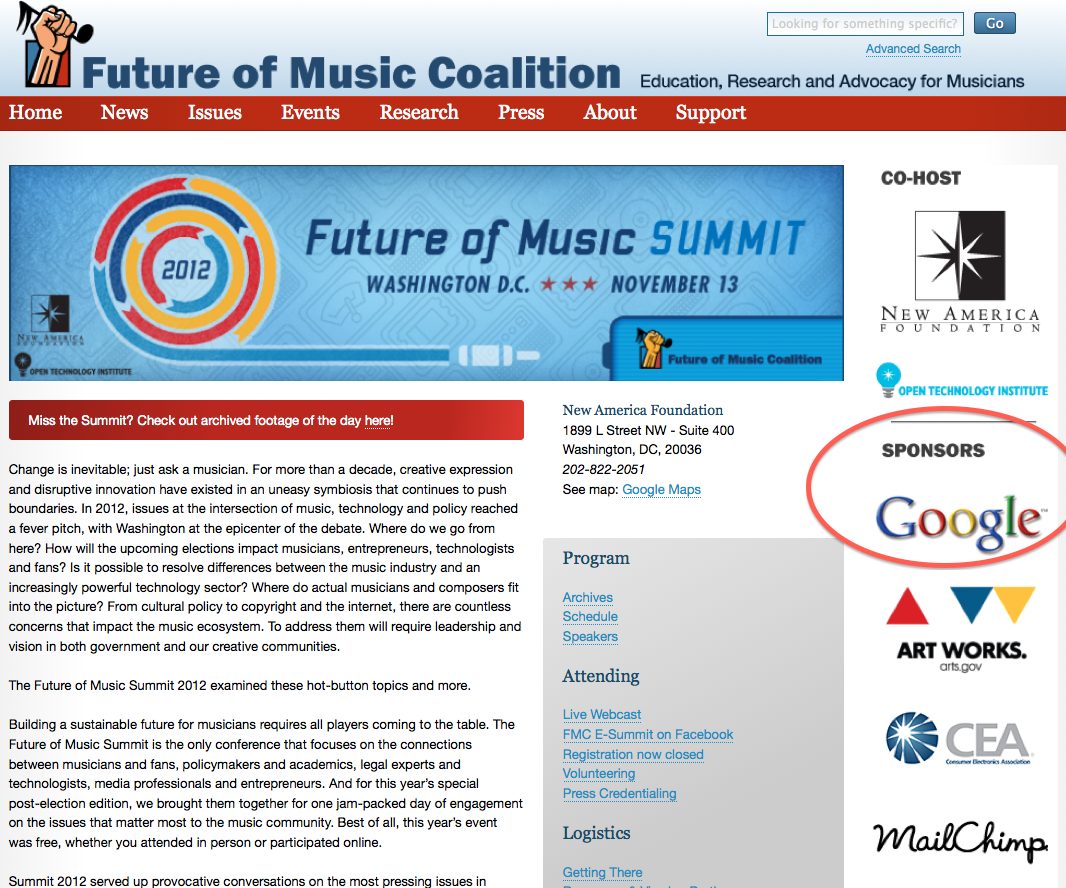
Google is listed as your first sponsor of your primary event.
http://futureofmusic.org/events/future-music-summit-2012

How much money do you get from Google?  Do you think you should be taking funding from a source many artists believe to be opposed to their interests?

FOMC Spondors

How Musicians Are (Not) Making Money, and who is… @SFMusicTech w/ East Bay Ray

SF Music Tech is always a great place to get the temperature of the current ideology and trends relating to music and technology. Brian Zisk does a great job of creating an environment for the tech community to explore it’s relationship to music and musicians.

Respect Musicians Choices. Musicians need to get Paid.

Artists should have creative control over their work, their careers and they should be paid fairly. We couldn’t agree more. This sentiment was echoed by Emily White of Whitesmith Entertainment on one panel and was ofter heard repeated during the day. Whenever there was a “shout out” to give props to musicians it was almost always met with universal applause from the audience regardless of the panel topic.

During the day the mantra of how artists deserved respect and payment was heard over and over. Everyone loves musicians. Musicians need to be paid. But some struggled to truly accept this as a universal concept that extended to businesses operating on the internet as well.

We’ve all heard the stories of musicians being exploited by record labels, music publishers, band managers, booking agents, etc. These tales are almost universally met with disgust, as they should be. But when artist exploitation takes the form corporate profiteering on the internet the tech community often recoils into a bit of selective reasoning and double standards.

So let us say this loud and clear about people throwing stones inside of glass houses… any wrong doing of illegally exploiting musicians for corporate profiteering should be unacceptable even it is happening on the internet.

How Musicians Are (Not) Making Money

Kristin Thompson from the Future OF Music Coalition noted that even though there may be many new revenue streams available to musicians, many of them only pay “micro pennies.” The consensus was clear and perhaps best summed up by Incubus manager Steve Rennie who essentially said, “eventually this should all work it self out where musicians can earn professional careers again, but the timing might just be really bad for this generation of musicians, and that’s the luck of the draw in life.” We actually don’t find that to be encouraging.

The irony and the disconnect didn’t take long to surface when East Bay Ray from the Dead Kennedy’s pointed out how exactly musicians don’t get paid from corporately funded music piracy sites when he showed a screenshot from mp3skull providing free downloads of his bands music financed by 1-800 Flowers and Alaska Airlines.

Willful Blindness

Of course those who believe in the exploitation of musicians for the profit of internet businesses had no problem rapidly resorting to name calling when it would be a lot more productive to acknowledge the problem as a detriment to the livelihood of musicians, and seek to work towards a cooperative solution to help musicians get paid.

What about Transparency, Being Open and More Human?

Ray went on to note how the negative effects of these sites create an environment that allows companies like YouTube to operate as an opaque black box. Using the best publicly available information he quickly calculated that YouTube’s 35% payment to artists (versus Itunes and Spotify’s 70%) could be a contributing factor to the 45% decline in professional musicians in the last decade. By Ray’s calculations (here at Digital Music News) the numbers may create a loss of 12,000 middle class musicians.

The Elephant In The Room

Some would like to argue that the revenue these sites are generating is inconsequential. These people seem to have difficulty understanding that if brand sponsored piracy can support 200,000 infringing domians that Google is tracking in it’s transparency report, then there is clearly enough there that musicians should be getting paid.

The real point is that there appears to be plenty of money being made online from the distribution of music, it’s just that the money is not being “shared” with musicians.

200kDomainsTracked

Any honest conversation about compensation to musicians has to address the single largest detriment to the revenue of artists at any level, which are the ad network financed music piracy sites. Ignoring these sites leaves out the most critical variable in evaluating fair and ethical compensation models when over 200,000 sites pay nothing at all to musicians with unlimited access to illegally free inventory. These sites profit from exploiting musicians and paying the musicians nothing.

Any legally licensed, legitimate music tech start up also has to acknowledge that mass scale, enterprise level, commercial infringement of music does NOT create a better environment for innovative entrepreneurs but rather a much more difficult one.

The truth is, there is no new professional middle class of musicians. The grand experiment of the digital utopia has been a massive failure for musicans and everyone at SF Music Tech now knows it. The soft back peddling by most on old hard line positions shows clearly that the reality for professional musicians has gotten worse, not better.

One of the most overheard phrases of the conference was, “we have to do better to get musicians paid.” Indeed, as we have noted here the truth is self evident, if the Internet is working for musicians, why aren’t more musicians working professionally? Not everyone aspires to work a day job, make music as a hobby and allow internet corporations to profit from their labor, illegally.

“Here we are, stuck with all these people who want music for free,” said Dave Allen, founding member of Gang of Four and interactive strategist at the branding agency North. “We have to find a way for musicians to make a living.”

If the tech and internet community are truly interested in getting musicians paid wouldn’t it make sense to start where money is already being made?