New models, huh?

YouTube’s biggest partners are learning there’s nothing innovative in the exploitation of labor. David Newhoff at The Illusion of More offers this insight…

…the first and most important story is this one about YouTube’s biggest producing partners coming to realize that their revenue doesn’t exactly coincide with increases in viewership.

I can’t say I was surprised to read, “These partners feel that YouTube’s business approach enriches YouTube without making them nearly as wealthy.”  Presumably, this is simply a failure of the partners to embrace the new model of “you make product, we make money.”

READ THE FULL POST HERE AT THE ILLUSION OF MORE:
http://illusionofmore.com/new-models/

YOU MAY ALSO ENJOY:
So Much For Innovation, YouTuber’s Meet The New Boss…

Julian Assange : Google Is Evil in “The New Digital Age”

Very interesting reading as Julian Assange comments on Google, CEO Eric Shchmidt and his book, The New Digital Age. Read on…

“THE New Digital Age” is a startlingly clear and provocative blueprint for technocratic imperialism, from two of its leading witch doctors, Eric Schmidt and Jared Cohen, who construct a new idiom for United States global power in the 21st century. This idiom reflects the ever closer union between the State Department and Silicon Valley, as personified by Mr. Schmidt, the executive chairman of Google, and Mr. Cohen, a former adviser to Condoleezza Rice and Hillary Clinton who is now director of Google Ideas.”

He goes onto say,

“This book is a balefully seminal work in which neither author has the language to see, much less to express, the titanic centralizing evil they are constructing….If you want a vision of the future, imagine Washington-backed Google Glasses strapped onto vacant human faces — forever.”

What does this have to do with artists rights you may ask? Well, the way we see it is that Privacy and Anti-Piracy are bound together by the same common bond of respecting the rights of individual citizens. Which is why individual citizens are granted BOTH the right of individual privacy and the right to protection of their labor under Article 27 of the Universal Declaration of Human Rights.

READ THE FULL ARTICLE AT THE NEW YORK TIMES HERE:
http://www.nytimes.com/2013/06/02/opinion/sunday/the-banality-of-googles-dont-be-evil.html

David Lowery Debates Google on Ad Sponsored Piracy in London

A full transcript of the debate is available at Music Ally. Here’s the set up…

The topic of ad-funded piracy has been increasingly prominent in recent months, with musician David Lowery, Beggars Group founder Martin Mills, music industry body the BPI and the University of Southern California’s Annenberg Innovation Lab (among others) questioning why so many big brands’ ads appear on sites that are engaged in piracy.

Google agrees with David that Music Piracy is a for profit business…

Google’s Theo Bertram gave his company’s view, suggesting that he agreed with most of what Lowery had said. “It does seem to me to be an entirely sensible way to tackle piracy… most people doing piracy are not some guy in his bedroom altruistically sharing music with his friends. It’s people making money out of piracy, and it’s big business: some of these sites have 2m visitors regularly, and they’re not doing a bad business from advertising.”

READ THE FULL TRANSCRIPT AT MUSIC ALLY:
http://musically.com/2013/05/28/live-google-david-lowery-and-the-bpi-talk-ad-funded-piracy/

Ready The Clown Car : Kim Dotcom Contemplates Suing Google, Twitter and Facebook

Serious folks, we can’t make this up.

“Twitter introduces Two-Step-Authentication. Using my invention. But they won’t even verify my Twitter account?!,” Dotcom tweeted.

“Google, Facebook, Twitter, Citibank, etc. offer Two-Step-Authentication. Massive IP (intellectual property) infringement by U.S. companies. My innovation. My patent,” he added.

But it get’s better…

“I never sued them. I believe in sharing knowledge & ideas for the good of society. But I might sue them now cause of what the US did to me,” he said.

However, he said a more productive approach would be if the tech giants helped cover his legal bills to fight prosecution under the Digital Millennium Copyright Act (DCMA), which he estimated would exceed US$50 million.

“Google, Facebook, Twitter, I ask you for help. We are all in the same DMCA boat. Use my patent for free. But please help fund my defence,” he tweeted.

So essentially he’s threatening to sue the very same people he’s asking for money. Interesting strategy. We’re not sure that Google, Facebook and Twitter feel they are in the same boat. It’s difficult to believe these companies would want to be anywhere near the imploding public spectacle known as Kim Dotcom.

READ THE FULL STORY HERE:
http://www.channelnewsasia.com/news/technology/kim-dotcom-mulls-suing-tech-giants-for-c/685072.html

you may also enjoy…

UPDATE:
Kim Dotcom claims he invented two-factor authentication—but he wasn’t first | Ars Technica

Dotcom’s European patent was revoked in 2011 largely because AT&T had a patent on the same technology with a priority date from 1995. (Thanks to Emily Weal of patent law firm Keltie for pointing out Dotcom’s European patent travails in the IP Copy blog.)

While Dotcom’s patent in the US is still in force, AT&T also has a US patent pre-dating hisThe Guardian pointed out that Ericsson and Nokia also have patent filings for two-factor systems predating Dotcom’s.

Two Sincere Questions for The Future Of Music Coalition #SFMUSICTECH

We notice that Future of Music Coalition has submitted testimony to congress asking that they “represent” artists in the Copyright Reform process begun by Congress.

So since they’ve  volunteered to represent us.  We feel it only fair that they answer these two questions:

1. Who selects your advocacy positions?  
AFM, AFTRA, NARAS, Nashville Songwriters Assn, and ASCAP all have democratically elected boards who set the organizations’ positions.  Do you have members who vote for leadership?  If not, who is making those decisions?

2. Who funds your organization?
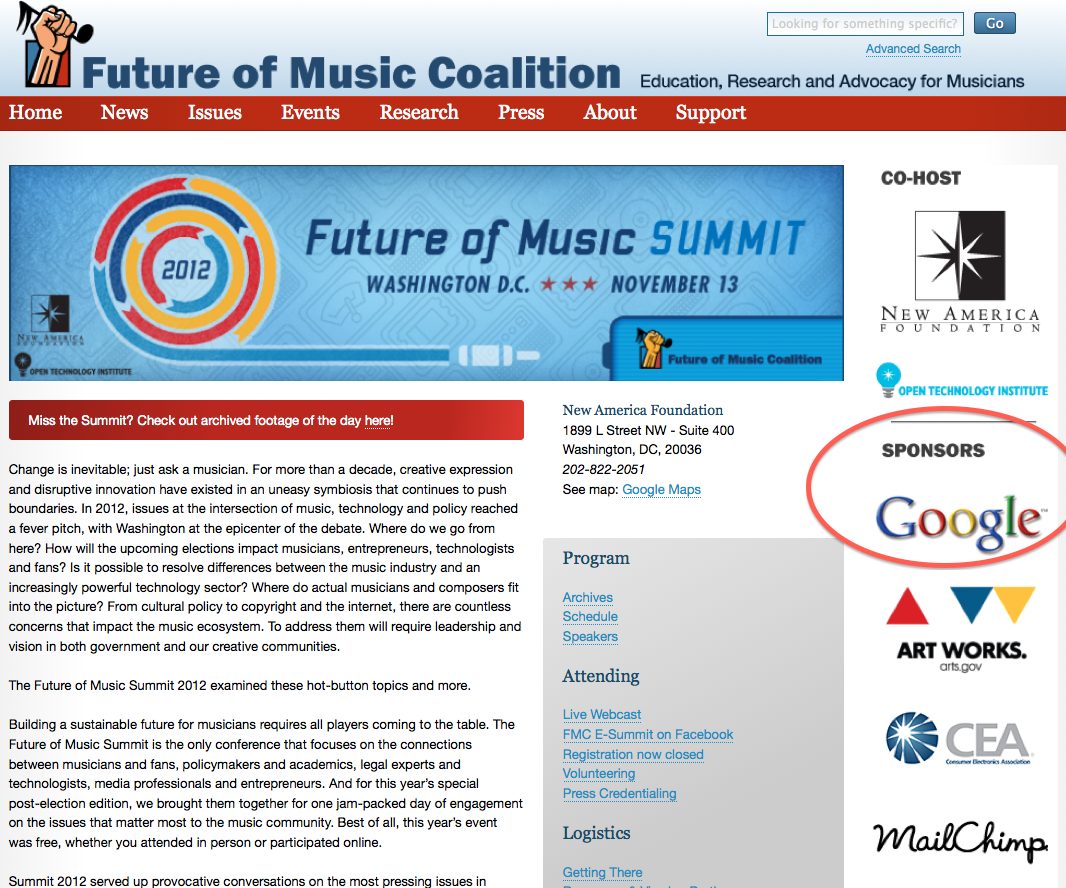
Google is listed as your first sponsor of your primary event.
http://futureofmusic.org/events/future-music-summit-2012

How much money do you get from Google?  Do you think you should be taking funding from a source many artists believe to be opposed to their interests?

FOMC Spondors

The New Ruling Class of Silicon Valley and Their Exploitation Economy

The Daily Beast published a must read on the new ruling class and the transfer of wealth in the economy, America’s New Oligarchs—Fwd.us and Silicon Valley’s Shady 1 Percenters. Of particular interest was one sentence in this paragraph,

Perversely, the small number of jobs—mostly clustered in Silicon Valley—created by tech companies has helped its moguls avoid public scrutiny. Google employs 50,000, Facebook 4,600, and Twitter less than 1,000 domestic workers. In contrast, GM employs 200,000, Ford 164,000, and Exxon over 100,000. Put another way, Google, with a market cap of $215 billion, is about five times larger than GM yet has just one fourth as many workers.

This is an equation that defines inequality: more and more wealth concentrated in fewer hands and benefiting fewer workers.

Here is the operative sentence from the paragraph above with one word added…

Google, with a market cap of $215 billion, is about five times larger than GM yet has just one fourth as many [PAID] workers.

It occurs to us in the new exploitation economy of loser generated content that many people are “working” for Google and other tech companies supplying endless hours of consumer created content from Facebook posts to Instagram photos. That’s just the stuff that people are willing to give away by consent (although we don’t know how much privacy they are actually consenting to give up in the process).

But the larger truth is even more scary. Google and other internet businesses profit greatly by avoiding paying for the cost of the goods they are monetizing (primarily by advertising). YouTube is a company built on infringement and theft as a business model.

In other words, it’s a lot easier to make money when you don’t have to pay for the labor or fixed costs of developing and producing a product. You know products like music, film, books, software, etc.

Obviously if all of these creators and producers were paid fairly in the value chain to which their work is creating revenue, than there would be less profit for the distributor. What we have now is a distribution mechanism that profits without paying the creative producers. Which is exactly how a company like Google can earn such extraordinary wealth, essentially through stolen labor.

Read the whole story here at The Daily Beast:

http://www.thedailybeast.com/articles/2013/05/14/america-s-new-oligarchs-fwd-us-and-silicon-valley-s-shady-1-percenters.html

Artists Rights Watch – Monday Feb 25, 2013

A Weekly Review of Artists Rights, Copyright and Technology News for Creators from Around The Web.

THE NEW YORK TIMES:
* For Music Industry, a Story of Two Googles

…as long as the search side of Google causes friction with the music industry, its other side — the one that is trying to compete with Apple, Amazon and every other digital music service out there — will face some rough patches.

SF GATE:
* New tune at SF MusicTech Summit

The freewheeling era of file sharing, it appears, is slowly coming to a close as artists begin to assert their rights and tech companies consider business alliances with the creators they once flagrantly ignored.

“Here we are, stuck with all these people who want music for free,” said Dave Allen, founding member of Gang of Four and interactive strategist at the branding agency North. “We have to find a way for musicians to make a living.”

SF WEEKLY:
* SF MusicTech: Dead Kennedys’ East Bay Ray Lashes Out at Internet “Pimps”

“There’s opportunists on the Internet that have taken advantage of the artists,” he said, at one point calling them “pimps.” The slim royalties from streaming services, coupled with the proliferation of free MP3s online, meant the music industry was “selling a free ride on a carnival horse, but they’re starving the carnival horse.”

SOLVEIG
* Recap SF Music Tech Summit XII 2013

REUTERS:
* Content economics, part 1: advertising

TV is still the monster, the elephant: for all the talk of cord-cutting, Americans have clearly voted that, given the choice, they’d much rather have cable TV than broadband internet.

And for web-based publishers, the situation is much, much worse even than this chart makes it look.

SEATTLE WEEKLY:
* The Misplaced Zeal of Aaron Swartz

The late activist’s efforts helped put power and public sympathy into the hands of corporations at the expense of artists, musicians, and the people.

Past and present facilitators of digital piracy like Napster, Audiogalaxy, Grokster, Megaupload, and The Pirate Bay are not misunderstood beacons of freedom of speech. They are digital black-market distributors who never asked artists’ permission to feature their works or paid creators a penny, and whose owners took money for themselves via venture-capital funding, subscription fees, or advertising revenue.

DIGITAL MUSIC NEWS:
* The Pirate Bay Is Actually Suing Someone for Trademark Infringement…
* I’m East Bay Ray. And I Think YouTube Has Forced 12,000 Musicians Out of Work…
* Spotify, Pandora & Google Have a New Problem: The New York Times…

MUSIC ALLY:
* Writing or speaking about streaming music screwing artists? Read these articles first
* Harlem Shake tops Billboard Hot 100 chart thanks to YouTube streams

ALL THINGS D:
* Big Music Says Google Isn’t Cracking Down on Pirate Sites, After All

“We have found no evidence that Google’s policy has had a demonstrable impact on demoting sites with large amounts of piracy.”

THE VERGE:
* Spotify pushing labels to lower costs, open up free service to phones

Spotify, the popular music subscription service, is due to meet in the coming weeks with its major counterparts in the record industry to renew their licensing agreements. The Verge has learned that managers at Spotify are expected to ask for substantial price breaks from the music labels as well as the rights to extend its free pricing tier to mobile devices.

VOX INDIE:
* Smokey the Bear Fuels Piracy’s Fire?
* Google Wants to Pass the Buck on Piracy, but Keep Theirs?

Any progress in severing piracy’s blood supply is a certainly a good thing BUT for Google to claim the company is working to “block funding” of pirate sites–while simultaneously profiting from them–seems more than a tad disingenuous. What about blocking access to funding via their AdSense accounts on YouTube and Blogger? Why focus on Visa and Mastercard when one’s own house is in such disarray?

COPYRIGHT ALLIANCE:
* The vine should suffer, not the artist.

THE CYNICAL MUSICIAN:
* The Limits of Copyright
* Copyright Maximalism

The misapplication tends to be especially apparent in the comments section of TCM, where the strangest things are brought up as examples of what would happen if we let up the good fight against copyright. The fact that they strangely failed to materialise over the 300 years or so that copyright had been in existence prior to 2000 (when it tended to be enforced a good deal better) doesn’t throw those who would put forward such theories.

FORBES:
* Congressman Says He’ll Propose Ban On 3D-Printable Gun Magazines

THE TELEGRAPH UK:
* Google looks to Cut Funds to Illegal Sites
* Google’s Copyright War Rages On

In private, the creative industries argue that Google’s supposed favoured status began in Number 10.

David Cameron’s former director of strategy, Steve Hilton, is married to Rachel Whetstone, head of communications at Google. It handed Ms Whetstone a “hotline” to Number 10, opponents argue. Although the couple now live in California, that hotline is “still hot”, says one source. “But it doesn’t matter anyway, because the damage is done.”

The close relationship between Number 10 and the top brass at Google’s Mountain View headquarters has become the framework for all subsequent discussion, critics say. It was emblematic when, nearly a year ago, Downing Street was apparently so in tune with Google’s thinking that the company’s chairman, Eric Schmidt, and the Chancellor, George Osborne, published a joint leader in The Financial Times.

COMPUTER WORLD:
* A Declaration of the Interdependence of Cyberspace

You allege that government has had no role in the Internet, and for this reason it has no claim to the Internet today, but this accusation is founded on nothing more than ignorance and superstition. Government labs and government-funded research programs gave birth to the Internet’s essential technologies, and government policies continue to guide the development of important Internet innovations today.

SALON:
* Stop pretending cyberspace exists – Treating the Internet as a mythical country makes us dumber

If you’re not convinced by now that the very notion of cyberspace is silly, try substituting “fax” or “telephone” or “telegraph” for “cyber” in words and sentences. The results will be comical. “Activists denounced government criminal surveillance policies for colonizing Fax Space.” “Should Telephone Space be commercialized?” Again, the point is not that telecommunications should not be structured and governed in the public interest, but rather that the debate about the public interest is not well served by the Land of Oz metaphor.

SPIEGEL.DE:
* ‘Liquid Democrazy’: Pirate Party Sinks amid Chaos and Bickering

The Pirate Party has been too busy tearing itself apart, with members fighting leaders, who are bickering among themselves and antagonizing the members too. In just the last two days, party leaders for the states of Baden-Württemberg and Brandenburg have stepped down, citing the negative climate. “The atmosphere is so poisonous, there’s hardly any constructive work taking place anymore,” says Udo Vetter

TORRENT FREAK:
* Former File-Sharing Site Admin Fined 6.4 Million Euros
* Google Refuses to Index Huge Streaming Movie Portal Homepage

THE VOICE OF RUSSIA:
* US to crack down on intellectual property theft

The 141-page document refers to China at least 188 times. Russia is mentioned 45 times, and India is also mentioned.Those cases cited mostly involved employees stealing trade secrets on the job rather than cyber-attacks. US corporate victims of the theft included General Motors, Ford, DuPont, Dow Chemical, Motorola, Boeing and Cargill.

TOP COPYRIGHT BLAWGS

Artists Rights Watch – Monday Feb 11, 2013

A Weekly Recap of Artists Rights, Copyright and Technology News for Creators from Around The Web

THE WALL STREET JOURNAL:
* Reappearing on YouTube: Illegal Movie Uploads

The recent problematic uploads may have undercut the rental effort. Movies produced by Disney’s Touchstone Pictures, such as “I Am Number Four” and “Shanghai Noon” are available free on YouTube, even though the studio struck a rental deal through the site.

HYPEBOT:
* Spotify Listener Data Used To Predict Grammy Winners

THE GUARDIAN UK:
* Pirate sites are raking in advertising money from some multinationals

Sites such as Pirate Bay often portray themselves as altruistic, non-profit “freedom fighters”, when the truth is they’re nothing of the sort – their exploitation of artists for their own monetary gain is far worse than the most unscrupulous labels ever were, as they pocket large sums of ad revenue without having to invest it into developing the content they flog.

MUSIC TECH POLICY:
* Pirate Site Isohunt Selling Dead Kennedys Tickets

JAPAN DAILY PRESS:
* Japan’s ‘Operation Decoy File’ to help deter online piracy

THE DEANS LIST:
* Music, Copyright and New Technology in the News From a Creator’s Perspective 02/05/2013

COPYHYPE:
* Friday’s Endnotes – 02/08/13
* Bringing Reality Back to Copyright Debates

Smith and Telang found that of the papers based on empirical data (as opposed to theoretical models), 25 found economic harm from piracy, while only 4 found little or no harm. And for those who are skeptical of non-academic papers: Smith found that 12 peer-reviewed papers published in academic journals found a negative impact from piracy while only 2 did not (and there are legitimate questions concerning the methodology of those 2 outlier papers, some of which are explored in Stan Liebowitz’s 2005 article Economists’ Topsy-Turvy View of Piracy).

Evidence like this, of course, does not tell us where to go from here. But it is amazing how many who join with skeptics of copyright either don’t know about the scholarly record on piracy or don’t care.

DIGITAL MUSIC NEWS:
* The Average TuneCore Artist Now Makes $120 a Year…
* Spotify Executive: “We’re Totally Transparent, and We Definitely Live by That Principle.”
* In Just 3 Years, P2P Usage Has Dropped 35% In France…

FORBES:
* We Need Strong Copyright Laws Now More Than Ever

So why does CEA attack songwriters in this way? Flawed logic. They reason that member companies can make more money if they pay songwriters and other creators less. The truth is that music creators and technology companies need each other. Many innovative and wonderful music-related products are made by CEA members. But many of these products have no purpose without music. The copyright and associated costs—often pennies on the dollar—are deemed harmful. Make no mistake, the companies of the CEA believe in intellectual property. Just ask them about their own intellectual property, such as their patents or trademarks.

Mr. Shapiro’s conclusion is that copyright laws are hurting America. Nothing could be further from the truth.

CNET:
* Next-gen Xbox will require constant net connection

THE HOLLYWOOD REPORTER:
* Recording Academy Chief on the Grammys, Pandora and Getting Artists Paid (Q&A)

The problem is, in the transition of all this, we have to remember that it all comes back to the men and women who are creating this wonderful music, and do they have a real ability to make that a full-time vocation as opposed to a part-time hobby?

USWITCH:
* Fines to replace disconnections for internet pirates?

SMART COMPANY:
* Why Telstra plans to slow you down to fight online piracy

Telstra will soon conduct a “limited trial of a range of technical options for better managing broadband internet performance for our customers during peak periods”. One of those options is to “shape”, as the industry euphemism puts it, customers’ access to peer-to-peer (P2P) file distribution networks such as BitTorrent.

PC PRO:
* Anti-piracy letter plans face delay over costs

COMPLEX:
* The 25 Most Important Civil Rights Moments in Music History

BILLBOARD:
* Business Matters: MP3 Stores Harder to Find as Google Search Removal Requests Accumulate

Legitimate MP3 links are becoming harder to find even as the RIAA has sent more than 3,400 removal requests to Google relating to approximately 10 million specific URLs from its search results. Legal stores like Amazon and Myxer, as well as legal streaming sites like YouTube and legal streams and downloads at music blogs, are buried under more illegal MP3 links than when Billboard.biz examined 30 artists in November.

Now, using the same 30 artists as before, it took an average of 11.06 search results to find the first legal search result of any kind and 26.84 search results to find the first legal MP3 store. In November, the results were 7.9 and 11.75, respectively. (Each search was conducted by typing in “MP3” and then the name of the artist. Two spellings were used for Ke$ha and P!nk.)

SONIC SCOOP:
* Input\Output Podcast: David Lowery and the Future of Artists’ Rights

SPIN:
* Music Piracy’s Search Problem: Recording Industry Bringing the Fight to Google

THE DUQUESNE DUKE:
* Pirating or advancing; Debating illegal music downloads – Stealing intellectual property is still a crime

The debate against music piracy has also decreased in popularity. Illegal downloading has become a socially accepted practice and as friends talk about what music they recently downloaded, they forget that they are discussing a crime.

Because of piracy, the music industry is in a downward spiral. And when the time comes for our favorite musicians to pack up their instruments and cancel their tours, we will look at each other, dumbfounded, wondering what could have caused such misfortune to manifest. We will blame the labels. We will blame iTunes. We will demonize Justin Bieber and denounce greed.

But what is really holding the industry back isn’t the greed of the structure. It’s the greed of the people who believe they have the right to all the music they want without paying for it. For the love of music, buy the album and appreciate it for what it is worth.

RAPID TV NEWS:
* Legal content downloading up in France, video and TV series stir piracy

CNN:
* What happens if the price of music falls to zero?

THE HUFFINGTON POST:
* The Internet Is Not Free by Lowell Peterson Executive Director, Writers Guild of America, East

So far, the brightest minds in the business have not figured out how to replicate the revenue streams currently generated by television advertising, theater tickets, and DVD sales, so the market for programs created directly for digital distribution has been pretty thin. Thus, if traditional television and cinema are displaced by the Internet, there will not be enough high-quality content for the ISPs to distribute unless we can figure out how to generate more money to pay people to create it.

TERRIBLE MINDS:
* 25 Thoughts On Book Piracy

MUSIC ALLY:
* Pandora’s active listeners dropped by 1.5m in January

HARPERS:
* Google’s Media Barons

As a journalist and board member of the Authors Guild, I’ve watched in dismay as writers, living and dead, have suffered steep drops in income and copyright control thanks to Google’s — and its smaller rivals’ — logistical support for pirating and repackaging everything that we writers, editors, and publishers hold dear. From the humblest newspaper reporter to the most erudite essayist, we do the work, we invest the money and time, some of us risk our lives — and Google, broadly speaking, reaps the benefits without spending a dime.

FROM THE TRICHORDIST:
* What You Can Do Today to Stop Brand Sponsored Piracy Through Touring Contracts or Sponsor Deals: Artists Helping Artists
* Yes, Piracy Does Cause Economic Harm
* Streaming Services Ranked By “Artist Friendliness”
* Wolves in Sheeps Clothing Criminalizing All Who Oppose Them But for He Who Brings the $unlight: The Troubled, $trange, Fearful, Frightened World of Gary $hapiro, the Diogenese of Anti-Copyright Lobbyists
* Google, Advertising, Money and Piracy. A History of Wrongdoing Exposed.
* Google’s Dehumanized “Safe” Advertising Practices in Gmail: More Laughs From the Leviathan of Mountain View
* Music Streaming Math, Can It All Add Up?
* One Bad Apple: The Complete Checklist on Google’s “Non Anti-Piracy” Anti-Piracy Policies

Google, Advertising, Money and Piracy. A History of Wrongdoing Exposed.

Readers of this blog will know that we’ve been gaining attention and awareness on brand sponsored piracy. We’ve noted how 50 Major Brands are Supporting Music Piracy. When that information is paired with The LA Times and The New York Times reports from the USC Annenberg Innovation Lab’s Transparency Report on Advertising Networks financing piracy we see a very clear picture emerging.

It is very clear that online piracy is a mass scale, for profit, enterprise level commercial business. There is a lot of money changing hands. Google is said to make approximately $30 Billion a year, with 97% of the money coming from advertising revenue. All of Google’s other products combined only account for less than 3% of it’s annual earnings.

So we can see that there are a lot of people making a lot money from the unauthorized, illegal infringement of artists and creators work. This is no longer about individual “sharing.” This is about businesses exploiting artists for profit, and not paying the artists a penny. We do not know of one cent being paid to artists from sites like The Pirate Bay, 4Shared and Filestube just to name a few of the major offenders.

So where does Google fit into this? Why do so many artists rights advocates focus so intently on Google? Simply because public documents have exposed Google as having knowledge of wrong doing and doing nothing about it – until they got busted, red handed, twice.

In 2011 Google paid $500,000,000 (that’s half a billion dollars) in a non-prosecution settlement agreement to avoid criminal prosecution. Yes, Google paid half a billion dollars to avoid criminal prosecution and the documents in the case revealed that knowledge of wrongdoing went all the way to the top, to none other than Larry Page himself. The story caught the attention of many mainstream media outlets including CNN.

The Wall Street Journal Reported:

“Larry Page knew what was going on,” Peter Neronha, the Rhode Island U.S. Attorney who led the probe, said in an interview. “We know it from the investigation. We simply know it from the documents we reviewed, witnesses that we interviewed, that Larry Page knew what was going on” . . .

Harvard Law Associate Professor Ben Edelman continues;

These admissions and the associated documents confirm what I had long suspected: Not only does Google often ignore its stated “policies”, but in fact Google staff affirmatively assist supposed “rule-breakers” when Google finds it profitable to do so…

In June I observed that Google’s bad ads span myriad categories beyond pharmaceuticals — charging for services that are actually free, promising free service when there’s actually a charge, promoting copyright infringement, promoting spyware/adware, bogus mortgage modification offers, work-at-home scams, investment rip-offs, identify theft, and more.

Note that Edelman reports the problem is much larger than just the illegal advertising of drugs.  It appears to even extend into such black markets as human trafficking. This issue was even met with a Change.Org petition as well as being reported on here and here.

So if Google has been caught lying about their knowledge of wrong doing in the past, and violating their actual practices versus policies, than what else do they know and what else are they doing? How many other of their own policies do they not follow, or worse, aid others in circumventing them? All reasonable questions to ask given the publicly available information.

The profiting from illegal behavior was also reported by Ars Technica ,

When the sting began in 2009, Google had in place policies designed to block illicit pharmaceutical advertising. Whitaker’s orders were initially rejected under those policies. But Whitaker says Google sales reps helped him tweak his sites to skirt the rules.

“It was very obvious to Google that my website was not a licensed pharmacy,” Whitaker told the Journal. “Understanding this, Google provided me with a very generous credit line and allowed me to set my target advertising directly to American consumers.”

All of this brings us back to where we are now regarding Google’s non-denial regarding financing commercial scale infringement sites. There is a history of this behavior with Google that dates back further. In May of 2011 The Copyright Alliance noted the following regarding the 2007 case of EasyDownloadCenter.com and TheDownloadPlace.com.

Indeed there is even publicly documented history of Google knowingly and purposefully working with pirate websites to increase traffic to such websites and profits to Google from the Sponsored Links/Adwords programs. In conjunction with the settlement of a copyright infringement lawsuit brought by the major Hollywood studios against Luke Sample, Brandon Drury and their companies for operation of subscription based websites devoted to helping consumers find and download pirated copyrighted works, Sample’s Affidavit was filed by one of the defendants testifying to the fact that Google worked directly with the illegal website to drive traffic to it and increase Google’s revenues from its participation in the sponsored links program.

This is the part below really gives us pause, reported not just by The Copyright Alliance, but also many tech publications and outlets such as DailyTech.

In fact, Google’s ad teams even made suggestions designed to optimize conversion rates by using keywords targeted to pirated content – such as suggesting downloading films still in theatrical release, that obviously were not available yet in any authorized format for home viewing.

According to PCWorld this added up to some decent money…

EasyDownloadCenter.com and TheDownloadPlace.com generated US$1.1 million in revenue between 2003 and 2005, and Google received $809,000 for advertising, the Journal reported.

So the question today is what does Google actually know about how it’s advertising practices are financing the destruction of the creative community by supporting these unauthorized, illegally operating, commercial infringers? How much has really changed?

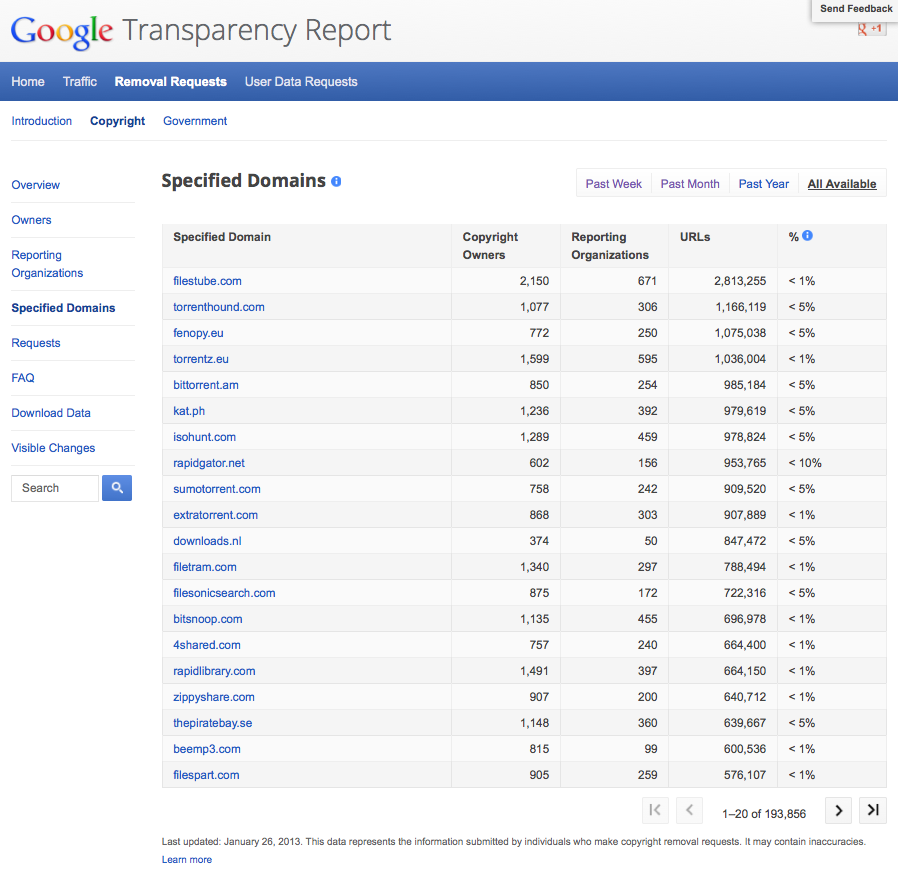
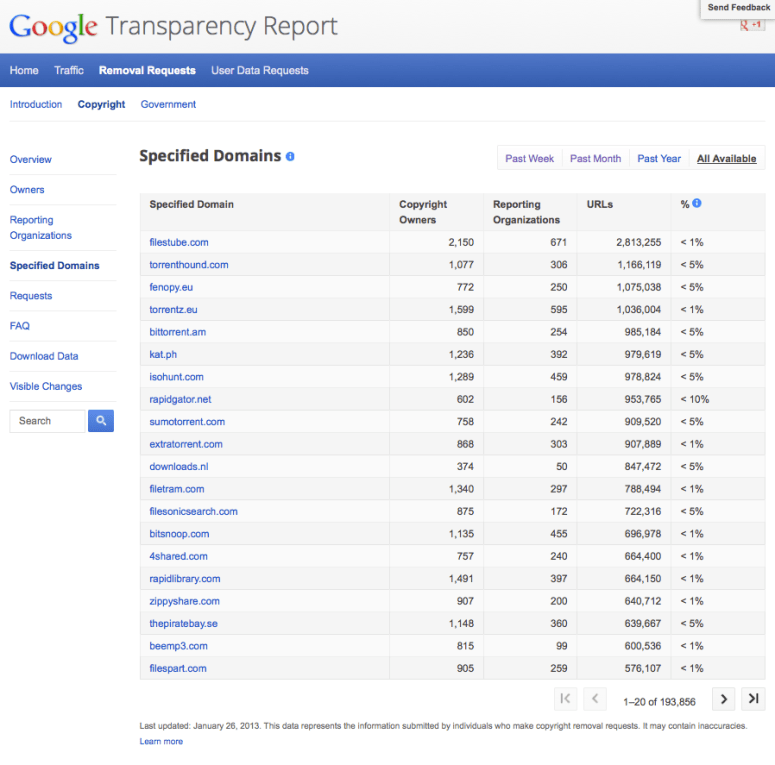
Keep in mind that although Google pays it’s “partners” a revenue share on YouTube for claimed content, the company makes no such offer to artists and creators on the advertising that it still appears to be serving to pirate sites. This is further demonstrated by the lack of ability for the company to make a definitive statement that Google does not serve any ads, to any pirate sites (or at least the 43,000 listed in the companies own transparency report).

Also central to this conversation is that the way consumers access the unauthorized, illegal and infringing sites which usually starts with a Google search itself. In fact according to Google’s own public transparency report there are over 13 million infringing links being removed from Google’s search engine monthly by rights holders. Those 13 million infringing links represent over 43,000 infringing sites.

Wouldn’t the rational and logical solution be to create a joint review board the represents the interests of all stakeholders that can negotiate penalties or the removal of bad actors?

GoogleTransparencyReport

Two Simple Facts about Technology and Piracy : iTunes Vs. YouTube

Fact number one.

Unlike Google’s YouTube, Apple’s Itunes Store does not have a piracy problem, nor does it have an unmanageable issue with DMCA notices. This is often explained that this is because Apple does not allow user generated content from just anyone, therefore there is a barrier to entry that prevents such issues. But this is simply just not true, anyone can upload an album of music to Itunes using any one of the third party aggregation services such as Tunecore or CDbaby. And yet, there are not (as far as we know) hundreds or thousands of DMCA notices and content take downs on Itunes per day, as there are on YouTube. So why is this? In a word, intent.

If Apple, Spotify, Amazon and virtually every other legal and licensed distributor of digital music can put into place, the checks and balances that are capable of managing these rights effectively why is it so hard for Google to do the same YouTube? Think about it.

Fact number two.

YouTube can effectively filter content if it wants to. Since day one, we have never, ever seen any live porn on YouTube. Not a single live link to porn, ever. In debates in various online forums we have often proposed the challenge to anyone to present an active live link to full fledged porn on YouTube. It has NEVER happened. No one has EVER been able to present a live link to an active porn video on YouTube in the six plus years we and our friends have presented the challenge. Talk about a crowd sourcing FAIL.

What these two facts reveal is that rights management online, the protection of copyrights and the enforcement of Intellectual Property require nothing more than the intent and will to do so. But don’t take our word for it, listen to Google’s own Chief Economist Hal A Varian from his book “Information Rules” where he describes “Bitlegging.”

“Bitlegging” can’t be ignored: there’s no doubt that it can be a significant drag on profits.

Bitleggers have the same problem that any other sellers of contraband material have: they have to pet potential customers know how to find them. But if they advertise their location to potential customers, they also advertise their location to law enforcement authorities. In the contraband business it pays to advertise… but not too much.

This puts a natural limit on the size of for-profit illegal activities: the bigger they get, the more likely they are to get caught. Digital piracy can’t be eliminated, any more than any other kind of illegal activity, but it can be kept under control. All that is required is the political will to enforce intellectual property rights.

So Apple, Amazon, Spotify (and hundreds of others) can effectively manage digital distribution without triggering millions of DMCA notices. YouTube can effectively filter porn, and yet the internet is not broken as best as we can tell.

Maybe, just maybe this isn’t so complicated after all. That is unless one has a specific intent and motive from which they perhaps profit from the mass scale aiding of commercial level infringement.