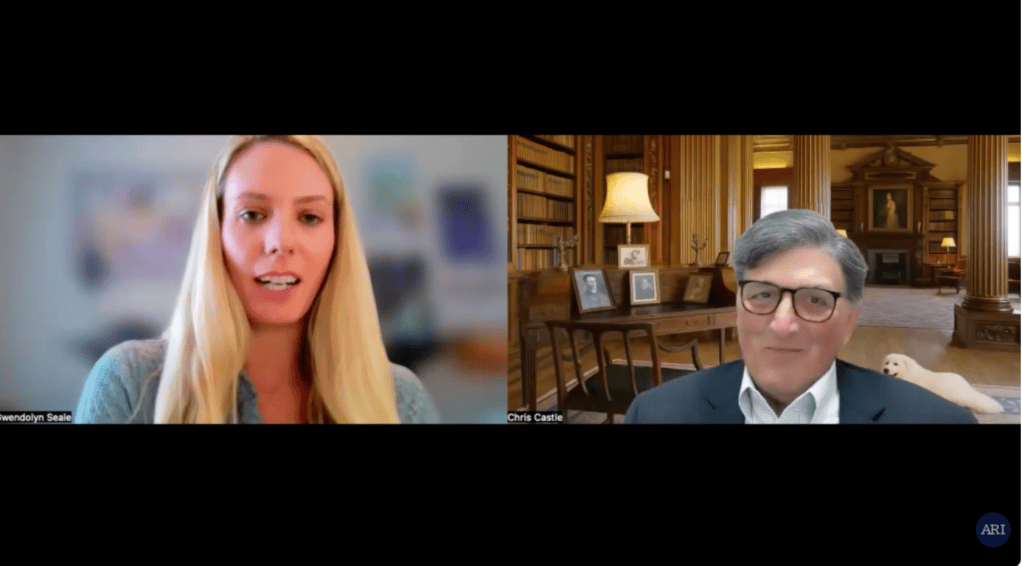
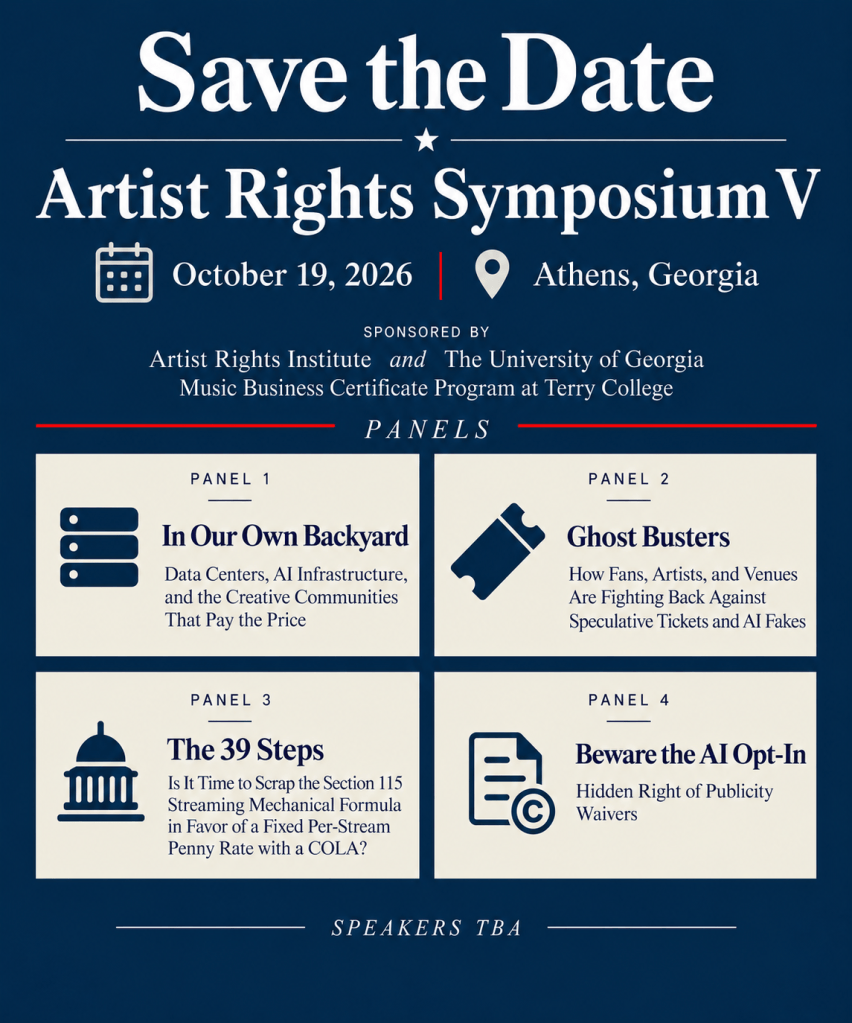
In this short video, Gwendolyn Seale and Artist Rights Institute Director Chris Castle preview “The 39 Steps,” a Symposium V panel asking whether Section 115’s complex streaming mechanical formula should give way to a fixed per-stream penny rate with a COLA.
Gwen joins fellow attorneys Tim Kappel and Shannon Sorensen—all three represent clients before the Copyright Royalty Board in Phonorecords V. ARI Director and UGA professor David C. Lowery moderates. David teaches at the Terry College of Business Music Certificate program. He led the class action against Spotify over nonpayment of streaming mechanical royalties and is a class representative in the Isbell v. Suno class action.
Join us October 19, 2026, at the University of Georgia in Athens, Georgia, for Artist Rights Symposium V hosted by Terry College of Business and the UGA School of Policy and International Affairs.
As part of our series highlighting selected objections to the NMPA-backed Phonorecords V Subpart B settlement, we turn to the filing of the Society of Composers & Lyricists (SCL), representing approximately 4,000 composers, lyricists, songwriters, and music copyright owners. SCL asks the Copyright Royalty Judges to reject the proposed settlement, arguing that it locks in an artificially low mechanical royalty base rather than genuinely preserving creators’ purchasing power.
SCL focuses particularly on what it calls the missing inflation of 2021 and 2022. Its objection argues that carrying forward the 12¢ benchmark fails to restore those unusually inflationary years and could perpetuate the resulting shortfall through every subsequent COLA adjustment. SCL objects that the NMPA settlement carries the Phonorecords IV formula into Phonorecords V in a way that effectively creates a new frozen mechanical. Rather than carrying forward the actual inflation-adjusted 2027 penny rate (for example), the settlement retains 12¢ as the benchmark, perpetuating the very rate-freeze problem Phonorecords IV’s COLA was intended to prevent.
SCL proposes instead a physical and permanent-download rate of approximately 15.6¢ beginning in 2028, followed by annual CPI adjustments which would take into account the 2021 and 2022 rates that the PR IV rates did not take into account in coming up with the 12¢ rate.
The filing also returns to a familiar issue from Phonorecords IV: vertical integration among the parties negotiating the settlement. SCL invokes the Judges’ own earlier warning that relationships linking major publishers and record labels can create inherent conflicts requiring scrutiny before a private agreement is transformed into rates binding the entire industry.
SCL also challenges the continued 24¢ ringtone rate, raises concerns about bundling, and disputes the proposition that agreement among major industry organizations necessarily represents a consensus of the individual creators whose statutory royalties will be determined.
Perhaps the filing’s central point is the simplest: an annual inflation adjustment cannot repair an incorrectly low starting point. SCL asks the Judges to reject the settlement and encourage a new negotiation that includes the views of independent creator organizations before rates are fixed for 2028–2032.
Continuing our series highlighting objections to the proposed Phonorecords V settlement for mechanical royalties on physical and permanent downloads, our friends Helienne Lindvall, David Lowery, and Blake Morgan focus on a deceptively simple question: What is the record that allows the Copyright Royalty Judges to conclude this settlement is reasonable? Our friends do not argue that settlement is improper—or even necessarily that this settlement is unreasonable. Instead, they argue that Congress assigned the Judges, not the negotiating parties, responsibility for determining whether a private agreement provides a reasonable basis for rates imposed industry-wide. There’s just no record other than the NMPA’s settlement itself.
The comment also questions carrying the 12¢ Phonorecords IV benchmark forward through another five-year rate period simply because it remains indexed for inflation. CPI preserves the real value of the existing benchmark; it does not establish that the benchmark remains reasonable for 2028–2032. With vertically integrated companies operating on both sides of the “settlement”, the commenters argue that the missing economic record matters even more.
It’s that time again. It’s no secret that we are not fans of the NMPA’s “quick and cheap” settlement on the statutory mechanicl license for physical and downloads which in its own way is essentially “take this eat that” freeze with no explanation that just extends the rates we fought for in the last rate setting. (David, Helienne and Blake filed a joint comment that we’ll get to posting in coming days.). Hard as it may be to believe, there’s no real record to support the NMPA settlement aside from “quick and cheap” and “we’re big.” Don’t think that that one appears in the rules anywhere.
But it turns out we are far from being the only ones who managed to achieve escape velocity from the influence of NMPA. Today we’re highlighting another submission in the Phonorecords V Subpart B proceeding before the Copyright Royalty Board.
In these comments, Kevin M. Casini and Kaila C. Coleman argue that the proposed settlement preserves inflation adjustments but does not reconsider whether the underlying 12¢ statutory mechanical royalty remains an appropriate benchmark for the 2028–2032 rate period. They contend that changes in the music marketplace—including the resurgence of vinyl, increased catalog values, and the continuing importance of physical formats for many independent writers—warrant closer examination.
One passage that stood out:
“The Board’s obligation extends beyond determining whether a proposed settlement has support among major industry participants. The Board must determine whether the resulting rates are fair, reasonable, and consistent with the objectives of the Copyright Act.”
As always, we’re featuring these comments to encourage readers to review the arguments being presented to the Copyright Royalty Judges.
The first settlement in the Phonorecords V mechanical royalty proceeding is now on file (see below). A settlement is supposed to result from a “voluntary negotiation,” so the document raises a simple question: when exactly did the negotiation happen?
The parties describe “conversations” with other participants. Maybe there were conversations. But conversations are not the same thing as negotiation. A proposal presented as essentially a finished product, with little or no opportunity to influence its terms, is notification—not negotiation.
The Parties have had settlement conversations regarding the so-called Subpart B rates and terms with the other copyright owner Participants in the Proceeding (Songwriters Guild of America, World Collections, Inc., Eight Mile Music Companies, and George Johnson), who declined to join this settlement.
That distinction is crucial because this settlement would establish the statutory mechanical royalty rate for physical records and permanent downloads starting in 2028 through 2032. Those rates affect every songwriter, including those ex-US songwriters whose songs are exploited in the US. According to sources overseas, ex-US songwriter groups were not consulted, although it is customary for NMPA and NSAI to not engage with them even though they are a significant group (other than major mostly English language songwriters who are represented in the US by major publishers).
This means that it is likely that an alternative proposal or several alternative proposals will come to the Copyright Royalty Board in coming days from those who were not included in the NMPA’s settlement. As the settlement itself anticipates, whatever deal the Judges end up adopting will be published as a tentative ruling allowing public comment, but that’s down the line. Watch this space or the CRB website for Phonorecords V for more on deadlines, etc., if you want to comment.
To our knowledge, this is also the first time we’ve seen multiple competing settlements in a CRB phonorecords proceeding. Multiple settlements are common in webcasting and other CRB cases because different categories of music users—commercial broadcasters, NPR, college radio, religious broadcasters, and others—often negotiate different deals tailored to their own services. Mechanical royalty proceedings have traditionally been different. Everyone is negotiating one statutory rate that applies across the board divided into two broad categories by music user: labels (who pay for physical and downloads), and digital services like Spotify, Apple, Google, Amazon, and Meta (who pay for streaming mechanicals and control the global streaming market and some of which largely control AI models so lead the charge on AI theft for training).
The settlement itself also leaves some obvious questions unanswered.
Artificial intelligence is rapidly changing every aspect of music licensing, yet AI is not mentioned at all in the settlement. If downloads or streaming services increasingly contain AI-generated tracks that may not even qualify for copyright protection, should those recordings receive statutory licenses or royalties at all? The Copyright Office has repeatedly stated that works lacking sufficient human authorship cannot be registered for copyright to enjoy the protections of the Copyright Act, and the statutory license is part of the Copyright Act. If that principle eventually affects downloads or streaming (which we think it does right now), it is difficult to imagine that it will never influence the economics of physical or download mechanical royalties as well. That issue received no attention in the NMPA’s settlement.
Then there is another provision that deserves far more discussion.
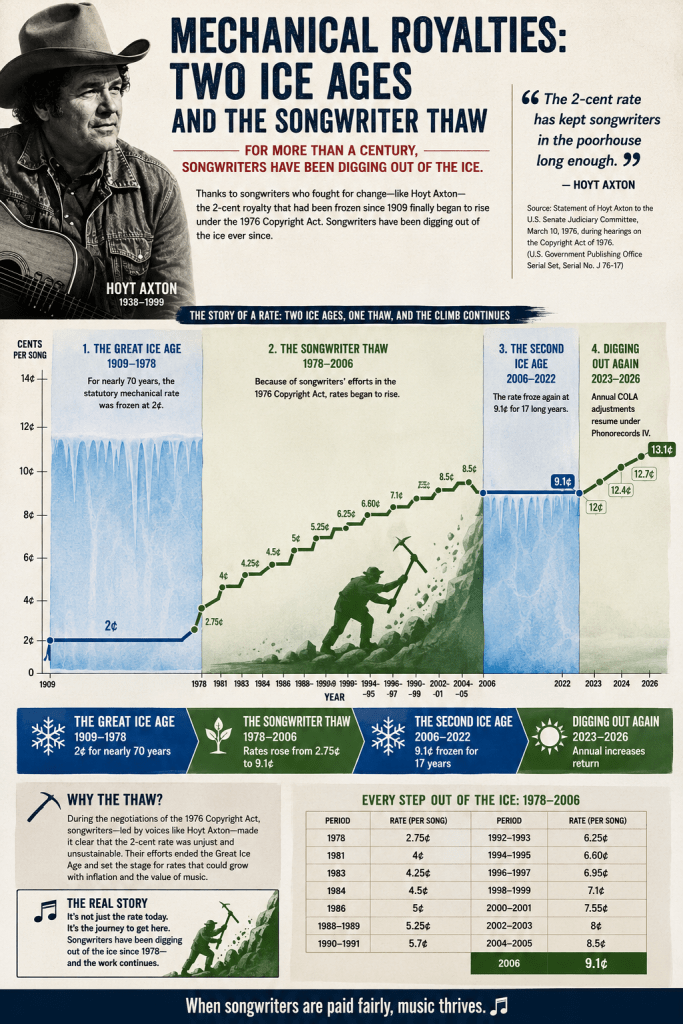
The settlement continues the existing CPI adjustment mechanism that songwriter’s fought for in the last rate setting that increased the mechanical rate from the frozen 9.1¢ proposed by the NMPA and major labels to 12¢ plus a “Cost of Living Adjustment” (or “COLA”) thanks to the Judges rejection of the extended freeze. In other words, they did the opposite of what we recently suggested in Don’t Freeze Mechanicals Again.
Adopting a 12¢ base rate makes no sense—that’s the same rate as the Judges took as the base rate for the first year of the five year rate period starting in 2023 and then applied the COLA to that rate in subsequent years. Of course, that 12¢ rate has been eroded by inflation every year and is now worth about 10¢ without the COLA, but songwriters negotiated and received that COLA which sustained the value of the rate. That’s how we got from 12¢ in 2023 to the current 13.1¢ rate in 2026 that will probably increase again for 2027 (our guess is somewhere in the 13.4¢ to 13.6¢ range). Why wouldn’t you just take that highest rate achieved during the last year of the Phonorecords IV period (2027) and start applying the COLA to that in the first year of the Phonorecords V period (2028)? Rather than go back to the arbitrary 12¢ reference rate? Huh?
On its first glance, adopting a COLA for the new rates sounds reasonable because it protects songwriters against inflation. But the formula contains no floor preventing the statutory rate from declining if cumulative CPI were ever to fall.
Deflation may be unlikely. That’s not the concern. But the COLA could still cause rates to decline. All that has to happen is that inflation doesn’t rise at the same rate or greater from one year to the next and then the COLA-adjusted statutory rate will decline.
The point is that, for what may be the first time in the history of the statutory rate and certainly since the modern Copyright Act took effect in 1978, songwriters are being asked to accept a statutory mechanical royalty structure under which the minimum statutory rate could actually move backward, and very likely will decline.
A simple solution exists. The regulation could easily provide that each year’s rate is the greater of (1) the COLA-adjusted calculation or (2) the prior year’s rate. That would preserve the existing inflation formula while ensuring the statutory royalty never declines.
Why wasn’t that included? Or better yet, why wasn’t an actual value based increase included since we are still digging out of two prior freezes of the statutory rate one from 1909-1978 when the rate froze at 2¢ and the other from 2006-2022 when the rate froze at 9.1¢.
That’s a fair question.
So is another one.
If we’re going to lock in the statutory mechanical royalty through 2032, shouldn’t there have been a meaningful discussion—not just among the settling parties, but across the songwriting community—about AI, future valuation, whether there should be a statutory minimum for streaming and whether the statutory minimum itself should ever be permitted to decrease?
Those conversations are coming. The only question is whether they should have happened before the settlement was filed instead of afterward. We had hoped for a longer table with more voices. Whether that happens remains to be seen.
Phonorecords V Commencement Notice: Government setting song mechanical royalty rates
The Copyright Royalty Judges announce the commencement of a proceeding to determine reasonable rates and terms for making and distributing phonorecords for the period beginning January 1, 2028, and ending December 31, 2032. Parties wishing to participate in the rate determination proceeding must file their Petition to Participate and the accompanying $150 filing fee no later than 11:59 p.m. eastern time on January 30, 2026. Deets here.
I’m angry. AI-enabled sexual exploitation isn’t a victimless act. The fear that friends, family and colleagues might see it. The loss of safety, dignity and control over our bodies and identity. This isn’t “just technology.” It causes real harm and should have real consequences pic.twitter.com/23AAEbUfA4
Spotify recently rolled out a quiet but seismic change to its royalty system: if a track doesn’t get at least 1,000 streams in a 12-month period, it earns no royalties. Zero. The company claims this policy is about reducing “fraud” and redirecting money to “working artists,” but behind that PR gloss is a shift that disproportionately harms independent musicians and smaller rightsholders.
Let’s be clear—this isn’t just about removing noise from the system. It’s about redrawing the map of who gets paid in the streaming economy and who gets pushed out.
The Hidden Impact on Artists
At first glance, 1,000 streams might sound like a modest hurdle. But in the aggregate, this threshold excludes potentially millions of tracks from ever receiving a dime—even though Spotify continues to profit from their presence through ad revenue and user engagement. It’s easy to assume the affected tracks belong only to DIY artists or obscure creators. But that’s not necessarily true.
Spotify’s royalty model is track-focused, not artist-focused. You could have a single that racks up a million streams while the rest of the album struggles to clear a few hundred. Those lower-performing tracks—despite being part of a cohesive release—won’t earn a cent. Left to its own devices, the platform favors individual track performance over albums or an artist’s entire catalog. And that has sweeping implications not only for how artists are paid, but for how music is created, released, and valued in the streaming age.
It’s Not About Growing the Pie—It’s About Cutting Out the Bottom
The most revealing part of this policy isn’t what it claims to fix, but what it quietly avoids. Spotify is likely under enormous pressure—from major labels and rights holders—to raise the artist payouts. No matter how much Spotify denies the per-stream rate, there will always be a per-stream rate even if they pay a “stream share” to a label for the very simple reason that the label has to convert that revenue share into a per stream rate in order to allocate it to their several artists. That’s as simple as gross vs. net.
Plus we know just how bad the gross is from indie artists who get paid 100% of the “stream share”. It’s shit, ok? That’s why we know Spotify are under pressure to increase royalties.
But arbitrarily raising the total royalty pool would have consequences: it could trigger most-favored-nation clauses, obligate Spotify to pay more across the board.
Another way to raise royalties would be to “flatten” some of the minimum guarantee, i.e., make a portion of it nonrecoupable from future royalty payments. This was the practice with record clubs—a nonrecoupable payment has the added benefit of not being shared with artists as a kind of catalog-wide payment. This would also likely trigger MFNs, so that’s not super appealing either.
So by excluding low-performing tracks from the royalty pool, Spotify isn’t reducing fraud or increasing fairness. It’s reallocating revenue. And not randomly—it’s redistributing it upward. The money those artists would have earned is now being handed to the top-performing tracks, which overwhelmingly belong to major labels and large catalog owners.
Don’t you think that if the goal was to reduce costs, Spotify would just shrink the pie and pocket the difference? It seems to me that more money to fewer people is likely the real purpose of the 1,000-stream rule.
The Threat of Industry-Wide Collusion
Spotify isn’t alone. Amazon Music and Deezer have introduced similar thresholds, raising serious concerns about whether this is a coordinated move by dominant platforms to marginalize smaller rightsholders. When multiple major services adopt the same gatekeeping metric at the same time, and benefit in the same way, it’s not unreasonable to ask whether they’re acting in lockstep. In fact, this concept in antitrust law is called tacit collusion (or “conscious parallelism”) which occurs when competitors coordinate their behavior—such as pricing or output—without explicit agreements or communication. Instead of entering into a formal cartel, companies mirror each other’s pricing or business strategies, knowing that mutual restraint benefits all of them
Even if there’s no smoking gun, the outcome is clear: fewer royalties paid to emerging and independent creators, and more concentrated control over who makes money from streaming.
Playlists, Penalties, and Platform Power
Here’s the twist: just because a track falls below 1,000 streams and no longer qualifies for royalties doesn’t mean Spotify stops using it. These sub-threshold tracks don’t vanish—they become part of what we might call Spotify’s “shadow catalog”: music that still populates playlists, fuels the recommendation algorithm, and keeps users listening, but doesn’t generate payouts.
Every time a user plays a low-performing track, Spotify collects engagement data. That information feeds into its personalization systems, sharpening the algorithm’s ability to retain users and increase time-on-platform. That extra engagement helps Spotify serve more ads, train better models, and keep listener churn down. It also enriches Spotify’s advertising and data ecosystem, especially on the free tier where listening time directly translates to ad revenue.
In other words, these unpaid tracks are still part of the machine. Spotify uses them to optimize engagement and advertising—but without paying the creators a cent. It’s profit without payout. Value extraction without compensation. And in the long tail of the music economy, that adds up to millions of tracks silently pulling their weight for free.
So it seems that this is the quid for the pro quo.
A Cautionary Tale for Songwriters
The 1,000-stream threshold is a cautionary tale for songwriters as they approach Phonorecords V. What began as a “fraud prevention” tool is now a benchmark for excluding smaller rights holders from royalties altogether. Streaming services will point to these thresholds as precedent—arguing that if labels can accept payout limits, publishers should too. Without strong opposition, platforms could push for mechanical royalty thresholds that mirror streamshare rules, cutting off compensation to low-earning songs. This isn’t just about recorded music anymore. It’s a warning: once a gate is built, it can be copied—and used to lock out songwriters next.
A Royalty System That Punishes the Wrong People
Spotify’s royalty threshold is spun as a way to fight fraud and reward “working artists,” you know, kind of like don’t be evil. But in reality, it codifies a system where only the most popular tracks get paid—regardless of how much they contribute to the overall value of the platform.
And when other streaming services follow the same path, it stops looking like business as usual and starts to resemble a coordinated effort to narrow the market and marginalize everyone but the top-tier players.
This isn’t a royalty system built on fairness or transparency. It’s a redistribution scheme—not to help more artists earn a living, but to serve bigger slices to fewer people.
And that should raise alarms far beyond the music industry. Looking at you, Gail Slater.
[Trichordist says: The Copyright Royalty Board reopened the comments on frozen mechanical song royalties in Phonorecords IV rate setting and the filings are coming in, especially from songwriters! We will be posting the comments (or excerpts from the long ones. First up is a straight from the heart contribution from Chelsea Crowell, Erin McAnally and Abby North.]
Copyright Royalty Board 37 CFR Part 385 [Docket No. 21–CRB–0001–PR (2023–2027)] Determination of Rates and Terms for Making and Distributing Phonorecords (Phonorecords IV)
Interim Chief Copyright Royalty Judge Suzanne Barnett Copyright Royalty Judge Steven Ruwe Copyright Royalty Judge David R. Strickler US Copyright Royalty Board 101 Independence Ave SE Washington, DC 20024
SECOND REOPENING PERIOD COMMENTS OF ABBY NORTH, ERIN MCANALLY AND CHELSEA CROWELL
To Your Honors:
Thank you for the opportunity to submit additional comments, now that the details of the Memorandum of Understanding (MOU4) apparently related to the Subpart B mechanical rate settlement negotiated by the NMPA, NSAI and three major labels have been made available.
Only the NMPA’s 300 or so publishers are potential parties to the MOU, assuming the opt in terms are the same as those of MOU3 (http://nmpalatefeesettlement.com/mou3/faq.php). The publishers that opt in to the MOU4 settlement will receive money for their participation, and in exchange for this money, the NMPA Board members have agreed to freeze the Subpart B mechanical rate at the $.091 rate that’s been in place since 2006.
In this exchange, NMPA publishers have a stream of revenue (the MOU4 money) that offsets the negative effect of the lack of rate increase in the Subpart B mechanical.
Although foreign CMOs could opt into the current MOU3 settlement, rightsholders that are not NMPA members may not opt in and will not receive the buffer that the MOU4 money provides, yet they are subject to the frozen mechanical rate that is an apparent condition of the negotiation related to the proposed settlement of the Subpart B rates and terms.
Thousands, if not tens of thousands of songwriters in the world have songs published or administered by those NMPA publishers that are party to the rate freeze settlement, but neither these songwriters nor the vast number of songwriters around the globe were given a say in the decision to freeze the mechanical rate.
The concern we have is not that there is a settlement. The concern is that the settlement does not provide for a base rate greater than $.091, plus annual increases to adjust for inflation.
To quote the NMPA’s Supplemental Comments: “…mechanical royalties from Subpart B configurations now constitute only a small part of total mechanical royalty revenue in the U.S., and that share is expected to get smaller during the period covered by this proceeding.”
That concept only resonates with a corporation that aggregates thousands or millions of copyrights.
To an individual songwriter or a small rightsholder, it doesn’t matter if Subpart B mechanicals constitute 1% or 15% or 50% of total royalties. Why? Because every single penny counts.
When an individual is paying a mortgage, tuition or a car payment, every single penny counts. When a health crisis occurs, every penny counts. When existing off the very low streaming royalties generated by even a hit song, every penny counts.
Physical and download mechanicals are still an extremely relevant revenue stream to individual songwriters and small publishers.
At the current retail price of $.99 for a download, the $.091 mechanical is 9.2%.
The streaming royalty pool for songs is roughly 10.5% of the total, possibly as much as 15.1%, per the CRB III hearing results (after all this time, still under appeal). The NMPA has suggested an increase of the streaming royalty rate to 20%. This would be an exceptional improvement.
How is the download royalty not at least the same percentage as the streaming royalty?
Why is the value of a downloaded song less than that of one that is streamed?
We suggest the Subpart B rate and the streaming mechanical rate (based on percentage) should be on no less than a most favored nations basis with one another.
To songwriters and most publishers, every royalty type and every revenue stream matters. The move from physical to digital, the unbundling of albums in favor of singles and the unlivable streaming royalty rates absolutely substantiate the need for an increase in Subpart B mechanicals, at least to reach the percentage paid on the streaming side, and with periodic adjustment for inflation. 3
We appreciate the opportunity to submit these additional comments, and we ask the Judges to recognize that songwriters and small publishers are individuals who do not have the luxury of collecting royalties from the aggregation of hundreds of thousands of works.
It is not fair that songwriters signed to the NMPA publishers have a frozen mechanical rate forced on them, and it is remarkably egregious that non-NMPA publishers and their writers are also forced into this horrible reality.
Respectfully,
Abby North, North Music Group LLC Chelsea Crowell, Songwriter Erin McAnally, Songwriter/Factory of Strange Tones




You must be logged in to post a comment.