One of the most frustrating tricks in the ticket resale business is something called speculative ticketing. That’s when someone lists a ticket for sale before they actually have the ticket. We’ve discussed the problem many times, but Kid Rock brought it to a head recently during a hearing on Capitol Hill.
If you haven’t run across spec ticking before, here it is: The seller is essentially betting they will be able to obtain the ticket later. If they succeed, they deliver the ticket to the buyer. If they don’t, the buyer often ends up with a refund—or a replacement ticket of uncertain quality—instead of the seat they thought they purchased.
For fans and artists, the bigger problem is what speculative listings do to the market before the onsale even begins.
When fans check resale marketplaces and see hundreds of tickets already listed—often at inflated prices—it creates the impression that tickets are already scarce or sold out. That perception alone can push fans to panic-buy at higher prices, even when the actual ticket inventory hasn’t even been released yet.
In other words, speculative listings can make the market look hotter and tighter than it really is.
Ironically, most of the major resale platforms already say this practice is prohibited on their service. Their terms of service typically ban selling tickets that the seller does not actually possess.
Yet those same marketplaces often display large numbers of listings that appear to be exactly that: tickets offered for sale before the seller could reasonably have them in hand.
California is now attempting to address this problem directly. A new proposal would make it clear that selling tickets you do not possess—or do not have the legal right to sell—is a deceptive practice under consumer protection law. It would also allow state and local authorities to enforce those rules, rather than leaving fans to fight the battle on their own.
AB 1349 aims to close the gap between what resale platforms claim to prohibit and what actually happens in the marketplace. The basic principle is simple: if a ticket is listed for sale, it should be a real ticket controlled by the seller, not a speculative promise that may or may not be fulfilled later.
The bill will not fix every problem in the ticketing ecosystem. But it represents an important step toward restoring a basic level of honesty to the resale market. After all, if the platforms themselves say you shouldn’t sell a ticket you don’t have, putting that rule into law should not be controversial.
For artists and fans alike, the idea behind AB 1349 comes down to something pretty straightforward:
You shouldn’t be able to sell a ticket you don’t actually own.
This led directly to both agencies inviting public comments on the state of the live event ticketing market—an industry riddled with speculation, opacity, and middlemen who seem to make money without ever attending a show. Over 4000 artists, fans, economists, state attorneys general, and industry veterans all weighed in. And the record reveals something important particularly regarding resellers: there’s a rising consensus that the resellers are engaged in some really shady practices designed for one purpose–to extract as much money as possible from fans and artists without regard to the damage it does to the entire artist-fan relationship.
Over the next several posts, I’ll be highlighting individual comments submitted to the DOJ/FTC inquiry. Some are technical, some personal, and some blisteringly direct—but all speak to the fundamental imbalance between artists, fans, and the multi-layered resellers, bots, and platforms that profit from both ends of the transaction.
This isn’t just about high prices. It’s about ownership, transparency, control, and accountability and the lenders who fuel the fraud. Many of the commenters argue that ticketing is no longer just a marketplace—it’s a manipulated, closed-loop ecosystem in which the reseller’s house always wins. And for too long, the architects of that system have claimed there’s nothing to see here. There is plenty to see here.
Each post in this series will spotlight one of these submissions that I have selected—not just to amplify the voices that took time to respond, but to help connect the dots on how the ticketing industry got here, who’s benefiting, and what needs to change.
We all have to be grateful to Kid Rock who brought this debacle to President Trump’s attention and to the President himself for making it a priority. We also have to thank Senator Marsha Blackburn for her continued defense of artists through her BOTS Act co-sponsored with Senator Blumenthal. Senator Blackburn has long opposed the use of automated fraudster systems to extract rents from fans and artists and we hope that the DOJ/FTC inquiry will also shed light on why there have been so few prosecutions.
Stay tuned for the first in the series. Spoiler alert: it’s going to be hard to argue that this is a “free market” when fans are bidding against bots and artists are not allowed to control the face value of their own shows.
This is a summary of a lot of the more involved issues that came up in the comments:
1. Speculative Ticket Listings
Resellers frequently list tickets for sale without possessing them, misleading consumers and inflating prices. These listings distort market data and should be treated as deceptive under federal consumer protection law.
2. Price Manipulation Through Bots
Automated bots are used to hoard tickets and create artificial scarcity, driving up resale prices. This not only violates the BOTS Act but enables unfair competition that harms consumers.
3. Deceptive Use of Venue, Artist, or Promoter Branding
Resellers often use official names and branding in ads, URLs, and metadata as well as typosquatting or URL hacking to trick consumers into believing they are purchasing from authorized sources. These deceptive practices undermine market transparency.
4. Misleading “Sold Out” or Urgency Claims
Some platforms advertise that events are “sold out” or create false urgency (e.g., “only 2 left at this price”) when primary tickets are still available. These tactics constitute false advertising and manipulative marketing.
5. Concealment of Total Ticket Cost
Fees are often hidden until checkout, misleading consumers about the true price. This “drip pricing” violates FTC guidance on transparent pricing and impairs consumers’ ability to comparison shop.
6. Resale of Non-Transferable or Restricted Tickets
Resellers list tickets that are explicitly non-transferable or designated will-call only, often in violation of the event organizer’s terms. Consumers risk being denied entry without recourse.
7. Lack of Delivery Guarantees and Refund Accountability
Many platforms offer no guaranteed delivery or refund protection when tickets are invalid or undelivered—despite charging substantial markups—leaving consumers with no remedy.
8. One-Sided Arbitration and Waiver Clauses
Some resale platforms impose forced arbitration clauses and class action waivers, effectively denying consumers access to meaningful remedies, even in cases of systemic fraud.
9. Failure to Disclose Broker Status or Ticket Quantities
Platforms often fail to identify brokers or disclose the number of tickets held, undermining market transparency and the ability of venues and regulators to detect fraud or hoarding.
10. Bankruptcy as a Shield Against Accountability
Resellers may use bankruptcy to discharge obligations arising from fraudulent or deceptive conduct. Congress should consider amendments to make such claims nondischargeable, similar to fraud-based exceptions under 11 U.S.C. § 523(a).
11. Federal RICO Liability for Coordinated BOTS Act Violations
The use of automated ticket-buying tools in coordinated schemes between resellers and bot developers may give rise to federal RICO charges under 18 U.S.C. §§ 1961–1968. The following are three plausible RICO predicates when tied to a pattern of violations:
(a) Wire Fraud (18 U.S.C. § 1343): Automated bulk purchases made using false identities or obfuscated IP addresses may constitute wire fraud if they involve misrepresentations in interstate commerce.
(b) Access Device Fraud (18 U.S.C. § 1029): Bot schemes often involve unauthorized use of payment cards, CAPTCHA bypass tools, or ticket platform credentials, qualifying as trafficking in access devices.
(c) Computer Fraud and Abuse (18 U.S.C. § 1030): Bypassing ticket site security measures may amount to unauthorized access under the CFAA, particularly when done for commercial advantage.
These acts, when carried out by a coordinated enterprise, support civil or criminal RICO enforcement, particularly where repeat violations and intent to defraud can be established.
U.S. Representative Scott Fitzgerald joined in the MLC review currently underway and sent a letter to Register of Copyrights Shira Perlmutter on August 29 regarding operational and performance issues relating to the MLC. The letter was in the context of the five year review for “redesignation” of The MLC, Inc. as the mechanical licensing collective. (That may be confusing because of the choice of “The MLC” as the name of the operational entity that the government permits to run the mechanical licensing collective. The main difference is that The MLC, Inc. is an entity that is “designated” or appointed to operationalize the statutory body. The MLC, Inc. can be replaced. The mechanical licensing collective (lower case) is the statutory body created by Title I of the Music Modernization Act) and it lasts as long as the MMA is not repealed or modified. Unlikely, but we live in hope.)
I would say that songwriters probably don’t have anything more important to do today in their business beyond reading and understanding Rep. Fitzgerald’s excellent letter.
Rep. Fitzgerald’s letter is important because he proposes that the MLC, Inc. be given a conditional redesignation, not an outright redesignation. In a nutshell, that is because Rep. Fitzgerald raises many…let’s just say “issues”…that he would like to see fixed before committing to another five years for The MLC, Inc. As a member of the House Judiciary Subcommittee on Courts, Intellectual Property, and the Internet, Rep. Fitzgerald’s point of view on this subject must be given added gravitas.
In case you’re not following along at home, the Copyright Office is currently conducting an operational and performance review of The MLC, Inc. to determine if it is deserving of being given another five years to operate the mechanical licensing collective. (See Periodic Review of the Mechanical Licensing Collective and the Digital Licensee Coordinator (Docket 2024-1), available at https://www.copyright.gov/rulemaking/mma-designations/2024/.)
The redesignation process may not be quickly resolved. It is important to realize that the Copyright Office is not obligated to redesignate The MLC, Inc. by any particular deadline or at all. It is easy to understand that any redesignation might be contingent on The MLC, Inc. fixing certain…issues…because the redesignation rulemaking is itself an operational and performance review. It is also easy to understand that the Copyright Office might need to bring in some technical and operational assistance in order to diligence its statutory review obligations. This could take a while.
Let’s consider the broad strokes of Rep. Fitzgerald’s letter.
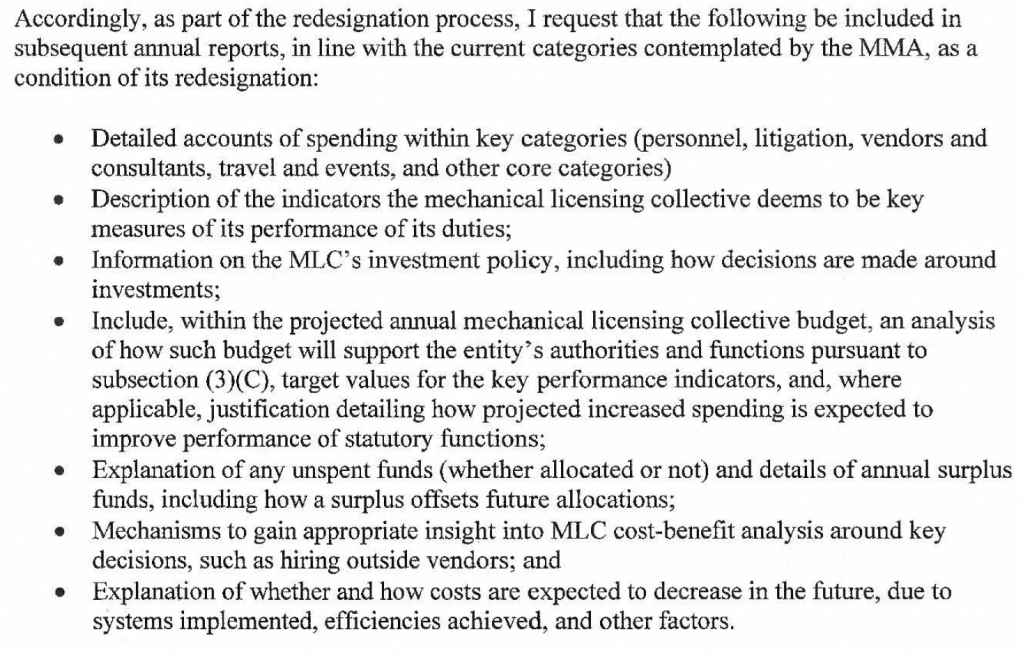
Budget Transparency
Rep. Fitzgerald is concerned with a lack of candor and transparency in The MLC, Inc.’s annual report among other things. If you’ve read the MLC’s annual reports, you may agree with me that the reports are long on cheerleading and short on financial facts. It’s like The MLC, Inc. thought they were answering the question “How can you tolerate your own awesomeness?” That question is not on the list. Rep. Fitzgerald says “Unfortunately, the current annual report lacks key data necessary to examine the MLC’s ability to execute these authorities and functions.” He then goes on to make recommendations for greater transparency in future annual reports.
I agree with Rep. Fitzgerald that these are all important points. I disagree with him slightly about the timing of this disclosure. These important disclosures need not be prospective–they could be both prospective and retroactive. I see no reason at all why The MLC, Inc. cannot be required to revise all of its four annual reports filed to date (https://www.themlc.com/governance) in line with this expanded criteria. I am just guessing, but the kind of detail that Rep. Fitzgerald is focused on are really just data that any business would accumulate or require in the normal course of prudently operating its business. That suggests to me that there is no additional work required in bringing The MLC, Inc. into compliance; it’s just a matter of disclosure.
There is nothing proprietary about that disclosure and there is no reason to keep secrets about how you handle other people’s money. It is important to recognize that The MLC, Inc. only handles other people’s money. It has no revenue because all of the money under its management comes from either royalties that belong to copyright owners or operating capital paid by the services that use the blanket license. It should not be overlooked that the services rely on the MLC and it has a duty to everyone to properly handle the funds. The MLC, Inc. also operates at the pleasure of the government, so it should not be heard to be too precious about information flow, particularly information related to its own operational performance. Those duties flow in many directions.
Board Neutrality
The board composition of the mechanical licensing collective (and therefore The MLC, Inc.) is set by Congress in Title I. It should come as no surprise to anyone that the major publishers and their lobbyists who created Title I wrote themselves a winning hand directly into the statute itself. (And FYI, there is gambling at Rick’s American Café, too.) As Rep. Fitzgerald says:
Of the 14 voting members, ten are comprised of music publishers and four are songwriters. Publishers were given a majority of seats in order to assist with the collective’s primary task of matching and distributing royalties. However, the MMA did not provide this allocation in order to convert the MLC into an extension of the music publishers.
I would argue with him about that, too, because I believe that’s exactly what the MMA was intended to do by those who drafted it who also dictated who controlled the pen. This is a rotten system and it was obviously on its way to putrefaction before the ink was dry.
For context, Section 8 of the Clayton Act, one of our principal antitrust laws, prohibits interlocking boards on competitor corporations. I’m not saying that The MLC, Inc. has a Section 8 problem–yet–but rather that interlocking boards is a disfavored arrangement by way of understanding Rep. Fitzgerald’s issue with The MLC, Inc.’s form of governance:
Per the MMA, the MLC is required to maintain an independent board of directors. However, what we’ve seen since establishing the collective is anything but independent. For example, in both 2023 and 2024, all ten publishers represented by the voting members on the MLC Board of Directors were also members of the NMPA’s board. This not only raises questions about the MLC’s ability to act as a “fair” administrator of the blanket license but, more importantly, raises concerns that the MLC is using its expenditures to advance arguments indistinguishable from those of the music publishers-including, at times, arguments contrary to the positions of songwriters and the digital streamers.
Said another way, Rep. Fitzgerald is concerned that The MLC, Inc. is acting very much like HFA did when it was owned by the NMPA. That would be HFA, the principal vendor of The MLC, Inc. (and that dividing line is blurry, too).
It is important to realize that the gravamen of Rep. Fitzgerald’s complaint (as I understand it) is not solely with the statute, it is with the decisions about how to interpret the statute taken by The MLC, Inc. and not so far countermanded by the Copyright Office in its oversight role. That’s the best news I’ve had all day. This conflict and competition issue is easily solved by voluntary action which could be taken immediately (with or without changing the board composition). In fact, given the sensitivity that large or dominant corporations have about such things, I’m kind of surprised that they walked right into that one. The devil may be in the details, but God is in the little things.
Investment Policy
Rep. Fitzgerald is also concerned about The MLC, Inc.’s “investment policy.” Readers will recall that I have been questioning both the provenance and wisdom of The MLC, Inc. unilaterally deciding that it can invest the hundreds of millions in the black box in the open market. I personally cannot find any authority for such a momentous action in the statute or any regulation. Rep. Fitzgerald also raises questions about the “investment policy”:
Further, questions remain regarding the MLC’s investment policy by which it may invest royalty and assessment funds. The MLC’s Investment Policy Statement provides little insight into how those funds are invested, their market risk, the revenue generated from those investments, and the percentage of revenue (minus fees) transferred to the copyright owner upon distribution of royalties. I would urge the Copyright Office to require more transparency into these investments as a condition of redesignation.
It should be obvious that The MLC, Inc.’s “investment policy” has taken on a renewed seriousness and can no longer be dodged.
Black Box
It should go without saying that fair distribution of unmatched funds starts with paying the right people. Not “connect to collect” or “play your part” or any other sloganeering. Tracking them down. Like orphan works, The MLC, Inc. needs to take active measures to find the people to whom they owe money, not wait for the people who don’t know they are owed to find out that they haven’t been paid.
Although there are some reasonable boundaries on a cost/benefit analysis of just how much to spend on tracking down people owed small sums, it is important to realize that the extraordinary benefits conferred on digital services by the Music Modernization Act, safe harbors and all, justifies higher expectations of those same services in finding the people they owe money. The MLC, Inc. is uniquely different than its counterparts in other countries for this reason.
I tried to raise the need for increased vigilance at the MLC during a Copyright Office roundtable on the MMA. I was startled that the then-head of DiMA (since moved on) had the brass to condescend to me as if he had ever paid a royalty or rendered a royalty statement. I was pointing out that the MLC was different than any other collecting society in the world because the licensees pay the operating costs and received significant legal benefits in return. Those legal benefits took away songwriters’ fundamental rights to protect their interests through enforcing justifiable infringement actions which is not true in other countries.
In countries where the operating cost of their collecting society is deducted from royalties, it is far more appropriate for that society to consider a more restrictive cost/benefit analysis when expending resources to track down the songwriters they owe. This is particularly true when no black box writer is granting nonmonetary consideration like a safe harbor whether they know it or not.
I got an earful from this person about how the services weren’t an open checkbook to track down people they owed money to (try that argument when failing to comply with Know Your Customer laws). Grocers know more about ham sandwiches than digital services know about copyright owners. The general tone was that I should be grateful to Big Daddy and be more careful how I spend my lunch money. And yes I do resent this paternalistic response which I’m sorry to say was not challenged by the Copyright Office lawyer presiding who shortly thereafter went to work for Spotify. Nobody ever asked for an open check. I just asked that they make a greater effort than the effort that got Spotify sued a number of times resulting in over $50 million in settlements, a generous accommodation in my view. If anyone should be grateful, it is the services who should be grateful, not the songwriters.
And yet here we are again in the same place. Except this time the services have a safe harbor against the entire world which I believe has value greater than the operating costs of the MLC. I’d be perfectly happy to go back to the way it was before the services got everything they wanted and then some in Title I of the MMA, but I bet I won’t get any takers on that idea.
Instead, I have to congratulate Rep. Fitzgerald for truly excellent work product in his letter and for framing the issue exactly as it should be posed. Failing to fix these major problems should result in no redesignation—fired for cause.
The most remarkable aspect of the pending legislation in Congress that would force a sale of TikTok is how much money and how many high profile lobbyists have taken the CCP’s shilling (or maybe yuan) to push the obviously corrupt company’s water. And yet…the legislation is advancing by leaps and bounds and TikTok is failing.
David was interviewed by Billboard to give a perspective. The headline here is that TikTok appears to be doing the same thing that Spotify was doing when Spotify was sued by Melissa Ferrick and David–using songs without a license.
The music industry’s view of the proceedings in Washington is mixed. The perspective of artists and songwriters is arguably best expressed by David Lowery, the artist rights activist and frontman for the bands Cracker and Camper Van Beethoven, who also was one of more than 200 creators that, in early April, signed an open letter to tech platforms urging them to stop using AI “to infringe upon and devalue the rights of human artists.”
“The rates TikTok pays artists are extremely low, and it has a history — at least with me — of using my catalog with no licenses,” Lowery says. “I just checked to make sure and there are plenty of songs that I wrote on TikTok, and I have no idea how they have a license for those songs.”
As a result, Lowery says that while “I’m kind of neutral as to whether TikTok needs to be sold to a U.S. owner, the bill pleases me in a general way because I feel that they’ve gotten away with abusing artists for so long that they deserve it. I realize the bill doesn’t punish them for doing that,” he continues, “but that’s why a lot of musicians feel they really deserve it.”
Adele, Taylor Swift, Beyonce’, Coldplay and more artists are fully understanding the value of not giving away their work for free right out of the gate. This is especially important during the biggest consumer spending season of the year. Why would anyone with a solid fan base and known demand for their work give it away for free during most profitable window of the year? This then begs the question how many more records would you be selling this holiday season if your record was not available on free streaming platforms?
Spotify and other free streaming services should be structured more like Netflix. The film industry understands the value of strategic pricing in the context of time based value propositions. Friday night block buster movies are not available on Netflix at the same time for a good reason.
There has been a lot of good work and innovation by the film industry to create “day and date” titles that are available both in theaters and as video on demand at the time of release. However none of these are made available free to consumer on an advertising supported platform. In fact, all the major film and tv streaming services require payment of some kind, be it subscription (HuluPlus, Netflix, Amazon Prime) or transactional fees for rental or permanent download (Itunes, Amazon, Vudu).
“Or Else They’ll Steal It!”
The only argument that is ever made against the use of windows is that tired old song that they like to sing in Silicon Valley called, “Or Else They’ll Steal It.” The problem is of course, they’re already stealing it, and will continue to steal it until there are real consequences to not do so. But the film and tv industries are not listening to the song of Stockholm Syndrome. Instead the film and tv industries continue to innovate and experiment with new windows, digital distribution models and competitive pricing based on the new value propositions.
Converting consumers from “pirate 2 paid” is dependent upon giving consumers more value and pricing options, not less. If the record industry doubts this for even a split second the proof is expressed in a single word, “vinyl.”
By contrast the record industry has given away valuable profits to tech companies like Spotify who give little in return for the high value products that are being licensed. The ubiquity of distribution on streaming platforms drives the price of all products to zero.
Windowing allows for price elasticity and rewards consumers who are willing to spend more for the premier product or experience. Of course, for windowing to work there has to be a fair and regulated marketplace where artists and rights holders actually can withhold their work from various platforms should they chose to do so.
If we’ve learned anything at all in 2015 it is that YouTube is probably the single greatest threat to the ability of artists and rights holders to have a long term sustainable business. There can be no windows if everything appears on YouTube via User Pirated Content anyway.
The grand irony here is that in a well controlled and regulated distribution system, it is far more likely that all stakeholders would have the ability to generate greater profits within their sectors. We now have a decade and a half of data behind us while heading towards the second half, of the second decade, of the new millennium. It’s time to for the adults to put an end to play time. It’s just math and common sense.
Windows work. Period.
Business decisions need to developed through common sense, innovation and time tested principles of basic economics. We’ll repeat our previous suggestion for an industry wide, consistent windowing platform strategy below.
Windowing works better when there is a reasonable amount of consistency. Our friends in the film business have been highly effective at windowing for decades and there’s no reason why it can’t work similarly well for the record business.
Every new release should have the option to determine the release windows when the record is being set up. For example the default could be 0,30,60,90 day option for transactional sales, followed by 0,30,60,90 day option for Subscription Streaming prior to being available for Free Streaming.
Windowing is not new for the record business. The industry has never had pricing ubiquity across all releases, genres and catalogs. There has always been strategic and flexible pricing strategies to differentiate developing artists, hits, mid-line catalog, and deep catalog. An industry wide initiative to re-allign time proven price elasticity is the key to growing the business and developing a broad based sustainable ecosystem for more artists.
Windowing allows for Free Streaming to exist as a strategic price point.
Windowing allows for Subscription Streaming to exist as a strategic price point.
Windowing allows for Transactional Downloads to exist as a strategic price point.
Windowing allows for artists and rights holders to determine the best and most mutually beneficial way to engage with their fans.
Windowing is the key (as it always has been) in rebuilding a sustainable and robust professional middle class that will inevitably lead to more artists ascending to the ranks of stars. Some will become superstars and legends capable of creating the types of sales and revenues currently achieved by Adele, Taylor Swift and Beyonce’. To get there however we need to abandon Stockholm Syndrome and embrace windowing that works for everyone.
Company accused of ‘derisory’ attempts to stop many illegal downloads amid concerns over level of influence in coalition
Google will be criticised by MPs for making “derisory” attempts to curb music and film piracy and using its “perceived power and influence” at the heart of David Cameron’s government to shore up its position.
The Commons culture, media and sport select committee accused the search engine of offering the thinnest of excuses to avoid taking action against widespread piracy, a problem that the committee claimed is costing the creative industries millions of pounds in lost revenue a year.
Tory MP John Whittingdale, the chairman of the committee, said his fellow MPs were “unimpressed by Google’s continued failure to stop directing consumers to illegal, copyright infringing material on the flimsy excuse that some of the sites may also host some legal content. The continuing promotion of illegal content through search engines is simply unacceptable, and efforts to stop it have so far been derisory.”
In Butch Cassidy and the Sundance Kid, Butch (Paul Newman) sits astride his horse outside the same boxcar of the same train he’s successfully robbed over and over. Frustrated by the railroad owner’s ceaseless but futile attempts to thwart the hold-ups, Butch proclaims, “If he’d just pay me what he’s spending to make me stop robbing him, I’d stop robbing him!” Of course it isn’t true, is it? Neither the character nor probably the real Butch Cassidy would likely have given up the life he knew for something as boring as just money.
If you wanted to watch this classic film directed by George Roy Hill right now, you could do so on Netflix or Amazon Prime or rent it from iTunes for four bucks. None of these innovations existed just a few years ago, and those who have repeatedly insisted that they “only use pirate sites because affordable, flexible, online alternatives don’t exist” are starting to sound a little dumb. This is especially true as of yesterday, with the release of a new report by Dr. David Price of London-based NetNames, entitled Sizing the piracy universe.
From the forthcoming documentary Unsound: Bad Religion guitarist and Epitaph Records founder Brett Gurewitz talks about how large tech corporations make millions of dollars selling advertising- essentially making people the product, without them even realizing. The promise of free or cheap music is often used to draw eyeballs to websites, apps, and social networking platforms, allowing corporations to make large amounts of money from advertising. The public is generally unaware and happy to have free/cheap music, corporations make tons of money from advertising, but how is the musician benefiting from this?
Unsound uncovers the dramatic collapse of the music industry and its impact on musicians and creators of all kinds trying to survive in the ‘age of free’.
The Trichordist links through to FarePlay on Facebook from the blog and there are also these other communities. Please support all of these pages and let us know if there are more.


 The Trichordist
You must be logged in to post a comment.