United for Artists’ Rights: Amicus Briefs Filed in Vetter v. Resnik Support Global Copyright Termination for Songwriters and Authors: Brief by Music Artists Coalition, Black Music Action Coalition, Artists Rights Alliance, Songwriters Of North America, and Screen Actors Guild-American Federation Of Television And Radio Artists

In Vetter v. Resnik, songwriter Cyril Vetter won his trial case in Baton Rouge allowing him to recover worldwide rights in his song “Double Shot of My Baby’s Love” after serving his 35 year termination notice on his former publisher, Resnik Music Group. The publisher appealed. The Fifth Circuit Court of Appeals will hear the case and currently is weighing whether U.S. copyright termination rights include “foreign” territories—a question that strikes at the heart of artists’ ability to reclaim their work worldwide (whatever “foreign” means).

Cyril’s attorney Tim Kappel explains the case if you need an explainer:

An astonishing number of friend of the court briefs were filed by many songwriter groups. We’re going to post them all and today’s brief is by Music Artists Coalition, Black Music Action Coalition, Artists Rights Alliance, Songwriters Of North America, And Screen Actors Guild-American Federation Of Television And Radio Artists–that’s right, the SAG-AFTRA union is with us.

We believe the answer must be yes. Congress gave creators and their heirs the right a “second bite at the apple” to regain control of their work after decades, and that promise means little if global rights are excluded. The outcome of this case could either reaffirm that promise—or open the door for multinational publishers to sidestep it entirely.

That’s why we’re sharing friend of the court briefs from across the creative communities. Each one brings a different perspective—but all defend the principle that artists deserve a real, global right to take back what’s theirs, because as Chris said, Congress did not give authors a second bite at half the apple.

Read the latest amicus brief below, watch this space for more.

United for Artists’ Rights: Amicus Briefs Filed in Vetter v. Resnik Support Global Copyright Termination for Songwriters and Authors: The Authors Guild, Inc., Dramatists Legal Defense Fund, Inc., Novelists, Inc., Romance Writers Of America, Inc., Society Of Composers & Lyricists, Inc. and Songwriters Guild Of America, Inc.

In Vetter v. Resnik, songwriter Cyril Vetter won his trial case in Baton Rouge allowing him to recover worldwide rights in his song “Double Shot of My Baby’s Love” after serving his 35 year termination notice on his former publisher, Resnik Music Group. The publisher appealed. The Fifth Circuit Court of Appeals will hear the case and currently is weighing whether U.S. copyright termination rights include “foreign” territories—a question that strikes at the heart of artists’ ability to reclaim their work worldwide (whatever “foreign” means).

Cyril’s attorney Tim Kappel explains the case if you need an explainer:

An astonishing number of friend of the court briefs were filed by many songwriter groups. We’re going to post them all and today’s brief is by The Authors Guild, Inc., Dramatists Legal Defense Fund, Inc., Novelists, Inc., Romance Writers Of America, Inc., Society Of Composers & Lyricists, Inc. and Songwriters Guild Of America, Inc.

We believe the answer must be yes. Congress gave creators and their heirs the right to regain control of their work after decades, and that promise means little if global rights are excluded. The outcome of this case could either reaffirm that promise—or open the door for multinational publishers to sidestep it entirely.

That’s why we’re sharing friend of the court briefs from across the creative communities. Each one brings a different perspective—but all defend the principle that artists deserve a real, global right to take back what’s theirs, because as Chris said Congress did not give authors a second bite at half the apple.

Read the latest amicus brief below.

Creators Rally Behind Cyril Vetter’s Termination Rights Case in the Fifth Circuit

by Chris Castle

Songwriter and publisher Cyril Vetter is at the center of a high-stakes copyright case over his song “Double Shot of My Baby’s Love” with massive implications for authors’ termination rights under U.S. law. His challenge to Resnik Music Group has reached the Fifth Circuit Court of Appeals, and creators across the country are showing up in force—with a wave of amicus briefs filed in support including Artist Rights Institute.  Let’s consider the case on appeal.

At the heart of Vetter’s case is a crucial question: When a U.S. author signs a U.S. contract governed by U.S. law and then later the author (or the author’s heirs) invokes their 35-year termination right under Sections 203 and 304 of the U.S. Copyright Act, does that termination recover only U.S. rights (the conventional wisdom)—or the entire copyright, including worldwide rights?  Vetter argued for the worldwide rights at trial.  And the trial judge agreed over strenuous objections by the music publisher opposing Cyril.

Judge Shelly Dick of the U.S. District Court for the Middle District of Louisiana agreed. Her ruling made clear that a grant of worldwide rights under a U.S. contract is subject to U.S. termination. To hold otherwise would defeat the statute’s purpose which seems obvious.

I’ve known Vetter’s counsel Tim Kappel since he was a law student and have followed this case closely. Tim built a strong record in the District Court and secured a win against tough odds. MTP readers may recall our interviews with him about the case, which attracted considerable attention. Tim’s work with Cyril has energized a creator community long skeptical of the industry’s ‘U.S. rights only’ narrative—a narrative more tradition than law, an artifact of smoke filled rooms and backroom lawyers.

The Artist Rights Institute (David Lowery, Nikki Rowling, and Chris Castle), along with allies including Abby North (daughter-in-law of the late film composer Alex North), Blake Morgan (#IRespectMusic), and Angela Rose White (daughter of the late television composer and music director David Rose), filed a brief supporting Vetter. The message is simple: Congress did not grant a second bite at half the apple. Termination rights are meant to restore the full copyright—not just fragments.

As we explained in our brief, Vetter’s original grant of rights was typical: worldwide and perpetual, sometimes described as ‘throughout the universe.’ The idea that termination lets an author reclaim only U.S. rights—leaving the rest with the publisher—is both absurd and dangerous.

This case is a wake-up call. Artists shouldn’t belong to the  ‘torturable class’—doomed to accept one-sided deals as normal. Termination was Congress’s way of correcting those imbalances. Terminations are designed by Congress to give a second bite at the whole apple, not the half.

Stay tuned—we’ll spotlight more briefs soon. Until then, here’s ours for your review.

Confirm Your Mechanical Rates Have Escalated

By Chris Castle

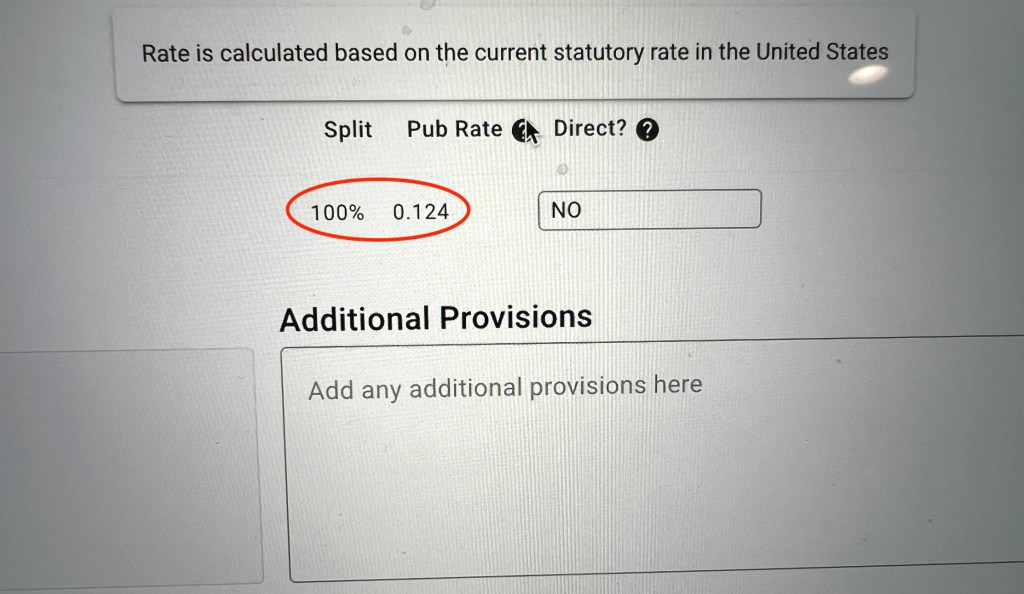
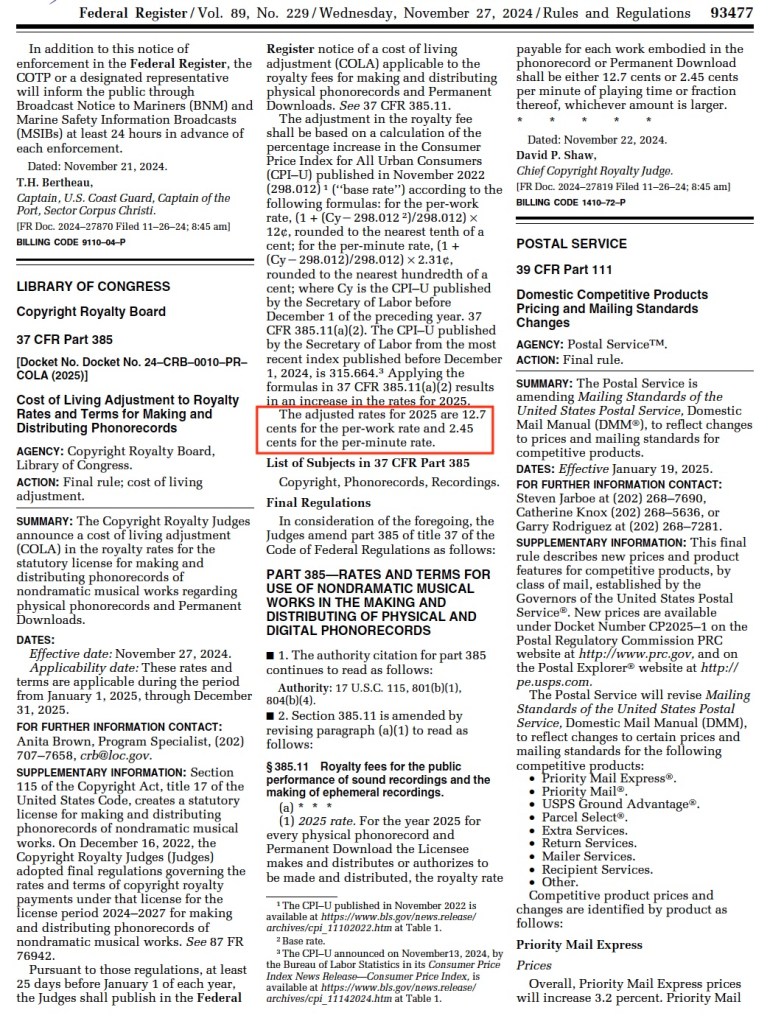
As you probably already know, the statutory mechanical royalty rate for physical or downloads (not streaming) has increased as of January 1, 2025. This means that all floating rate licenses (e.g., not subject to controlled comp rates) should have increased as of January 1, 2025 from 12.4¢ to 12.7¢ due to the Phonorecords IV cost of living adjustment. (And of course should have increased in prior PR IV years in 24.). And of course we have Trichordist readers to thank for helping to persuade the Copyright Royalty Judges to reject the Phonorecords IV frozen mechanical rate settlement that led to the labels agreeing to an increase from 9.1¢ to 12¢ plus a cost of living adjustment on physical and downloads that rose to 12.4¢ in 2024 and now to 12.7¢ in 2025. (But remember there is no cost of living adjustment for streaming mechanicals like Spotify.)

It’s probably just a glitch, but I understand that HFA hasn’t updated the 1/1/25 rates yet for “licensing out” in at least one instance (see screen capture below obtained this week). I’m inclined to believe that the issue is with the database and would not be a one-off, but I could be wrong. That suggests to me that every songwriter and publisher with either a newly issued license since 1/1/25 or a floating rate license in place during PR IV rate period (2023-2027) should probably confirm that the respective COLA escalations have been properly applied as of January 1 of 2024 and 2025. I would imagine that this isn’t an isolated incident, but maybe it is. No reason to let grass grow, however.

Here’s the Copyright Royalty Board’s timely notice of the new rate effective 1/1/25–which means that the HFA system does not appear to have been updated unless the screen capture reflects a one-off which seems doubtful to me.

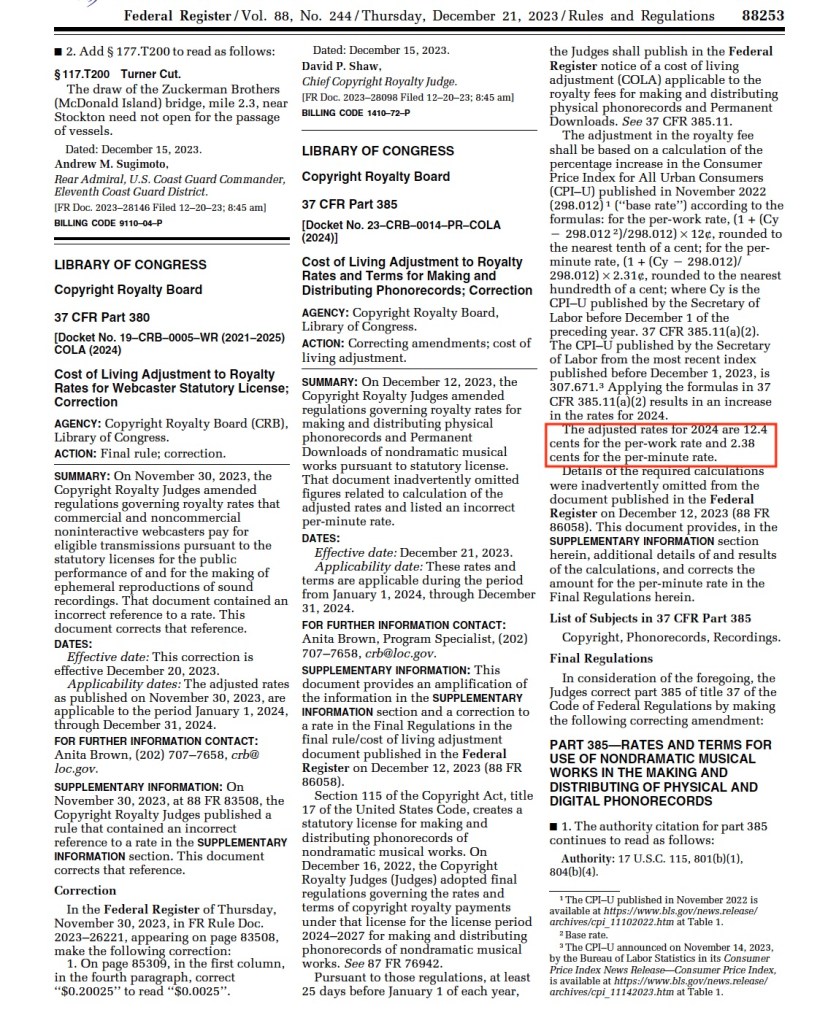
And for reference, this is the rate for 2024 with the COLA adjustment that may also have been misapplied–everyone would have to check to know if it was misapplied to them.

How Spotify (and others) Could Have Avoided Songwriter Lawsuits, Ask The Labels.

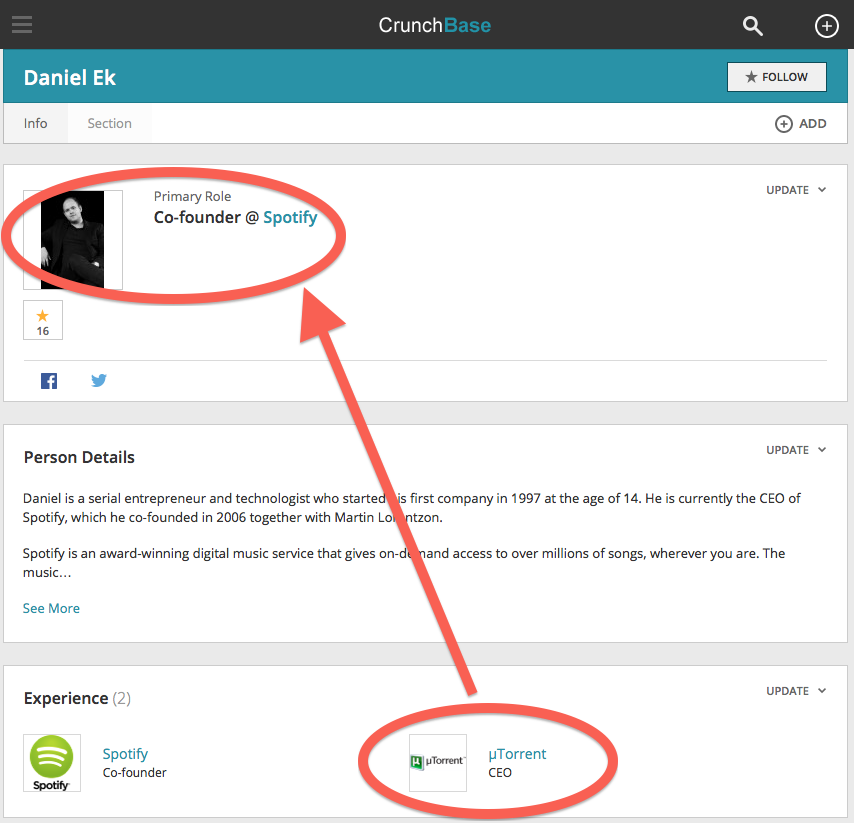
This is simply a story about intent. Daniel Ek is the co-founder of Spotify, he was also the CEO of u-torrent, the worlds most successful bit-torrent client. As far we know u-torrent has never secured music licenses or paid any royalties to any artists, ever.

Spotify could have completely avoided it’s legal issues around paying songwriters.  The company could have sought to obtain the most recent information about the publishing and songwriters for every track at the service.  The record labels providing the master recordings to Spotify are required to have this information. All Spotify (and others) had to do, was ask for it.

Here’s how it works.

For decades publishers and songwriters have been paid their share of record sales (known as “mechanicals”) by the record labels in the United States. This is a system whereby the labels collect the money from retailers and pay the publishers/songwriters their share. It has worked pretty well for decades and has not required a industry wide, central master database (public or private) to administer these licenses or make the appropriate payments.

This system has worked because each label is responsible for paying the publishers and songwriters attached to the master recordings the label is monetizing. The labels are responsible for making sure all of the publishers and writers are paid. If you are a writer or publisher and you haven’t been paid, you know where the money is – it is at the record label.

Streaming services pay the “mechanicals” at source which are determined by different formulas and rules based upon the use. For example non-interactive streaming and web radio (simulcasts and Pandora) are calculated and paid via the appropriate performing rights society like ASCAP or BMI. These publishing royalties are treated more like radio royalties.

The “mechanicals” for album sales from interactive streaming services are calculated in a different way. It is the responsibility of the streaming services to pay these royalties. CDBaby explains the system here and here. Don’t mind that these explanations are an attempt to sell musicians more CDBaby services, just focus on the information provided for a better understanding of this issue.

Every physical album and transactional download (itunes and the like) pays the “mechanical” publishing to the record label directly, who then pays the publishers and writers.  This publishing information exists as labels providing the master recordings to Spotify have this information. All Spotify (and others) have to do, is ask for it.

Record labels have collectively and effectively “crowd sourced” licensing and payments to publishers and songwriters for decades. Why can’t Spotify simply require this information from labels, when the labels deliver their masters? It’s just that simple. Period.

The simple, easy, and transparent solution to Spotify’s licensing crisis is to require record labels to provide the mechanical license information on every song delivered to Spotify. The labels already have this information.

The simple solution is for Spotify to withdraw any and all songs from the service until the label who has delivered the master recording also delivers the corresponding publisher and writer information for proper licensing and payments. Problem solved!

No need for additional databases or imagined licensing problems. Every master recording on Spotify is delivered by a record label. Every record label is required by law to pay the publishers and songwriters. This is known and readily available information by the people who are delivering the recordings to Spotify!

There is no missing information, and no unknown licenses. Why is this so F’ing hard?

This system would mean that the record labels would have to provide this information. It’s also possible that some of that information is not accurate. Labels would probably fight against any mechanism that would make them have to make any claims about the accuracy of their data, which is fine. If it’s the most update information it’s a great place to start.

Of course, we know that both sides (both labels and streamers) will reject any mechanism that introduces friction into the delivery of masters. However, with the simple intent of requiring publisher and songwriter info for every song master delivered there will no longer be a problem at the scale that currently exists.

To be completely fair to Spotify they did work to make deals with the largest organizations representing publishers and songwriters (NMPA and HFA). However those two organizations leave out a lot of participants. So back to square one. If publishing information is required upon the delivery of masters, the problem is largely solved. Invoking a variation on Occam’s Razor, the best solution is usually the most simple one.

You’d think that in the times before computers this would have been harder than it is now, but like all things Spotify you have to question the motivations of a company whose founder created the most successful bittorrent client of all time, u-torrent.

Oh, and of this writing Spotify is now claiming they have no responsibility to pay any “mechanicals” at all. Can’t make this up.