New Survey for Songwriters: We are surveying songwriters about whether they want to form a certified union. Please fill out our short Survey Monkey confidential survey here! Thanks!
StubHub is one of the richest thieves in the live ticket arbitrage market. The company is also a direct beneficiary of the U.S. government’s abysmal failure to enforce the Better Online Ticket Sales (BOTS) Act. Just like Spotify, another Goldman Sachs’ grifter, StubHub’s main objective is about to be a reality–a $16.5 billion initial public offering that will make its executives even richer. In case you were wondering where the value of all that touring was going, now you know. And StubHub’s IPO is yet another slap in the face to artists, not to mention the fans exploited by this tech oligarch.
Given the government’s newly acquired interest in the ticketing business as measured by the Department of Justice antitrust lawsuit against Live Nation, you would think that the DOJ and FTC would also step up to their obligation to enforce the BOTS Act. Remember, The BOTS Act, signed into law by President Obama in 2016, was designed to curb the use of automated software (bots) that purchase large quantities of event tickets, often within seconds of their release, to resell them at inflated prices through market makers like StubHub. It is so under-enforced that StubHub will no doubt be able to sneak out an IPO and slurp up money from the pubic trough before anyone knows better.
BOTS-driven Risk Factors
If it were ever enforced, the BOTS Act could have a significant financial downside for StubHub. I can’t wait to see the risk factors about bots in their IPO prospectus because let’s face it–if there were no bots and no boiler room operations, StubHub probably wouldn’t have much of a business. No bots, no billionaires. This one is not a theoretical antitrust case, this one is dealing with real-time massive consumer fraud about to be perpetuated and funded by the public financial markets.
The government’s enforcement of the BOTS Act is so poor that Senator Marsha Blackburn, a gifted legislator and one of the law’s co-authors, found it necessary to introduce even more legislation to try to get the FTC to do their job. The Mitigating Automated Internet Networks for (MAIN) Event Ticketing Act is a bill introduced in 2023 by Senators Blackburn and Ben Ray Luján that aims to give the FTC even fewer excuses not to enforce the BOTS Act. It would further the FTC’s consumer protection mission against IPO-driven ticket scalping.
The sad truth is that the FTC didn’t take its first action to enforce the 2016 law until 2021. And that’s the only action it has ever taken. Yet we live in hope.
When the drafting sessions get started for the StubHub IPO, the underwriters really need to ask themselves how big a hit the company’s valuation will take when prosecutors figure out how dependent reseller platforms are on bots and market manipulation to extract hard-earned dollars from enthusiastic fans.
And it isn’t just bots by the way. MTP readers will recall our discussions about speculative ticketing which turns live event tickets into commodities to be traded like pork bellies–minus the consumer protection of the securities laws. Speculative ticketing is when a market maker like StubHub allows shady operators to offer the public a ticket that the seller doesn’t actually own and may not even exist. This is what happens when an artist has publicly announced a concert tour but has not yet put the tickets on sale. Speculative ticketing lets a scalper offer a ticket that doesn’t exist without properly disclosing that the seller doesn’t own the ticket being sold.
Now that just sounds criminal, doesn’t it? Selling something you don’t own?
StubHub RICO Suave
And speaking of criminal, StubHub is currently defending a civil RICO case in New York, accused of making a market for tickets it is not able to sell. The Kaiser v. StubHub class action lawsuit, filed on January 3, 2024, in the Supreme Court of the State of New York, alleges fraudulent ticket sales by StubHub, Inc. The plaintiff, Daniel J. Kaiser, a resident of Brooklyn, New York, claims that StubHub knowingly and repeatedly advertised and sold fraudulent tickets, thereby defrauding consumers and violating the Racketeer Influenced and Corrupt Organizations Act.
What’s RICO? Civil RICO can be brought by private plaintiffs like Mr. Kaiser, but criminal RICO has to be brought by the government. Criminal RICO cases are initiated by government prosecutors, who must first obtain an indictment from a grand jury, followed by a criminal trial. While both civil and criminal RICO cases address racketeering activity, criminal RICO focuses on punishing and deterring criminal behavior, requiring a high standard of proof and resulting in severe penalties. Now there’s a risk factor. How’s this sound:
Potential Liability Under the Racketeer Influenced and Corrupt Organizations Act (RICO)
We are currently under investigation for potential violations of the Racketeer Influenced and Corrupt Organizations Act (RICO). RICO is a federal law designed to combat organized crime by allowing for both criminal and civil penalties for acts performed as part of an ongoing criminal organization. The investigation is focused on allegations that certain activities conducted by our company and its affiliates may constitute a pattern of racketeering activity under RICO.
Uncertainty and Potential Impact on Business Operations
The outcome of this investigation is uncertain, and we cannot predict the timing, outcome, or potential impact on our business, financial condition, or results of operations. If we are found to have violated RICO, we could face severe penalties, including substantial fines, forfeiture of assets, and significant reputational damage. Additionally, a criminal conviction under RICO could result in imprisonment for our key executives, which would severely disrupt our management and operations.
Nothing says white collar crime like RICO. This kind of consumer fraud is happening on a massive scale, yet the FTC apparently doesn’t feel it rises to the level of an investigation priority.
Making it Stop
In the face of this weak-kneed approach to law enforcement, artists could simply prohibit the resale of their concert tickets. If companies like StubHub keep trying, that very well may be the result, particularly with fan-to-fan solutions like Twickets competing with the likes of StubHub. How about this risk factor:
Restrictions on Ticket Resales Could Adversely Affect Our Business
Our business model relies significantly on the resale of concert tickets. However, many artists and event organizers have implemented policies that prohibit the resale of their tickets above the face price. These restrictions are designed to prevent ticket scalping and ensure that fans can purchase tickets at reasonable prices.
If artists or event organizers enforce these resale restrictions, it could limit our ability to sell tickets at a premium, which is a key component of our revenue generation. This could result in reduced profit margins and negatively impact our financial performance. Additionally, compliance with these restrictions may require us to implement new systems and processes, which could increase our operational costs.
Furthermore, any violation of these resale restrictions could lead to legal actions against us, including fines and penalties, and could damage our relationships with artists, event organizers, and customers. This could harm our reputation and result in a loss of business opportunities.
Investors should consider the potential impact of these resale restrictions on our business and financial condition before making an investment decision. There can be no assurance that we will not face additional restrictions or legal challenges related to ticket resales in the future, which could further adversely affect our business.
Underwriters be thinking, where do I sign up, right? Maybe not.
[This post previously appeared on MusicTechPolicy]
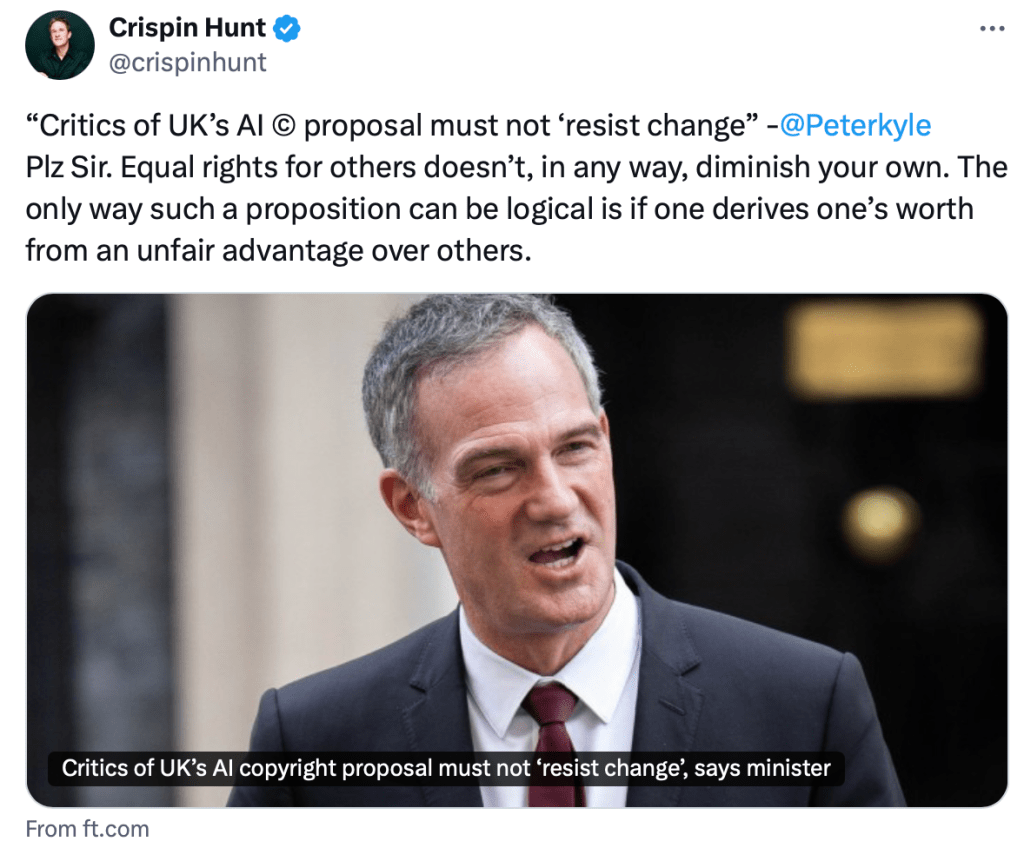
All the true promise of AI does not require violating writers, artists, photographers, voice actors etc copyrights and rights of publicity. You know, stuff like reading MRIs and X-rays, developing pharmaceuticals, advanced compounds, new industrial processes, etc.
All the true promise of AI does not require violating writers, artists, photographers, voice actors etc copyrights and rights of publicity. You know, stuff like reading MRIs and X-rays, developing pharmaceuticals, advanced compounds, new industrial processes, etc.
All the shitty aspects of AI DO require intentional mass copyright infringement (a RICO predicate BTW). You know stuff like bots, deep fakes, autogenerated “yoga mat” music, SEO manipulation, autogenerated sports coverage, commercial chat bots, fake student papers, graphic artist knockoffs, robot voice actors etc. But that’s where the no-value-add-parasitic-free-rider-easy-money is to be made. That’s why the parasitic free-riding VCs and private equity want to get a “fair use” copyright exemption.
Policy makers should understand that if they want to reduce the potential harms of AI they need to protect and reinforce intellectual property rights of individuals. It is a natural (and already existing) brake on harmful AI. What we don’t need is legislative intervention that makes it easier to infringe IP rights and then try to mitigate (the easily predictable and obvious) harms with additional regulation.
This is what happened with Napster and internet 1.0. The DMCA copyright infringement safe harbor for platforms unleashed all sorts of negative externalities that were never fairly mitigated by subsequent regulation.
Why do songwriters get 0.0009 a stream on streaming platforms? Because the platforms used the threat of the DMCA copyright safe harbor by “bad actors” (often connected to the “good actors” via shared board members and investors*) to create a market failure that destroyed the value of songs. To “fix” the problem federal legislation tasks the Copyright Royalty Board in LOC to set royalty rates and forced songwriters to license to the digital platforms (songwriters can not opt out). The royalty setting process was inevitably captured by the tech companies and that’s how you end up with 0.0009 per stream.
TBF the DMCA safe harbor requires the platforms to set up “technical measures” to prevent unlicensed use of copyrights, but this part of the DMCA safe harbor were never implemented and the federal government never bothered to enforce this part of the law. This is the Napster playbook all over again.
1. Unleash a technology that you know will be exploited by bad actors**.
2. Ask for federal intervention that essentially legalizes the infringing behavior.
3. The federal legislation effectively creates private monopoly or duopoly.
4. Trillions of dollars in wealth transferred from creators to a tiny cabal of no-value-add-parasitic-free-rider-easy-money VCs in silicon valley.
5. Lots of handwringing about the plight of creators.
6. Bullshit legislation that claims to help creators but actually mandates a below market rate for creators.
The funny thing is Lars Ulrich was right about Napster. [See our 2012 post Lars Was First and Lars Was Right.] At the time he was vilified by what in reality was a coordinated DC communication firm (working for Silicon Valley VCs) that masqueraded as grassroots operation.
But go back and watch the Charlie Rose debate between Lars Ulrich and Chuck D, everything Lars Ulrich said was gonna happen happened.
If Lars Ulrich hadn’t been cowed by a coordinated campaign by no-value-add-parasitic-free-rider-easy-money Silicon Valley VCs, he’d probably say the same thing about AI.
A performance metric one hears from the digerati is the term “conversion rate.” “Conversion rate” for a streaming service usually means the rate at which users of an ad-supported free service are “converted” to paying users. That motivation is usually because they are so fed up with the advertising they are willing to pay. (This was one of the many failed pitches from Spotify before people stopped trying to justify hanging on until the IPO riches flowed in.)
YouTube, of course, has never been too terribly interested in anything that moves users away from advertising. That resistance (and potential internal competition between the massive ad sales team and the ever changing YouTube managers), may explain the many failed efforts at launching a YouTube subscription service by a company that knows more about user behavior than anyone in history. They just couldn’t seem to get it right for the longest time. You don’t suppose that YouTube’s apparent lack of interest in getting large numbers of users to substitute away from free to subscription was because YouTube made a lot more money from the ads than they ever would from the subscriptions?
One of the ways that YouTube (and Google) makes money from advertising is by taking money that is not theirs to take (sometimes called “monetizing” content). The civil law calls that act a claim of “conversion” and the criminal law calls it the crime of “theft”. Conversion and theft are two sides of the same coin and often one implies the other, albeit with different burdens of proof.
YouTube’s Content ID tool is a way for copyright owners to block or permit advertising on user-generated content that includes their copyrights, often music. Users of Content ID will tell you that it works just well enough that Google can say it is an effective tool, but even with Content ID music still gets through (and is often monetized by YouTube) for a variety of reasons. This requires time consuming and costly manual searches. Companies like AdRev make it a bit easier, but are essentially third party Content ID users. These companies are compensated with a commission on infringing works they find on YouTube that they convert–there’s that word again–from infringing to monetized, which means that YouTube now splits the advertising revenue with the copyright owners who in turn split their share with an AdRev.
But see what happened there? If you have Content ID, you can block on the upload some of the time, or you can do a search. If you don’t have Content ID (see Maria Schneider’s class action) then you can’t block on the upload only chase the infringements manually. But quite rightly from an economic perspective, companies like AdRev are not that interested in doing that work on a rev share basis if there’s no rev share when you block.
Here’s the point–you have a property right in your copyright. You have a property right to license that copyright. Any revenue derived from exploitations of that copyright is your money. YouTube uses its monopoly power to impose a deal to monetize your copyright (under duress, of course, due to whack a mole DMCA). That deal involves a revenue share. (Let’s just assume you decide to take the King’s shilling and accept Google’s deal under duress which you shouldn’t have to do and which may not even be enforceable.)
The question is, when should that revenue share attach–when they start exploiting your copyright in violation of your property rights or when you catch them doing it. And if (1) you catch them violating your property rights and (2) agree to monetize, when should they pay you your agreed upon share of the revenue from monetizing? Should they pay retroactively to the first exploitation? Or only prospectively after you catch them?
The correct answer is they should pay retroactively. But they don’t. They just keep the money. For millions of infringements. And they get away with it because of their monopoly power, which leaves one choice most artists won’t make, which is to sue them like Maria has.
Remember–Content ID operates largely like any other fingerprinting tool. (Psychoacoustic fingerprinting is old technology–remember Jonesy in “The Hunt for Red October”? That’s fingerprinting. A “fingerprint” is simply a mathematical rendering of the waveform of an audio file.)
There is a reference databases of recordings that are “known knowns” (which is why it is important to be included in the Content ID database as Maria Schneider correctly points out in her class action.) The fingerprinting tool encounters a new file, takes a fingerprint, then looks for a match in the reference database and reports a result that triggers an action. Typically, fingerprinting tools are binary: match or no match. What happens after the tool finds a match is entirely in the control of the operator. (So while the tool could have a match rate of 90%, the operator could report a random number of matches or a fixed number of matches, like one every ten, or one every 1000. That means 90% accuracy could turn into a much lesser percentage of reported matches. It’s important to know how many matches trigger an action.)
Having had some experience with audio fingerprints, I think you will find that once a fingerprint is in the reference database, the recognition tool (Content ID in this case) will spot the reference fingerprint a very, very high percentage of the time. The fingerprinting tool I’m most aware of caught matches over 90% of the time. I can’t imagine that a tool developed by the biggest technology company in commercial history would do less–unless they wanted it to. Remember, this is not taking into account re-records unless the re-record is itself in the database, or pitch bends. This is an exact match which is very common use of Content ID. (See Maria’s class action complaint, and Kerry Muzzey has a great description of this in his recent Senate testimony.)
If Content ID is actually missing matches to known knowns on the upload (assuming exact matching is possible), I find it very odd that Content ID is missing much. Maybe it’s not, but one way to find out is to force Google to reveal the inner workings through discovery in the class action case.
But if Content ID does miss exact matches, it would be interesting to know what percentage of those misses end up being monetized, and of those, what percentage end up getting caught later by a subsequent use of Content ID or a manual investigative process. This will give an idea of the scale of the retroactive payment issue.
As Maria rightly points out, it is virtually impossible for an artist or film maker without Content ID to catch YouTube monetizing infringing works. But I think the analysis has to go a step further–even if you have Content ID, at the moment you catch YouTube monetizing illegal versions, you are in no different position than the artist who lacks access to the Content ID tool.
Both have the same problem–YouTube is profiting from illegal copies. If when you catch them you then elect to monetize, YouTube will pay you going forward, i.e., prospectively. But I do not believe they will pay you retroactivelyfor the illegal use. (There is a rumor that some music publishers do get paid retroactively under some settlement, but that needs to be confirmed.)
That means that YouTube is directly profiting from piracy for the retroactive views which could total into the hundreds of millions per day given the massive number of daily views on YouTube. If you elect to monetize due to YouTube’s monopoly power, you are essentially releasing them from liability under duress. Ifyou catch them.
So YouTube takes your property, monetizes it, and refuses to pay you for how much they made before you caught them if you ever do catch them. They dare you to sue them because you would be taking on the biggest company in commercial history that controls 90% of the access to information in the world and routinely defies governments. Not everyone has the spine of Maria Schneider.
Failing to license at all or failing to pay retroactively means that YouTube profits from piracy by converting your property to their own. And as Maria rightly points out, Google scrapes user data through non-display uses in the background even if YouTube is not monetizing overtly which they then use to compile user profiles in “millions of buckets” (which dribbled out before Judge Koh in the Gmail litigation (In Re: Google, Inc. Gmail Litigation, Case No. 13-MD-02430-LHK, (U.S.D.C. N.D. California, San Jose Division, Sept. 26, 2013)).
In either case, the value of the amount converted or stolen should rightly include the value of these user profiles scraped in the background, as well as the advertising revenue.
And don’t forget that Google is controlled by Larry Page, Sergei Brin, and Eric Schmidt through their “supervoting” shares of stock. It’s hard to believe that this YouTube policy was created without their blessing.
The simplest move for Google would be to simply pay both retroactively and (if the copyright owner elects to monetize) prospectively. Otherwise, it seems like a huge number of crimes are going on in a very planned and organized way dreamed up by YouTube and Google employees. “Dreamed up” is also called a conspiracy, and if there’s an actual conspiracy it’s not a theory (which came up in an interesting trade secret misappropriation RICO case against Google they managed to wriggle out of, at least for the moment).
The law has another word for organized theft at scale–we sometimes call it “racketeering.”





 The Trichordist
You must be logged in to post a comment.