FTC Cracks Down on Ticket Scalpers in Major BOTS Act Enforcement

The wheels of justice turn slowly, but they do turn.

In what appears to be a response to NITO’s complaint filed last year with FTC, pressure from Senator Marsha Blackburn and President Trump’s executive order on ticket scalping, Hypebot reports that the Federal Trade Commission is going after large-scale ticket resellers for violating the Better Online Ticket Sales (BOTS) Act (authored by Senators Blackburn and Richard Blumenthal). 

The enforcement action seeks tens of millions of dollars in damages and signals that federal regulators are finally prepared to tackle the systemic abuse of automated tools and deceptive practices in the live event ticketing market.

According to Hypebot, the FTC alleges that the companies used bots and a web of pseudonymous accounts to bypass ticket purchasing limits—snagging prime seats to high-demand concerts and reselling them at inflated prices on platforms like StubHub and SeatGeek. The case represents one of the largest BOTS Act enforcement efforts to date. 

“The FTC is finally doing what artists, managers, and fans have been asking for: holding scalpers accountable,” said Randy Nichols, artist manager for Underoath and advocate for ticketing reform. “This sends a message to bad actors that the days of unchecked resale are numbered.”

As Hypebot reports, this enforcement may just be the beginning. The case is likely to test the limits of the BOTS Act and could set new precedent for what counts as deceptive or unfair conduct in the ticket resale market—even when bots aren’t directly involved.

Read the full story via HypebotFTC Goes After Ticket Scalpers, Seeks Tens of Millions in Damages

A New Twist in the AM Radio Debate: Why Tying AM Mandates to AMFA Is a Game-Changer #IRespectMusic

The latest twist in the long-running AM radio saga comes from a new alliance: cars and music. Automaker trade groups Alliance for Automotive Innovation, Consumer Technology Association, and Zero Emission Transportation Association are shoulder to shoulder with the musicFIRST Coalition and SoundExchange in urging Congress to link the “AM Radio in Every Vehicle Act” with the American Music Fairness Act (AMFA). If we’re going to mandate AM radios be placed in new cars then music played on those radios should pay the people who made that music. It’s unfair and fundamentally inconsistent to require one without the other, so broadcasters should pay artists.

What Is the American Music Fairness Act?

If you haven’t run across it yet, AMFA is bipartisan legislation sponsored by our champion Senator Marsha Blackburn in the Senate and our long-time ally Rep. Darrell Issa in the House of Representatives that would finally require AM/FM radio stations to pay performance royalties to recording artists and performers when their recordings are played over the air. Currently, the U.S. remains the only democracy that allows terrestrial radio to make billions from music without compensating performers.

Why Artists Get Left Out

As incredible as it may seem, under U.S. copyright law, terrestrial radio must pay songwriters and publishers—but not performers or sound recording rights holders. That means backup singers, session musicians, and producers receive zero compensation, even when their work drives–literally–billions in broadcast revenue. This is what allows the National Association of Broadcasters shillery to claim “we pay for music” and then try to pit artists against songwriters. That dog won’t hunt, but that never stops them from trying.

The musicFIRST Coalition, including SoundExchange and tons of artists and creators, has been front and center pushing Congress to close this loophole for years and we have been right there with them along with our friend Blake Morgan and his #IRespectMusic campaign.


“Mandating AM radio without addressing the performance royalty issue would perpetuate an inequity that denies hundreds of millions of dollars in compensation to countless recording artists every year. Congress should not pass a mandate for radio without ensuring appropriate royalties for artists… They deserve to have their hard work respected and valued with fair compensation — like they receive in every other industrialized country.”
SoundExchange CEO Michael Huppe


The Math on AMFA

  • U.S. radio plays over 240 million songs annually without compensating performers
  • The music industry could gain an estimated $200–300 million annually if Americans were paid for domestic and foreign broadcast plays 
  • Aligns U.S. copyright with global norms—terrestrial radio already pays performers in virtually every other developed nation.

What is to be done

If Congress is going to mandate AM radio in every car, it can’t ignore the rights of the very artists who create the content. By demanding performance royalties through AMFA, we can preserve public safety benefits while ensuring creators are paid for their work. This is a rare chance for Congress to get it right—fairness and infrastructure can go hand-in-hand.

If you believe artists deserve fairness when their music plays on the radio, now is the time to act:

  1. Sign the letter to Congress. The musicFIRST Action Center has made it easy—just a few clicks to add your name. 
  2. Call your Senator and Representative and tell them to support both:
    • American Music Fairness Act (H.R. 861 / S. 326)
    • AM Radio in Every Vehicle Act—(S. 315 / H.R. 979–but only inclusive of performance royalties
  3. Spread the word on social media with tags like #PassAMFA#FairPayForArtists#IRespectMusic

Can RICO Be Far Behind?  President Trump and Kid Rock Announce Whole of Government Enforcement of the BOTS Act

By Chris Castle

Yes, the sound you hear echoing from Silicon Valley is the sound of gnashing teeth and rending garments—some freaking guitar player did an end run around Big Tech’s brutal lobbying power and got to the President of the United States.  Don’t you just hate it when that happens?  Maybe not, but trust me, they really hate it because in those dark hours they don’t talk about at parties, they really hate us and think we are beneath them.  Remember that when you deal with YouTube and Spotify.

But to no avail.  President Trump signed an executive order yesterday that can only be described as taking a whole of government approach to enforcement of the BOTS Act.  As readers will recall, I have long said when it comes to StubHub, SeatGeek and their ilk, no bots, no billionaires.  It is hard to imagine a world where StubHub & Co.  are not basing their entire business model on the use of bots and other automated processes to snarf up tickets before the fans can get them.  This was also the subject of our ticketing panel at the 2024 Artist Rights Symposium in Washington, DC.

Remember, the BOTS Act, sponsored by Senator Marsha Blackburn and signed into law by President Obama in 2016, was designed to curb the use of automated software (bots) that purchase large quantities of event tickets, often within seconds of their release, to resell them at inflated prices through market makers like StubHub. It was so under-enforced that until the Executive Order it was entirely possible that StubHub could have sneaked out an IPO to slurp up money from the pubic trough before anyone knows better.

The government’s enforcement of the BOTS Act is so poor that Senator Blackburn found it necessary to introduce even more legislation to try to get the FTC to do their job. The Mitigating Automated Internet Networks for (MAIN) Event Ticketing Act is a bill introduced in 2023 by Senators Blackburn and Ben Ray Luján that aims to give the FTC even fewer excuses not to enforce the BOTS Act. It would further the FTC’s consumer protection mission against IPO-driven ticket scalping.

There are entire business lines built around furthering illegal ticket scalping that are so blatant they actually hold trade shows.  For example, NITO complained to the FTC that their investigators found multiple software platforms on the trade show floor  at a ticket brokers conference that are illegal under the BOTS Act and possibly under other laws such as Treasury Department regulations, financial crimes, wire fraud and the like.

The NITO FTC complaint details how multiple technology companies, many of whom exhibited at World Ticket Conference hosted by The National Association of Ticket Brokers in Nashville on July 24-26, 2024, provide tools that enable scalpers to circumvent ticket purchasing limits. These tools include sophisticated browser extensions, proxy services, and virtual credit card platforms designed to bypass security measures implemented by primary ticket sellers.

As is mentioned in the Executive Order, the sad truth is that the FTC didn’t take its first action to enforce the 2016 law until 2021. And that’s the only action it has ever taken.   Which is why President Trump’s executive order is so critical in stopping these scoundrels.

Kid Rock apparently had a chance to present these issues to President Trump and was present at the signing ceremony for the Executive Order. He said:

First off thank you Mr. President because this has happened at lightning speed.  I want to make sure Alina Habba gets her credit too because I know she worked very hard in this but thank you for making this happen so quick.

Anyone who’s bought a concert ticket in the last decade, maybe 20 years, no matter what your politics are knows it is a conundrum.  You buy a ticket for $100 but by the time you check out it’s $170.  You don’t know what you were charged for, but more importantly these bots come in and get all the good tickets to your favorite shows you want to go to.  Then they’re relisted immediately for sometimes a four or five hundred percent markup—the artists don’t get that money!

Ultimately I think this is a great first step. I would love down the road if there be some legislation that we could actually put a cap on the resale of tickets.

Yes, folks, we may be onto something here.

The reason I say that the EO establishes a “whole of government” approach is because of what else is in the order.  The actual EO was published, and the press release on the White House site says this:

  • The Order directs the Federal Trade Commission (FTC) to:
    • Work with the Attorney General to ensure that competition laws are appropriately enforced in the concert and entertainment industry.
    • Rigorously enforce the Better Online Ticket Sales (BOTS) Act and promote its enforcement by state consumer protection authorities.
    • Ensure price transparency at all stages of the ticket-purchase process, including the secondary ticketing market.
    • Evaluate and, if appropriate, take enforcement action to prevent unfair, deceptive, and anti-competitive conduct in the secondary ticketing market.
  • The Order directs the Secretary of the Treasury and Attorney General to ensure that ticket scalpers are operating in full compliance with the Internal Revenue Code and other applicable law.
  • Treasury, the Department of Justice, and the FTC will also deliver a report within 180 days summarizing actions taken to address the issue of unfair practices in the live concert and entertainment industry and recommend additional regulations or legislation needed to protect consumers in this industry.

In other words, the EO directs other Executive Branch agencies at the DOJ, FTC, Treasury to take enforcement seriously.  If the Department of Justice is involved, that could very well lead to enforcement of the BOTS Act’s criminal penalties.  And it’s kind of hard to have a StubHub IPO from prison although President Trump may want to add the Securities and Exchange Commission to the list of agencies he is calling into action.

In addition to fines, individuals convicted under the BOTS Act could face imprisonment for up to 1 year for a first offense. Repeat offenders may face longer prison sentences, depending on the nature of the violation and if there are aggravating factors involved (such as fraud or large-scale operations).  And remember, wire fraud is a common RICO predicate under the racketeering laws which is where I personally think this whole situation needs to go and go quickly. Remember, StubHub narrowly escaped a claim for civil RICO already.

So we shall see who is serious and who isn’t.  But I will say I’m hopeful. If you wanted to seriously go after actually solving the problem on the law enforcement side, this is how you would do it.

If you wanted to go after it on the property rights side, Kid Rock’s line about establishing a cap is how you would start.  The guy has clearly thought this through and we’re lucky that he has.  We’ll get around to speculative ticketing and taking out some of the other trash down the road if that’s even a problem after getting after bots.  But on property rights, let’s start with respecting the artist’s rights to set their own prices and have them followed instead of the current catastrophe.

The other take away from this is that Marsha was right—BOTS Act is probably enough law to handle the problem.  You just need to enforce it.

I always say you can’t get Silicon Valley to behave with fines alone because they print money due to the income transfer.  Prison, though, prison is the key that picks the lock.

[Editor Charlie sez: This post first appeared on MusicTechPolicy]

@human_artistry Press Release: Senators Introduce COPIED Act to Combat AI Deepfakes

Senators Cantwell, Blackburn, and Heinrich introduce the Content Origin Protection and Integrity from Edited and Deepfaked Media Act (COPIED Act), Giving Artists New Tools to Protect Against Deepfakes
“Deepfakes pose an existential threat to our culture and society, making it hard to believe what we see and hear and leaving individual creators vulnerable as tech companies use our art without consent while AI-generated content leads to confusion about what is real. Requiring transparency is a meaningful step that will help protect us all – ensuring that nonconsensual, harmful content can be removed quickly and providing a clear origin when our life’s work has been used.” 
– Dr. Moiya McTier, Human Artistry Campaign Senior Advisor
With widespread creative community support from organizations including the Artist Rights Alliance, SAG-AFTRA, the Recording Academy, RIAA, NMPA, NSAI, and more, the bill would set new federal transparency guidelines for marking, authenticating and detecting AI-generated content, protect journalists, actors and artists against AI-driven theft, and hold violators accountable for abuses.  

Creates Transparency Standards: Requires the National Institute of Standards and Technology (NIST) to develop guidelines and standards for content provenance information, watermarking and synthetic content detection. These standards will promote transparency to identify if content has been generated or manipulated by AI, as well as where AI content originated. The bill also directs NIST to develop cybersecurity measures to prevent tampering with provenance and watermarking on AI content. 

Puts Journalists, Artists and Musicians in Control of Their Content: Requires providers of AI tools used to generate creative or journalistic content to allow owners of that content to attach provenance information to it and prohibits its removal. The bill prohibits the unauthorized use of content with provenance information to train AI models or generate AI content. These measures give content owners—journalists, newspapers, artists, songwriters, and others—the ability to protect their work and set the terms of use for their content, including compensation. 

Gives Individuals a Right to Sue Violators: Authorizes the Federal Trade Commission (FTC) and state attorneys general to enforce the bill’s requirements.  It also gives newspapers, broadcasters, artists, and other content owners the right to bring suit in court against platforms or others who use their content without permission.

Prohibits Tampering with or Disabling AI Provenance Information: Currently, there is no law that prohibits removing, disabling, or tampering with content provenance information. The bill prohibits anyone, including internet platforms, search engines and social media companies, from interfering with content provenance information in these ways.  

BMI’s Insult that Keeps On Insulting! @hypebot: Radio doesn’t pay performers, but iHeart will get $100M from BMI sale to Google/Private Equity

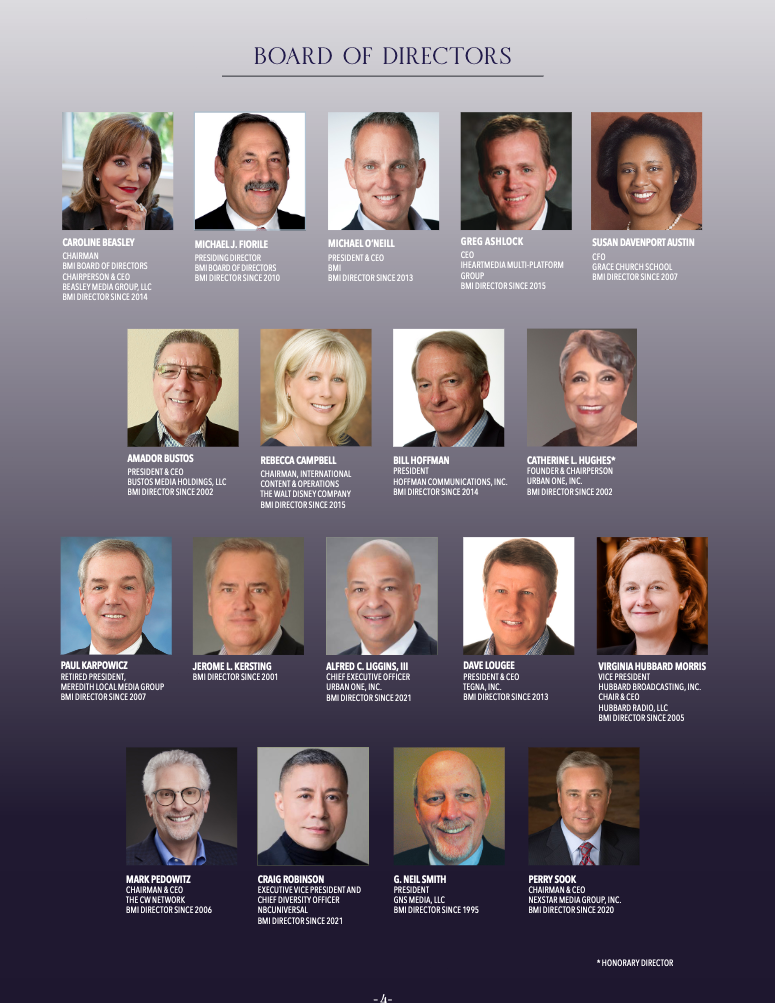
[T Editor sez: Remember how we have all fought alongside #IRespectMusic, Blake Morgan and MusicFirst to get artists paid for radio play of their recordings on terrestrial radio? Remember how iHeartMedia and the rest of the National Association of Broadcasters used their lobbying muscle to block our heroes in Congress like Reps. Jerry Nadler, Ted Deutch, and Darrell Issa and Senators Marsha Blackburn and Alex Padilla from passing the American Music Fairness Act? And are blocking it to this day? Well, adding insult to injury, the broadcasters who apparently own BMI, the for-profit PRO, are making serious bank for selling their shares to Google and private equity fund New Mountain. You know, Broadcast(er) Music, Inc.? Thus screwing songwriters, but screwing artist/songwriters TWICE. Who are they? According to the most recent BMI annual report we could find they are probably the same companies with board seats which are these smiling faces:

Bruce Hougton at Hypebot fills us in on the details of just how profitable the sale for Google’s blood money really is for one stockholder owner of BMI, iHeart Media (formerly Clear Channel). iHeart is, of course, the largest radio station owner in the US and poster child for media consolidation and screwing artists. iHeart profits from blood money stealing from artists and then does it again stealing from songwriters. And if iHeart is doing it, the rest of the BMI owners are, too. Of course you can complain to your songwriter-board member of BMI…oh wait, you don’t have any. Unlike ASCAP and SoundExchange. Of course, the question is whether those Members of Congress who worked so hard on the American Music Fairness Act and its predecessors will exercise their oversight role and investigate the sale. As well as the series of moves that lead to Google acquiring songwriter personal data that we don’t think belonged to BMI in the first place. It may not just be insulting, it may also be illegal. And answer the musical question, how big is your black box?]

 In an ironic twist, iHeart Media, the largest owner of broadcast radio stations in the US, will receive $100 million from the sale of BMI to New Mountain Capital [and Google’s CapitalG venture fund]. The windfall is a result of iHeartMedia’s equity interest in BMI.

Read Bruce’s post on Hypebot

Press Release: @MarshaBlackburn, @SenAlexPadilla Reintroduce Bipartisan Bill to Ensure Artists Are Paid for Their Music Across All Platforms #irespectmusic

The US is still the only Western democracy that stiffs artists on royalty payments for radio airplay. Let’s fix that!

[Editor Charlie sez: Anyone who tells you that artists can’t pass legislation to get fair pay for radio play is either a charlatan or full of shit and they are not on our side of the football.]

U.S. Senators Marsha Blackburn (R-Tenn.) and Alex Padilla (D-Calif.), along with Senators Thom Tillis (R-N.C.) and Dianne Feinstein (D-Calif.), introduced the bipartisan American Music Fairness Act to ensure artists and music creators receive fair compensation for the use of their songs on AM/FM radio. This legislation will bring corporate radio broadcasters in line with all other music streaming platforms, which already pay artists for their music. 

Congressmen Darrell Issa (R-Calif.) and Jerry Nadler (D-N.Y.) led the legislation in the U.S. House of Representatives.

“From Beale Street to Music Row to the hills of East Tennessee, Tennessee’s songwriters and artists have undeniably made their mark,” said Senator Blackburn. “However, while digital music platforms compensate music performers and copyright holders for playing their songs, AM/FM radio stations only pay songwriters for the music they broadcast. This legislation takes a long overdue step toward leveling the music industry playing field and ensuring creators are fairly compensated for their work.”

“California’s artists play a pivotal role in enriching and diversifying our country’s music scene, but for too long, our laws have unfairly denied them the right to receive fair compensation for their hard work and talent on AM/FM radio broadcasts,” said Senator Padilla. “As we celebrate the accomplishments of our musical artists at the Grammy Awards in Los Angeles this weekend, we must commit to treating them with the dignity and respect they deserve for the music that they produce and that we enjoy every day.”

“Protecting one’s intellectual property is the signature right of every American who dares to invent. Every artist who first picked up a drumstick, sang to their mirror, or wrote lyrics from the heart did so because they had a dream and wanted to share it with the world. I look forward to working with stakeholders and colleagues to achieve this overdue reform,” said Congressman Issa.

“The United States is an outlier in the world for not requiring broadcast radio to pay artists when playing their music, while requiring satellite and internet radio to pay,” said Chairman Nadler. “This is unfair to both artists and music providers. I’m proud to sponsor the American Music Fairness Act which would finally correct this injustice.  This is what music creators want and deserve.”

“It’s clear that the movement for music fairness continues to gain momentum, bringing us closer than ever before to ending Big Radio’s ability to deny artists the fair pay they deserve. This week’s House and Senate introductions of the American Music Fairness Act is evidence of that. We thank Senators Padilla and Blackburn and Representatives Issa and Nadler for their leadership in the effort to secure economic justice for our nation’s music artists and creators, and look forward to working together to drive continued progress in the coming months,”said Congressman Joe Crowley, Chairman of musicFIRST.

“Music creators have been forced to give away their work for far too long. It is time for Congress to demonstrate that they stand behind the hard-working Americans that provide the music we all love by finally passing the American Music Fairness Act. This bill has the broad support of artists, labels, small broadcasters, unions, and others because it strikes a fair balance by respecting creators for their work and protecting truly local broadcasters. No more excuses, no more waiting in line for their turn. Music creators demand the economic justice AMFA provides,” said Michael Huppe, President and CEO of SoundExchange.

“As we prepare to focus our attention on celebrating music this weekend at the GRAMMY Awards, the Recording Academy also renews its commitment to ensuring music creators are always compensated fairly for their work. We applaud Reps. Issa, Nadler, McClintock, and Lieu and Senators Padilla, Blackburn, Feinstein, and Tillis for reintroducing the American Music Fairness Act and look forward to working with them to build on the historic progress we made last year on this important legislation,” said Harvey Mason jr., CEO of the Recording Academy.

“The American Music Fairness Act is practical compromise legislation that has already passed the House Judiciary Committee with bipartisan support last Congress. It takes a smart, calibrated approach towards solving a decades old problem in the radio industry. When enacted into law, AMFA will ensure recording artists and copyright owners are paid fairly for recorded music regardless of the technology used to broadcast it while carefully protecting small and noncommercial stations to preserve truly local radio our communities depend upon,” said Mitch Glazier, Chairman and CEO of the Recording Industry Association of America.

“For far too long, our broken and unfair system has let AM/FM radio stations — many of which are owned by just a few massive media corporations — get away with refusing to pay artists when they play their music. While these big corporate broadcast companies gobble up billions upon billions in advertising dollars, the session and background musicians, whose work makes all of it possible, receive no compensation whatsoever for their creations. It’s time to right this wrong, and the American Music Fairness Act aims to do just that. It’s vital that Congress protects the livelihoods of those who create the music we know and love,” said Ray Hair, International President of the American Federation of Musicians.

“I want to thank Congressman Jerry Nadler, Congressman Darrell Issa, Senator Alex Padilla and Senator Marsha Blackburn for their leadership on this crucial legislation. When you consider the billions of dollars the big radio corporations generate in revenue and profits, it’s shocking that recording artists, vocalists and musicians don’t receive a penny when their work is played on AM/FM radio. Since when do workers in America get exploited without pay? This is an unfair and egregious loophole especially since both streaming and digital services pay for the use of artists’ work. AM/FM radio has had a free ride for decades and it’s time to put a stop to it! I urge Congress to fix this outdated practice by passing the American Music Fairness Act,” said Fran Drescher, President of SAG-AFTRA. 

“We are grateful that our champions are making it crystal clear that the fight for fairness continues in this new Congress. By reintroducing the American Music Fairness Act, Senators Blackburn and Padilla, along with Representatives Issa, Nadler, McClintock, and Lieu, as defenders of property rights and supporters of artistic expression, have put the mega broadcasting conglomerates on notice that it is time to erase their stain on America’s history,” said Dr. Richard James Burgess, President and CEO of the American Association of Independent Music.

Currently, the United States is the only democratic country in the world in which artists are not compensated for the use of their music on AM/FM radio. By requiring broadcast radio corporations to pay performance royalties to creators for AM/FM radio plays, the American Music Fairness Act would close an antiquated loophole that has allowed corporate broadcasters to forgo compensating artists for the use of their music for decades.

In recognition of the important role of locally owned radio stations in communities across the U.S., the American Music Fairness Act also includes strong protections for small, college, and non-commercial stations.

The American Music Fairness Act will positively impact artists and the music industry at large by:

  • Requiring terrestrial radio broadcasters to pay royalties to American music creators when they play their songs.
  • Protecting small and local stations who qualify for exemptions — specifically those that fall under $1.5 million in annual revenue and whose parent companies fall under less than $10 million in annual revenue overall — by allowing them to play unlimited music for less than $500 annually. 
  • Creating a fair global market that ensures foreign countries pay U.S. artists for the use of their songs overseas.

The American Music Fairness Act is endorsed by: the AFL-CIO, the American Association of Independent Music (A2IM), the American Federation of Musicians, the Recording Academy, the Recording Industry Association of America (RIAA), SAG-AFTRA and SoundExchange.

Full text of the bill is available here.

###

https://www.blackburn.senate.gov/2023/2/blackburn-padilla-reintroduce-bipartisan-bill-to-ensure-artists-are-paid-for-their-music-across-all-platforms

Press Release: @MarshaBlackburn, @SenAlexPadilla Reintroduce Bipartisan Bill to Ensure Artists Are Paid for Their Music Across All Platforms #irespectmusic — Artist Rights Watch–News for the Artist Rights Advocacy Community