If you got one of these emails from Spotify, you might be interested

Spotify failed to consult any of the people who drive fans to the data abattoir: the musicians, artists, podcasters and authors.

Spotify has quietly tightened the screws on AI this summer—while simultaneously clarifying how it uses your data to power its own machine‑learning features. For artists, rightsholders, developers, and policy folks, the combination matters: Spotify is making it harder for outsiders to train models on Spotify data, even as it codifies its own first‑party uses like AI DJ and personalized playlists.
Spotify is drawing a bright line: no training models on Spotify; yes to Spotify training its own. If you’re an artist or developer, that means stronger contractual leverage against third‑party scrapers—but also a need to sharpen your own data‑governance and licensing posture. Expect other platforms in music and podcasting to follow suit—and for regulators to ask tougher questions about how platform ML features are audited, licensed, and accounted for.

Below is a plain‑English (hopefully) breakdown of what changed, what’s new or newly explicit, and the practical implications for different stakeholders.

Explicit ban on using Spotify to train AI models (third parties). 

Spotify’s User Guidelines now flatly prohibit “crawling” or “scraping” the service and, crucially, “using any part of the Services or Content to train a machine learning or AI model.” That’s a categorical no for bots and bulk data slurps. The Developer Policy mirrors this: apps using the Web API may not “use the Spotify Platform or any Spotify Content to train a machine learning or AI model.” In short: if your product ingests Spotify data, you’re in violation of the rules and risk enforcement and access revocation.

Spotify’s own AI/ML uses are clearer—and broad. 

The Privacy Policy (effective August 27, 2025) spells out that Spotify uses personal data to “develop and train” algorithmic and machine‑learning models to improve recommendations, build AI features (like AI DJ and AI playlists), and enforce rules. That legal basis is framed largely as Spotify’s “legitimate interests.” Translation: your usage, voice, and other data can feed Spotify’s own models.

The user content license is very broad. 

If you post “User Content” (messages, playlist titles, descriptions, images, comments, etc.), you grant Spotify a worldwide, sublicensable, transferable, royalty‑free, irrevocable license to reproduce, modify, create derivative works from, distribute, perform, and display that content in any medium. That’s standard platform drafting these days, but the scope—including derivative works—has AI‑era consequences for anything you upload to or create within Spotify’s ecosystem (e.g., playlist titles, cover images, comments).

Anti‑manipulation and anti‑automation rules are baked in. 

The User Guidelines and Developer Policy double down on bans against bots, artificial streaming, and traffic manipulation. If you’re building tools that touch the Spotify graph, treat “no automated collection, no metric‑gaming, no derived profiling” as table stakes—or risk enforcement, up to termination of access.

Data‑sharing signals to rightsholders continue. 

Spotify says it can provide pseudonymized listening data to rightsholders under existing deals. That’s not new, but in the ML context it underscores why parallel data flows to third parties are tightly controlled: Spotify wants to be the gateway for data, not the faucet you can plumb yourself.

What this means by role:

• Artists & labels: The AI‑training ban gives you a clear contractual hook against services that scrape Spotify to build recommenders, clones, or vocal/style models. Document violations (timestamps, IPs, payloads) and send notices citing the User Guidelines and Developer Policy. Meanwhile, assume your own usage and voice interactions can be used to improve Spotify’s models—something to consider for privacy reviews and internal policies.

• Publishers and collecting societies: The combination of “no third‑party training” + “first‑party ML training” is a policy trend to watch across platforms. It raises familiar questions about derivative data, model outputs, and whether platform machine learning features create new accounting categories—or require new audit rights—in future licenses.

• Policymakers: Read this as another brick in the “closed data/open model risk” wall. Platforms restrict external extraction while expanding internal model claims. That asymmetry will shape future debates over data‑access mandates, competition remedies, and model‑audit rights—especially where platform ML features may substitute for third‑party discovery tools.

Practical to‑dos

1) For rights owners: Add explicit “no platform‑sourced training” language in your vendor, distributor, or analytics contracts. Track and log known scrapers and third‑party tools that might be training off Spotify. Consider notice letters that cite the specific clauses.

2) For privacy and legal teams: Update DPIAs and data maps. Spotify’s Privacy Policy identifies “User Data,” “Usage Data,” “Voice Data,” “Message Data,” and more as inputs for ML features under legitimate interest. If you rely on Spotify data for compliance reports, make sure you’re only using permitted, properly aggregated outputs—not raw exports.

3) For users: I will be posting a guideline to how to clawback your data. I may not hit everything so always open to suggestions about whatever else that others spot.

Spotify’s terms give it very broad rights to collect, combine, and use your data (listening history, device/ads data, voice features, third-party signals) for personalization, ads, and product R&D. They also take a broad license to user content you upload (e.g., playlist art). 

Key cites

• User Guidelines: prohibition on scraping and on “using any part of the Services or Content to train a machine learning or AI model.”

• Developer Policy (effective May 15, 2025): “Do not use the Spotify Platform or any Spotify Content to train a machine learning or AI model…” Also bans analyzing Spotify content to create new/derived listenership metrics or user profiles for ad targeting.

• Privacy Policy (effective Aug. 27, 2025): Spotify uses personal data to “develop and train” ML models for recommendations, AI DJ/AI playlists, and rule‑enforcement, primarily under “legitimate interests.”

• Terms & Conditions of Use: very broad license to Spotify for any “User Content” you post, including the right to “create derivative works” and to use content by any means and media worldwide, irrevocably.

[A version of this post first appeared on MusicTechPolicy]

@ArtistRights Newsletter 8/11/25: @DavidCLowery on Streaming, SX v. Sirius, AI the Cult and “Dual Use AI” Culture is Upstream of War

Save the Date! September 18 Artist Rights Roundtable in Washington produced by Artist Rights Institute/American University Kogod Business & Entertainment Program. Details at this link!

Artist Rights Institute logo - Artist Rights Weekly newsletter

Save the Date! September 18 Artist Rights Roundtable in Washington produced by Artist Rights Institute/American University Kogod Business & Entertainment Program. Details at this link!

Streaming Economics

@nickgillespie and @davidclowery: Streaming is a Regulated Monopoly (Reason Magazine/Nick Gillespie)

Spotify’s Royalty Threshold Is Conscious Parallelism Reshaping the Music Business—But Not in a Good Way (The Trichordist/Chris Castle)

SoundExchange v. SiriusXM

Did the Court Misread Congress? Rethinking SoundExchange v. SiriusXM Through the Lens of Legislative Design

Copyright Terminations Vetter v. Resnik

Controversial ruling on US termination right fulfills the intention of Congress, say creators (Complete Music Update/Chris Cooke)

Amicus Brief Supporting Cyril Vetter of Artist Rights Institute (David Lowery, Nikki Rowling), Blake Morgan, Abby North, and Angela Rose White (Chris Castle)

Cult of the AI Singularity

AI Frontier Labs and the Singularity as a Modern Prophetic Cult (MusicTech.Solutions/Chris Castle)

AI Czar David Sacks Shortcut to Nowhere: How the Seven Deadly Since Keep Him From Licensing Solutions

Dual Use AI

America Isn’t Ready for the Wars of the Future (Foreign Affairs/GEN Mark Milley and Eric Schmidt)

Spotify CEO Daniel Ek Named Chairman of Military AI Firm Following 600M Investment (Playy Magazine)

Eric Schmidt Is Building the Perfect AI War-Fighting Machine (Wired/Will Knight)

Souls for Sale: The Long Con Behind AI Weapons and Cultural Complicity (MusicTechPolicy/Chris Castle)

Eric Schmidt-led panel pushing for new defense experimentation unit to drive military adoption of generative AI(Defense Scoop/Brandi Vincent)

The Lords of War: Daniel Ek, Eric Schmidt and the Militarization of Tech (MusicTechPolicy/Chris Castle)

On the Internet, “Partners” Don’t Hear You Scream: Spotify CEO Makes a $350M “Bundle” While Sticking Songwriters with an ESG “Bundle” of Crap

Here’s a quote for the ages:

MICHAEL BURRY

One of the hallmarks of mania is the rapid rise and complexity 
of the rates of fraud. And did you know they’re going up?

The Big Short, screenplay by Charles Randolph and Adam McKay,
based on the book by Michael Lewis

We have often said that if screwups were Easter eggs, Spotify CEO Daniel Ek would be the Easter bunny, hop hop hopping from one to the next. That’s is not consistent with his press agent’s pagan iconography, but it sure seems true to many people.

This week was no different. Mr. Ek cashed out hundreds of millions in Spotify stock while screwing songwriters hard with a lawless interpretation of the songwriter compulsory license. That interpretation is so far off the mark that he surely must know exactly what he is doing. It’s yet another manifestation of Spotify’s sudden obsession with finding profits after a decade of “get big fast.”

The Bunny’s Bundle

Let’s look under the hood at the part they don’t tell you much about. Mr. Ek evidently has what’s called a “10b5-1 agreement” in place with Spotify allowing staggered sales of incremental tranches of the common stock. Those sales have to be announced publicly which Spotify complied with (we think). And we’ll say it again for the hundredth time, stock is where the real money is at this stage of Spotify’s evolution, not revenue.

As a founder of Spotify, Mr. Ek holds founders shares plus whatever stock awards he has been granted by the board he controls through his supervoting stock that we’ve discussed with you many times. These 10b5-1 agreements are a common technique for insiders, especially founders, who hold at least 10% of the company’s shares, to cash out and get the real money through selling their stock.

A 10b5-1 agreement establishes predetermined trading instructions for company stock (usually a sale so not trading the shares) consistent with SEC rules under Section 10b5 of the Securities and Exchange Act of 1934 covering when the insider can sell. Why does this exist? The rule was established in 2000 to protect Silicon Valley insiders from insider trading lawsuits. Yep, you caught it–it’s yet another safe harbor for the special people. Presumably Mr. Ek’s personal agreement is similar if not identical to the safe harbor terms because that’s why the terms are there.

As MusicBusinessWorldWide reported, Mr. Ek recently sold $118.8 million in shares of Spotify at roughly the same time that he likely knew Spotify was planning to change the way his company paid songwriters on streaming mechanicals, or as it’s also known “material nonpublic information”.

As Tim Ingham notes in MusicBusinessWorldwide, Mr. Ek has had a few recent sales under his 10b5-1 agreement: “Across these four transactions (today’s included), Ek has cashed out approximately $340.5 million in Spotify shares since last summer.” Rough justice, but I would place a small wager that Ek has cashed out in personal wealth all or close to all of the money that Spotify has paid to songwriters (through their publishers) for the same period. In this sense, he is no different than the usual disproportionately compensated CEOs at say Google or Raytheon. 

Stock buybacks artificially increase share price. Now why might Spotify want to juice its own stock price?

Spotify Shoves a “Bundled” Rate on Songwriters

Spotify’s argument (that may have caused a jump in share price) claims that its recent audiobook offering made Spotify subscriptions into a “bundle” for purposes of the statutory mechanical rate. (While likely paying an undiscounted royalty to the books.) 

That would be the same bundled rate that was heavily negotiated in the 2021-22 “Phonorecords IV” proceeding at the Copyright Royalty Board at great expense to all concerned, not to mention torturing the Copyright Royalty Judges. These Phonorecords IV rates are in effect for five years, but the next negotiation for new rates is coming soon (called Phonorecords V or PR V for short). We’ll get to the royalty bundle but let’s talk about the cash bundle first.

You Didn’t Build That

Don’t get it wrong, we don’t begrudge Mr. Ek the opportunity to be a billionaire. We don’t at all. But we do begrudge him the opportunity to do it when the government is his “partner” so they can together put a boot on the necks of songwriters. This is how it is with statutory mechanical royalties; he benefits from various other safe harbors, has had his lobbyists rewrite Section 115 to avoid litigation in a potentially unconstitutional reach back safe harbor, and he hired the lawyer at the Copyright Office who largely wrote the rules that he’s currently bending. Yes, we do begrudge him that stuff.

And here’s the other effrontery. When Daniel Ek pulls down $340.5 million as a routine matter, we really don’t want to hear any poor mouthing about how Spotify cannot make a profit because of the royalty payments it makes to artists and songwriters. (Or these days, doesn’t make to some artists.) This is, again, why revenue share calculations are just the wrong way to look at the value conferred by featured and nonfeatured artists and songwriters on the Spotify juggernaut. That’s also the point Chris made in some detail in the paper he co-wrote with Professor Claudio Feijoo for WIPO that came up in Spain, Hungary, France, Uruguay and other countries.

Spotify pays a percentage of revenue on what is essentially a market share basis. Market share royalties allows the population of recordings to increase faster than the artificially suppressed revenue, while excluding songwriters from participating in the increases in market value reflected in the share price. That guarantees royalties will decline over time. Nothing new here, see the economist Thomas Malthus, workhouses and Charles Dickens‘ Oliver Twist.

The market share method forces songwriters to take a share of revenue from someone who purposely suppressed (and effectively subsidized) their subscription pricing for years and years and years. (See Robert Spencer’s Get Big Fast.). It would be a safe bet that the reason they subsidized the subscription price was to boost the share price by telling a growth story to Wall Street bankers (looking at you, Goldman Sachs) and retail traders because the subsidized subscription price increased subscribers.

Just a guess. 

The Royalty Bundle

Now about this bundled subscription issue. One of the fundamental points that gets missed in the statutory mechanical licensing scheme is the compulsory license itself. The fact that songwriters have a compulsory license forced on them for one of their primary sources of income is a HUGE concession. We think the music services like Spotify have lost perspective on just how good they’ve got it and how big a concession it is.

The government has forced songwriters to make this concession since 1909. That’s right–for over 100 years. A century.

A decision that seemed reasonable 100 years ago really doesn’t seem reasonable at all today in a networked world. So start there as opposed to the trope that streaming platforms are doing us a favor by paying us at all, Daniel Ek saved the music business, and all the other iconographic claptrap.

Has anyone seen them in the same room at the same time?

The problem with the Spotify move to bundled subscriptions is that it can happen in the middle of a rate period and at least on the surface has the look of a colorable argument to reduce royalty payments. If you asked songwriters what they thought the rule was, to the extent they had focused on it at all after being bombarded with self-congratulatory hoorah, they probably thought that the deal wasn’t “change rates without renegotiating or at least coming back and asking.”

And they wouldn’t be wrong about that, because it is reasonable to ask that any changes get run by your, you know, “partner.” Maybe that’s where it all goes wrong. Because it is probably a big mistake to think of these people as your “partner” if by “partner” you mean someone who treats you ethically and politely, reasonably and in good faith like a true fiduciary. 

They are not your partner. Don’t normalize that word.

A Compulsory License is a Rent Seeker’s Presidential Suite

But let’s also point out that what is happening with the bundle pricing is a prime example of the brittleness of the compulsory licensing system which is itself like a motel in the desolate and frozen Cyber Pass with a light blinking “Vacancy: Rent Seekers Wanted” surrounded by the bones of empires lost. Unlike the physical mechanical rate which is a fixed penny rate per transaction, the streaming mechanical is a cross between a Rube Goldberg machine and a self-licking ice cream cone. 

The Spotify debacle is just the kind of IED that was bound to explode eventually when you have this level of complexity camouflaging traps for the unwary written into law. And the “written into law” part is what makes the compulsory license process so insidious. When the roadside bomb goes off, it doesn’t just hit the uparmored people before the Copyright Royalty Board–it creams everyone.

David and friends tried to make this point to the Copyright Royalty Judges in Phonorecords IV. They were not confused by the royalty calculations–they understood them all too well. They were worried about fraud hiding in the calculations the same way Michael Burry was worried about fraud in The Big Short. Except there’s no default swaps for songwriters like Burry used to deal with fraud in subprime mortgage bonds. 

Here’s how the Judges responded to David, you decide if they are condescending or if the songwriters were prescient knowing what we know now:

While some songwriters or copyright owners may be confused by the royalties or statements of account, the price discriminatory structure and the associated levels of rates in settlement do not appear gratuitous, but rather designed, after negotiations, to establish a structure that may expand the revenues and royalties to the benefit of copyright owners and music services alikewhile also protecting copyright owners from potential revenue diminution. This approach and the resulting rate setting formula is not unreasonable. Indeed, when the market itself is complex, it is unsurprising that the regulatory provisions would resemble the complex terms in a commercial agreement negotiated in such a setting.

PR IV Final Rule at 80452 https://app.crb.gov/document/download/27410

It must be said that there never has been a “commercial agreement negotiated in such a setting” that wasn’t constrained by the compulsory license. It’s unclear what the Judges even mean. But if what the Judges mean is that the compulsory license approximates what would happen in a free market where the songwriters ran free and good men didn’t die like dogs, the compulsory license is nothing like a free market deal.

If the Judges are going to allow services to change their business model in midstream but essentially keep their music offering the same while offloading the cost of their audiobook royalties onto songwriters through a discount in the statutory rate, then there should be some downside protection. Better yet, they should have to come back and renegotiate or songwriters should get another bite at the apple.

Unfortunately, there are neither, which almost guarantees another acrimonious, scorched earth lawyer fest in PR V coming soon to a charnel house near you.

Eject, Eject!

This is really disappointing because it was so avoidable if for no other reason. It’s a great time for someone…ahem…to step forward and head off the foreseeable collision on the billable time highway. The Judges surely know that the rate calculation is a farce

But the Judges are dealing with people negotiating the statutory license who have made too much money negotiating it to ever give it up willingly although a donnybrook is brewing. This inevitable dust up means other work will suffer at the CRB. It must be said in fairness that the Judges seem to find it hard enough to get to the work they’ve committed to according to a recent SoundExchange filing in a different case (SDARS III remand from 2020).  

That’s not uncharitable–I’m merely noting that when dozens of lawyers in the mechanical royalty proceedings engage in what many of us feel are absurd discovery excesses. When there are stupid lawyer tricks at the CRB, they are–frankly–distracting the Judges from doing their job by making them focus on, well, bollocks. We’ll come back to this issue in future. The dozens and hundreds of lawyers putting children through college at the CRB–need to take a breath and realize that judicial resources at the CRB are a zero sum game. This behavior isn’t fair to the Judges and it’s definitely not fair to the real parties in interest–the songwriters.

Tell the Horse to Open Wider

A compulsory license in stagflationary times is an incredibly valuable gift, and when you not only look the gift horse in the mouth but ask that it open wide so you can check the molars, don’t be surprised if one day it kicks you.

A version of this post first appeared on MusicTech.Solutions

Guest Post: Honesty In Our Favor: HFA Loses Attempt To Exit Eight Mile Style Case–What Implications For MLC?

Guest post by Chris Castle

The Uniform Commercial Code defines “good faith” as “honesty in fact and the observance of reasonable commercial standards of fair dealing.”

Spotify was sued by Eight Mile Style and Martin Affiliated, two publishers that control rights in some of the early Eminem repertoire, including Lose Yourself. Remember that earlier this year, Spotify announced with great fanfare that Lose Yourself was streamed over 1 billion times on the platform. That’s just one measurement of Eminem’s dominance on Spotify. Turns out that Spotify had failed to license a good chunk of Eminem’s catalog.

The publishers eventually joined the Harry Fox Agency to the lawsuit as participating in the situation, adding claims of vicarious and contributory copyright infringement against the long-time publishing administrator to the industry. In fact, the Harry Fox Agency gave some people the impression that when it came to Section 115 of the Copyright Act, HFA thought they were the government. What ever is this venerable organization doing getting sued for copyright infringement instead of leading the charge against the infringer?

At one point a few years ago, quite a few years ago now, HFA decided to jump up on top of the wall. They started working for tech companies like Spotify and also administering publishing rights. That’s right–both sides. What could possibly go wrong?

Let me illustrate with an anecdote (one that does not involve HFA, or MRI for that matter). A highly ethical licensing administrator interviewed for a job handling music licensing for a big tech company. After several rounds of interviews, the administrator was told they weren’t getting the job. Asking for a reason, the tech company told the administrator that the company thought the administrator were likely going to flag and at least try to fix any problems they found in the tech company’s reporting. The administrator didn’t find this remarkable as this was the honest thing to do. The company said, we don’t want honesty when it’s not in our favor. The company hired someone else because they did not want “honesty in fact”.

There are serious allegations against the Harry Fox Agency in the Eight Mile Case. Remember, this is a defense motion to dismiss, so the plaintiff largely gets the benefit of the doubt in their favor. You may ask yourself what possible motivation could Spotify have for engaging in such risky behavior. In her order denying in part and granting in part HFA’s motion to dismiss, Judge Trauger puts her finger right on the most plausible explanation:

[I]t is undisputed that [Eminem, aka Marshall] Mathers is an artist who has enjoyed extraordinary commercial success and has built a large, dedicated fanbase, such that his omission from a major streaming platform might discourage some meaningful number of potential users from subscribing

In other words, they did it for the subscribers, they did it for the growth and they did it for the money.

While Eight Mile alleged both vicarious and contributory infringement, Judge Trauger dismissed the claim for vicarious infringement on technical grounds (with leave to amend). Not so with the claim for contributory infringement, however:

HFA objects that it was under no obligation to police Spotify’s in-house decisions regarding infringement. Whether that is true or not, the plaintiffs have not merely alleged that HFA failed to affirmatively police Spotify’s conduct; they have alleged both that HFA knew and, through the ordinary fulfillment of its duties, should have known that the infringement was occurring and that HFA was helping to conceal it.…There is little doubt, moreover, that those allegations of knowledge were pleaded sufficiently. Even when a claim is governed by the heightened pleading requirements of Rule 9(b), “[m]alice, intent, knowledge, and other conditions of a person’s mind may be alleged generally.” Fed. R. Civ. P. 9(b). The Supreme Court, moreover, has recognized a party’s “aiming to satisfy a known source of demand for copyright infringement” as evidence of an improper purpose in the contributory infringement analysis. Grokster, 545 U.S. at 939. That circumstantial evidence is only heightened when the defendant, knowing of the capacity for infringement, fails to take steps to avoid it. See id. (citing Groskter’s lack of “attempt[s] to develop filtering tools or other mechanisms to diminish the infringing activity using their software”).

The plaintiffs have plausibly alleged that HFA became aware of Spotify’s licensing predicament and offered services that directly filled its need to maintain an illusion of lawfulness while continuing to infringe. 

If these allegations turn out to be proven true, songwriters (and the Copyright Office for that matter) may well ask themselves if there are implications for HFA’s continued role as a vendor for The MLC, if not why they were selected in the first place.

This post first appeared in MusicTechPolicy

Guest Post: Streaming and the Embarrassment of COVID Riches

By Chris Castle (first appeared on MusicTechPolicy)

We’re starting to see a narrative emerging from the digital music services in reaction to artists chafing under the misery of streaming royalties.  Streamers want lawmakers to focus attention on the allocation of current period revenue that they pay to creators and deflect attention from the company’s stock market valuation (or private company valuation).  That’s a grand deflection and misdirection away from the true value of artists, songwriters and their recorded music to streaming companies like Spotify.  But they can’t escape the embarrassment of riches by discounting the value of stock price through deflecting attention to loss-making revenues that companies like Spotify keep artificially low through a kind of Malthusian reverse pricing power to drive growth.  It may be rational for investors, but it’s not sustainable for the creators of the company’s sole or primary product.

We saw this with Pandora–lawmakers were told how much of Pandora’s monthly revenue the company paid out in royalties as though revenue was the primary metric.  The deflection worked until lawmakers started realizing that Tim Westergren was booking $1 million a month in stock sales.  Then it rang pretty hollow.  But the commoditizers are at it again.

No matter how much Big Tech tries to commoditize music, this is not about selling widgets at a deep discount–it’s about people’s lives.

“Get Big Fast”

Let’s be clear–companies like Spotify don’t get into business to eke out a profit.  They get into business to get their snouts into the trough of IPO stock as fast as possible and share that wealth with as few people as possible.  (And get out of corporate governance before the chickens come home to roost.)  So looking at revenue allocation without the accretive boost of stock market valuation is simply a grand deflection.  Abracadabra!

That deflection is particularly galling when the executives dip into current revenues to reward themselves like drunken sailors.  This is the profit fallacy—I would go so far as to say that in Silicon Valley, “profit motive” is very 1980 and long ago was replaced by the motive of  “get big fast.”  These companies seek to capture public stock market valuation, and share price valuation implies a belief in top line earnings and market share growth–not current period profit or–God forbid–dividends to shareholders.  And “get big fast” is working for Spotify.

share of streaming services

There is also controversy about a perceived “allocation” of music royalties payable by the streaming services particularly between record companies and recording artists or PROs and songwriters (especially the PROs and authors’ societies that Silicon Valley would dearly like to replace).  The allocation theory again focuses on revenue instead of the total value transfer. It goes something like this: Streaming services pay 69¢ of each dollar for royalties. When the artists or songwriters complain, it’s not because the saintly streaming services don’t pay enough, it’s because the greedy record companies or PROs take too much of that 69¢.

There is a lot that is not said with that fallacious allocation statement. I think a focus on revenue “allocation” is the wrong way to look at the royalty issue from a policy perspective.  The “allocation” focus presupposes there is an aggregate payment for music that is somehow misallocated.  

Pie-ism a la Mode

This allocation or “pie” fallacy is a very familiar argument in the U.S. It often comes from broadcasters fighting equitable remuneration for recording artists on terrestrial radio by attempting to limit their total payment for both sound recordings and songs to the amount that broadcasters historically have paid for songs only.  Instead of acknowledging the value of sound recordings, the platforms confound song performance royalties with “music”.  They say, “We pay $X for music, we don’t care how you allocate it between songs and recordings.”  This is like comparing apples to oranges and producing a pomegranate.

I call this thinking the fallacy of the pie, a derivative of the fallacy of composition.  It makes creative sectors fight each other in a kind of digital decimation.  

There is nothing particularly sophisticated about this strategy.  But the policy challenge for industrial strategists is to how to grow the pie, not to cut smaller pieces for everyone.  Growing the pie is particularly relevant when the platform seeks to monetize its valuation in the public financial markets. At that point, focusing solely on the allocation of revenue to the exclusion of the total valuation transfer is simply a kind of cruel joke.

Here’s the sad reality broken down to current per-stream rates that are entirely based on service revenue:

etude-ecoute-en-continu-streaming-montants-spotify-apple-music-google

This is front of mind as we see reports of Believe Digital (owner of the independent pre-pay distributor Tunecore) contemplating a €2 billion IPO drafting behind the reported COVID-fueled success of streaming and the Spotify public offering.  Government may play a role in requiring a share of riches transferred from the public financial markets to be shared by those artists and songwriters who gave the issuer its valuation, particularly when the issuer did not invest in the creative community.  

Get COVID Profitable Fast

If profit were really the target, one could make Spotify more profitable almost overnight by moving their U.S. headquarters to Syracuse, Cedar Rapids or even Austin rather than multiple floors of the World Trade Center in Manhattan.  One could cut executive compensation, one could do many things to reduce their Selling, General and Administrative costs.  But profit is not the issue for them.  Valuation is the issue and valuation is driven by bets on future growth.   In Spotify’s case, growth is often measured as subscriber growth and subscriber growth implies competing on price because Spotify offers more or less the same product as its competitors in a triumph of the commoditizer.  Which in turn implies keeping retail prices down (and Monthly Service Revenue) in a race to the bottom on subscription price and to the top on share price.  You may find that analyzing the economics of who wins in streaming is similar to who wins a gas war among price cutting petrol stations.

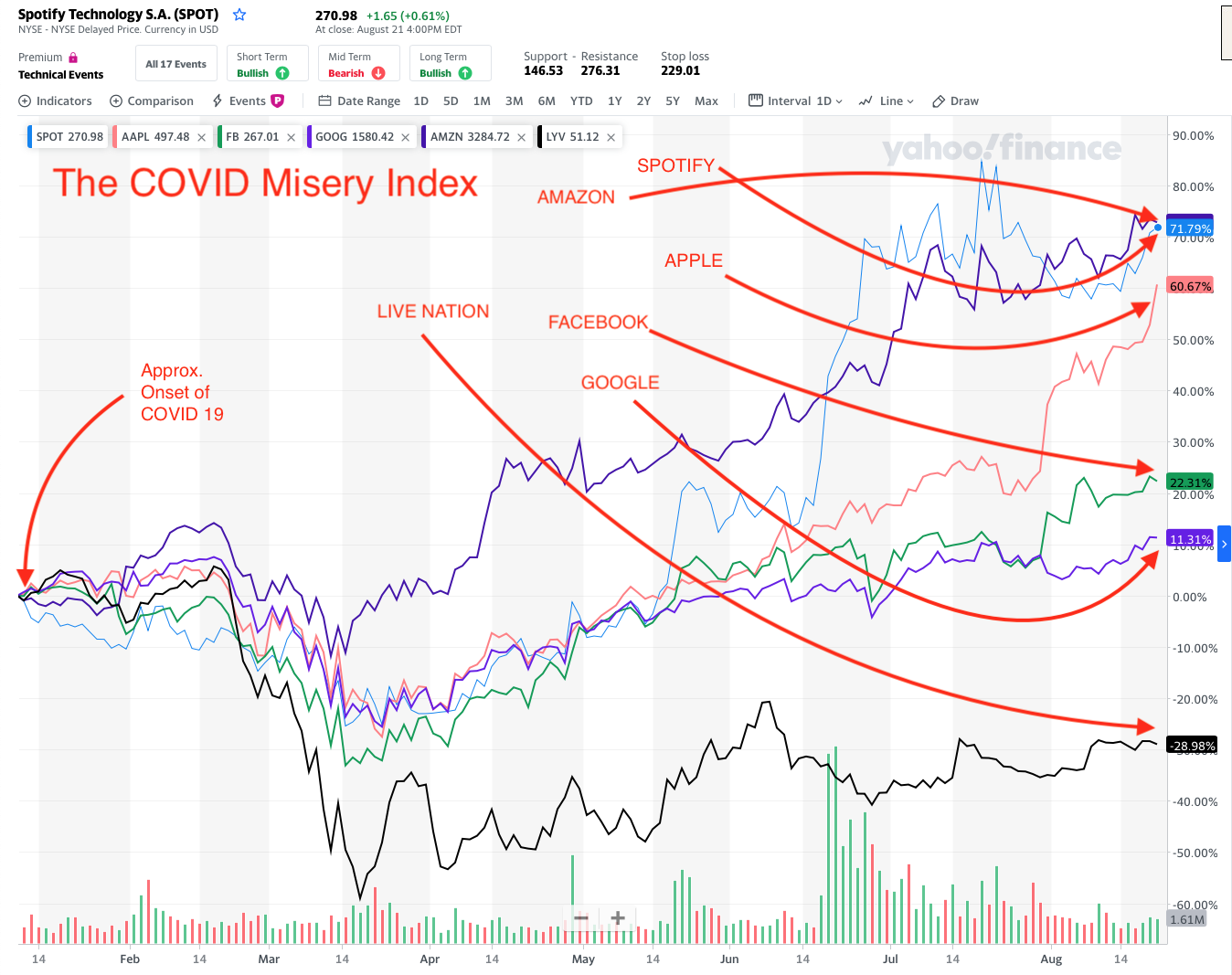
COVID has nearly destroyed the live music business that sustained the artists who previously tolerated their mils per stream Spotify royalties.  Far from being harmed by COVID, COVID has been rocket fuel for Spotify which adds to the unfairness of the “big pool” revenue share royalty system.  As the COVID Misery Index demonstrates, Spotify’s growth in valuation has outpaced its fellow oligopolists:

COVID Misery Index 1-8-21

Given the urgency of the COVID crisis, it is important to understand the difference between the creator community and other workers affected by COVID.  For example, restaurants are not failing while some other entity succeeds in extracting value from their customers.  As the COVID Misery Index demonstrates, Spotify’s stock price has more than doubled since the onset of COVID.

Again, Spotify’s success is largely predicated on keeping both royalties and prices low and bargaining for special royalty treatment.  I don’t object to the company’s pricing decisions so much as the complete failure of Spotify to share its success with independent artists who make up a significant amount of its offering but who are doomed to scrap at the decimal point in search of a positive integer.

Instead of launching billion-dollar stock buy-back programs to juice their share price, it would be a simple thing for Spotify to credit the royalty accounts of independent artists and songwriters with a cash infusion not connected to the revenue share deflection.  They have a direct billing relationship with thousands of artists and songwriters and they could simply deposit some thousands in these accounts which overnight would help balance the inequities and also provide an alternative to government support payments.  We have experienced government payments to creators in Austin, and one of the biggest problems was the mechanics of getting the money from the government’s account into the creator’s account. 

Spotify could just do it today as a thank you for doubling the value of their company while artists and songwriters suffered. Or perhaps Daniel Ek could just pay it out of his own pocket since he loves creators so damn much.

Whether it’s driven by the embarrassment of riches or a guilty conscience, the commoditizer’s grand deflection is back. Don’t let them fool you twice.

Copyright Office Regulates The MLC: Selected Public Comments on the Copyright Office Black Box Study: The DLC Spills the Beans, Part 3

[Read Part 2 here.  This is the last of 3 parts]

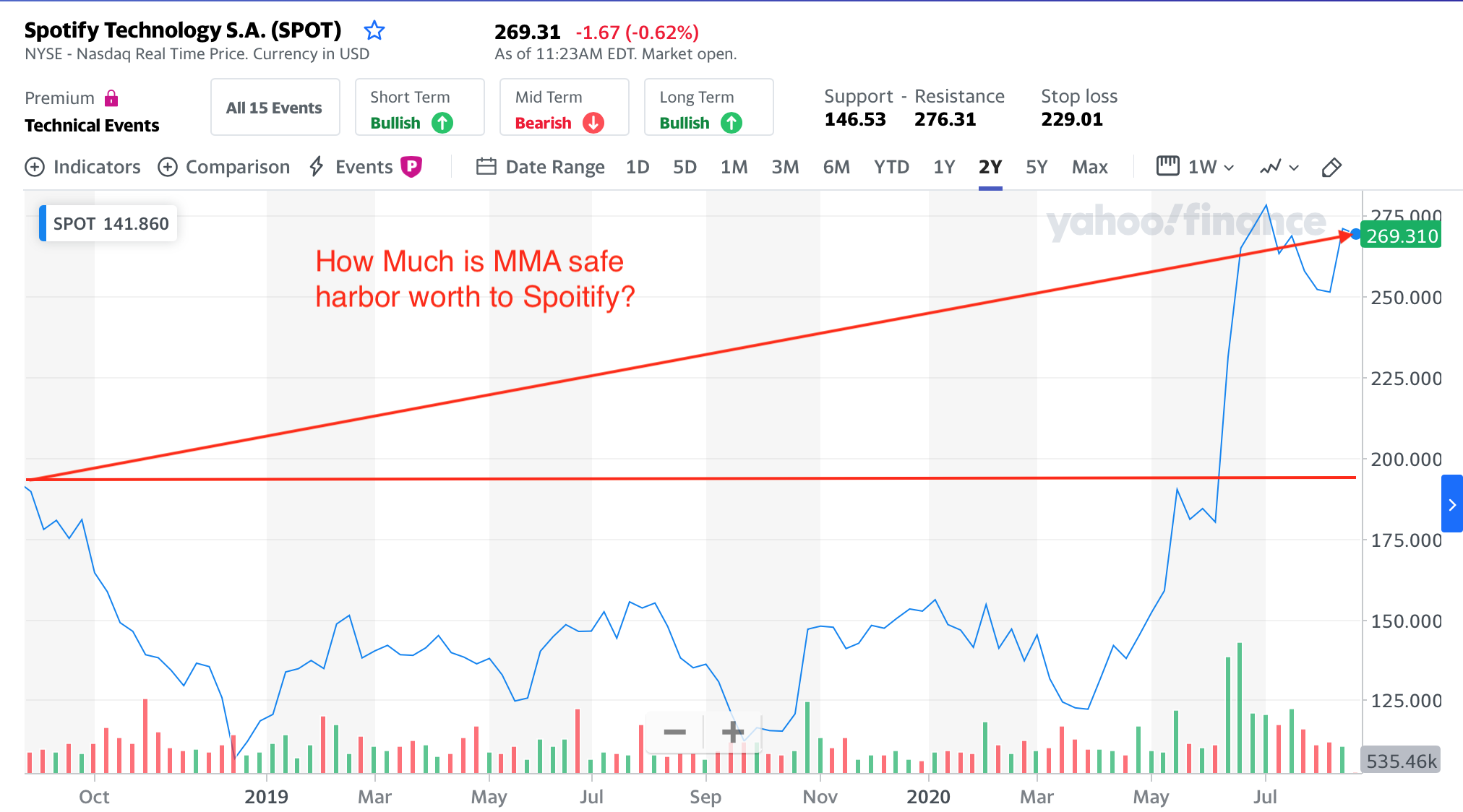
The services tell us in their Copyright Office comment that the whole point of the Music Modernization Act was this (largely secret) deal to get them a new retroactive safe harbor so their massive infringement couldn’t be stopped by songwriters.  (That’s their third statutory safe harbor counting DMCA and Section 230.)  What do you think that MMA safe harbor is worth to them to avoid what they call “ruinous litigation”?

Let’s use Spotify’s market cap as a proxy for the value of the safe harbor–imperfect, yes, but at least it is transparent unlike anything else having to do with Title I of the MMA.

SPOT Safe Harbor Value

Around October of 2018 when the MMA was signed into law, Spotify traded at $189.  A recent closing price for SPOT is $268.  Is it fair to say that the MMA was the rocket fuel that made Daniel Ek a billionaire?  Not entirely.  You can see from the graph that Spotify actually broke through a $190 per share support level to the downside right after the MMA was signed and bounced around below that price for a year or more.

The clear driver of Spotify CEO for Life Daniel Ek’s wealth and profiteering is the COVID virus.  Make no mistake, human misery–not the MMA safe harbor–is what provided the rocket fuel for Spotify’s 2020 growth.  In fact, the same rocket fuel of misery seems to have benefited each of the exploitative cohort as this graph shows using Live Nation as a proxy for the collapse of touring:

COVID MISERY INDEX 8-22-20

So it could be said that the entire “ruinous litigation” argument from the DLC is simply so much bullshit that these companies fed to the MMA negotiators by the plateful.  What is not bullshit, however, is that the one thing the negotiators could have scored that they didn’t is a waiver of the services appeal rights in the Phonorecords III rate setting decision.  This is the appeal that the services recently won when the appeals court handed the negotiators heads to them.  There could also have been a settlement since they seem to like those so much.  The negotiators didn’t do either.  We’ll see how the do-over turns out, but one thing we know is that there will be millions in legal fees that songwriters will have to eat one way or another that could easily have been avoided.

What is also not bullshit is the other side of the MMA transaction:  The loss to songwriters of this heretofore secret deal.

You will note that none of the music services appear to have paid out jack in the way of newly matching the previously “unmatched” in the years since the signing of the MMA. Why?  Because the MMA negotiators did not require any interim payments of matched funds or any public reconciliation of black box to matching efforts.  No, no, the first time the black box gets disclosed publicly is when those funds are paid to the MLC, not to the songwriters who earned the money.  Round and round and round it goes, and where it stops, nobody knows.

If you believe as we do that the services have not lifted a finger to increase their matching efforts (and based on the DLC’s disclosures seem to have already paid out pre-MMA black box on a market share basis), you will better understand why we think this was a colossally terrible deal for songwriters.  You will also understand why this part of it was largely kept secret or downplayed.

The Eight Mile Style complaint against Spotify and the Harry Fox Agency (which is the same Harry Fox Agency that is now going to be handing your royalties for The MLC, how curious) has an informative passage about the timing of this retroactive safe harbor:

In addition, the retroactive elimination of the right to profits attributable to infringement, statutory damages, and attorneys’ fees under the MMA is an unconstitutional denial of substantive and procedural due process, and an unconstitutional taking of Eight Mile’s vested property right, and this Court should so declare.

It is settled law that an infringement claim is a property right that vests in a plaintiff the moment the infringement occurs. The Bill that ultimately became the MMA, written by the NMPA, with input from Spotify, became law in October 2018, but provides retroactively that a plaintiff who did not file an action by December 31, 2017, could lose any right to profits attributable to infringement, statutory damages, and attorneys’ fees if successful in a case against Spotify or other DMPs of interactive streams. On information and belief, the MMA, according to the NMPA’s own announcements, lobbyist spending, and congressional testimony on Capitol Hill, was jointly crafted by members of the NMPA (whose three top markets shares and dues-paying affiliated companies own equity in Spotify) and Spotify, DiMA, and other interactive streaming companies.

They knew what they were doing….

[W]ith the removal of these remedies, it cleared the last hurdle for Spotify to go public, thereby reaping tens of billions of dollars for its equity owners, including the major music companies as mentioned above. The unconstitutional taking of Eight Mile’s and others’ vested property right was not for public use but instead for the private gain of private companies.

The reference to timing on Spotify “going public” means Spotify filing their “DPO” to sell stock on the public markets–the really big money.  That’s relevant to the MMA negotiation because the MMA bill was introduced on December 21, 2017.  Spotify filed a confidential paper with the Securities and Exhange Commission on January 3, 2018 and Spotify’s stock started trading on April 3, 2018.  The MMA allowed them to show the markets that they were doing something about their systemic copyright infringement problem and gave fuel to the specious argument that lawsuits against them were merely opportunistic gotcha lawsuits and not a bellweather for their utter incompetence and cavalier treatment of songwriters.

Why is this timing important?  Because the MMA was filed on December 21.  What happened on December 22?  Congress closed for the holidays and would not reopen until after January 1, 2018.  That meant there would not be an official version of the bill until after January 1, 2018, the deadline to sue before the retroactive safe harbor would eventually take effect.  Various copies leaked, but since the entire music industry was also shut down for the holidays, it was unlikely that any songwriters would see it, particularly because we can’t find that their so-called “representatives” ever brought it up in any public messaging before the January 1 deadline had passed.

Do you think that timing is a coincidence?

As Eight Mile Style tells us:

The proof is in the pudding: Spotify was sued many times prior to December 31, 2017, for similar acts of copyright infringement as alleged herein, but not once since December 31, 2017. This is because the Bill that ultimately became the MMA first publicly leaked shortly before December, 2017, leaving music publishers with little or no time to investigate or file a lawsuit for infringement, even if they somehow became aware of the Bill at that time.

It just happened that Wixen Music Publishing was already on a war footing from opposing the various Spotify settlements and was able to easily pivot to filing its own lawsuit against Spotify before the December 31, 2017 deadline in a move worthy of General Patton at Bastogne.  But Wixen was alone.  No one else probably even knew the deadline was passing or what it meant.

The value of what the “negotiators” gave away cannot realistically be measured for the reason that Eight Mile Style clearly states, which is also the same reason that the retroactive safe harbor is unconstitutional:

The only practical or realistic remedies in these cases is the statutory damage remedy, and profits attributable, together with the ability to receive attorneys’ fees, and the drafters of the MMA knew it. The elimination of these remedies takes away from Eight Mile and others who may be similarly situated any practical or realistic remedy, immunizes complying DMP’s from suit, and should be declared an unconstitutional deprivation of due process and a taking of a vested property right.

So what’s the value that songwriters gave up in the MMA?  Wixen sued for $1.6 billion.  You figure it out.

Copyright Office Regulates The MLC: Selected Public Comments on the Copyright Office Black Box Study: The DLC Spills the Beans, Part I

We once had a mechanical licensing system in the U.S. that worked well enough for songwriters for 100 years.  The problem with the mechanical licensing system wasn’t so much the licensing function it was the royalty rate.  The government held down songwriters for 70 years to a 1909-based royalty rate that for some reason was frozen in time (more on frozen mechanicals here).  But if users failed to license, songwriters could at least sue for statutory damages.

After the Music Modernization Act passed in 2018, they managed to even give away songwriters’ rights to sue.  The songwriter part of the three-part MMA is called “Title I” and that’s the part that gave away the one hammer that songwriters had to be heard when their rights were infringed.  They called it the “limitation on liability” and it was retroactive to January 1, 2018—before the bill was actually passed by Congress and signed into law.

It’s entirely possible that even if you knew about the MMA, you didn’t know about this new safe harbor created by the same uber-rich companies that wrote themselves the DMCA safe harbor that has created the value gap and plagued artists for years and the “Section 230” safe harbor in the “Communications Decency Act” that services use to profit from human trafficking and revenge porn stalkers.  And now there’s the MMA safe harbor.

Only a handful of insiders got to be at the table when they gave away your rights in Title I without your even knowing what they were up to.  Don’t get us wrong, there are great things in the other parts of MMA dealing with closing the pre-72 loophole, some important changes to the rules for ASCAP and BMI with rate courts, and the fix for producers getting a fair share of SoundExchange royalties.  These are all good things.

The part that sucks is Title I that created this new safe harbor give away that will bedevil songwriters for generations to come.

So you may be asking how do we know this?  Since the so-called “negotiations” for the Title I give away happened behind closed doors, how do we even know what happened?  The answer is that we didn’t have the proof because anyone who tried to offer constructive criticism to the “negotiators” for songwriters was menaced, threatened and stabbed in the back.  Nobody was talking about the safe harbor give away.

But now we do have the proof courtesy of the music services representative at the “Digital Licensee Coordinator” who opened the kimono in their recent comments to the Copyright Office about the black box.  (Read the entire DLC comment here.)  Their comments make for quite a read, not only about the so-called “negotiations” by the unrepresentatives of songwriters but also about the run-up to the MMA in the private settlements that nobody sees.

The first issue is that the Copyright Office has proposed some well-meaning regulations to increase the likelihood that the black box will actually get paid to the songwriters who earned the money.  The services seem to be all in a huff about rules applying retroactively when they’ve been using old rules to organize their data.  You know, they don’t like this retroactive thing unless it’s a retroactive expansion of their safe harbor.  Then they like it just fine.

“The DLC emphatically opposes the Office’s proposal to retroactively expand the required reporting of sound recording and musical work information beyond that which is required by the existing regulations in 37 C.F.R. § 210.20. Those regulations were issued in interim form in December 2018, and finalized in March 2019, and unambiguously required collection of reporting information under the existing monthly statement of account regulations in 37 C.F.R. § 210.16. The Office has now proposed, in paragraph (e) of the proposed rule, to change the required reporting elements for the individual tracks, nearly two years after the MMA’s enactment and months before cumulative statements of account are due to be served.”

Sorry, but we think that the richest companies in commercial history, with trillions and trillions of dollars in market capitalization and the most advanced data mining capability in the known universe, can manage to figure out how to pay songwriters in a way that will actually result in songwriters getting paid. The truth is that they are so used to screwing songwriters that they are not going to lift a finger to help beyond the absolute minimum they have to do.

They got their retroactive safe harbor to give away, so don’t come whinging about retroactivity if it makes the distributions more likely to get to the right person, something the services have uniformly failed to do from their founding.

But now it gets interesting.

“It is well-known that—prior to enactment of the MMA—a number of DMPs entered into industry-wide royalty distribution agreements under the auspices of the NMPA, structured to allow all unmatched works to be claimed by their owners and all accrued royalties to be paid out, in what became the model for the MMA. These agreements were designed to, and did, put tens of millions of dollars in statutory royalties in the hands of copyright owners—money that they had been unable to access due to the broken pre-MMA statutory royalty system.”

First of all—“money that they had been unable to access due to the broken pre-MMA statutory royalty system” is utter crap.  The reason that services didn’t pay out is because they didn’t clear the songs but exploited them anyway.  For example, that’s also why Spotify got sued so many times and is still getting sued.  It’s not that the system was broken, it’s that the services didn’t care and handled licensing in an incompetent manner. In case you missed it, that’s what they want to keep doing by extending into the future the same sloppy practices they got sued for in the past.  The only thing new and improved about it is their absurd and undeserved safe harbor.

We don’t know what these “industry-wide royalty distribution agreements” were all about, but one thing we know for sure is that they weren’t “industry-wide” and the NMPA wouldn’t have had the authority to make those deals “industry-wide” in the first place.  “Industry-wide” seems to mean “with the major publishers” or with NMPA members or just plain insiders.  The implication is that “industry-wide” means everyone, which it clearly does not and cannot if you think about it for 30 seconds.

And if the copyright owners were owed a payment with their own money, the only reason that they couldn’t “access” the funds is that the services wouldn’t let them.  When you owe somebody money, you should pay them because you owe them, not act like you’re doing them a favor.

But here it comes:

Congress in the MMA’s limitation on liability provision enacted a compromise among stakeholders’ interests: elimination of the uncertainty of litigation facing DMPs in exchange for the transfer of accrued royalties to the MLC.

In other words, the services sat on the money and refused to pay until they got the MMA safe harbor.  That was the “trade”—do something the services were already required to do in return for something the songwriters were never obligated to do.  The songwriters paid for the safe harbor with their own money.

“As set forth in the relevant statutory provision, in exchange for payment of accrued royalties from “unmatched” usage prior to license availability date (and related reporting), DMPs are protected from the full brunt of copyright damages in any infringement lawsuits based on alleged failures to comply with the requirements of the prior mechanical licensing regime. The provision provides a clean slate for any past failures under the prior licensing regime for those DMPs who pay those back royalties and provide associated reporting. It provides requirements for DMPs that seek to take advantage of the limitation on liability, ensuring that DMPs that pay accrued royalties to the MLC can do so without having to second-guess whether the payment was worth it—that is, whether they qualify for the limitation.

This was the heart of the deal struck by the stakeholders in crafting the MMA: to provide legal certainty for DMPs, through a limitation on liability, in exchange for the transfer of accrued royalties.

Which “stakeholders” were these?  Did they include any of the plaintiffs who were then suing the services?  No.  Did they include anyone who didn’t drink the Kool-Aid?  No.

So let’s be clear—the reason that the services deigned to actually pay money they owed for failing to license properly is because they didn’t want to be sued for screwing up.  They wanted a vig of a new safe harbor, and as the DLC tells us very, very clearly this issue was at the core of the deal you didn’t make for Title I.

More in Part II