Swedish Artists Are Now Threatening Legal Action Over Streaming Royalties… | DMN

The origin of the outrage is telling: Sweden is widely regarded as a model country for streaming and access, thanks to massive adoption and recovering recording revenues. The threatened suits suggest that not everyone is celebrating or, more importantly, enjoying the early spoils.

Regardless of the locale, the issue comes ahead of very difficult juncture for Spotify. Mega-artists like Thom Yorke continue to raise uncomfortable questions about paltry payouts, but more perilous questions are dangling on the financial side. Recent financial figures show an unsustainable level of cash burn at Spotify, and potentially serious problems attracting more capital as a result. And after burning through hundreds of millions of dollars, Spotify is getting dangerously close to depleting its funding tranche.

READ THE FULL STORY AT DIGITAL MUSIC NEWS:
http://www.digitalmusicnews.com/permalink/2013/10/25/swedishartists

Why Spotify is not Netflix (But Maybe It Should Be)

If we are to explore the digital marketplace for both streaming and transactional downloads the music business might do well to look at what the film business is actually doing in the same space. We will quickly see that Spotify is not Netflix, but maybe it should be.

Readers will note the film business has not bought into the faulty logic that the only way to combat internet piracy is to make every film ever made, available instantly, on an all you can eat service for $9.99 a month. Some might argue that is what Netflix is, but people making that argument are obviously not current subscribers!

One thing that has struck us in the comparisons between Spotify and Netflix is that Netflix does not have every film, or even every current film, or even a large percentage of popular films. For the vast inventory that Netflix has, you also realize the service has a lot missing. But then again, what do you expect for nine bucks a month?

This is not to say that most in demand films are not available, somewhere (and legally). It’s just not available on Netflix. Other services such as Itunes, Vudu and Cinemanow (to name just a few) offer some films for rental while they are still in the theater, some for streaming rental prior to a home video “dvd” date, and there are constantly new variations and options.

Generally speaking films arrive at Netflix last in the distribution chain, if at all. This is a problem for Netflix in a lot of ways so they have responded to this by 1) offering competitive advances to film producers to get films earlier (generally in the cable window) and 2) they have begun investing in producing original content to differentiate themselves from the competition (this strategy worked particularly well for HBO).

Netflix in responding to their needs in the marketplace is actually investing capital directly into content creation in a meaningful way. Perhaps some artists should charge an advance for high profile new releases that will attract listeners to the service. Likewise, perhaps Spotify should provide funding for the financing and development of new artists.

So here is the question, is the record business really utilizing the new digital platforms correctly to address the current market place? Perhaps by looking at the options available to consumers from movie streaming, rental and download businesses we can find more robust and flexible opportunities for artists.

One thing we’ve noticed absent from the current offerings for example, is say, a $1 a day transactional streaming rental for an album. Why doesn’t this exist?

FILM RELEASE WINDOWING

The movie business releases films in what is known as “windows”. A typical feature length film is generally released in a pattern that looks something like this:

1 Film Released in Theaters
2 Film Released later on Video on Demand (Rental)
3 Film Released later on Cable and/or Broadcast
3 Film Released Later on Home Video (Rental and Purchase)
4 Film Released Later on Netflix (Subscription)

There are variations on the above, but the point being that you can not buy the DVD of a blockbuster film the day it opens in theaters, nor can you view it on TV that night from the usual cable movie channels. Today these windows are being rethought as the film industry explores different release models including how digital platforms are utilized as part of a theatrical release.

RECORD RELEASE WINDOWING

We’ve heard people say that the record business historically has not windowed releases. This is only sorta true. It is true that a record is released to all outlets in all configurations more/less simultaneously on a single release date. There may be some exceptions with the availability of say vinyl, but mostly it is true that labels do not withhold music releases from different markets or distribution channels. But maybe that’s not exactly either right if we look at it closer.

Generally speaking, a historical record release “window” looks like this:

1 Radio Airplay prior to a commercial release of the single
2 Commercial Single Release
3 Album Release at Full List Price, but “Discounted” at Retailers

There’s not much more that is done until the album gets to be a catalog title, which the record industry would refer to as a mid-line title. Some records, drop one more step from midline to budget. Records that generally make the last drop may have been albums by artists who had one hit on the album.

Today, these traditional old physical model windows built around pricing incentives don’t really make sense on digital platforms. New Releases on Itunes are not discounted on release date and then return to their suggested list price a week or two later when the discounting ends. So if record release windowing is not based in pricing incentives, perhaps it should be based in accessibility incentives.

DIGITAL PLATFORM MUSIC RELEASE WINDOWING

What comes next is the starting point for a discussion to break free from much of the current controversy over whether or not Spotify is fair and sustainable. It is an attempt to rethink the digital music distribution landscape in the same way the film business has with varied consumer offerings and options.

We’d love to see some new players in the marketplace for music that function much in the same way that Vudu or Cinemanow do for films. These would be transactional streaming rentals.

1 Single Release Digital Transactional Download 99 cents
2 Single/Song Release Digital Transactional Streaming Rental 10 cents for 24 hours
3 Album Release Digital Transactional Download 9.99
4 Album Release Digital Transactional Streaming Rental $1 for 24 hours
5 Select Songs Released to Subscription Streaming Services, not whole albums.
6 Album Release Subscription Streaming Services

The key to a future where streaming may be the preferred delivery method is dependent upon more variations and flexibility in the the business model than currently offered by Spotify. There are a range of opportunities in exploring business models that allow for streaming rentals, and limited access to different material at different times.

If every decision we make is based upon the extortion of illegally operating and infringing businesses, surely we will pay the price in a race to the bottom where eventually everyone loses except the companies getting our labor for next to nothing.

The music industry may be streaming towards a cliff | Business Spectator

In August the cellist Zoe Keating published a spreadsheet of her earnings from various streaming sites. In the first half of 2013 she scored 232,000 streams, for which she was paid $906.41.

I used the word “legitimate” above because by far the biggest “publisher” of music is BitTorrent, which is simply the internet protocol for enabling peer to peer sharing of files, and the foundation of Napster’s many successors. Some people I know have zettabytes of music and movies they have downloaded; BitTorrent has been estimated to account for as much as 70 per cent of all global internet traffic.

READ THE FULL POST AT THE BUSINESS SPECTATOR:
http://www.businessspectator.com.au/article/2013/10/9/information-technology/music-industry-may-be-streaming-towards-cliff

“Artists Should Expect Nothing” from Spotify says George Howard

Why George Howard should stop chasing what’s best for musicians and focus on academics.

George Howard just wrote an article for Forbes, “Why Artists Should Stop Chasing Spotify’s Pennies And Focus On Top Fans“. It’s amazing how decade old talking points can keep being recycled. It’s always interesting to see an academic (and/or business consultant) telling artists what is best for them. But it’s kinda disturbing when they let loose with gems like this…

Artists must therefore recalibrate not only their expectations with respect to payments (they should expect nothing), but also their approach generally.

There you have it, artists should expect nothing. Not that George Howard doesn’t make valid points earlier about the meaninglessness of Spotify royalties to musicians. Although the irony of how bad he misses the point is astounding.

Certainly, the payments to artists from streaming services are immaterial to the artists. This does not mean that these services aren’t paying out some, prima facie, big numbers to certain artists. It’s just that even if, for instance, Pandora pays out a million dollars to Jay Z, this amount, when compared to the money Jay Z earns from other ventures, is immaterial. It works the same way for a new artist who gets a payment of $0.25 from Spotify; it’s immaterial when compared to what they got paid for playing a club gig or selling a t-shirt. Same deal for mid-level and heritage artists.

And this is where the tired, decade old, tech lobby talking points come in (Bueller, Bueller…). Focus on building a fanbase and the money will follow from other revenue sources like t-shirts and touring. OH MY GOD… did this guy actually, really say this in Forbes? That horse from 1999/2000 could not be any more dead than the original Napster that spawned such out of touch suggestions.

It’s thirteen years later. There is no magical unicorn business model that pays artists while their work is being either devalued for fractions of a penny, or they are not being compensated at all.

Here’s a brief recap of what these so called “business experts” and “internet technology consultants” see as the “new” models for artists… Ready, set, go!

* Touring… existed BEFORE the internet…
* Merchandise (T-Shirts)… existed BEFORE the internet
* Film/Sync Licensing… existed BEFORE the internet
* Sponsorships/Endorsements… existed BEFORE the internet

These are not NEW models or revenue streams.

So “touring and t-shirts” (CwF+RtB babee!) is not a business model for artists, but rather an open admission that the internet has completely and undoubtedly failed to empower artists. In light of this fact George (and others) instead suggested that musicians and songwriters revert to pre-internet ANCILLARY income streams to now be their PRIMARY revenue streams. Wow, what genius is this?

As seen as a potential catalyst to herd more casual and active fans — fans who may become Passionate Fans — into this funnel, these services take on a real value. This value far exceeds any direct financial payment (whether that number goes up or down 10%). To this end, the artists must learn to use these services and benefit them in the same way the artists are being used by and benefiting these services.

In fact, the “new music business” looks pretty much exactly like the “old music business” with revenue from recorded music sales removed.

Repeat after us, “Exploitation is NOT innovation“.

[UPDATE] : When asking investors for a new round of funding, while getting bad press from upset musicians you probably are looking for some spin control. We don’t think George Howard is that solution. More than anything else, Spotify like Pandora might only be of interest to investors if musicians are completely screwed on royalties. Maybe the ask for cash, and the call for musicians to accept nothing are not related, but that would be suspicious timing at best.

Spotify Is Now Asking Investors for More Cash, Swedish Paper Reports…

How Will Musicians Survive In the Spotify Era? | The New Yorker

Sasha Frere-Jones, Dave Allen, Jace Clayton, and Damon Krukowski discuss how (mildly) popular musicians are going to survive.

Last month, Damon Krukowski and I discussed Spotify, the public exit of Nigel Godrich and Thom Yorke from that platform, and the various challenges facing musicians who do or don’t want to participate in similar streaming services. Toward the end of the discussion, Damon and I both hinted at the freedom of going free, the moments when giving your music away is more profitable—in the long run—than letting another company sell it inefficiently and unprofitably. Damon expanded on his position in a subsequent article for Pitchfork, but neither of us was advocating that musicians play and record for free, in all scenarios, all the time: nothing of the sort. So before I hand this discussion over to a new panel, one clarification.

My band, Ui, released a clutch of records through Southern Records. These albums are no longer available on Spotify because, according to Southern, the costs of administrating the relationship were not covered by the microscopic amount of revenue generated. I believed them then, and believe them even more now.

READ THE FULL STORY:
http://www.newyorker.com/online/blogs/sashafrerejones/2013/08/how-will-musicians-survive-in-the-spotify-era.html

Why Spotify is NOT the Enemy of Artists, and Who Is…

Spotify has been taking a beating in the press lately and we understand why. We have offered our own criticisms which mostly revolve around royalty rates and transparency. But we’ve also stated that Spotify is a symptom of a much larger disease of illegally operating, infringing businesses who make millions individually and billions collectively while paying absolutely zero to artists and rights holders.

As much as we disagree with Spotify over their rates and PR spin on several issues, we also recognize that they are legal, licensed and pay out royalties as they have been negotiated. Artists are able to opt out of Spotify individually (and also if their label permits).  It is for these reasons that Spotify are NOT the enemy.

However this begs the question, if Spotify are not the enemy, who is? Well, as we stated above it is the massively deceptive Ad Tech businesses who have been financing mainstream music piracy for over a decade. This is the Silicon Valley internet tech lobby (lead by Google) who seek to dismantle and destroy copyright protection for individual creators.

Yes, we hear a lot of lip service about how these people say they are really pro-copyright and pro-artist, but when every meaningful action and suggestion is to the contrary of protection and compensation of the artists work and labor it all rings a bit hollow. We now know after a decade plus of internet/tech snake oil salesmen there is no magic bullet and that “touring and t-shirts” is an admission of the failure of these online businesses to provide sustainable earnings for creators.

Piracy is NOT Promotion

Exploitation is NOT Innovation

In our ongoing “Exploited By…” series of posts we illustrate how major Fortune 500 companies, represented by Madison Avenue Advertising Agencies have been, and continue to finance the destruction of the creative community.

So we say this…

Let us focus first on the many who pay nothing at all to musicians while pocketing 100% of the Profit. Let us focus our energies on the illegally operating companies and corporations who have made infringement for profit their business model.

We are encouraged to see Spotify also take up this mutually beneficial fight against those companies and business who have so greatly devalued the work of musicians as well as impeding the growth potential of legal and licensed companies to create sustainable models for all stakeholders.

Will Page a Spotify spokesperson had this to say in The Register UK:

“Copyright infringing websites are big businesses … 2/3 of piracy sites have advertising, and 1/3 also include credit card logons. This competition is real: consider how ad pricing is distorted by those unlicensed sites who offer more scale and no content costs.”

This is the first step towards making real change that will remove the bad actors from the marketplace and move towards a sustainable ecosystem for all legal and licensed stakeholders.

We’ve commented before that we believe that Spotify is unsustainable at current rates. It is also worth noting that Spotify pays significantly MORE than YouTube, a business that was founded and built on the premise of infringement for profit. Although YouTube and Google have made improvements in their services for rights management they still fundamentally devalue the work of artists hiding behind the DMCA.  Google and YouTube also continue to create and distribute anti-copyright and anti-artist propaganda asserting that any “remix” of an artists work is “fair use.” It is not.

In the end Spotify needs to increase it’s revenue per stream so it can increase it’s royalties per stream to be sustainable for artists. The number one way to do this is to capture the millions or even billions in advertising revenue that are financing illegally operating and infringing businesses that pay artists nothing.

In closing, the enemy is not so much those who pay so little offering artists both consent and compensation, but more so those who are paying nothing at all and deny the artists consent.

Exhibit A:

Lou Reed Exploited By American Express, AT&T, Chevorlet, Chili’s, Lysol, Pottery Barn, Vons, Domino’s Pizza, Netflix, Galaxy Nexus and Ron Jeremy!

Why Spotify’s Piracy Study Isn’t Cause for Celebration | SPIN | Newswire

Report shows promising signs, but only in the Netherlands…

…According to a Spotify spokesperson, the company doesn’t break down user numbers by individual country, but has 6 million paying subscribers and 24 million users worldwide…

…The report follows news that music sales increased greatly in Sweden, Spotify’s home country, corresponding with the service’s growing popularity there. Which is great news across the pond, but which doesn’t necessarily scale to America’s humungous market. The Netherlands is a country of under 17 million people with 6.8 million residential broadband connections versus the United State’s 313 million population and 82.4 million broadband users…

READ THE FULL STORY AT SPIN.COM:
http://www.spin.com/articles/spotify-piracy-study-festivals-thom-yorke/

Tell Us Again “Streaming Is The Future” As Paid Downloads Are Down 2.3 Percent In the US…

Let’s see… maybe streaming services are cannibalizing transactional sales, maybe? Streaming Royalties are small but they can really grow? Really? Let us guess… the good news is streaming is reducing piracy? In Norway and Sweden

According to half-year stats shared by Nielsen Soundscan with Digital Music News this weekend, paid downloads are slumping 2.3 percent at the half-point, meaning the period from January 1st through June 30th.

All of this points to the same issue of streaming services paying too little, while illegally operating, infringing businesses pay absolutely nothing at all. So much for sustainability…

READ THE FULL POST AT DIGITAL MUSIC NEWS:
http://www.digitalmusicnews.com/permalink/2013/20130721downloads

Thom Yorke Vs Spotify : Why Doesn’t Spotify Speak Out Against Ad Funded Piracy?

Thom Yorke’s announcement to boycott Spotify is just the latest public acknowledgement that the pay rates and business models of streaming services need to adapt and evolve to pay sustainable rates to artists and rights holders. We’ve previously offered our own point of view on Spotify whereby we believe that current streaming based models are fundamentally flawed at the level of their pay rates and are especially devastating to developing artists.

Both Thom Yorke of Radiohead and Trent Rezenor of Nine Inch Nails were two of the first artists to explore and experiment with potentially new music business models on the internet. However, the realities of those experiments have become apparent this year as Thom Yorke spoke out about Google and Trent Reznor against music streaming services being unfair to artists.

But it’s also important to remember that despite our disagreements over the revenue distribution models of Spotify and Pandora these are legal and licensed services. The primary reason that these streaming businesses even exist is in response to a decade plus of infringing and illegally operating business who pay nothing at all, zero, zilch, nada.

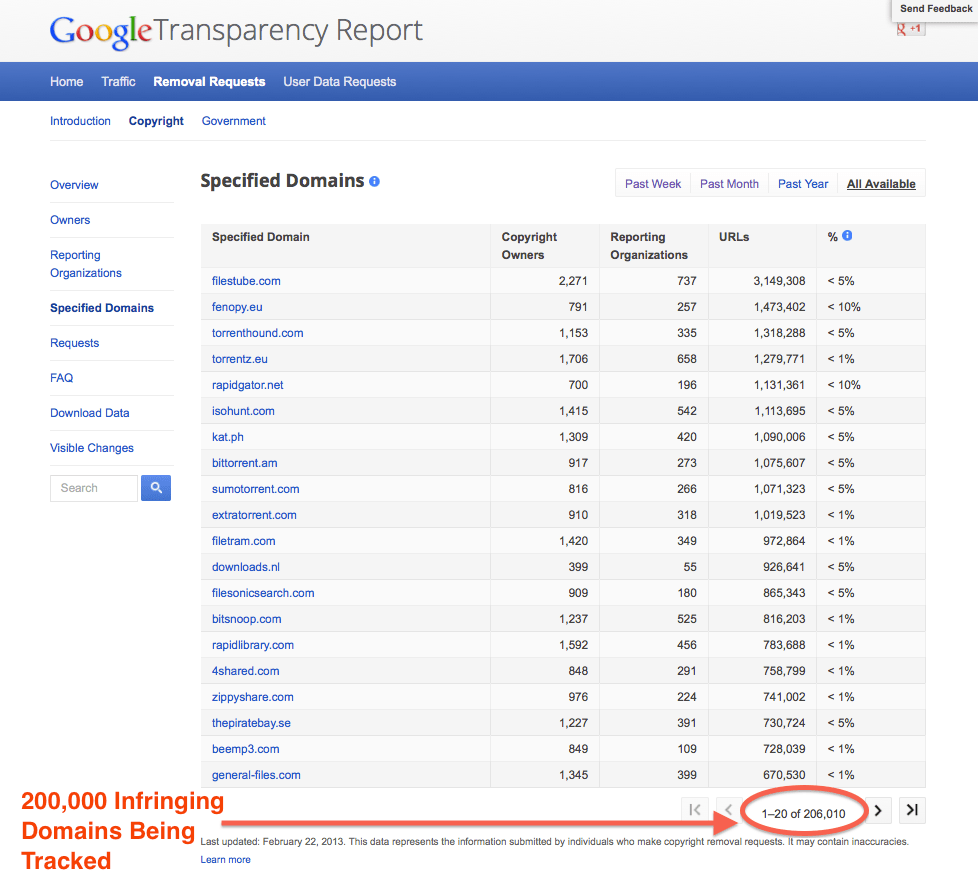
Let’s get really real for one second… One of the primary reasons Spotify pays so little is because so many more pay nothing at all. Google alone is tracking millions and millions of infringement notices to over 200,000 known illegally operating businesses.

For those who unaware, Ad Sponsored Piracy is the mechanism by which illegal and infringing online businesses get paid to display advertising on their sites. These sites do not license any of the music they distribute nor do they share any of this revenue with artists or rights holders. In other words Silicon Valley corporate interests pocket 100% of the money and pay artists nothing.

Simply put, ad supported piracy is the practice whereby ad networks like Google’s Adsense profit by placing ads on pirate sites like www mp3skull com.

Brand $$$-> Ad Agency $$$-> On Line Ad Services $$$-> Ad Exchanges $$$-> Illegal and Infringing Sites Profit from Ad Placements.

Any legally licensed, legitimate internet music business has to acknowledge that mass scale, enterprise level, commercial infringement of music only harms their business. The devaluation of advertising inventory on infringing sites harms both the legitimate businesses ability to grow, and the ability to pay sustainable rates to musicians.

So why doesn’t Spotify join with artists by insisting on better controls and regulation of online advertising? Spotify’s existence alone is not the solution as the payments to artists and rights holders simply do not scale as we have previously pointed out (also note how much less YouTube pays than Spotify – more on this later).

Music Streaming Math, Can It All Add Up?

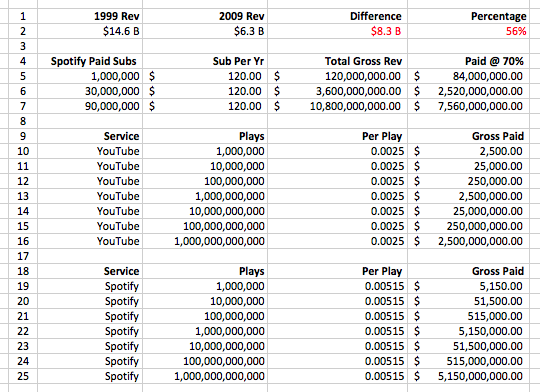
Maybe we’re missing something. If streaming is the future how does $2.5b in revenue from a massively successful Spotify replace the loss of $8.3b in annual earnings?

Solutions for Artist Rights must include the acknowledgement that the mathematical facts of streaming services is that they are unsustainable at current rates (see chart above). Therefore, there must be regulatory enforcement to protect artists and other creators (authors, filmmakers, etc) from Ad Sponsored Piracy.

We have previous identified over 50 Major Brands Supporting Illegal and Infringing online businesses here:

Over 50 Major Brands Supporting Music Piracy, It’s Big Business!

See more Corporate Advertising Funded Exploitation of Artists:
Tom Waits * Neil Young * Aimee Mann * Neko Case * U2 * Ben Gibbard/Death Cab For Cutie * East Bay Ray / Dead Kennedy’s * Billy Corgan/Smashing Pumpkins

Music Streaming Math, Can It All Add Up?

Music streaming is clearly a challenge for the recording industry and even more so for the new generation of artists hoping to build professional careers in music like Zoë Keating. This new report from the New York Times, “As Music Streaming Grows, Royalties Slow to a Trickle” is the latest to reignite controversies about music streaming royalties.

We’ve leveled our own criticism of streaming sites in the past perhaps focusing unfairly on Spotify. But as we reported in the, Music Streaming Price Index : Pay Rates as of 12/31/11 our complaint is more with the revenue models and royalty payments than with the services themselves.

To be clear, we like Spotify and the people we’ve met that work there. We’d just like to see better royalty rates and the kind of transparency requested by Zoë Keating, and/or the kind we get from Apple’s Itunes.

We also like that Spotify and other music streaming services are legal and licensed. Spotify (Rhapsody, Zune and Napster) are far more ethical businesses than YouTube and Grooveshark. There are no unauthorized copies of an artists material on Spotify and no massive DMCA issues. We’d love to see more brands spending their money with legitimate services than the shady ad networks that feed advertising to pirate sites.

It’s now clear that the brands themselves are a big part of the problem by supporting piracy when they could be supporting the legally licensed sites. Brands, advertising networks and payment processors are driving the race to the bottom in the “optional payment” and “Illegally free” world of exploiting musicians through online piracy.

In a recent interview for Hypebot, music and technology veteran Ted Cohen sums it up well,

Do you still favor subscription over advertising-based music services?

Yes, I do. I don’t think that the advertising model so far has proved to be sustainable. I think that we have undervalued subscription. I am paying $150 a month for cable. I watch 20 or 30 hours of TV a week. I probably listen to 50 to 60 hours of music a week. I’d argue with you that music is worth more than $10 a month subscription service.

The labels were so concerned about (piracy)—and I was there at the time—that we had to come up with a price that was just a little bit more than free to convince people that they should pay. So far, we have not been able to raise the price. I think that music is worth at least $20 or $25 a month.

In the chart below calculations are created in tables to illustrate the simple math required to determine the revenue opportunities in different streaming models. For example, lines 5, 6, and 7 detail how much revenue Spotify can generate to artists, songwriters and rights holders paying out 70% of their gross at 1m, 30m and 90m paid subscribers.

If Spotify can capture what most believe is an optimistic amount of paid subscribers in the USA (30m) that would only generate $2.5b in revenue for rights holders. Line 2 represents the revenues of the record industry in the USA between 1999 when it was $14.6b through 2009 when it had plummeted to $6.3b leaving a loss of $8.3b annually since that time.

Maybe we’re missing something. If streaming is the future how does $2.5b in revenue from a massively successful Spotify replace the loss of $8.3b in annual earnings?

streamingmath

So in 2012 when Spotify has claimed 1 million paid subscribers in the US, that’s a payout to artists and rights holders of only about $84m. In simple math, this is about 12m albums at $7 wholesale each (what iTunes pays on a $9.99 album).

Additional food for thought is that Spotify is currently valued at 3 billion dollars. That’s just a little less then half of the entire earnings of the entire US record industry in 2012 at an estimated 7 billion dollars. This means that if the same valuation method is used for both Spotify as a single company, and the domestic record industry as a whole, than either Spotify is overvalued or the record industry is undervalued.

But there are larger problems here than Spotify. As you can see in the chart above YouTube also represents a challenge for artists and rights holders. The site was born of infringement as a business model, and despite policy changes at Google (YouTube’s parent company) the situation is still completely unacceptable for artists as East Bay Ray of The Dead Kennedy’s explains to NPR.

YouTube really deserves it’s own post, and there will be several forthcoming.  In the new “exploitation economy” artists seem to be willing to trip over transactional dollars attempting to pick up streaming pennies. Again, one of the most important distinctions between Spotify and YouTube is that Spotify does not have a massive DMCA and rights management issues that cheats artists of their due. Additionally, YouTube is paying a fraction of what Spotify is, so if this is the future, everyone is really in trouble.