
The truth is self evident.
.@Spotify and @Pandora have made it impossible for songwriters to earn a living: three months streaming on Pandora, 4,175,149 plays=$114.11.
— Bette Midler (@BetteMidler) April 4, 2014
The truth is self evident.
.@Spotify and @Pandora have made it impossible for songwriters to earn a living: three months streaming on Pandora, 4,175,149 plays=$114.11.
— Bette Midler (@BetteMidler) April 4, 2014
We just can’t get enough of this story. There’s a great interview with the band at the link below.
Spotify is a great way for most musicians to make money. By most musicians, I mean a superstar economy of 1% who account for 77% of all artist revenue from streaming. And by “money” I mean the $0.007 per stream that most artists receive.
READ THE FULL STORY AT VICE:
http://noisey.vice.com/blog/one-band-have-worked-out-a-way-to-cheat-spotify-out-of-money
What we find so interesting about this is that the digital music services that report to be friends of musicians are not taking a strong public position against Ad funded Piracy and supporting these measures.
Spotify, Pandora and the like are affected by the downward economic pressure created by Ad Funded Piracy that diminishes both the amount consumers are willing to spend on subscription fees and the amount that can be charged for legitimate advertising on legitimate services.
Why aren’t Spotify and Pandora more publicly engaged in the fight against Ad Funded Piracy as it certainly is a large contributing factor as to why these businesses remain unprofitable.
Websites offering illegal copyrighted material could see their advertising revenue cut under a new initiative.
Police have created an online database of websites “verified” as being illegal.
It is hoped that firms that handle advertising will use the resource to make sure they do not serve advertising on those sites, cutting off revenue.
Top piracy sites generate millions of pounds thanks to advertising.
One estimate, from the Digital Citizens Alliance – a group backed by rights holders – suggested that piracy websites worldwide generated $227m (£137m) from advertising revenue each year.
Even smaller sites commanded revenues into the hundreds of thousands, the group said.
READ THE FULL STORY AT THE BBC:
http://www.bbc.com/news/technology-26788800
Watch stories about Spotify planning a stock market flotation this Autumn spread across the web in the coming hours, triggered by a report on tech/business site Quartz.
“The popular music-streaming company has participated in informal chats with some of the investment banks likely to fight for a role in a potential IPO, sources familiar with the process said,” claims the article.
“The six-year-old service may start holding formal meetings as early as next month in anticipation of an offering in autumn. (Though the timeline for a possible IPO could change for a number of reasons, including unfavorable market conditions.)”
READ THE FULL POST AT MUSICALLY:
http://musically.com/2014/03/27/spotify-ipo-planning/
RELATED:
The Black Keys are a huge band.
Huge bands lose a lot of money on Spotify.
Which is why, once again, the Black Keys are withholding their latest album release from Spotify.
READ THE COMPLETE POST AT DIGITAL MUSIC NEWS:
http://www.digitalmusicnews.com/permalink/2014/03/24/blackkeysspotify
Just watch this totally awesome video. Genius idea.
We don’t know how well this is gonna work out, but we love the intention behind it.
Is this the future of music? We continue to explore artist revenue streams.
Here’s what 1 million streams looks like from different revenue perspectives on the two largest and mainstream streaming services.
| Service | Units | Per Unit | Total | Notes |
| Spotify | 1,000,000 | $0.00521 | $5,210.00 | Gross Payable to Master Rights Holder Only |
| Spotify | same million units as above | $0.00052 | $521.00 | Gross Payable to Songwriter/s & Publisher/s (est) |
| YouTube | 1,000,000 | $0.00175 | $1,750.00 | Gross Payable for All Rights Video, Master & Publishing |
| YouTube CMS Master Recording (Audiam / AdRev) | 1,000,000 | $0.00032 | $321.00 | Gross Payable to Master Rights Holder Only |
| STREAMING TOTALS | 3,000,000 | $7,802.00 | TOTAL REVENUE EARNED FOR 3 MILLION PLAYS ON SPOTIFY AND YOUTUBE | |
| Itunes Album Downloads | 1,125 | $7.00000 | $7,875.00 | Gross payable including Publishing |
Here are some compelling stats on the break down of what percentage of videos on YouTube actually achieve breaking the 1 million play threshold, only 0.33%
CHART OF THE DAY: Half Of YouTube Videos Get Fewer Than 500 Views | Business Insider
Some 53% of YouTube’s videos have fewer than 500 views, says TubeMogul. About 30% have less than 100 views. Meanwhile, just 0.33% have more than 1 million views.
That’s not a huge surprise. But it highlights some of the struggles Google could have selling ads around all those unpopular videos, despite the money it has to spend to store them.
An artist needs to generate THREE MILLION PLAYS on the two largest and most popular streaming platforms to equal just 1,125 album downloads from Itunes. This is an important metric to put in context. In 2013 only 4.8% of new album releases sold 2,000 units or more. So if only 4.8% of artists can sell 2,000 units or more, how many artists can realistically generate over four million streams from the same album of material?
in 2013 there were 66,565 new releases, only 3,237 sold more than 2,000 units = 4.8% of new releases sold over 2,000 units
in 2013 there were 915,482 total releases in print, only 14,856 sold more than 2,000 units = 1.6% of ALL RELEASES in print sold more than 2,000 units.
This is even more important when you start to consider that many artists feel that growing a fan base of just 10,000 fans is enough to sustain a professional career. Note we said solo artists because these economics probably need to be multiplied by each band member added for the revenue distribution to remain sustainable. So a band of four people probably need a sales base of 40,000 fans to sustain a professional career for each member of the band.
Each 10,000 albums sold on iTunes (or 100,000 song downloads) generates $70,000 in revenue for the solo artist or band. To achieve the same revenue per 10,000 fans in streams, the band has to generate 30 million streaming plays (as detailed above) if they are distributing their music across the most common streaming services including Spotify and YouTube.
In 2013 the top 1% of new releases (which happen to be those 620 titles selling 20k units or more) totaled over 77% of the new release market share leaving the remaining 99% of new releases to divide up the remaining 23% of sales.
This appears to confirm our suspicion that the internet has not created a new middle class of empowered, independent and DIY artists but sadly has sentenced them to be hobbyists and non-professionals.
Meanwhile the major artists with substantial label backing dominate greater market share as they are the few who can sustain the attrition of a marketplace where illegally free and consequence free access to music remains the primary source of consumption.
What’s worse is that it is Silicon Valley corporate interests and Fortune 500 companies that are exploiting artists and musicians worse than labels ever did. New boss, worse than the old boss, indeed.
So whose feeling empowered?
Is this the future of music? We continue to look at artist revenue streams.
Now that we’ve been blessed with a few data sets we’re going to be digging deeper into cross referencing them in the hopes of building a much better overall view of the marketplace for independent musicians. This is especially true in the area of music streaming rates and royalties.
We hoping to provide as much open and transparent information as we can get on artists revenue streams. Through the release of these posts offering per play rates, relative market share of these companies, and the distribution tiers at different unit thresholds we hope artists will use these tools to model a better understanding of their revenue potential on digital platforms.
| Service | Market Share Streams | Market Share $$$ |
| Spotify | 61% | 69% |
| YouTube* | 32% | 12% |
| Deezer | 2% | 4% |
| Amazon Cloud | 2% | 0% |
| Rhapsody | 1% | 3% |
| Muve Music | 1% | 1% |
| Rdio | 0% | 1% |
| Xbox Music | 0% | 2% |
| MediaNet | 0% | 1% |
| Google Play | 0% | 2% |
| Nokia | 0% | 0% |
| simfy | 0% | 0% |
| MySpace Music | 0% | 0% |
| Amazon MP3 | 0% | 5% |
| eMusic | 0% | 1% |
| VerveLife | 0% | 0% |
| TOTAL | 100% | 100% |
* These YouTube numbers are not directly comparable to the rest of the numbers as the information comes from a different data set of considerably less titles than the larger data set.
That being said there are still a few important take-a-ways in looking at this data even on a percentage of market share basis. If we doubled the amount of YouTube Streams to match the amount of Spotify streams (48% YouTube Streams and 47% Spotify Streams) the revenue disparity still places Spotify 3x’s higher at 62% of overall revenue market share versus YouTube’s only 21% of market share revenue. Simply said, you have to stream at least 3x’s more on YouTube to equal the same amount of revenue generated from YouTube.
| Service | Market Share Streams | Market Share $$$ |
| YouTube (x’s2) | 48% | 21% |
| Spotify | 47% | 62% |
| Deezer | 2% | 3% |
| Amazon Cloud | 1% | 0% |
| Rhapsody | 1% | 2% |
| Muve Music | 0% | 1% |
| Rdio | 0% | 1% |
| Xbox Music | 0% | 2% |
| MediaNet | 0% | 1% |
| Google Play | 0% | 2% |
| Nokia | 0% | 0% |
| simfy | 0% | 0% |
| MySpace Music | 0% | 0% |
| Amazon MP3 | 0% | 4% |
| eMusic | 0% | 1% |
| VerveLife | 0% | 0% |
| TOTAL | 100% | 100% |
Our conclusion is that this is a very compelling reason to remove as much of your music from YouTube as you possibly can and redirect streaming music consumers to Spotify where you will earn at least 3x’s more for the same amount of streams.
Of course, creators and musicians are not given this type of consent over the use of their music on YouTube and the new CMS Services like Audiam exist only to monetize illegal and unlicensed user generated content (UGC) uploads to YouTube, and at significantly lower per play rates than the ones we’ve been tracking that pay 100% of earned revenue.
This just confirms what we’ve known all along. Google not only profits greatly from the illegal and unlicensed uploads of an artists work to YouTube, but artists are more and more powerless over having their work exploited against their will.
Here are some compelling stats on the break down of what percentage of videos on YouTube actually achieve breaking the 1 million play threshold, only 0.33%
CHART OF THE DAY: Half Of YouTube Videos Get Fewer Than 500 Views | Business Insider
Some 53% of YouTube’s videos have fewer than 500 views, says TubeMogul. About 30% have less than 100 views. Meanwhile, just 0.33% have more than 1 million views.
That’s not a huge surprise. But it highlights some of the struggles Google could have selling ads around all those unpopular videos, despite the money it has to spend to store them.
Why does this just feel like just so much more extortion and exploitation?
Is this the future of music? We continue to look at artist revenue streams.
If you’re heading out to any panels at SXSW this week, you might want to keep this handy when you’re being told how much money you can make… And if the services at the top of the list like Nokia, Google Play and Xbox Music can pay more per play, why can’t the services at the bottom of the list like Spotify and YouTube?
We’ll give you a hint, the less streams/plays there are the more each play pays. The more plays there are the less each stream/play pays. Tell us again about how these services will scale. Looking at this data it seems pretty clear that the larger the service get’s, the less artists are paid per stream.
So do you think streaming royalty rates are really going to increase as these services “scale”? No, we didn’t either.
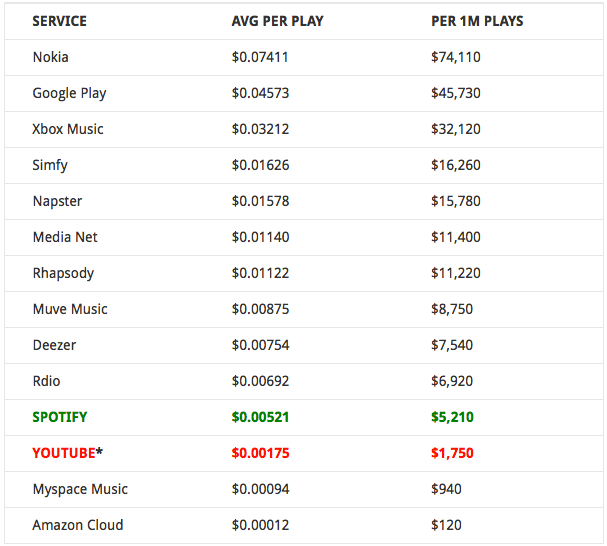
* YouTube payment includes gross payable to single party uploader claiming 100% of rights including video, master and publishers. There should also be additional PRO money earned however we haven’t been able to get any reporting to date.Our YouTube pay rate calculations can be found here:What YouTube Really Pays… Makes Spotify Look Good!
Zoë Keating released her Annual Music Sales & Streaming Data Spreadsheet a little bit ago and we stayed out of the fray, although we did also publish an update of the Music Streaming Price Index for 2014 as well.
This quote from Zoë in a follow up post about her open and transparent sharing of information on Hypebot got our attention.
I want you to know that I don’t release these numbers as a marketing tool. I’ve always tabulated stuff as part of doing my annual accounting and last year I decided to make a portion of them public. Music commentators were saying, over and over, that artists are not making a living selling music, they make all their money touring, etcetera etcetera. I noted that in my case that wasn’t true and never had been. In the commentary I wasn’t seeing a lot of actual numbers from artists and thought I’d offer some details of how it all works for me: a non-labeled artist whose career has existed entirely in the internet-age.
It’s curious to us that someone would insinuate the motivation behind sharing information in an open, human and transparent way was an attempt at self serving marketing. Shame on those who have made such comments. Zoë should be celebrated for doing what the interweb companies claim to do, and ask others to do, but do not do themselves.
We also found the following statement to be true of our experience of the vast number of artists we hear from who report similar experiences with streaming services ranging from Spotify to YouTube. These services only financially serve the very large artists and the very large labels. In other words, Spotify, YouTube and the like have not empowered artists towards financial freedom and very well appear to be achieving the very opposite.
Meanwhile yes, the big money is to be made at the top of the tail…and therein lies the promise of commercial music streaming services. It will be financially valuable to those who make hits and those who aggregate legions of artists. For a single artist like me commercial streaming will never be more than promo. I accept that. But will keep talking about it until streaming companies do more to make that promo more useful (i.e data).
But there appears to be more to this story. In this recently posted video clip by “Unsound” documentary filmmaker Mikeal Eldridge, Zoë reveals that she has dug a bit deeper into the realities of streaming economics noting that the more streams that are served, the less the artists makes per stream. Again, this is consistent with her observation that “the promise of commercial music streaming services… will be financially valuable to those who make hits and those who aggregate legions of artists.”
We’ve yet to see anyone propose how streaming can actually scale and be sustainable for artists. We love streaming services, what we don’t like are the economics.
92% of Zoë’s recording income is from transactional digital sales. If these streaming businesses are claiming to be the future, the question to ask is whose future?
| Downloads | Streams | Total | % Downloads |
| $75,341 | $6,380 | $81,721 | 92% |
RELATED:
 The Trichordist
You must be logged in to post a comment.