
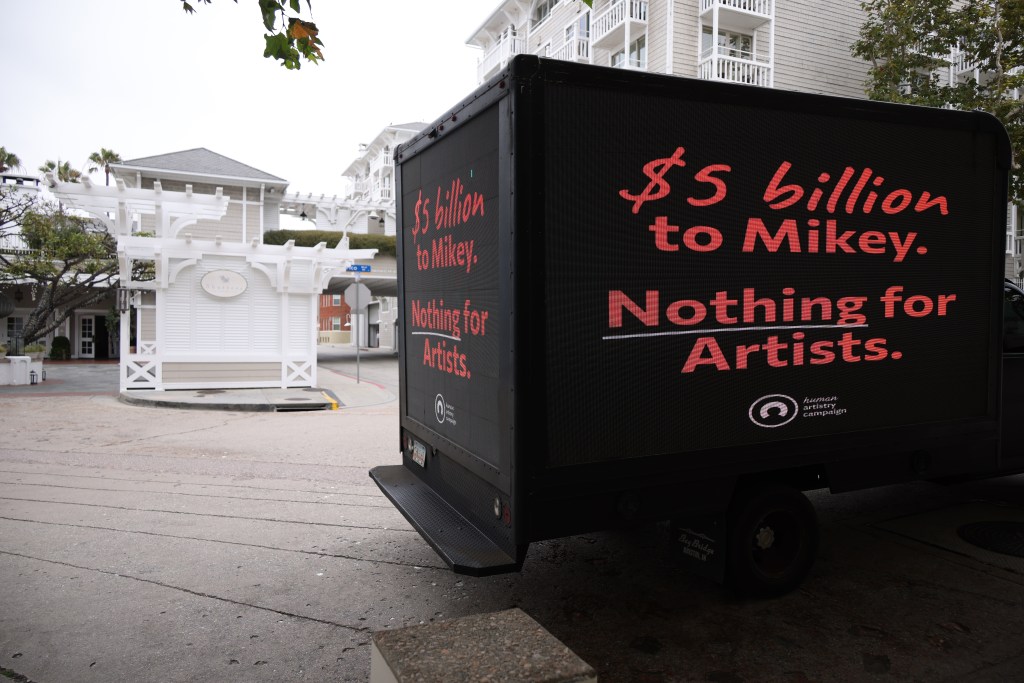
As Suno Celebrated a $5.4 Billion Valuation, Artists Took Their Message Directly to Wall Street

SANTA MONICA, CALIFORNIA – JUNE 03: A mobile billboard sponsored by Human Artistry protesting Suno’s use of AI is pictured on display during Suno’s annual meeting on June 03, 2026 in Santa Monica, California. (Photo by Anna Webber/Getty Images for Human Artistry Campaign)

On June 3, 2026, as investors and technology executives gathered at the UBS AI in Entertainment Summit at Shutters on the Beach in Santa Monica, a plane circled overhead carrying a simple message: “SAY NO TO SUNO.” A second banner could just as easily have read, “Stealing Music Is Bad Karma.” The scene was more than a protest against a single AI music company. It was a reminder that technology itself is neither good nor evil; what matters is how humans choose to use it. Throughout history, some of the most transformative technologies have been driven by the same motivations that power every bully: greed and fear. Fear of being left behind. Fear of missing out. Greed for market share, dominance, and wealth and crushing anyone who gets in the way. The generative AI race increasingly appears to be driven—and corroded—by both.
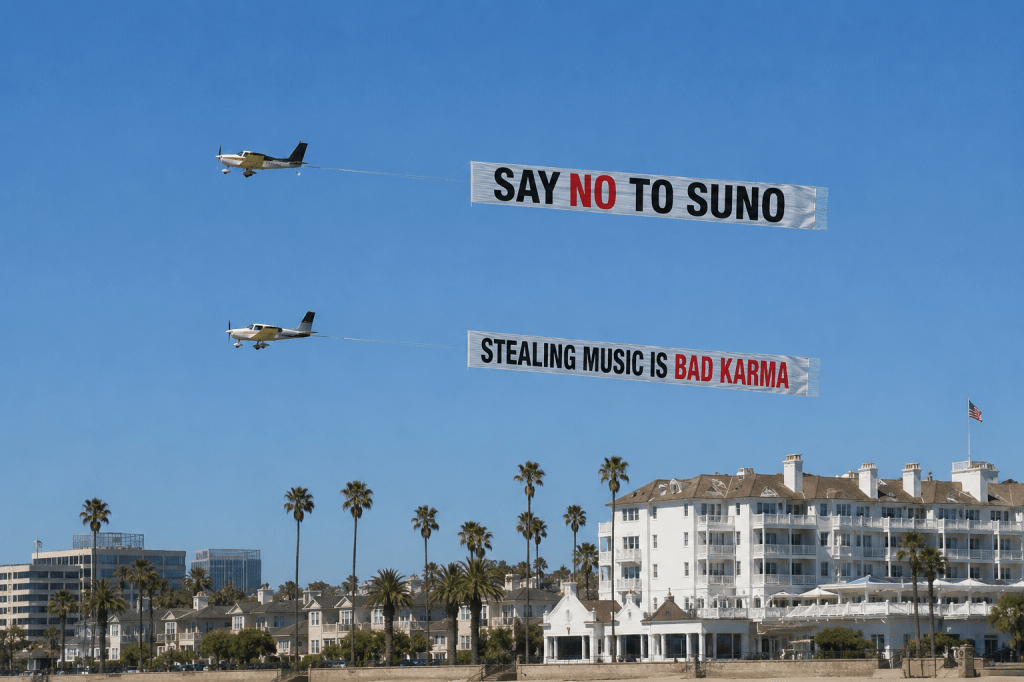


That is why the protest above Santa Monica was about more than music. It connected directly to a broader national backlash against the infrastructure being built to support the AI economy. Across the United States, communities are fighting data centers, transmission lines, water consumption, tax subsidies, and industrial development projects that many believe are being imposed without meaningful public consent. Residents from Texas to Georgia to Louisiana are asking the same basic question: who benefits, and who pays the price?

In the case of generative AI, artists argue that they are among those paying the price.

The Human Artistry Campaign demonstration took place on the same day that Suno announced a funding round exceeding $400 million at a valuation of approximately $5.4 billion. Let it not be said that music has no value and that Suno is not free riding on a thriving market to extract their absurd valuation.

While Silicon Valley investors celebrated another milestone in AI’s rapid expansion, the protest highlighted an uncomfortable reality: much of the value being created by generative AI companies originates from extracting human expression while paying no regard whatsoever to those humans. Whether the source material is music, visual art, photography, authors, voice performances, or other creative works, creators continue to ask how their contributions found their way into commercial AI systems and demand the right to say no to Suno.
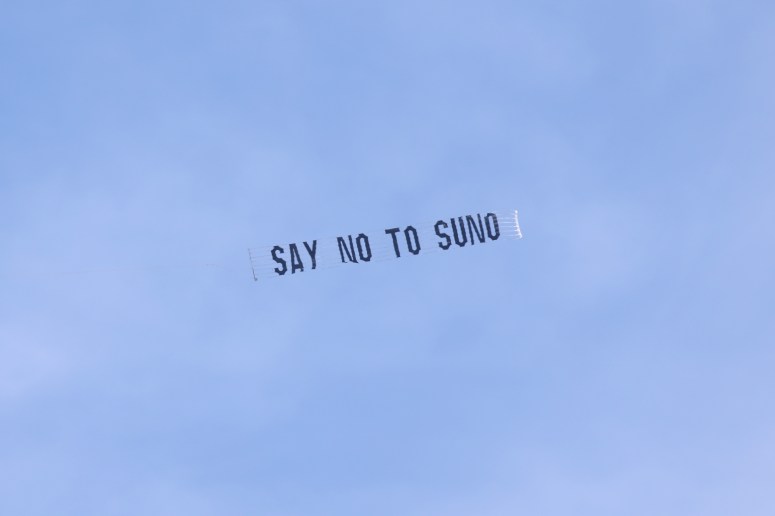
SANTA MONICA, CALIFORNIA – JUNE 03: A plane sponsored by Human Artistry protesting Suno’s use of AI is pictured on display during Suno’s annual meeting on June 03, 2026 in Santa Monica, California. (Photo by Anna Webber/Getty Images for Human Artistry Campaign)

The narrative that the AI labs want you to focus on is often framed as a conflict between innovation and regulation. That framing misses the point. The real question is whether innovation requires the abandonment of consent, compensation, and accountability. Human Artistry’s message was not anti-technology. Rather, it was that technology should serve human beings rather than treating them as raw material for extraction.
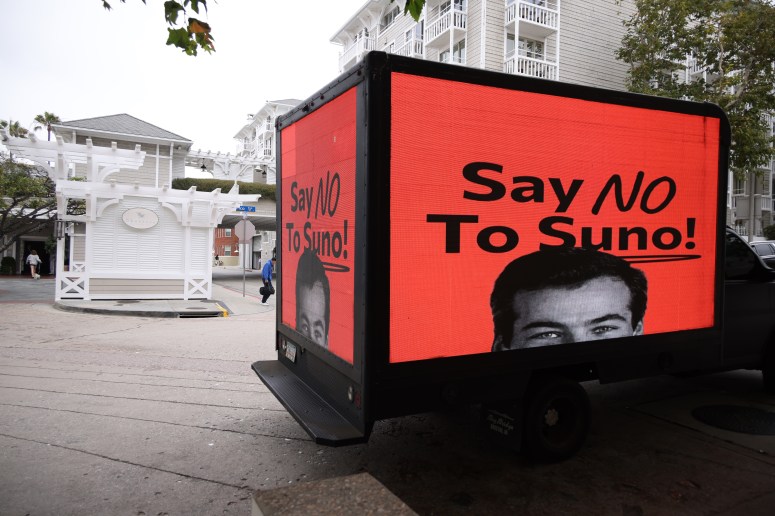
That concern increasingly links artist-rights advocates with communities opposing AI infrastructure projects using eminent domain powers to seize homes and compel residents to acept 765kV transmission lines. Both groups are confronting different manifestations of the same phenomenon: the concentration of economic gains among a relatively small number of companies while costs are dispersed across creators, workers, taxpayers, ratepayers, and local communities. One side sees its creative works absorbed into training datasets. The other sees land, water, energy resources, and public subsidies redirected toward facilities designed to power those systems.

Viewed through that lens, the protest at Shutters on the Beach becomes part of a much larger story. The controversy surrounding generative AI is no longer confined to copyright litigation or entertainment-industry politics. It now reaches questions of energy policy, infrastructure planning, local governance, environmental impact, and economic fairness.

The image of a protest banner flying above an investor summit captures that convergence perfectly. Below, financiers discussed the future of artificial intelligence and celebrated millions of dollars in new investment while licking their IPO chops in drooling anticipation of getting richer still on the backs of humanity. Above, artists and advocates posed a simpler question: if the future is being built on human creativity, shouldn’t the humans who created it have a meaningful voice in how that future is constructed?
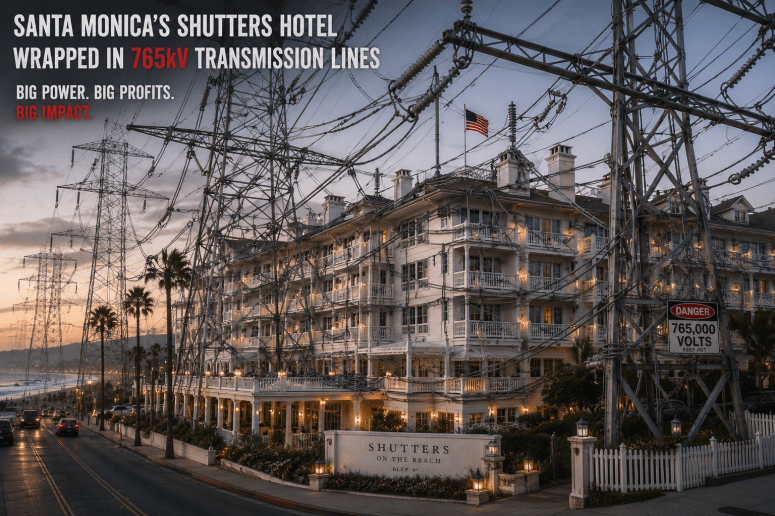

That question is impossible to ignore. As billions continue to flow into AI companies and the infrastructure supporting them, the debate is no longer merely about technology. It is about power, consent, and who gets to decide how the benefits of human creativity and expression are captured by the Big Tech kleptocrats.

Say No to Suno

Late last year, thieves disguised as construction workers broke into the Louvre during broad daylight, grabbed more than $100 million worth of crown jewels, and roared off on their motorbikes into the busy streets of Paris. While some of those thieves were later arrested, the jewelry they stole has yet to be recovered, and many fear those historic works of artistry have already been recut, reset, and resold.

Closer to home, but no less nefarious, is the brazen rip-off of artists enabled by irresponsible AI, whose profiteers are recutting, remixing, and reselling original works of artistry as something new.  The hijacking of the world’s entire treasure-trove of music floods platforms with AI slop and dilutes the royalty pools of legitimate artists from whose music this slop is derived. 

Meanwhile, those who are promoting this new business model are operating in broad daylight, too – minus the yellow safety vests.  That is AI music company Suno, the brazen “smash and grab” platform whose “Make it Music” ad campaign suggests that the most personal and meaningful forms of music can now be fabricated by their unauthorized AI platform machinery trained on human artists’ work. 

How significant is this activity?  Publicly revealed data says Suno is used to generate 7 million tracks a day, a massive quantity that suggests a dominant market share of AI tracks.  According to recent reports, Deezer “deems 85% of streams of fully AI-generated tracks [on its service] to be fraudulent,” and that such tracks include outputs from major generative models.  As JP Morgan’s analysts said, Deezer’s data “should be indicative of the broader market.”  Suno has yet to demonstrate persuasively that its platform does not, in practice, serve as a scalable input into streaming-fraud schemes — raising a serious concern that Suno has, in effect, become a fraud-fodder factory on an industrial scale.

In a February 2 LinkedIn post, Paul Sinclair, Suno’s Chief Music Officer, claims that his company’s platform is about “empowerment” that enables “billions of fans to create and play with music.”  He argues that closed systems are “walled gardens” that deny people access to the full joy of music.

Ironically, Sinclair’s choice of analogy undermines his own argument.  Ask yourself: just why are most gardens surrounded by fences or walls?  To keep out rabbits, deer, raccoons and wild pigs seeking a free lunch.  We cultivate, nurture and protect our gardens precisely because that makes them much more productive over the long run.

While Sinclair may be loath to admit it, AI is fundamentally different from past disruptive innovations in the music industry.  The phonograph, cassettes, CDs, MP3s, downloads, streaming – all these technologies were about the reproduction and distribution of creative work.  By contrast, irresponsible AI like Suno appropriates and plunders such creative work while undermining the commercial ecosystem for artists.

Think back to the days of Napster.  What brought the music industry back from the ruinous abyss of unfettered digital piracy?  It was the very “closed systems” that Sinclair derides as exclusionary.  At least streaming platforms maintain access controls and content management systems that enable creator compensation, even if the economic outcomes for many creators remain inadequate.  Should we be against Apple Music, Spotify, Deezer, YouTube Music, and Amazon Music?  What about Netflix, Disney+ and HBO, too, while we’re at it?

At its core, Sinclair’s argument is just a tired remix of the old trope that “information wants to be free.”  What that really means is: “We want your music for free.”

Artists need to understand Suno’s game.  They are not putting technology in the service of artists; they are putting artists in the service of their technology.  Every time artists’ creations are used by the platform, those creations have just unwittingly been contributed to the creation of endless derivatives of artists’ own work, not to mention AI slop, with limited or no remuneration back to the human creators.  Suno built its business on our backs, scraping the world’s cultural output without permission, then competing against the very works exploited.

It’s also important to keep in mind that using Suno to generate audio output calls into question the copyrightability of whatever Suno creates.  Most countries around the world including the US Copyright Office have been clear that generative AI outputs are largely ineligible for a copyright – meaning the economic value of the Suno creation lies solely with Suno, not with the artist using it.  The only ones gaining empowerment from Suno are Suno themselves.

Many in our community are embracing responsible AI as a tool for creation, and as a means for fans to explore and interact with our artistry.  That’s wonderful.  But it’s not the same as creating an environment where AI-generated works sourced from our music are mass distributed to dilute our royalties or, worse yet, reward those actively seeking to commit fraud.  Artists need to know the difference – all AI platforms are not the same, and Suno, which is being sued for copyright infringement, is not a platform artists should trust.

Responsible AI-generated music must evolve within a framework that respects and remunerates artists, enhances human creativity rather than supplants it, and empowers fans to engage with the music they love.  At the same time, AI services must preclude mass distribution of slop and prevent fraudsters from destroying the very ecosystem that has been built to reward and sustain artists and audiences alike.

All of us, including billions of music fans, share an urgent, deep and abiding interest in protecting and rewarding human genius, even as AI continues to change our industry and the world in unimaginable ways.  So in 2026, even as the Louvre continues to revamp its own approach to security, we in the arts must rise to confront those who would “smash-and-grab” our creativity for their own benefit.

Together, while embracing innovation, we must work to establish more effective safeguards – both legal and technological – that better promote and protect all creative artists, our intellectual property, and the spark of human genius.

Say no to Suno. Say yes to the beauty and bounty of the gardens that feed us all.

Signed: 

Ron Gubitz, Executive Director, Music Artist Coalition

Helienne Lindvall, Songwriter and President, European Composer and Songwriter Alliance

David C. Lowery, Artist and Editor The Trichordist

Tift Merritt artist, Practitioner in Residence, Duke University and Artist Rights Alliance Board Member

Blake Morgan, artist, producer, and President of ECR Music Group.

Abby North, President, North Music Group

Chris Castle, Artist Rights Institute