
Fired for Cause:  @RepFitzgerald Asks for Conditional Redesignation of the MLC

By Chris Castle

U.S. Representative Scott Fitzgerald joined in the MLC review currently underway and sent a letter to Register of Copyrights Shira Perlmutter on August 29 regarding operational and performance issues relating to the MLC.  The letter was in the context of the five year review for “redesignation” of The MLC, Inc. as the mechanical licensing collective.  (That may be confusing because of the choice of “The MLC” as the name of the operational entity that the government permits to run the mechanical licensing collective.  The main difference is that The MLC, Inc. is an entity that is “designated” or appointed to operationalize the statutory body.  The MLC, Inc. can be replaced.  The mechanical licensing collective (lower case) is the statutory body created by Title I of the Music Modernization Act) and it lasts as long as the MMA is not repealed or modified. Unlikely, but we live in hope.)

I would say that songwriters probably don’t have anything more important to do today in their business beyond reading and understanding Rep. Fitzgerald’s excellent letter.

Rep. Fitzgerald’s letter is important because he proposes that the MLC, Inc. be given a conditional redesignation, not an outright redesignation.  In a nutshell, that is because Rep. Fitzgerald raises many…let’s just say “issues”…that he would like to see fixed before committing to another five years for The MLC, Inc.  As a member of the House Judiciary Subcommittee on Courts, Intellectual Property, and the Internet, Rep. Fitzgerald’s point of view on this subject must be given added gravitas.

In case you’re not following along at home, the Copyright Office is currently conducting an operational and performance review of The MLC, Inc. to determine if it is deserving of being given another five years to operate the mechanical licensing collective.  (See Periodic Review of the Mechanical Licensing Collective and the Digital Licensee Coordinator (Docket 2024-1), available at https://www.copyright.gov/rulemaking/mma-designations/2024/.)

The redesignation process may not be quickly resolved.  It is important to realize that the Copyright Office is not obligated to redesignate The MLC, Inc. by any particular deadline or at all.  It is easy to understand that any redesignation might be contingent on The MLC, Inc. fixing certain…issues…because the redesignation rulemaking is itself an operational and performance review.  It is also easy to understand that the Copyright Office might need to bring in some technical and operational assistance in order to diligence its statutory review obligations.  This could take a while.

Let’s consider the broad strokes of Rep. Fitzgerald’s letter.

Budget Transparency

Rep. Fitzgerald is concerned with a lack of candor and transparency in The MLC, Inc.’s annual report among other things. If you’ve read the MLC’s annual reports, you may agree with me that the reports are long on cheerleading and short on financial facts.  It’s like The MLC, Inc. thought they were answering the question “How can you tolerate your own awesomeness?”   That question is not on the list.  Rep. Fitzgerald says “Unfortunately, the current annual report lacks key data necessary to examine the MLC’s ability to execute these authorities and functions.”  He then goes on to make recommendations for greater transparency in future annual reports.
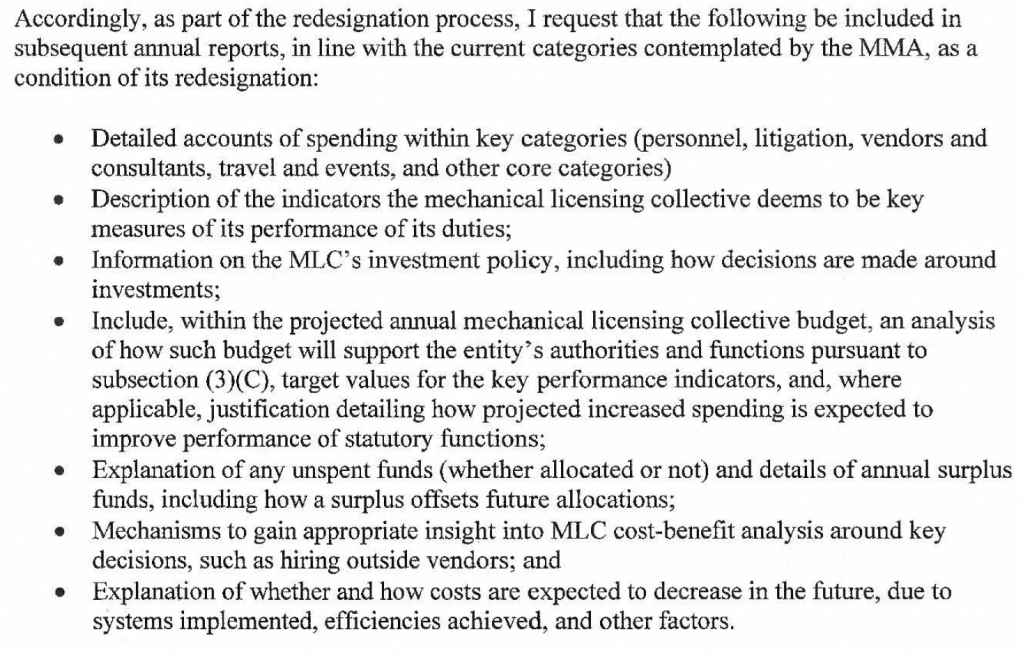
I agree with Rep. Fitzgerald that these are all important points.  I disagree with him slightly about the timing of this disclosure.  These important disclosures need not be prospective–they could be both prospective and retroactive. I see no reason at all why The MLC, Inc. cannot be required to revise all of its four annual reports filed to date (https://www.themlc.com/governance) in line with this expanded criteria.  I am just guessing, but the kind of detail that Rep. Fitzgerald is focused on are really just data that any business would accumulate or require in the normal course of prudently operating its business.  That suggests to me that there is no additional work required in bringing The MLC, Inc. into compliance; it’s just a matter of disclosure.

There is nothing proprietary about that disclosure and there is no reason to keep secrets about how you handle other people’s money.  It is important to recognize that The MLC, Inc. only handles other people’s money.  It has no revenue because all of the money under its management comes from either royalties that belong to copyright owners or operating capital paid by the services that use the blanket license.  It should not be overlooked that the services rely on the MLC and it has a duty to everyone to properly handle the funds. The MLC, Inc. also operates at the pleasure of the government, so it should not be heard to be too precious about information flow, particularly information related to its own operational performance. Those duties flow in many directions.

Board Neutrality

The board composition of the mechanical licensing collective (and therefore The MLC, Inc.) is set by Congress in Title I.  It should come as no surprise to anyone that the major publishers and their lobbyists who created Title I wrote themselves a winning hand directly into the statute itself.  (And FYI, there is gambling at Rick’s American Café, too.)  As Rep. Fitzgerald says:  

Of the 14 voting members, ten are comprised of music publishers and four are songwriters. Publishers were given a majority of seats in order to assist with the collective’s primary task of matching and distributing royalties. However, the MMA did not provide this allocation in order to convert the MLC into an extension of the music publishers.

I would argue with him about that, too, because I believe that’s exactly what the MMA was intended to do by those who drafted it who also dictated who controlled the pen.  This is a rotten system and it was obviously on its way to putrefaction before the ink was dry.

For context, Section 8 of the Clayton Act, one of our principal antitrust laws, prohibits interlocking boards on competitor corporations.  I’m not saying that The MLC, Inc. has a Section 8 problem–yet–but rather that interlocking boards is a disfavored arrangement by way of understanding Rep. Fitzgerald’s issue with The MLC, Inc.’s form of governance:

Per the MMA, the MLC is required to maintain an independent board of directors. However, what we’ve seen since establishing the collective is anything but independent. For example, in both 2023 and 2024, all ten publishers represented by the voting members on the MLC Board of Directors were also members of the NMPA’s board.  This not only raises questions about the MLC’s ability to act as a “fair” administrator of the blanket license but, more importantly, raises concerns that the MLC is using its expenditures to advance arguments indistinguishable from those of the music publishers-including, at times, arguments contrary to the positions of songwriters and the digital streamers.

Said another way, Rep. Fitzgerald is concerned that The MLC, Inc. is acting very much like HFA did when it was owned by the NMPA.  That would be HFA, the principal vendor of The MLC, Inc. (and that dividing line is blurry, too).

It is important to realize that the gravamen of Rep. Fitzgerald’s complaint (as I understand it) is not solely with the statute, it is with the decisions about how to interpret the statute taken by The MLC, Inc. and not so far countermanded by the Copyright Office in its oversight role.  That’s the best news I’ve had all day.  This conflict and competition issue is easily solved by voluntary action which could be taken immediately (with or without changing the board composition).  In fact, given the sensitivity that large or dominant corporations have about such things, I’m kind of surprised that they walked right into that one.  The devil may be in the details, but God is in the little things.

Investment Policy

Rep. Fitzgerald is also concerned about The MLC, Inc.’s “investment policy.”  Readers will recall that I have been questioning both the provenance and wisdom of The MLC, Inc. unilaterally deciding that it can invest the hundreds of millions in the black box in the open market.  I personally cannot find any authority for such a momentous action in the statute or any regulation.  Rep. Fitzgerald also raises questions about the “investment policy”:

Further, questions remain regarding the MLC’s investment policy by which it may invest royalty and assessment funds. The MLC’s Investment Policy Statement provides little insight into how those funds are invested, their market risk, the revenue generated from those investments, and the percentage of revenue (minus fees) transferred to the copyright owner upon distribution of royalties. I would urge the Copyright Office to require more transparency into these investments as a condition of redesignation.

It should be obvious that The MLC, Inc.’s “investment policy” has taken on a renewed seriousness and can no longer be dodged.

Black Box

It should go without saying that fair distribution of unmatched funds starts with paying the right people.  Not “connect to collect” or “play your part” or any other sloganeering.  Tracking them down. Like orphan works, The MLC, Inc. needs to take active measures to find the people to whom they owe money, not wait for the people who don’t know they are owed to find out that they haven’t been paid.  

Although there are some reasonable boundaries on a cost/benefit analysis of just how much to spend on tracking down people owed small sums, it is important to realize that the extraordinary benefits conferred on digital services by the Music Modernization Act, safe harbors and all, justifies higher expectations of those same services in finding the people they owe money.  The MLC, Inc. is uniquely different than its counterparts in other countries for this reason.

I tried to raise the need for increased vigilance at the MLC during a Copyright Office roundtable on the MMA. I was startled that the then-head of DiMA (since moved on) had the brass to condescend to me as if he had ever paid a royalty or rendered a royalty statement.  I was pointing out that the MLC was different than any other collecting society in the world because the licensees pay the operating costs and received significant legal benefits in return. Those legal benefits took away songwriters’ fundamental rights to protect their interests through enforcing justifiable infringement actions which is not true in other countries. 

In countries where the operating cost of their collecting society is deducted from royalties, it is far more appropriate for that society to consider a more restrictive cost/benefit analysis when expending resources to track down the songwriters they owe. This is particularly true when no black box writer is granting nonmonetary consideration like a safe harbor whether they know it or not.

I got an earful from this person about how the services weren’t an open checkbook to track down people they owed money to (try that argument when failing to comply with Know Your Customer laws).  Grocers know more about ham sandwiches than digital services know about copyright owners. The general tone was that I should be grateful to Big Daddy and be more careful how I spend my lunch money. And yes I do resent this paternalistic response which I’m sorry to say was not challenged by the Copyright Office lawyer presiding who shortly thereafter went to work for Spotify.  Nobody ever asked for an open check.  I just asked that they make a greater effort than the effort that got Spotify sued a number of times resulting in over $50 million in settlements, a generous accommodation in my view. If anyone should be grateful, it is the services who should be grateful, not the songwriters.

And yet here we are again in the same place.  Except this time the services have a safe harbor against the entire world which I believe has value greater than the operating costs of the MLC.  I’d be perfectly happy to go back to the way it was before the services got everything they wanted and then some in Title I of the MMA, but I bet I won’t get any takers on that idea.

Instead, I have to congratulate Rep. Fitzgerald for truly excellent work product in his letter and for framing the issue exactly as it should be posed.  Failing to fix these major problems should result in no redesignation—fired for cause.

[This post first appeared in MusicTech.Solutions]
Are You Better off Today Than You Were Five Years Ago? Selected comments on the MLC Redesignation: Monica Corton

The Mechanical Licensing Collective has its operations and functions reviewed every five years by the Copyright Office. That review is required by Title I of the Music Modernization Act as written by the lobbyists. The Copyright Office noticed the first of these five year reviews on January 30.

The statutory purpose of the period review is so that Congress, in the person of the Copyright Office, can determine whether the operators of the Mechanical Licensing Collective who the Copyright Office appointed (or “designated”) should be permitted to continue for another five years. If the Copyright Office determines that the operators of the Collective will do a good job in the next five years, the head of the Office may reward them with the equivalent of a valuable new government contract or a “redesignation”.

The current operators of the Collective are The MLC, Inc., but there is nothing that requires the Office to allow The MLC, Inc. to continue being the mechanical licensing collective–the the Collective and The MLC, Inc. are not the same thing. Be clear that the entity that is being considered to be “redesignated” is The MLC, Inc., not the Collective. The Collective is a statutory entity and The MLC, Inc. is the organization that is permitted by the Copyright Office to operate as the Collective. (That’s confusing because someone allowed The MLC, Inc. to take the same corporate name as the statutory entity which was probably an oversight by the Delaware Secretary of State if not the Copyright Office itself.)

The five year review is important because it is the only chance for songwriters and publishers as well as the public to comment on whether they support rewarding The MLC, Inc. with another five years of operations and the tens and tens of millions of dollars in operating costs and high salaries paid for by the users of the blanket license–the services themselves–in the conflict ridden process imposed on songwriters and publishers by the government.

For reasons known only to them, the Copyright Office has chosen to conduct this five year review as though it were any other rulemaking rather than engaging independent experts to conduct a technology, financial, operational, and personnel audit of The MLC, Inc. from top to bottom. That choice is presumably based on some guidance from somewhere, but would seem to inevitably substitute opinions–however astute–for an empirical review using at least industry experts with the power to compel answers if not managerial science.

While this rulemaking approach has the benefit of allowing the public to comment, it fails to offer independent expert review of the very thing that the Office is being asked to approve. Instead, that “redesignation” decision will be based on whether or not the public caught the “right” issues, expressed them the “right” way, and were able to communicate their ideas persuasively. Assuming the public even knew of the opportunity in the first place.

It must be said that if we are going to solicit opinions, the first opinion we would be interested in hearing is from the Copyright Office itself. The Register, after all, is the one making the redesignation decision, not the MLC, the DLC, or any one commenter. It seems that comments would be more compelling if informed by the Copyright Offices own views, including the opportunity to comment on the Office’s methodology. It doesn’t look like we will know about that one until the next step in the rulemaking. A “proposed redesignation” does not seem particularly apt, so we will look forward to finding out after the fact how a large chunk of songwriter income is to be managed.

We are impressed with the quality of many of the comments filed in the “Initial Comments” at the Copyright Office. As there will be an opportunity to comment again, including to comment on the comments, we will be posting selected Initial Comments to call to your attention. You can read all the comments at this link. If you are hearing about this for the first time, you have until June 28 to file a “reply comment” with the Copyright Office at this link.

You will see that there is a recurring theme with the comments. Many commenters say that they wish for The MLC, Inc. to be redesignated BUT…. They then list a number of items that they object to about the way the Collective has been managed by The MLC, Inc. usually accompanied by a request the The MLC, Inc. change the way it operates.

That structure seems to be inconsistent with a blanket ask for redesignation. Rather, the commenters seem to be making an “if/then” proposal that if The MLC, Inc. improves its operations, including in some cases operating in an opposite manner to its current policies and practices, then The MLC, Inc. should be redesignated. Not wishing to speak for any commenter, let it just be said that this appears to be a conditional proposal for redesignation. Maybe that is not what the commenters were thinking, but it does appear to be what they are saying. Perhaps this conditional aspect will be refined in the Reply Comments.

For purposes of these posts, we may quote sections of comments out of sequence but in context. We recommend that you read the comments in their entirety.

The first comment is by Monica Corton, the highly experienced and respected publisher. You can read her comment at this link.

The Top Unmatched Recording List
While I believe this list exists, I have never received an email asking me to review such a list. I recently learned that you could ask for the list, but it comes in the DDEX format (like the unmatched songs list) and as an independent publisher, I do not have the capability to change this to a CSV format. As I explained before, it can easily be converted to a CSV file if you have the
right software. I think that conversion from the DDEX format to the CSV format should be a service done by The MLC. Otherwise, the only people who can benefit from the Top Unmatched Recording List are the largest companies with the resources to convert this list.

Investment Policy
Why isn’t the investment policy made public and fully transparent to the membership? It is our money that they are investing, and I’d like to know the details as would many other publishers. Why did the board decide to not make the policy documents regarding investments available to the public?

IPI Number Use Not Mandatory
The MLC doesn’t require publishers to use IPI numbers of songwriters in their registrations. As a result, there are a lot of duplicate registrations at The MLC/HFA that never get linked together because different registrants used different names for the same writer (e.g. Eminem, Marshall Mathers) which creates different registrations for the same song. If IPI numbers for songwriters
were mandatory, this would clear up this problem.

Royalty Adjustments at The MLC
The MLC will not credit or debit a publisher for an incorrect royalty payment due to a change in registration unless they are directly responsible for the error. If you missed the snapshot because The MLC didn’t process a Catalog Transfer Form on time, the new publisher will not be credited, and it is their responsibility to contact the old publisher and get the incorrect royalty
payment paid between them rather than through The MLC. The MLC doesn’t consider a bad registration at HFA as the cause of an incorrect payment even though it is the HFA data that caused the incorrect payment. Every other PRO and CMO does internal debits and credits for incorrect payments and adjustments, especially when there is a transfer of a new catalog. The
minute The MLC is served notice of via a Catalog Transfer Form, all royalties should be put on hold until the transfer is confirmed and set up by The MLC.

Who Will Get to the Bottom of The Hundreds of Millions of Black Box Money at MLC?

By Chris Castle

One of the most common questions we get from songwriters about the MLC concerns the gigantic level of “unmatched funds” that have been sitting in the MLC’s accounts since February 2021.  Are they really just waiting until The MLC, Inc. gets redesignated and then distributes hundreds of millions on a market share basis like the lobbyists drafted into the MMA?  

Not My Monkey

Nobody can believe that the MLC can’t manage to pay out several hundred million dollars of streaming mechanical royalties for over three years so far.  (Resulting in the MLC holding $804,555,579 in stocks as of the end of 2022 on its tax return, Part X, line 11.) The proverbial monkey with a dart board could have paid more songwriters in three years.  Face it—doesn’t it just sound illegal?  In my experience, when something sounds or feels illegal, it probably is.

What’s lacking here is a champion to extract the songwriters’ money.  Clearly the largely unelected smart people in charge could have done something about it by now if they wanted to, but they haven’t.  It’s looking more and more like nobody cares or at least nobody wants to do anything about it.  There is profit in delay.

Or maybe nobody is taking responsibility because there’s nobody to complain to.  Or is there? What if such a champion exists?  What if there were no more waiting?  What if there were someone who could bring the real heat to the situation?

Let’s explore one potentially overlooked angle—a federal agency called the Office of the Inspector General.  Who can bring in the OIG?  Who has jurisdiction?  I think someone does and this is the primary reason why the MLC is different from HFA.

Does The Inspector General Have MLC Jurisdiction?

Who has jurisdiction over the MLC (aside from its severely conflicted board of directors which is not setting the world on fire to pump the hundreds of millions of black box money back into the songwriter economy).  The Music Modernization Act says that the mechanical licensing collective operates at the pleasure of the Congress under the oversight of the U.S. Copyright Office and the OIG has oversight of the Copyright Office through its oversight of the Library of Congress.

But, hold on, you say.  The MLC, Inc. is a private company and the government typically does not have direct oversight over the operations of a private company.

The key concept there is “operates” and that’s the difference between the statutory concept of a mechanical licensing collective and the actual operational collective which is a real company with real employees and real board members.  Kind of like shadows on the wall of a cave for you Plato fans.  Or the magic 8 ball.

The MLC, Inc. is all caught up with the government.  It exists because the government allows it to, it collects money under the government’s blanket mechanical license, its operating costs are set by the government, and its board members are “inferior officers” of the United States.   Even though The MLC, Inc. is technically a private organization, it is at best a quasi-governmental organization, almost like the Tennessee Valley Authority or the Corporation for Public Broadcasting.  So it seems to me that The MLC, Inc. is a stand-in for the federal government.

But The MLC, Inc. is not the federal government.  When Congress passed the MMA and it charged the Copyright Office with oversight of the MLC.  Unfortunately, Congress does not appear to have appropriated funds for the additional oversight work it imposed on the Office.  

Neither did Congress empower the Office to charge the customary reasonable fees to cover the oversight work Congress mandated.  The Copyright Office has an entire fee schedule for its many services, but not MLC oversight.  

Even though the MLC’s operating costs are controlled by the Copyright Royalty Board and paid by the users of the blanket license through an assessment, this assessment money does not cover the transaction cost of having the Copyright Office fulfill an oversight role.

An oversight role may be ill suited to the historical role of the Copyright Office, a pre-New Deal agency with no direct enforcement powers—and no culture of cracking heads about wasteful spending like sending a contingent to Grammy Week.

In fact, there’s an argument that The MLC, Inc. should write a check to the taxpayer to offset the additional costs of MLC oversight.  If that hasn’t happened in five years, it’s probably not going to happen.  

Where Does the Inspector General Fit In?

Fortunately, the Copyright Office has a deep bench to draw on at the Office of the Inspector General for the Library of Congress, currently Dr. Glenda B. Arrington.  That kind of necessary detailed oversight is provided through the OIG’s subpoena power, mutual aid relationships with law enforcement partners as well as its own law enforcement powers as an independent agency of the Department of Homeland Security.  Obviously, all of these functions are desirable but none of them are a cultural fit in the Copyright Office or are a realistic resource allocation.

The OIG is better suited to overseeing waste, fraud and abuse at the MLC given that the traditional role of the Copyright Office does not involve confronting the executives of quasi-governmental organizations like the MLC about their operations, nor does it involve parsing through voluminous accounting statements, tracing financial transactions, demanding answers that the MLC does not want to give, and perhaps even making referrals to the Department of Justice to open investigations into potential malfeasance.  

Or demanding that the MLC set a payment schedule to pry loose the damn black box money.

One of the key roles of the OIG is to conduct audits.  A baseline audit of the MLC, its closely held investment policy and open market trading in hundreds of millions in black box funds might be a good place to start.  

It must be said that the first task of the OIG might be to determine whether Congress ever authorized MLC to “invest” the black box funds in the first place.  Congress is usually very specific about authorizing an agency to “invest” other people’s money, particularly when the people doing the investing are also tasked with finding the proper owners and returning that money to them, with interest. 

None of that customary specificity is present with the MLC.

For example, MLC CEO Kris Ahrens told Congress that the simple requirement that the MLC pay interest on “unmatched” funds in its possession (commonly called “black box”) was the basis on which the MLC was investing hundreds of millions in the open market.  This because he assumed the MLC would have to earn enough from trading securities or other investment income to cover their payment obligations.  That obligation is mostly to cover the federal short term interest rate that the MLC is required to pay on black box.

The Ghost of Grammy Week

The MLC has taken the requirement that the MLC pay interest on black box and bootstrapped that mandate to justify investment of the black box in the open market.  That is quite a bootstrap.

An equally plausible explanation would be that the requirement to pay interest on black box is that the interest is a reasonable cost of the collective to be covered by the administrative assessment.  The plain meaning of the statute reflects the intent of the drafters—the interest payment is a penalty to be paid by the MLC for failing to find the owners of the money in the first place, not an excuse to create a relatively secret $800 million hedge fund for the MLC.  

I say relatively secret because The MLC, Inc. has been given the opportunity to inform Congress of how much money they made or lost in the black box quasi-hedge fund, who bears the risk of loss and who profits from trading.  They have not answered these questions.  Perhaps they could answer them to the OIG getting to the bottom of the coverup.

We do not really know the extent of the MLC’s black box holdings, but it presumably would include the hundreds of millions invested under its stewardship in the $1.9 billion Payton Limited Maturity Fund SI (PYLSX). Based on public SEC filings brought to my attention, The MLC, Inc.’s investment in this fund is sufficient to require disclosure by PYLSX as a “Control Person” that owns 25% or more of PYLSX’s $1.9 billion net asset value. PYLSX is required to disclose the MLC as a Control Person in its fundraising materials to the Securities and Exchange Commission (Form N-1A Registration Statement filed February 28, 2023).  This might be a good place to start.

Otherwise, the MLC’s investment policy makes no sense.  The interest payment is a penalty, and the black box is not a profit center.

But you don’t even have to rely on The MLC, Inc.’s quasi governmental status in order for OIG to exert jurisdiction over the MLC.  It is also good to remember that the Presidential Signing Statement for the Music Modernization Act specifically addresses the role of the MLC’s board of directors as “inferior officers” of the United States:

Because the directors [likely both voting and nonvoting] are inferior officers under the Appointments Clause of the Constitution, the Librarian [of Congress] must approve each subsequent selection of a new director. I expect that the Register of Copyrights will work with the collective, once it has been designated, to ensure that the Librarian retains the ultimate authority, as required by the Constitution, to appoint and remove all directors.

The term “inferior officers” refers to those individuals who occupy positions that wield significant authority, but whose work is directed and supervised at some level by others who were appointed by presidential nomination with the advice and consent of the Senate. Therefore, the OIG could likely review the actions of the MLC’s board (voting and nonvoting members) as they would any other inferior offices of the United States in the normal course of the OIG’s activities.

Next Steps for OIG Investigation

How would the OIG at the Library of Congress actually get involved?  In theory, no additional legislation is necessary and in fact the public might be able to use the OIG whistleblower hotline to persuade the IG to get involved without any other inputs.  The process goes something like this:

  1. Receipt of Allegations: The first step in the OIG investigation process is the receipt of allegations. Allegations of fraud, waste, abuse, and other irregularities concerning LOC  programs and operations like the MLC are received from hotline complaints or other communications. 
  2. Preliminary Review: Once an allegation is received, it undergoes a preliminary review to determine if OIG investigative attention is warranted. This involves determining whether the allegation is credible and reasonably detailed (such as providing a copy of the MLC Congressional testimony including Questions for the Record). If the Office is actually bringing the OIG into the matter, this step would likely be collapsed into investigative action.
  3. Investigative Activity: If the preliminary review warrants further investigation, the OIG conducts the investigation through a variety of activities. These include record reviews and document analysis, witness and subject interviews, IG and grand jury subpoenas, search warrants, special techniques such as consensual monitoring and undercover operations, and coordination with other law enforcement agencies, such as the FBI, as appropriate.  That monitoring might include detailed investigation into the $500,000,000 or more in black box funds, much of which is traded on open market transactions like PYLSX.
  4. Investigative Outputs: Upon completing an investigation, reports and other documents may be written for use by the public, senior decision makers and other stakeholders, including U.S. Attorneys and Copyright Office management. Results of OIG’s administrative investigations, such as employee and program integrity cases, are transmitted to officials for appropriate action. 
  5. Monitoring of Results: The OIG monitors the results of those investigations conducted based on OIG referrals to ensure allegations are sufficiently addressed.

So it seems that the Office of the Inspector General is well suited to assisting the Copyright Office by investigating how the MLC is complying with its statutory financial obligations.  In particular, the OIG is ideally positioned to investigate how the MLC is handling the black box and its open market investments that it so far has refused to disclose to Members of Congress at a Congressional hearing as well as in answers to Questions for the Record from Chairman Issa.

This post previously appeared on MusicTech.Solutions

The First Shot Across the Bow at the MLC’s “Redesignation” Proceeding #TheReup

We must always tell what we see. Above all, and this is more difficult, we must always see what we see.
Charles Peguy

By Chris Castle

The Reup is on! MTP readers will remember that The MLC, Inc. is in the beginning of its “redesignation” proceeding before the U.S. Copyright Office that we call “the rep,” because…because….well, you have to laugh at some point. Having appointed (or “designated”) The MLC, Inc. as the statutory mechanical licensing collective in 2019, the Copyright Office is required by statute to review The MLC, Inc. to see how they are doing with their exclusive monopoly over songwriter streaming mechanical collections.

It’s important to remember that the mechanical licensing collective (lower case) is a statutory body. Congress tasked the head of the Copyright Office with selecting an entity to actually do the work. In a shocker that rocked the industry, the Copyright Office selected (or “designated”) the favorite corporation of the National Music Publishers Association and the Nashville Songwriters Association International that styled itself “The MLC, Inc.” 

The MLC, Inc. then turned right around and selected the Harry Fox Agency as its data vendor to actually run the accounting part of the collective–another shocker. If you thought you were going to escape the hubris and incompetence of HFA under the glorious revolution of the Music Modernization Act, tough break. So it is now the Copyright Office’s decision to either redesignate The MLC, Inc. (and by default, HFA) for another five years of holding onto your money in their vast black box, or find someone else.

And just to be clear, these exclusive appointments or “designations” last for five years. Every five years, Congress required the Copyright Office to take a critical look at the wisdom of their prior decision and determine after soul-searching and self-criticism whether they should ratify their previous genius by extending the monopoly another five years. As Congress said in the legislative history narrative:

The Register [the head of the Copyright Office] is allowed to re-designate an entity to serve as the collective every 5 years after the initial designation. Although there is no guarantee of a continued designation by the collective, continuity in the collective would be beneficial to copyright owners so long as the entity previously chosen to be the collective has regularly demonstrated its efficient and fair administration of the collective in a manner that respects varying interests and concernsIn contrast, evidence of fraud, waste, or abuse, including the failure to follow the relevant regulations adopted by the Copyright Office, over the prior five years should raise serious concerns within the Copyright Office as to whether that same entity has the administrative capabilities necessary to perform the required functions of the collective. In such cases, where the record of fraud, waste, or abuse is clear, the Register should give serious consideration to the selection of a new entity even if not all criteria are met pursuant to section 115(d)(3)(B)(iii).

So the way this is going to go down according to the Copyright Office is that they will seek a kind of thesis defense from each of The MLC, Inc. and the MLC’s counterpart for the digital services called the Digital Licensee Coordinator or “the DLC” which we often forget is there. Then the public gets to comment on how things are going.

Let’s understand how this game is played. Nobody likes to open the kimono and have their operations examined. But opening the kimono is actually a much bigger deal for the MLC than for the DLC. The MLC has a lot of functionality that perpetuates the same old spaghetti code from HFA and the need to hide it from sunlight. In my view the sense of entitlement and hubris is overwhelmingly stronger at The MLC, Inc. than at the DLC. Remember, the DLC pretty much just writes the overpriced checks to keep MLC executives in the style to which they have become accustomed (see Trichordist “Know Your MLC 2022“).

We are starting to get a sense of how the DLC is going to approach the reup proceeding given a recent blog post by Graham Davies, the new head of the Digital Media Association. DiMA essentially is the DLC. Technically, the DLC’s mission is to represent all users of the blanket mechanical license, and I think perhaps for the first time, the DLC will represent all the users both large and small, not just DiMA members. Let’s take a look at some of the points Graham raised.

The Insult of Governance

But first, remember that the MMA created the first US mechanical licensing CMO. This was an event that had been coming for oh, say 100 years round numbers. The first difference between the US and most other countries is that in the US there is not equal board representation between publishers and songwriters. This is an insult to songwriters. 

That’s right–in the rest of the world, songwriters have at least equal representation. Just call it what it is, it’s an insult. And not a casual insult or the insult of low expectations. This insult is right in your face.

There will be a lot of rending of garments about the unfairness of the MLC’s board composition and that’s all fine, but know this: You will not change the board composition until you change the mindset that produced the board composition.

What is astonishing about how this happened is that before they get to Washington, all these publishers with board seats have good relations with songwriters and value their writers. Do we have arguments inside the family? Sure. But something happens to these publishers when they get to Washington, DC and they go rogue or they are encouraged to go rogue. 

So I would encourage these board members to come back to your values and what you hold dear and don’t listen to the bad advice. The bad advice didn’t build your companies; your relations with your songwriters did. Yet there is such hostility toward this board composition that it will take you years to overcome the insult and the distrust it produced. It didn’t have to happen that way and it should not be allowed to continue.

No Free Lunch

The next big difference is that the cost of standing up and operating the MLC is born by the licensees. There is a reason that this doesn’t happen in any other country–it is a bullshit idea. It OBVIOUSLY produced an inherent conflict of interest at the outset. Does it shovel money onto the kitchen tables of the insiders? Of course. Does it feed into salaries, bonuses and T&E of the MLC? Oh, yes. So let’s see what Graham Davies has to say about this one.

For starters, here’s a headline: THE MONEY IS NOT HAPPY. Get it? What do you think happens when the money is not happy? Maybe, just maybe, you think they might not want to keep paying? Maybe just maybe they gave you your lead for five years and let you get good and hooked before they started reeling you in?

As Graham says:

All around the world, it is the rightsholders who bear the cost of the collectives licensing their rights, and copyright offices or similar government bodies often have oversight powers over the collectives to ensure that royalties are distributed fairly and the collectives operate efficiently.  

In the US, unlike anywhere else in the world, legislators placed the burden of funding the collective’s operations on the licensees as opposed to the rightsholders. This particular arrangement was a feature of the statute, but means a collective’s traditional incentives for optimum performance are not inherently built in and may become skewed. [Now there’s a shocker.]

This structure makes it even more important that the Copyright Office ensures fair and efficient operation of the collective, including for those who fund it.

How can you read that and not realize that THE MONEY IS NOT HAPPY. See what you see. Anyone who believed that the licensees large and small would just go on writing the checks for absurd salaries and ridiculous travel and entertainment expenses must be from Washington.

Oversight Culture Clash

This goes hand-in-hand with the true problem with the entire megillah which is where Graham starts: Lack of oversight. Don’t blow past this. 

Remember, DiMA represents the biggest corporations in commercial history and make no mistake–they own Washington, DC. So when the DiMA members look at this oversight issue, from their point of view the government works for them and the government is falling down on the job. The money is not happy. See what you see.

Oversight is a key part of Graham’s complaint.

As we embark on the redesignation process, oversight of the mechanical licensing collective is a key issue. Collective licensing is common for many rights in the music sector, because it is a sensible solution for reducing transaction costs and improving efficiencies between rightsholders and licensees….

The MMA mandated that the MLC be run by a Board made up largely of music publishers and some songwriters. While it makes sense for rights holders to have oversight over a collective of their rights, it has become apparent in the five years since the MMA was passed, that this structure, without guardrails and robust oversight, provides little incentive for the collective to carefully weigh risks and conduct rigorous cost-benefit analysis of decisions before action. [Like any CMO conducts a “rigorous cost-benefit analysis”–try not to laugh, but you get the idea.] This is of great importance because without a clearly circumscribed remit for The MLC, the positions the collective takes can have significant consequences for the functioning of the US music market.

The record shows that in passing the MMA, Congress chose to establish a collective that would serve as the administrator of  the mechanical blanket license….Congress [did not] intend to write the collective a blank check.  Indeed, Congress was astute in requiring that streaming services be responsible only for the reasonable costs of the collective. Such reasonable costs relate to the collective’s core functions – such as work registration and matching. Where The MLC has focused on these core functions, there is good work [no there isn’t], particularly in the context of the relatively short window from designation to operation [already making excuses]. However, where The MLC has gone beyond its remit, there has been, and continues to be cause for concern. Reasonable costs of the collective cannot include everything from traveling to distant countries to conduct outreach to songwriters far beyond the U.S. licensing system, to suing one of the licensees that pays its costs — using licensee money to pursue its allegations against a licensee on a novel legal theory. [This is the Pandora lawsuit filed by The MLC, Inc. I was wondering how long that would take to get under the skin.]

I take Graham’s point and understand his frustration (and discretion in not calling out the ridiculous salaries). But it must also be said that only lobbyists in the Imperial City would have drafted Title I of the MMA to provide for oversight of a private company by a government agency. That’s just idiotic. First of all, it’s really unfair to expect the Copyright Office to supervise the MLC’s travel and entertainment expenses. They barely have the resources to manage their own operations much less have oversight on Kris Ahrend’s tips in transit. It’s also just not in the cerebral culture of the Copyright Office to have the kind of dressing down relationship with the MLC that would be necessary for financial oversight. 

I also have to call bullshit on this complaint about costs being framed as an oversight issue. Yeah, sure, I guess on some level everything is an oversight issue. But if anything, this is an issue for the board of directors at the MLC which includes the DLC. But in most companies it’s a management issue for the CEO and the CFO. So if Graham has a beef about T&E (which sounds like a legitimate beef and is not the first I’ve heard of it), he needs to take it up with the management. You know, the management that reports to the board the DLC sits on (nonvoting or not).

Alternatively, the operating budget of the MLC comes through the Copyright Royalty Board which approves the budget in the form of the “Administrative Assessment.” The DLC can raise these complaints about spending in that forum as well and really should.

So Graham raises some important points that we should be aware of as the MLC enters its all-important reup proceeding. Stay tuned for responses.

Better than Cats: The Copyright Office Seeks Public Comment on Periodic Review of the Designations of the Mechanical Licensing Collective and Digital Licensee Coordinator aka #TheReup

In case you missed it, the MLC, Inc. was handed a five year contract in 2019 to operate the mechanical licensing collective. This contract was worth millions and millons of dollars, but more importantly guaranteed that the Harry Fox Agency would have a job for at least another five years. The salty arrangement was the brainchild of the lobbyists, the controlled opposition and the Copyright Office–and has resulted in The MLC, Inc. sitting on hundreds of millions of other peoples money. 

The Copyright Office has posted a notice letting us know that the time has come for the circular admiration society also known as the 5 year review of the MLC and the DLC as required by Title I of the oh so modern Music Modernization Act (yet we keep comeing back to these age-old problems that are not modern at all). This is all conducted by the Copyright Office which in a meaningful way is simply reviewing how well the Copyright Office did with the designation of the MLC, Inc. as much as how well the MLC met expectations.

After suffering through establishing some regulations for the MLC that largely favored the services, the head lawyer at the Copyright Office threw down the pretenses and became employed as a lobbyist for Spotify. Another went to work for the National Association of Broadcasters to screw artists our of a performance right for sound recordings. Can’t wait to congratulate current Copyright Office staff on their employment futures after we get through this important reup for the MLC, Inc. and the lobbyists. I hear the chief butterfly killers have openings for copyright lawyers trained on the public purse.

The comment period in this vitally important review is divided into at least two parts: The special people, i.e., The MLC, Inc. quango and the DLC get to go first, and then the hoi polloi (that’s you and me). You’ll find this language buried at the very bottom of the Reup notice:

Interested members of the public are encouraged to comment on the topics addressed in the designees’ [i.e., the DLC or the MLC’s] submissions or raised by the Office in this notification of inquiry. Commenters may also address any topics relevant to this periodic review of the MLC and DLC designations. Without prejudice to its review of the current designations, the Office hopes that this proceeding will serve as an opportunity for any songwriter, publisher, or DMP who wishes to express concerns, satisfaction, or priorities with respect to the administration of the MMA’s blanket licensing regime to do so, and that any designated MLC or DLC will use that feedback to continually improve its services.

Bite your tongue now.

Bridgeport Music Files Notice of The MLC’s First Royalty Audit

[Editor Charlie sez: a royalty “audit” is a right of the song owner to look inside the books and records of the party paying royalties to confirm that all royalties were paid and that all royalties were paid correctly, usually during a specified period of time. This usually results in the song owner discovering an underpayment that would have gone unpaid without the audit.]

By Chris Castle

It is commonplace for artists to conduct a royalty examination of their record company, sometimes called an “audit.” Until the Music Modernization Act, the statutory license did not permit songwriters to audit users of the statutory license. The Harry Fox Agency “standard” license for physical records had two principal features that differed from the straight statutory license: quarterly accounting and an audit right. When streaming became popular, the services both refused to comply with the statutory regulations and also refused to allow anyone to audit because the statutory regulations they failed to comply with did not permit an audit. I brought this absurdity to the attention of the Copyright Office in 2011.

After much hoopla, the lobbyists wrote an audit right for copyright owners into the Music Modernization Act. However, rather than permitting copyright owners to audit music users as is long standing common practice on the record side, the lobbyists decided to allow copyright owners to audit the Mechanical Licensing Collective. At the expense of the copyright owner, of course, no matter how many mistakes the copyright owner discovered or how big the underpayment. This is consistent with the desire of services to distance themselves from those pesky songwriters by inserting the MLC in between the services and their ultimate vendors, the songwriters and copyright owners. The services can be audited by the MLC (whose salaries are paid by the services), but that hasn’t happened yet to my knowledge.

But the MLC has received what I believe is its first audit notice that was just published by the Copyright Office after receiving it on November 9. First up is Bridgeport Music, Inc. for the period January 1, 2021, through December 31, 2023. January 1, 2021 was the “license availability date” or the date that the MLC began accounting for royalties under the MMA’s blanket license.

Why Audit Now?

Bridgeport’s audit is wise. There are no doubt millions if not billions of streams to be verified. The MLC’s systems are largely untested, compared to other music users such as record companies that have been audited hundreds, if not thousands of times depending on how long they are operating. Competent royalty examiners will look under the hood and find out whether it’s even possible to render reasonably accurate accounting statements given the MLC’s systems. Maybe it’s all fine, but maybe it’s not. The wisdom of Bridgeport’s two year audit window is that two years is long enough to have a chance at a recovery but it’s not so long that you are drowned in data and susceptible to taking shortcuts. 

In other words, why wait around?

Auditing the Black Box

A big difference between the audit rules the lobbyists wrote into the MMA and other audits is that the MLC audit is based on payments, not statements. The relevant language in the statute makes this very clear (17 USC §115(d)(3)(L):

A copyright owner entitled to receive payments of royalties for covered activities from the mechanical licensing collective may, individually or with other copyright owners, conduct an audit of the mechanical licensing collective to verify the accuracy of royalty payments by the mechanical licensing collective to such copyright owner…The qualified auditor shall determine the accuracy of royalty payments, including whether an underpayment or overpayment of royalties was made by the mechanical licensing collective to each auditing copyright owner.

Royalty payments would include a share of black box royalties distributed to copyright owners. It seems reasonable that on audit a copyright owner could verify how this share was arrived at and whatever calculations would be necessary to calculate those payments, or maybe the absence of such payments that should have been made. Determining what is not paid that should have been paid is an important part of any royalty verification examination.

Systems Transparency

Information too confidential to be detected cannot be corrected.  It is important to remember that copyright owner audits of the MLC will be the first time an independent third party has had a look at the accounting systems and functional technology of The MLC. If those audits reveal functional defects in the MLC’s systems or technology that affects any output of The MLC, i.e., not just the royalties being audited, it seems to me that those defects should be disclosed to the public. Audit settlements should not be used as hush money payments to keep embarrassing revelations from being publicly disclosed.

Unsurprisingly, The MLC lobbied to have broadly confidential treatment of all audits. Realize that there may well be confidential financial information disclosed as part of any audit that both copyright owners and The MLC will want to keep secret. There is no reason to keep secrets about The MLC’s systems. To take an extreme example, if on audit the auditors discovered that The MLC’s systems added 2 plus 2 and got 5, that is a fact that others have a legitimate interest in having disclosed to include the Copyright Office itself that is about to launch a 5 year review of The MLC for redesignation. Indeed, auditors may discover systemic flaws that could arguably require The MLC to recalculate many if not all statements or at least explain why they should not. (Note that a royalty auditor is required to deliver a copy of the auditor’s final report to The MLC for review even before giving it to their client. This puts The MLC on notice of any systemic flaws in The MLC’s systems found by the auditor and gives it the opportunity to correct any factual errors.)

I think that systemic flaws found by an auditor should be disclosed publicly after taking care to redact any confidential financial information. This will allow both the Copyright Office and MLC members to fix any discovered flaws.

The “Qualified Auditor” Typo

It is important to realize that there is no good reason why a C.P.A. must conduct the audit; this is another drafting glitch in the MMA that requires both The MLC’s audited financial statements and royalty compliance examinations be conducted by a C.P.A, defined as a “qualified auditor” (17 USC § 115(e)(25)). It’s easy to understand why audited financials prepared according to GAAP should be opined by a C.P.A. but it is ludicrous that a C.P.A. should be required to conduct a royalty exam for royalties that have nothing to do with GAAP and never have. 

To be frank, I doubt seriously whether anyone involved in drafting the MMA had ever personally conducted or managed a royalty verification examination. That assessment is based on the fact that royalty verification examinations are one of the most critical parts of the royalty payment process and is the least discussed subject in the lengthy MMA; at the time, the lobbyists did not represent songwriters and tried very hard to keep songwriters inside the writer room and outside of the drafting room as you can tell from The MLC, Inc.’s board composition; and that the legislative history (at 20) has one tautological statement about copyright owner audits: ”Subparagraph L sets forth the verification and audit process for copyright owners to audit the collective, although parties may agree on alternate procedures.” Well no kidding, smart people. We’ll take some context if you got it.

As Warner Music Group’s Ron Wilcox testified to the Copyright Royalty Judges, “Because royalty audits require extensive technical and industry-specific expertise, in WMG’s experience a CPA certification is not generally a requirement for conducting such audits. To my knowledge, some of the. most experienced and knowledgeable royalty auditors in the music industry are not CPAs.” (Testimony of Ron Wilcox, In re Determination of Royalty Rates and Terms for Ephemeral Recording and Digital Performance of Sound Recordings (Web IV), Copyright Royalty Judges, Docket No. 14-CRB-0001-WR (Oct. 6, 2014) at 15.). 

I would add to Ron’s assessment that the need for “extensive technical and industry-specific expertise” has grown exponentially since he made the statement in 2014 due to the complexity and numerosity of streaming. I’m sure Ron would agree if he had a chance to revisit his remarks. But inside the beltway of the Imperial City, it ain’t that way and you can tell by reading their laws handed down by the descendants of Marcus Licinius Crassus. All accountants are CPAs, all accounting is according to GAAP, all the women are strong, all the men are good-looking, and all the children are above average and go to Sidwell Friends. In the words of London jazzman and club owner Ronnie Scott to an unresponsive audience, “And now, back to sleep.”

The “qualified auditor” defined term should be limited to the MLC’s financials and removed from the audit clauses. This was a point I made to Senate staff during the drafting of MMA, but was told that while they, too, agreed it was stupid, it’s what the parties wanted (i.e., what the lobbyists wanted). And you know how that can be. So now we sweep up behind the elephants in the circus of life. But then, I’m just a country lawyer from Texas, what do I know.

All praise to Bridgeport for stepping up.

This post first appeared on MusicTech.Solutions

Selected Comments on the Copyright Office Proposed Rule on Termination Rights and MLC Operations: Digital Licensee Coordinator

The Copyright Office has asked for comments from the public on important issues for rulemakings under the Music Modernization Act. This will potentially affect the operations of The MLC and related rights especially because the Copyright Office recently extended the scope of that rulemaking. The proposal drew a mixed response.

We will be posting selected comments that we think might be interesting to Trichordist readers. The project is a bit wonky, but important to stay informed on. This comment by attorney Allison Stillman representing the Digital Licensee Coordinator (who controls the purse strings for The MLC) has some interesting complaints about The MLC that are food for thought in light of the MLC’s potential redesignation coming next year.

The DLC’s firm view is that any additional costs associated with a proposed rule that upends the practices of the entire industry, without actually facilitating the payment of royalties to songwriters or music publishers, as a matter of law would not be “reasonable collective total costs” that could be imposed on the DMPs, through the administrative assessment or otherwise….

As noted in the DLC’s Initial Comments…the [Copyright Office] raises important issues regarding the need for the MLC to have a fair, efficient and transparent methodology for administering corrections and adjustments to payments. These are issues that apply…more broadly to any form of payment adjustment that may be necessary….

While some other commenters echoed similar concerns, the MLC suggests that error corrections, adjustments, disputes and payee changes outside of the specific and purportedly unique termination context “do not represent a controversial topic that would require regulation of operational details” and merely constitute part of “the normal course of business, which The MLC can administer without additional regulation.”

But the DLC members’ experiences in waiting for corrections and adjustments from the MLC where the issue has arisen so far indicate otherwise, and that is before the MLC has had to operationalize the anticipated regular practice of DMPs’ over-estimating monthly royalties [or Phonorecords III retroactive adjustments]…. The same principles underlying any regulatory approach to ensuring the prompt and transparent correction of erroneous payments to one rightsholder vs another as a result of copyright termination apply equally to require the prompt and transparent correction of [other payments to DMPs or rights holders].

@northmusicgroup Calls Out The MLC’s Ability to Make “Law” Through Business Rules that Hurt Songwriters and Skew the Black Box to Benefit Majors — Artist Rights Watch/Music Technology Policy

In this comment to the Copyright Office, Abby North (independent publisher and Artist Rights Symposium III Moderator) calls on the Copyright Office to stop the MLC quango from unilaterally establishing “business rules” that hurt songwriters and their heirs and protect working families from these arbitrary actions of The MLC. The passing of Jeff Beck reminds us once again that we must take care to protect the heirs of creators.

Read the original comment here on Regulations.gov

January 5, 2023

Via Electronic Delivery

Comments of Abby North

Docket No. 2022-5

Re: Termination Rights and the Music Modernization Act’s Blanket License

To the United States Copyright Office:

My name is Abby North. I am a music publishing administrator based in Los Angeles. My views expressed in this letter are solely my own. 

With my husband, I am a copyright owner of the classic song “Unchained Melody,” among other copyrights. I also administer musical works and sound recordings on behalf of songwriters, their families and heirs. In many instances, I assist my clients in identifying their termination windows, assist in the research required, and interface with the attorneys who process termination filings.

Abby North, Helienne Lindvall, Erin McAnaly, Melanie Santa Rosa speaking at UGA Artist Rights Symposium III (Nov. 15, 2022 in Athens, GA)

I’m thankful for the opportunity to submit comments in support of the Copyright Office’s proposed rule.

The ability to recapture rights via the United States copyright termination system truly provides composers, songwriters and recording artists and their heirs, a “second bite of the apple.” Many of my clients exercise this right, and in doing so grow their family’s revenue, which, given today’s inflation and very high interest rates, coupled with a depleted stock market, is absolutely necessary.

Allyn Ferguson was a successful composer of film/television scores including “Little Lord Fauntleroy,” “Les Miserables,” “Charlie’s Angels,” and “Barney Miller.” According to Variety in its June 27, 2010 obituary, Ferguson was “among the most prolific composers of TV in the past 40 years.” My company North Music Group administers works controlled by Ferguson’s family.

In addition to his scores, Ferguson wrote songs performed by artists including Johnny Mathis, Count Basie Band and Freddie Hubbard. While the bulk of his film and television scores were created on a work for hire basis, and therefore are not eligible for termination under US copyright law, Ferguson’s commercial compositions and songs were not created as works for hire. Ferguson’s family has been able to exercise its termination rights in various musical works,

thereby increasing its earnings as it now collects the publisher share of United States royalties generated by the terminated works. Individual songwriters and composers and their heirs are not copyright aggregators. Every musical work, and every penny generated is very necessary to these families.

The Music Modernization Act created the blanket digital mechanical license. This move from one-off copyright licenses to a blanket license was a dramatic improvement in US mechanical licensing. However, the suggestion that rights held at the inception of this blanket license might remain, in perpetuity, with the original copyright grantee was frightening. I concur with the Office’s proposed rule and legal analysis of the relevant statutes and authorities.

I appreciate the Office requesting comments on the mechanics of solving the payment issues, because for the independent publishers I speak with and for me personally, many operational questions arise regularly regarding The MLC’s uncharted territories.

As one of The MLC’s statutory goals is to provide transparency to songwriters and copyrightowners, I would ask that the Office require The MLC to notify copyright owners (1) if The MLC’s unilateral termination policy has already been imposed on payments previously paid or that are being held in the historical or current black box, and (2) when the adjusting payment required by the proposed rule had been made.

To be clear, this rule must absolutely be retroactive to inception date of The MLC. Beyond the simple, clarifying amendment to the MMA, I believe there are additional, related issues that must be resolved:

1) What is The MLC’s “business rule” regarding the MLC/HFA Song Code for the terminated work? Prior to the inception of The MLC, the Harry Fox Agency would assign one HFA Song Code fr the work and its pre-termination parties, and a different HFA Song Code for the work with the post-termination parties.

What happens now? Do these multiple HFA Song Codes remain in The MLC’s database? Will there continue to be two separate MLC/HFA Song Codes, particularly given the Harry Fox Agency continues to license physical and download mechanicals on behalf of many publishers? Is it reasonable for the HFA Song Code to be the same as The MLC Song Code, when there is no derivative works exception in Section 115?

2) Which party is entitled to the Unmatched (Black Box) royalties, the related interest fees and to The MLC’s investment proceeds for a terminated work?

Finally, it should be noted that the initial concept proposed by The MLC Board (that the server fixation date should impact termination dates) most likely would have served large publishers, not songwriters.

It is crucial that the Copyright Office exercise vigilant oversight and governance of The MLC’s reporting regarding any payment obligations to copyright owners. Specifically, composers, songwriters and their heirs must have as significant a voice as the largest publishers and copyright aggregators.

Additionally, in the spirit of full transparency, I request full disclosure of board or committee votes, minutes of meetings or other documentation of process. For me and others like me, this would tremendously enhance our understanding of The MLC.

Decisions are being made by The MLC’s board and committee members, while the general MLC member or songwriters have no mechanism to gain information regarding the discussions, the decisions and the implementations thereof. Access to minutes and notes would provide valuable insights to the general membership.

I applaud the Copyright Office for moving swiftly to create this rule and clarify and codify how The MLC must treat copyright terminations. It is important that this rule be dictated by the Office as it is absolutely not The MLC’s job todecide who controls rights and is entitled to collect royalties. 

That said, a “business rule” established by The MLC could have the effect of law absent vigilance by the Copyright Office.

On behalf of my family and clients, I wholeheartedly support this proposed regulation, and I truly appreciate the Copyright Office’s consideration of my comments.

Sincerely,

Abby North

North Music Group LLC

@northmusicgroup Calls Out The MLC’s Ability to Make “Law” Through Business Rules that Hurt Songwriters and Skew the Black Box to Benefit Majors — Artist Rights Watch–News for the Artist Rights Advocacy Community — Music Technology Policy

Songwriters and Publishers Ask the MLC: Where’s my money?–MusicTechPolicy

By Chris Castle

If anyone connected to The Mechanical Licensing Collective, Inc. quango brings up the $424,000,000 black box payment that the MLC received in February as part of services claiming their safe harbor under the Music Modernization Act Title I giveaway, it’s usually in the context of claiming credit for the payment as in “Aren’t we great, we got the services to pay $424,000,000 of black box money owed to songwriters.” (Followed shortly by so where’s my bonus?)

Notice what’s not mentioned in that sentence? True, some services paid some money to the MLC which was required by Title I in order for the major infringers like Spotify to enjoy yet another safe harbor. But the payment was not made to songwriters or publishers–it was made to the MLC quango, which is where it sits today, seven months later

How could this be, you say? Very simple. Nobody made sure that the MLC was in a position to pay the money out before they took the money in. This is the kind of thing that you would make sure is tied down in the two-plus years the MLC was operational before they got the money. You know, like when did Noah build the Ark?  Before the rain.

This is the kind of thing you might expect to be mentioned in the MLC’s annual report which was due June 30 but seems to have been delayed. What should have happened, of course, is that the Copyright Office in its supposed oversight role for the MLC quango should be closely reviewing MLC’s progress with paying out a half billion of other people’s money. This is what you would expect from a bit-in-the mouth hard-driving approach to oversight of hundreds of millions that Congress tasked to the Copyright Office. 

Ask yourself (or maybe the Library of Congress Inspector General) whether you think that a pre-New Deal federal agency that has never had enforcement powers is culturally suited to the kind of rigorous prosecution that the oversight role requires? Having created the MLC self-licking ice cream cone, does anyone seriously think that the Copyright Office will rock the boat, particularly when the lawyers seem very interested in landing a job at Spotify (regulated by the Copyright Office) or the National Association of Broadcasters both of which have an ontologically hostile relationship with songwriters? Do you think anyone at the MLC is looking over their shoulder because they’re afraid of the Copyright Office? And if they don’t fear the oversight, what incentive do they have? Nobody else will be twisting their arms.

So should it come as a surprise to anyone that people are asking “where’s my money?” Or that no one is answering?