As Suno Celebrated a $5.4 Billion Valuation, Artists Took Their Message Directly to Wall Street

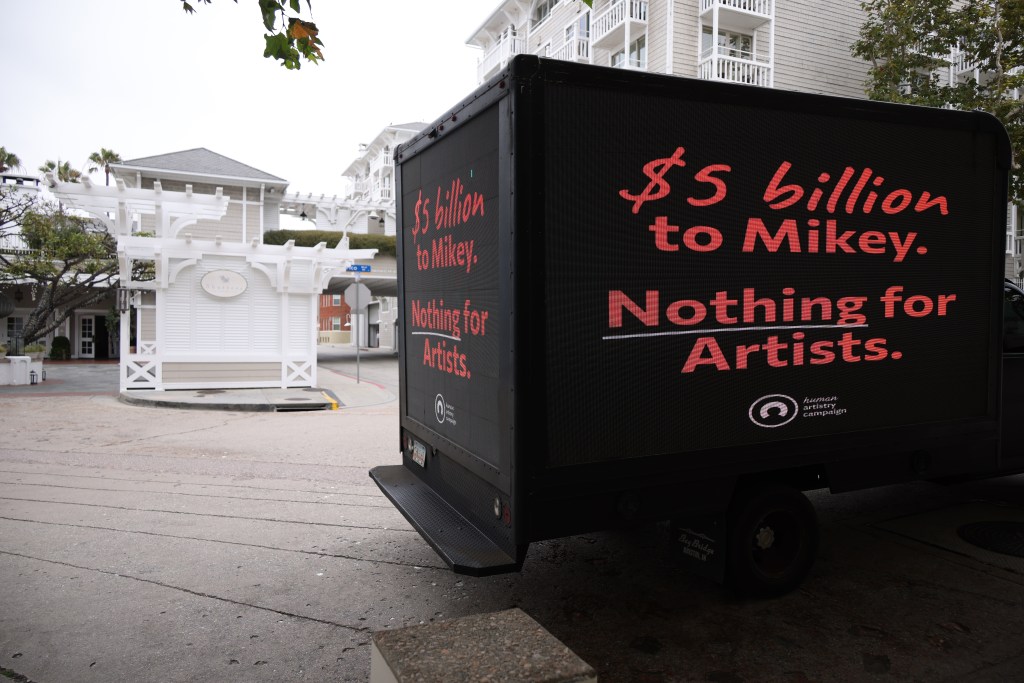
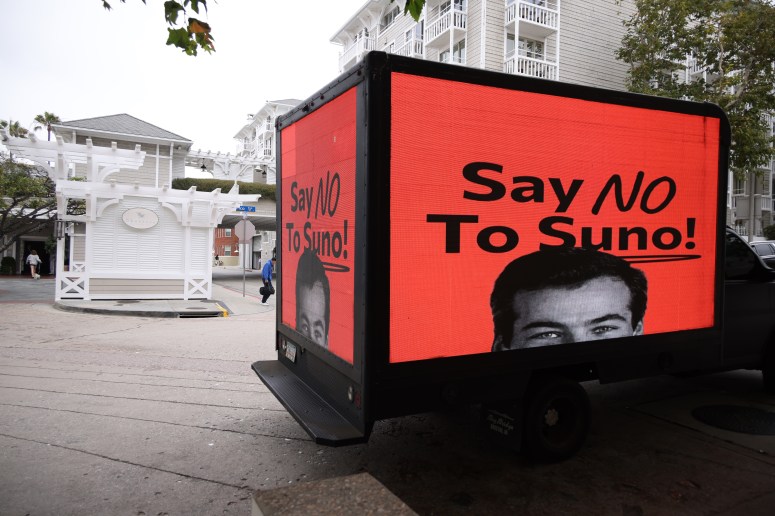
SANTA MONICA, CALIFORNIA – JUNE 03: A mobile billboard sponsored by Human Artistry protesting Suno’s use of AI is pictured on display during Suno’s annual meeting on June 03, 2026 in Santa Monica, California. (Photo by Anna Webber/Getty Images for Human Artistry Campaign)

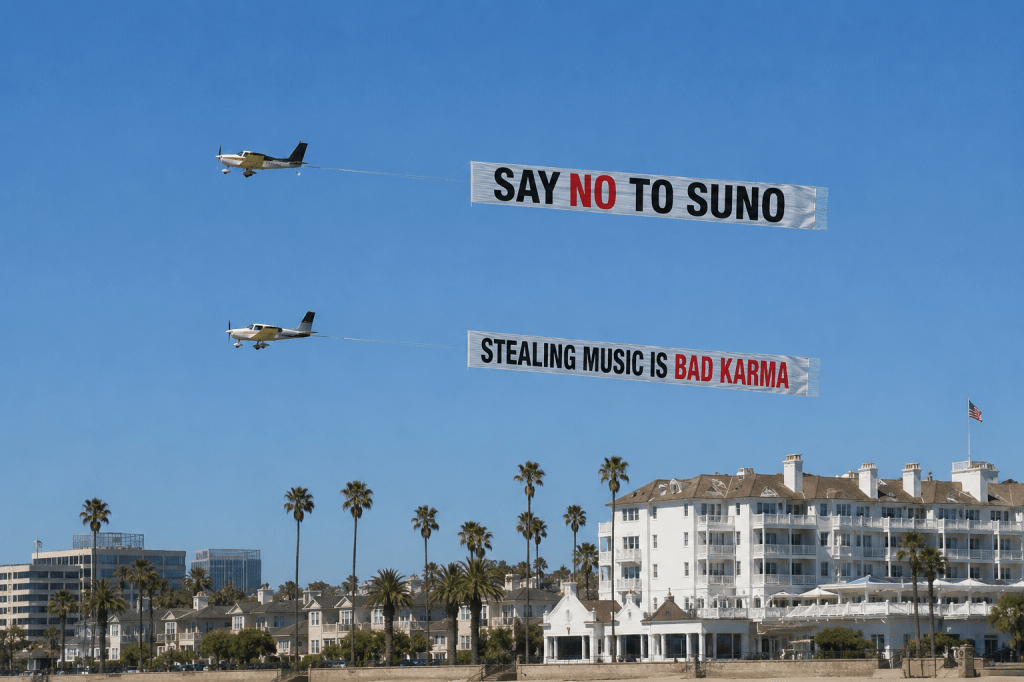
On June 3, 2026, as investors and technology executives gathered at the UBS AI in Entertainment Summit at Shutters on the Beach in Santa Monica, a plane circled overhead carrying a simple message: “SAY NO TO SUNO.” A second banner could just as easily have read, “Stealing Music Is Bad Karma.” The scene was more than a protest against a single AI music company. It was a reminder that technology itself is neither good nor evil; what matters is how humans choose to use it. Throughout history, some of the most transformative technologies have been driven by the same motivations that power every bully: greed and fear. Fear of being left behind. Fear of missing out. Greed for market share, dominance, and wealth and crushing anyone who gets in the way. The generative AI race increasingly appears to be driven—and corroded—by both.


That is why the protest above Santa Monica was about more than music. It connected directly to a broader national backlash against the infrastructure being built to support the AI economy. Across the United States, communities are fighting data centers, transmission lines, water consumption, tax subsidies, and industrial development projects that many believe are being imposed without meaningful public consent. Residents from Texas to Georgia to Louisiana are asking the same basic question: who benefits, and who pays the price?

In the case of generative AI, artists argue that they are among those paying the price.

The Human Artistry Campaign demonstration took place on the same day that Suno announced a funding round exceeding $400 million at a valuation of approximately $5.4 billion. Let it not be said that music has no value and that Suno is not free riding on a thriving market to extract their absurd valuation.

While Silicon Valley investors celebrated another milestone in AI’s rapid expansion, the protest highlighted an uncomfortable reality: much of the value being created by generative AI companies originates from extracting human expression while paying no regard whatsoever to those humans. Whether the source material is music, visual art, photography, authors, voice performances, or other creative works, creators continue to ask how their contributions found their way into commercial AI systems and demand the right to say no to Suno.
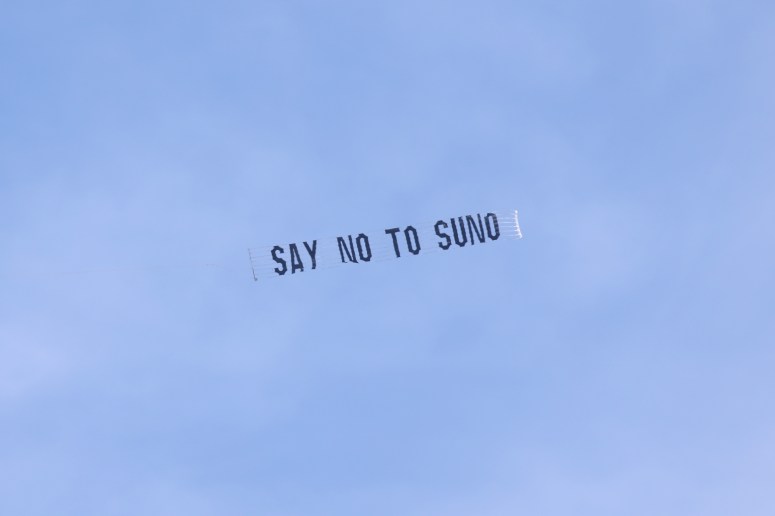
SANTA MONICA, CALIFORNIA – JUNE 03: A plane sponsored by Human Artistry protesting Suno’s use of AI is pictured on display during Suno’s annual meeting on June 03, 2026 in Santa Monica, California. (Photo by Anna Webber/Getty Images for Human Artistry Campaign)

The narrative that the AI labs want you to focus on is often framed as a conflict between innovation and regulation. That framing misses the point. The real question is whether innovation requires the abandonment of consent, compensation, and accountability. Human Artistry’s message was not anti-technology. Rather, it was that technology should serve human beings rather than treating them as raw material for extraction.
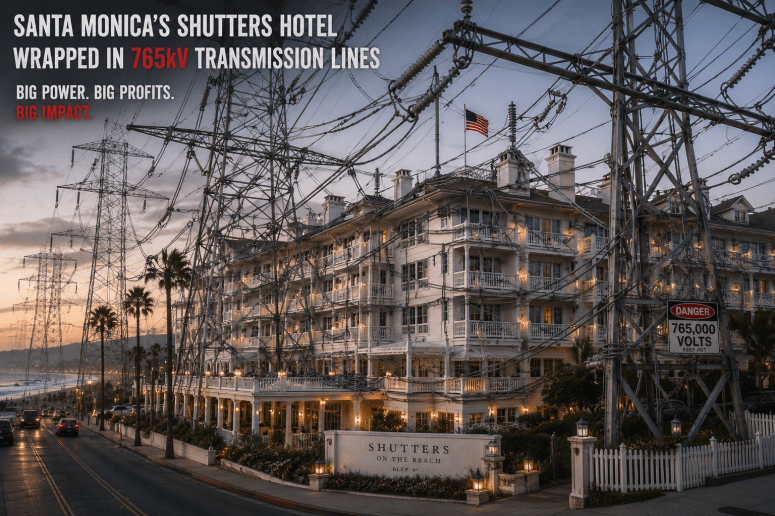
That concern increasingly links artist-rights advocates with communities opposing AI infrastructure projects using eminent domain powers to seize homes and compel residents to acept 765kV transmission lines. Both groups are confronting different manifestations of the same phenomenon: the concentration of economic gains among a relatively small number of companies while costs are dispersed across creators, workers, taxpayers, ratepayers, and local communities. One side sees its creative works absorbed into training datasets. The other sees land, water, energy resources, and public subsidies redirected toward facilities designed to power those systems.

Viewed through that lens, the protest at Shutters on the Beach becomes part of a much larger story. The controversy surrounding generative AI is no longer confined to copyright litigation or entertainment-industry politics. It now reaches questions of energy policy, infrastructure planning, local governance, environmental impact, and economic fairness.

The image of a protest banner flying above an investor summit captures that convergence perfectly. Below, financiers discussed the future of artificial intelligence and celebrated millions of dollars in new investment while licking their IPO chops in drooling anticipation of getting richer still on the backs of humanity. Above, artists and advocates posed a simpler question: if the future is being built on human creativity, shouldn’t the humans who created it have a meaningful voice in how that future is constructed?

That question is impossible to ignore. As billions continue to flow into AI companies and the infrastructure supporting them, the debate is no longer merely about technology. It is about power, consent, and who gets to decide how the benefits of human creativity and expression are captured by the Big Tech kleptocrats.
@DavidSacks Isn’t a Neutral Observer—He’s an Architect of the AI Circular-Investment Maze

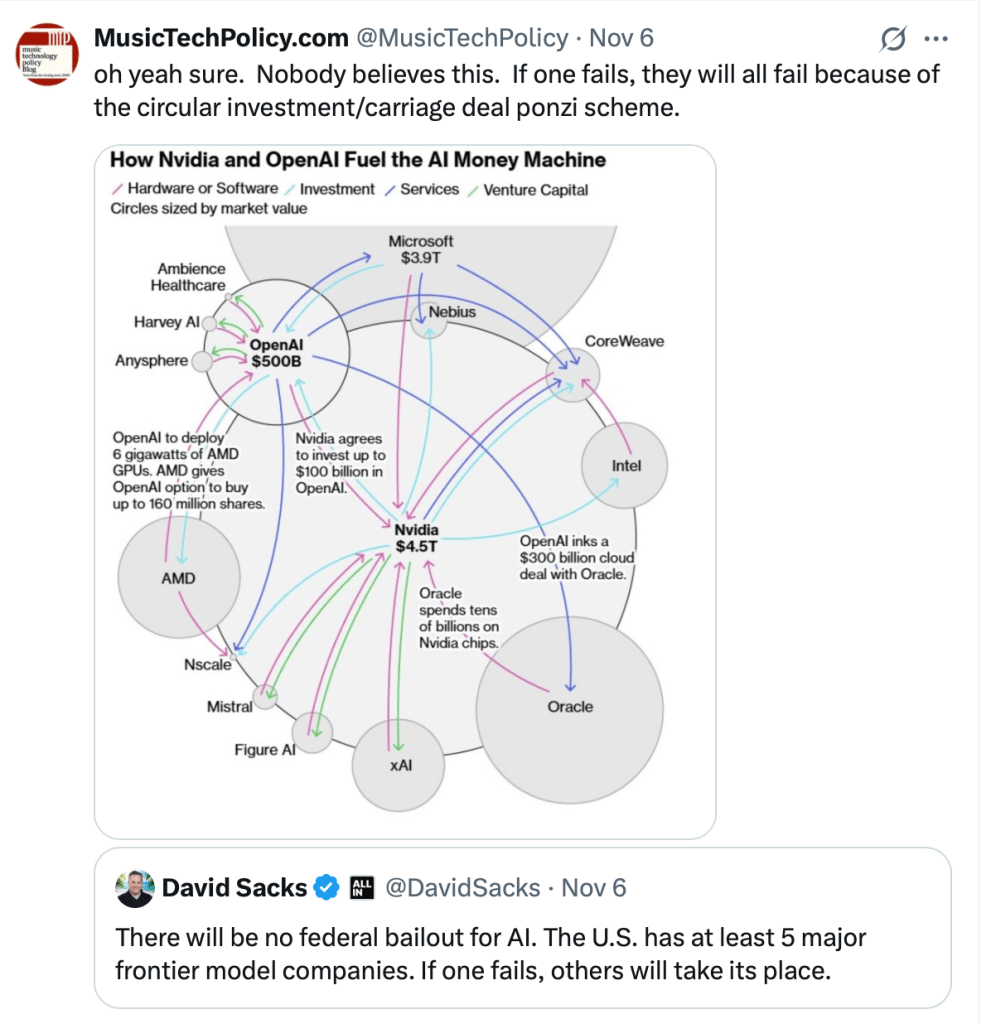
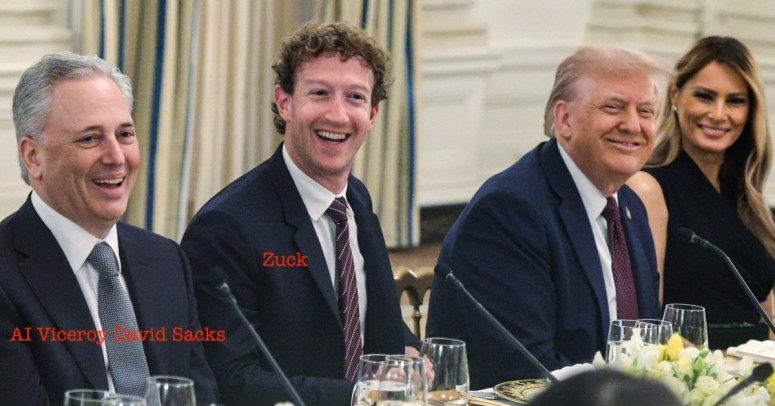
When White House AI Czar David Sacks tweets confidently that “there will be no federal bailout for AI” because “five major frontier model companies” will simply replace each other, he is not speaking as a neutral observer. He is speaking as a venture capitalist with overlapping financial ties to the very AI companies now engaged in the most circular investment structure Silicon Valley has engineered since the dot-com bubble—but on a scale measured not in millions or even billions, but in trillions.

Sacks is a PayPal alumnus turned political-tech kingmaker who has positioned himself at the intersection of public policy and private AI investment. His recent stint as a Special Government Employee to the federal government raised eyebrows precisely because of this dual role. Yet he now frames the AI sector as a robust ecosystem that can absorb firm-level failure without systemic consequence.

The numbers say otherwise. The diagram circulating in the X-thread exposes the real structure: mutually dependent investments tied together through cross-equity stakes, GPU pre-purchases, cloud-compute lock-ins, and stock-option-backed revenue games. So Microsoft invests in OpenAI; OpenAI pays Microsoft for cloud resources; Microsoft books the revenue and inflates its stake OpenAI. Nvidia invests in OpenAI; OpenAI buys tens of billions in Nvidia chips; Nvidia’s valuation inflates; and that valuation becomes the collateral propping up the entire sector. Oracle buys Nvidia chips; OpenAI signs a $300 billion cloud deal with Oracle; Oracle books the upside. Every player’s “growth” relies on every other player’s spending.

This is not competition. It is a closed liquidity loop. And it’s a repeat of the dot-bomb “carriage” deals that contributed to the stock market crash in 2000.

And underlying all of it is the real endgame: a frantic rush to secure taxpayer-funded backstops—through federal energy deals, subsidized data-center access, CHIPS-style grants, or Department of Energy land leases—to pay for the staggering infrastructure costs required to keep this circularity spinning. The singularity may be speculative, but the push for a public subsidy to sustain it is very real.

Call it what it is: an industry searching for a government-sized safety net while insisting it doesn’t need one.

In the meantime, the circular investing game serves another purpose: it manufactures sky-high paper valuations that can be recycled into legal war chests. Those inflated asset values are now being used to bankroll litigation and lobbying campaigns aimed at rewriting copyright, fair use, and publicity law so that AI firms can keep strip-mining culture without paying for it.

The same feedback loop that props up their stock prices is funding the effort to devalue the work of every writer, musician, actor, and visual artist on the planet—and to lock that extraction in as a permanent feature of the digital economy.

#SXSW REWIND : Venture Capitalist Admits Artists Can Not Make A Living Streaming

The grand irony here is that the panel which asked the question “”Will Artists Make Money on Big Music Platforms?” not only reported that artists could not, but also suggested that artists needed to focus on selling concert tickets and merchandise. You know, things artists did BEFORE the internet.

We admire the honesty of Hany Nada, Managing Partner GGV Capital who bluntly and glibly admitted during the SXSW Panel “Will Artists Make Money on Big Music Platforms?” that he believed that they would not be able to do so. He also added that he the point of digital streaming platforms such as Pandora, Spotify, and others was promotion to help the artists tour, sell t-shirts and offer other non-digitally distributable “experiences” to fans (why is this sounding more and more like prostitution?).

At least Mr.Nada is honest, which is refreshing given that the man has more integrity than most of the executives at that streaming services who claim the problem of royalties is one of scale and not sustainability. Mr. Nada (ironically named in this context) may be well intentioned and honest but he is also grossly misguided.

Mr. Nada’s statement and philosophy that streaming sites should be viewed by artists as a promotional platform more so than a financial one are an admission of the failure of these unprofitable start ups to serve musicans. As such, let artists decide if there is a value proposition in these companies that benefits the artist and allow them to opt out. Not every album should be on streaming services. Not every artist should be on streaming services. And if streaming is nothing more than promotion with little value proposition, than artists need to rethink their relationships and strategies regarding those businesses.

To be fair, it’s not just Mr.Nada who has promoted this philosophy. It appears that many of the music streaming company executives on panels at SXSW alternate between two talking points. First is that these services will support musicians when they scale (which we can find no evidence of). And second, when pressed on the first point, that streaming platforms offer promotional value for artists to make money in other ways. Oddly, other than “t-shirts and touring” no one seems to have any idea how to translate an artists participation on streaming services into a sustainable revenue stream.

In almost every way streaming companies represent the worst of both the old boss and the new boss.

So here’s the take away, which was put forth by a series of questions from the floor that largely went unanswered.

1) If artists can’t be expected to make a living from streaming music why should streaming executives make a living from streaming businesses at the artists expense? These are essentially, artists subsidized corporations.

2) As artist’s are bringing the audience to the platform, why should the platform profit, but not the artists? Test this theory, No Music = No Business. Done.

3) Artists have been able to sell t-shirts and tour long before the internet and without streaming platforms, but streaming platforms can’t exists without the artists music. Again, No Music = No Business. Done.

4) Given that the streaming music thought leaders believe that the”new revenue model’s” for musicians are “touring and t-shirts” when are the streaming company executives going on tour to sell t-shirts to support their businesses? We find it odd that the executives running companies that are not profitable are giving business advice to musicians.