The Copyright Policy Reality Gap

We hear a lot from the free culture movement and the CopyTheft advocates about where they think Copyright and IP Protection should be headed, but it’s important to note what the actual values are for Copyright protection on Capital Hill. Perhaps there’s no place better to start than with the White House itself…
“”What’s more, we’re going to aggressively protect our intellectual property.  Our single greatest asset is the innovation and the ingenuity and creativity of the American people.  It is essential to our prosperity and it will only become more so in this century.  But it’s only a competitive advantage if our companies know that someone else can’t just steal that idea and duplicate it with cheaper inputs and labor. ” – President Barack Obama
“…piracy is theft. Clean and simple. It’s smash and grab. It ain’t no different than smashing a window at Tiffany’s and grabbing [merchandise].” – Vice President Joe Biden
Also, let’s be clear (as is noted below) that at this point there is nothing the least bit controversial about acknowledging the degree of the seriousness that online piracy presents to American jobs and the US economy.
“Let us be clear—online piracy is a real problem that harms the American economy, threatens jobs for significant numbers of middle class workers and hurts some of our nation’s most creative and innovative companies and entrepreneurs.  It harms everyone from struggling artists to production crews, and from startup social media companies to large movie studios. While we are strongly committed to the vigorous enforcement of intellectual property rights, existing tools are not strong enough to root out the worst online pirates beyond our borders. ” – whitehouse.gov

Artists and creators live a different lifestyle with many trade offs from conventional employment often working long odd hours for lower than minimum wage and without benefits. For artists and creators this is balanced out in the rights and protections granted in copyright that allow the artist a sustainable living. As a society we have granted these rights to creators as an incentive to produce a meaningful cultural economy. So effective have these protections been that America has the most profitable and most exported popular culture throughout the world.

“Recently, I’ve had a chance to read letters from award winning writers and artists whose livelihoods have been destroyed by music piracy. One letter that stuck out for me was a guy who said the songwriting royalties he had depended on to ‘be a golden parachute to fund his retirement had turned out to be a lead balloon.’ This just isn’t right.” – US Commerce Secretary Gary Locke

Now is the time to have a serious and meaningful conversation about the future of a fair and ethical internet that does not punish the innovative artists and creators who enrich our lives. Technology may change but principles do not. The internet and digital technology have opened up many new opportunities for artists, but it has also opened up new opportunities for those who wish to exploit those artists for personal or corporate gain.

We call upon the administration and both parties to protect the fundamental rights of artists and creators by adopting a fair and ethical set of principles for internet policy.

The Return of Orphan Works: Trojan Horse: Orphan Works and the War on Authors by Brad Holland, Part 5 (Conclusion)

The tenth rule of the ethics of rules and means is that you do what you can with what you have and clothe [“reform”] in moral arguments. …the essence of Lenin’s speeches during this period was “They have the guns and therefore we are for peace and for reformation through the ballot. When we have the guns then it will be through the bullet.” And it was. — Rules for Radicals, pp.36-37

Two events this week told the story that will unfold in the new Congress–Google’s complete gelding of the FTC and the panel of “copyright reformers” at CES moderated by a Google spouse and including several prominent members of the Google Shill List After watching this display of raw corporate power that might even have given pause to the robber barons of the industrial age, Alinsky’s advice rang truer than ever.  Except now the bullets could be made in a 3D printer for assembly according to instructions on the Pirate Bay.  Let’s be clear–the revolution will be anonymized.

The Pinkertons are back, but this time they have PhDs.

We are pleased to be able to serialize an excellent article about the recent history of one campaign in the war on authors–the “orphan works” movement in the U.S. written by the distinguished illustrator, Brad Holland.  This concluding installment leads us to the barricades on an effort to counteract a lobbying effort that will be quite different in 2013.  Google now has a standing army of lobbyists that’s the largest the world has ever seen–not just in the US but also in most countries around the world.  Make no mistake–they are out for your property and they mean to take it.

The article demonstrates what a small group of independent artists are able to accomplish in the face of the lobbying might of Big Tech, especially Google.  They got organized, believed in their cause and never gave up.  We suggest that you pay particular attention to the role played by Google Shill Lister Public Knowledge–they never left and will be back.  Expect them.  During the time the orphan works bills were being worked in Washington, we have heard from artist advocates that they suspected that Google was pulling the strings despite the continual denials.  Now we have the benefit of the disclosures in the Oracle v. Google case (also known as the “Google shill list“) we know that Google has acknowledged contributing to Public Knowledge “for years”.

This is what the Illustrators Partnership was up against–as we have seen demonstrated as recently as last week at the FTC, a well-oiled lobbying machine with an essentially limitless budget dedicated to victory at all costs for a major media company, including destroying the rights of individual artists.  And they are proud of themselves.  This takes the “creepy line” to a whole new level way beyond anything the worst record company would have tried.

We encourage our music and film industry readers to make common cause with the illustrators and photographers who will likely be most harmed by this specious legislation backed by Google the last two times it appeared in the Congress. Because orphan works or something worse will be coming in the new Congress–the money won’t just be from Google this time, it will include Facebook and other members of the Big Tech oligarchy (or what Eric Schmidt calls the “Gang of Four”).  Take for example, the Facebook Structured Stories class action settlement that is about to pay millions to some of these same Google Shill Listers.  To what end?

If you missed Part 1 of this important article, you can read it here.  You can read Part 2 here, part 3 here and part 4 here.  The article first appeared in the Journal of Biocommunication in 2010 and is used by permission of the author.

One reason we are serializing Brad’s article is to help you develop awareness of the situation, so that if we are right and legislation is introduced (whether it is orphan works, “fair use” Google style, or other legislation that undermines creators), you’ll be able to take action quickly.  Given what we know of Google’s cozy relationship with the FTC, we may well be entirely on our own.

Conclusion: Trojan Horse: Orphan Works and the War on Authors, by Brad Holland

The War on Authors

The first – indeed the only – effort to assess the economic impact the Orphan Works bill would have on real-life business affairs came August 8, 2008 when the Office of Advocacy of the US Small Business Administration conducted an Orphan Works Roundtable at the Salmagundi Club in New York City. 77 The participants included artists, writers, photographers, songwriters, musicians, performers, and small business owners. All of us stressed that the Orphan Works Act would harm our businesses in two major ways: first, by acting as a compulsory license on business transactions that properly should be conducted as voluntary agreements; and second, by acting as an unfunded mandate requiring small business owners to bear a cost in time and money that would make compliance virtually impossible, while at the same time forcing us to subsidize the business models of large Internet enterprises. As David Rhodes, President of the School of Visual Arts said:

“[S]ince the expense of registering works [with commercial databases] will be born by the creative community, the expense of copyright protection will be socialized while the profit of creative endeavors will be privatized.”78

The individuals who participated in this Roundtable represented hundreds of years of professional experience in all aspects of the creative arts. Yet to Public Knowledge, we were simply a fringe group motivated by irrational fears. In her May 29 speech, PK’s President had condemned visual artists for the “FUD – fear, uncertainty and doubt,” that she said we were spreading about the bill. Portraying us as feckless demagogues, perversely determined to keep our work from the public, even at the expense of being paid “reasonable” fees for its use, she suggested our real goal was to lurk under the bridge of copyright law like trolls and pounce on hapless infringers to extract the maximum financial penalties from them in infringement lawsuits:

“By preferring to lock down culture, even if it means getting paid, these small copyright holders are no less copyright maximalists than the large corporate copyright holders that Public Knowledge has been battling for the past six years.” 79

The acknowledgement that advocates of the Orphan Works bill had been trying to defeat “small copyright holders” was – at long last – at least a breakthrough in transparency.

The “populist reformers” of the Copy Left (their own name for themselves) have long tried to brand themselves champions of the People bravely battling the copyright Goliaths of Big Business to unlock the treasury of the Commons and usher in a New Age of collective creativity among the masses. Having established this as their premise, it was no doubt inconvenient to be seen waging a public war against an entire class of small rights holders whose work they had hoped to present as a generous gift to the public. Yet the fact that they did begs the key question of the Orphan Works story: Who exactly are the “large corporate copyright holders” Ms. Sohn says they’ve had to fight?

• Not Publishers; they supported the Orphan Works bill;80 in fact some have acknowledged that its passage would justify their demands that authors sign all-rights contracts.81
• Not large stock houses; they supported the bill too; it would allow them to harvest “orphans,” “transform” them into “derivative works” and copyright the “derivatives” as their own commercial product.
• Not Google and Microsoft; they too supported the bill and Google said it planned to use millions of the works the bill would orphan.
• And not corporations such as the Copyright Clearance Center; it lobbied for the House version of the bill and was promoted [by the Graphic Artists Guild] as the commercial “Dark Archive” with which infringers could register their intent to infringe work.82

So if it wasn’t large corporate interests that opposed the bill, who is it that the “reformers” were actually battling? The evidence of the Orphan Works fight has made that clear: authors.

A Seismic Shift

The War on Authors isn’t new. Dickens, Victor Hugo and others were vilified for promoting copyright law more than a hundred years ago. What’s new is a technology that tips the scales against authors. As attorney Bruce Lehman, former Commissioner of the US Patent Office told the Association of Medical Illustrators at the Mayo Clinic in 2000:

“[W]e are on the verge of a seismic shift – comparable to radio in the 1920’s – that is the Internet. The Internet has the capacity to seize images and send them around the world in digital form so they can be produced with original quality. Now, that is a scary thing if you can’t control your rights. But if you can, it may be an opportunity.”83

Visual artists opposed the Orphan Works Act because it would impose a radically new business model on the licensing of our property. It would let giant image banks access our commercial inventory and metadata and enter our commercial markets as clearinghouses to compete with us for our own clients. I can think of no other field where small business owners can be pressured by the government to supply potential competitors with their content, business data and client contact information – all at their own expense.

Google and other large database, advertising and search engine companies clearly have a major financial stake in the weakening of copyright law through new legislation. The Orphan Works Act, if it should ever be enacted, would solve the problem that has vexed so many start-up Internet companies: how to make money by giving away free content. By opening the door to potentially billions of “permitted” infringements of protected copyrights, this legislation would allow big Internet companies to create entirely new business models by licensing content they don’t have to pay for — through the digitizing, archiving and monetizing of the intellectual property of ordinary citizens. If this legislation were to pass, its consequences would be far-reaching, long lasting, perhaps irreversible, and would strike at the heart of art itself.

Legislation By Misdirection

Reviewing the evidence, it seems compelling to conclude that the orphan works legislation presented to Congress was not what it was purported to be, but was intended rather to deliver commercial opportunities to large Internet interests while furthering the ideological agenda of legal scholars committed to expanding the public domain by stripping creators, small businesses and ordinary citizens of their intellectual property rights.

This raises fundamental questions not only about this legislation, but also about the process that spawned it and saw it nearly passed by misdirection and backroom deals. In light of the world’s ongoing financial crisis, is it wise for Congress to concentrate our nation’s copyright wealth in the hands of a few corporate databases? The contents of these databases would be more valuable than secure banking information; so why should small business owners and ordinary citizens be compelled to subsidize their start-ups? Why should we place our own assets at risk in the event of corporate failure, mismanagement or corruption? Under copyright law, no author can be compelled to publish his or her work; so by what right of eminent domain can Congress give strangers the right to publish our work without our knowledge, consent or payment? By what mandate do legal scholars, lobbyists, and civil servants presume the right to require small business owners to change their business models? Last but not least: why should Congress pass legislation that has been presented to it as something other than what it is?

“The Plural of Anecdote is Not Data”

From the beginning of the Orphan Works crusade, lawyers, lobbyists and big Internet firms have all sought to justify the rights grab that would follow by asserting that creative work has little or no meaningful value to its owners. Yet what’s striking about these assertions is that they’ve never been backed up by evidence.

The legal case for Orphan Works “reform” has been based solely on anecdotal assertions by lawyers, CEOs and legal scholars, the very people whose disciplines ordinarily require them to substantiate claims with evidence. Yet rather than document their own assertions, they’ve tried instead to burden rightsholders with the task of proving that our work isn’t worthless.

In 2006, for example, Rebecca Tushnet, a lawyer and professor of law at Georgetown University Law Center, denigrated our testimony that the work in an artist’s inventory has residual value. She called such claims “anecdotal,” and commented “the plural of anecdote is not data.” 84 Indeed it’s not, as we’ve pointed out about the self-serving statements of orphan works advocates.

But in fact artists do have data to document the value of our work: tax returns, contracts, invoices to clients. All these prove that our work is an ongoing source of income for us. Under current copyright law, we’re not required to document the day-to-day value of each and every picture in our inventory – nor should we ever have to. This is just common sense. As we all know, the value of any particular work of art is never static. Like gold, John Lennon’s guitars or Teddy Bears once owned by Elvis, the value of any property, especially non-essential property, fluctuates. One day a drawing may be worth nothing because there’s no client who wants to use it. The next it may be worth thousands of dollars to a client who does.

Contrary to the claim that “[t]he vast majority of copyrighted works have little or no economic value soon after their creation or publication,” some works may in fact have little or no value until years after their creation. Just ask the estate of Vincent Van Gogh.

Against a Culture of Appropriation

On March 24, 2005 Cynthia Turner and I authored a four-page paper to the Copyright Office’s Orphan Works study. In it, we argued that artists’ work once published retains residual value and may even increase in value with the rise of an artists’ reputation. We explained why “free speech is not restricted by protecting orphaned works,” why “archival preservation is not hampered by copyright protections,” and why stripping “orphaned” works of protection would both threaten an author’s integrity and favor the business interests of corporate giants over that of individual creators.

Our paper, submitted on behalf of the Illustrators’ Partnership, was endorsed by 42 national and international arts organizations and signed by nearly 2,000 individual working artists from across the spectrum of the graphic arts. Yet despite this testament from working artists, speaking with one voice about their own business experience and the value of their work, our statement was never once referenced in the 127 pages of the Orphan Works study. Instead the authors of the study, citing their 215 letters, asserted that our business models had to be changed because there was no way for users to find us.

Our letter can still be read on the Copyright Office website 85 In our summation, we cited our reasons for opposing this particular vision of copyright “reform.”

“The ‘Free Culture’ argument is at odds with the principle of tangible expression, which is the only aspect of the creative process protected by copyright law. By arguing that creative work is only a ‘remix’ of the work of others, the critics of copyright ignore the factors of experience, personal development and individual vision that are embodied in any author’s tangible expression of an idea. The computer and internet, as well as Photoshop, stock and royalty-free content have all made it possible for many people to become content providers by ‘sampling’ the work of others. But the demands of this ‘new modality’ for free and easy access to usable work should not induce lawmakers to legislate as if creativity can be adequately defined by the ‘remix’ model. There is a difference between the alchemy of new creation and the assembling of ‘found work.’ Legal protections for this difference have been built up over centuries and once eroded, would be painful and costly to recover.

“The Internet has created a culture of appropriation; and immediate global access to artistic works has facilitated piracy, unintentional infringement and plagiary. But instant and unrestricted access to work should not be construed as a necessity just because technology has made it a possibility. That an artist’s work now can be instantly transmitted around the world without the artist’s permission or control does not justify a user’s ‘right’ to take the work. And if inability to trace a work to its author becomes the justification for creating such a ‘right,’ who and what will define the inability to trace the work?

“The ‘orphaned’ works currently under consideration by the Copyright Office include the work of many artists now in the prime of their careers. To remove copyright protection from this work has the potential to undermine the important public policy behind copyright: To promote the creation and dissemination of culture by rewarding incentive. Rescinding guaranteed protection from copyrighted works will do more harm than good to the creative community and by extension, to the public good.”86

Afterward

Following the failure of the first Orphan Works bill to pass in 2006, but at a time when experts still predicted its swift passage in the 110th Congress, two of the bill’s key authors left public service to enter the employ of corporations that had supported the bill or which hoped to profit from its passage.

In January 2007, Jule L. Sigall, principal author of the Copyright Office’s Report on Orphan Works – who later stated that artists, like cats, needed to have their food moved – left the Copyright Office to become Associate General Counsel for Copyright in the Legal & Corporate Affairs department of Microsoft.87Nine months earlier, on April 6, 2006 Thomas C. Rubin, Associate General Counsel for Microsoft had testified on his company’s behalf in favor of the Orphan Works Act.88Mr. Sigall had been at the Copyright Office for three years,89and like Professor Peter Jaszi, taught law (in his case as an Adjunct Professor) at the George Washington University Law School.90

Also in 2006, another key player in the Orphan Works story left government service. Since 2005, attorney Joe Keeley had served as Intellectual Property Counsel to the House Subcommittee that wrote the bill. In his own words, he “was the lead staffer on the orphan works issue responsible for drafting the language and arranging the hearings.”91At the end of 2006, he left that position and after a year in the Office of General Counsel of the US Copyright Office, he joined the law firm of Arent Fox, where he became a registered lobbyist for the Copyright Clearance Center.92The Copyright Clearance Center (CCC) is the organization which in 2008 the Graphic Artists Guild recommended as a trusted entity to serve as the Dark Archive at which infringers could register their intent to infringe copyrighted work. CCC is a Salem, Massachusetts-based corporation that issues licenses for the reprographic republication of books and articles in print. In 2009, CCC’s revenues exceeded $200 million.93 CCC is unique among the world’s Reprographic Rights Organizations in that it has consistently failed or refused to recognize visual artists as authors who deserve to be paid for the republication of their contributions to the collective works CCC licenses.

  1. Small Business Administration Orphan Works Roundtable Webcast Stream, August 13, 2008, Illustrators’ Partnership Orphan Works Blog
    http://ipaorphanworks.blogspot.com/2008/08/sba-roundtable-webcast-stream.html
  2. David Rhodes, Quoted at “Orphan Works: Risking our Nation’s Copyright Wealth,” by Brad Holland and Cynthia Turner, September 23, 2008, Illustrators’ Partnership Orphan Works Blog
    http://ipaorphanworks.blogspot.com/2008/09/meltdown-on-wall-street-warning-for.html
  3. Gigi B. Sohn: “The Orphan Works Act of 2008: Copyright Reform Takes Its First Steps,” Presented to the Center for Intellectual Property 8th Annual Intellectual Property Symposium, University of Maryland University College, May 29, 2008 http://www.publicknowledge.org/node/1594
  4. The Illustrators’ Partnership Orphan Works Blog, March 29, 2006: “Allan R. Adler, a lawyer and lobbyist for the Association of American Publishers, said the copyright office’s recommendation regarding compensation to copyright owners is precisely what his group wanted.” Quoted from the Chronicle of Higher Education, February 2, 2006 http://ipaorphanworks.blogspot.com/2006_03_01_archive.html
  5. Paul Sleven, Holtzbrinck Publishers, U.S. Copyright Office Transcript of Orphan Works Roundtable, July 27, 2005 at page 88: “I think whatever else the harm that may come to artists from inequitable bargaining power with large publishers, if the artist has signed the rights away to a Conde Nast or a Time-Warner…it is much, much less likely to be an orphaned work…because everyone knows where to find Conde Nast and Time.” http://www.copyright.gov/orphan/transcript/0727LOC.PDF
  6. Unpublished letter from Graphic Artist Guild lobbyist Megan E. Gray to Shanna Winters, Chief Counsel, Office of Representative Howard Berman, Chairman, Subcommittee on Courts, the Internet, and Intellectual Property; Committee on the Judiciary; United States House of Representatives May 21, 2008: In the letter, Ms. Gray proposes (page 3) that the Copyright Clearance Center would be an appropriate repository for “Notice of Use” filings by infringers, noting that such filings need not be burdensome on infringers, requiring them to submit merely their names and addresses and allowing them to attach multiple visual works of art to a single notice of intent to infringe.
  7. Bruce Lehman, Esq. “Protecting Your Rights Collectively,” July 2000, Excerpted from a speech given to the Association of Medical Illustrators, Mayo Clinic, Rochester, Minnesota http://illustratorspartnership.org/01_topics/article.php?searchterm=00027
  8. Rebecca Tushnet’s 43(B)log, March 7, 2006 “Orphan Works, Panel 2, part 1: Brad Holland, Illustrators’ Partnership”  http://tushnet.blogspot.com/2006/03/orphan-works-panel-2-part-1.html
  9. Brad Holland and Cynthia Turner, Comments on Orphan Works Notice of Inquiry http://www.copyright.gov/orphan/comments/OW0660-Holland-Turner.pdf   (Note: 126 pages)
  10. The Holland-Turner paper was cited as a source in one of the most authoritative scholarly articles published on this subject. On August 30, 2008, just days before Congress reconvened for its final legislative session, prominent legal scholar Jane Ginsburg of the Columbia Law School published Recent Developments in US Copyright Law: Part I – “Orphan” Works.In her paper, Professor Ginsburg raised many critical questions about the merits of the Orphan Works Act. Among these, she noted that certain provisions might violate Article 9.2 of the Berne Convention, which prohibits prejudicial exceptions to an author’s exclusive right of copyright. She also stated that the preclusion of injunctive relief with respect to derivative works would appear to force authors to tolerate “even derivative uses they find offensive or that distort their works.” She added that this “has economic consequences as well,” depriving the author of the right “to grant exclusive derivative work rights to a third party. The bill thus potentially devalues the derivative work right.” (Page 10)On page 5, Professor Ginsburg noted: “The ‘progress of knowledge’ to which US copyright aspires is achieved not only by putting works into circulation, but also by fostering conditions conducive to creativity.” http://lsr.nellco.org/cgi/viewcontent.cgi?article=1044&context=columbia_pllt
  11. “Jule Sigall Joins Microsoft,” Tech Law Journal Daily E-Mail Alert, December 27, 2006
    http://www.techlawjournal.com/alert/2006/12/27.asp
  12. “Orphan Works: Proposals for a Legislative Solution,” United States Senate Committee on the Judiciary, Official Hearing April 6, 2006
    http://www.archive.org/details/senate_hearing_on_orphan_works
  13. “Register of Copyrights Announces Appointment of Associate Register for Policy and International Affairs,” News from the Library of Congress, January 29, 2003
    http://www.loc.gov/today/pr/2003/03-017.html
  14. http://www.law.berkeley.edu/institutes/bclt/statuteofanne/imgs/Jule-Sigall.pdf
  15. Orphan Works.net “Following the Progress of Orphan Works Legislation” This is a website started by Mr. Keeley following his departure from government service. http://www.orphanworks.net/
  16. “Joe Keeley. Federal Lobbying activities for 2008,” impluCorporation
    http://www.implu.com/lobbyist/49749/2008
  17. International Federation of Reproduction Rights Organizations, Information page for Copyright Clearance Center, Inc http://www.ifrro.org/show.aspx?pageid=members/rrodetails&memberid=8


Author

Brad Holland is a self taught artist and writer whose work has appeared in Time, Vanity Fair, The New Yorker, Playboy, Rolling Stone, the New York Times and many other national and international publications. His paintings have been exhibited in museums around the world, including one-man exhibitions at the Musée des Beaux-Arts, Clermont-Ferrand, France; the Museum of American Illustration, New York City and the Torino Atrium, Turin, Italy. His satire of the art business, “Express Yourself, It’s Later Than You Think,” first published in The Atlantic Monthly, has been widely republished, both in print and on the Internet. In 2005 he was elected to the Society of Illustrators Hall of Fame.

“During a career that has stretched over three decades,” wrote Steven Heller in Print Magazine, October 2002, “Brad Holland has changed the way illustration is perceived and practiced. By the late ’60s he had helped transform a profession of renderers into one of conceivers, challenging editors and art directors to let him create images that complemented rather than mimicked texts.” In 2000, the editors of the artists’ directory RSVP voted Holland “the one artist, who in our opinion, has had the single greatest impact on the illustration field during the last twenty five years.” Holland has won more awards presented by the New York Society of Illustrators than any other artist in its long history. The American illustrator Mark English has called him “the most important illustrator in America today.”

In the last decade, Holland has become an outspoken advocate for artists’ rights and is a founder of the Illustrators’ Partnership of America. In 2005, he represented artists at the Orphan Works Roundtables held by the US Copyright Office; in 2006, he testified before the Intellectual Property Subcommittees of both the US House and Senate, and in 2008 he and medical illustrator Cynthia Turner led the opposition to the Orphan Works Act of 2008. It was through their lobbying efforts that the US Small Business Administration acted to conduct its own Orphan Works Roundtable at the Salmagundi Club in New York City, August 8, 2008.

Holland is featured in the documentary, “Citizen 3.0 Copyright, Creativity and Contemporary Culture,” available at www.kinobserver.com and his article, “First Things About Secondary Rights,” published by The Columbia Journal of Law and the Arts is available at weblog.ipcentral.info/holland_ColumbiaLaw.pdf

Holland’s blog, Poor Bradford’s Almanac, can be accessed at http://www.drawger.com/holland/?article_id=9022

© 2010 Brad Holland

Free Culture’s Epic Fail – If Free is Working, Why Fight Copyright?

One of the argument’s that is often trotted out by free culture advocates and the copytheft hive mind is to make hay of any artist or creator who gives away their work willingly as an example of how free models can work to benefit creators. Well, the truth is that creators have been employing “Freemium” models long before the birth of the internet. Previously, musicians would for example employ street teams to canvas consumers exiting the concert of a similar type artist and give them free music.

However, it was also the creators choice to determine what would be given away for free, how much of it and for how long. In other words, the creator embracing the power of free, also retained the power of choice. Unfortunately the simple concept of choice and consent has been lost and the faucet free can no longer be turned off.

The power of free, works best with the creators power of choice.

After all, anyone can surrender their Copyright, opt out, or even use Creative Commons. Which also begs the question, if Creative Commons is the solution, shouldn’t there be enough content available after 10 years to show how much better Creative Commons is for artists and creators than traditional copyright protections?

If there are really so many people, creating so much great content, and willing to give it away for free wouldn’t this alone render Copyright a useless and antiquated concept? Why argue so aggressively to take what is not given, when there is so much being given away freely?

It makes no sense to oppose the protections granted in Copyright or to deny these rights to those who wish have them, when there is so much content being made available for free. Why so little faith in free markets? Why not honor the artists and creators who chose not to give their work away by removing their work from the businesses of the exploitation economy? Why not let an honest marketplace chose between the products made available willingly for free, and see how they perform against those who wish to charge?

If we are talking about free markets, wouldn’t there be a great benefit to the artists and creators who embrace “permissionless innovation”? If there are so many benefits to artists and creators in “permissionless innovation” it would attract more than enough creators eager to reap the rewards. We think the answer is pretty obvious as to why so many in the free culture movement insist on wanting to take rights away from artists and creators. Simply put, “permissionless innovation” is nothing more than theft for profit, without consent or compensation.

It appears many of these so called new business models are so deeply flawed as to be incapable of functioning with only willing participants. In other words, they can only function with unwilling participants, who have not granted consent and who are not being compensated.

The epic fail of the free culture and copytheft movement is to have so little faith in their own philosophy so as to not believe that creators and artists would actually, willingly surrender enough content of high enough quality to allow their models to function.

CES Fart Club aka The Slaptastic “Pro-Artist Copyright Policy Panel” features Anti-Copyright Advocates and Google Named Shills #2013CES

Not even kidding, just match the Anti-Copyright Google shills to the panelist list below. Talk about letting the fox guard the hen house. Wow, these are the same people who whine when not invited to trade organization and policy meetings like the TPP, but are so opposed to a balanced conversation they couldn’t actually invite a single artist rights representative! Ok, wow.

This is looking like a Silicon Valley Smug Alert, or otherwise known as Fart Club.

Beyond SOPA: Creating a Pro-innovation, Pro-artist Copyright Policy

Copyright policy – once an esoteric and legal backwater – now has a critical impact on our ability to work, play and communicate. In 2012, millions of Americans contacted their member of Congress to protest restrictive copyright proposals, while intellectual property issues took center stage in Washington and at the Presidential debates.

Join a group of entrepreneurs and DC policymakers as we discuss how to protect IP while maintaining a vibrant internet and creating new opportunities for content creators.

Moderated by:
Declan McCullagh, CNet Reporter

Featuring panelists:

Also on Tuesday January 8th, our own Hank Shocklee will be the DJ at The Innovation Movement party at Surrender at Encore from 7-10 pm.

Hit us up if you’re in town for the show – we’re still taking business meeting requests if you’d like to meet up.
See you in Vegas!

Google names names in amended ‘shills’ list – Employees, consultants, trade groups outed | The Register UK

In addition to the CCIA, Google named the Electronic Frontier Foundation, Public Knowledge, the Center for Democracy and Technology, and the Competitive Enterprise Institute as organizations who have received funds from Google…

Oh, and yeah… Mike Masnick is listed as a Google shill as well in the article at the link above too…

Reading Between The Lines Google Tells The Truth On Ad Supported Piracy, Now Let Markets Do Their Work.

An Elegant Non-Denial And It’s Implications.

We previously noted that USC’s Annenberg Innovation Lab released a report detailing their initial observations regarding the top online advertising networks that appear to facilitate the payment of advertising revenue to sites that exploit artists without compensation, i.e., pirate sites.

In the 1950s, record labels (often controlled by shady figures of legend and myth) exploited songwriters and artists without compensation.  When artists complained, the label might give the artist a Cadillac in lieu of their royalties. When we hear these stories about how some of the music moguls from those days exploited artists we are rightly outraged.

Today, sites like The Pirate Bay, Hotfile and Isohunt exploit artists in a similar way except the artists don’t even get the occasional  Cadillac.  And not many people seem outraged.  In fact journalists (like this Spin Magazine writer ) seem to want to romanticize the operators of these sites as folk heroes. Instead of portraying them as they truly are: sleazy opportunists and scam artists waving the banner of “freedom” while they rob artists blind.   The really sad part is “respectable” Fortune 500 companies seem to be complicit in this racket.   By advertising on these sites, these otherwise respectable companies fund these illegal operations that exploit artists.

But there is good news.  At least one company, Google has accidentally admitted to being complicit in this racket.  Well maybe that’s not quite right.   Perhaps a better way of phrasing it is they simply didn’t categorically deny their involvement and invited us to read between the lines.   Still I’m taking this as an admission the industry has a problem.  And admitting you have a problem is the first step to recovery. Even if it’s only a read-between-the-lines kind of admission.

The reason I say this is because Google issued a curious and very carefully worded response to the USC report. I am quoting from the LA Times reporting on the study.

“To the extent [the study] suggests that Google ads are a major source of funds for major pirate sites, we believe it is mistaken,” a Google spokesperson said. “Over the past several years, we’ve taken a leadership role in this fight. The complexity of online advertising has led some to conclude, incorrectly, that the mere presence of any Google code on a site means financial support from Google.”

I don’t know-perhaps I’m crazy but I think they did this purposely. There is almost a deconstructed  free jazz beauty to this statement.  It’s like they hired the Ornette Coleman of press releases. The melody is there, but it’s in the omissions, the implied notes,  the silences and the negative spaces.  And using a little mathematical logic you can reconstruct that melody.  You can clearly deduce the statements that they specifically intended to not deny.  Probably just so they couldn’t be accused of lying later.  You follow my logic?

The four read-between-the-lines admissions are as follows.

1. Google is a source of some funding for some pirate sites.

“To the extent the study suggests that Google ads are a major source of funds for major pirate sites, we believe they are mistaken.”

Google  is not denying that it is a source of funds for pirate sites.  They are simply proclaiming (without evidence) that they are something less than a major source of funding.  So they are a moderate source of funding?  A minor source of funding? Just shy of being a major source of funding?  Left unexplained is how Google can measure major versus minor funding and how Google has knowledge of the revenues generated by these illegal and mostly offshore sites.

2. Google funds pirate sites, just not the top 8 sites.

“To the extent the study suggests that Google ads are a major source of funds for major pirate sites, we believe they are mistaken.”

Read this sentence again.  They are denying funding the “major” sites. But they are not denying they may be funding sites that they don’t (arbitrarily) consider major.  Now in this case we were able to do a little reverse engineering to figure out the cut-off between major and non-major websites.  As noted before on the Trichordist we have caught Google providing ads (and we can only assume revenue)  to http://www.filestube.com.  They admitted that filestube had an account and have since disabled it (thank you).  According to web traffic analysis site http://www.Alexa.com there are only 8 file-sharing/cyberlocker type sites that rank higher than filestube!  Google’s own transparency report names http://www.filestube.com as the #1 recipient of valid notices of copyright infringement.

Since Google is basically an engineering operation, you should consider  it significant that it has implicitly  created 4 quadrants for their involvement:

A.  Major Funding For Major Sites

B. Less Than Major Funding For Major Sites

C. Major Funding For Less Than Major Sites

D. Less Than Major Funding For Less Than Major Sites.

They are specifically not denying that they may be operating in quadrants B, C and D. They are only denying that they are in quadrant A.

3. Google lacks sufficient corporate oversight to really know if they are providing funds to illegal sites or not.  

“…we believe it to be mistaken.”

Note the use of the word “believe.”   They are hedging their bets.  They don’t really know.  Google claims its mission is to “organize the world’s information” (whether the world likes it or not).  How can a company that can organize the world’s information lack sufficient knowledge of their own data to know where they are sending revenue? Don’t they issue 1099s in accordance with tax laws?  We can only assume that they are specifically not denying a lack of corporate oversight.   Because the other possibilities are terrifying.

What are the other  possibilities?

A.  The online advertising network has grown so complex it is actually a sentient being.  And like Skynet in Terminator movies, Google has lost control of it and it is now trying to kill us all.  (I’d assign this a low probability, Google’s fascination with The Singularity notwithstanding.)

B. They do know where they are sending revenue.  And if this is the case, Google shareholders may be in for another $500 million dollar fine, like the one they got in the illegal online pharmacy settlement.

For the sake of Google stockholders, lets just hope they are merely disorganized.

4. Google is not denying that their source code on pirate sites means that they have a financial relationship with these sites.

“The complexity of online advertising has led some to conclude, incorrectly, that the mere presence of any Google code on a site means financial support from Google.”

Read this very carefully.  This is very, very clever. Or to keep using the Ornette Coleman analogy this is like the Science Fiction of  this press release.  It’s explosive, wild and takes a while to understand.  No one is really clear why there is a recording of a baby crying in the middle of the saxophone solo.   I’m sure it will confuse a lot of overworked underpaid journalists.

Note the words “some” and “any Google code”.  By using the word “some” Google has set up a hypothetical “straw man” to knock down.  For this statement to be true all they need is ONE example in which a pirate site  contained any Google code (Google Plus, Google Analytics) and someone  mistakenly thought Google was serving ads on the site.  It’s a beautiful hypothetical and that seems to “explain” everything.   When it really doesn’t.  That’s a wild bit of science fiction.  Or as one of my colleagues puts it  “a totally unrelated story that cross-dresses as a reasonable explanation.”

So once again Google cleverly DOES NOT deny that when we see Google or DoubleClick ad code or publisher IDs on rogue websites this confirms a financial relationship with Google.

But perhaps most telling of all is Google’s description of the ad networks as “complex.” And I heartily agree.   In the financial world there is an old adage “complexity is fraud.”   That is honest markets and financial products tend towards simplicity. But in the online advertising world you have ever increasing complexity. This usually indicates there is some fraudulent aspect to the market.  I believe that much of this “complexity” is there to simply insulate the big firms from illegal and unethical practices up and down the chain.  Because complexity has a useful byproduct: deniability.

To be fair, it should be noted that the online advertising ecosystem was not created by Google alone.  Other networks and the Madison Avenue agencies had a hand in creating this system.  I find it very interesting that not one of the Madison Avenue agencies has anything to say about this report.  Why the silence?

+++++++++++++++++++++++++++++++++++++++++

Transparency + Markets.

So my conclusion from all of this is probably not what you expect.   I think Google and the other ad networks are unreachable on this matter and we artists  shouldn’t waste time engaging them in a public relations battle.  They would love to confuse us with sideshows about ad exchanges, open protocols, “self-serve accounts”  and the complexity of the system.  None of that really matters.  What matters is that companies like State Farm and Amex show up on these sites.  We artists need to focus on the brands that are advertising on the these sites and nothing else.

The other thing to consider.  It is becoming ever more apparent that Google gets a form of “celebrity” justice when it comes to their wrongdoing.  A minuscule $25,000 dollar fine in the Google WiFi snooping case? How did that happen?   Or Friday’s mysterious  FTC announcement that the Obama Administration won’t be pursuing an anti-trust investigation of Google.  Google has too much clout in the political system.  While it’s reported that Google’s PAC may have divided its contributions between Republicans and Democrats, its employees and executives overwhelmingly supported Democrats and Obama.  The technology sector is one of the few industries that Democrats can rely upon to counter the Republicans’ advantage in corporate political donations.  This gives me little hope that Washington will ever punish Google or any other tech company involved in the online advertising cesspool.

Now I’m not in favor of this sort of cronyism, I’d love to see Congress investigate these ad networks, especially Google.   But ultimately I think it doesn’t matter.  What matters more is that we shine a light onto these practices. This is the best way to attack the problem.

The silver lining is that companies like Google are  helping us.   Their protestations are inadvertently providing transparency into how the online advertising ecosystem truly functions:   It’s out of control, un-reliable, and does not work as advertised.  It may actually do harm to some brands.  To paraphrase Chris Castle at Music Tech Policy: Online ad networks are Silicon Valley’s exploding Pinto. The mother of all product liability cases.  I believe that as this information becomes widely known  market forces will correct much of the problem, for there are clear financial incentives.

This will happen in two distinct but interrelated ways.  Downward pressure on share prices and lower revenues.

The money starts with the Fortune 500 brands.  We don’t need to know every single place where it ends up. We can see it in the screen captures.  We don’t need to follow the money to every Vladmir and Constantin running a pirate site.  We just need to cut off  funds at the source. And transparency is the most effective AND easiest way to do this.

As Fortune 500 firms become aware of how these ad networks really work, brands will abandon the “bad” networks reducing their revenue, or force the “bad” networks to change their practices. Either way funding for these sites should drop.

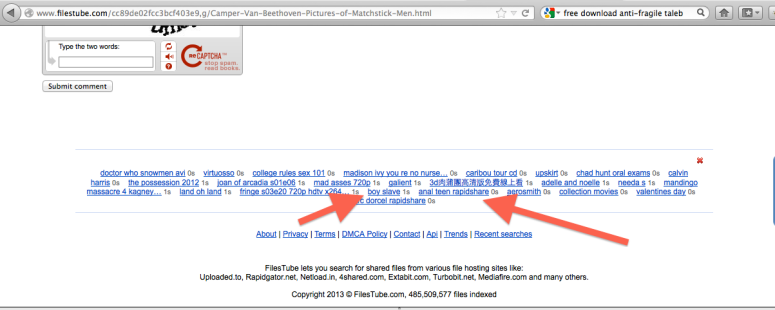
Part of the reason I’m so optimistic is that I’ve discovered that it’s really pretty easy to get a bad network in trouble with its clients. Let me demonstrate.   Virtually every illegal file-sharing and/or “cyber locker site”  will auto-suggest “recently downloaded” or “popular files”.  Every once in a while they suggest files that appear to be illegal pornography.  The site http://www.stopfilelockers.com  explains this  in detail.  But as an example even this innocuous search for “camper van beethoven pictures of matchstick men” on a site like http://www.filestube.com immediately autosuggested some very sketchy links at the bottom of the screen.

Screen Shot 2013-01-03 at 4.49.45 PM

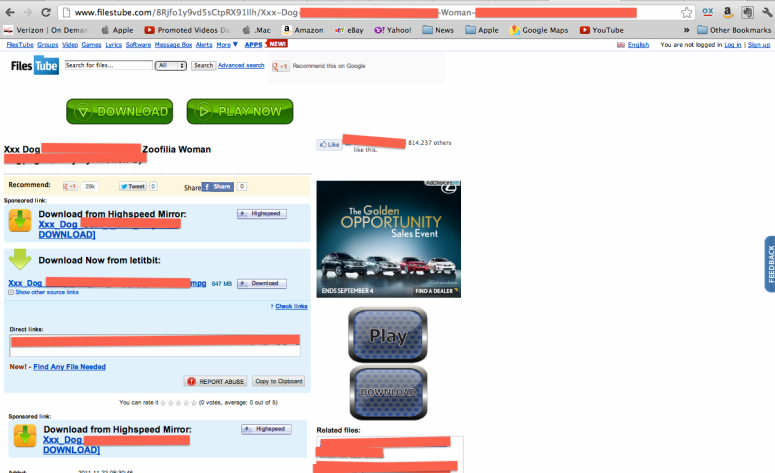
And because these sites are completely unregulated eventually something really embarrassing happens to a major brand.  Like this real screenshot I captured earlier this fall:

“Bestiality brought to you by Lexus.”  For their “The Golden (Retriever) Opportunity Sales Event” advertising campaign

lexus and bestiality

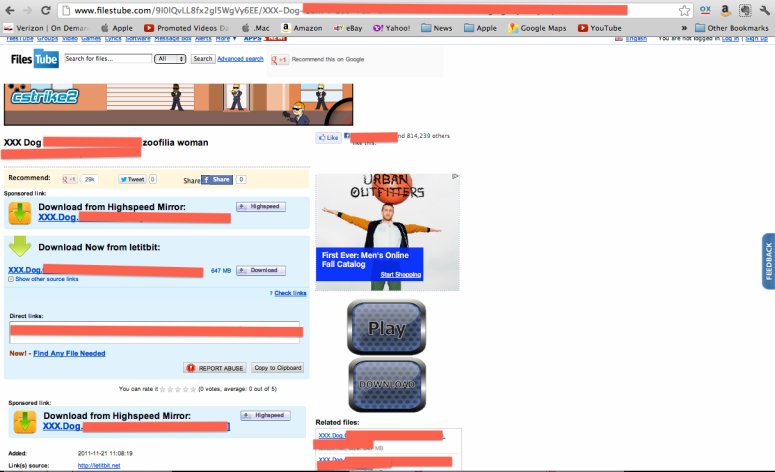
And the same thing happened to  Urban Outfitters.  Although honestly I really can’t be 100% sure this isn’t intentional.  You follow me? This  may be some high level extreme branding. You never can be sure with a brand that uses  a litter box with cat poop spelling out “2013” for it’s web catalogue.  Not kidding.

urban outfitters and bestiality

Transparency + Markets is quite a wonderful thing.  Isn’t there now a high probability that  someone at an ad agency or an entire ad network somewhere gets fired over these two screenshots?  The ultimate effect is that it reduces revenue to http://www.filestube.com.

But even more interesting is that the  publicly traded companies that operate ad networks,  like Google, Microsoft, Yahoo and ValueClick expose themselves to civil and criminal liability by doing business with these websites. What happens if one of these networks get caught up in a RICO investigation? What happens to the share price?

Many of these websites pay “affiliates” money for  uploading popular files.  In the case of MegaUpload I’d imagine many of these affiliates are in the US.  Do you really think MegaUpload sent 1099’s to these people? Do you think these affiliates declared this income on their taxes?  What happens to one of these ad networks when they get caught up in a US tax evasion investigation?  You do realize that the US Government is likely in possession of this data?

What happens when a major brand like Ford that doesn’t want their ads on these sites sues the ad network for a refund?  What happens if  hundreds  of brands sue the same ad network for a refund?  what will happen to the share price? I’m told that at least the big ad agencies require the ad network to submit to a compliance audit that could allow some brands to receive refunds on commissions if their ads end up in the wrong places.

And finally for finance geeks:

None of these things even has to actually happen for share prices to plunge.  The mere possibility that this could happen, the mere possibility that these companies have exposed themselves  to large  unpredictable downsides can drive the share price down. Influential stock analysts may notice these dangers  and issue bearish warnings.  But the more  likely scenario in my mind is a large hedge fund may make a big bet that these dangers are “underpriced” and start buying puts on one or all of these companies.  If it’s a large enough bet option market makers will have to sell short the stock to hedge potential losses.  This drives prices down.  Then “momentum” players  begin short selling further depressing shares.  Soon you have a vicious cycle.

Google, Yahoo and ValueClick are particularly vulnerable in this scenario since more than 90% of their revenue comes from advertising. Watch out when analysts start to ask the question “what percentage of their revenue is from rogue sites?”

So instead of arguing tit for tat with Google and their many paid bloggers and sock puppets, we artists should direct our energies elsewhere.   Let me humbly suggest that all artists should start searching these sites for their own music and observing which brands are financially supporting these sites.  Take screenshots and send them to us here  at the Trichordist.  We will then publicize these and notify the brands.  But by all means post them to your own facebook and twitter accounts.  You never know who’s gonna see them.

Remember : Transparency + Markets is usually a good thing.  The online advertising ecosystem is in desperate need of transparency. But we don’t have to wait for “the grownups” to get their shit together.  We can do this now!

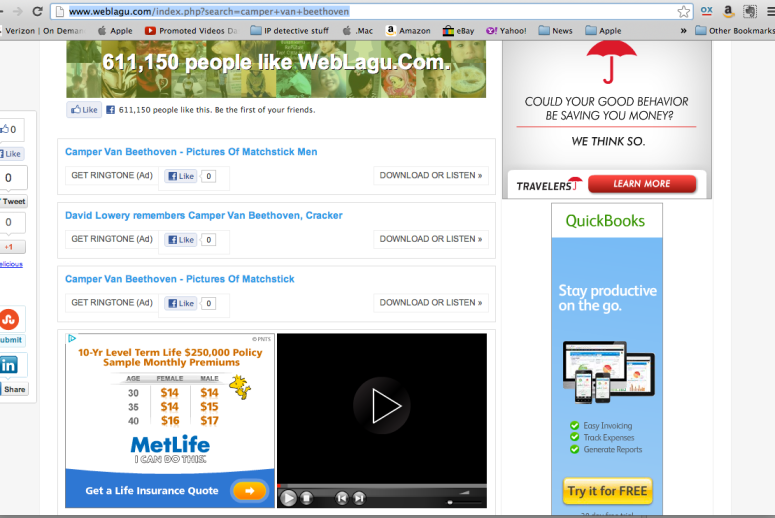
I’ll get us started. It’s easy.  Here is Traveler’s Insurance, Metlife and Quickbooks  helping fund the massively infringing site http://www.weblagu.com.  And since they are ripping me off.  I get to say:

SCREW YOU QUICKBOOKS/INTUIT.   GNUCASH IS JUST AS GOOD AND IT’S SHAREWARE! DOWNLOAD HERE.

Try it yourself.  http://www.weblagu.com/index.php?search=camper+van+beethoven.  See which advertisers pop up for you. Put in your own band name.

(Since I’m speaking to musicians I’m gonna assume you are on a mac .  So you can select an area for a screenshot by pressing Command+Shift+4. Your cursor turns into a sort of gunsight.  Click and drag  until you get a box the correct shape and area.  When you “let go” you will hear a snapshot sound and there  will be a .png file on your desktop. It’s name will reflect the date and time. 

If you have a PC you  probably already know how to do this 50 ways and  I don’t need to tell you how to do this.

Oh and those of you who are even more advanced,  use firefox and install the firebug plugin so you can capture the served source code in your screenshots.  Even better get a packet logger.  If you don’t understand what I’m talking about you won’t know how to do this anyway.)

Screen Shot 2013-01-03 at 12.48.41 PM

Artists Rights Watch – Sunday Jan 6, 2013

Happy New Year! Grab the coffee!

Recent posts from The Trichordist:
* First USC-Annenberg Brand Supported Piracy Report and Google Response
* Trojan Horse: Orphan Works and the War on Authors by Brad Holland, Part 2
* Trojan Horse: Orphan Works and the War on Authors by Brad Holland, Part 3
* Trojan Horse: Orphan Works and the War on Authors by Brad Holland, Part 4
* What the FTC Should Know About Brand Sponsored Piracy and Google’s “Pinto Problem”

FROM AROUND THE WEB:

THE SMITHSONIAN :
* What Turned Jaron Lanier Against the Web?

“I’d had a career as a professional musician and what I started to see is that once we made information free, it wasn’t that we consigned all the big stars to the bread lines.” (They still had mega-concert tour profits.)

“Instead, it was the middle-class people who were consigned to the bread lines. And that was a very large body of people. And all of a sudden there was this weekly ritual, sometimes even daily: ‘Oh, we need to organize a benefit because so and so who’d been a manager of this big studio that closed its doors has cancer and doesn’t have insurance. We need to raise money so he can have his operation.’

“And I realized this was a hopeless, stupid design of society and that it was our fault. It really hit on a personal level—this isn’t working. And I think you can draw an analogy to what happened with communism, where at some point you just have to say there’s too much wrong with these experiments.”

THE NEW YORK TIMES:
* Copyright Rules and the Art They Inspire

PITCHFORK:
* The Year in News 2012

THE REGISTER UK:
* The ‘Digital Economy’ in 2012: A big noisy hole where money should be

“Privacy and copyright are two things nobody cares about,” Mark Bide told us, “unless it’s their own privacy, and their own copyright.” How true.”

THE LOS ANGELES TIMES:
* Report links Google, Yahoo to Internet piracy sites

COPYRIGHT ALLIANCE:
* Instagram Still Has the Right to Commercialize Your Work (or Why You Should Read Terms of Service Carefully)

CNET:
* Google, Yahoo accused of funding piracy

TECHCRUNCH:
* Keen On… Piracy: How Online Ad Networks Are Supporting The Major Pirate Movie And Music Sites [TCTV]

Annenberg’s Advertising Transparency Report should be seen as a wake-up call to brands to invest their advertising dollars in legal networks like Spotify or YouTube rather than pirate sites. Pretty simple, eh? Let’s hope that Madison Avenue wakes up to the troubling implications of Taplin’s report and shifts all its online advertising dollars to movie and music sites which actually pay artists for their content.

VOX INDIE:
* More Evidence Ad Dollars Fuel Web Piracy

HUFFINGTON POST:
* Towards a Bill of Rights for Online Advertisers

THE MUSICAL DISCONNECT:
* The Takedown-Why the DMCA has failed

AD LAND:
* David Lowery makes list of people who changed the music industry.
* Collateral Damage: How Free Culture destroys advertising.

STOP FILE LOCKERS:
* Crocko.com lose Paypal. Resellers to follow.
* UltraMegaBit: A Crime Committed on American Soil
* Avangate forced to drop file sharing sites. More sites poised to lose Avangate payment processing.

DIGITAL MUSIC NEWS:
* Abject Looting Continues at Pandora…
* In France, 92% of Pirates Never Receive a Second Warning Letter…
* Growth of Paid Downloads vs. Streaming, 2012 vs. 2011…

TORRENT FREAK:
* Top 10 Most Popular Torrent Sites of 2013
* Music Biz Wants To Block Pirate Bay….Plus 260 Additional Sites
* IMAGiNE BitTorrent Group Leader Sentenced To Five Years in Prison
* Identifying Pirates Now Easier Following Swedish Supreme Court Decisions

COPYHYPE:
* A look ahead to 2013

BARRY SOOKMAN:
* Most popular intellectual property and technology law blogs

The Return of Orphan Works: Trojan Horse: Orphan Works and the War on Authors by Brad Holland, Part 4

Nothing says “Internet Freedom” like getting away with it, and in case you missed it, Google got away with it again at the Federal Trade Commission yesterday.  According to press reports (see “Google Pressed Hard Behind the Scenes to Convince Regulators” in the New York Times, Did Google Buy Its Way Out of Trouble with the Feds? in The Atlantic Wire, and “How Google Beat the Feds” in Politico), Google appears to have effectively captured the U.S. Federal Trade Commission the old fashioned way–they bought it.  And given how well Google controls the press, if the press is writing a story about Google’s crony capitalism, it’s because Google wants that story told and we can assume that they want that story told because they are proud of it.

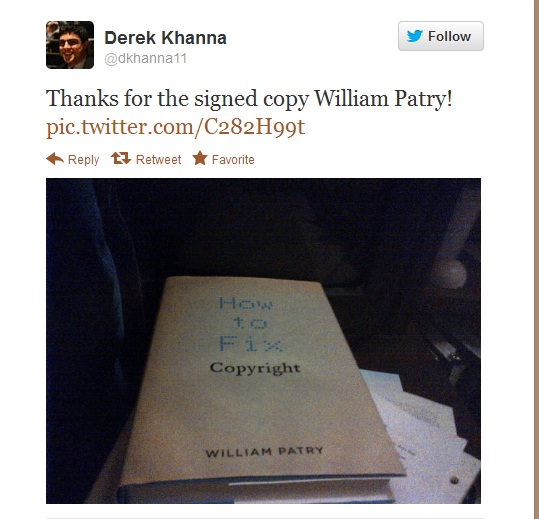
According to Politico’s Tony Romm, “[Google] even consulted with [which usually means ‘paid’] the late Robert Bork and The Heritage Foundation  and met with senators like John Kerry to make its case. In other words, these  traditional outsiders worked the system from the inside.”  The Heritage Foundation, eh?  We wonder if the Heritage Foundation also got a signed copy of William Patry’s book? (Patry is one of the senior copyright lawyers at Google.)  One of Patry’s punters proudly posted this pretty picture of an autographed copy of the book apparently received as a gift from Mr. Patry:

A covered legislative branch official receives a gift
https://twitter.com/dkhanna11/status/278134555368628224

So what can we expect in the coming legislative session in the Googleplex By The Potomac?  What is happening in the UK right now may well be a guide.

Andy Heath, the Chairman of UK Music, testified a few weeks ago before the powerful Culture Media and Sport Committee of the UK Parliament and had this to say:

From my perspective, I think one of the biggest problems for the music industry and the cultural industries generally is the bewildering attitude that we seem to be getting from the Government about its ambivalence towards the benefit of copyright. It seems to me that Governments for some time, but especially this Government, have bought the line that intellectual property is a barrier to growth, and that simply is a lie. It is not true. That line has been bought by some very important and influential politicians in this country and I do not understand it. We have an asset that is very valid, that has been built up over 100 years-the theatre, the music, the films, the TV. It would be madness to create an atmosphere where that is at risk-absolute craziness.

I work with various businesses, I am involved with fundraising to license various forms of entertainment generally and I am also involved with start-ups from my own business and help them. The business community and the finance community always say to me, “Yes, but Government hates copyright. They are going to bring in all sorts of laws that are going to make it easier for Google to steal your music that they already steal, so why should we invest?” and that is a story I get every month of every year. It is this bewildering ambivalence, if not outright hostility, towards copyright that comes from the powers that be in this country and it is very, very damaging.

Oh, and one thing that Mr. Heath was too polite to mention is that Rachel Whetstone, Google’s global head of communications and public policy is married to Tory political consultant Steve Hilton, and the power couple were godparents to the late son of David Cameron.  That would be Prime Minister David Cameron.  The UK Prime Minister.  A Tory–actually, the Tory–for whom Steve Hilton was employed.  (See “Power Couple Behind the New Tory Throne“.)  This fact (that we suppose was known so very well to all present at Mr. Heath’s panel that it need not be mentioned) may help to explain the “bewildering attitude” of the UK Government (by which he means the “Government”, i.e., the Parliamentary coalition that Mr. Cameron leads).

This pattern should sound familiar to Americans.

Orphan works legislation is just one of those ways that it will make it easier for Google to steal our life’s work, whether you are a songwriter, photographer, illustrator, artist, musician, singer, director, actor, screenwriter, or best boy.

We are pleased to be able to serialize an excellent article about the history of the “orphan works” movement in the U.S. written by the distinguished illustrator, Brad Holland. We encourage readers to make common cause with the illustrators and photographers who will likely be most harmed by this specious legislation backed by Google the last two times it appeared in the Congress. The article first appeared in the Journal of Biocommunication in 2010 and is used by permission of the author.

If you missed Part 1 of this important article, you can read it here along with Brad’s bio.  You can read Part 2 here and part 3 here.

One reason we are serializing Brad’s article is to help you develop awareness of the situation, so that if we are right and legislation is introduced (whether it is orphan works, “fair use” Google style, or other legislation that undermines creators), you’ll be able to take action quickly.  Given what we know of Google’s cozy relationship with the FTC, we may well be entirely on our own.

Part 4: Trojan Horse: Orphan Works and the War on Authors, by Brad Holland

The Gospel of the Commons

The premise that intellectual property should not be treated as real property is the gospel of the anti-copyright movement. Its chief apostle has been Lawrence Lessig, currently a Harvard Law School professor, formerly of Stanford and founder of Stanford’s Center for Internet and Society. Lessig also co-founded Creative Commons. Gigi Sohn of Public Knowledge has called Lessig “the first populist copyright reformer,” adding he “made the existence of organizations like Public Knowledge possible.”49

In books such as Free Culture and Remix, Lessig has argued that copyright law is a tool of the corporate power structure, enabling large media corporations to “lock down culture” and thwart the creativity of ordinary citizens by suspending the sword of infringement litigation over the heads of anyone who wants to “incorporate existing material” into their own creations. Creative Commons routinely celebrates music remixers, collage makers, and film and print publishers who seek to profit by republishing with impunity the copyrighted works of others. Implying that all creativity is a remix of the work of others, Lessig argues that the principle of ownership embodied in current copyright law compels ordinary citizens to create only at their own peril: “Under the existing system of copyright law,” he writes, “there’s no easy way to be a legal creator.”50 Contributors to Lessig’s wiki have spelled out why they believe the unauthorized use of others’ intellectual property should not necessarily be regarded as theft:

“The owner of physical property can clearly be deprived of the use of their [sic] property by the act of confiscation. But no such deprivation occurs when a work enters the public domain. The previous copyright holder can still publish their [sic] works, or market them more effectively…”51

This of course is nonsense. One can hardly market one’s work effectively – or perhaps even market it at all – if potential clients can access the same work for nothing from the public domain. Lessig has said he wants to create a culture of “[u]ser-generated content, spreading in businesses in extraordinarily valuable ways…celebrating amateur culture. By which I don’t mean amateurish culture, I mean culture where people produce for the love of what they’re doing and not for the money.”52

Money, however, appears to come in handy when you’re a “populist copyright reformer” crusading for a change in the law. In November 2006, for example, Lessig was pleased to accept a pledge of $2 million from Google to his Center for Internet and Society at Stanford University. According to the Online Wall Street Journal, “[t]he money will help fund a project at the center dedicated to help preserve the public’s legal right to ‘fair use’ of copyrighted material. It also intends to pursue legal cases relating to the topic.”53

“Aine Donovan, executive director of the Ethics Institute at Dartmouth College, says Stanford shouldn’t have accepted the Google gift because it is too narrowly tailored to benefit Google’s corporate interests. ‘It might as well be the Google Center,’ she says.”54

Lessig, of course, assured the Journal that the gift wouldn’t affect his scholarship, adding that his views on copyright “don’t always agree with Google’s,” and anyway, “there was no ‘quid pro quo.’”55

Lessig’s Gospel of the Commons is merely the fin that breaks the surface of the Free Culture/Orphan Works debate. Beneath the waterline lurks a gathering body of hostile dogma that copyrights are a “public resource” given as “subsidies” or “bribes” to feckless artists in order for work “to be gotten out of them.” Contributors to Lessig’s blog have routinely called copyrights restrictive “monopolies,” impositions on the freedom of others to create, and “a burden which the public ends up shouldering.” One acolyte writes that “[a]uthors should simply not have that much control over their published works,” while another says “the majority of [authors] would probably be better off with the welfare checks.”56

It would be hard to call such expressions scholarly opinions. Prejudice would be a better word. Yet these are merely examples of the reckless bias Lessig has ginned up throughout the world with his evangelical insistence that all creativity comes from the “Commons” and is everywhere being “strangled” by the outdated concept that individual creators have proprietary rights to the work they create. 57

In 2008, Lessig demurred from endorsing the Orphan Works bill, arguing instead that the length of copyright should be reduced to 14 years across the board. 58 This was a proposal he had spelled out two years earlier, March 6, 2006 in a nine-page letter to Congresswoman Zoe Lofgren of the House Judiciary Subcommittee. His logic was yet another undocumented assertion that works of art are generally of no lasting value to their creators:

“A presumptive 14 year term far exceeds the time during which the vast majority of work earns any commercial return at all…Thus, under this rule, any work less than 15 years old would be governed by the existing copyright rules…In the fifteenth year after a domestic work has been published and for every ten years afterwards, the copyright owner must take steps to maintain the copyright.” (Emphasis added.)59

Those steps would include the re-registering, every ten years, of each and every individual work with privately managed registries. All other works would fall automatically into the public domain, just as Creative Commons had recommended to the Copyright Office in its proposal “Reform(alizing) Copyright.”

Orphan Works: “Half a Loaf”

It’s hard to imagine how a panel of legal scholars could successfully convince lawmakers to re-write copyright law by lecturing them on “Derridean propositions” of “intertextuality” and “the inherent instability of meaning.” It’s even less likely they’d succeed by insisting that US law be re-written to reflect a post-Marxist analysis of private property. In Supreme Court cases such as Eldred v. Ashcroft, 60 Lessig and others have failed to bring about a judicial reinterpretation of existing law. Presumably this is why the authors of the Orphan Works Act chose to concoct and promote the myth of a market failure so pervasive that only the transfer of the world’s copyright wealth into the hands of a few corporate databases could correct it. In May of 2008, it looked as if that strategy would soon pan out for them.

Anticipating the imminent passage of the Orphan Works Act, Free Culture advocates had already begun to celebrate their achievement when as James V. DeLong of the Convergence Law Institute reminded them, there was still much work to be done. Calling the Orphan Works bill just “half a loaf,” he hinted at the new legislation the “Copy Left” would have to tackle next:

“These possibly-orphan, sort-of-orphan, and gray literature works simply cannot be made available if the digitizers are required to make one-by-one judgments and seek permission before copying. If they are to be retrieved in useful form, then sooner or later Google, Amazon, Microsoft, and some others must be permitted to digitize on a massive scale.”61

While Mr. DeLong acknowledged that the new reverse copyright law should not deprive intellectual property owners of their “legitimate rights,” 62 he reaffirmed the Copy Left’s fundamental premise that intellectual property owners should not be allowed to have legitimate rights except in situations where they’ve registered their works with commercial databases:

“At some point, some kind of grand grandfathering proceeding will probably be required, a window in which holders of existing rights must reaffirm them or lose them.” (Emphasis added.) 63

These admonitions however, like predictions of the bill’s imminent passage, were premature.

A Public Knowledge Postmortem

“Orphan works relief was vigorously opposed by visual artists…And while we have thought some of their concerns misguided, they did a fine job of organizing and getting their voices heard.”64

That was the rueful analysis from Gigi Sohn of Public Knowledge October 6, 2008, as she conducted a postmortem on her blog to explain how the Orphan Works bill had ultimately failed to pass. Throughout the summer of 2008 the bill, which in the spring had appeared to be a slam dunk, had become one of the 10 most controversial pieces of legislation facing Congress. Congressional observers still predicted that its passage was inevitable. Yet by September, with only a month left to go before adjournment, the Senate was reduced to passing its version of the bill only by using the controversial practice of “hotlining” it. 65Hotlining is a legislative end-run that allows a bill’s sponsors to pass it without subjecting it to testimony, debate or a vote.66This inspired Public Knowledge to lobby for similar tactics to be used in the House:

“The best option [Sohn wrote] was to put it on the ‘suspension calendar,’ which is the place largely non-controversial legislation gets put so that it will get passed quickly. There can be no amendments to bills placed on the suspension calendar.”67

Until the very last minute, Sohn acknowledged, she and others “were on the phone imploring the [House leadership] to move the bill” in this underhanded fashion. Yet in the end, “it was to no avail.” On October 3, 2008 Congress adjourned without passing the Orphan Works Act. “Time had run out.”68 Surveying the wreckage, Sohn nonetheless found a bright spot. Some “positive things,” she said, had “come out of the process.” 69 Ignoring the fact that 85 creators organizations had joined the Illustrators’ Partnership in opposing the bill; 70ignoring the more than 167,000 opposition letters that had been sent to lawmakers from the Illustrators’ Partnership website; 71and ignoring the adverse testimony of freelance creators at a Small Business Administration Roundtable two months earlier (see below), Ms. Sohn chose instead to praise the one graphic arts group72 that had supported the House version of the bill and had spent $200,000 lobbying for its passage.73

Calling officers of the Graphic Artists Guild “enlightened,” Sohn vowed that the Orphan Works Act would be back “next year,” and inexplicably, she tried to portray GAG’s support for it as proof that the world’s artists had finally learned their lesson:

“[V]isual artists, graphic designers and textile manufacturers who opposed orphan works relief now understand that they must change their business models.” (Emphasis added.)74

And with that backhanded praise for GAG, Public Knowledge finally laid its cards on the table.

Beware of Lawyers Bearing Gifts

In the beginning, the sponsors of the Orphan Works Act had all argued that the amendment was merely a minor adjustment to copyright law to let libraries and museums digitize their collections of old works. In 2006, during the bill’s first incarnation, its sponsors were so certain of swift passage that Public Knowledge even argued against imposing a “reasonable fee” on infringers. “That approach,” Ms. Sohn wrote, “keeps the orphans in the orphanage.”75 Yet by May 2008, realizing that artists were waging a persuasive fight to protect their rights, Public Knowledge adopted a different public relations strategy. Casting her new argument in terms that suggested infringement is the normal means by which clients procure work from contributors, Ms. Sohn portrayed the bill as a boon to artists: “The purpose of the legislation [she wrote] is to match users with copyright holders and get the latter paid”:

“If a copyright holder reappears after a user has done a diligent search, then the copyright holder is entitled to reasonable compensation. This is compensation that the copyright holder would likely never have obtained without orphan works relief, because the user would not have risked paying the huge damages provided by copyright law.” (Italics added.) 76

Of course, infringement would only become an everyday means of doing business if this legislation were to pass. Yet watching it fail for the second time in three years, PK’s President dropped the pose of benefactor to artists, admitting petulantly that the real purpose of the law was to force artists to change their business models. In doing so, she merely echoed Professor Jaszi’s 1994 declaration that creators of the future “may not need the long, intense protection afforded by conventional copyright – no matter how much they would like to have it.”

To be concluded in Part 5…

49.  Gigi B. Sohn, “Searching for the Possible in the Orphan Works Debate,” May 20, 2008 http://www.publicknowledge.org/node/1584

50.  Interview with Lawrence Lessig by David Kushner, “Uncommon Law: Lawrence Lessig has pioneered a new approach to copyright,” March 2006, ieee spectrum http://spectrum.ieee.org/at-work/innovation/uncommon-law

51.  Lawrence Lessig’s Wiki, Article: Against perpetual copyright, 6. Deprivation http://wiki.lessig.org/index.php?title=Against_perpetual_copyright

52.  Lawrence Lessig, “Larry Lessig says the law is strangling creativity,” Lecture March 2007, video: http://www.ted.com/talks/larry_lessig_says_the_law_is_strangling_creativity.html transcript: http://dotsub.com/view/d3509948-261f-4fbb-9b7c-c63110f13451/viewTranscript/eng

53.  John Hechinger and Rebecca Buckman, “The Golden Touch of Stanford’s President,” Wall Street Journal February 24, 2007 http://www.signallake.com/innovation/Hennessy022407.pdf

54.  John Hechinger and Rebecca Buckman, “The Golden Touch of Stanford’s President,” Wall Street Journal February 24, 2007

55. ibid

56.  Lawrence Lessig’s Blog http://web.archive.org/web/20080501230937/http://lessig.org/blog/2006/03/orphans.html

57.  Lawrence Lessig, “Larry Lessig says the law is strangling creativity,” Lecture March 2007, video: http://www.ted.com/talks/larry_lessig_says_the_law_is_strangling_creativity.html Transcript: http://dotsub.com/view/d3509948-261f-4fbb-9b7c-c63110f13451/viewTranscript/eng

58.  Lawrence Lessig, “Little Orphan Artworks,” Op-ed, New York Times, May 20, 2008 http://www.nytimes.com/2008/05/20/opinion/20lessig.html

59.  Lawrence Lessig, Letter to Representative Zoe Lofgren (D-CA) March 6, 2006, Page 4, Paragraph 3 http://www.yellowdocuments.com/4998410-march-6-2006-the-honorable-zoe

60.  http://www.oyez.org/cases/2000-2009/2002/2002_01_618

61.  James V. DeLong, “Orphan Works: Half a Loaf,” Coop’s Corner, May 20, 2008. http://news.cnet.com/8301-10787_3-9948731-60.html

62.  ibid

63.  ibid

64.  Gigi B. Sohn, “The Orphan Works Bill: Wait ‘Till Next Year,” October 6, 2008, Public Knowledge http://www.publicknowledge.org/node/1783

65.  Brad Holland and Cynthia Turner, “Orphan Works: The Devil’s Own Day: Never Too Busy to Pass Special Interest Legislation,” September 28, 2008, Illustrators’ Partnership Orphan Works Blog http://ipaorphanworks.blogspot.com/2008/09/orphan-works-devils-own-day.html

66.  Critics of hotlining say “that lawmakers are essentially signing off on legislation neither they nor their staff have ever read.”

“In order for a bill to be hotlined, the Senate Majority Leader and Minority Leader must agree to pass it by unanimous consent, without a roll-call vote. The two leaders then inform Members of this agreement using special hotlines installed in each office and give Members a specified amount of time to object – in some cases as little as 15 minutes. If no objection is registered, the bill is passed.” (Italics added.) – Roll Call, Sept 17, 2007

In other words, a Senate bill can pass by “unanimous consent” even if some Senators don’t know about it. http://tinyurl.com/3p8x2u

67.  Gigi B. Sohn, “The Orphan Works Bill: Wait ‘Till Next Year,” October 6, 2008, Public Knowledge http://www.publicknowledge.org/node/1783

68.  ibid

69.  ibid

70.  85 Creators’ Organizations Opposed the U.S. Orphan Works Bills,” Illustrators’ Partnership CapWiz Website http://www.illustratorspartnership.org/01_topics/article.php?searchterm=00273

71.  Groups Opposing the House and Senate Orphan Works Acts, Illustrators’ Partnership Orphan Works Blog http://www.illustratorspartnership.org/01_topics/article.php?searchterm=00273

72.  Posting by Graphic Artists Guild, October 1, 2008, 4:18 pm: “URGENT: Contact your Representative to oppose [Senate Bill] S. 2913 Either the House version of Orphan Works legislation, H.R. 5889, or the Senate version will become law. There are no other possible outcomes. The Guild continues to support Rep. Berman’s House bill. The Graphic Artists Guild is urging all members and other artists to support H.R. 5889” (Emphasis added.) http://allthingscopyright.com/?p=54 (formerly Orphan Works News – http://orphanworksnews.com/)

Posting by Graphic Artists Guild, September 9th, 2008, 7:40 am: “A Message from the President” “The artistic community just has to get real about this Orphan Works scare… The Guild has promoted the ‘Notice of Use’ provision… and that’s why the Guild can and does support the House version of the Bill…” http://allthingscopyright.com/?p=44#more-44

73.  Mandatory filings with the United States government indicate that the Graphic Artist Guild spent nearly $200,000 in lobbying fees: Office of the Clerk, United States House of Representatives, Public Disclosure Search: Lobbying Disclosure Filing Search: Graphic Artists Guild, Issue Data: Orphan Works 2006 Q4     http://disclosures.house.gov/ld/pdfform.aspx?id=200044500 2007 Q1,2  http://disclosures.house.gov/ld/pdfform.aspx?id=200044508 2007 Q3,4  http://disclosures.house.gov/ld/pdfform.aspx?id=300006705 2008 Q1     http://disclosures.house.gov/ld/pdfform.aspx?id=300052584 2008 Q2     http://disclosures.house.gov/ld/pdfform.aspx?id=300066272 2008 Q3     http://disclosures.house.gov/ld/pdfform.aspx?id=300100998 2008 Q4     http://disclosures.house.gov/ld/pdfform.aspx?id=300117685 2009 Q1     http://disclosures.house.gov/ld/pdfform.aspx?id=300160662 2009 Q3     http://disclosures.house.gov/ld/pdfform.aspx?id=300192823 2009 Q4     http://disclosures.house.gov/ld/pdfform.aspx?id=300216372

74.  Gigi B. Sohn, “The Orphan Works Bill: Wait ‘Till Next Year,” October 6, 2008, Public Knowledge http://www.publicknowledge.org/node/1783

75.  Art Brodsky, “Public Knowledge Praises Orphan Works Report, Wants More Certainty,” Public Knowledge, February 1, 2006, Quoted at “Orphan Works Legislation: Responses to Proposal,” Source Watch, Page last modified July 1, 2008 at 21:04 http://www.sourcewatch.org/index.php?%20title=Orphan_works_legislation

76.  Gigi B. Sohn, “Searching for the Possible in the Orphan Works Debate,” May 20, 2008 http://www.publicknowledge.org/node/1584

Music Technology Policy

A Picture Speaks 1000 Words

The Los Angeles Times published yesterday a story about the USC-Annenberg Innovation Lab first monthly report on brand sponsored piracy–the purchase by major brands of advertising inventory located on pirate websites.  This is one of the ways, for example, that Megavideo became such a megamoney enterprise.  Page 8 paragraph 18 of the Megavideo indictment tells us:  “Originally, the Mega Conspiracy had contracted with companies such as AdBrite, Inc., Google AdSense, and PartyGaming plc for advertising. Currently, the Conspiracy’s own advertising website, Megaclick.com, is used to set up advertising campaigns on all the Mega Sites.”

The study highlights the fundamental problem with the brand sponsored piracy–if you follow the money, big brands buy advertising that is served to users of pirate sites by a variety of means.  How the ad comes to be there is important, but following the money in this case is a lot easier than some…

View original post 1,584 more words

First USC-Annenberg Brand Supported Piracy Report and Google Response

Professor Jonathan Taplin of the USC-Annenberg Innovation Lab released the first monthly report on brand supported piracy that demonstrates how major brands make pirates rich (not to mention the ad networks that take a cut–or some might say a vigorish–along the way.

[The USC Annenberg Lab Advertising Transparency Report details] the Online Ad Networks support of the major pirate movie and music sites around the world. The top ten ad networks placing the most ads to Pirate sites are:

  1. Openx
  2. Google (including Double Click)
  3. Exoclick
  4. Sumotorrent
  5. Propellerads
  6. Yahoo (including Right Media)
  7. Quantcast
  8. Media Shakers
  9. Yesads
  10. Infolinks

The list of top infringing sites was compiled using the Google Transparency Report (http://www.google.com/transparencyreport/removals/copyright/domains/?r=last-month) of domains with the most DMCA Takedown requests.

The Los Angeles Times reported that Levi’s is one brand that responded immediately:

Jeans maker Levi’s took swift action when Taplin presented evidence that the clothing company’s ads had appeared on file-sharing sites.

“When our ads were running unbeknownst to us on these pirate sites, we had a serious problem with that,” said Gareth Hornberger, senior manager of global digital marketing for Levi’s. “We reached out to our global ad agency of record, OMD, and immediately had them remove them…. We made a point, moving forward, that we really need to take steps to avoid having these problems again.”

Google, of course, had a carefully parsed response to the Times:

“To the extent [the study] suggests that Google ads are a major source of funds for major pirate sites, we believe it is mistaken,” a Google spokesperson said. “Over the past several years, we’ve taken a leadership role in this fight. The complexity of online advertising has led some to conclude, incorrectly, that the mere presence of any Google code on a site means financial support from Google.” (emphasis added)

Right.  Of course, this may well be a true statement–except the issue isn’t only about “Google ads”, that is, ads for Google products like this ad for Google Play on a pirate lyric site.

google ads sponsored links 2

And even if they meant any ad served by Google for any product, what if Google ads are a minor source of funds for major pirate sites?  Or are a major source of funds for minor pirate sites?

And what if the “mere presence of Google code” includes the Google ad publisher account number for the pirate?  Does that still count as “mere”?

Isn’t this called a nondenial denial?

Lyrics007 Google Ads Code 1

The Return of Orphan Works: Trojan Horse: Orphan Works and the War on Authors by Brad Holland, Part 3

The Fair Use/Orphan Works Connection: A Lesson from the UK

We would all do well to observe the intellectual property meltdown occuring in the UK largely as the result of the so-called “Google Review” commissioned by the UK government (officially titles the “Hargreaves Review”).   This is particularly acute given the concurrent “agency capture” of the UK’s Intellectual Property Office (roughly equivalent to a combined version of our Patent & Trademark Office and Copyright Office).

We should expect to see Google and its allies (CCIA, CES, various library associations) go for something similar in the Congress that starts this week in the US.

The Register’s Andrew Orlowski sums it up well:

The threat to the sovereignty of the individual now comes from academics and bureaucrats. Parliamentarians spent much of the year studying the radical, activist department of Whitehall called the IPO, the Intellectual Property Office – formerly the Patent Office, which has been behind a succession of moves to strip the individual of his or her rights. The MPs and Lords stopped short of calling for the IPO to be disbanded, but reminded the bureaucrats that copyright is a property right – not a regulatory impediment to some imaginary digital Utopia.

The IPO responded by placing a permanent extension of its powers onto the Coalition’s Business and Enterprise Regulatory Reform Bill (BERR) and seeking, in effect, to “do a Zuckerberg” by statute. Millions of unidentified works, without metadata, would be swept into schemes where they could be commercially exploited without the knowledge of their owner. It’s the only scheme in the world which proposes to allow third parties to rip off the creator for profit. The UK faces a “firestorm” of litigation from overseas, US creators have warned. And expect to see some real fireworks as the Bill moves into report stage.

(Note that China is beefing up its IP – the winner of the new economic wars will be the nation that can best protect and exploit its inventiveness).

Why has Britain been blessed with such a barmy bureaucratic class? They’re undoubtedly sincere in thinking the public would benefit from removing rights from creators. But we could abolish copyright entirely overnight and have an orgy of consumption – only to wake up from the Remixing Party with a headache, discover the creative industries have upped sticks and moved abroad (easier to do than you might think), at a huge cost to future growth and economic opportunities.

Politicians don’t really understand the potential damage, and won’t really appreciate the dangers, until UK businesses decide they need to move outside the UK to protect their work.

The UK government has been mislead by Google into thinking that somehow “fair use” was a cornerstone to the company’s success–naturally, “fair use” as defined by Google has found its way into the Google Review.

Alison Wenham, OBE, chair and chief executive of the Association of Independent Music, confronted Hargreaves at one of the few (if not the only) public meetings to receive comments about the Google Review before the report was issued.  She said:

“’I don’t believe IP is the problem,’ said Alison Wenham, representing independent music companies. ‘One of reasons Google did not start here is nothing to do with IP, it was to do with funding. The US has a rich culture of high risk investment and unfortunately our banking system does not value this, we have a criminal lack of funding for high risk ventures’….‘There’s no lack of business models, there’s a lack of market traction, because we’re all competing with free,’ she said. ‘What safe harbour and fair use has given US copyright owners is zero. Professor Hargreaves, you must be very careful what you wish for.’ Wenham wondered why Google promoted pirate sites so heavily, and why government agencies advertised the pirate sites.”

To which Hargreaves replied [disregarding the fact that the leader of AIM might actually know something about what’s happening in her own industry]: ’I don’t think the current system (of copyright) is serving you well.’  He added, ‘It is clear that in all sorts of ways that the market place for digital content in the UK is a troubled place in all sorts of ways. The Government having a Review will not be able to calm all of those waters. But what we are looking for are ideas to edge forward the ease with which markets with rights work.’”

Like excluding the enforcement of those rights by means of vauge and expansive “fair use” safe harbors.  A close cousin to the “fair use” safe harbor is “orphan works”.

We take a dim view of the “orphan works” theory–it seems to be yet another way of undermining copyright through a back-door safe harbor. If the last effort at “orphan works” legislation was any guide, it will another excuse for copyright infringement–if the infringer doesn’t quite qualify for a “fair use” defense, then they will say that their use of the infringed work is an “orphan” because they tried really, really hard to find the copyright owner, but couldn’t quite seem to find them. We think that “orphan works” puts the fox squarely in the henhouse, and is another clear example of the law creating another moral hazard to the detriment of artists.

We are expecting another push at so-called “orphan works” legislation in the U.S. Congress during the upcoming legislative session because the U.S. Copyright Office is soliciting comments in a Notice of Inquiry proceeding that closes February 4, 2013 (in a few weeks).

We have a lot of readers in the music business, and people in the music business often think that “orphan works” don’t affect them–we have all these databases after all. That places an awful lot of trust in the infringer. Remember–Google specifically asked the Copyright Office to consider users of “millions” of orphan works and the outside counsel for Google seems to be parking the orphanworks.com domain on the EFF’s servers. Still want to be so trusting? What about Google getting 3 million DMCA notices a week for search alone suggests that artists should trust the system?

We are pleased to be able to serialize an excellent article about the history of the “orphan works” movement in the U.S. written by the distinguished illustrator, Brad Holland. We encourage readers to make common cause with the illustrators and photographers who will likely be most harmed by this specious legislation backed by Google the last two times it appeared in the Congress. The article first appeared in the Journal of Biocommunication in 2010 and is used by permission of the author.

If you missed Part 1 of this important article, you can read it here along with Brad’s bio.  You can read Part 2 here.

Keep this thought in mind as you read the article: If orphan works represent a market failure, how can you have a market failure without a market, and how can you have a market without enforceable property rights?

Part 3: Trojan Horse: Orphan Works and the War on Authors, by Brad Holland

A One Day Symposium

If the Glushko-Samuelson Law Clinic conceived the “legislative blueprint” before the Copyright Office commenced its study, what kind of research did the Law Clinic undertake to inform its proposals? Here, in their own words, is how the authors of the plan described it:

“Since 2001, the Glushko-Samuelson Intellectual Property Law Clinic…has provided student attorneys with the opportunity…to work on important public policy projects related to important issues in the field. Clearly, the problem of ‘orphan works’ is one such issue.

“On April 11, 2003, the Clinic held a symposium with scholars, academics and other interested parties to discuss this issue. Since then, the work of CCI has focused its efforts on devising the blueprint for a legislative solution to the ‘orphan works’ problem (hereafter the CCI proposal) and has been in close contact with various non-profit organizations, intellectual practitioners and academics…”23

A footnote on page 2 identifies the eight “clinic students” who allegedly conceived this plan. It also names three organizations whose “representatives…made significant contributions to the proposal.” 24 These include two of the groups we’ve already encountered: Public Knowledge, whose president later praised the Copyright Office for proposing the plan; and the College Art Association, which two years later asked its members to flood the Copyright Office with anecdotes about orphan works “difficulties.” Of course, we shouldn’t be surprised that groups which helped draft the amendment would fully support it. But how plausibly can they argue that the “framework” they helped write between 2003 and 2005 was actually conceived by the Copyright Office only in response to a study the Copyright Office didn’t launch until 2005?

There’s nothing in the Glushko-Samuelson proposal that explains how eight law students had gained any knowledge of the dynamic $187 billion dollar licensing markets their recommendations would affect. Nor does it explain how a one day symposium attended by “non-profit organizations, intellectual practitioners and academics” could shed any serious light on the matter.  Yet the Glushko-Samuelson proposal was adopted by the Copyright Office and passed on to Congress with only slight modifications: where the law students had proposed capping infringement fees at $100, the Copyright Office report changed that to the ambiguous and undefined “reasonable fee.”

Based on this evidence it appears that the Orphan Works bill was cobbled together by marrying the “limitation on remedies” proposed by the Glushko-Samuelson Clinic to the Creative Commons proposal that compulsory registration be imposed on rightsholders in such a way as to appear voluntary. As Creative Commons predicted, this would “move works [probably in the millions of works] into the public domain.”

These works would act effectively as start-up capital to benefit two classes of opportunists: Internet businesses, which could harvest newly-created orphans as their own property to license to others; and entrepreneurs who wish to start new commercial rights-clearance registries, clearing the rights to copyrights that have been registered with them and certifying unregistered works as orphans available for legally-sanctioned infringement. Both types of business would operate essentially as stock houses do now, channeling client contact away from creators and into their own hands.

The Myth of Market Failure

Officially, the goal of forcing copyright holders to rely on private registries was expressed benignly on page 106 of the Copyright Office Report:

“[W]e believe that registries are critically important, if not indispensable, to addressing the orphan works problem, as we explain above. It is our view that such registries are better developed in the private sector…” (Italics added.) 25

But subsequently, in defending their proposal from unexpected opposition, the Report’s principal author began stating the case for registration in more coercive terms. Speaking at “Orphan Works: A Search for Solutions,” hosted by the Progress and Freedom Foundation, March 31, 2006, Jule Sigall, the Copyright Office’s Associate Register for Policy & International Affairs, explained why they had proposed stripping artists of the automatic protection afforded under current copyright law. He said it was necessary to “push” us into handing our work over to the private registries the bill would create. Artists, he said, are like cats who can’t be herded, and:

“You can’t herd cats, but you can move their food…It’s really what kind of incentives, what kind of pressure and how you put on the right pressure.” (Italics added.)26

He justified such coercive measures by blaming visual artists for having failed to create such registries themselves:

“I use this line a lot, photographers and illustrators like to say, ‘We haven’t collectivized.’ This is a problem, generally, for their marketplace. It’s hard to have a marketplace where buyers can’t find sellers.” (Italics added.)27

Nothing expresses the looking glass logic of the Copyright Office proposals better than this apparent belief by the bill’s principal author that an amendment legalizing the infringement of millions of commercial copyrights is necessary so that art directors can find artists. Even a quick glance at a newsstand should dispose of that argument. There are thousands of magazines and daily newspapers filled from cover to cover with photographs and art. There are billions of images published in trade publications, medical journals, ads, annual reports, posters, brochures, catalogues, postcards, greeting cards, surface and fabric designs. How can anyone be surrounded by this sea of pictures and seriously argue that the trade in images is being impeded because clients can’t find artists who have failed to collectivize?

Artists were not the only ones to notice that the Copyright Office lacked any substantial supporting evidence for its Orphan Works recommendations. The Association of Independent Music Publishers and the California Copyright Conference made the same observation in a joint paper published July 15, 2008.

“The Copyright Office,” they wrote, “requested orphan works legislation without having conducted a needs assessment study, an independent audit of its registration and copyright history records, an economic impact analysis, or an evaluation of how the public, society and authors would be affected by reduced quantity and quality of art, film, television, music, video games and other copyrighted works in the future.” 28

The Runaway Scope of the Orphan Works Bill

The assertion of market failure, though entirely unsupported by evidence, took on the authority of fact when presented to Congress with the imprimatur of the Copyright Office. By the time Howard Berman, Chairman of the House Judiciary Subcommittee on Courts, the Internet and Intellectual Property, opened his single hearing on the Orphan Works Act of 2008, he simply cited the premise to decree an end to an author’s exclusive right to control the uses of his or her own intellectual property.

“[W]e should correct a misnomer” [he began]. “The works we’re talking about are not orphans…The more accurate description… is probably an unlocatable copyright owner…this situation better describes the orphan works construct, which is to correct the market failure when a potential user can’t find the copyright owner. But for the sake of ease we’ll keep talking about them as if they’re orphans.” (Italics added.) 29

With this breezy introduction, the Chairman casually brushed aside Article 9.2 of the Berne International Copyright Convention, which states that “[m]ember [countries] shall confine limitations and exceptions to [an author’s] exclusive rights to certain special cases which do not conflict with a normal exploitation of the work and do not unreasonably prejudice the legitimate interests of the rightsholder.” (Emphasis added.) 30

Clearly, by redefining an “abandoned” work as any work by any author that anybody finds sufficiently hard to find, the Orphan Works bill would not limit exceptions to “certain special cases.” Since everybody can be hard for somebody to find, this definition would void every rightsholder’s exclusive right to his or her own property. It would create the public’s right to use private property as a new default position – and creating a new default position for copyright was exactly the deceptive strategy proposed by Creative Commons for “moving works into the public domain.”

The Subcommittee’s hearing lasted less than an hour and a half. No one asked why a bill that was not about orphaned work should be called an Orphan Works bill, even “for the sake of ease.” There were no further hearings on the Orphan Works Act of 2008. The terms of the bill had been decided over the previous two years during closed-door negotiations with special interest groups; and so, with almost casual indifference to facts (or the lack of them), the Orphan Works Act was introduced in March 2008 and placed on the “Rocket Docket” for swift passage by early summer. Despite its “paucity of data,” lawmakers had accepted the Copyright Office report as “a detailed study” of a crisis in commercial markets. The Trojan Horse had done its job.

Deconstructing Authorship

Peter Jaszi is a distinguished legal scholar at the Washington College of Law at American University. Along with Professor Lawrence Lessig, founder of Creative Commons, Jaszi is one of the most influential of a zealous group of legal scholars who believe that laws respecting intellectual property are based on “outdated” concepts of individualism and should be radically changed to favor common “sharing” by the public. As Director of the Glushko-Samuelson Law Clinic, Professor Jaszi could plausibly be characterized as the true Godfather of the Orphan Works bill.

In 1994, the professor co-edited The Construction of Authorship, a book of essays by various contributors subtitled Textual Appropriation in Law and Literature, in which “Appropriation” is clearly intended to mean unauthorized use. In his introduction, Jaszi spelled out his belief that in the new “information environment” created by the Internet, authors, artists and others “may require some kind of legal security [for the work they create] as an incentive to participate [in the creative process, but] they may not need the long, intense protection afforded by conventional copyright — no matter how much they would like to have it.” (Italics added.)31 The punitive tone of the comment is striking.

Copyright, Jaszi argued, is rooted in outdated concepts of “possessive individualism.” 32 He dismisses authorship as a “Romantic paradigm,” 33 a vestige of the 18th and 19th centuries “in which entrepreneurial publishers…[and] entrepreneurial writers…played out their shared conviction that the ‘individual [is] essentially the proprietor of his own person or capacities’ — and thus of whatever can be made of them.” 34 Most writing today,” he argues, “in business, government, industry, the law, the sciences and social sciences — is collaborative.” Therefore he objects to the fact that authorship is still being taught and treated by the law “as if it were a solitary, originary [sic] activity.”35

The professor has criticized the US for joining the international Berne Copyright Convention, calling it “an international agreement grounded in thoroughly Romantic assumptions about creativity.” 36

“The first Act of this preeminent ‘authors’ rights’ treaty in 1886 represented the culmination of a process which got underway in the mid-nineteenth-century with Victor Hugo’s vigorous campaign for the rights of European writers and artists. Other famous ‘authors’ rallied to the cause: Gerhard Joseph suggests that the manic energy with which Charles Dickens championed international copyright stemmed from the novelist’s private insecurities about his own ‘originality.’”37

Note the disparaging quotes around “authors” and “originality.” Professor Jaszi appears to subscribe to the postmodern cliché that all creativity derives from the “transformative” uses of the work of others, and therefore such concepts as authorship and originality are merely covers for one writer’s “vigor” or another’s “insecurities.” There may or may not be any merit to such an argument, but if you’re a working author you might simply guess that Dickens and Hugo campaigned for copyright laws because they wanted to protect the books they wrote.

In The Construction of Authorship Professor Jaszi cites the “critique of authorship” by postmodern literary critics and complains that their theories have “gone unheard by intellectual property lawyers.”

“However enthusiastically legal scholars may have thrown themselves into “deconstructing” other bodies of legal doctrine, copyright has remained untouched by the implications of the Derridean proposition that the inherent instability of meaning derives not from authorial subjectivity but from intertextuality. Above all, the questions posed by Michel Foucault in ‘What Is an Author?’ about the causes and consequences of the persistent, over-determined power of the author construct — with their immediate significance for law — have gone largely unattended by theorists of copyright law, to say nothing of practitioners or, most critically, judges and legislators.” (Emphasis added.)38

Or to put it into plain English, why hasn’t Congress written some debatable literary theories into US statute law? In a Content Agenda interview entitled “10 Pushy Questions,” the professor offered his own answer to that question:

“This is a society built around protection of private property and they’ve [the content industry] been very effective in persuading people that all property is the same. And if you take someone else’s property, that’s theft.  But all property is not the same; there are differences.” (Emphasis added.)39

These differences, of course, refer to intellectual property, and the concept that theft of intellectual property may not be theft can indeed be traced to the French literary critics Professor Jaszi cites as his source of revealed wisdom. In What is an Author? Michel Foucault asserts that authorship is a false concept of ownership arising from a “privileged moment of individualism,”40 a by-product of nineteenth century capitalism. He objectifies creative works as mere “texts,” a pseudo-scientific classification that can include anything from Shakespeare’s plays to “a laundry list;” 41 then he challenges the right of any legal system to treat these texts as “objects of appropriation” by anyone, including the author. 42 Citing the “disappearance of the author function,”43 he predicts a future in which “[a]ll discourses…would then develop in the anonymity of a murmur,” 44 and the questions one would ask about any creative work would not be “whose property is it?” but

“What are the modes of existence of this discourse? Where has it been used, how can it circulate, and who can appropriate it for himself?” (Emphasis added.) 45

Foucault asserts that authors are no longer any more important to the “texts” they create than are their readers, and less important than the enlightened critic who deconstructs the text by means of post-Marxian analysis. In an interview published in L’Express July 6-12, 1984, just before his death, Foucault explained what he had tried to accomplish in his work:

“What did Marx do when in his analysis of capital he came across the problem of the workers’ misery? He refused the customary explanation, which regarded this misery as the effect of a naturally rare cause of a concerted theft. And he said substantially: given what capitalist production is, in its fundamental laws, it cannot help but cause misery.  Capitalism’s raison d’etre is not to starve the workers but it cannot develop without starving them. Marx replaced the denunciation of theft by the analysis of production. Other things being equal, that is approximately what I wanted to say.” (Emphasis added.)46

Jacques Derrida, whose “propositions” Professor Jaszi also suggested should be used to inform US statute law, likewise derived his inspiration from Marx. In his book Specters of Marx, he argued that with the falling-away of state-sponsored Marxism, it’s the duty of modern intellectuals to create a “New [stateless] International” 47 to translate Marxist thought into political action:

“Upon rereading the Manifesto and a few other great works of Marx, I said to myself that I know of few texts in the philosophical tradition, perhaps none, whose lesson seemed more urgent todayIt will always be a fault not to…go beyond scholarly ‘reading’ or ‘discussion.’ It will be more and more a fault, a failing of theoretical, philosophical political responsibility. When the dogma machine and the ‘Marxist’ ideological apparatuses (States, parties, cells, unions, and other places of doctrinal production) are in the process of disappearing, we no longer have any excuse, only alibis, for turning away from this responsibility. There will be no future without this. Not without Marx, no future without Marx, of his genius, of at least one of his spirits.” (Italics in the original, underlines added.)48

Since we now know that the legislative blueprint for the Orphan Works bill was drafted before, not after, the Copyright Office study; and since we know it was drafted by (or under the direction of) Professor Jaszi; and since there’s no reason to doubt the professor’s sincerity in his belief that the laws governing intellectual property should be altered to reflect the opinions of Derrida and Foucault, is there any reason to doubt that the legislative” blueprint” his Law Clinic drafted between 2003 and 2005 reflects this ideological agenda rather than the underwhelming “evidence” of 215 letters submitted in 2005 to the Copyright Office study?

To be continued…

23.  Glushko-Samuelson Intellectual Property Law Clinic, Response to Notice of Inquiry on the Issue of “Orphan Works,” Submitted to the United States Copyright Office, Library of Congress March 24, 2005, Page 2  http://www.copyright.gov/orphan/comments/OW0595-Glushko-Samuelson.pdf

24.  ibid

25.  Report on Orphan Works, A Report of the Register of Copyrights, January 2006 United States Copyright Office, Page 106 http://www.copyright.gov/orphan/orphan-report.pdf

26.  Jule L. Sigall, “Orphan Works: A Search for Solutions,” hosted by the Progress and Freedom Foundation, March 31, 2006. http://www.archive.org/details/PffSeminar-OrphanWorksASearchForSolutions

27.  ibid

28.  Association of Independent Music Publishers (AIMP) and California Copyright Conference (CCC) Joint Position Paper on Orphan Works Legislation, July 15, 2008, Page 2 http://www.brandaideblog.com/pdf/Position_Statement.pdf

29.  Rep. Howard Berman (D-CA), Chairman, Subcommittee on Courts, the Internet, and Intellectual Property; Committee on the Judiciary; United States House of Representatives, Opening Statement: “Orphan Works Problem and Proposed Legislation,” March 13, 2008 http://www.copyright.gov/docs/regstat031308.html Video Testimony of Chairman Berman’s opening comments (requires RealAudio plug-in):
http://www.copyright.gov/video/testimony-3-13-08.html

30.  Article 9.2 Berne Convention for the Protection of Literary and Artistic Works http://www.law.cornell.edu/treaties/berne/9.html

31.  Peter Jaszi, The Construction of Authorship: Textual Appropriation in Law and Literature, Page 12, Edited by Martha Woodmansee and Peter Jaszi, Duke University Press, 1994 http://books.google.com/books?id=dpRKltgJYYwC&printsec=frontcover&dq=Peter+Jaszi,+The+ Construction+of+authorship&hl=en&ei=1UXsS6aJFsH68AaF4NzBCA&sa=X&oi=book_result &ct=result&resnum=1&ved=0CCwQ6AEwAA#v=onepage&q&f=false

32.  Peter Jaszi, The Construction of Authorship: Textual Appropriation in Law and Literature, Page 6 Edited by Martha Woodmansee and Peter Jaszi, Duke University Press, 1994

33.  Peter Jaszi, The Construction of Authorship: Textual Appropriation in Law and Literature, Page 9 Edited by Martha Woodmansee and Peter Jaszi, Duke University Press, 1994

34.  Peter Jaszi, The Construction of Authorship: Textual Appropriation in Law and Literature, Page 6 Edited by Martha Woodmansee and Peter Jaszi, Duke University Press, 1994

35.  Peter Jaszi, The Construction of Authorship: Textual Appropriation in Law and Literature, Page 9 Edited by Martha Woodmansee and Peter Jaszi, Duke University Press, 1994

36.  Peter Jaszi, The Construction of Authorship: Textual Appropriation in Law and Literature, Page 10 Edited by Martha Woodmansee and Peter Jaszi, Duke University Press, 1994

37.  Peter Jaszi, The Construction of Authorship: Textual Appropriation in Law and Literature, Page 9-10 Edited by Martha Woodmansee and Peter Jaszi, Duke University Press, 1994

38.  Peter Jaszi, The Construction of Authorship: Textual Appropriation in Law and Literature, Page 8-9 Edited by Martha Woodmansee and Peter Jaszi, Duke University Press, 1994

39.  Peter Jaszi, “10 Pushy Questions for Peter Jaszi and Patricia Aufderheide” This interview is no longer online, but was once available at http://www.contentagenda.com/info/CA6434467.html (This URL no longer exists)

40.  Michel Foucault, What is an Author? Text of a lecture presented to the Societé Francais de philosophie, February 22, 1969 Translation by Josue V. Harar, Page 1, http://www.scribd.com/doc/11397906/What-is-an-AuthorFoucault

41.  Michel Foucault, What is an Author? Page 3

42.  Michel Foucault, What is an Author? Page 6

43.  Michel Foucault, What is an Author? Page 14

44.  ibid

45.  ibid

46.  Michel Foucault, Interview by Pierre Boncenne, Page 113, Politics, philosophy, culture: interviews and other writings, 1977-1984 by Michel Foucault, Lawrence D. Kritzman, Alan Sheridan, Routledge, Chapman & Hall, Inc. 1988 http://books.google.it/books?id=HfWNHGCw55EC&pg=PA113&lpg=PA113 &dq=michel+foucault+%22+What+did+Marx+do+when+in+his+analysis+of+capital+he+came+across+the+problem +of+the+workers’+misery&source=bl&ots=mQRxyxhm3s&sig=Tnlz6of6aN-V_ak1vosmlpwH-MQ&hl=it&ei= dj_XS8qBE82PsAa84OScAw&sa=X&oi=book_result&ct=result&resnum=1&ved=0CAYQ6AEwAA#v=onepage&q&f=false

47.  Jacques Derrida, Specters of Marx: the State of the Debt, the Work of Mourning, & the New International, Translated by Peggy Kamuf, Routledge 1994, Page 13 http://books.google.it/books?id=sEENbAP5FZsC&dq=derrida++specters+of+marx&printsec=frontcover &source=bn&hl=it&ei=ncXYS6z1OoXdsAbur92FAw&sa=X&oi=book_result&ct=result&resnum=4&ved= 0CBsQ6AEwAw#v=onepage&q&f=false

48.  ibid