What Happens When NPR Reporter @sydell Starts asking Big Radio about Payola?

FCC Payola 1

As David said in his post FCC Payola Lanes: Big Broadcasters ask FCC for Payola Waiver, Clear Channel and other NAB radio gigantamo chains have asked the FCC for a “waiver” on the FCC’s payola rules.  What’s interesting about this is the filing date, November 26, 2014.

What else happened on November 26?  One thing is that NPR reporter Laura Sydell posted “Pandora’s New Deal: Different Pay, Different Play“.  Laura Sydell quoted David alongside Georgetown professor Jim Burger and Pandora CEO Brian McAndrews all on the subject of whether Pandora’s “steering” deal with Merlin labels is payola and whether the FCC’s payola rules apply to Pandora.  This would be based on Pandora being the only pureplay webcaster to at least try to become an FCC licensed broadcaster.  (We’re not really sure where that application is at, but if you do, please comment with a reference.)

Was Sydell’s post the first time the payola issue has come up in the context of steering or promotion in direct deals between broadcasters and labels?  Of course not, it’s come up repeatedly.  But it was the first time that we know of that it came up in the context of Pandora and especially in the context of Pandora’s “Chris Harrison special” that they are trying to run in the current rate court as Sydell reports (and as was later confirmed in Billboard’s (admittedly skeptical) reporting about the similarities between the Pandora and DMX licensing strategies.  Harrison worked at DMX before Pandora–see DMX’s chest-beating press release trumpeting its defeat of songwriters).

Not to get too tin foil hat about it all, but it is very coincidental that an NPR reporter starts asking about payola and then the NAB quietly asks the FCC to give them a waiver.

If the FCC rules in the broadcaster’s favor, that could also apply to Pandora’s purchase of South Dakota radio station KXMZ-FM.

And maybe to Pandora itself.

FCC Payola Lanes: Big Broadcasters Ask FCC for Payola Waiver

You think internet “fast lanes” were problematic? How about “payola lanes”  on terrestrial radio and webcasting? Payola is back! And it wants to go Legit this time.  That’s right, broadcasters are proposing a payola waiver from the FCC.  Here is the document they filed with the FCC.  Read it for yourself. It freaking unbelievable.  PDF below or you can read it on the FCC website here.

DA-15-325A2

Paying for airplay is not actually illegal.  As long as a radio station announces to its audience that the track you are about to play (or just played) is”sponsored” and who has “sponsored” it, no penalty.

Although this requirement is weak,  it has largely ended (blatant) payola**.  Having to announce this puts label, artist and radio station in awkward and unflattering position.

So big broadcasters are asking for a waiver that would change the way this rule works.  They propose phasing out this requirement in two steps.  First they want to lump all the “we accepted payola” announcements into a single announcement broadcast 3 times a day.  The idea here is you wouldn’t really know you were listening to a payola song. Even if you heard the announcement you wouldn’t necessarily be able to put the sponsorship with the song.

The broadcasters helpfully provide an example announcement:

“Some of the music [and/or] sports programming that you hear on this station is sponsored [or paid for] by Interscope, Sony, Universal Records, or the Washington Nationals. For additional information, please visit our website at http://www.WXYZ.com or contact the station at 12345 Main Street, Washington, DC 20036, info@wxyz.com, or 202-555-1234.”

After a transition period  they would only do a single block announcement once a day.

If for some reason you might think I’m exaggerating and  you think that there must be some logical explanation for this waiver request? Check out the totally hilarious and lame reason the broadcasters give for moving the disclosure to their website.  No one with good or honest intentions would ever provide an excuse this lame:

Broadcast disclosures are fleeting, and can be interrupted by the honking of a horn; they can be interrupted when a car is in a tunnel, or when a driver receives a call on a mobile phone and mutes the radio. Unlike the spoken word, online disclosures will remain available long after a broadcast disclosure has disappeared into the ether.

Car horns?  Well if you are trying to look  at the Sponsor ID page on the radio station website while driving I imagine there will be a lot of car horns.

You see what’s happening here, right?  They are making it so it’s palatable for radio stations to accept payola and for labels to pay to have their artists promoted.  If you’ve read your popular music history you know that we’ve had several periods of widespread payola and it’s negative consequences. The net effect was that large established record labels were able to block independents and startups from getting radio play.  We already know how this story ends.

This is a very dangerous.  Don’t let history repeat itself.  All indie artists and labels should be very concerned by this.   Fortunately the FCC is forced to ask for public comments on waivers like this.  We dug up the comment page. Unfortunately they’ve only given a curiously short period for comments. 30 days.   Let’s all chime in.  Let’s make a lot of racket.  Let’s not let the bastards get away with this.

http://www.fcc.gov/document/media-bureau-seeks-comment-waiver-petition-re-sponsorship-id-rules

While you are at it.  The President seems to have taken a keen interest in the affairs of the FCC.  Tell the President what you think about this payola proposal.

https://www.whitehouse.gov/contact/submit-questions-and-comments

** Payola has never gone away. Currently it works in an indirect and convoluted manner. Things like contests for radio station staff or record label artists play for free at event sponsored by radio stations, record companies pay above market rates for advertising their artists, etc etc.  And it’s virtually impossible to get on the radio unless you hire “indie promoters.” I wouldn’t be surprised if  money is still changes hands directly but under the table.

The MTP Interview: Terry Manning, Engineer, Producer, Artist

Awesome interview with a living legend!

Music Technology Policy

terry-manning-lucky-seven-records-1

Terry Manning with Guitar, photo by Simon Mott

“Manning is one of the most respected engineers and producers in music history — Led Zeppelin III, the first two Big Star records, Al Green, ZZ Top, the Staple Singers, Albert King, Shakira, Lenny Kravitz, and literally over 100 others have benefitted from his work in either or both capacities.”
—Tom Jurek, All Music Guide

Terry Manning grew up in Texas and started his musical career in El Paso being mentored by his friend and another Texas legend, Bobby Fuller (“I Fought the Law“).  After Bobby Fuller’s death, Terry moved to Memphis and was hired by Steve Cropper to work at the Stax Records studio.  His career as an engineer and producer included working at Ardent Studios and Abbey Road and then joining Island Records founder Chris Blackwell at Compass Point Studios in the Bahamas for many years.

Terry has…

View original post 3,046 more words

Everyone is “Pro-Digital” It’s Just Some of Us Do Math, Others Believe in Unicorns

New Jargon:  Math Doers & Magic Unicorn Lovers

There is no digital divide in the music business.  There is no pro-digital music business and anti-digital music business.  This is the real divide, it’s between  those that do the math on the revenues, and those that believe in magic unicorns.

I’m in a band. Like virtually every performer, I’m pro-digital.   I’ve been running a profitable web enabled business since 1993 (built our first website).  A profitable web-based business since 1999 (Napster). And managing a transmedia brand campaign since 2005 (YouTube + WordPress).  Bands were the early adopters of social media, crowd funding and just about everything that the digital gurus think was just invented (and need to desperately explain back to the pioneers for a fee).

Ever heard of  The Well and the Grateful Dead?  Anyone remember the pre www days of AOL? The most popular “boards” were hosted by bands to interact with their fans. Yeah we had acoustic dial up modem cradles sloshing around in the back of the van. Websites?  I know we had a website before Coca-Cola.  It’s fun to laugh at this now but Friendster was revolutionary, and it really took off when bands discovered they could convert their email lists to networks of friends.   Myspace specifically killed Friendster because they offered band pages and music players to bands.  Overnight bands moved their interactions with fans to MySpace.  And yes that’s funny to think about now but remember in 2005 people in Silicon Valley AND Hollywood were proclaiming it the future of the music business.   YouTube?  to this day half their top 50 videos are music videos.  We wrote the rules on social networking and social marketing.   We took the old Grateful Dead/DIY/indie-rock/punk rock grassroots techniques and applied them online.  In 2003 the big players in Silicon Valley and Holly wood they were still thinking top down.  Thinking about how they could use the web to “broadcast” out to fans.  I think that’s why bands identified with the early social media startups and self publishing entrepreneurs.  We immediately saw that they could help us get around the gatekeepers. They were helping us stick it to the man.

I can’t tell you how many talented coders, web-designers, and generally tech savvy people I know that play semi-professionally or professionally in bands. I believe bands are quicker to adapt new technologies and more efficient at using these technologies than practically any other business.

And because of our long experience in the music business we have serious bullshit detectors.  We have spent our lives dealing with crooks, charlatans, shysters, snake oil salesman and people that promise us ever elusive riches if first we do them this one little favor….

Our skepticism towards the new digital services may be confusing to some outsiders and consumers, but it’s almost always grounded in reality.  Remember we get the royalty statements, we see the contracts and terms of service. We could tell the moment it changed.  Meet the New Boss, Worse Than The Old Boss.  Bloggers and journalists?  Not so much. They just see the press releases from the digital platforms or glowing statements from some manager who coincidentally is an investor in DigitalSnakeOil.com.   (Although this sounds like I’m talking about ScooterBraun and Troy Carter,  I’m not.)

So let’s all say this together.  Everyone in the music business is pro-digital.  There’s just those of us who do the math.  And there are those who believe in Magic Unicorns.

Or profit on the IPO.


Because Songwriters are Just Bad People

At today’s Senate Antitrust Subcommittee hearing, the one unifying theme between the Google-backed Public Knowledge, the National Association of Broadcasters and Pandora is that the reason for the consent decrees is that songwriters are a special class of people who simply cannot be trusted to behave themselves.

Time and time again throughout the hearing Public Knowledge, the NAB and Pandora regaled the subcommittee with stories for just how untrustworthy songwriters and publishers are as a class.  And of course the Google-backed Public Knowledge was just frothing at a chance to bash record companies who weren’t even present.

Then we had the database scam.  Guess who wants to control that database?  They what want a compulsory license on the world’s information.

The sum and substance of the NAB, Pandora and Google side of the table is that the music industry is just filled with bad people who you have to keep an eye on because the $2 trillion collusion of the broadcast, Internet and webcasting business is just so hard done by.

A favorite moment was when Senator Al Franken called out Pandora’s Chris Harrison (aka Songwriter Enemy #1) about the usual sensationalized statements about “$150,000 fines” that Pandora would pay for failing to license a song.  The truth–$150,000 is the maximum range that a court can set for statutory damages for willful copyright infringement.  We have it on pretty good authority that no court has ever set the damages that high, but shillers like Harrison always use this as an example.

Franken asked if Harrison could give one example of $150,000 damages being awarded.  After wriggling around trying to dodge the question, Harrison had to admit that he didn’t know of any music cases where it happened.  That’s because there are none.

That was worth the price of admission alone.

We always thought that singling out a class of people for prosecution by the government based on their status was unconstitutional.  Not in the new world order, apparently.

Screen Shot 2014-07-20 at 3.23.11 PM

Founding Father James Madison Weighs in On Consent Decree @alfranken @sendavidperdue

Founding father James Madison weighs in on the songwriter consent decree:

“[government] interference is but the first link of a long chain of repetitions, every subsequent interference being naturally produced by the effects of the preceding.”

Respectfully, I suggest that Madison could have been describing the Kafka-esque rate courts.  Remember the NAB and PANDORA are the repeat petitioners in the rate court/consent decree. Not Songwriters.  I suggest you admonish the wrongdoers not the victims of this process.

& NAB is lying about data, most television shows come with music cue sheets. Isn’t it illegal to lie to Senate?


Pandora Execs Will Have Received Nearly 1/2 Billion Dollar in “Stock Compensation” By End of 2015

Dude, where is my America? Pandora is Crony Capitalism completely dependent on the DOJ to force rates artificially lower.

The Trichordist

While Pandora is busy in court suing BMI songwriters for lower rates we thought you’d like to read this guest comment from George Johnson.

“The past 3 years, according to the SEC, Pandora executives and investors extracted over $360 million dollars in “stock compensation”. This new $122 million dollar gravy train for 2015 will put Pandora executives at almost $500 million dollars for themselves in 4 short years while they plead poverty to Congress, Judge Stanton, Judge Cote, and the Copyright Royalty Board. (Ed note: New information suggests it’s closer to $550 million.)

Not bad for a guy who thought of the entire idea for Pandora while “tripping on psychedelic mushrooms”. — see Washington Post in 2013.

It’s time for the SEC, DOJ, or Congress to shut down Pandora with a temporary injunction and have these executives PAYBACK these hundreds of millions of stolen royalty money to songwriters, music…

View original post 10 more words

Pandora Sues Songwriters For Lower Rates While it Pays Execs $122 Million in Stock This Year

To me Pandora looks like a stock scam supported by DOJ songwriter consent decrees.

The Trichordist

There they go again!

Pandora is currently suing BMI songwriters for lower rates.  Last year it was ASCAP.  They’ve also been been  sued by  The Turtles for refusing to pay royalties to artists who recorded before 1972.    Pandora’s entire business model seems to be either suing songwriters or artists and trying to set us against each other.

And taking money off investors.

Pandora plans to pay its top executives $122 million in “Stock Compensation” for this year alone.  That’s right, the money-losing Pandora plans on paying executives $122 million in stock this year. Unbelievable.  This is on top of their already inflated Silicon Valley size salaries. No wonder their stock is collapsing. It sure looks like the executives are vampires sucking the company dry.  While pleading poverty to the BMI rate court judge and public.  I don’t understand how these people stay out of jail.

“The Specialist” at Seeking Alpha has carefully…

View original post 25 more words

Will Senator Lee Challenge the Rate Court–an intellectual elite in a far away Eastern city?

Chris Castle: Somehow these companies with combined market capitalizations in excess of $2 trillion, companies including the richest companies in the history of commerce, are so threatened by a truly free market that they need to hide behind consent decrees that predate all of them.” Read more.

Music Technology Policy

Senator Mike Lee is presiding over a hearing tomorrow before the U.S. Senate Antitrust Subcommittee with the provocative title “How Much For a Song?: The Antitrust Decrees that Govern the Market for Music“.

There are three fundamental questions presented to Senator Lee and the Subcommittee regarding the antitrust decrees that govern two of the three U.S. performing rights organizations.

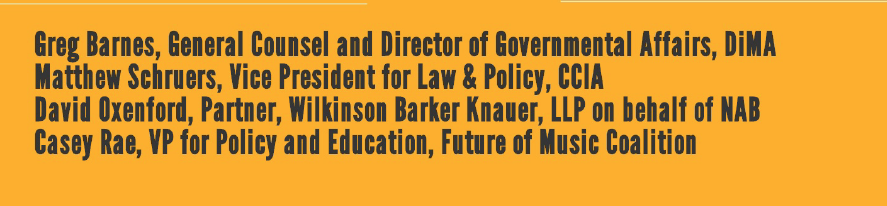
1.  How Much Longer Will The Government Throttle America’s Innovators?   Whatever the rationale once was for the ASCAP and BMI consent decrees, it is long lost in the dustbin of history.  Let’s be clear–the National Association of Broadcasters, the Digital Media Association, the Computer and Communications Industry Association, the Consumer Electronics Association and their overlapping membership and boards of directors want the Congress to think that this dispute is about “Big Music” versus innovation.

Somehow these companies with combined market capitalizations in excess of $2 trillion, companies including the richest…

View original post 871 more words