Mass NOI Update:  Christopher Sabec and Rightscorp Tackle the Songwriters’ Copyright Office Problem 

Mass “address unknown” filings to the copyright office allow companies like Amazon and YouTube to avoid paying royalties to songwriters. I have downloaded these massive files from the copyright office website and found that the “address unknown” filings are preposterous. For instance nearly the entire Beach Boys catalogue is listed as address unknown by one of the major Silicon Valley digital services. This may seem a little down in the weeds, but this new tactic employed by Silicon Valley firms has the potential to deprive songwriters of tens of millions of dollars in revenue each year. This looks like more loophole exploiting by Silicon Valley, in the same way they tried to exploit the pre-1972 sound recording copyrights.

Can’t this assholes just once play by the rules?  Most ordinary Americans play by the rules,  why can’ these guys?  Drunk on arrogance and power?

Fortunately this will likely end the same way the pre-1972 sound recordings fiasco ended. Kudos to Sabec for providing the tools to help songwriters stop this new outrage.

Music Tech Solutions

We’re going to assume that readers know the general background on the millions of “address unknown” NOIs filed with the Copyright Office under a loophole in the Copyright Act (Sec. 115(c)(1)).

The nutshell summary:  Starting April of last year,  Google, Amazon, Pandora and other on-demand digital services using compulsory licenses began filing very large numbers of “address unknown NOIs” for compulsory mechanical licenses with the Copyright Office.  These filings were implemented through a taxpayer funded customized electronic filing process that allows services to exploit songs for free–no royalty is payable.  The Copyright Office created this customized platform for these services about the time that the Copyright Office announced a reduced fee structure for this customized electronic filing process that increases the burden on songwriters.  (Even though Pandora has yet to launch its on-demand music service, Pandora appears to have served the Copyright Office with well over 1,000,000 address unknown…

View original post 1,386 more words

Without Music Licenses Facebook Can’t Pursue Long Form Video, Should Investors Say #F*ckTheZuck?

6-richest-men-in-the-world

Should investors and songwriters join hands and sing a rousing chorus of #FuckTheZuck? 

Facebook appears to have no licenses for music.  No sync licenses, no mechanical licenses, not even public performance licenses.  Yes, the world’s 6th richest man apparently thinks he doesn’t need music licenses for the world’s largest media company.  The Zuck seems to be in utter denial that it hosts hundreds of thousands if not millions of music videos.  Is this dude only surrounded by sycophantic “yes” men/women?  How could he not know he needs to pay artists? (Ed. Note:  Maybe a habit he picked up from Sean Parker?)

We artists may complain about the rates we get from YouTube, but at least they admit they need licenses!   Look if small shops,  music venues and small webcasters can get licenses, why doesn’t the Zuck?  Tech firm exceptionalism? Arrogance?  Sheer ignorance?  Either way this is absolutely shameful.   How is this any different than a luxury hotel billionaire stiffing refusing to pay subcontractors?

But it’s not just artists that are screwed by The Zuck’s refusal to license music and pay royalties, investors and shareholders are likely to suffer as well.  Many investors and analysts are beginning to speculate that Facebook may have peaked or plateaued in value.   Here’s a quote from a Wall Street Journal article titled Have We Seen Peak Facebook? 

“To achieve its next leg of growth, it must win over ad dollars from TV. Facebook has been promoting its live-streaming capabilities and is testing a new video-ad format that would insert ads into the middle of live videos. The company is also developing a video-centric app for TV set-top boxes and is discussing licensing long-form TV-style programming from media companies, The Wall Street Journal reported. But Facebook faces stiff competition for content and viewing hours from traditional TV and more established video-streaming platforms.”

It’s simple,  in order for Facebook to justify it’s lofty stock price (as measured by forward P/E ratio) it needs to get its hands on some professionally produced video from real media companies.  And generally this content has music in it.  And when Facebook reproduces the video content that contains music, at the very minimum they will need a public performance license!   Unless Facebook wants to limit itself to “long form content” with low grade royalty free “library music” it will have to get music licenses.  It can’t pursue a serious video strategy that gets TV ad dollars without these licenses.

Until Facebook grows up and starts paying royalties to songwriters investors should be very careful.


Musicians Action Group Submits Comments To Judiciary Committee On Copyright Reform

Musicians Action is a participatory democratic grass roots organization dedicated to public direct action to support economic justice for working artists in the digital domain.     Here is the text of our comments on copyright reform to the House Subcommittee on Courts, Intellectual Property and the Internet.


January 30, 2017

The Honorable Bob Goodlatte

Chairman, Committee on the Judiciary

United States House of Representatives

2309 Rayburn House Office Building

Washington, DC 20515


The Honorable John Conyers

Ranking Member, Committee on the Judiciary

United States House of Representatives

2426 Rayburn House Office Building

Washington, DC 20515


Re: Policy Proposal for Reform of the U.S. Copyright Office

Dear Chairman Goodlatte and Ranking Member Conyers,

We write in response to your request for written comments on the white paper entitled “Reform of the U.S. Copyright Office” issued on December 8, 2017 by the U.S. House of Representatives Judiciary Committee. We appreciate the opportunity to offer our views on this important process and we are grateful for your willingness to consider our comments.

Musicians Action is a participatory democratic grass roots organization dedicated to public direct action to support economic justice for working artists in the digital domain. The organization is comprised exclusively of working musicians. We have come together to present the voice of working artists. We exist for one purpose, and one purpose only—to inform legal policy discussions about how the decisions being made affect our livelihoods and ability to create, and to highlight the importance of modern and effective copyright protection to our ability to sustain ourselves and to fuel our creative output. Our website is available at http://musiciansaction.org.

We wish to comment on three of the issues outlined in the policy proposal for copyright reform.

The Register of Copyrights and Copyright Office Structure

The proposal recommends that the U.S. Copyright Office remain part of the Legislative Branch where it can provide independent and timely advice to Congress. We fully support the proposal that the Copyright Office have autonomy over its budget and technology needs.

More specifically, we believe that the Copyright Office should not fall under the general oversight of the Librarian of Congress. We believe that it should be removed from the Library of Congress so that it can function properly as an independent institution serving the public interest and immune from the influence of what we believe to be a misguided Library of Congress.

First, we view the recent removal of Register of Copyrights Maria A. Pallante by the new Librarian of Congress Carla Hayden as inappropriate. The unprecedented “reassignment” carried out by the Librarian of Congress in our view reflects special interest interference in governance at the highest level. It has destroyed our trust in the Library of Congress as an institution capable of properly serving Congress or functioning in the full interest of the American public.

Second, the subsequent posting online by the Library of Congress of a public survey to solicit input on the knowledge, skills and abilities required for the position of Register of Copyrights was in our opinion also an exercise in bad judgment and it undermines confidence in the authority of the Library of Congress in matters relating to copyright. We are alarmed that the Library of Congress posted a public survey like this that invites manipulated comments and robotically generated replies. It is well-known that technology corporations and their supporters are adept at influencing the public, particularly younger people with no knowledge or awareness of the issues in question, to follow suggestions to join petitions and submit robotic comments, such as they did during deliberations on SOPA / PIPA in January 2012, and more recently on April 1, 2016, when they overloaded the regulations.gov website with 86,000 sets of identical comments, crashing the system and making it impossible for people to file real comments by the deadline.

We are deeply concerned about the assumptions underlying this survey as it relates to public awareness of what the Register of Copyrights is, does, should be, or should do. The number of people who have adequate knowledge of the role of the U.S. Register of Copyright and the legal and policy context in which she works, and who are thus capable of sending a thoughtful reply, is small. The survey invites any member of the public over 13 years of age to participate; in actuality, there is no way to even confirm that a participant is over 13. We believe that this survey is subject to tampering and misrepresentation.

Also, questions arise as to whether and how the results of this survey can be used in public policy decisions or by the Library of Congress at all. As recently posted on The Trichordist blog, in a 2010 memo generated by the Executive Office of the President, Office of Management and Budget stated:

“Because, in general, the results of online rankings ratings, and tagging (e.g., number of votes or top rank) are not statistically generalizable, they should not be used as the basis for policy or planning.”

The fact that a survey is being conducted in this manner is troubling, and in our view it is evidence of faulty judgment at the Library of Congress. It indicates the inability of the Library of Congress to manage the issue of copyright law and to administer the U.S Copyright Office. We are concerned about the lack of common sense behind this survey and believe that it is critical to restore the integrity of the legislative process and the administration of copyright by removing Copyright Office from the Library of Congress where it does not belong.

Third, we observe that libraries as organizations have aligned with the interests of digital technology corporations against the interests of creators and other copyright holders. To the extent that the Library of Congress has authority over the Copyright Office, we believe that our interests will not be fairly served.

We ask Congress to resist the pressure of special interests who would destroy the integrity of the Copyright Office’s historic mission and its ability to administer the copyright law and to provide impartial expertise on copyright law and policy. The Library of Congress should function as a library and do what libraries do, and leave matters of copyright to Congress and the Copyright Office.

We agree with the proposal that future Registers of Copyright should be subject to a nomination and consent process with a 10-year term limit, subject to potential re-nomination, and that new advisory positions be created, including Chief Economist, Chief Technologist, and Deputy Register.

Information Technology Upgrades

We support the IT modernization plan developed by the Copyright Office and the white paper proposal for a quick rollout of the plan. We welcome the idea that the Copyright Office will maintain a searchable digital database of copyrighted works and copyright ownership information that will facilitate fair licensing of copyrighted works. The lack of an effective licensing framework and the lack of a comprehensive database of copyright information has had a negative impact on the ability of creators and rightsholders to negotiate with those who wish to use their works and to be fairly compensated for use of their works. We strongly support efforts that will contribute to the development of an effective licensing environment for all types of works so that creators and rightsholders will be properly recognized, particularly in the online environment, and so that the economic value of their works will be restored.

Small Claims

In the course of the study that led to the report by the Register of Copyrights on Copyright Small Claims, the U.S. Copyright Office received numerous comments from individuals and organizations representing the interests of creative people who face insurmountable challenges in enforcing legal rights that constitute the basis for their livelihoods. On the one hand, these rights are granted by copyright law but other hand, they are taken away by the inability to enforce them. In his letter to former Register of Copyrights Maria Pallante requesting the study, Representative Lamar Smith, Chairman, U.S. House Judiciary Committee wrote: “On an individual level, the inability to enforce one’s rights undermines the economic incentive to continue investing in the creation of new works. On a collective level, the inability to enforce rights corrodes respect for the rule of law and deprives society of the benefit of new and expressive works of authorship.”

This is the situation that we, as working musicians, face in the current environment where our rights, and enforcement of our rights, are being summarily denied due to a legal system that places the burden of infringement on us and provides us with no realistic mechanisms to address it. The vast majority of artists have limited incomes and we do not have the resources to engage in complex and expensive litigation when we find the value of our works decimated by infringement. What is most egregious is that the ineffective notice and takedown procedures and the special privilege “safe harbor” protections for corporate hosting platforms in Section 512 of the copyright law actually encourage mass infringement of our works.

We are grateful that this Congressional committee understands the importance of implementing a small claims system that will enable copyright owners to pursue small infringement matters and related claims, and provide a mechanism to ease the devastating impact of infringement. We would like to reinforce the urgency of this measure.

We also encourage Congress to amend the “safe harbors” for internet and online service providers in Section 512 that strip artists of their livelihoods and that enrich major technology corporations in what has become one of the most disgraceful episodes in the history of U.S. law. We urge Congress to end the massive injustice wrought by the safe harbors of Section 512 that were not intended by Congress when it implemented the DMCA. Testimony from the Section 512 Study being conducted by the Copyright Office provides more than adequate evidence than the business model of user-generated content based on stolen content should be eliminated, as outlined in the submission of the Music Community.

We also ask Congress to amend the unfair and ineffective notice and takedown regime that has developed into a massive copyright exception for wealthy digital corporations, and transform it into an enforceable system of permanent “staydown” to enable creators and rightsholders to exercise their rights. One example of many that could be offered to illustrate how the current system fails musicians is Facebook, the sixth largest company in the world by market capitalization. By any measure, Facebook is the world’s largest media company. It hosts millions of music video performances a day. Yet Facebook does not pay any fees to songwriters. It hosts infringing works posted by the public as a business model, profiting from our works and positing this “service” as a benefit to the public.

Too many observers posit a false division between the interests of the public and those of working creators, and many of those who do so are seeking to defend exploitative practices that benefit them economically, directly at our expense.

We thank the United States House of Representatives Judiciary Committee for your efforts to reform the statutory framework for the U.S. Copyright Office and stand ready to provide further comments at your request.

Respectfully,

David Lowery, Songwriter and Musician On behalf of Musicians Action

Was Daniel Ek Really Joking When He Offered Obama Job at @Spotify? Was Obama Joking When He Asked For One?

screen-shot-2017-01-25-at-8-48-20-pm

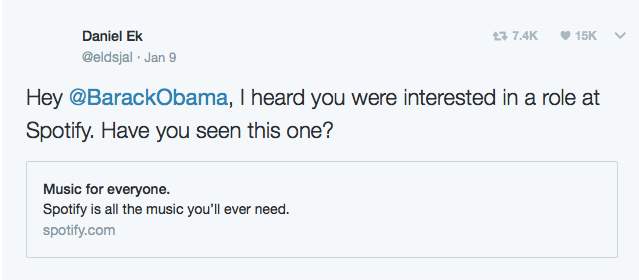
Was Daniel Ek really joking when he offered a job to former President Barrack Obama?  In 2014 Spotify hired former Obama/Clinton official Jonathan M Prince to be the head of comms and public policy and ever since then we’ve noticed a certain “coziness” between Obama and the dominant player in the streaming market.  Cozy?  Sure: POTUS playlists;  this piece in Billboard where he says he’s “still waiting for his job at Spotify;”  and then of course he sic’ed the DOJ Antitrust division on both  Apple Music and songwriters in ways that greatly benefitted the streaming giant.

And here is Jonathan Prince begging his former boss to take a job at Spotify:

screen-shot-2017-01-25-at-9-01-10-pm

And in case that wasn’t clear enough.  Prince tweets again:

screen-shot-2017-01-25-at-9-00-28-pm


I know most musicians supported the president’s two campaigns, and this is probably upsetting to read but doesn’t this seem a little weird? And facts are facts.  The last two years of the Obama administration they have been #TeamSpotify all the way.  Imagine if George W Bush had joked that he was “waiting for his job at Halliburton?”  in his final days at the White House?  Imagine the outcry.

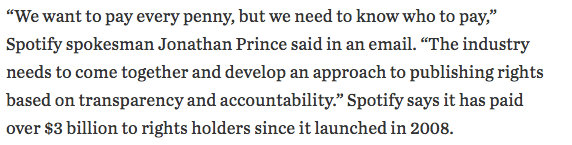
Come to think of it,  this is worse than Halliburton because there is the little matter of the $200 million plus class action songwriter lawsuit.  Spotify is being sued for not licensing songs and failure to pay royalties to millions of songwriters.   They don’t even deny it:

screen-shot-2017-01-25-at-9-53-32-pm

(BTW this is total nonsense from Prince.  If Spotify doesn’t know who to pay its because Spotify didn’t bother to get licenses for those songs. Prince should know it’s not the “industry’s” duty to come together and bail out his multi-billion dollar Goldman Sachs backed employer.)

Here is the former head of Spotify music licensing admitting TO THE COPYRIGHT OFFICE in 2015 they were aware of the problem.  Yet they continue to this day to play music they haven’t licensed and continue to not pay songwriters.  For all practical purposes they are an outlaw corporation.

Hypothetically, let’s say a major airline had illegally refused to pay its baggage handlers,  or a luxury hotel chain had illegally failed to pay its sub-contractors, and thousands of workers were owed hundreds of millions of dollars, would Obama “joke” about going to work for one of these companies?  I think not.

This guy (Obama) turned out to be just as incurious about the financial plight of middle class workers as his predecessor.  How does Obama not know how shitty Spotify is to songwriters?  Or maybe he doesn’t care and just wants to cash in his Spotify chips. (BTW this comes from a guy who gave his campaign $2,500 in 2008.)

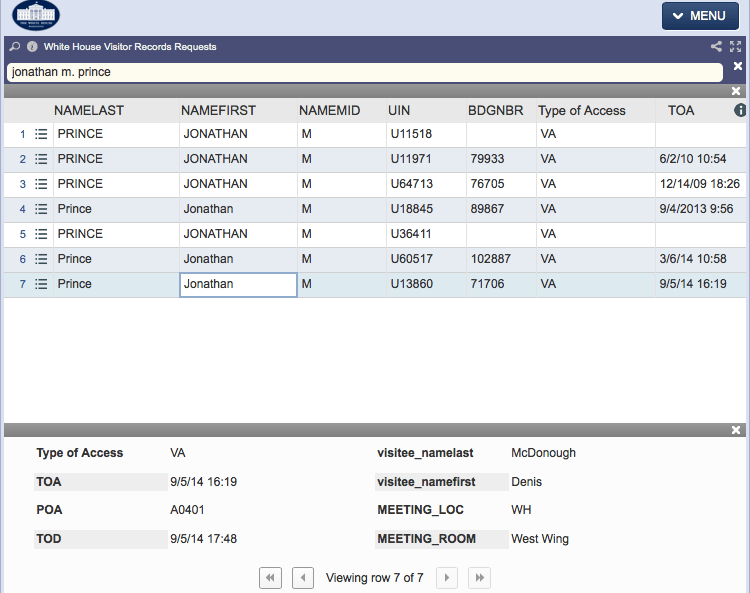
Oh and one last thing…  Here is Spotify’s Jonathan Prince visiting the White House immediately after taking the Spotify job.  90 minutes with Obama’s Chief of Staff on a Thursday afternoon?  Wow.    Wonder what they talked about…?  A little co-promotion between the office of the President and Spotify?  Maybe a summer playlist? Hopefully the job offer is simply a joke and there is not some sort of quid pro quo.  

White House Visits


Once Again Big Machine/Taylor Swift Lead the Way, This Time on YouTube

Our recent updated “streaming price bible” illustrates the terrible revenues from YouTube to musicians.  Using 2016 payments for a mid sized indie catalogue we estimated that YouTube pays $0.00069 to performer and label per stream.  10,145 spins to generate the revenue created by the sale of one album.

This is well below rates paid by Spotify ($0.00437) and Apple Music ($0.00735).

But the real shocker is this:   YouTube  represents 21.7% of all the catalogue streams but only 3.81% of all revenue.  But this also suggests a strategy.   With revenue at 3.81% who needs these guys right?  If labels and artists managed to pull all their tracks from YouTube the worst that would happen is we would lose a mere 3.81% of revenue.  But in exchange we could drive consumers to better paying services like iTunes an Spotify.   It’s possible this strategy could increase overall revenues.

Now comes this press release from Taylor Swift’s label Big Machine:

Big Machine Label Group will soon launch a proprietary digital video platform that gives fans direct access to content featuring the label’s superstar roster of talent.  Big Machine TV (www.BigMachineTV.com) will offer music videos and behind-the-scenes content when it goes live in February, later hosting exclusive interviews, announcements, contests and more. All of the label’s artists, including superstars Taylor Swift, Tim McGraw, Reba, Florida Georgia Line, Rascal Flatts and Thomas Rhett, will have individual channels on the platform that allow viewers to seamlessly search for desired content for an immersive online fan experience.

Holy shit!  Are Swift and company going after YouTube by creating their own video streaming service?   It’s too soon to know whether or not it will be successful, but this is the kind of in-your-face tactic we need to fight back against YouTube.    YouTube has been ruthless towards musicians.  They have fought fair pay for creators on every front: the courts, the congress and even proposed trade agreements.

It’s time we turn the tables on them.

Class Action by Artists Against Distributor For Accountings Under Direct Deal With SiriusXM

As labels cut more and more deals that bypass SoundExchange expect to see more of these lawsuits.

Music Technology Policy

The string trio Time for Three and S’More Entertainment filed a class action yesterday (Jan 17) in New York federal district court against “Defendants Entertainment One GP LLC and Entertainment One U.S. LP, doing business as E1 Entertainment and/or Koch Entertainment LP” for a variety of claims relating to the defendant’s direct deal with SiriusXM.

The class action complaint describes the suit:

4. In violation of the Class Member Contracts, Defendants entered into secret negotiations and agreements with satellite radio provider Sirius XM Radio (“Sirius XM”), for the exploitation of Plaintiffs’ and the Class Members’ intellectual property. Defendants have systematically failed to account for any revenue, or pay any portion of the revenue generated from the exploitation of the Class Members’ Musical Works on Sirius XM under this agreement.

5. Plaintiffs bring this nationwide class action on behalf of themselves and similarly situated Class Members arising from Defendants’ failure to…

View original post 594 more words

#F*ckTheZuck: It Appears the World’s 6th Richest Man/Company Does Not Pay Songwriters


6-richest-men-in-the-world

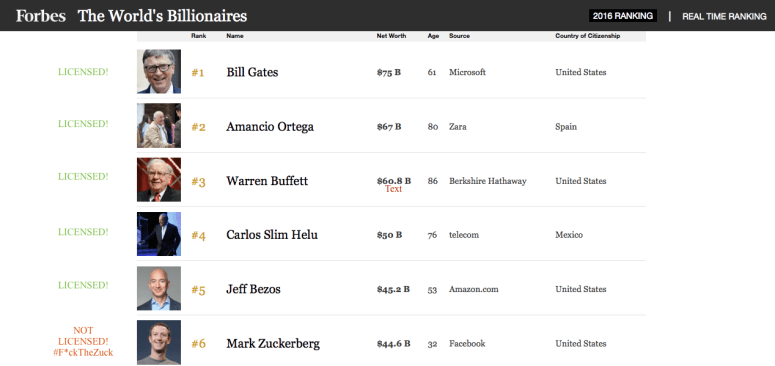
Mark Zuckerberg is the 6th richest person on the planet. Facebook is the 6th largest company in the world by market cap.  By any measure Facebook is the world’s largest media company and hosts millions of music video performances a day.   Yet unlike every other media company that regularly hosts and performs music it appears Facebook does not pay any fees to songwriters.  Word on the street is the company knows this is likely illegal yet they are refusing to get licenses.

Over the last few years musicians and songwriters have had a lot to say about paltry royalties (and non payment)  from digital services like YouTube and Pandora. But at least these companies bothered to get licenses and (most of the time) pay songwriters.   Facebook apparently flat out refuses to pay and thinks they don’t need licenses.

Looked at another way, of the 6 richest men in the world only The Zuck is not paying for music licenses at his core business.

#1 Bill Gates:  Microsoft licenses music through it’s Groove and XBox services.

#2 Amancio Ortega:  Main business is the retail clothing giant Zara. The company pays for licenses to perform music in all its stores.

#3 Warren Buffet:  Buffet’s Berkshire Hathaway has extensive media and broadcast holdings that all pay fees to songwriters.

#4 Carlos Slim:  The Mexican billionaire offers licensed music through his core mobile telephone business. In addition he owns various entertainment companies that license music.

#5 Jeff Bezos:  Amazon has extensive licensed music offerings.

#6  Mark Zuckerberg:  Facebook does not pay songwriters for music videos hosted on the site.

Can you say robber baron? #F*ckTheZuck


Artificial Scarcity Makes Itself Scarce

screen-shot-2017-01-08-at-12-27-46-pm

The use of the term “artificial scarcity” by Reddit users has declined dramatically since its peak in 2008. (Source FiveThrityEight.com)  

The use of the term “artificial scarcity” is becoming increasing rare in generalized discussions concerning copyright on the internet.  At least on Reddit as measured by FiveThirtyEight.com   It’s a positive for artists that this pseudo scientific argument appears to be dying.

Artificial scarcity is one of those dubious (and more dubiously applied) concepts from economics that has been used for the last decade to direct moral opprobrium at individuals and companies that hold rights to intellectual property in some form: music, books, films, patents etc. The idea is that the owners of intellectual property control the copying and production of each additional copy by authorizing only certain websites or manufacturers to reproduce a good, thus creating “artificial scarcity.” In the case of copyright, the argument is often made that file sharing and torrenting websites are “naturally” making available a good that has been “artificially” made scarce.

And of course like artificial coloring and artificial sweeteners anything artificial is bad, right?

The problem with this argument should be obvious:  the goods in question are generally not scarce at all. My recordings that are legally licensed to Apple’s iTunes may be infinitely reproduced by the terms of the contract. Like all recording artists I make no restrictions on the number of copies Apple may reproduce. When music distribution was largely confined to the physical reproduction of vinyl it wasn’t scarce either. My independent record label was happy to produce as many copies as the public demanded. Consequently properly licensed and reproduced music is not scarce and never was. This basic fact seems to have gone unnoticed by those who decry the “artificial scarcity” imposed by copyright.

Sure, if a consumer is unwilling to pay for a recording there is a sort of “scarcity.” My recording may be scarce in the user’s music library. But this is a condition the consumer has freely imposed on themselves. Isn’t it? Perhaps the consumer is unable to pay for the song?  The problem then is not that my song is “scarce” the problem is that money is scarce for that consumer. It seems stupid to have to note this but: this is not a condition imposed by copyright!

The dubious concept of “artificial scarcity” as applied to copyright doesn’t even seem to rise to the level of pseudo science. It is not logically coherent. It hardly seems like something worthy of review and discussion by academic economists and law professors. Yet,look at all the papers a Google Scholar search produces for “copyright and artificial scarcity.”

Fortunately the argument seems to be dying.  Good riddance!

++++++++++++++++++++++

Rather than “artificially scarce” a more accurate description of a copyright protected work is a non-rivalrous good that is also excludable.  That is, making a copy of my song does not make less available elsewhere or somehow diminish or degrade preexisting copies.  And since it’s a private good I can exclude others from using or reproducing it.    Sometimes economists call this type of product a “club good.”  Unlike the dubious application of “artificial scarcity” to copyright there are legitimate debates as to whether some forms of club goods are harmful to the greater good.   For example a company creates a life saving medicine but poor people are unable to afford this medicine.   Clearly there is a real human and economic loss if thousands of people needlessly die.  One solution of course is to allow other manufacturers to make very cheap generics of the drug, thus effectively making the good non-excludable.   I believe this is what  happened with life saving drugs used to treat HIV in poor countries in Africa.

The problem comes in when economists (and especially law professors) try to assume a generalized economic loss (“dead weight loss” no pun intended)  for all forms of club goods.  Some critiques of club goods  are well thought out. But in my experience when these arguments are applied to cultural goods they fail.  In it’s most common formulation critics argue that profits above and beyond the fixed and marginal costs of producing club goods are creating a dead weight loss.   The problem is these arguments rarely take into account the cost of the “failures.” Many songs, recordings, books and other works never even make it to market!  I work on at least a dozen song ideas for every one that I finish.  I often spend days  on these before I abandon them. Further for every professional working there are thousands of aspirants producing dozens of songs hoping to one day become at least a semi professional.  Without accounting for this “hidden” effort it is impossible to calculate a dead weight loss.

If such a loss even exists.

Considering the fact the culture business is so aspirational, I suspect if it could be accurately measured copyright incentives would prove to provide a valuable surplus to consumers.


Does Science Fiction Writer and EFF “Special Advisor” Cory Doctorow Profit from Corporate Music Piracy?


Cyber Fiction: Cory Doctorow and the rest of EFF are genuinely fighting for the rights of individuals, not to protect the profits of their corporate Silicon Valley benefactors.  Photo Author and Attribution  Ed Schipul under Creative Commons Share Alike 2.0 License.  

Cory Doctorow the Canadian science fiction writer, Boing Boing editor, and creepy grown up Disneyland enthusiast, is also a special advisor to the Google funded Electronic Frontier Foundation (the world’s first “progressive” anti-civil rights organization).   One of our colleagues recently noticed this product for sale in the Boing Boing store.  For $9.99 Boing Boing sells software it claims can rip ANY YouTube video presumably even illegally uploaded songs and movies from YouTube.  Yeah sure, we know there are plenty of sketchy websites that allow you to do similar things (and also infect your computer with malware).  But generally these sleazy websites don’t add insult to injury by charging a fee and NOT sharing it with the creators of the work.  Since Boing Boing sells this software in its store it is fair to assume that Boing Boing and hence Doctorow eventually get a cut.  Creators of the music or videos being downloaded?  Nada.

There is also the question of whether the software being sold by Boing Boing simply “records” the YouTube streams (an important legal distinction).   Over the last couple of years we have tested many of the so called “YouTube to MP3 converters “and they appear to simply  host the mp3s/mp4s  themselves, making these services indistinguishable from full blown illegal cyberlocker sites like Hotfile or Megaupload  The conversion from YouTube is completely fake, simply a ruse to hide the fact it’s really a cyberlocker.  The YouTube URL is only used to identify the track and seems intended to act as a MacGuffin for journalists. Reports show the Boing Boing software seems to make the conversion fairly quickly. This is pure speculation but I would wager at least even odds that this software sold by Boing Boing hosts or caches the most popular content on a “friendly” or commercially related server.   But why speculate.  I know we have enough tech savvy  readers out there to test this software.   Is a $100 bounty enough?

It’s bad enough that Google/Youtube (the 2nd wealthiest corporation on the planet” has built a music streaming service on illegally uploaded music. But now we have a Google lapdog seemingly profiting from this decidedly non-progressive activity. You’d think it would bother someone like Doctorow who left the UK simply because a Tory was elected.  But then again aren’t all progressives completely full of shit these days? The old cliche was conservatives shilling for big banks and tobacco companies, now it is the modern progressive shilling for technology companies. Anyway what’s the difference?  It’s the same old crony capitalist pay to play racket, they should all be taken down.

The fact that Doctorow continually dresses up his activities as progressive, vaguely revolutionary or for the benefit of “the public” only makes him more contemptible.

Here’s the software that Boing Boing is gleefully pitching

Screen Shot 2017-01-02 at 7.40.30 PM.png

Here is how it’s described on the Boing Boing website:

“YouTube is a massive video and music library, but its only significant flaw is that you need internet access to use it. Well, not anymore. With Softorino YouTube Converter, you can download and import YouTube videos directly into your iTunes, Mac or iPhone. No Wi-Fi? No problem. It’s as easy as copy and download, and all your favorite content will be readily available on your computer or mobile device in no time.

Import files to iTunes as MP3, MP4, or M4A w/o losing quality
Get automatic clipboard monitoring so you don’t have to paste a link–just copy it
Download from Facebook, Vimeo, Instagram, YouTube & more
Skip the ads when you watch offline
Transfer videos & music to your iPhone, iPad or iPod Touch w/ ease
Watch or listen in high quality 4k, 1080p HD video & 192kb/s music”


GhostShip: Mourn the Dead: Fight Like Hell For The Living- Guest Post by Marc Ribot

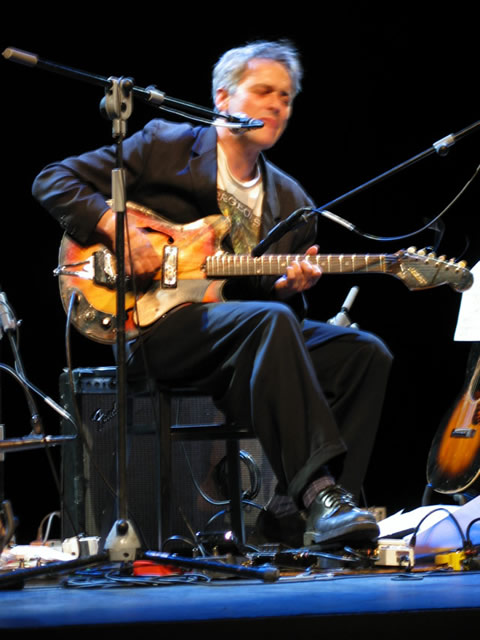
Marc Ribot is an American Musician a member of NYC artists rights group MusiciansACTION http://musiciansaction.org/.   Photo by Webb Traverse at English Wikipedia (Transferred from en.wikipedia to Commons.) [Public domain], via Wikimedia Commons


The initial horror evoked by Oakland’s GhostShip fire is now turning into self questioning and anger at those who placed the victims in harms way.

Yes, there will be individuals —landlords, inspectors, event organizers —held to account.

But the political context of this tragedy is that artists — not only musicians, but graphic artists, photographers and other content creators–have been placed in a condition of risk and precarity by Silicon Valley’s trashing of the copyright laws— a mass expropriation of value which turned what was once an important source of income into an expense for working artists.

Yes, marginal, new, and unsuccessful artists have long been precarious. But Silicon Valley’s implementation of a business model earning itself hundreds of billions via the ad based exploitation of copyright infringing work has marginalized an increasingly large number of working “content creators”, driving many into substandard housing, work spaces, and multiple jobs; and out of health insurance, safe housing, and sleep.

The geographically marginal location of the GhostShip lofts— in Oakland’s industrial zone, far from the nightlife centers of SF, is not only a metaphor, but a sign and

symptom of a wider and deeper phenomenon: the economic marginalization of working artists.

The GhostShip’s Oakland location — right across the Bay from the SV corporations which drove them into fatal precarity — is also more than metaphor. These artists were driven out of less precarious situations by rent increases. San Franscisco real estate has gone through the ceiling as a direct result of the huge wealth of Silicon Valley corporate execs, investors, financiers, and employees.

Rage at this Silicon Valley driven gentrification has been local news for almost a decade. Conflict between local residents and SV employees broke into violence over Google’s usage of public bus stops for their private busses. Leftists may not consider the local residents’ choice of an epithet (“dot.communist”) the ideal metaphor for evil, but it was meant to express the contempt Bay Area residents felt for the tech industry yuppies who drove them out of their homes and work places.

Working artists were by no means the only San Franciscans displaced. But added to the injury of artist displacement was the insulting knowledge that the money enabling their displacers had been generated by their own labor, expropriated via ad based profits on infringing files of their own work, files often posted and used without their consent or remuneration.

Silicon Valley propaganda outlets like the Google funded “Electronic Frontier Foundation” have long taken the position that the 60% collapse of the record industry caused by infringement was only hurting rich major record company exec’s, that somehow you could suck 7 billion a year out of an industry without hurting the working artists — and engineers, and indie label staff, and photographers/graphic artists/designers etc — who worked with them and lived off the sales of their music.

So now the precarity caused by these policies has hurt real people. And the only thing unusual about those hurt or killed in the GhostShip fire was that, unlike the hundreds of thousands of individual, isolated disasters caused by structural precarity, this hurt made national headlines.

Our personal disasters —the broken relationships of those working two jobs, or forced onto the road because that’s all that’s left, the deferment or avoidance of family due to poverty….the dislocations, evictions, foreclosures — will never be on CNN or Fox News. But we all know people, or are people, who have suffered them.

“Precarity” describes the social dimension of supposedly “natural” disasters: the increased risk of death, injury, and misery for those pushed to the social edge. The cause of death may be attributed to natural phenomena: fire, flood, earthquake. But the degree of risk is created

socially: politically, legally, economically. San Fransisco’s “Loma Prieta” earthquake of 1989 registered 6.9 on the richter scale and resulted in 63 deaths. The 2010 Haitian earthquake was a similar magnitude (7.0), but resulted in over 160,000 deaths. The earthquake didn’t kill: substandard housing did. It’s poverty, not nature, that places people in substandard housing. And it’s the lack of political rights and power that condemn populations to poverty.

The precarity pushing ‘content creators” to the social edge is entirely political, caused not by digital technology itself, but by:

1. the special privilege “Safe Harbor” clauses of the Digital Millennium Copyright Act of 1997-98, which prevent artists from seeking damages from online corporations, even those, like YouTube, whose business model is based on the mass infringement of artists rights.

2. The 2ndary boycott provision of the Taft Hartley law which limits the target of “collective economic (ie: union) action” to the immediate direct employer (meaning that almost all corporate profiteering from ‘content’ is off limits to labor action by almost all producers of content).

Many people know that Taylor Swift withdrew her material from Spotify to protest its low rates of pay. Fewer

know that if Ms. Swift had asked other artists to join her, or the public to boycott, she could have been sued for everything she ever made or ever will make. And if a union had made that call on her behalf, they could have seen all their assets, including pension funds, seized, and their officers arrested and placed under gag order.

3. Reagan era court decisions limiting the scope of anti-trust law, even when corporations are clearly using their “monopsony” power to crush producers.

Rip, Mix, Burn

The february 2003 edition of Wired Magazine celebrated the death of the recording industry with a cover (referring to Charles C Mann’s accompanying “The Year The Music Dies” article) consisting of a famous graphic image of the Hindenburg disaster, in which hundreds of passengers were burnt to death in the ill-fated zepellin’s launching.*

This graphic image was accompanied by the text “Rip, Mix, Burn”, a slogan borrowed from an Apple campaign to both advertise their product as a tool for copyright infringement and rationalize the harm done to artists by presenting a for profit corporate campaign as anti-corporate direct action. Apple profited greatly from sales to consumers using their product precisely as suggested.

Wired’s advertisers are often tech corporations reaping similar profits.

The clear implication of Wired’s gleeful use of the Hindenberg disaster photo… is now obscene.

We now know that “the music” didn’t die in 2003. Musicians still make music (using similar technological tools to those in use since the 90’s). People still listen to the music musicians make. Their listening is still mediated by corporations, and still produces (now more than ever) profits for those corporations. Only now those profits aren’t shared by the people who produce them. This isn’t ‘creative destruction’, or ‘technological unemployment’: its exploitation pure and simple.

Thanks to the Safe Harbor clause of the Digital Millennium Copyright Act, and the 2ndary boycott provision of the Taft Hartley Law, content creators have been prevented from fighting this exploitation individually and collectively.

Denied legal means of fighting back, politically swamped by the massive lobbying power and social media manipulation of Silicon Valley corporations, artists have been pushed into economic precarity and risk.

As is so often the case with the violation of rights, violence against the body is the inevitable consequence.

M. Ribot

The author is a member of NYC artists rights group MusiciansACTION http://musiciansaction.org/.