No, The FCC Should Not Have the Power to Cancel Contracts

Some casual reading on set top box proposal. But it’s important to note that the issue here is remarkably similar to the DOJ 100% licensing rule.

1) non-legislative likely unconstitutional attempt to establish what is essentially a statutory license.
2) interferes with private contracts.
3) comes at the behest of Google int the 11th hour of Obama administration.

How Songwriters Could Legally Strike and Bring the Entire Music Licensing System Down

You may not realize this yet but the new 100% DOJ licensing rule, attempts to put an enormous financial and compliance  burden on BMI/ASCAP songwriters.  Read the rule folks. Within the next year we are required to indemnify our PROs and the services that use our songs, that our co-writers won’t sue if they start licensing 100% of a co-written song.  IF YOU HAVE  CO-WRITER AGREEMENTS THAT SAY EACH WRITER ADMINISTERS THEIR OWN SHARES YOU WILL HAVE TO RENEGOTIATE THOSE AGREEMENTS.

I have a remarkably small number of songs in my catalogue of 400+ songs that will require this fix.  But I estimate it will be a minimum $1,000 in legal fees for each of those agreements.  If you are a professional songwriter in Nashville, instead of a performer/songwriter like me it is likely that you have a lot of co-writer agreements to modify. You could be facing tens of thousands of dollars in legal fees to renegotiate those co-writer agreements.

Fuck these people.  I’m sick of it. Aren’t you?

We tried to reason with these fucks and explain just how disruptive this 100% licensing bullshit was gonna be.

THE FUCKING US COPYRIGHT OFFICE TOLD THEM IT WOULD BE CHAOS.

Yet they didn’t’ listen.

The DOJ Antitrust Litigation Division Section III appears to be completely in the pocket of Google so they just went ahead and did it anyway.  Because it fucking helps Google, no one else. It is the only logical explanation.

Maybe we should bring on the chaos?  If songwriters are gonna be locked in a Kafkaesque nightmare with no due process, no appeal, no reasoning and no recourse?  Maybe we should bring the whole system down. Break the entire music licensing system.

Fortunately I think the DOJ overreach on this one may have given us the monkey wrench we needed.

See songwriters can’t really strike.   We aren’t considered laborers so we can’t form unions.  The closest thing we have to unions are our non-profit  “performing rights societies”  or PROs. The largest and most well known of these are ASCAP and BMI.   And these have been under “temporary” justice department consent decrees for 75 years,  basically because there was essentially previous threat of something like a strike.

Because we are not unions and we produce a good, if we collectively decided to withhold our goods I suppose the US Government (and Google controlled)  DOJ Antitrust Division Litigation Section III could come after us for collusion or some other trumped up charge.  And given their thuggish, corrupt and unconstitutional behavior since ex-Google lawyer Renata Hesse arrived to oversee this division you can bet they WOULD  come after us.

However I think the DOJ over reached on this one.  Here’s how we get away with it.

We don’t do anything.

Look at the clause below.

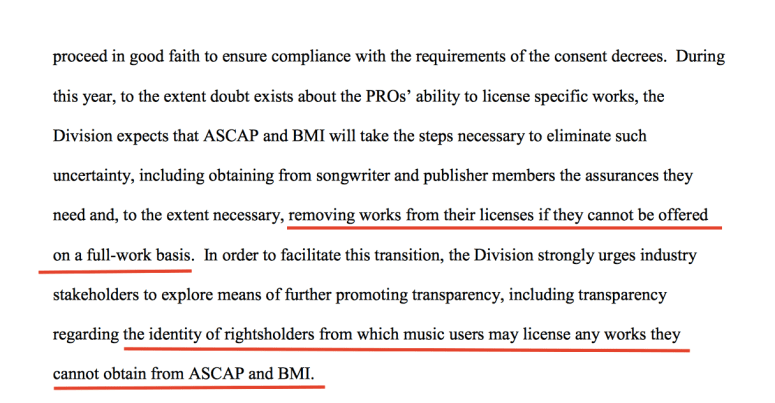
“To facilitate this adjustment and ease the transition to a common understanding, the Division will not take any enforcement action based on any purported fractional licensing by ASCAP and BMI for one year, as long as ASCAP and BMI proceed in good faith to ensure compliance with the requirements of the consent decrees. During this year, to the extent doubt exists about the PROs’ ability to license specific works, the Division expects that ASCAP and BMI will take the steps necessary to eliminate such uncertainty, including obtaining from songwriter and publisher members the assurances they need and, to the extent necessary, removing works from their licenses if they cannot be offered on a full-work basis. In order to facilitate this transition, the Division strongly urges industry stakeholders to explore means of further promoting transparency, including transparency regarding the identity of rightsholders from which music users may license any works they cannot obtain from ASCAP and BMI.”

You see even though this is a Kafkaesque nightmare, the DOJ still seems to realize they can’t go back in time and make previously legal private contracts between songwriters illegal.  Something to do with the constitution….   But they can require PROs to ask songwriters to give them “assurances” that there are no longer co-writer agreements that prevent 100% licensing.    But the DOJ can’t make us give those assurances.

What if we didn’t?  What if we did nothing?  Give no assurances and provided no information on co-writes and whether co-administration agreements exist that prevent full work licensing. Remember we are not legally required to respond.  And if the DOJ tries to force us to respond…well that is exactly how autocracies get started.

See here is the thing.  We call their bluffs.  This isn’t like we are dealing with the Counter Terrorism part of the DOJ, these are a bunch of pussy assed Harvard/Yale/Berkeley political appointees that would cross the street or lock their car door if they saw a musician walking down the sidewalk towards them.

Is the DOJ Antitrust Litigations Section III, really just gonna let all millions of songs in the BMI and ASCAP catalogues disappear from radio, tv, syndicated television shows, bars, jukeboxes, streaming services,  and webcasting services?  Especially considering many of these services are locked into four, six even eight year contracts with BMI and ASCAP.  There just went their cushy revolving door job at Sirius XM, YouTube or Cox Media!

We should just sit back eat some popcorn and enjoy the show.  Let’s make Renata Hess and the DOJ explain to music users what the fuck just happened.

DO NOTHING. MAKE THEM FIX IT.

@LThomasMiller: DOJ RELEASES OFFICIAL WRITTEN RULING REGARDING 100% LICENSING

To the barricades. What if we refused to comply? What if we withdrew our music from every PRO? We could bring the entire music licensing system crashing down. No legal music for TV, radio, streaming, YouTube, movies, restaurants, venues and bars? Maybe we should burn the whole fucking thing down. Let the DOJ explain to the public why there is no music.

Artist Rights Watch--News for the Artist Rights Advocacy Community

The below statement has been issued by NSAI Board President and songwriter, Lee Thomas Miller on August 4, 2016. 

CLICK TO THE READ THE OFFICIAL DOJ RULING

“I cannot emphasize strongly enough how ludicrous this DOJ ruling is. NSAI has had multiple conversations and meetings with the DOJ.

When I met with the assistant Attorney General, who is behind this, I graphically explained to her and her team the damage that the current, archaic music licensing and rate setting process is having on the songwriters. I then told her that her 100% licensing plan will threaten the last stream of income we have.

I am disgusted that they are proceeding with this hostile attack against the smallest business in America- the songwriter. Please know that we at NSAI will not be silent. We do not accept this.

Songs do not fall out of the sky. They are created slowly through…

View original post 128 more words

STOOPID: Restaurant, Bar and Venue Lobbyists Applaud DOJ Decision That Will Limit Available Music or Require Further Licenses

MIC Coaltion 8-15

(Performing rights organizations or PROs are unions of songwriters.  They are also licensing organizations that peform a valuable service to the public.  They allow a quick way for any business big or small to get a license to play music.  You’ve heard of BMI, ASCAP right? These are the main two PROs. There are also two other smaller ones SESAC and GMR.  But most of this blog concerns the DOJ rules that govern BMI and ASCAP).

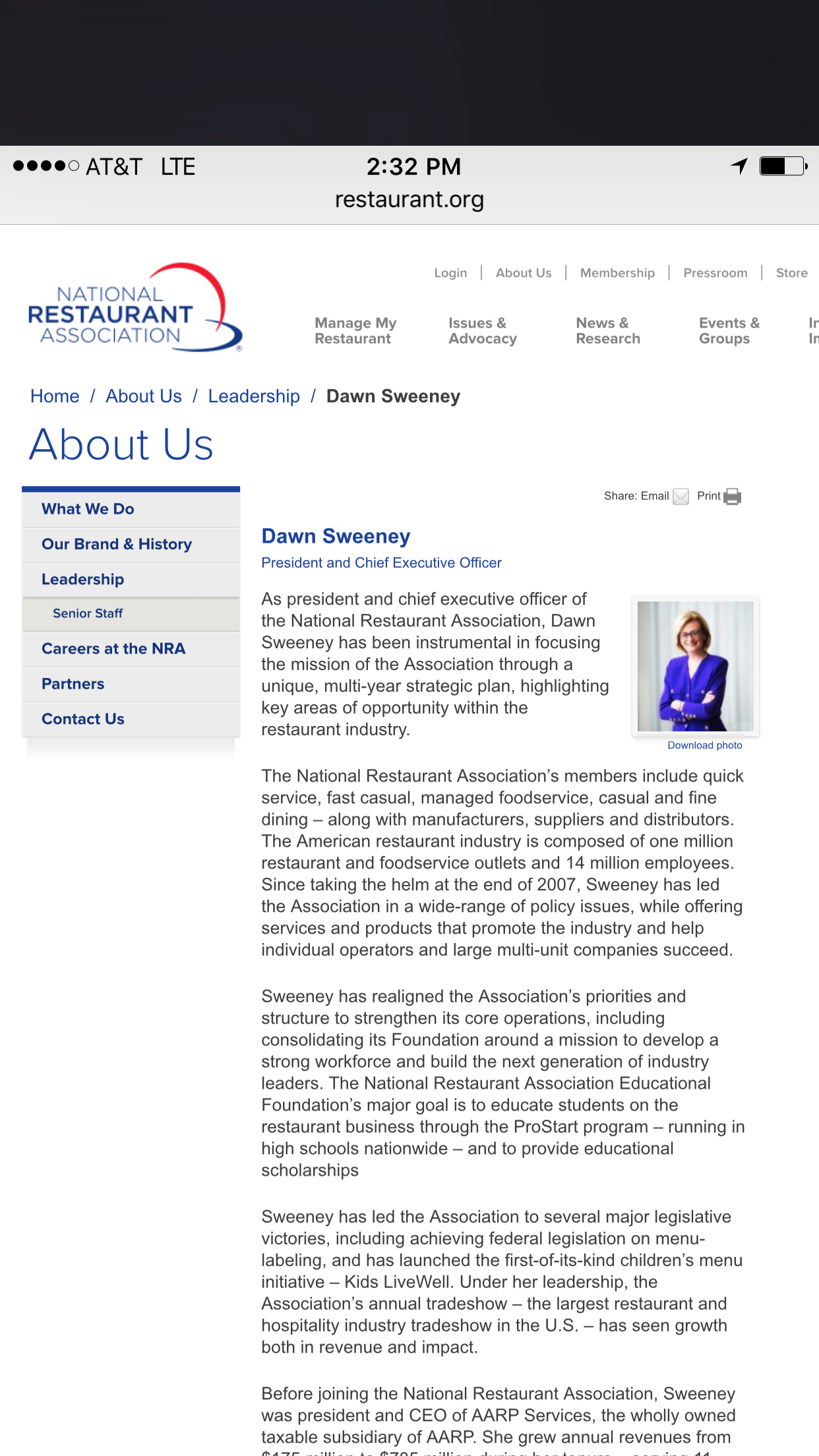
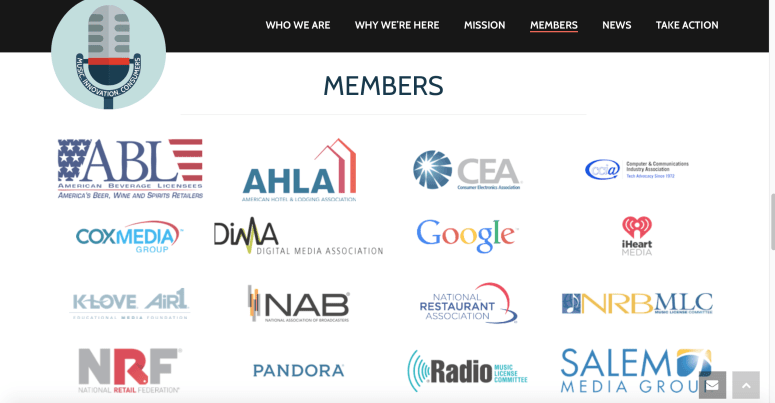
I’m gonna make this very easy for everyone to understand.  These are the companies and organizations that make up the MIC-Coaltion.   As a venue or restaurant your interests in music licensing are represented by National Restaurant Association, Alcohol Beverage Licensees or National Retail Federation. They are all members of this group.

As far as we can tell this was the only group (along with Google) that was pushing the DOJ to change song licensing from the historical and internally accepted standard of fractional licensing to “100% licensing.”   Or forcing a single co-writer to license the song for everyone else.
 

Screen Shot 2016-08-05 at 4.48.23 PM

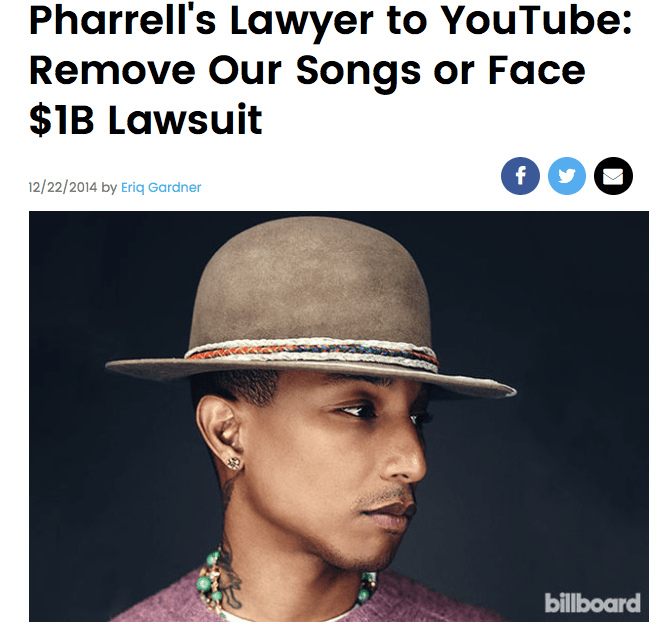
Google (the de facto leader of the MIC Coalition)  especially wanted songs to be licensed this way because of the threatened lawsuit above.  See Google could get a license to many of Pharrell (and other GMR artists’) songs, by getting DOJ to force his BMI and ASCAP co-writers to license songs. Clever right?  That’s why  Google formed this coalition right about the time this dispute began. And let’s not kid ourselves, Google formed this coalition  and drove the entire lobbying effort. 

Google to restaurants and venues:  “Kumbaya,  Let’s all work together to keep our songwriter royalty rates low.”

Translation: “Hey restaurants, bars and venues want to be human shields?”

Yes, in reality Google was simply using these other organizations as human shields.  It was quite predictable that restaurants, bars and venues would end up as collateral damage. Google doesn’t care about anyone but Google.

renata_hesse-headshot

This is Renata Hesse.  She is the Acting Assistant Attorney General of US.  She oversees DOJ Antitrust Litigation Section III that has decided to meddle relentlessly in music licensing space.  She also represented Google when she was in private practice right before she (re) joined the DOJ.   She has been the DOJ point person on this issue.  She even met with songwriters to explain to them why this new rule would be good for them! How nice! 

Too bad she should have recused herself from this matter because she worked for Google on Antitrust issues before coming back to DOJ. Can you say conflict of interest?   She also violated Obama administration ethics rules by getting involved in this.
Screen Shot 2016-08-05 at 5.12.23 PM

Shortly before the MIC Coaliton was formed the DOJ put forth this proposal to radically change how music is licensed. Odd timing? Did Mic Coalition leader Google know it was coming? 

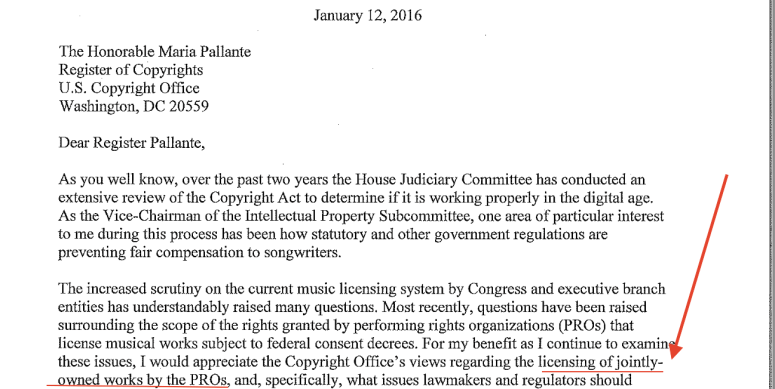
Many people in the music industry (both creators of music and users of music) were  perplexed by the DOJ sudden fixation on the issue.   Until the DOJ put forth this bizarre “fix” for something that wasn’t broke, no one in the industry (music creators or users) questioned the fractional licensing of songs.    It was so perplexing my own congressman Doug Collins asked the Register of Copyrights to explain (see above).
Screen Shot 2016-08-05 at 5.17.20 PM


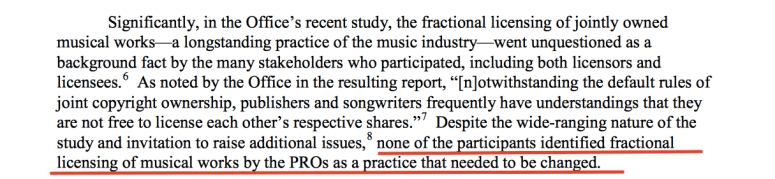
And this is the response from the Register of Copyrights.   In the recent Copyright Office music licensing consultation, NO ONE asked  to change music licensing from fractional to 100% licensing (see above). The Copyright Office makes it unequivocally clear. So who supported and pushed this change?  How did it emerge as an idea from the dark Googley recesses of the DOJ?
 

Screen Shot 2016-08-05 at 5.01.52 PM


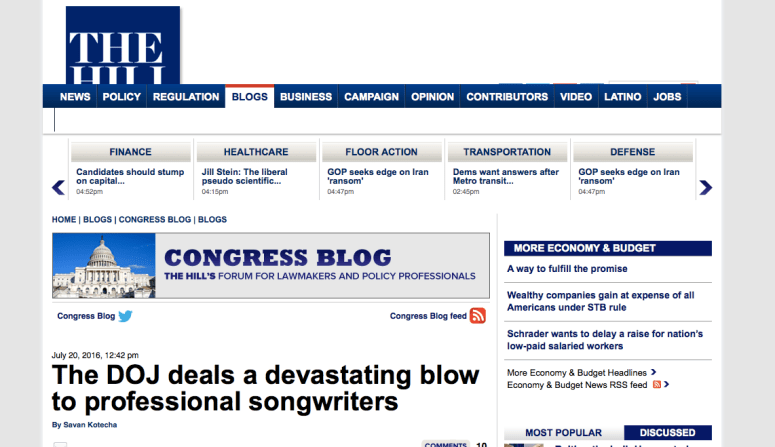
Even though this was a change that no one but Google seemed to want, the DOJ with former Google lawyer Renata Hesse leading the charge went ahead and initiated the rule.

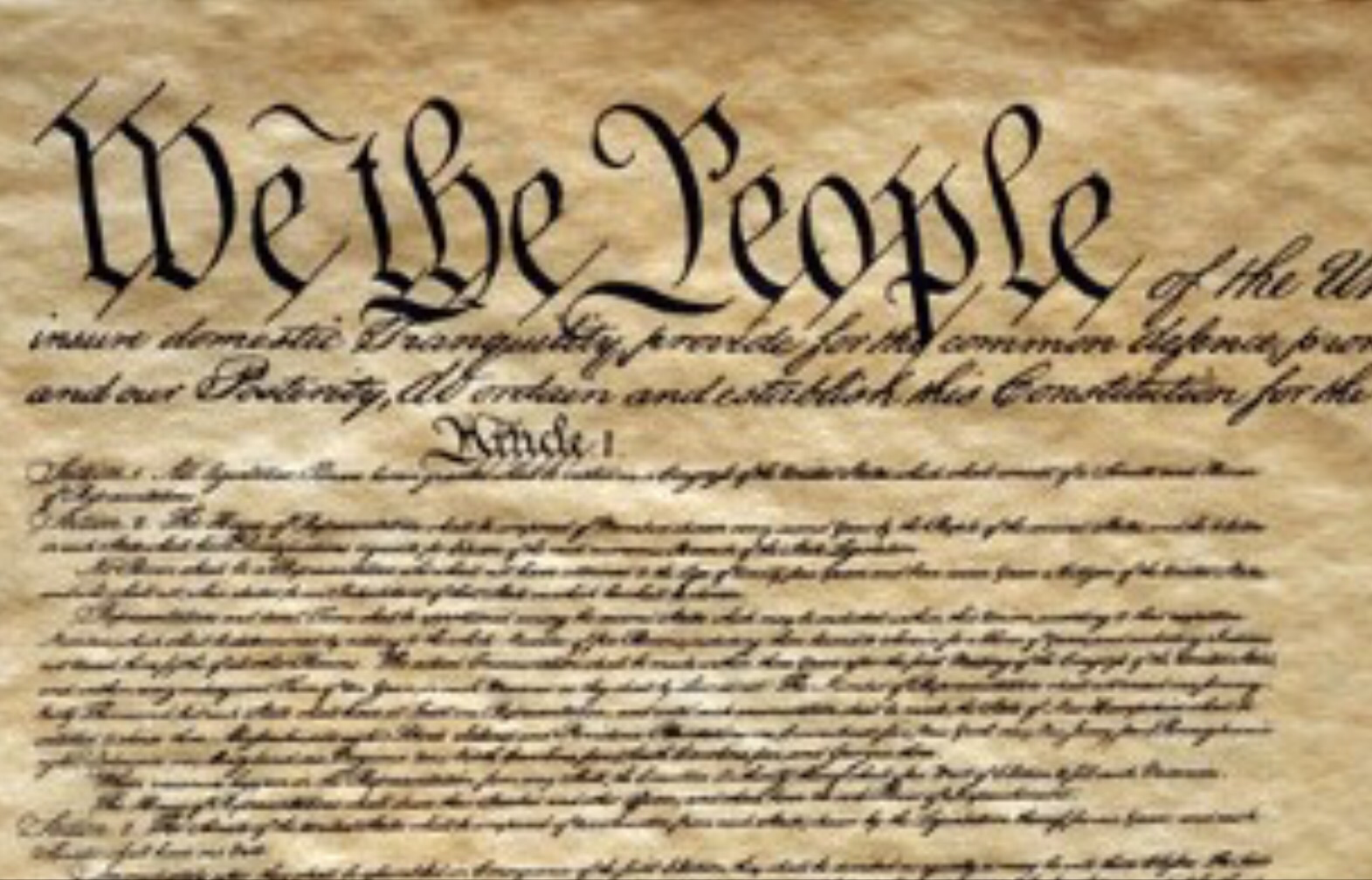
Above is the US Constitution.  Songwriters have constitutional rights (although lately I’ve come to doubt it). For instance we have a right to make legal private contracts with our co-writers without the federal government later making them illegal.   In order for Renata Hesse and the rest of the can’t-shoot-straight DOJ antitrust gang to institute this new rule without violating existing private contracts between songwriters,  the final rule is incredibly complex.  Unless hundreds of thousands of songwriters (or their estates) go back and modify co-writing agreements with hundreds of thousands of co-writers, hundreds of thousands of songs (maybe millions) will no longer be available for licensing.  This rule change requires a vast re-ordering of the music licensing system that will likely take decades. 
 

Screen Shot 2016-08-05 at 6.49.06 PM


Now as a restaurant or venue owner how does this affect  you?

First you know how you obtain the right to publicly perform music for the public in your establishment, right?   From your ASCAP, BMI and SESAC licenses!  The very licenses the DOJ (apparently at the behest of Google)  has just obliterated.

Currently these are blanket licenses. You don’t have to keep track of what songs the bands are playing and what songs the DJs are spinning.  You don’t have to check the bands setlist before they go on stage or dig through the DJs crate of albums and note which albums are not licensed and forbid DJs to play these songs.   That is the beauty of the songwriter rights organizations.  They create efficiency.  It’s a win-win.  Venues are shielded from infringement claims.   Songwriters get paid.   Without these blanket licenses a bar, restaurant and venue would literally have to license each song directly from every music publisher and songwriter.

 Will it stay this way?  It is highly unlikely.  A significant number of songs will be unavailable for licensing and you will have to negotiate and obtain many more licenses from many more organizations to have the same coverage you have now.   You may even be required to negotiate directly with an individual writer depending on the song.

“Hi this is John from the Red Dog Saloon outside North Platte Nebraska. I’d like to talk to Max Martin about licensing that Taylor Swift Song”
Screen Shot 2016-08-06 at 5.18.15 PM

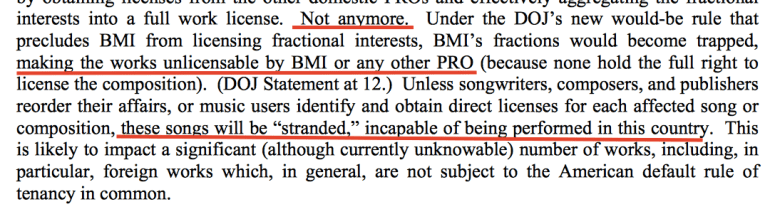
Above you can see what BMI wrote to the Judge Stanton who oversees BMI’s consent decree (the rule DOJ changed).  A significant portion of songs especially songs with foreign writers or cowriters, (and works with samples) become “stranded.”  Same thing would happen to ASCAP.  So because of the new DOJ rule, certain songs become “incapable of being performed in this country.”   Suddenly your BMI and ASCAP licenses are not “blanket licenses.” Don’t believe BMI?  What does the US Copyright Office say?
Screen Shot 2016-08-06 at 5.52.59 PM

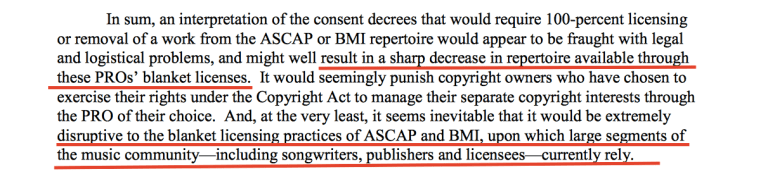
The copyright office said the same thing last year when they warned against changing this rule.  See above.  “…might well result in a sharp decrease in repertoire available through these PRO’s blanket licenses.”  Now that we’ve seen the actual text of the DOJ rule we see the Copyright office was correct in its prediction.
Screen Shot 2016-08-06 at 6.46.53 PM

Even the Department of Justice admits in their own brief (above) that this new rule will require removing songs from BMI and ASCAP “blanket” licenses.  

Further order that BMI and ASCAP identify the songs no longer allowed in the blanket licenses. The expenses associated with this Sisyphean task (new songs constantly created) will come out of songwriter royalties or higher licensing fees to venues. That’s right lower royalties, higher costs for venues and fewer songs available.  Doesn’t this violate the entire antitrust division mandate. 

How many fewer songs available? 

A shitload. Think about this for a minute. ASCAP and BMI are tasked with reviewing tens of millions of songs, contacting and getting responses from hundreds of thousands if not millions of songwriters, who then in turn need to review co-writer arrangements with co-writers and execute new agreements and get back to BMI and ASCAP.

In one year. 

Hahahahahahahahahahahahahahaahaha

Pure comedy gold.

It seems reasonable to say that this is an impossible verification task and the resulting database of unlicenseable songs will be in the millions. Tons of work. Less songs. Massive inneficiency that benefits no one except Google (they can always rely on the DMCA safe harbor and let users upload unlicensable songs a bar can’t). 

Guess what venue, restaurant and bar owners?  You’ve been fucked.   By your own public policy folks and Google through your membership in the MIC-Coalition. 

“You see what happens when you find a stranger in the alps? ”

Looks like restaurants, venues and bar owners WILL be asking bands and DJs which songs they will be playing and checking the setlist against some sort of database.  

 Oh and this pretty much makes your BMI/ASCAP/SESAC licenses considerably less valuable. They are no longer blanket assurances that you won’t get sued by some gold digging lawyer with a few song copyrights.   And with millions of “stranded” songs floating around it’s inevitable. But you’ll still be paying for your PRO licenses. Because some significant portion of the songs will still be in BMI and ASCAP. 

And the DOJ went along with this idiotic rule. Despite the fact the US Copyright office warned them this would happen. 

This is completely batshit crazy.  

This is one of the most powerful departments of the US government Staffed with lawyers from elite institutions like Yale, Harvard and Berkeley.  (Hmm maybe that’s the problem!).  How did they fuck things up this bad.  I mean shouldn’t these people be fired? At least investigated for corruption? Sadly corruption or lose-your-law-license incompetence are the two most plausible explanations. 

My bet is on corruption.  I mean doesn’t it seem a more than a little odd that this rule benefits no one but Google and it was pushed through by a DOJ official that used to work for Google?
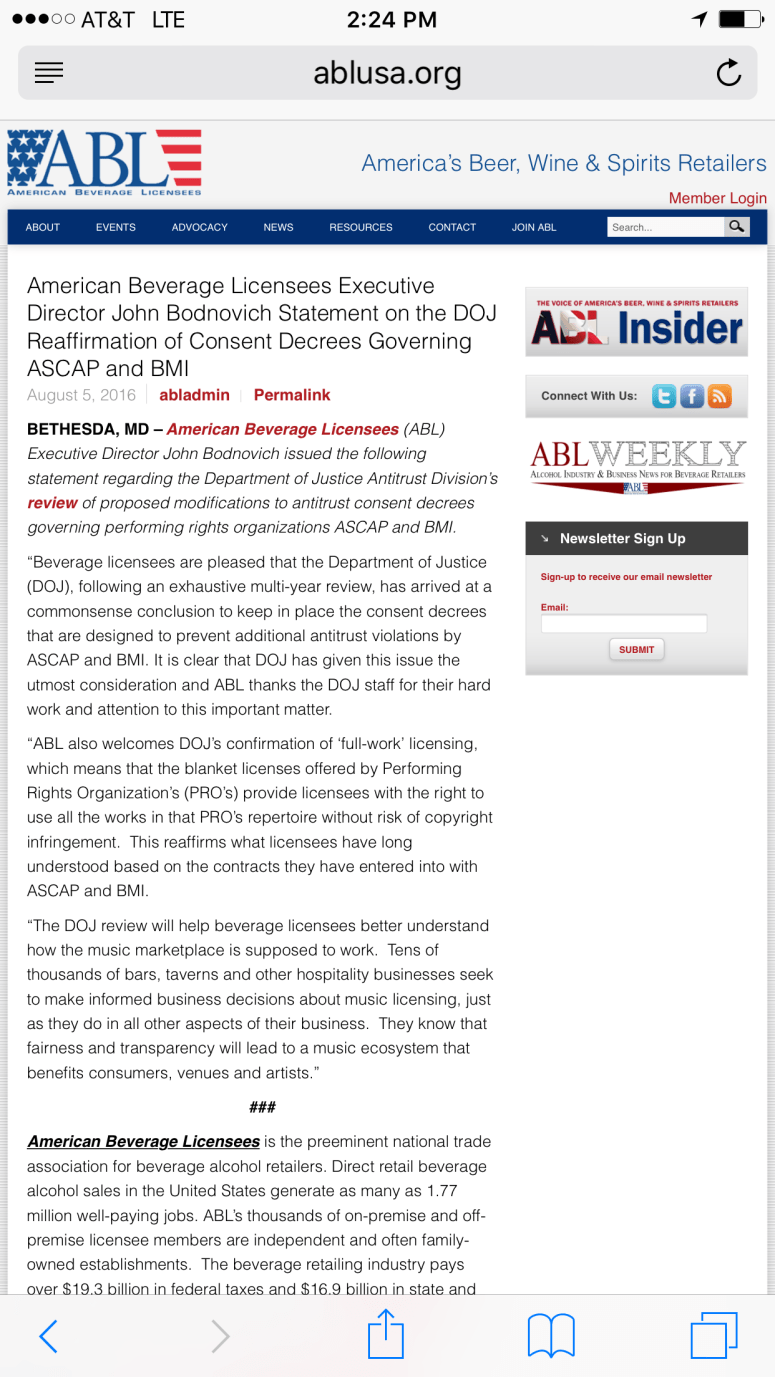

Yet looks like the public policy folks that should be looking out for the interests of bar, restaurant and venue owners are applauding this decision.  Apparently they were  too lazy to read the actual rule. Or too stoopid to understand the implications clearly spelled out. 

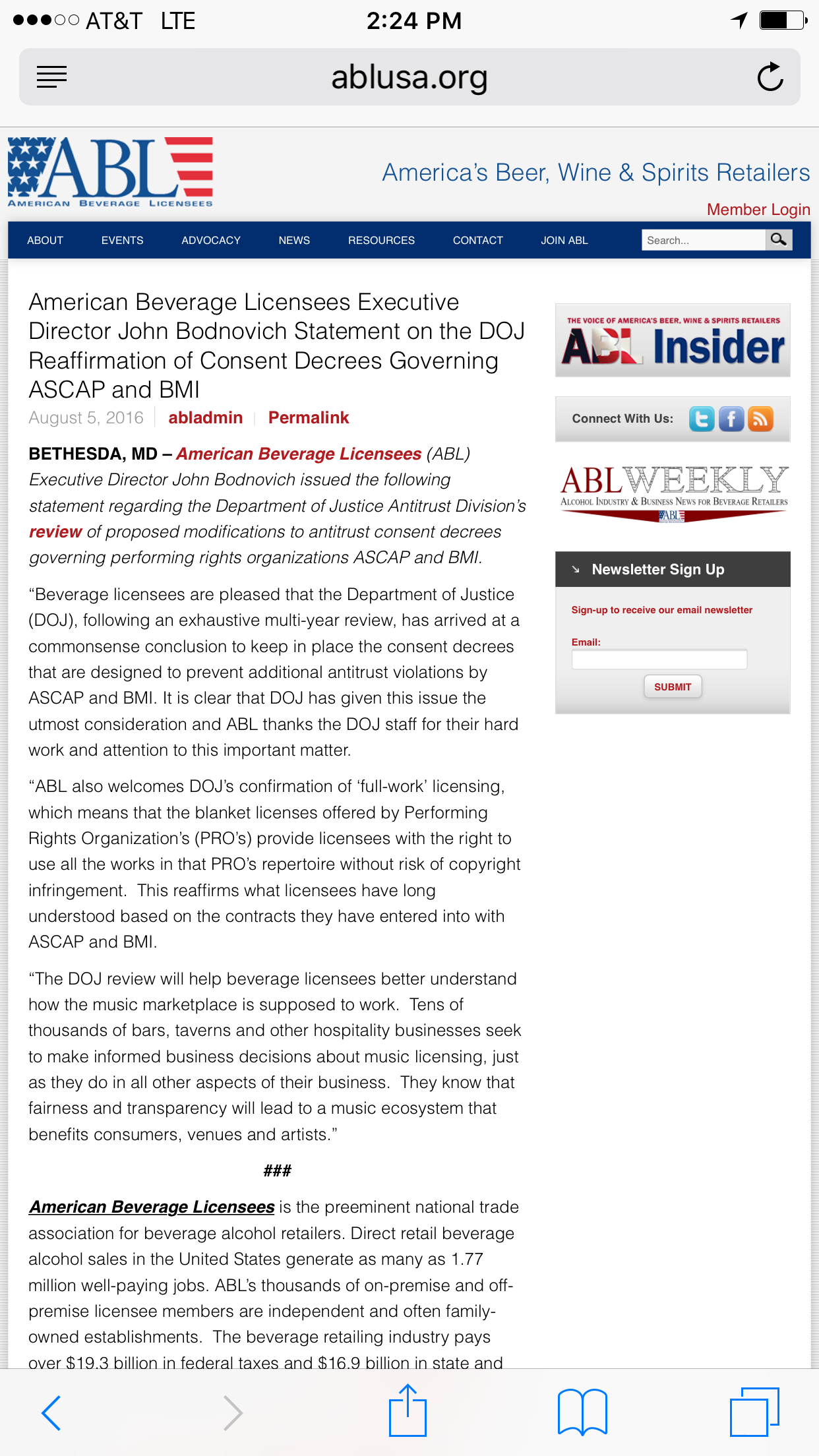
Look what theABL president says:

“ABL also welcomes DOJ’s confirmation of ‘full-work’ licensing, which means that the blanket licenses offered by Performing Rights Organization’s (PRO’s) provide licensees with the right to use all the works in that PRO’s repertoire without risk of copyright infringement.”

Either he is conveniently leaving out the fact that potentially millions of songs will be removed from those blanket licenses.  Or he doesn’t understand what he is celebrating. Before all of this venue owners were pretty much insulated from random copyright infringement with the blanket licenses.  Now by the admission of the DOJ they won’t. Songs will be removed from those repertoires!!!

Stoopid. 

Restaurant and venue owners should ask their public policy folks exactly why they supported a rule that clearly will make licensing music less efficient,more expensive or even impossible? 

 If they can’t give you a straight answer? 

 Fire their asses as well.

BTW the solution is incredibly simple.  Withdraw the rule. Continue with the old system of fractional licensing. It  was working just fine. And in the previous 80 years no one objected. 



Thank @iamjohnoliver and @LastWeekTonight for Supporting Songwriters!

Nice to see John Oliver and Last Week Tonight stand up for the rights of songwriters.  In the last segment of the show Oliver reviewed the permissionless/unlicensed use of songs by various candidates ending with a spoof music video “Don’t use our songs.”   Guest appearances included Nancy and Ann Wilson, Usher, Michael Bolton, Dan Reynolds, Cyndi Lauper, Cheryl Crow, Josh Groban, and John Cougar.  The message was unequivocally clear:  respect the rights and wishes of songwriters.

And of course there was this:

Michael Bolton:  Thank you for not playing me that’s a license you didn’t buy

Josh Groban: If I wanted to sing and not get paid I put my songs on Spotify

While some rights holders are being paid Last Week Tonight is correctly noting the issue with Spotify is that a large percentage of songwriters have not been paid at all.

A heartfelt thank you to  John Oliver and the staff at Last Week Tonight.


DOJ Shuts Down KickAssTorrents, Seizes Domains, Internet Doesn’t Break

Can we finally put the most outrageous of the Google funded anti-SOPA canards to rest?

The Department of Justice just shut down the massively infringing KickAssTorrent site.  Domains owned* by KAT were seized.  And the Internet didn’t break. Due process was not violated.  Free Speech continues unabated.

NYAN cat still soars

And  ISIS still gets to use twitter and YouTube to broadcast calls to kill westerners.   Stay classy YouTube,  this is why you will never ever replace television.

Screen Shot 2016-07-21 at 6.07.32 PM

YouTube inspiring the next lone wolf attack again!

+++++++++++++++++++++++++++++++++++++

*The question of whether a domain name is truly owned by whomever  has registered the domain is an open question. The US Commerce department gives ICANN  “coordination role of the Internet’s naming system.”  Among the many powers (derived from the commerce department) it appoints registries for each TLD (Top Level Domain).  Things like .com, .org, .sucks  etc.   These registries then license the use of domain names that are effectively the creation of the US Commerce department through its appointed agent ICANN.  The US Commerce Department could change the contract it has with ICANN forcing it to manage domain names in any way it sees fit. It could even replace ICANN with a different entity  (Considering the fact that ICANN has essentially become the FIFA of the Internet it’s not necessarily a far fetched idea).   Many people in the rest of the world chafe at the notion that the US taxpayers essentially own the internet.  But why shouldn’t we?  We built it. More than any other country we guarantee the integrity of the system.

And I don’t know about you, but I would much rather have a democratically elected government (however flawed) run the thing, rather than an unaccountable FIFA type international collection of corrupt despots.


Department of Justice Shuts Down KickAssTorrents

From the DOJ website today:

“Copyright infringement exacts a large toll, a very human one, on the artists and businesses whose livelihood hinges on their creative inventions,” said U.S. Attorney Fardon. “Vaulin allegedly used the Internet to cause enormous harm to those artists. Our Cybercrimes unit at the U.S. Attorney’s Office in Chicago will continue to work with our law enforcement partners around the globe to identify, investigate and prosecute those who attempt to illegally profit from the innovation of others.”

Read more here

https://www.justice.gov/usao-ndil/pr/owner-most-visited-illegal-file-sharing-website-charged-criminal-copyright-infringement


@sisario: Apple, in Seeming Jab at Spotify, Proposes Simpler Songwriting Royalties

Although not perfect this is a step in the right direction. Penny rate instead of an absurd percentage of ad rev calculation.

Artist Rights Watch--News for the Artist Rights Advocacy Community

Apple, in a government filing on Friday, proposed simplifying the highly complex way that songwriting royalties are paid when it comes to on-demand streaming services like Apple Music, Spotify and Tidal.

According to Apple’s proposal, made with the Copyright Royalty Board, a panel of federal judges who oversee rates in the United States, streaming services should pay 9.1 cents in songwriting royalties for every 100 times a song is played. This formula would replace the long passages of federal rules for streaming rates, which often leave musicians bewildered about just how the money flows in streaming music.

But even in this seemingly innocuous proposal, which was not made public but was obtained by The New York Times, Apple’s target is clear: Spotify, its archenemy in streaming music. The proposal would significantly raise the rates that Spotify pays, and the filing includes lines that are clearly directed at Spotify and…

View original post 131 more words

FINALLY, A SMALL CLAIMS SOLUTION THAT WOULD PROVIDE SONGWRITERS AND COMPOSERS A REAL REMEDY FOR OUR RIGHTS!

Guest post from Rick Carnes, President, Songwriters Guild of America. 

How many times in a dispute have you heard someone say, “Let’s not a make a Federal case out of this.” Everyone knows that the enormous cost and energy it takes to prosecute a case in Federal Court is beyond the means of most citizens, and rarely makes financial sense, except as to those rare claims for damages in the millions of dollars. But “making a Federal case of it” is exactly what an individual songwriter must currently do under the law if his or her song is used without permission and infringed.

I recall with great dismay the day that I first saw my songs being streamed on YouTube without my consent, and realized the futility of sending a take down notice to protect my rights. When I sent the notice, another unlicensed copy appeared within minutes of the first one being taken down. And then another. And another.

Faced with playing an unwinnable game of ‘Whack-a-mole’ with infringers, I realized that my only other recourse was to file an infringement case in Federal Court against the unauthorized up-loaders which would, ages later, likely end up costing massively more than I could ever collect in damages. The average cost to bring a single, full-blown copyright infringement claim today is estimated to approach $350,000 in legal fees. At the same time, statutory damages for such infringements are currently capped under the US Copyright Act at less than half that amount per title!

The Copyright law is useless to songwriters when the cost of enforcement of our rights far exceeds the compensatory damages able to be recovered against infringers. In response to this conundrum, The Songwriters Guild of America several years ago began promoting the idea of a Copyright Small Claims Court, and we are happy to say that the US Copyright office heard us and recently issued a detailed report in support of the idea.

http://www.copyright.gov/docs/smallclaims/usco-smallcopyrightclaims.pdf

Today, I am even happier to report that Congressmen Hakeem Jeffries and Tom Marino have responded with the newly introduced the “Copyright Alternative in Small Claims Enforcement (CASE) Act of 2016”.

We believe that this Bill strikes the right balance between consumers and creators, establishing an alternative, opt-in arbitration system to resolve copyright infringement cases without necessitating the time and expense of filing and defending a “Federal Case.”

Every American should have the right to protect his or her property, whether a lawnmower, a bicycle, or a song. It is long past time for Congress to give music creators a viable way to seek fair remedies when our rights are violated, and we thank both the Copyright Office and the Congressional sponsors for standing up in this regard for the smallest of small business people: American Songwriters.

6 Real Problems in Music Business the DOJ Should be Investigating

rfk-building_2

Department of Songwriter Injustice

Songwriters are perplexed by the attention that the Department of Justice Antitrust Division has given to a rather obscure facet of the public performance licensing of songs.  97% of the market is already completely regulated by the ancient (1941) and outdated DOJ consent decrees that govern BMI and ASCAP.   Specifically the DOJ antitrust division process sets the public performance royalties for 97% of the songs in existence. There is no legislative basis for this regulation.  Most living songwriters were not born when the consent decrees were enacted and thus never gave their consent to have their rights limited.  Nor has their ever been any proper due process.  This is simply the executive branch gone wild.

Regardless a relatively small amount of songwriters have managed to escape this unconstitutional and overbearing regulation by joining small performing rights organizations like SESAC and GMR not subject to consent decrees.  Unfortunately the DOJ’s novel “reinterpretation” of the 70 year old consent decree brings the last of the free songwriters under their control by mandating that any prices for songs co-written with BMI and ASCAP songwriters should be 100% priced by consent decrees and not fractionally priced as is often mandated by existing private contracts and international treaties.   This creates absolute chaos in the music licensing system by introducing a host of administrative and payment issues; additional constitutional rights violations; the specter of wholesale withdrawal of publishers/songwriters from the songwriter performing rights organizations; and appearance of impropriety by a former Google lawyer now working in the DOJ as the one entity it clearly benefits is YouTube/Google.

See https://thetrichordist.com/2016/07/05/1-billion-reasons-the-doj-wants-to-force-100-licensing/

And you might also wonder “how is this even an antitrust issue?”   We are wondering that as well.  The DOJ has indicated that it views the fact that a tiny percentage of songwriters can refuse to license their songs to monopoly digital services as an existential threat to competition in the digital music marketplace.

Huh??!!

This is some spectacular through-the-looking-glass thinking right there.  The kind of mass-hysteria-groupthink you can only get  when the entire government is run by lawyers that all went to one of four elite copyleft law schools. It takes a special kind of arrogance that only a Harvard, Stanford, Yale or Berkeley law degree gives you to not ask: Aren’t the monopoly digital services actually the real threats to competition?   And hasn’t the DOJ by forcing virtually all songwriters to license their songs to these services at below market rates created monopsonies that are driving consolidation among music publishers?  Aren’t the actions of DOJ antitrust lawyers killing competition rather than enhancing it?

But that all presupposes that the Department of Justice is in the business of meting out justice  and protecting the little guy rather than protecting a few politically favored corporations.   To illustrate I’ve come up with 6 real pressing problems that a Department of Justice that was interested in justice would pursue.

Online advertising fraud.  The online advertising industry is riddled with fraud. Bots and related fraud ensure that advertisers are paying for ads that no one sees.  Ad Week estimates it is costing advertisers 7 Billion dollars a year.  Where is the DOJ investigation?  Do you think the fact that Google/Facebook control 70% of the online ad market has anything to do with the DOJ’s blind eye? After all these two companies are some of the biggest campaign contributors to Obama/Clinton campaign coffers. The executive branch is lousy with former Google lawyers including Renata Hesse in the antitrust division who appears to be pushing the 100% licensing rule.   So how exactly does ad fraud impact musicians?  Most digital music services rely on ad revenue. Ad revenue per spin, per click and per view has been falling rapidly because  advertisers have lost faith in the entire online advertising system.   Hence revenue per spin is rapidly falling.  Midia consulting reports YouTube’s per spin rate has been halved in the last year.

Ticket Master/Live Nation/Secondary ticket markets.   When most people focus on Live Nation invariably their concern is Live Nation’s share of concert promotion business.  This is a misplaced concern.  The real problem is that Live Nation owns Ticketmaster which has a near monopoly on ticket sales. This allows Live Nation to extract a “vig” on concerts it doesn’t even promote.  It also raises concerns of a data monopoly, whereby Ticketmaster has the biggest and best pool of data on who is likely to buy a Luke Bryan ticket in Buffalo New York.  This makes it extremely hard for an upstart to compete against TicketMaster.   But the most pressing issue is that billions of dollars of live music revenue is not going to artists.  Instead it is going to “scalpers” and ticket resellers.  A cursory and unscientific review of the StubHub indicates that most of these tickets are coming from Live Nation/Ticketmaster events.  Granted Live Nation/Ticketmaster has a dominant market share, but I find it curious that there are so few tickets sold through TicketFly finding their way to StubHub.

Unlicensed songs on streaming services.   What if 25 percent of the CDs in the biggest music chain store were bootleg and no royalties were being paid to songwriters?  You would think the DOJ would investigate. Right?  Yet Billboard reports that as much as 25% of the royalties payable to publishers/songwriters are not being paid.  Meanwhile Senator Warren (hmm another Harvard professor) is urging the antitrust division to investigate alleged anti-competitive practices by Apple on behalf of Spotify. You would think smart Harvard professors would realize not paying 25% of your songwriters gives Spotify an unfair competitive advantage.

Abuse of the DMCA Safe Harbor by YouTube.   YouTube is clearly abusing the DMCA safe harbor to extract the most favorable royalty rate from rights holders.   It is essentially using piracy by its users as the “broken window” in a protection racket shakedown.  How is it that the antitrust division manages to ignore this anticompetitive practice?  Fuck that, how is this not a RICO violation?   This is why it’s so important that we remove former Google lawyers like Renata Hesse from the antitrust division.  This sort of illegal and anti-competitive behavior will never be investigated while Google exercises influence at the DOJ.

Harry Fox Agency/Spotify mail fraud.    As I have detailed here,  The Harry Fox Agency on behalf of Spotify has been sending many songwriters fraudulent “Notices of Intent” to obtain a compulsory license.  Since these notices are not in fact valid compulsory licenses (they have clearly been backdated) they are misleading songwriters into thinking they no longer have a right to negotiate a potentially more beneficial direct license.  That is a kind of fraud. I’m not a attorney but the fact these are sent through the US mail this seems to meet the criteria for mail fraud, which is a RICO predicate.   Where is that investigation?

The DOJ Antitrust Division Litigation Section III   The Office of the Inspector General of the Justice Department should investigate whether the Renata Hess violated ethics rules by not disclosing work for Google in her official DOJ bio.  and pushing through an “interpretation” of the consent decree that clearly benefits her former client.    More on how she violated ethics rules right here.

But more important is the big picture on the DOJ Antitrust Litigation Section III.  As evidenced by this very article, Litigation Section III which oversees the entertainment industry has not just failed to do its job, its actions have dramatically decreased competition.  The entire section is corrupt or incompetent.  It should be disbanded or at the very least reorganized.