Briefing Op Ed: Should the Feds Shoulder Some of the Blame for Low Digital Music Royalties?

Lowery briefing screen capture

I have an exclusive op ed at Briefing this morning.  It’s making waves.

“If you step back from the debate about whether Spotify or Pandora pay fairly and look at the big picture, something very ugly becomes apparent: The playing field is not even at all. The federal government protects the corporate broadcasters, technology firms and digital services from market forces when it comes to paying artists. But when it comes to ad supported piracy and “user generated content” the federal government sits on its hands, refuses to enforce performers’ legitimate property rights, and in effect provides another subsidy to many of these same companies. Constitutional scholars might term this a “taking.” For this reason I say much of the blame for low pay to artists in the digital realm stems from gross mismanagement by the federal government.

Full piece here: http://briefi.ng/perspectives/david-lowery

AIM Stands Up For Indies Against Apple, So Where Were They On Spotify?

Alison Wenham of the UK Association of Independent Music helpfully pointed out the problems with the 3-month free trial for apple music.

“The main sticking point is Apple’s decision to allow a royalty free, 3-month trial period to all new subscribers. This means that no royalties will be paid through to rights holders during that 3-month period.

This is a major problem for any label that relies on new releases rather than deep catalogue as the potential for this free trial to cannabalize not only download sales, which remain a very important revenue stream, but also streaming income from other services, is enormous.”

She makes an excellent point.   The free period would pay no royalties and has the potential (like all free streaming services) to cannibalize sales and subscription streaming revenue.  So this brings up an excellent point.  Where has AIM been when it comes to Spotify? Cause it does exactly the same thing?

StreamingRatesandPercentagesUSA

Real Spotify revenue data from a moderately sized independent label 2014. Broken down by free, premium and trial tiers.


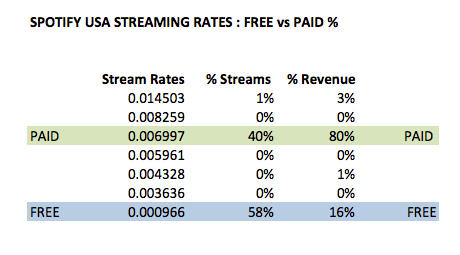
As we have demonstrated over and over again here on this blog Spotify free tier in the US pays about 1/7th per spin compared to the premium tier.   AND since Spotify requires that your entire catalogue be available on both the free and premium tier, this simply allows the free tier to cannibalize not just sales but also spins on the higher paying premium tier.   That is, Spotify does exactly what Wenham accuses Apple of doing.

While we certainly appreciate AIM and Wenham rallying and defending the indie community against Apples predatory pricing,  it also illustrates the hypocrisy of  advocates for indie music industry when it comes to Spotify.   AIM’s licensing partner MERLIN has been a strident defender of all things Spotify.  This blog was singled out early on by MERLIN for mildly criticizing Spotify.  We suspect this is because Indie labels got stock in Spotify and they are willing to look the other way.  Either that or MERLIN is corrupt.  And I do mean corrupt in a legal way. Like there exists some sort of quid pro quo to defend and favor Spotify in the digital streaming space.  Let us not forget that MERLIN  cooked up a likely illegal and anti-competitive deal with Pandora in which indie labels trade lower rates for more spins.  This certainly meets the letter of the law for Payola in the US.

We’d like to see AIM apply the same logic to Spotify free tier, because it’s increasing looking like they are giving Spotify a pass.   Given that we now have multiple anti-competitive investigations into Apple  in the EU, DOJ and New York and Connecticut AG offices, this is starting to  look like “lawfare” between Spotify and Apple with the indie community as partisans.  Apple partisans are already whispering that the EU action is “backdoor protectionism.”  This is a terrible mistake for indies and artists.  We might never get a fair shake from these institutions again.  And there is gonna come a time when we need these government institutions to defend our economic interests.

#irespectmusic Invades the Boardroom: @sivers Calls Out How Pandora Hides Its War on Songwriters from Shareholders

I Believe Castle and Sivers are largely right on Pandora. But there is an alternative hypothesis to consider. The very public nature of Pandora’s fight against Songwriters and Performers was designed to keep their stock price high while insiders sold millions in stock. By some measure the stock compensation to executives has reached 1//2 a billion dollars. Quite rich for a company that continues to lose money. Now that court rulings are going against them -Pandora lost to BMI and the Turtles case looks very bad for them- they are silent on these issues. Why? To keep their stock prices high. I continue to maintain that Pandora is no longer simply an issue for songwriters and performers. I believe the SEC should investigate on behalf of shareholders.

Music Technology Policy

The arc of the moral universe is long, but it bends toward justice.

The Rev. Dr. Martin Luther King, Jr.

A common criticism of both public and private companies that waste the stockholder’s money is “where was the board?”  The company’s board of directors are charged by stockholders with providing the first line of oversight over a runaway executive team that act against the company’s interest.

If the board fails in its role, one of the ways that individual stockholders can call executives and board members to account is by attending an annual meeting.  Most of the attending stockholders have already voted by proxy (often by proxies given to vote in line with recommendations of the company’s board of directors–who are usually a slate approved by the company’s senior management.  Unfortunately for the attending stockholders, given the proxy system, voting at an annual meeting is quite the kabuki dance as…

View original post 997 more words

The Serial Dissembling of Daniel Ek and Spotify on Artist Pay (and Just About Everything Else)

Screen Shot 2015-05-24 at 11.34.57 PM

 Dissemble

Verb, dissembled, dissembling.

to give a false or misleading appearance to; conceal the truth or real nature of

For the past three years I’ve been advocating for better pay for artists from digital services.  However when I started on this quest Spotify was not at the top of my list.  While I have never been enthusiastic about having all my catalogue on the free tier of streaming services (there is a substantial difference in pay per spin on free and premium platforms)  I was willing to put this issue on the back burner while we focused on much bigger  problems like ad-funded piracy and much much lower rates from services like YouTube and Pandora.

But over the last three years I’ve come to believe that Spotify is a much bigger problem.  Not only because of their low rates  but because they deliberately use highly manipulative tactics, paid flacks, proxy organizations, leaked documents, and even paid bloggers to intimidate critics and counter criticism of their service.   As a former State Department employee remarked  “their public relations strategy resembles the playbook of an authoritarian regime.”  The real problem with Spotify is that you cannot trust them.

The latest object-lesson is the still-unfolding kabuki surrounding the leak of the Spotify-Sony Music contract  to the  technology website The Verge.   The Verge is the same site that leaked the  Sony pictures hack.  The Verge apparently has a hard-on for Sony.

Now I have to admit to some schadenfreude when I heard about the Spotify contract leak.  For the last three years we’ve taken significant pushback from the recording industry over our criticism of Spotify.   Major labels have strongly defended Spotify against criticism from artists like myself.  Meanwhile Sony went so far as to replace its own streaming service on the playstation with Spotify.  So yes,  I have to admit it was kind of awesome to see Sony get stabbed in the back by their “partner” Spotify with the contract leak.  On behalf of artists everywhere I must issue a pro forma “We told you so!”

And yes it’s abundantly clear  that it was Spotify that leaked the contract.  Who else beside Sony and Spotify had paper copies of this contract?  The leak helped Spotify and clearly hurt Sony.  Spotify had motive, Sony did not.

Plus it was excellent timing for Spotify.   Let’s review timeline of the kabuki so far:

1. Tuesday Spotify-Sony contract leaks to Sony hater The Verge.  The Verge doesn’t really understand the contract but eviscerates Sony anyway.   Internets go crazy.

2) Wednesday Spotify has press conference (live streamed by The Verge ) announcing new Spotify features. Internets go “meh.”

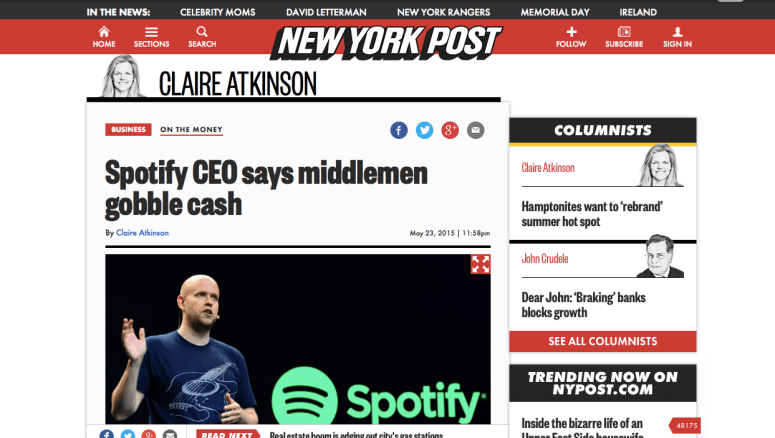
3) Thursday Daniel Ek does interview with NY Post which results in a convenient headline that reads: “Spotify CEO Says Middlemen Gobble Cash”

So what Spotify and their publicity flacks would have you believe is that this whole problem with artists being fairly compensated has nothing to do with them. It is all the fault of the record labels.   In the NY Post Ek goes pseudo diplomatic and says “I don’t want to point fingers, it’s a systemic thing.”  Meanwhile the  little green men over at The Verge do all his finger pointing for him.

And this is why I say Ek and Spotify are dissembling on artist compensation.  While the major labels like Sony or WMG are contributing to the problem of low compensation by treating revenue as sales (10-20%)  not licensing (50%), the problem still starts with Spotify.  And specifically it starts with the free tier.  Spotify and Ek know this.

We didn’t need a leaked Sony contract to know this.   We have access to digital revenue reports for a moderately sized indie label catalogue and we have diligently reported on the payouts for the last 18 months.  These are the rates paid FROM Spotify TO the labels.  No middlemen involved.  The rate on the free tier in the US is abysmal.

 It takes 7,000 spins (not 1,500 as Billboard magazine would have you believe) to generate the same revenue as a digital album download.

StreamingRatesandPercentagesUSA

Spotify pays out at seven different rates with the free tier being the majority of spins. 

 Artists would make SEVEN times as much if consumers could be converted from the free streaming tier to the paid tiers.   One way to do this would be to have exclusive content on the paid tier right?  An incentive to subscribe to the service.  But Spotify refuses to do this.   Spotify insists there be no exclusives and all music on the service is also available for free.  This specifically led  to Taylor Swift’s album not being available on the service.

Ek does not get it. Why would anybody in their right mind switch to the paid service if they can get the same service for free?

Ek and Spotify need to come clean.  They need to stop playing games and admit they have as much to do with bad pay to artists as the major labels.

Google Proxies Double Down on Piracy AND Child Prostitution

Where do we even begin?

Google anti-copyright proxies Electronic Frontier Foundation and Center For Democracy and Technology file amicus briefs in support of defendants in Backpages Child Prostitution case. Wow.

http://www.theregister.co.uk/2015/05/21/backpage_ruling_dismisses_child_prostitution_allegations/ 

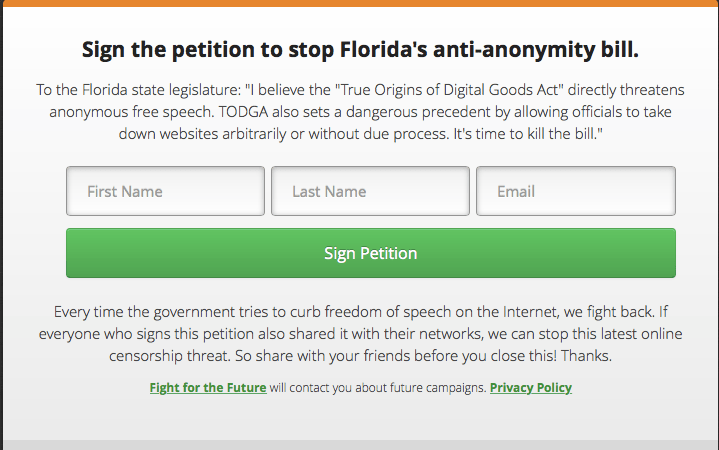
Meanwhile down in Florida a very modest bill aimed at pirate websites gets the hysterical “break the internet” treatment from other Google proxies.

Center For Democracy and Technology has a busy week, by also opposing this  bill.  I guess because it’s important to be able to buy music from anonymous pirate websites on the internet?    And artists really want their music sold and distributed by anonymous websites because it’s so much easier to get paid when we don’t know who it is that is selling our music.  Right?

Not to be outdone Fight for the Future the biggest fake-grassroots-internet-corporation-ass-kissing organization of all time weighs in as well.   Fight for the Future does its usual routine of making up the most far fetched interpretation of the bill (what most reasonable people would term “a total lie”) and tries to whip up the old “censorship” hysteria.

Screen Shot 2015-05-21 at 6.41.54 PM
Did Holmes Wilson and Tiffiniy Cheng dream  “One day I’m gonna grow up to totally manipulate the public by demagoguing on behalf multi billion dollar internet corporations and get paid for doing it.”  Because if they did it would appear they have succeeded beyond their wildest dreams.  There’s a special place in…. er… uh… Mountain View for these two.

And in case you are just joining us.  Why does Google care?  Google is an advertising company. And they are still advertising on many sites like these. They’ll apparently advertise on anything. Including ISIS training videos.  Report here.

PROXY:  Acting on behalf of another party. For instance filing an amicus brief on behalf of the other party. Like here, here. herehere, here and here.

You still don’t think these groups are Google Proxies?   Have you been sniffing glue?

http://voxindie.org/google-funded-interest-groups-come-defense-sugar-daddy/

https://musictechpolicy.files.wordpress.com/2014/09/cy-pres.jpg

http://www.washingtonpost.com/Politics/How-Google-Is-Transforming-Power-And-Politicsgoogle-Once-Disdainful-Of-Lobbying-Now-A-Master-Of-Washington-Influence/2014/04/12/51648b92-B4d3-11e3-8cb6-284052554d74_Story.html

Media Democracy Fund gave over a million dollars to Fight For the Future.  Google at the very least indirectly funds the Media Democracy Fund.  They may directly fund  MDF but no one knows for sure because they don’t fully disclose their funding.   Certainly there is significant overlap between Google Public Policy Fellowships and grants made by MDF. I’ll come to your house and wash your car if it turns out they aren’t funding MDF.  Regardless FFTF is right there with Google on every single issue.


UN Airlifts Calculators, Clues to The Verge: $25 Million is Tiny Advance and @Verge Missed Real Story

Evstafiev-bosnia-sarajevo-un-holds-head


Norwegian UN Peacekeeper reacts to news that The Verge thinks $25 million dollar advance for streaming rights to 25% of music market is a lot of money. Photo by Русский: Фото: Михаил Евстафьев English: Photo: Mikhail Evstafiev (Mikhail Evstafiev).


The UN announced today that it is airlifting calculators, music industry textbooks and clues to Silicon Valley tabloid tech blog The Verge.   This was prompted by an article published by The Verge that seemed to completely misunderstand the scale of revenues generated by the recorded music business (even with widespread piracy). As a result The Verge missed the real story contained in the leaked Spotify-Sony contract: Sony gave away streaming rights to our music for (pardon the pun) a song!

Sony represents about 25% of worldwide recorded music revenue. In 2011 (the date of contract) recorded music revenue was around 16 billion dollars.   Sony’s share was actually higher then but we can safely assume they were responsible for approximately $4 billion dollars.   So the $25 million over 2 years (or $43 million if you optimistically interpret the contract like The Verge) is a pittance for these rights.   The Verge then made a big fuss about whether this advance was likely to be properly credited to artist accounts.   But that’s missing the point because everyone knows the real payout was probably in the Spotify stock that Sony, key managers, artists and executives received. Now, that’s the story. How is the equity to be credited to artists? Not the $25 million. That’s chump change.

Now I understand how The Verge may have missed this.   They consulted the MySpace of music industry experts, Rich Bengloff for comment.  Bengloff who is highly unlikely to look kindly on his former employer Sony Music,  piled on saying that Sony artists were unlikely to receive any of this advance. What Bengloff didn’t note was that the “indie” labels that he represents are also unlikely to share these advances with artists either.

Pot,kettle,black.

Finally here is another clue for The Verge: Does Sony Entertainment CEO Michael Lynton (not Sony Music chief Doug Morris) have some sort of special (investor?) relationship with Spotify’s Daniel Ek? Might this have something to do with what looks like a remarkably good Sony catalogue deal for Spotify?

I mean I’m just guessing here but has anyone bothered to search the Wikileaks archive for some keywords?  I dunno… different combinations of  “Spotify, Lynton, Daniel, wife, manuscript?”

Did Spotify Leak Their Own Contract With Sony?

Just think about this.

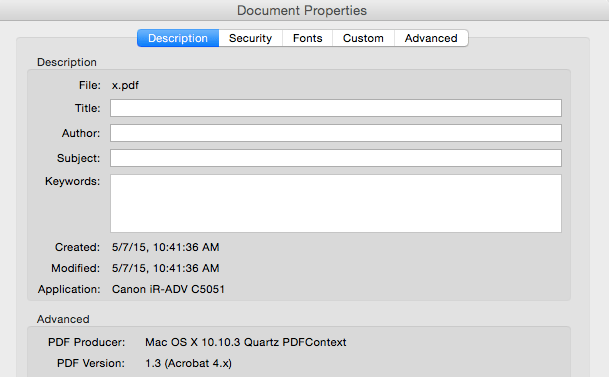
This document was scanned 13 days ago?!  If The Verge scanned this document why did they wait so long to “break” the story?

So it seems likely The Verge did not scan this contract and this is the original leak.

Only two parties had access to this agreement before The Verge got a copy:   Spotify and Sony.

Sony clearly does not benefit from the leak. This is a disaster for Sony. Now it could be a disgruntled employee.  But it would have to be quite a high level employee to have access to this contract.  My understanding is that contracts like this are stored in highly secure locations.

My bet is on Spotify.  Why? Because they benefit from this leak in two ways:

1) It helps Spotify with their complaint to EU against Apple and major record labels over the new Apple streaming service. Especially the disclosures about “Most Favored Nations” clauses, which UMG is forbidden to use.

2) The leak happened a day before Spotify’s big press event announcing new partnerships.   This event was coincidentally live streamed by The Verge.  (hmm….was The Verge in on it?)

But my speculation doesn’t really matter.  Both Spotify and Sony could review their internal network traffic.  They probably already have.  It’s a simple question who was using a Canon imageRUNNER ADVANCE C5051 at 10:41:36 Am on May 7th 2015? Who was using the Cannon iR-ADV C5051 App on a relatively new Mac?   Does Sony even use Macs?

Sony already knows whether this was an internal leak or if Spotify leaked it.

Things are about to get very, very interesting.


Screen Shot 2015-05-20 at 1.03.16 PM

Stockholm Syndrome: Do DC and LA Insiders Really Think Artists Need to Demonstrate They Can Work With Google?

We’ve now heard this rumor from multiple sources and we believe it to be accurate:

There is an idea going around in Washington DC (and LA) that somehow “the music industry” (whoever that is) needs to find a project to work on with Google to show congress that we can all get along.

Huh?

This is an idea that manages to be both hysterically funny (as a joke) and highly offensive (wait, you’re serious!?) at the same time.  It’s not like we performers and songwriters  are remotely capable of doing anything to a company with a market cap of $360 billion.  Especially Google which  seems to enjoy the complete political protection of the executive branch. Nor have we performers ever done anything to Google. Quite the opposite, any rational and sensible person would look at this situation and reasonably conclude that it is the performers and songwriters that are abused by Google. There are no two sides to this situation.   Perhaps the most accurate way to view the situation is to imagine Google as the schoolyard bully, sitting on the chest of the skinniest kid on the playground (performers and songwriters), slapping them silly with their own fists and DC and LA insiders are chanting:

“Stop hitting yourself, stop hitting yourself, stop hitting yourself!”

Is everybody now smoking weed up there in DC? On what planet are songwriters and performers required to demonstrate that we can work together with our serial abuser?  Who’s insane idea is this?

However to demonstrate we have a sense of humor and are willing to play along,we’ve come up with some specific ideas for how Google and “the music industry” could work together.  Google could demonstrate it will “stop hitting us”  by doing the following:


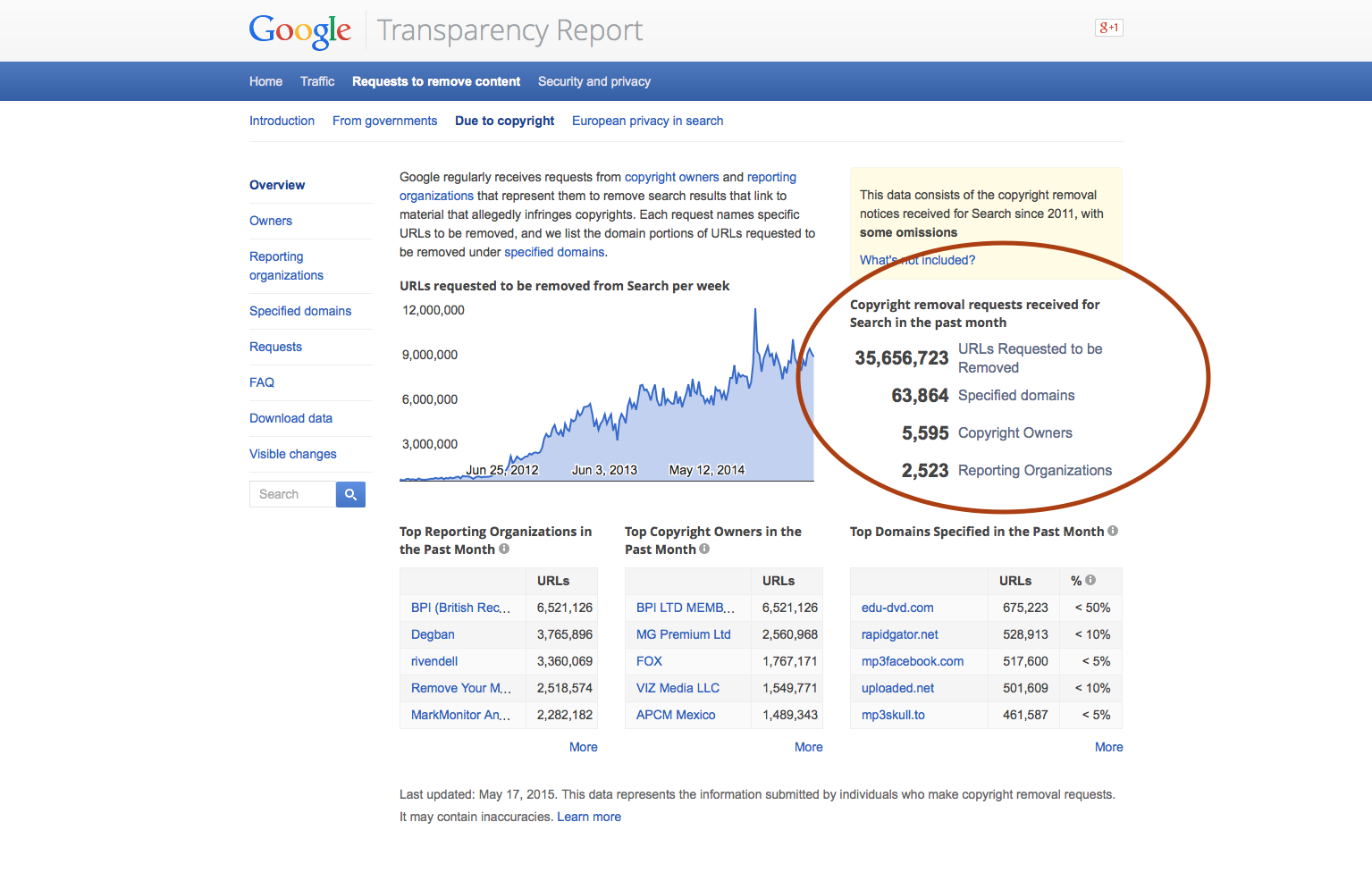
1.  Fix the Defects in Google’s Search Algorithm to get DMCA Notices below 100 million a Year:  Google gets over 350 million take down notices a year now.  This is mostly due to ad supported pirate sites that Google not only drives traffic to but for which Google may also be serving advertising or using Google Wallet to fulfill transferring revenue to publishers.  How much longer must this charade go on?  Did any sitting Member of Congress who drafted the DMCA really think that their handiwork would produce hundreds of millions of notices to one search service?  Does anyone really believe that Google is not running their search algorithm exactly the way they want it to perform?

Google Trans

2.  Fix ContentID Rights Registration:  Every rights holder who’s both honest and can afford it will tell you that they spend extraordinary amounts of time fixing the broken ContentID system on YouTube.  Before trusting Google to do anything like creating a rights database, they really need to fix the absurd ContentID system.

3.  Provide Independent Artists the Same Tools that Taylor Swift Has:  Taylor Swift showed everyone what happens to sales when you can control your rights on YouTube and bless her for showing everyone it can be done.  But it also must be said that it takes an expensive effort to use those tools the way she did.  YouTube needs to make these same tools available to everyone.

4.  Stop Threatening Independent Labels and Artists:  As we saw with Zoë Keating and the indie labels, Google will use whatever leverage they have as a monopolist and strong arm goon to try to force their will on anyone who can’t push back hard–which is essentially everyone.  Before doing anything that gives Google even more leverage, they need to demonstrate that they can be trusted.

And no one trusts them.

5.  Audit Rights for Songwriters:  Google routinely denies independent songwriters (and we hear independent publishers as well) the right to audit royalty payments.  This is something they could change overnight but they haven’t and have given no indication that they ever intend to do so.

So like the man said, trust but verify.  If the Congress wants to see us work with Google, then the Congress needs to level the playing field because they’re the only ones who might–might–be able to stand up to Google.

We see little indication that the Congress has the stomach to do so.

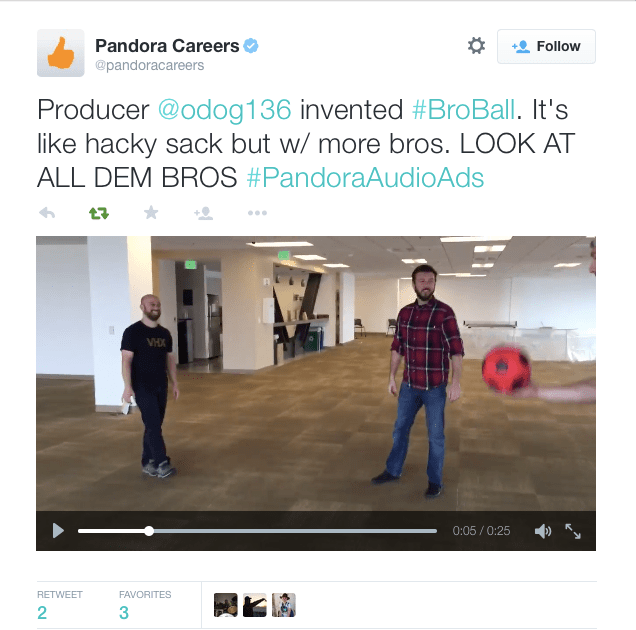
Pandora Demands Lower Rates From Artists While Playing “Bro Ball”

These are the people that are demanding the government bail out their bad business model by lowering performer and songwriter royalties.

These are the people that refuse to pay royalties on pre-1972 recordings.

How ’bout y’all try making money the old fashioned way?   You know, by working for it.

(Just in case the video has been deleted, below is a static screenshot)

Screen Shot 2015-05-15 at 1.42.10 PM

Return of the $50 Handshake: My FCC Comments on Proposed Payola Waiver and “Steering” Agreements PT 2

You think internet “fast lanes” were problematic? How about “payola lanes”  on terrestrial radio and webcasting? Payola is back! And it wants to go Legit this time.  That’s right, broadcasters are proposing a payola waiver from the FCC.  Here is the document they filed with the FCC.  Read it for yourself. It is freaking unbelievable.  PDF below or you can read it on the FCC website here

 DA-15-325A2

As a member of the public you can make an “express” comment to FCC.  It doesn’t have to be as long and as detailed as my comment.   It can simply be a couple sentences.   Proceeding number is 15-52.  Deadline is today!  Link here:

http://apps.fcc.gov/ecfs/upload/display


BEFORE THE FEDERAL COMMUNICATIONS COMMISSION
Washington, D.C. 20554

MB Docket No.15-52

Comments of David Lowery In the Matter of Media Bureau Seeks Comments on Petition for Class Waiver of the Commission’s Sponsorship Identification Requirements Filed by the Radio Broadcasters Coalition – March 20, 2015….. (Continued).


Examples of Steering Agreements by Pandora and iHeartMedia

I wish to call the Commission’s attention to two categories of steering agreements. The first is the type of agreement between Pandora Media and Merlin[1] that Pandora may have replicated with Naxos Records.[2] The second is the type between iHeartMedia and Big Machine Label Group[3] that iHeart Media has stated that it has replicated with dozens of record companies including Warner Music.

Because these agreements are in large part secret and subject to confidential treatment, I can only point to press reports and some public disclosures in the Webcasting IV proceeding currently underway before the Copyright Royalty Judges.[4]

I respectfully suggest that steering deals should be of concern to the Commission in considering the payola waiver requested. As Billboard Magazine reported[5], these deals can be used to mask commercial shenanigans and Pandora hired an expert in these matters:
Back in 2007-2010, when ASCAP and BMI rate court judges were involved in litigation between DMX and performance rights societies, the judges examined the direct licensing deals DMX cut with publishers. During that process, judges did not review the advances or any of the other aspects of the deal, and only looked at the reduced per-store royalty rate. Consequently, in the case of BMI, this resulted in the per-store negotiated rate falling from $36.36 to a per-location fee of $18.91, much to the chagrin of the publishers, who stayed a part of the PROs’ blanket licenses. The ASCAP rate court returned a similar finding.

(Did we mention that Pandora VP of business affairs and assistant general counsel Chris Harrison was DMX’s vp of business affairs at the time of the rate court ruling in a lower per-location blanket fee?)


Pandora’s Steering Agreement with Merlin
The payola waiver offers the Commission an opportunity to consider the legality of steering agreements for both the Radio Broadcasters Coalition but also for Internet radio operated by an FCC licensee. Pandora is a great example.

As Pandora has sought the Commission’s approval and indicated its intention to become an FCC licensed broadcaster, I can infer that Pandora intends to comply with the payola rules over all of its businesses, both terrestrial broadcast and webcasting. If this were not the case, it would be a strange result that a broadcaster with an Internet radio offering could violate the spirit of the payola rules as an Internet radio operator but not as a terrestrial broadcaster. That would be quite a loophole.[6]

As National Public Radio reporter Laura Sydell wrote in the NPR Article about the Merlin deal (in which I am quoted):

“Pandora recently signed a deal with a company called Merlin, a consortium of independent record labels that’s adding another factor to the [Pandora music genome] algorithm: money.

Performers get paid a small royalty each time one of their songs is played on Internet radio, at a rate set by a Royalty Court at the Library of Congress. But Internet radio and labels can strike individual deals, as Pandora did with Merlin. The Internet service will recommend Merlin artists over those not affiliated with the consortium in exchange for paying Merlin’s musicians a lower royalty rate.

Merlin artists get more spins, and Pandora winds up paying less in royalties than it would if were giving those same spins to non-Merlin artists. Plus, consortium labels will get to suggest favorite tracks.”


There is no way for an artist like me to find out what the terms of these agreements are, even if the terms are being used to benchmark my royalty rates in Web IV.

I respectfully suggest that if the FCC grants this class payola waiver, the Commission should do so with specific guidance for how steering agreements are to be addressed by the payola rules. This is particularly true for Pandora. The lines between FCC licensees and Internet radio are rapidly blurring as companies like Pandora compete directly with broadcast radio and manipulate loopholes.

As CNN reported[7]:

Pandora is angry about the royalties it’s paying to [songwriters and] music publishers, so the company is making a bold move: It’s buying a terrestrial radio station in South Dakota mainly to score lower rates.

For reasons that are not obvious, Pandora has devoted itself to spending large sums to litigate royalty payments to artists and songwriters, to lobby in Congress against artist and songwriters, and to conduct public relations campaigns against us. Respectfully, the Commission should not allow them to also manipulate the public through steering agreements that skirt at best or may violate the payola rules and get away with it through an FCC loophole.

As Ms. Sydell reported in the NPR Article, Pandora’s CEO has an odd idea about what the payola rules require:

Jim Burger, a copyright lawyer and adjunct professor at Georgetown University, says this kind of deal would receive legal scrutiny if it were taking place on old-fashioned radio.

“If they were a terrestrial radio station and they were getting a discount on certain music as long as they played it more than other music, that would be considered illegal,” Burger says, adding that stations would have to announce such an arrangement upfront….

Pandora CEO Brian McAndrews says there’s no comparison between that and what his company is doing.

“Payola is where record labels pay radio stations to get airplay,” McAndrews says, “and the opposite is what happens today. As Pandora, we pay the record labels and the artist to allow airplay. So it’s completely different.”


Mr. McAndrews clearly never read Hit Men.[8] He may be confusing the $50 handshake with a liquidation preference. This is troubling because Pandora is going to great effort to become an FCC licensee and their CEO evidently has a poor understanding of the payola laws.

As Mr. Burger told National Public Radio (arguably concurring with Mr. Oxenford’s prescient 2008 article), if Pandora were a terrestrial station, the “discount” from the steering agreement would be considered illegal—and Pandora is trying hard to become one. As Mr. McAndrews is eager to tell investors, “Pandora is Radio”.[9]

Respectfully, I do not see how the FCC can ignore Pandora’s efforts at skirting the payola laws either in the current waiver proceeding or in Pandora’s assignment application for KXMZ.


iHeartMedia Steering Agreements
The iHeartMedia “steering agreements” were described in a heavily redacted statement filed under a protective order in Web IV by Mr. Steven Cutler, Executive Vice President of Business Development and Corporate Strategy at iHeartMedia.[10] In the unredacted part of his statement, Mr. Cutler confirms that iHeartMedia has 26 similar deals with independent labels and another with Warner Music Group.

Mr. Cutler states:

Although listener demand for iHeartRadio had more than doubled in the past year, iHeartMedia recognized that the cost of licensing music for the services was so high relative to the revenues these services could generate that it constrained the company’s ability and incentive to grow the services.   [REDACTED]

To address this problem, iHeartMedia developed a multi-pronged approach to reducing its music licensing costs. It began a campaign to negotiate performance licenses directly with individual record labels. These licenses were designed to promote the growth of iHeartRadio and increase overall digital promotion of the participating labels’ music. [REDACTED] [Emphasis added.]

Mr. Cutler clearly identifies the purpose of these direct agreements as being to (1) “promote the growth of iHeartRadio” and to (2) “increase overall digital promotion of the participating labels’ music.” I would add that there may well have been was a third purpose—to manufacture benchmarks for use in Web IV to influence the royalty rates to be paid to artists like me who are not party to one of these iHeartMedia agreements.

Ben Sisario of the New York Times reported[11] on iHeartMedia’s steering deal with Warner Music:

…that would for the first time allow the label and its acts to collect royalties when their songs were played on Clear Channel’s 850 broadcast stations. In exchange, Clear Channel will receive a favorable rate in the growing but expensive world of online streaming.


This quotation from the iHeartMedia press release also suggests that the labels are participating in iHeartMedia’s broadcasting revenues, further highlighting the quid pro quo:

“Focusing that same creativity on how best to grow the music business, [Big Machine] has developed this new model with [iHeartMedia] to let [Big Machine’s distributed] labels and artists participate in the revenue of broadcast radio immediately and in digital radio as it builds.”


Mr. Cutler’s testimony includes this statement regarding what I suspect are “steering” payments:

Prior to the [Warner agreement] being signed, my staff and I prepared a set of projections for iHeartMedia’s Board of Directors that demonstrated what iHeartMedia would pay Warner for the use of its sound recordings absent a deal, as well as what it would pay [the quid] – and the additional performances it would receive [the pro quo] – if the deal were signed. [Emphasis added.]

This reference raises the question of what the form of iHeartMedia label agreements said regarding steering payments and the method by which those payments are triggered and then calculated. If the purpose of the agreement was in part to lower royalty payments as stated by Mr. Cutler and if Mr. Cutler prepared projections for the approval of iHeartMedia’s board showing what iHeartMedia would pay without the agreement (presumably more) than with the agreement (presumably less), then the reference to “additional performances” would again seem to be the quid pro quo for the lower royalty payments. In other words—arguably the exact type of transaction that the payola statutes address.

I am also more persuaded that this quid pro quo was the very purpose of the agreement because there is a section of Mr. Cutler’s testimony entitled “iHeartMedia’s Efforts to Use Lower Royalty Music” that is entirely redacted.

In other words—the agreements that iHeartMedia negotiated and its board of directors approved are for consideration for airplay that seems to me would require disclosure under the payola rules. As Mr. Cutler stated in his sworn testimony, this was the purpose of the deals.

I would respectfully suggest to the Commission that these steering agreements are of vital importance to the public interest because of the vast number of recordings that we know are involved and that likely will be covered in the future. Over time, steered recordings could easily crowd out recordings by artists who were not party to a steering agreement—and the public would be none the wiser absent the FCC’s robust sponsorship identification requirements.

Other Steering Agreements

I am not aware of other steering agreements, but the Commission is in a position to ask members of the Radio Broadcasters Coalition to present any such agreements in evidence as part of the waiver hearing and is also in a position to ask Pandora to present their steering agreements as part of the evidentiary record for the KXMZ license assignment.

Pandora’s direct agreement with Naxos Records might be just such a candidate. The agreement was announced after the NPR Article and others raised questions about the payola implications of “steering agreements.” As the Radio and Internet Newsletter explained[12]:

[Pandora’s p]rivate licensing deals are significant for another reason. The CRB process of setting government-mandated rates has been distorted, some audio publishers believe, by a lack of real-world deal-making examples which could establish a value of licensed music that isn’t theoretical. Pandora used its Merlin [steering] deal as an anchor example in its initial argument brief. Presumably, the Naxos agreement could bolster Pandora’s case during this year-long lead-up to new rates….We reached out to Pandora to ask whether the Naxos licensing agreement includes similar “steering” as with Merlin, and received a polite “no comment.”

Why “no comment” and why all the secrecy regarding “steering agreements”?

  1. Conclusion

I would respectfully suggest that the Radio Broadcasters Coalition appears to be seeking to create a “payola lane” on their stations by further obfuscating from artists, songwriters, and the public the kinds of disclosure that would make them remind their listeners about steering deals.

Not only would the proposed class payola waiver potentially deceive the public, iHeartMedia and Pandora appear to be using steering agreements as benchmarks in rate proceedings that affect the rates paid to all artists. The FCC has the opportunity to address the legality of steering agreements in this proceeding and the Commission’s decision to act or refrain from acting could have far reaching effects.

From my perspective as an artist and songwriter, I see no reason why any broadcaster should be relieved of its obligations under the payola rules further to blur a quid pro quo that is exactly what the payola rules were designed to prevent.

Respectfully submitted.


David C. Lowery /s/

[1] Laura Sydell, “Pandora’s New Deal, Different Pay, Different Play” (Nov. 26, 2014) available at http://www.npr.org/2014/11/26/366339553/pandoras-new-deal-different-pay-different-play (hereinafter, “NPR Article”)

[2] “The Return of the $50 Handshake: Naxos Says “No Comment” About Steering Payola In Pandora Deal” available at https://thetrichordist.com/2015/02/17/the-return-of-the-50-handshake-pandora-says-no-comment-about-steering-payola-in-direct-deal-with-naxosrecords/

[3] Press Release, “Big Machine Label Group and Clear Channel Announce Groundbreaking Agreement to Enable Record Company and Its Artists to Participate in All Radio Revenue Streams and Accelerate Growth of Digital Radio” (June 5, 2012) available at http://www.iheartmedia.com/Pages/Big-Machine-Label-Group-and-Clear-Channel-Announce-Groundbreaking-Agreement-to-Enable-Record-Company-and-Its-Artists-to-Par.aspx

[4] In the Matter of Determination of Royalty Rates for Digital Performance in Sound Recordings and Ephemeral Recordings ) (2016–2020) (Web IV) Docket No. 14–CRB–0001–WR (hereinafter “Web IV”).

[5] Ed Christman, “Less Could Mean More: Why Merlin’s Deal With Pandora May Pay Off” (Billboard, Dec. 11, 2014) available at http://www.billboard.com/articles/business/6405575/analysis-merlin-deal-pandora (emphasis added).

[6] As Mr. Oxenford persuasively argues, the Internet radio provider might well be subject to prosecution for commercial bribery.

[7] “Pandora buys South Dakota radio station in bid for lower fees” (June 11, 2013) available at http://money.cnn.com/2013/06/11/technology/pandora-buys-radio-station/index.html

[8] Fredric Dannen, Hit Men: Power Brokers and Fast Money Inside the Music Business (1990).

[9] Pandora Media’s CEO Discusses Q1 2014 Results – Earnings Call Transcript http://seekingalpha.com/article/2164393-pandora-medias-ceo-discusses-q1-2014-results-earnings-call-transcript?page=2

[10] Testimony of Steven Cutler, Webcasting IV Proceeding, available at http://www.loc.gov/crb/rate/14-CRB-0001-WR/statements/iHeartMedia/Vol%203_02%20Testimony%20of%20S%20Cutler/2014_10_07_Testimony_of_S_Cutler (“Re_PUBLIC.pdf (“Redacted Cutler Testimony”).

[11] Ben Sisario, “Clear Channel-Warner Music Deal Rewrites the Rules on Royalties” New York Times (Sept. 13, 2013) available at http://www.nytimes.com/2013/09/13/business/media/clear-channel-warner-music-deal-rewrites-the-rules-on-royalties.html?_r=0 (emphasis added)

[12] Brad Hill, “Pandora closes direct licensing deal with leading classical label Naxos”, Radio and Internet Newsletter (Feb. 12, 2015) available at http://rainnews.com/pandora-closes-direct-licensing-deal-with-leading-classical-label-naxos/.