Spotify is Right on Ad Funded Piracy and YouTube

We were very pleased to see this statement by Spotify’s in house economist Will Page (and sorry if we missed it before) :

“Copyright infringing websites are big businesses … 2/3 of piracy sites have advertising, and 1/3 also include credit card logons. This competition is real: consider how ad pricing is distorted by those unlicensed sites who offer more scale and no content costs.”

This is exactly what we’ve been saying and are glad that we can find some common ground between artists and streaming/webcasting services.  Ad supported  piracy reduces revenues for both artists and legitimate licensed services.

We’d also like to note that one Spotify executive pointed out to us the inconsistently in artists pulling their music from Spotify but keeping their music on YouTube.

They are both on-demand streaming services but YouTube is a much less artist friendly service.  Artists don’t seem to realize these facts:

*Spotify appears to pay more than YouTube.  A lot more (see my songwriting statement below).

*Spotify relies on licenses from rightsholders.  Whereas YouTube often relies on  the legally questionable premise that it’s “users”  make the songs available on YouTube and thus aren’t responsible for getting a license.

* If artists control enough of their rights  they can remove their music from Spotify.  Try that with YouTube.

*YouTube is essentially the  largest on-demand music streaming service.  If Artists are being underpaid by these services  the logical place to start is with YouTube not Spotify.

*YouTube sounds terrible compared to Spotify.  It sounds like every song has a flanger on it. ( Sorry this is just my pet peeve.)

(Ed note:  And then there is the matter that YouTube’s policies on comments and free speech.  These allow YouTube to be a platform for every conceivable form of hatemongering. Do you really want your kids going to this site?)

spotify vs pandora

Rat Farming: How The Interactive Advertising Bureau’s “Best Practices” Incentivizes Piracy.

There is a famous story about the French Colonial authorities in Vietnam trying to reduce the rat population in Hanoi. They offered a bounty for each rat pelt turned into the colonial authorities. However instead of reducing the rat population it exploded. Why? The vietnamese did what any logical group of people would do when faced with such a financial incentive. They started farming rats!

Anytime you give people an financial incentive to do something they will do it. This is the case with Ad Supported Piracy. If Ad Networks don’t screen the websites on which they publish their ads the websites will do anything to generate page views to receive more revenue. One of the easiest ways to generate pageviews is to host popular infringing content.

Faced with this problem the White House tried to broker a deal with the Interactive Advertising Bureau. Recently they announced a “best practices” intended to address the problem of Ad Supported Piracy. Unfortunately The White House despite their best intentions was totally duped on this. As Bill Rosenblatt has so clearly spelled out in his Copyright and Technology Blog, the best practices will for many reasons NOT make the situation better:

So how will compliance be enforced? Consider this: the companies that have signed on to these guidelines are 24/7 Media, Adtegrity, AOL, Condé Nast, Google, Microsoft, SpotXchange, and Yahoo!. These companies have agreed to have the Internet (Interactive) Advertising Bureau (IAB, the trade association for internet advertising) monitor them for compliance. The largest six of these eight companies have seats on the IAB board. In other words, this is rather like foxes agreeing to be monitored by the American Fox Association for compliance with henhouse guarding guidelines.

I’ve now had some time to dig into this best “practices” document and here are my observations:

At best it attempts to legitimize the illegal status quo whereby companies Google and AOL “try” not to advertise on bad sites.

At worst it creates a DMCA whack-a-mole like process whereby individual creators and rights holders assume the burden of telling the online advertising networks exactly who are their bad (as in criminal) customers. Further it then seems to creates a new Kafkaesque process whereby the creator would (among other things) have to learn to use highly specialized packet logging and data tracing tools to even file a complaint. I quote from the document:

(prove) (ii) that the advertising appearing on the participating website containing the illegitimate activity is provided by the Ad Network. This can be done by providing, for example, a Tamper Data trace and relevant screenshots showing that the participating website is making ad calls to the Ad Network for the advertising reflected in the screenshots.

How many indie musicians do you know that know how to use packet logging and data tracing programs?

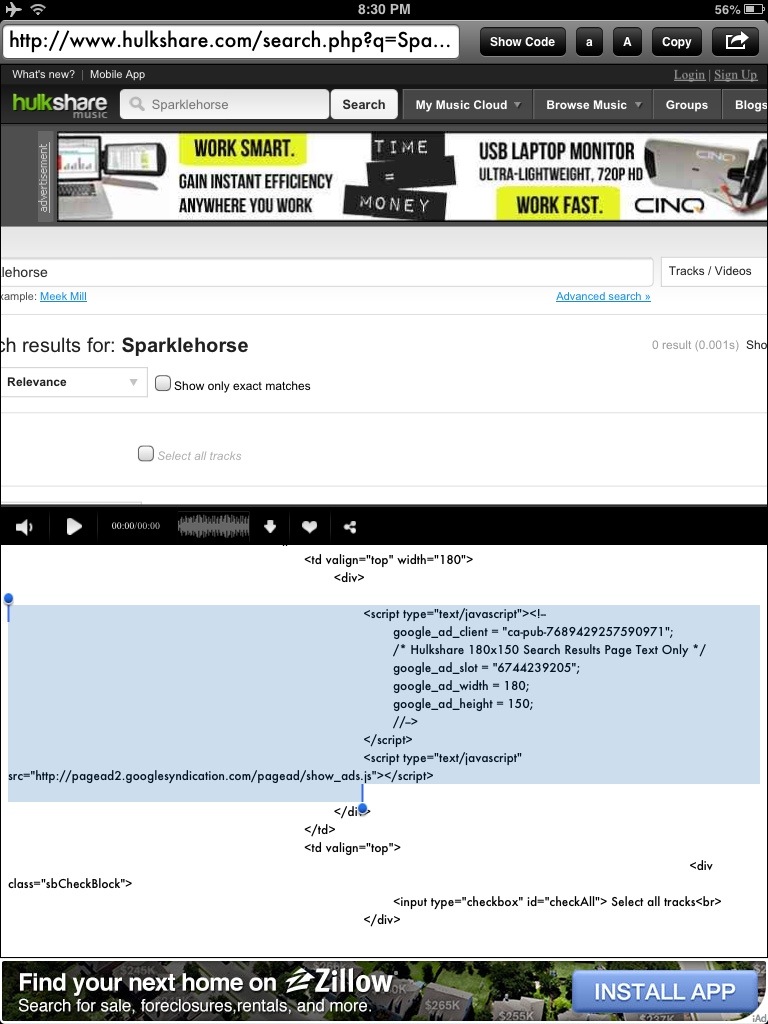
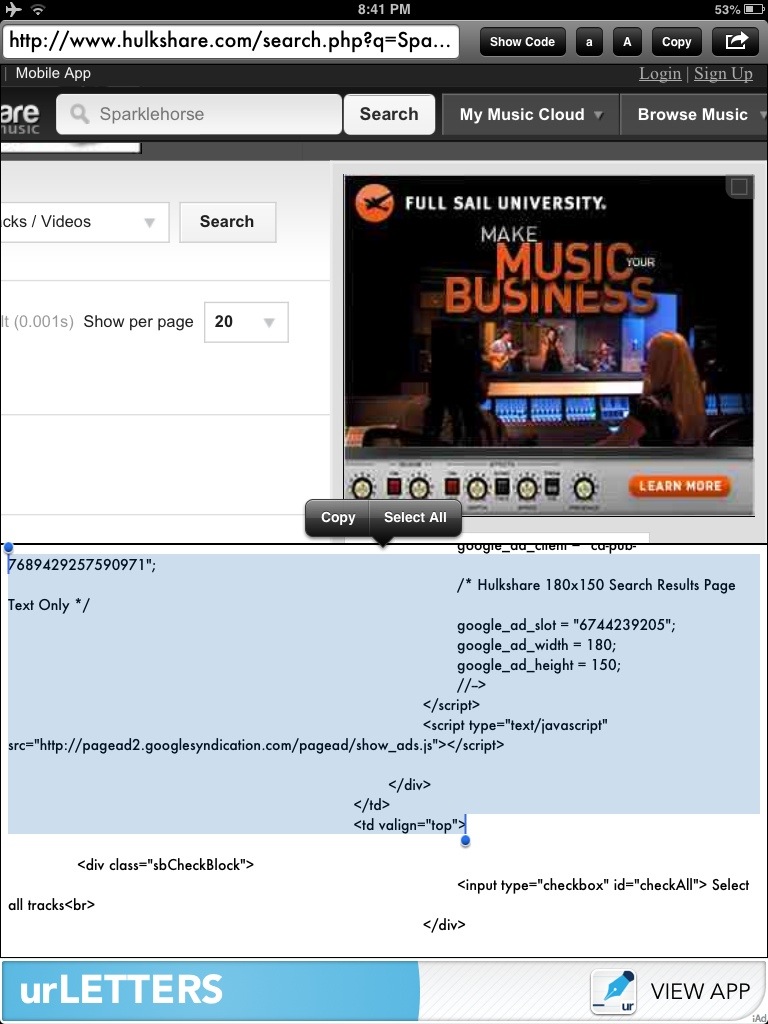
Even if you know how to use this software it’s time consuming to find the exact “call” associated with a particular ad. (see screenshot).

Finally the “best practices” allow the copyright infringing website in question to challenge the creators claim setting up a never ending cycle of claim and counterclaim.

This document is so heavily weighted in favor of powerful (Editor note and Obama supporting?) corporate interests it’s absurd.

The creative community should reject this “best practices” for what it is: A tacit legitimization of current illegal and unethical practices.

Fortunately the “best practices” are voluntary and have no legal standing. Further they are a gift to people like me. It should make it even easier to name and shame Fortune 500 brands. Why? I’m sure their online advertising networks will be telling their brands that “the problem is now fixed.” Amusing. I look forward to the next few months.

But what does this have to do with Rat Farming?

The online networks – no let’s face it mostly Google wants to be able to push ads onto any website without the burden of screening any of the sites. Without even screening who they are paying. It’s like they are putting out bowls of yummy pest attracting food out in the garden. What happens if you leave bowls of food around your garden? Eventually you get rats. Lots of rats. It’s rat farming.

The IAB/White House “best practices” absurdly burdens the creators with the task of finding the rats, proving they are rats, DNA testing the rats, packet tracing the food the rats eat and finally getting rid of them but not before the rats initiate an endless loop of claims and counterclaims that it has not been proven definitively that they are always rats.

Once gain this is a SUBSIDY from creators to Silicon Valley and Madison Avenue. We work for free to clean their networks. They make the money.

Here’s a much simpler and effective “best practices”. The IAB should ask their members not to create the incentives in the first place.

After all advertising is THEIR business not ours.

Do they teach packet logging and data tracing at Berklee School of Music?

Screen Shot 2013-07-21 at 11.04.43 PM

Ad Networks Adopt Notice-and-Takedown for Ads on Pirate Sites

Bill Rosenblatt has an insightful piece on the problems with the White House brokered IAB “Best Practices” with online Advertising. We largely agree with Bill and will be following up with our own post.

Copyright and Technology

Eight top Internet advertising networks will participate in a scheme for reducing ads that they place on pirate sites — websites that exist primarily to attract traffic by offering infringing content as well as counterfeit goods.  The Best Practice Guidelines for Ad Networks to Address Piracy and Counterfeiting document, announced on July 15th, specifies a process modeled on the US copyright law’s notice-and-takedown regime, a/k/a DMCA 512: a copyright owner can send an ad network detailed information about websites on which it placed ads and that feature pirated material; then the ad network can decide to remove its ads from the site.

Although this scheme may result in some ads being pulled from obvious pirate sites, it has several major shortcomings.  First of all, because this is a voluntary scheme, ad networks don’t risk legal liability for failing to comply with takedown notices, as they do under the DMCA.

So…

View original post 926 more words

The Digital Royalty Fight: A Primer for Business Journalists. Pt 2 Thom Yorke and Spotify

The Digital Royalty Fight: A Primer for Business Journalists Part Two

How Thom Yorke And Nigel Godrich Pulled Their Solo Recordings From Spotify.

Thom Yorke and Nigel Godrich blew up the Internets last week when they abruptly pulled some of their catalogue from Spotify.  I’ve been getting many inquiries as to how they managed to do this, when other artists and songwriters can’t.  Short answer: they were able to do this because they controlled all or most of the rights to their recordings.  They actually pulled their recordings but not their songs.   Confused?  Let’s dive in.

#1.  I covered this in part 1 but let’s reiterate.  The copyrights for songs and recordings are two separate copyrights.  Sometimes they are owned by the same individuals or companies.  But most of the time they are not.  However the songwriting copyright is contained within every recording of the song.   For this reason any service using a recording needs TWO licenses.  One from the songwriter and another from the owner of the recording.  This is also why as explained in part 1 there are two kinds of royalties.  Songwriter royalties and Performer royalties.

#2.  Copyrights for songs and copyrights for recordings are treated differently under the law.   Different rules, rates and uses are mandated (or not mandated) by the government for songs and recordings.  (Again why in 2013 the government is involved in setting prices for different uses of songs and recordings makes no sense to me either.)

#3 Different rules and rates are mandated (or not mandated) for different kinds of digital services. Webcasting has different rules and rates than streaming.

#4 Webcasting and Streaming are two totally different kinds of digital services.  Pandora is webcasting.  Among other things you can’t play a song on demand. Spotify is Streaming. You can play a song on demand.   Spotify is like virtually owning a song and is purely “consumption” not promotion.  Pandora allows you to play a particular artist on demand but not the exact song.   Pandora is a combination of promotion and consumption (See part 1 #4 and #5 for explanation.)

#5. A compulsory license is a use that is essentially mandated by the government. It is a use for which a songwriter or performer cannot “opt out”.   It also generally mandates a price that the songwriter and performer must sell the right to use that song or recording. However companies and individuals may privately negotiate that rate lower.

#6.  A consent decree is similar to a compulsory license but it’s even weirder.  It essentially allows a service to use a song while negotiating prices and use of song. Again it’s virtually impossible for an individual songwriter to “opt out”.   The consent decree only covers songs not recordings.

Still with me?  Cause here comes the interesting part.

#7  A streaming services like Spotify uses a compulsory license and the consent decree to allow it access to songs.  But there is no compulsory license for the recordings.  Therefore Spotify had to go around and cut private deals with all the major record labels and a large alliance of independent labels.   Independent artists often get their recordings on Spotify through services called aggregators.  These aggregators also cut deals with Spotify.  So for recordings these are all private agreements.  No one is compelled by the government to let the Spotify play their recordings.

#8  Since Yorke and Godrich likely control all or most of their rights to their solo recordings they could pull their recordings from Spotify.  Remember there is no compulsory license for recordings when it comes to Streaming services.  Yorke and Godrich are not mandated to let Spotify use their recordings.

#9.  But Radiohead is still on Spotify?   Yes. Yorke and Godrich are unlikely to control these recordings.  These recordings are likely controlled by their record label or perhaps Yorke simply decided to leave his “back catalogue” on Spotify.

#10. On the other hand Spotify has a government mandated compulsory license to use any songs. (Also the Consent Decree comes into play, but it’s too complicated to explain here).  No songwriter can prevent the use of their songs on a commercial service like Spotify as long as they pay the government mandated royalty.   This is true for any streaming service. So strangely Someone could record covers of Yorke and Godrich’s songs and put them back on Spotify.

11.  Pandora and webcasters are in an even stronger position.  They enjoy government mandated access and rates for both the song copyrights and the recording copyrights.    Technically there is a consent decree for the songs and then a compulsory license for the recordings. Songwriters nor performers can “opt out” of webcasting no matter how terrible the rates.  Hence Yorke and Goodrich are still on Pandora.

12.  I sort of lied about #11.   You can opt out but it’s a sort of a “Nuclear Option”. I don’t quite understand how this works yet but it goes something like this:  If you as a songwriter also happen to be what is known as a publisher. AND you are represented by the Non-profit-member-owned American Society of Composers Authors and Publishers apparently you can withdraw your digital rights from ASCAP and cut or rather choose NOT to cut a direct deal with Pandora and other webcasters.  It appears the band Tool somehow managed to do this.  The downside is, if you want to be on some digital services but not others, you have to go around and individually negotiate deals and collect monies. Essentially you throw away your right to be part of any collective-like bargaining.  Also good luck getting paid.  Not a very good position to be in.   It’s still unclear to me if you can do this if you are a member of BMI instead of ASCAP.

***************************************

Now allow me to editorialize for a moment.   The United States Congress has started a periodic review of the copyright laws.  IMHO I think that congress should consider doing less,  when it amends the copyright act. In particular it should rethink the compulsory licenses for webcasting and streaming. In particular it should get rid of them.   There may have once been a rationale for compulsory licenses and rates  when these industries were in their infancy. But now these compulsory licenses have essentially become subsidies to some of the richest companies on earth (Google and Apple are now in the streaming game!)

These one price fits all compulsory licenses commoditize music and limit the kind of monetization models available to musicians. They limit innovation on the artists side.  They are anti market and prevent the market from discovering the true prices of songs and recordings.

Further I believe these licenses limit innovation on the tech side by specifying the exact model for streaming and webcasting businesses.  Finally they are just plain unnecessary.  Terrestrial radio does not have the luxury of a compulsory license for songs yet BMI/ASCAP/SESAC and the broadcast industry seem to manage to come to agreement on prices and uses without government interference.   Webcasters and Streaming services should be expected to do the same.

The Spotify Shakedown: “That’s a Real Nice Album You Got There I’d Hate For It To Be Torrented”

We’ve been hinting at this for a while.  That essentially the streaming services implicitly  use the threat of piracy to negotiate lower rates with artists.    We suspect that is why a service like Spotify that claims to be “Pro-Artist”  refuses to speak out against Ad Supported Piracy despite our previous request for them to do so and despite the fact the “legal” services and pirate sites compete for exactly the same ad revenue.

We no longer have to hint at this.  It appears Spotify has crossed the rubicon.  In this corporate “study” they explicitly link non-availability on Spotify to increased piracy.  In other words:

“Thats a real nice album you got there. I’d hate to see it torrented”

To me this reads like a admission that the threat of piracy is fundamental to their business model.

(Ed note: Is this legal? A question for National Association of Attorneys General?)

But I could be wrong.  Spotify could easily clear this up. We ask once again for Artist-in-Residence at Spotify D.A Wallach to take action against Ad Supported Piracy.  Will Spotify join us in the fight against Ad Supported Piracy?

When will the streaming and webcasting  services understand that their low payments (to songwriters especially) make them qualitatively no different than a pirate site.  In fact I’d rather have an honest conversation with a pirate party advocate than to listen to lies from some Silicon Valley billionaire.

“Oh please! Tell me again how your 5th amendment violating, government mandated and  artists subsidized streaming service is gonna be good for me  ‘when it scales?‘”

Poll: Should Songwriters Have The Right To Opt Out Of Individual Digital Music Services?

Many of my non-music business friends ask “If streaming services and webcasters pay so little to songwriters  why don’t you pull your songs off the services?”

To further confuse things you probably know by now Thom Yorke pulled his recordings from Spotify.   But oddly any “covers” of his songs will remain on Spotify.   Why is it that?  Why don’t songwriters pull their songs from digital services like Pandora and Spotify if the rates are so bad?

The short answer is:  By government mandate we are not allowed.

And here’s the short explanation: There are two similar government mandates that prevent us from doing this. Something called a “consent decree” and another called “compulsory licensing”.  Yes believe it or not in 2013 The Government of The United States mandates terms and prices  for certain digital uses of songs!

The long explanation:  We can sort of opt out but we have to exercise the “Nuclear Option” and pull our digital rights from ASCAP/BMI/SESAC.   We would then have to negotiate and collect directly from each and every single digital service on the planet.  This is feasible for someone with a lot of catalogue and market power (like Sony ATV)   but not for individual songwriters.  In other words the only way to “opt out” is to essentially abandon our ability to bargain in a collective manner.

Maybe the solution is to allow songwriters to  “opt out” of specific services, or to pick and choose which songs are available on which types of services.  This would be a small step towards free markets and  aid in “price discovery.”   If we have true price discovery for songs we could eliminate the need for governments to set prices and mandate licenses in the first place.  I realize this could create new challenges for Songwriters and publisher but can the situation really get any worse?

But heck what do we know?   We’d  genuinely like to hear what you think.

Despite Mississippi Attorney General’s Action, Is Google Still Advertising On Specific Pirate Site In Complaint?

I just spent a week with my kids doing some coding,  so I’m thinking in a binary fashion.   Let’s look at this Google, Mississippi Attorney General Hood and “Ad Supported Piracy” situation in an IF/THEN/ELSE kind  of way.

If you are not aware the Federal Government has basically decided to let Google get away with anything. And just like the Tobacco Settlement it’s been left up to the states to try to reign in the Mountain View Drug Advertising and Spying Cartel. Mississippi Attorney General Hood is leading State attorneys general in an investigation into current Google advertising practices.  And in particular whether they violate Google’s criminal Non Prosecution Agreement with the US Government for knowingly enabling sales of controlled substances online. 

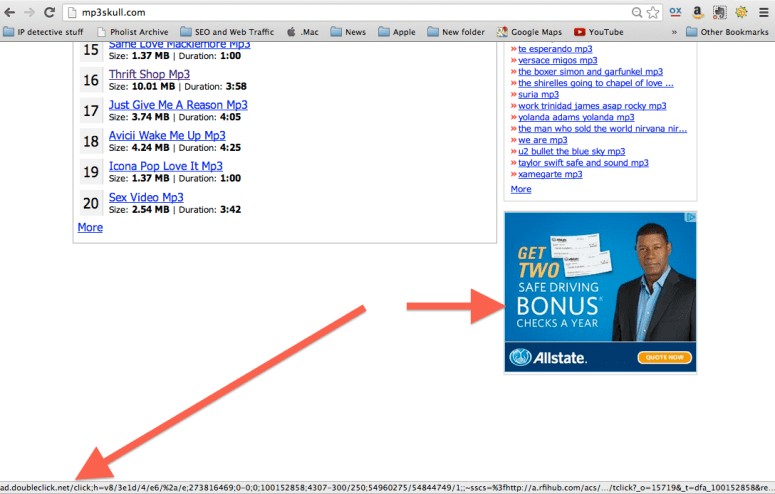
Google claims to AG Hood  that they are trying not to serve advertising onto pirate sites like Mp3skull.com.  But as evidenced from the screenshots below, clearly DoubleClick (Google) is somehow involved in serving these Allstate Insurance ads on this massively infringing site. Further this is the very website that the General Hood used as an example of Google’s behavior.

(BTW according to my preliminary UGA study  Allstate Insurance is  one of the biggest repeat enablers of Ad Supported Piracy and I feel artists should organize a boycott until they change their ways.)

So this is the way I see it:

IF >

You take Google at their word

Then>

Google genuinely has no idea where they are serving ads nor do they have any control over where the ads end up.  So Google advertising products are the mother of all  products liability design defect cases. 

ELSE>

Google is not being forthright with the Attorney General Hood.

What happens when you aren’t forthright with the kind of people with subpoena power?  Just curious.

Below is excerpt of statement April 19th 2013 from John Burchett Google Director of Public Policy for United States, Latin America and Canada. This was in response to the State Attorney Generals Action.

google to hood

Here is exhibit from Attorney General Hood  singling out the site http://www.mp3skull.com.  Further the AG has taken this from Google’s own Transparency Report to show they are keenly aware of the mass infringement on this website. They acknowledge that they have been notified of over 800,000 infringing links!

AG hood g trans mp3 skull

Here are a few Screenshots I took July 12th 2013 .  These show Google’s DoubleClick helping serve Allstate advertising onto the http://www.mp3skull.com website.

doubleclick allstate mp3skull1

And again a short time later.

doubleclick allstate mp3skull2

And for the coders, again using firebug/firefox.

allstate double click firebug skull

The Digital Royalty Fight: A Primer for Business Journalists. Part 1.

The Digital Royalty Fight: A Primer for  Business Journalists. 

We realize that to those outside of the music business the digital music royalty system seems incredibly complex.  Those of us on the music side often forget we’ve often had decades of experience dealing with the intricacies and machinations of the system and our explanations are not always as clear as they should be, partly because we assume certain awareness that may be asking too much.

There are also many journalists who honestly try but confuse the distinctions between a performer royalty and a songwriter royalty; or the simulcast stream of a radio station on IHeartRadio.com and Spotify’s on demand music service; or the fact that the government essentially dictates both the license for most songs through its consent decrees with ASCAP and BMI and the rate courts that set the prices for those songs and the compulsory mechanical license.  The government also dictates both the license for sound recordings and the government’s Copyright Royalty Judges essentially dictate the prices for recordings online and the mechanical royalty for songs.  If you are a songwriter you have the government setting your prices for almost everything except sync in film/tv/commercials.  (Weird right?  Is this World War II? Are we rationing sugar?  Nylon?  Gasoline? We need to set prices for songs?)

On the other hand there are technology companies (and bloggers)- that should know better-who purposely confuse the public on these matters by mixing the different kinds of royalties and make false equivalencies between songs and recordings, not to mention types of services, to help bolster their public relations campaign for lower royalties.

So it’s no wonder people are confused.

So let me try to give everyone a quick primer on digital royalties by highlighting some of the most common misunderstandings that have been fueling the debate over webcasting royalties this last month.  One caveat: When I speak of “artists” or “performers” I include session musicians and vocalists with “featured” artists.

Let’s start with the simplest misconception.

Misconception #1.  There is no difference between an Artist and a Songwriter.

The songwriter and the artist are often two different people.   Sometimes –like in my case- I am both songwriter and artist.   But the majority of songs populating The Billboard top 20 at this moment are written or co-written by professional songwriters that are not the performing artists!! And because music sales exhibit what is mathematically termed a “wild distribution” often the Top 20 songs represent the majority of all recorded music revenue for that week!

These professional songwriters are economically very important to the entire music business (including all forms of radio). They create the fundamental element on which the entire music industry is based–it all starts with the song. The consumer clearly values the work of these professional songwriters. Yet these important professionals don’t tour, sell T-shirts or have clothing lines.  Their songwriting royalties are their only income.  Songwriters are not paid a share of the artist royalties for Pandora.  Songwriters are paid from a completely different source.

Occasionally more obscure performer/songwriters have their songs covered by pop superstars.  They also do not benefit from the touring activities, t-shirt sales or clothing lines of the pop superstar, even though the superstar’s fame may be based entirely on covering some obscure songwriter’s songs!

To make things more equitable most countries in the world pay separate royalties to songwriters and performers.  Even “old boss” record companies are required to pay songwriters “mechanical royalties” for  “cover” songs they release.

This brings me to #2.

Misconception #2. Webcasters and other digital services pay only one kind of royalty.

There are two broad kinds of royalties paid by digital services, Satellite radio, AM/FM Radio (ex-US), Cable TV, Broadcast TV and others to “Artists”. The Songwriter gets one royalty and the performer gets another royalty.  It’s very important when discussing royalties to know which one is being discussed and most importantly NOT lump them together.

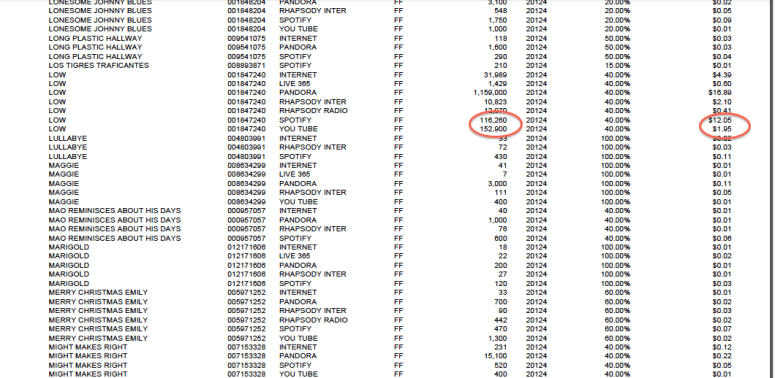
Example.  I am both the co-writer and co-performer (with Cracker) of the song “Low”.  As a songwriter I received $16.89 for 1,159,000 spins of “Low” on Pandora (paid to me by BMI).  In contrast, my  band Cracker (the artist and performer) was paid a little over $600 in performance royalties for those spins (paid to Cracker by SoundExchange).

Like most bands, Cracker takes these moderately sized checks and deposits them into the band’s general operating funds.  (You don’t have to do it that way, but that’s how we do it.)  Airplay after all is often the result of touring and other promotional activity of the band and is part of the band’s gross revenues, not net profit.

But let’s ignore that and pretend there are no costs associated with achieving airplay.  Then eventually as 1 of 4 members of the band Cracker about $150 dollars works its way into my paycheck.

Now switch to the songwriters on “Low”.  Compare my $150 share of as an artist to my co-writer Davey Faragher. He is not a member of the band Cracker.   He received no royalties as an artist.   As a 30% co-writer of “Low” he received $12.67.   Total.   No more.

Most people don’t understand the difference between an artist royalty and a songwriter royalty. They add them together when they should not. If Justin Beiber covers one of my songs I don’t get any of his artist royalty.

This misunderstanding was skillfully (and purposely?) exploited by Tim Westergren of Pandora when he made his rebuttal to my 100% unimpeachably factual statement that the songwriters of “Low” had received $42.23 in royalties for 1,159,000 spins on Pandora.  He subtly and carefully mixed the bands performer royalties with songwriter royalties.  Many other journalists who didn’t understand the difference also unintentionally made the same mistake.

Misconception #3.  Terrestrial Radio (AM/FM) doesn’t pay royalties. Why should Internet radio?

Not true.  They pay songwriters quite significant royalties.  The confusion arises because in the United States we don’t pay performance royalties to  artists on terrestrial (“over the air”) radio.   A handful of other countries in the world also don’t pay performer royalties: North Korea, Iran, Rwanda and Syria.   Quite a nice club to belong to right?  The axis of weasel.

Webcasters should be arguing that terrestrial radio pay its share.  They are noticeably quiet on this matter.  Instead their surrogates often falsely claim that terrestrial radio doesn’t pay any royalties at all so webcasters shouldn’t either. And hence the confusion.

An important underreported consequence of the US not paying sound recording performance royalties is other nations do not have to reciprocate and pay our artists performance royalties in their countries.  Since we are a net exporter of music we are leaving hundreds of millions of dollars on the table every year.  SoundExchange has been working hard for years to solve this informally on a country-by-country basis with some success, but it’s still not a legal requirement.

Misconception #4.  All radio and streaming services are “promotion” never consumption.

There is a big difference between promotion and consumption.  Fundamentally this is the distinction between who is bringing the value when a song is spun. The service or the performer and songwriter.  Many writers and commentators fail to see the distinction, yet this distinction has always influenced royalty negotiations and court deliberations that set royalty rates.

AM/FM radio and Sirius play music to a (largely) passive audience that does not get to select which song it hears.    Obviously there is actual promotional value to a new artist that suddenly gets added to the playlist at KROQ in Los Angeles. The average listener generally knew little or nothing about this new artist before they heard it on KROQ.  The listener didn’t tune into KROQ to hear an artist they never heard before–that’s the artificial scarcity that the “format” or “Top 40” concept is all about. There is clearly some benefit and value transferred from the radio station to the artist.  This is promotion.

At the other extreme is the song-on-demand or “interactive” version of Spotify (Spotify also has a non-interactive web radio service to which this analysis does not apply).   When I go to Spotify and I want to hear  music I generally already know the name of the artist or the song.  “New boss” Spotify doesn’t do much of anything until I tell it what to play.  Someone or something other than Spotify–often touring by the artist or the artist’s “old boss” record company–helped me discover that artist.   Someone or something else promoted that song to me. In this scenario it’s largely the fame of the artist bringing value to Spotify.   This is the opposite. This is consumption.

Now I realize that these are both oversimplifications. I’m simply trying to illustrate the difference between consumption and promotion which are too often blurred.  Spotify does promote artists on their home page (for high fives and hugs or for a fee?).  And they do have a webcasting service that does help to promote artists.

It’s also an oversimplification  in the case of AM/FM and other forms of broadcast radio. Oftentimes the artist brings value to the radio station–there’s a tipping point.   Can you imagine a  Top 40 radio station that didn’t play Macklemore and Lewis in the months of April, May and June 2013?   Quite a few listeners would switch to  competing stations playing these popular songs. Same with Daft Punk and Pharrell this week.

Pandora and other interactive webcasters (including Spotify’s radio like service)  lie somewhere in the middle.  Pandora is sometimes promotion and sometimes consumption.  If someone builds a custom “radio station” around the band Cracker they will immediately be played a Cracker song.   Not the exact song they might want to hear but they get the right band.  This is the artist bringing value to Pandora.  This is consumption.

If however someone builds a radio station around Weezer and they get exposed to an obscure Cracker track like “Guarded By Monkeys” this is promotion.  This is Pandora radio service bringing value to Cracker. (But judging by my royalty statements, 99% of my spins on Pandora  are coming from my songs that were already hits long before Pandora exisisted, so I doubt I’m getting much “promotion” from Pandora).

This is one reason that per spin per listener Pandora should (and often does) pays more than pure broadcast radio but less than on demand Spotify and YouTube.  It has to do with who is bringing value to whom.

(If you look at the actual rates, if anyone is getting a free ride it’s YouTube.  They are essentially an on demand music service just like Spotify but they pay songwriters 1/8th of what Spotify pays songwriters–if you assume you are getting a straight count from YouTube which I do not.  But I digress.)

Misconception #5.   Fairness requires all services to pay the same rates and percentages of revenues  to performers and songwriters.

Not true for two reason.

1) Because of the distinction between promotion and consumption (above) and the level of interactivity offered,  different services should pay different rates.   Spotify on demand is like virtually owning a song.  you can play it at anytime as long as you have a broadband connection.  They should pay more per spin than a simulcast stream of a terrestrial station on Iheartradio.com in which the user has no control over which song is played.  Again it’s all based on who is bringing the value in the transaction.  The service? or the performer and songwriter? Promotion or consumption.  You would expect to see the market struggle to differentiate between services, which is what happens even under the government mandated pricing regime–SoundExchange has separately negotiated royalty rates for Pureplay, small webcasters, NAB stations, college radio, etc.  Those markets just want to be free.

2) Pandora in particular disingenuously compares the royalties it pays to royalties Sirius/XM pays in percentages of gross revenue.   So Pandora says it pays more than 50% of its (largely ad-supported) revenue to performers while Sirius XM pays 12.5% of revenue from music subscription plans and then cries foul!

This is a mathematical trick.  Pandora has relatively low revenues per user because 90% of their users pay nothing for the ad supported service. Further Pandora has decided to play  only one minute of commercial an hour further hobbling their business model.   In contrast Sirius/XM is 100% subscription supported service (sometimes with advertising).  Users pay a minimum of $9.95 a month and are subjected to 13 minutes of advertising on many of the nonmusic channels.

With that said, I want to be very clear about something.   There are distortions in the relative rates paid by different services.  When rates are negotiated under threat of government mandate or set directly by government mandate  there are gonna be distortions.   You can see this most clearly in the rates the politically connected YouTube  (Google) pays songwriters vs the rates that Spotify pays songwriters.  Judging by my statements YouTube pays about an eighth of the rate Spotify pays songwriters–and there are no representatives of the creative community on YouTube’s board, either, and certainly not Google’s.

Pandora hires Qorvis consultant (as in Lobbying firm for Kingdom of Saudi Arabia) for “Grassroots” campaign.

Pandora has apparently hired Nancy Tarr , a self-described consultant for Qorvis Communications, to manage their grassroots artists outreach campaign.  (See her Linkedin profile here http://www.linkedin.com/in/tarrwager.)

If you are not aware, both Source Watch  and Wikipedia identify Qorvis Communications as a big Washington DC PR and Lobbying firm that has  such respectable clients such as The Kingdom of Saudi Arabia.  (BTW how  do you ” PR manage” an adultery stoning?)  

We’re not sure if she’s behind the “sock puppet” comments we are getting in reply to the Pandora post but we are clearly getting an organized astroturf response.   Many of the comments we are getting contain the exact same language. D’oh!

Now just in case this is a Qorvis orchestrated campaign let us give you some basic advice on how to organize a corporate funded fake grassroots campaign:

Don’t have your folks cut and paste the exact same language into comments. Have them put the talking points in their own words.

By the way we are headed towards 1 million page views on this one post today alone.