Like A Rock. Digital Music News Reports that Chevrolet Is Sponsoring Grooveshark’s Mobile App.

Paul Resnikoff at Digital Music News is reporting that Chevrolet is sponsoring the new Grooveshark App. We verified this.  For those that don’t know, Grooveshark is NOT a legitimate streaming service.  Like most artists, Grooveshark has my entire catalogue available for streaming despite the fact they do not have permission to use my songs  nor have they ever paid me the proper royalties.

But what is amusing about all of this is that Chevrolet more than any other truck brand has relied on performers to build their brand and their image.  In particular they have relied on Bob Seger.   “Like A Rock”  the Bob Seger track was the Chevy truck theme song for years.

Here is Chevrolet exploiting Bob Seger via Grooveshark.  This was at 12:35 pm EDT  March 21 2013.

chevy grooveshark

like a rock and grooveshark

My Cracker catalogue on Groove shark.  (Oh yeah screw you WestJet).

cracker on grooveshark

My CVB Catalogue on Grooveshark (again screw you WestJet).

cvb on grooveshark

David Lowery at South By Southwest Austin TX

I am fortunate enough to attend SXSW this year as fan, artist and as a panelist.  So much good stuff to see.  But here are some highlights.

March 13th. 12:30pm I’m gonna start my day at the Anatomy of Amanda F-ing Palmer.  While I sometimes disagree with Ms. Palmer about things  (crowd funding helps incumbent artists like myself but not necessarily unknown artists)  there is no denying that she has set a bold example for how independent artists can operate in this day and age.  Before her Kickstarter success the conversation was about whether artists should be paid to record at all.  You know,  sell T-shirts and such.   Thanks to Ms. Palmer, the conversation is now about how artists should be paid to record.

March 13th  4:00 pm.   Camper Van Beethoven at the Brooklyn Vegan Party.

http://www.brooklynvegan.com/archives/2013/03/brooklynvegan_f_5.html

March 13th 7:00 pm  Camper Van Beethoven at the Make Your Mark Party.

March 14th  2:00pm   David Lowery panelist at the “Big Data: New Oil or Snake Oil”

http://schedule.sxsw.com/2013/events/event_MP4094

Right after that I’m gonna race over and see:

March 14th 3:30pm  East Bay Ray of the Dead Kennedys at “Infamous Band Disputes & How to Avoid Them.”

http://blog.legalzoom.com/intellectual-property/hang-out-with-joe-escalante-and-east-bay-ray-at-sxsw/

March 15th 5:00 pm  David Lowery panelist at “Who’s ripping you off now.”

http://schedule.sxsw.com/2013/events/event_MP3736

Hope to see you there!

Conservatives Have A “You Didn’t Write That” Moment: Collectivize Music, Books and Film.

There is a curious and profound difference between how Americans and the rest of the world (ROTW) define the term “liberal”. In the US “liberal” is identified with the left and progressive movement. In the rest of the world it’s identified with the center right and especially those that embrace free markets and market mechanisms. Indeed in the ROTW liberals and libertarians claim many of the same thinkers and philosophers as their own.

If I had to put a label on my political views it would be as a ROTW liberal. Not an American liberal. Yes my views on social issues generally match the Democrats and American liberals (and also genuine libertarians) but I’ve often found myself at odds with other musicians and the music business establishment on economic issues and the role of government. I came to these views gradually over my 30 years in the music business. Not in spite of being in the music business but because I’m in the music business. The overwhelming evidence is that free markets for cultural goods have been spectacularly successful. Countries that do not have market based cultural industries have faired far worse. Yes people bitch and moan that our for-profit market incentivized culture business has produced a lot of pop fluff like Justin Bieber, Avengers movies, Danielle Steele and the Real Housewives franchise. But it also produced Captain Beefheart, Jimmy Hendrix, Black Metal, NWA, The Sex Pistols, Ornette Coleman, David Foster Wallace, Thomas Pynchon, Cormac McCarthy, Eraser Head, The Big Lebowski, The Wire and a host of other profound, edgy or just plain weird cultural goods. The only other nations that can compete with us on quantity and quality also have capitalist market based cultural economies. Meanwhile countries that should have vibrant culture businesses have fallen far behind. Brazil’s once vibrant recording industry has been crushed. Most of Brazil’s stars now rely on music sales outside their own countries. Recently China’s largest record label decided not to release any more albums. In the face of officially sanctioned piracy they gave up. Meanwhile the tiny but very market oriented South Korea has developed the dominant music industry in Asia, right in China’s own backyard.

So it’s a mystery to me why a certain strain of conservative and libertarian is suddenly arguing that we must move away from our wildly successful market based cultural goods system to a “you didn’t write that” sharing economy. Specifically by weakening copyright even further; by pushing works into the (collectivized) public domain very quickly; and to grant exceptions to copyright that essentially collectivize what has been regarded as personal property for hundreds of years.

Most disturbing is many are arguing its all for some sort of ill defined common good. In this case “to spur innovation.” Never mind that by it’s very definition we can’t know what future “innovation” looks like. Once again another example of Washington DC’s would-be policy makers intervening and trying to pick winners. In this case choosing to adjust copyright to help a certain sub-sector of the technology industry, at the expense of another sector of the economy.

I first encountered this notion at the libertarian think tank the Cato Institute in December of 2012 when the affable but wrong Jerry Brito presented his book Copyright Unbalanced: From Incentive to Excess. Brito invited Mitch Glazier of the RIAA and Tom Bell a law professor from Chapman University to speak and debate the issues.

The whole experience was surreal, partly because I had injured my neck a few days before while playing football with my kids and I’d taken a painkiller so I could comfortably sit for the 90 minutes. As a result I had a weird urge to get up and walk around the room hugging people. “I know we’ll never agree, but come on let’s hug it out.”

Fortunately I didn’t as it would have interrupted what seemed like a bit of well planned Kabuki theatre. For instance, seated in the front row was the young RSC (Republican Study Committee) staffer who had “coincidentally” stirred controversy the week before when he released a paper calling for reform of copyright to spur innovation in the DJ remix scene (not joking). And scattered about the room were various other members of the copyleft politburo. The whole thing was about as unscripted as a North Korean May Day parade.

Tom Bell – who I find to be bizarre – held forth on his ideas about copyright for a while, which I thought came off like a Stephen Colbert type parody of a Libertarian. A particular highlight was when he referred to everything that wasn’t books or nautical charts as “Frippery” and undeserving of protection by copyright.

I had to look that up to make sure he really was using a 18th century descriptor and not somehow talking about guitarist Robert Fripp’s solo work. Remember, I’d taken a painkiller.

Regardless every liberal(ROTW) should pay close attention to what Bell is saying. Ultimately he is saying some official somewhere should arbitrarily decide what is deserving of copyright. That is non-frippery. Not whether something is of sufficient originality or the highly specific expression of a creator. Never mind that massive markets exist for these “fripperies.” Never mind that consumers seem to value fripperies over nautical charts. And as far as consumers are concerned the more frippish the frippery the better! (Gangnam Style anyone?) Ultimately Bell asks us to ignore all this and let a bureaucrat somewhere decide whether something is frippery or not. Sounds very un-liberal to me.

Mitch Glazier of the RIAA looked mightily relieved after Bell’s weird performance. And why shouldn’t he? If Bell is the new libertarian face of the collectivize Intellectual Property crowd his job just got considerably easier. For his big hollywood backers now look positively down-to-earth compared to Bell.

But unfortunately the Kool Aid™ drinking is not confined to 18th century powdered wig loving academics. The usually reasonable Jeff John Roberts has apparently joined the Cultural Revolution. In his article “Can Conservatives Break the Copyright Stalemate” he lists as reasonable voices Cory Doctorow and Lawrence Lessig. These are two guys that are barely to the right of Stalin in my opinion.

The copyright debate is not entirely controlled by the ideologues, of course. In the last decade, scholars and journalists (Lawrence Lessig, Bill Patry, Cory Doctorow and Mike Masnick to name a few) have made eloquent arguments about reforming the law.

I had to check to make sure Gigaom wasn’t some www.TheOnion.com  like parody news site after reading this.  Masnick is a sometime-consultant for CCIA and found himself on what Roberts himself described and defended as the “Google Shill” list. Patry is Google’s senior copyright counsel and looks to me to be a distinguished hatchet man for the copyleft. Also it’s unclear in which universe Doctorow (especially) is considered “reasonable” on any matter. This is the guy that harassed a female journalist by posting X-rays of his nether regions simply because he disagreed with her column. (On Flickr with the caption “My hips, for Helienne”—with a small…very small…blacked out spot in the right place.)

But here’s where Roberts really begins to lose it:

To justify this behavior, pirates point to the mendacity of the entertainment industry to say, in effect, that content owners have it coming to them.  There is some validity to this (especially as the industry often shortchanges the artists it purports to stand for) but it doesn’t address the underlying issue: how should we pay content creators?

Really? And which artist asked pirates to go to bat for them? Or Roberts for that matter?

There is some validity to this? So we should dispense with the rule of law and instead start going extra-legal on private companies based on hearsay and speculation? We are gonna start licensing the cyber-mob to go after companies we don’t like because of the rumored details of private contracts they signed with a willing party? Are we gonna start dictating the details of these private contracts under threat of extra-legal punishment? Further I’d like to see Roberts explain his definition of often; cite evidence to back  up the use of the term; and then explain why artists continue to freely line up to be “shortchanged” by record labels.

And why work out a new way to pay content creators when we can objectively conclude the market based copyright system has worked spectacularly well? Think it through: all other solutions rely on non-market based subsidies, government interventions, taxes  or patronage. Do we really want to go down that road? What happens to free speech and creativity when governments or George Soros choose which artists get subsidized? The real liberal (ROTW) solution is to correct the market failure created by piracy not to dispense with the entire market.

Roberts continues to dig the hole deeper:

It’s worth recalling just why the copyright system is so troubled in the first place and and who is responsible. For starters, note that U.S. copyright has ballooned from its original term of 28 years* to the life of the author plus 70 years — meaning a young novelist or songwriter’s work is now likely to stay locked up until the year 2143 or beyond.

The length of copyright is a red herring. If the copyright system is broken, it will remain broken no matter the length of copyright. Companies like Youtube and ad funded pirate sites like http://www.webgalu.com won’t suddenly change their illegal business models because they now don’t have to pay royalties on Cab Calloway recordings from the 1930’s. This is a joke and should be treated accordingly. However I would love to see what “stronger enforcement” looks like and I’d love to hear the justifications for why we can’t have that now?

But what I find most disturbing in this paragraph is Roberts use of the term “locked up”. These songs are not locked up. Anyone is free to use these songs under a compulsory mechanical license under the terms of existing copyright law. As long as the proper royalties are paid these songs are easily re-recorded. Permission is required to license for film, television commercials, or samples, but last time I looked, the world is not falling apart and lots of audiovisual licenses and sample licenses are obtained every day. If this is “locked up” then Roberts might as well argue the false outrage that my Chevrolet Crew Cab 2500 is “locked up”. For people can’t use it without my permission or without compensating me.

Liberals (ROTW) Beware! This is a “you didn’t build that” argument. It is collectivist at heart.

*Ahem. I don’t know what “original term” Roberts refers to, but one 28 year term Roberts could be referring to was under the 1909 Copyright Act which had an initial term of 28 years and could be—and usually was—extended for a second 28 year term. Total 56 years, not 28. Surely Roberts knows this. So he is misleading for starters. And the copyright term didn’t “balloon”—the US adopted the international standard of life plus 50 in the 1976 copyright act and in 1988 signed up (finally) to international copyright treaties so US authors got the same protections as creators from Albania or Zimbabwe (life plus 50 among other things).  The US term was extended in 1998 to life plus 70 in the Bono Act which followed the rule in the EU adopted in 1993.  If the US term “ballooned,” so did the rest of the world.

Hypebot Have No Defense of Ad Supported Piracy So They Resort To Name-Calling.

East Bay Ray of The Dead Kennedys  and I had an informal bet going.  Well maybe not a bet,  just a sort of prediction that once Ray spoke against ad supported piracy at SF Music Tech,  the music tech bloggers would start with the usual name calling. 
 
 Sure enough right on cue we see Bruce Houghton’s Hypebot giving Mike Masnick (see the “Google Shill List”) a platform to bash Ray and other  artists. “Whining” “Old” “Grumpy” and “Rant” were some of the unfair and unbalanced terms  that Ray and I predicted they would use in the de rigueur  postSF Music Tech cyber bullying. And they did.
 
This is pretty sad since ending ad supported piracy is a no-brainereven Google and Yahoo! fall over themselves to try to explain their unexplainable connection (see USC Annenberg Innovation Lab report).   Both artists and the legitimate music tech firms are negatively affected by ad supported piracy.  For instance legitimate music streaming services have to compete against these same unlicensed services for ad revenue.   Why the music tech space bloggers fail to grasp this is a mystery.
 
Bruce Houghton also owns the talent agency  Skyline Agency.   This agency tends to have a lot of “Old” and “Grumpy” artists that would probably go on a “Rant” if they were to see that their agency head is tacitly defending this practice.  So we prepared a few screenshots.  
 
Any comment Bruce?  Do you think that this practice is acceptable?  How do our “future” music models like streaming compete with the  guys that don’t pay any royalties to artists?   We’re all ears. 

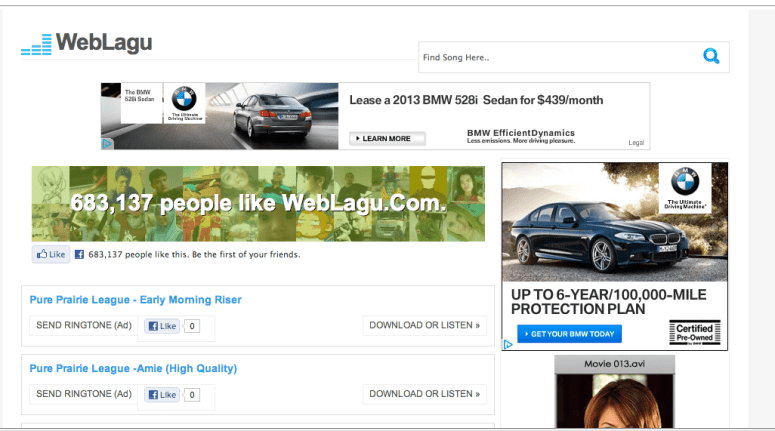
Pure Prairie League piracy brought to you by BMW.

Screen Shot 2013-02-22 at 3.57.36 PM

Al Stewart By Celestion and zZounds.

Screen Shot 2013-02-22 at 7.23.02 PM

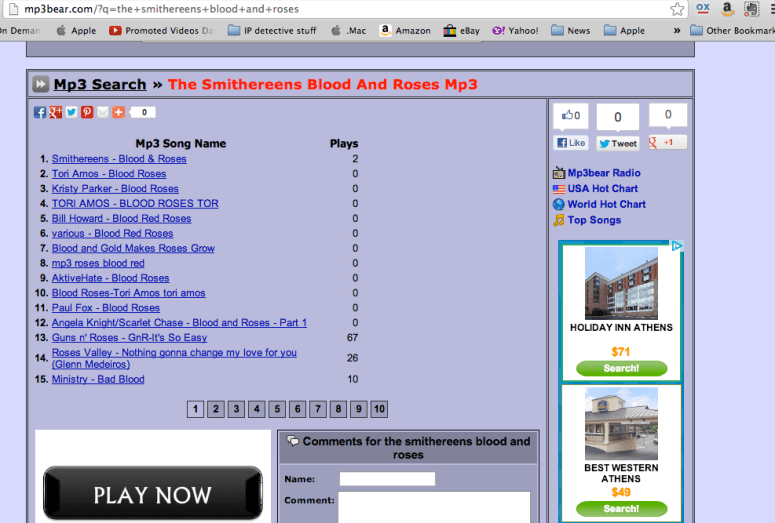
The Smithereens By Priceline

Screen Shot 2013-02-22 at 7.29.48 PM

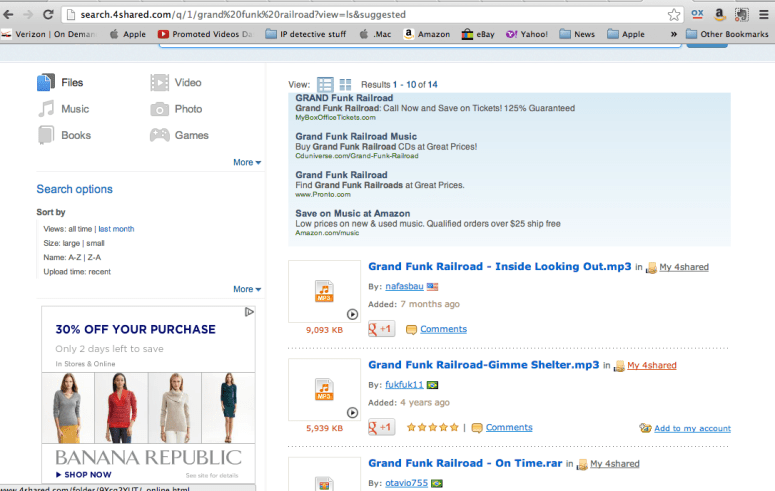
Grand Funk Railroad By Banana Republic, Amazon and others. 

Screen Shot 2013-02-22 at 7.32.59 PM

Streaming Services Ranked By “Artist Friendliness”

There is a lot of debate concerning the amounts paid to artists by streaming services.  It’s often very confusing because what an artist sees in royalties on their statements is highly dependent on a number of factors including whether they have a record deal, publishing deal or whether they are a solo performer or a band.  From an artists perspective royalties may accumulate from multiple sources. The other problem is that in general royalties are based on a percentage of the streaming services revenue.  So the amount may vary month to month and year to year.

Still one good  way to compare services is to look at statements for a moderately sized catalogue and calculate the revenue per stream they pay to “the rightsholders” (label/publisher/performer/songwriter) over a period of months.   This would also be the same amount that a completely independent artist that owns 100% if their own recordings and songwriting receives.

But this is not the only way to look at these streaming services from an “artist friendly” viewpoint.   We also need to look at whether these services respect artists rights. That is, whether these services respect the Artists right to choose how to monetize their music.   When you look at it in those terms the picture is a little different.  Here I’ve ranked the 7 most common services.

1. Rhapsody (Napster/Zune).  These three “on demand” services allow you access to virtually any song at any time. From an artist’s perspective they are identical.   These all work on a paid subscription model.  Like Spotify these services pay a percentage of revenue to rights holders.   But because they do not offer an ad based free service they have more revenue and pay more per stream to each artist than Spotify.  All these services  (like Spotify) operate under a private license.  They do not rely on a government imposed compulsory licenses or rates.  This also means rightsholders can theoretically “opt out” of this service if they think it doesn’t pay well enough. Or better yet negotiate a better deal.

I’m not opposed to compulsory licenses and rates in certain situations. But as  an artist I have to note that these rates are set by political appointees.  Broadcasters generally have a lot more money than artists and are thus better positioned  to influence the political process.  This is not some sort of tin foil hat paranoia.   If you were paying attention this fall you will note  that this is exactly  what happened  with the Orwellian-named Internet Radio Fairness Act.  Pandora fronting for Clear Channel,  Sirius XM and various Silicon Valley firms tried to use their lobbying money and influence to force the government to reduce those compulsory license rates!  Artists could have got an 85% pay cut!  So in general private blanket licensing is better for the artist.  Compulsory federal government imposed rates benefit the politically connected.

As previously noted have access to the streaming royalty payments for a moderately sized catalogue. Here are the average per stream rates paid by these three services Jul-Dec 2011.

Zune 2.8 cents

Napster  1.6 cents

Rhapsody 1.3 cents

These are close to being a sustainable* rate for artists.  (See footnote at end for an explanation.)

As a consumer I enjoy Rhapsody’s  256k mp3s.  As a consumer I prefer Spotify’s interface. I’ve never tried Zune or Napster.

2. Spotify.  #2 ?!! This surprises many of you.  Right? Let me explain.

Currently Spotify appears to be paying rightsholders about .5 -.7  cents a stream.  Considerably lower than the three services above.     While my colleagues here believe this is not a sustainable rate and that it may never become a sustainable rate we can’t know for sure.   It  is unclear how much streaming services  “cannibalize” or displace traditional sales. If streaming services  displace 20% of sales Spotify’s per stream rate could be sustainable.  If they displaces 80% of sales? Probably not.

Spotify  relies heavily on it’s free streaming service that is ad supported.  Spotify pays 70% of revenue to rightsholders.  If Spotify manages to convert more users to it’s premium subscription services revenues will rise.  As a result  rightsholder’s revenues rise.  If the ratio of paying subscribers to free subscribers rises substantially the per stream rate rises to something  sustainable.

What we  like about Spotify:  It operates (mostly?**) under  private licenses which means that rightsholders can withdraw from the service if they wish.  More importantly Spotify  has quietly allowed individual artists to “window” their releases and limit which singles or albums are available in the free service.  This is very important. For instance my band Cracker which has had four top ten rock tracks might find it’s revenues from Spotify acceptable.  But a niche artist like Zoe Keating might find she is losing sales to streaming services. She might chose to have only some or none of her catalogue available.  Choice is the foundation of free markets. Allowing artists to experiment with how to use streaming services, and how to monetize their songs is good for everyone. It will eventually be clear the best way to balance revenue and access.

I also should note that Spotify is being unfairly blamed for the knock on effects of disintermediation.  Disintermediation creates winner-take-all markets, and in an industry that was already winner take almost all, the small and middle class artists have gotten clobbered.  On a positive note, in these kind of markets there are usually countervailing market forces at work that nudge us towards  risk and revenue sharing. Or in Layman’s terms: It usually gets better.    The explanation is kind of complex so I’ll skip it for now.  Suffice it to say that right now it’s not so much Spotify taking artists’ royalties but the superstars taking everyone else’s royalties.

Finally Spotify has gone out of it’s way to engage artists, even critics like myself.  The fact that they were willing to sit down with me and discuss my issues with  their service is encouraging.

#3 Pandora.   Oh how the mighty have fallen.    Once they were our favorite.  Look at early Trichordist blogs and note our enthusiastic tone whenever we speak of Pandora!

For those of you that don’t know Pandora is NOT an on-demand streaming service.  I call it a “virtually on demand streaming service.”  If I type in a song title and artist name, I dont’ get that song.  But I usually get a song by that artist.  Pandora is a music discovery service.  It’s not a replacement for owning an album.  As a result Pandora gets and should get a lower rate than on demand services.

What we don’t like about Pandora:

They operate under a compulsory license so artists can not opt out of the service if they do not like the rates!! But what is worse is they have adopted the tactics of Silicon Valley’s hardball monopolists.  Proudly on display are  lobbyists, fake bloggers, planted stories, paid mouthpieces  and all the usual Kabuki Theatre bullshit we’ve come to expect from the “innovators” of Wall Street- er I mean Silicon Valley.  As I mentioned previously  Pandora fronted for the Internet Radio Fairness Coalition and pushed the Orwellian-named Internet Radio Fairness Act. The bill had nothing to do with Internet radio or fairness and everything to do with screwing artists out of 85% of their royalties.

Curiously the Internet Radio Fairness Coalition which supports the bill  has a lot of traditional broadcasters like Clear Channel and Sirius XM. Kind of odd for an organization with the publicized  purpose of leveling the playing field between Internet broadcasters and traditional broadcasters. The CCIA and CEA are also  inexplicably members of the IRFC.  Well maybe not inexplicably.  Just as the Four Horsemen herald the Apocalypse,   The CCIA  and CEA seem to always herald  La Chingada of someone, somewhere by Google.

So for participating in this rapacious anti-artist skullduggery we move Pandora from the top of the list  to #3.   We would put it at the bottom of the list but the other two lower ranking  services in my humble opinion are not even completely legal.

#4.   YouTube/Google.   YouTube is the biggest on demand streaming service. I know people think of it as a video service but it turns out that it’s the most popular music streaming service.  The main problem is that a lot of the music is uploaded and monetized by people that have no right to the music in the first place.  For example here is one of my recordings:  All Her Favorite Fruit. The problem is I didn’t authorize this person to upload this song, nor did I authorize YouTube to sell advertising or sponsored videos against this song.  It’s possible that the record label did but as I am also the songwriter and legally I should have been consulted.  Worse, the person who uploaded the static image can receive advertising revenues  since they “own” the video.  This is no different than Kim Dotcomm/MegaUpload paying people to upload the most popular movies and songs.  Further I have no idea where the money goes since you can’t audit YouTube without signing an agreement with them that basically says you can’t audit them!  YouTube is like the exploitative 1950’s music business but even worse, as  the artist does not receive the occasional Cadillac in lieu of royalties.

Now consider this:  This track is competing with legitimate authorized  streams of my track on other services.  These services generate some revenue for me.  So say I find it in my financial interests  to take this down?  I have to file what’s called a  DMCA notice.  When I do this Google can place my DMCA notice  on this website to try to publicly shame me into not doing this anymore.  I don’t file DMCA notices with YouTube/Google because I don’t want some deranged Freehadists showing up at my  home or office. This is not a far fetched idea, many of us in the vanguard arguing for artists rights and the preservation of copyright receive constant threats from seriously deranged free culture nutbags.  So the result is I don’t file a notice and I let YouTube/Google get away with this. This website is a tool of intimidation. It is my belief that this is exactly what Google intended when it launched this site.

If Google and UC Berkeley (which hosts the site and lends it intellectual legitimacy) had any common decency they would stop this practice cause someone is gonna get hurt one day. Now while  I don’t hold out hope for Google developing any common sense anytime soon (they are still allowing advertising for no prescription Oxycontin despite a half a billion dollar fine and threat of jail time)  maybe the Chancellor of UC Berkeley will recognize how screwed up this is.  You should ask Chancellor Birgeneau yourself: “Why is UC Berkeley supporting Googles intimidation scheme?”  chancellor AT berkeley.edu.

My friend East Bay Ray of The Dead Kennedys  told me he recently got an “offer” from YouTube/Google to let him claim  his own songs and start receiving royalties.(“Really you’re letting me have control over my own songs? Gee thanks how nice!”).  All he had to do was sign away most of his rights and in return the band would get about .1 cents a view.   Considering your typical banner ad on a shitty pirate website gets 1.5 cents an impression,  this is not even a joke.  It’s an insult.   Honestly I can’t understand how artists can complain about Spotify when YouTube/Google is so much worse and certifiably evil.  As I’ve said before “Don’t be Evil” is not their corporate slogan, It’s their widely ignored corporate reminder. 

#5 Grooveshark.   Many young people I run across seem to think this is a legitimate streaming service. It’s not.  My entire catalogue is on this service. No license, no permission and not a dime ever from these guys.   The sooner these guys go to jail the better.  I’m tempted to have a conversation with Ted Nugent. You think he’s mad about Obama raising his taxes and restricting his gun rights?  Wait till he finds out that Grooveshark is not paying him royalties.

* “Sustainable Rate” is my attempt to figure out a streaming rate that compensates artists well enough to continue to write (and especially) record albums.   I’ve examined a lot of iTunes libraries and “most played” lists.   A typical 20 year old college student seems to play a track they have purchased around 25-30 times before they seem to tire of the track.   So if on demand streaming replaces all album sales a stream should pay about 2.3-2.8 cents to be the equivalent of the 69 cents net received from iTunes on a 99cent download.  But if on-demand streaming only replaces 50% of album sales it could be half that rate.  You see?

But a  word of caution.  First this assumes that 99 cents a track is the right price for all songs.  Not necessarily true.   This is a price that iTunes essentially imposed on the record business, against a backdrop of mass piracy.  You can make an argument that this artificially lowered the price of music.

Second the music business has always worked on a revenue sharing model that assumes the “winners” subsidize the “losers” through record companies, publishing companies and their advances.   If you have total disintermediation in the streaming market even with high per stream rates  niche artists like Zoe Keating and Camper Van Beethoven would never generate enough revenue to record albums.  Music sales exhibit a “wild” variation and with total disintermediation almost all the revenue goes to the winners.   So this “sustainable rate” is not necessarily sustainable at all.  It is only one piece in the puzzle.  Eventually the revenue and risk sharing roles once assumed by record labels will need to be assumed by the record labels again, or other mechanisms need to be developed.

Other’s have suggested non market based  mechanisms which  include “crowd funding” government subsidies and corporate patronage.  I am uncomfortable with all of these.   Government and Corporate funding allow powerful elites to decide what music is made.   Crowd funding works for the most extroverted and popular personalities.   While crowdfunding comes closest to market based incentivizing  I don’t believe crowd funding would have ever given us  important artists  like Jimmy Hendrix, Captain Beefheart, Frank Zappa,  NWA,  Black Flag or Nirvana.   Can you imagine Kurt Cobain or Jimmy Hendrix offering a premium support package that includes the artist coming to your house and cooking dinner for you and 4 of your friends? No crowdfunding works for people like me who already have a career or extremely extroverted self promoting personalities like Amanda Palmer (no offense intended). 

One day I hope that all my musician and digital utopists friends wake up and see that the West’s private market based system for creating culture  has produced some extraordinarily profound and non-mainstream work.   No other system can match it. Why are some so  hell bent on throwing it away?  

** My understanding is that there is a compulsory on demand rate for songwriters (song in abstract) not performers.  It’s not clear to me whether Spotify uses this rate.   And I can’t two experts that agree.  But certainly the bulk (if not all) the revenues Spotify pays our are under the private license not compulsory license.

With Friends Like These: Amazon Advertising Against Illegal Camper Van Beethoven Links While Camper Van Beethoven Gives Amazon Exclusive Content.

For the release of Camper Van Beethoven’s new album we set up various promotional campaigns with various web retailers.  We did a signed edition with Newbury Comics,  we gave iTunes a couple of exclusive tracks to make a bonus edition.  And we also gave Amazon a couple of exclusive tracks for their bonus edition.

Today as we are compiling and labeling our screenshots to see who is advertising on massively infringing sites like Weblagu, against our music we came across Amazon advertising against an illegal download link.  Thanks Amazon.  With friends like these who needs enemies?

Now we know what Amazon is gonna say. “We can not control where our ads end up.”   We know this is not  true because we NEVER see Apple or Coca Cola products on these sites.

And even if that were true are you telling us that online ad networks are the equivalent of Skynet?

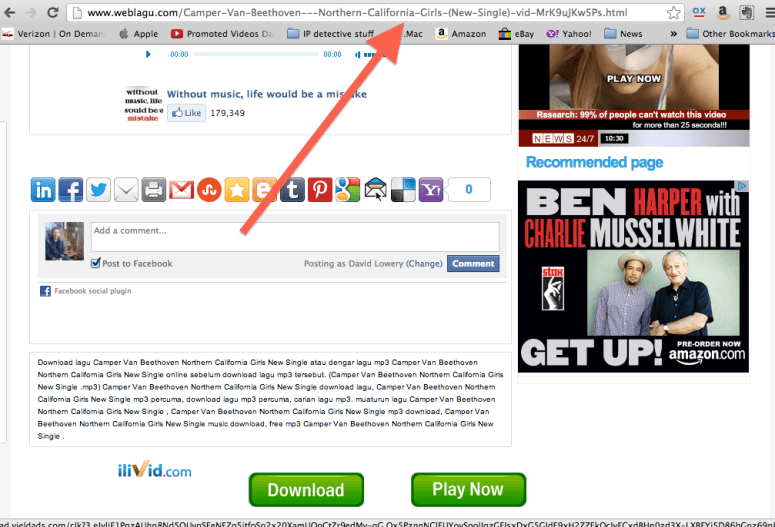
(the page was too long I had to cut it into two screenshots.  First shows the amazon advertisement.  The second screenshot show the top of the page with the infringing link).

Screen Shot 2013-01-24 at 11.59.04 AM

Screen Shot 2013-01-24 at 11.57.34 AM

Reading Between The Lines Google Tells The Truth On Ad Supported Piracy, Now Let Markets Do Their Work.

An Elegant Non-Denial And It’s Implications.

We previously noted that USC’s Annenberg Innovation Lab released a report detailing their initial observations regarding the top online advertising networks that appear to facilitate the payment of advertising revenue to sites that exploit artists without compensation, i.e., pirate sites.

In the 1950s, record labels (often controlled by shady figures of legend and myth) exploited songwriters and artists without compensation.  When artists complained, the label might give the artist a Cadillac in lieu of their royalties. When we hear these stories about how some of the music moguls from those days exploited artists we are rightly outraged.

Today, sites like The Pirate Bay, Hotfile and Isohunt exploit artists in a similar way except the artists don’t even get the occasional  Cadillac.  And not many people seem outraged.  In fact journalists (like this Spin Magazine writer ) seem to want to romanticize the operators of these sites as folk heroes. Instead of portraying them as they truly are: sleazy opportunists and scam artists waving the banner of “freedom” while they rob artists blind.   The really sad part is “respectable” Fortune 500 companies seem to be complicit in this racket.   By advertising on these sites, these otherwise respectable companies fund these illegal operations that exploit artists.

But there is good news.  At least one company, Google has accidentally admitted to being complicit in this racket.  Well maybe that’s not quite right.   Perhaps a better way of phrasing it is they simply didn’t categorically deny their involvement and invited us to read between the lines.   Still I’m taking this as an admission the industry has a problem.  And admitting you have a problem is the first step to recovery. Even if it’s only a read-between-the-lines kind of admission.

The reason I say this is because Google issued a curious and very carefully worded response to the USC report. I am quoting from the LA Times reporting on the study.

“To the extent [the study] suggests that Google ads are a major source of funds for major pirate sites, we believe it is mistaken,” a Google spokesperson said. “Over the past several years, we’ve taken a leadership role in this fight. The complexity of online advertising has led some to conclude, incorrectly, that the mere presence of any Google code on a site means financial support from Google.”

I don’t know-perhaps I’m crazy but I think they did this purposely. There is almost a deconstructed  free jazz beauty to this statement.  It’s like they hired the Ornette Coleman of press releases. The melody is there, but it’s in the omissions, the implied notes,  the silences and the negative spaces.  And using a little mathematical logic you can reconstruct that melody.  You can clearly deduce the statements that they specifically intended to not deny.  Probably just so they couldn’t be accused of lying later.  You follow my logic?

The four read-between-the-lines admissions are as follows.

1. Google is a source of some funding for some pirate sites.

“To the extent the study suggests that Google ads are a major source of funds for major pirate sites, we believe they are mistaken.”

Google  is not denying that it is a source of funds for pirate sites.  They are simply proclaiming (without evidence) that they are something less than a major source of funding.  So they are a moderate source of funding?  A minor source of funding? Just shy of being a major source of funding?  Left unexplained is how Google can measure major versus minor funding and how Google has knowledge of the revenues generated by these illegal and mostly offshore sites.

2. Google funds pirate sites, just not the top 8 sites.

“To the extent the study suggests that Google ads are a major source of funds for major pirate sites, we believe they are mistaken.”

Read this sentence again.  They are denying funding the “major” sites. But they are not denying they may be funding sites that they don’t (arbitrarily) consider major.  Now in this case we were able to do a little reverse engineering to figure out the cut-off between major and non-major websites.  As noted before on the Trichordist we have caught Google providing ads (and we can only assume revenue)  to http://www.filestube.com.  They admitted that filestube had an account and have since disabled it (thank you).  According to web traffic analysis site http://www.Alexa.com there are only 8 file-sharing/cyberlocker type sites that rank higher than filestube!  Google’s own transparency report names http://www.filestube.com as the #1 recipient of valid notices of copyright infringement.

Since Google is basically an engineering operation, you should consider  it significant that it has implicitly  created 4 quadrants for their involvement:

A.  Major Funding For Major Sites

B. Less Than Major Funding For Major Sites

C. Major Funding For Less Than Major Sites

D. Less Than Major Funding For Less Than Major Sites.

They are specifically not denying that they may be operating in quadrants B, C and D. They are only denying that they are in quadrant A.

3. Google lacks sufficient corporate oversight to really know if they are providing funds to illegal sites or not.  

“…we believe it to be mistaken.”

Note the use of the word “believe.”   They are hedging their bets.  They don’t really know.  Google claims its mission is to “organize the world’s information” (whether the world likes it or not).  How can a company that can organize the world’s information lack sufficient knowledge of their own data to know where they are sending revenue? Don’t they issue 1099s in accordance with tax laws?  We can only assume that they are specifically not denying a lack of corporate oversight.   Because the other possibilities are terrifying.

What are the other  possibilities?

A.  The online advertising network has grown so complex it is actually a sentient being.  And like Skynet in Terminator movies, Google has lost control of it and it is now trying to kill us all.  (I’d assign this a low probability, Google’s fascination with The Singularity notwithstanding.)

B. They do know where they are sending revenue.  And if this is the case, Google shareholders may be in for another $500 million dollar fine, like the one they got in the illegal online pharmacy settlement.

For the sake of Google stockholders, lets just hope they are merely disorganized.

4. Google is not denying that their source code on pirate sites means that they have a financial relationship with these sites.

“The complexity of online advertising has led some to conclude, incorrectly, that the mere presence of any Google code on a site means financial support from Google.”

Read this very carefully.  This is very, very clever. Or to keep using the Ornette Coleman analogy this is like the Science Fiction of  this press release.  It’s explosive, wild and takes a while to understand.  No one is really clear why there is a recording of a baby crying in the middle of the saxophone solo.   I’m sure it will confuse a lot of overworked underpaid journalists.

Note the words “some” and “any Google code”.  By using the word “some” Google has set up a hypothetical “straw man” to knock down.  For this statement to be true all they need is ONE example in which a pirate site  contained any Google code (Google Plus, Google Analytics) and someone  mistakenly thought Google was serving ads on the site.  It’s a beautiful hypothetical and that seems to “explain” everything.   When it really doesn’t.  That’s a wild bit of science fiction.  Or as one of my colleagues puts it  “a totally unrelated story that cross-dresses as a reasonable explanation.”

So once again Google cleverly DOES NOT deny that when we see Google or DoubleClick ad code or publisher IDs on rogue websites this confirms a financial relationship with Google.

But perhaps most telling of all is Google’s description of the ad networks as “complex.” And I heartily agree.   In the financial world there is an old adage “complexity is fraud.”   That is honest markets and financial products tend towards simplicity. But in the online advertising world you have ever increasing complexity. This usually indicates there is some fraudulent aspect to the market.  I believe that much of this “complexity” is there to simply insulate the big firms from illegal and unethical practices up and down the chain.  Because complexity has a useful byproduct: deniability.

To be fair, it should be noted that the online advertising ecosystem was not created by Google alone.  Other networks and the Madison Avenue agencies had a hand in creating this system.  I find it very interesting that not one of the Madison Avenue agencies has anything to say about this report.  Why the silence?

+++++++++++++++++++++++++++++++++++++++++

Transparency + Markets.

So my conclusion from all of this is probably not what you expect.   I think Google and the other ad networks are unreachable on this matter and we artists  shouldn’t waste time engaging them in a public relations battle.  They would love to confuse us with sideshows about ad exchanges, open protocols, “self-serve accounts”  and the complexity of the system.  None of that really matters.  What matters is that companies like State Farm and Amex show up on these sites.  We artists need to focus on the brands that are advertising on the these sites and nothing else.

The other thing to consider.  It is becoming ever more apparent that Google gets a form of “celebrity” justice when it comes to their wrongdoing.  A minuscule $25,000 dollar fine in the Google WiFi snooping case? How did that happen?   Or Friday’s mysterious  FTC announcement that the Obama Administration won’t be pursuing an anti-trust investigation of Google.  Google has too much clout in the political system.  While it’s reported that Google’s PAC may have divided its contributions between Republicans and Democrats, its employees and executives overwhelmingly supported Democrats and Obama.  The technology sector is one of the few industries that Democrats can rely upon to counter the Republicans’ advantage in corporate political donations.  This gives me little hope that Washington will ever punish Google or any other tech company involved in the online advertising cesspool.

Now I’m not in favor of this sort of cronyism, I’d love to see Congress investigate these ad networks, especially Google.   But ultimately I think it doesn’t matter.  What matters more is that we shine a light onto these practices. This is the best way to attack the problem.

The silver lining is that companies like Google are  helping us.   Their protestations are inadvertently providing transparency into how the online advertising ecosystem truly functions:   It’s out of control, un-reliable, and does not work as advertised.  It may actually do harm to some brands.  To paraphrase Chris Castle at Music Tech Policy: Online ad networks are Silicon Valley’s exploding Pinto. The mother of all product liability cases.  I believe that as this information becomes widely known  market forces will correct much of the problem, for there are clear financial incentives.

This will happen in two distinct but interrelated ways.  Downward pressure on share prices and lower revenues.

The money starts with the Fortune 500 brands.  We don’t need to know every single place where it ends up. We can see it in the screen captures.  We don’t need to follow the money to every Vladmir and Constantin running a pirate site.  We just need to cut off  funds at the source. And transparency is the most effective AND easiest way to do this.

As Fortune 500 firms become aware of how these ad networks really work, brands will abandon the “bad” networks reducing their revenue, or force the “bad” networks to change their practices. Either way funding for these sites should drop.

Part of the reason I’m so optimistic is that I’ve discovered that it’s really pretty easy to get a bad network in trouble with its clients. Let me demonstrate.   Virtually every illegal file-sharing and/or “cyber locker site”  will auto-suggest “recently downloaded” or “popular files”.  Every once in a while they suggest files that appear to be illegal pornography.  The site http://www.stopfilelockers.com  explains this  in detail.  But as an example even this innocuous search for “camper van beethoven pictures of matchstick men” on a site like http://www.filestube.com immediately autosuggested some very sketchy links at the bottom of the screen.
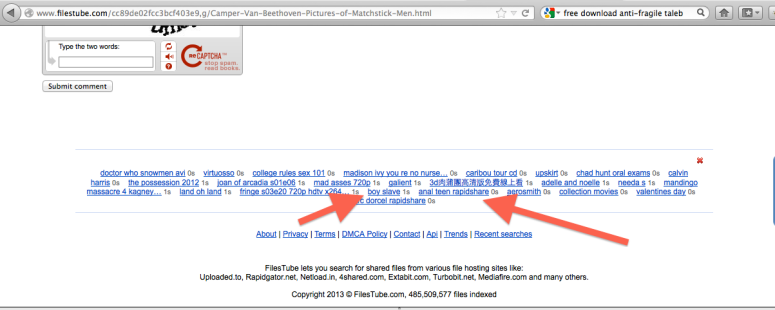
Screen Shot 2013-01-03 at 4.49.45 PM

And because these sites are completely unregulated eventually something really embarrassing happens to a major brand.  Like this real screenshot I captured earlier this fall:

“Bestiality brought to you by Lexus.”  For their “The Golden (Retriever) Opportunity Sales Event” advertising campaign
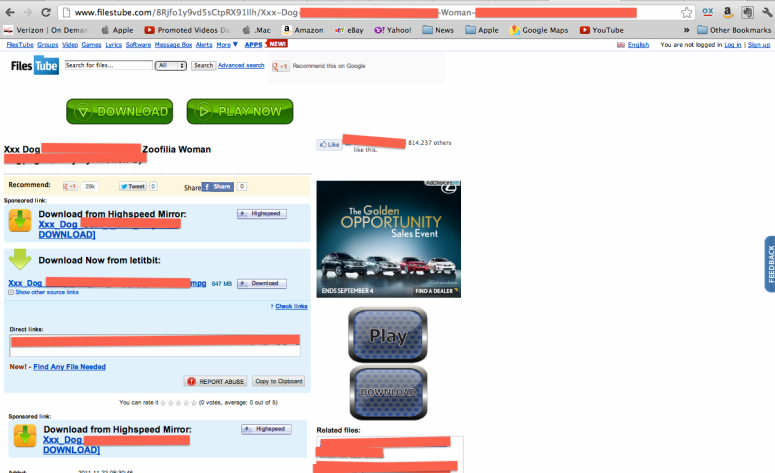
lexus and bestiality

And the same thing happened to  Urban Outfitters.  Although honestly I really can’t be 100% sure this isn’t intentional.  You follow me? This  may be some high level extreme branding. You never can be sure with a brand that uses  a litter box with cat poop spelling out “2013” for it’s web catalogue.  Not kidding.
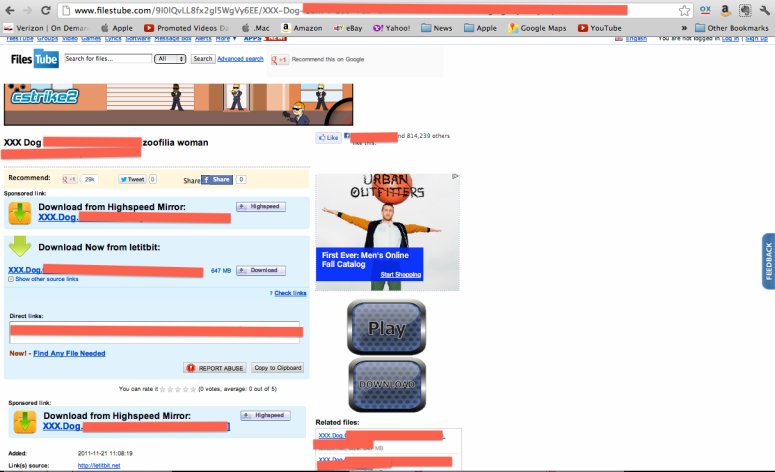
urban outfitters and bestiality

Transparency + Markets is quite a wonderful thing.  Isn’t there now a high probability that  someone at an ad agency or an entire ad network somewhere gets fired over these two screenshots?  The ultimate effect is that it reduces revenue to http://www.filestube.com.

But even more interesting is that the  publicly traded companies that operate ad networks,  like Google, Microsoft, Yahoo and ValueClick expose themselves to civil and criminal liability by doing business with these websites. What happens if one of these networks get caught up in a RICO investigation? What happens to the share price?

Many of these websites pay “affiliates” money for  uploading popular files.  In the case of MegaUpload I’d imagine many of these affiliates are in the US.  Do you really think MegaUpload sent 1099’s to these people? Do you think these affiliates declared this income on their taxes?  What happens to one of these ad networks when they get caught up in a US tax evasion investigation?  You do realize that the US Government is likely in possession of this data?

What happens when a major brand like Ford that doesn’t want their ads on these sites sues the ad network for a refund?  What happens if  hundreds  of brands sue the same ad network for a refund?  what will happen to the share price? I’m told that at least the big ad agencies require the ad network to submit to a compliance audit that could allow some brands to receive refunds on commissions if their ads end up in the wrong places.

And finally for finance geeks:

None of these things even has to actually happen for share prices to plunge.  The mere possibility that this could happen, the mere possibility that these companies have exposed themselves  to large  unpredictable downsides can drive the share price down. Influential stock analysts may notice these dangers  and issue bearish warnings.  But the more  likely scenario in my mind is a large hedge fund may make a big bet that these dangers are “underpriced” and start buying puts on one or all of these companies.  If it’s a large enough bet option market makers will have to sell short the stock to hedge potential losses.  This drives prices down.  Then “momentum” players  begin short selling further depressing shares.  Soon you have a vicious cycle.

Google, Yahoo and ValueClick are particularly vulnerable in this scenario since more than 90% of their revenue comes from advertising. Watch out when analysts start to ask the question “what percentage of their revenue is from rogue sites?”

So instead of arguing tit for tat with Google and their many paid bloggers and sock puppets, we artists should direct our energies elsewhere.   Let me humbly suggest that all artists should start searching these sites for their own music and observing which brands are financially supporting these sites.  Take screenshots and send them to us here  at the Trichordist.  We will then publicize these and notify the brands.  But by all means post them to your own facebook and twitter accounts.  You never know who’s gonna see them.

Remember : Transparency + Markets is usually a good thing.  The online advertising ecosystem is in desperate need of transparency. But we don’t have to wait for “the grownups” to get their shit together.  We can do this now!

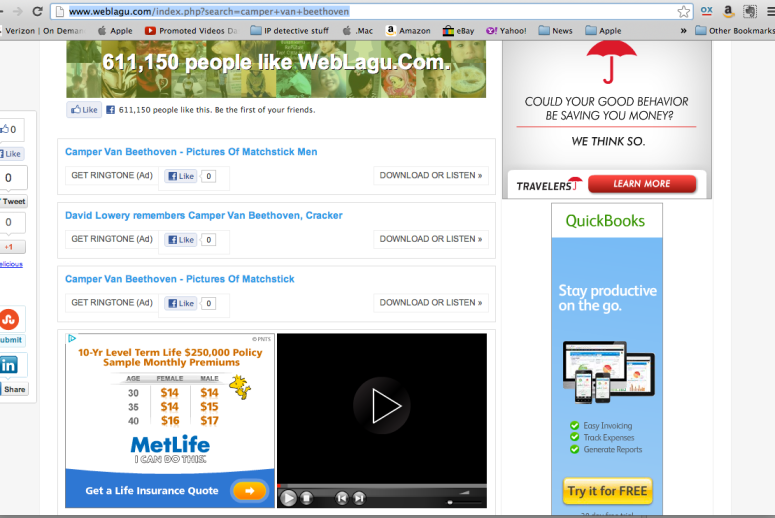
I’ll get us started. It’s easy.  Here is Traveler’s Insurance, Metlife and Quickbooks  helping fund the massively infringing site http://www.weblagu.com.  And since they are ripping me off.  I get to say:

SCREW YOU QUICKBOOKS/INTUIT.   GNUCASH IS JUST AS GOOD AND IT’S SHAREWARE! DOWNLOAD HERE.

Try it yourself.  http://www.weblagu.com/index.php?search=camper+van+beethoven.  See which advertisers pop up for you. Put in your own band name.

(Since I’m speaking to musicians I’m gonna assume you are on a mac .  So you can select an area for a screenshot by pressing Command+Shift+4. Your cursor turns into a sort of gunsight.  Click and drag  until you get a box the correct shape and area.  When you “let go” you will hear a snapshot sound and there  will be a .png file on your desktop. It’s name will reflect the date and time. 

If you have a PC you  probably already know how to do this 50 ways and  I don’t need to tell you how to do this.

Oh and those of you who are even more advanced,  use firefox and install the firebug plugin so you can capture the served source code in your screenshots.  Even better get a packet logger.  If you don’t understand what I’m talking about you won’t know how to do this anyway.)
Screen Shot 2013-01-03 at 12.48.41 PM

Other Than That Mr Westergren, How Was The Play? IRFA Gets An Ass Whupping

Yesterday the Internet Radio Fairness Act got a hearing before congress and promptly got it’s ass kicked.  I mean there is really no polite way of saying it.  Democrats and Republicans alike were scornful and clearly not interested in hearing Pandora’s ginned up unfairness crap. Not only did they seem to disagree with Pandora’s argument for lower royalties the committee went completely off the reservation and began to question why terrestrial radio doesn’t pay royalties to performers.  At one point Rep John Conyers asks:

“I’m still trying to figure out why artists and performers who play 24-7 on terrestrial radio don’t get a dime.”

Oops.

My favorite  part was Virginia Republican Bob Goodlatte’s scornful reproach to Pandora’s CEO Joe Kennedy

“Here we are again,  Mr Kennedy, when is a deal a deal?”

The Congressman was referring to the fact that just 3 years ago Pandora was crowing about the deal they had made with record labels, publishers and artists for royalties.  Now instead of trying to increase their paid subscribers, or increase advertising revenue, they are back asking congress for a handout.

And doesn’t congress have better things to do?  A fiscal cliff or something?

Or Pandora Could Add Another Minute Of Advertising And Raise Their Revenue 50%

Silicon Valley tech gurus  love to tell musicians that they “need new business models.”  This is kind of funny when you consider that most of these folks work for companies that have never shown a profit. Never!  Whereas my web-enabled businesses Cracker and Camper Van Beethoven  (like many bands) have been profitable for decades.  So can someone please tell mewhy we’re supposed to  listen to these serial failures with their snake oil schemes?

I think it’s high time that artists turn the tables.  We should tell these folks how to run their businesses for a change.  Quit whining and bootstrap it! Just like we had to when we were starting our bands.  Sell T-shirts or something!

For instance here’s how Pandora can increase their revenue 50%:

1. Pandora plays one minute of commercials per hour.  Satellite radio plays about thirteen minutes an hour. Pandora could easily double the number of ads and still have a very pleasant consumer experience.

2. Pandora made approximately $86 million from advertising on total revenues of $101 million last quarter.  Let’s say they double the amount of advertising and they only generate another 65 million from doubling ads.  This gives them a minimum of $151 million in revenue. And that is an increase of 50%.

But seriously folks, have investors considered that the so-called Internet Radio Fairness act could take years to pass?  And then once it passes it requires the President to appoint new judges that would have to be approved by the Senate.  Does that sound like a quick fix to you folks?  But that’s not all . These new judges would then have to convene new hearings on the royalty rates under the new below fair market value standards.    This would take years.

On the other hand Pandora could start increasing revenue tomorrow by simply airing more ads.  This is what most main street businesses do.  They need more revenue?  They generate more revenue.  They don’t run to the federal government to force their suppliers to lower their prices!  Adapt or die Pandora!

Of course we know the IRFA is about more than royalty rates.  This is about agency capture.  It’s about replacing current judges with judges that are more friendly to the the Tech and Broadcast industry’s agenda.  It’s about not allowing artists and their representatives to speak out when mega-broadcasters propose direct licensing deals that benefit labels at the expense of artists.   We artists could be prosecuted under The Sherman Act if this bill passes!

Let’s just hope that congress sees this for what it is: Crony Capitalism.

The Most Important Fact Academics and The Copyleft Neglect to Mention: Copyright is Optional.

This started as a quick response to a piece that Paul Resnikoff ran on his excellent Digital Music News blog.   I realized later that I really had a more general point to address.  There is a large contingent of people in the Copyleft (especially academics) that don’t seem to realize that eliminating copyright actually reduces choices and empowers rich and powerful corporations. 

++++++++++++++++++++++++++++++++++++++

A few years ago I had the pleasure of seeing comedian Patton Oswalt at my wife’s venerable DIY/indie music venue The 40 Watt club.

Patton opened with an apology to the largely liberal academic and college students in audience.

“I want to sincerely apologize for my opposition to gay marriage, I realize I may have offended many of you. But no one told me  gay marriage wasn’t mandatory”.

This is what is so incredibly stupid about the copyright debate. The tech lobby has created an army of ignorant academics, tech public policy apparatchiks and paid bloggers that seem to not understand that copyright is not mandatory.  Anyone is free to enter into a creative commons like licensing agreement or even just give away their music by fiat if they chose.  The hybrid/sharing economy is here and it’s thriving.

In fact that is what I do with some of my repertoire.  Cracker and Camper Van Beethoven have had a Grateful Dead inspired taping/sharing policy since our inception in the the early 1980’s.  We have thousands of live tracks on the internet music archives I unequivocally support an artist’s right to monetize his/her songs however they see fit. Or not to monetize those songs.

Eliminating Copyright protections does not increase choice by artists but limits them.  It does the opposite. We would no longer be able to choose how we monetize songs.  We could not chose with whom we do business. Eliminating copyright is mandatory collectivization, it’s closer to something that totalitarian regimes impose than the kind of free choice we provide in our democratic societies.

If this had been the public policy in the 1950’s and 1960’s the mafia connected Morris Levy wouldn’t have even had to buy those R&B singers the occasional Cadillac. He could have paid them nothing.  Most of the digital shysters arguing that they they want to “help” artists by “promoting” their music and paying them nothing are making the exact same arguments that Morris Levy made to artists in the 1950s and 1960’s when artists came to him asking for money.

Those calling for the abolition of copyright protections would simply be allowing multinational corporations like Universal Music, Google, Apple and BitTorrent  to exploit artists without little or no compensation.   It would make the most exploitative practices of the old music business look like childs play.

While it may seem revolutionary to many academics and bloggers to sit behind a computer and post invectives against copyright and the major record labels it’s not. It’s actually a regressive pro-corporate activity.  The truth is the rights of millions of individual artists (not record labels) would be destroyed in the process.  While mostly large multinational corporations would benefit.

The ideals of western civilization are ultimately designed to protect the rights of the weak, poor and powerless against the strong rich and powerful.  It may seem stupid in this age of cynicism and greed to measure policies against the fundamental principles of western civilization.  But it is not.  Especially if you believe in leaving behind a better and fairer world. If academics and intellectuals have time and energy for “fair trade” coffee isn’t it hypocritical that they don’t want to ensure that artists (the vast majority of which are in the developing world) are also fairly compensated and not exploited?

In an age when we are obsessed with advancing the rights of formerly persecuted minorities  and generally making the world a kinder place.  It is startling to see so many people arguing to make the world less fair and less civilized place for the milions of individual artists on the planet.  I can’t help but wondering if these generally progressive academics and intellectuals have really thought through their opposition to copyright.