Trump’s Historic Kowtow to Special Interests: Why Trump’s AI Executive Order Is a Threat to Musicians, States, and Democracy

There’s a new dance in Washington—it’s called the KowTow

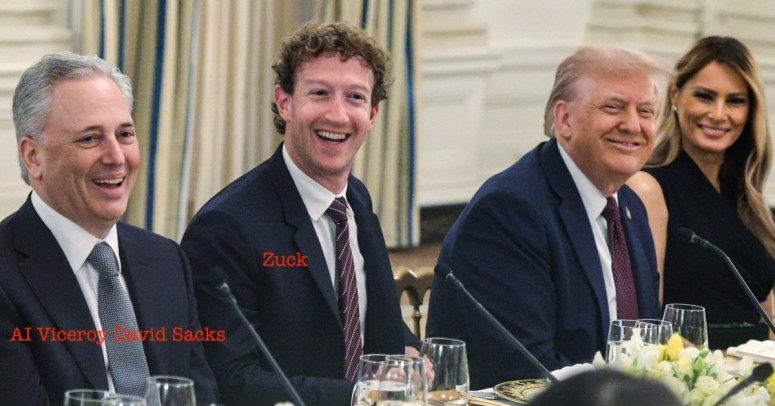
Most musicians don’t spend their days thinking about executive orders. But if you care about your rights, your recordings, your royalties, or your community, or even the environment, you need to understand the Trump Administration’s new executive order on artificial intelligence. The order—presented as “Ensuring a National Policy Framework for AI”—is not a national standard at all. It is a blueprint for stripping states of their power, protecting Big Tech from accountability, and centralizing AI authority in the hands of unelected political operatives and venture capitalists. In other words, it’s business as usual for the special interests led by an unelected bureaucrat, Silicon Valley Viceroy and billionaire investor David Sacks who the New York Times recently called out as a walking conflict of interest.

You’ll Hear “National AI Standard.” That’s Fake News. IT’s Silicon valley’s wild west

Supporters of the EO claim Trump is “setting a national framework for AI.” Read it yourself. You won’t find a single policy on:
– AI systems stealing copyrights (already proven in court against Anthropic and Meta)
– AI systems inducing self-harm in children
– Whether Google can build a water‑burning data center or nuclear plant next to your neighborhood 

None of that is addressed. Instead, the EO orders the federal government to sue and bully states like Florida and Texas that pass AI safety laws and threatens to cut off broadband funding unless states abandon their democratically enacted protections. They will call this “preemption” which is when federal law overrides conflicting state laws. When Congress (or sometimes a federal agency) occupies a policy area, states lose the ability to enforce different or stricter rules. There is no federal legislation (EOs don’t count), so there can be no “preemption.”

Who Really Wrote This? The Sacks–Thierer Pipeline

This EO reads like it was drafted directly from the talking points of David Sacks and Adam Thierer, the two loudest voices insisting that states must be prohibited from regulating AI.  It sounds that way because it was—Trump himself gave all the credit to David Sacks in his signing ceremony.

– Adam Thierer works at Google’s R Street Institute and pushes “permissionless innovation,” meaning companies should be allowed to harm the public before regulation is allowed. 
– David Sacks is a billionaire Silicon Valley investor from South Africa with hundreds of AI and crypto investments, documented by The New York Times, and stands to profit from deregulation.

Worse, the EO lards itself with references to federal agencies coordinating with the “Special Advisor for AI and Crypto,” who is—yes—David Sacks. That means DOJ, Commerce, Homeland Security, and multiple federal bodies are effectively instructed to route their AI enforcement posture through a private‑sector financier.

The Trump AI Czar—VICEROY Without Senate Confirmation

Sacks is exactly what we have been warning about for months: the unelected Trump AI Czar

He is not Senate‑confirmed. 
He is not subject to conflict‑of‑interest vetting. 
He is a billionaire “special government employee” with vast personal financial stakes in the outcome of AI deregulation. 

Under the Constitution, you cannot assign significant executive authority to someone who never faced Senate scrutiny. Yet the EO repeatedly implies exactly that.

Even Trump’s MOST LOYAL MAGA Allies Know This Is Wrong

Trump signed the order in a closed ceremony with sycophants and tech investors—not musicians, not unions, not parents, not safety experts, not even one Red State governor.

Even political allies and activists like Mike Davis and Steve Bannon blasted the EO for gutting state powers and centralizing authority in Washington while failing to protect creators. When Bannon and Davis are warning you the order goes too far, that tells you everything you need to know. Well, almost everything.

And Then There’s Ted Cruz

On top of everything else, the one state official in the room was U.S. Senator Ted Cruz of Texas, a state that has led on AI protections for consumers. Cruz sold out Texas musicians while gutting the Constitution—knowing full well exactly what he was doing as a former Supreme Court clerk.

Why It Matters for Musicians

AI isn’t some abstract “tech issue.” It’s about who controls your work, your rights, your economic future. Right now:

– AI systems train on our recordings without consent or compensation. 
– Major tech companies use federal power to avoid accountability. 
– The EO protects Silicon Valley elites, not artists, fans or consumers. 

This EO doesn’t protect your music, your rights, or your community. It preempts local protections and hands Big Tech a federal shield.

It’s Not a National Standard — It’s a Power Grab

What’s happening isn’t leadership. It’s *regulatory capture dressed as patriotism*. If musicians, unions, state legislators, and everyday Americans don’t push back, this EO will become a legal weapon used to silence state protections and entrench unaccountable AI power.

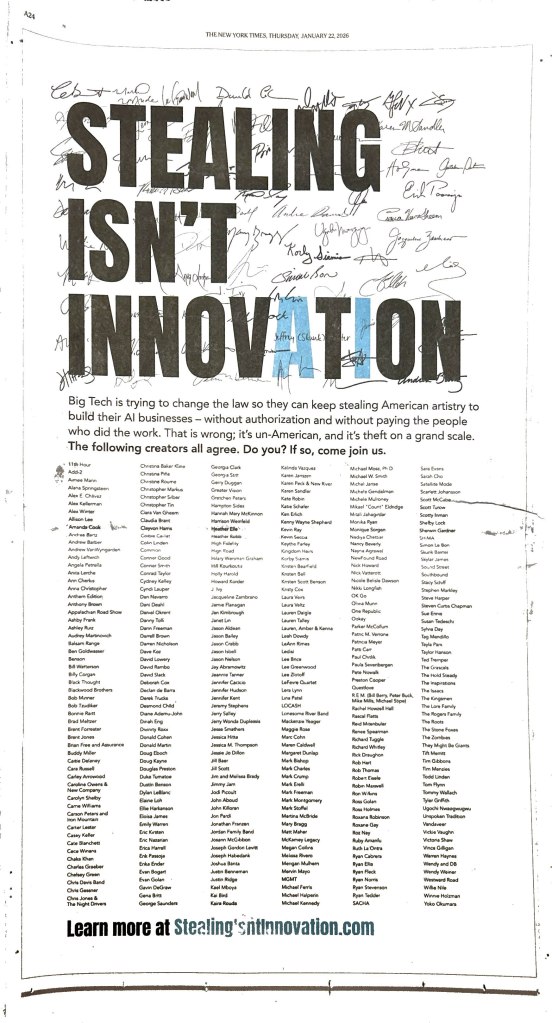
What David Sacks and his band of thieves is teaching the world is that he learned from Dot Bomb 1.0—the first time around, they didn’t steal enough. If you’re going to steal, steal all of it. Then the government will protect you.


Gene Simmons and the American Music Fairness Act

Gene Simmons is receiving Kennedy Center Honors with KISS this Sunday, and is also bringing his voice to the fair pay for radio play campaign to pass the American Music Fairness Act (AMFA).

Gene will testify on AMFA next week before the Senate Judiciary Committee. He won’t just be speaking as a member of KISS or as one of the most recognizable performers in American music. He’ll be showing up as a witness to something far more universal: the decades-long exploitation of recording artists whose work powers an entire broadcast industry and that has never paid them a dime. Watch Gene’s hearing on December 9th at 3pm ET at this link, when Gene testifies alongside SoundExchange CEO Mike Huppe.

As Gene argued in his Washington Post op-ed, the AM/FM radio loophole is not a quirky relic, it is legalized taking. Everyone else pays for music: streaming services, satellite radio, social-media platforms, retail, fitness, gaming. Everyone except big broadcast radio, which generated more than $13 billion in advertising revenue last year while paying zero to the performers whose recordings attract those audiences.

Gene is testifying not just for legacy acts, but for the “thousands of present and future American recording artists” who, like KISS in the early days, were told to work hard, build a fan base, and just be grateful for airplay. As he might put it, artists were expected to “rock and roll all night” — but never expect to be paid for it on the radio.

And when artists asked for change, they were told to wait. They “keep on shoutin’,” decade after decade, but Congress never listened.

That’s why this hearing matters. It’s the first Senate-level engagement with the issue since 2009. The ground is shifting. Gene Simmons’ presence signals something bigger: artists are done pretending that “exposure” is a form of compensation.

AMFA would finally require AM/FM broadcasters to pay for the sound recordings they exploit, the same way every other democratic nation already does. It would give session musicians, backup vocalists, and countless independent artists a revenue stream they should have had all along. It would even unlock international royalties currently withheld from American performers because the U.S. refuses reciprocity.

And let’s be honest: Gene Simmons is an ideal messenger. He built KISS from nothing, understands the grind, and knows exactly how many hands touch a recording before it reaches the airwaves. His testimony exposes the truth: radio isn’t “free promotion” — it’s a commercial business built on someone else’s work.

Simmons once paraphrased the music economy as a game where artists are expected to give endlessly while massive corporations act like the only “god of thunder,” taking everything and returning nothing. AMFA is an overdue correction to that imbalance.

When Gene sits down before the Senate Judiciary Committee, he won’t be wearing the makeup. He won’t need to. He’ll be carrying something far more powerful: the voices of artists who’ve waited 80 years for Congress to finally turn the volume up on fairness.

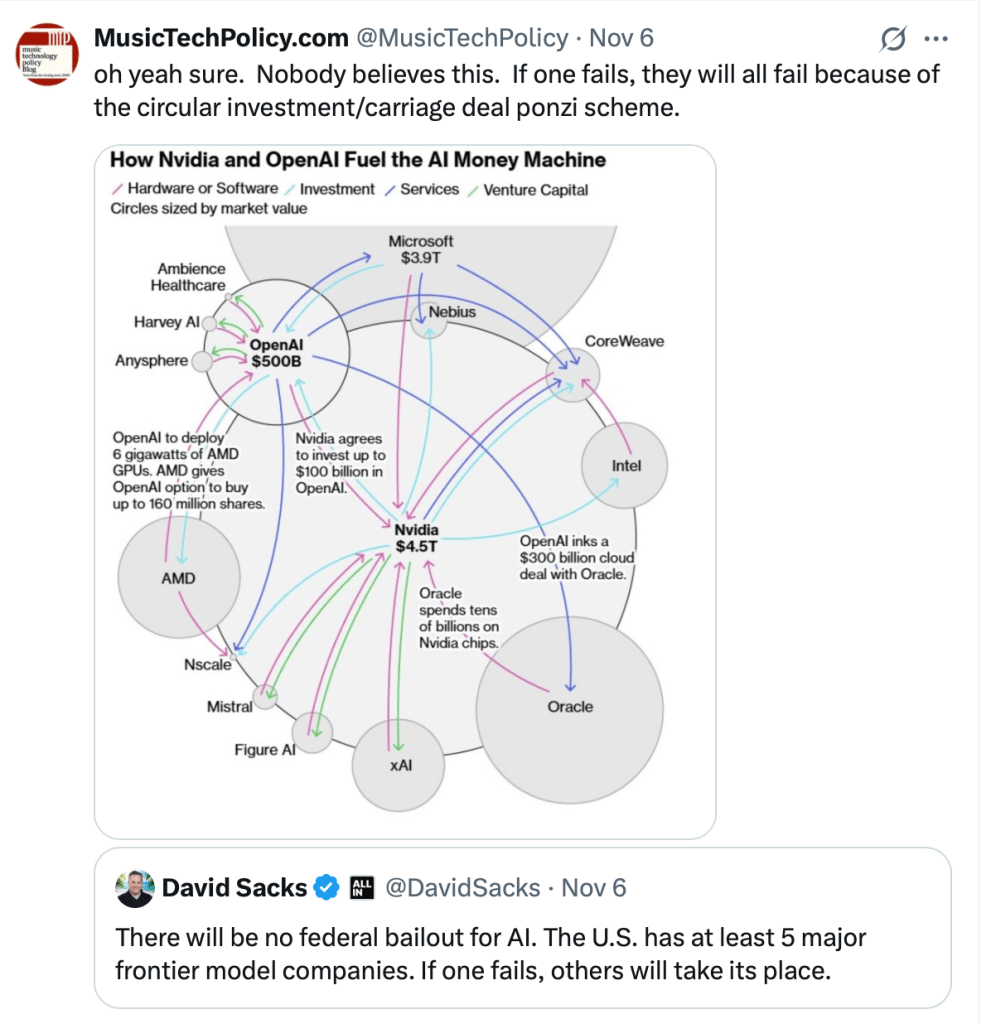
@DavidSacks Isn’t a Neutral Observer—He’s an Architect of the AI Circular-Investment Maze

When White House AI Czar David Sacks tweets confidently that “there will be no federal bailout for AI” because “five major frontier model companies” will simply replace each other, he is not speaking as a neutral observer. He is speaking as a venture capitalist with overlapping financial ties to the very AI companies now engaged in the most circular investment structure Silicon Valley has engineered since the dot-com bubble—but on a scale measured not in millions or even billions, but in trillions.

Sacks is a PayPal alumnus turned political-tech kingmaker who has positioned himself at the intersection of public policy and private AI investment. His recent stint as a Special Government Employee to the federal government raised eyebrows precisely because of this dual role. Yet he now frames the AI sector as a robust ecosystem that can absorb firm-level failure without systemic consequence.

The numbers say otherwise. The diagram circulating in the X-thread exposes the real structure: mutually dependent investments tied together through cross-equity stakes, GPU pre-purchases, cloud-compute lock-ins, and stock-option-backed revenue games. So Microsoft invests in OpenAI; OpenAI pays Microsoft for cloud resources; Microsoft books the revenue and inflates its stake OpenAI. Nvidia invests in OpenAI; OpenAI buys tens of billions in Nvidia chips; Nvidia’s valuation inflates; and that valuation becomes the collateral propping up the entire sector. Oracle buys Nvidia chips; OpenAI signs a $300 billion cloud deal with Oracle; Oracle books the upside. Every player’s “growth” relies on every other player’s spending.

This is not competition. It is a closed liquidity loop. And it’s a repeat of the dot-bomb “carriage” deals that contributed to the stock market crash in 2000.

And underlying all of it is the real endgame: a frantic rush to secure taxpayer-funded backstops—through federal energy deals, subsidized data-center access, CHIPS-style grants, or Department of Energy land leases—to pay for the staggering infrastructure costs required to keep this circularity spinning. The singularity may be speculative, but the push for a public subsidy to sustain it is very real.

Call it what it is: an industry searching for a government-sized safety net while insisting it doesn’t need one.

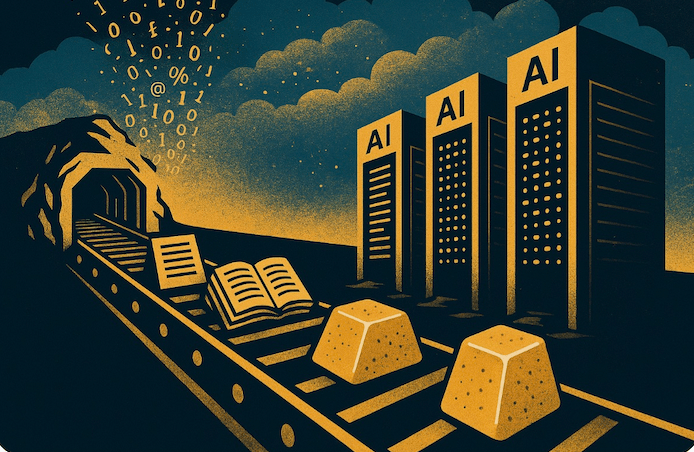
In the meantime, the circular investing game serves another purpose: it manufactures sky-high paper valuations that can be recycled into legal war chests. Those inflated asset values are now being used to bankroll litigation and lobbying campaigns aimed at rewriting copyright, fair use, and publicity law so that AI firms can keep strip-mining culture without paying for it.

The same feedback loop that props up their stock prices is funding the effort to devalue the work of every writer, musician, actor, and visual artist on the planet—and to lock that extraction in as a permanent feature of the digital economy.

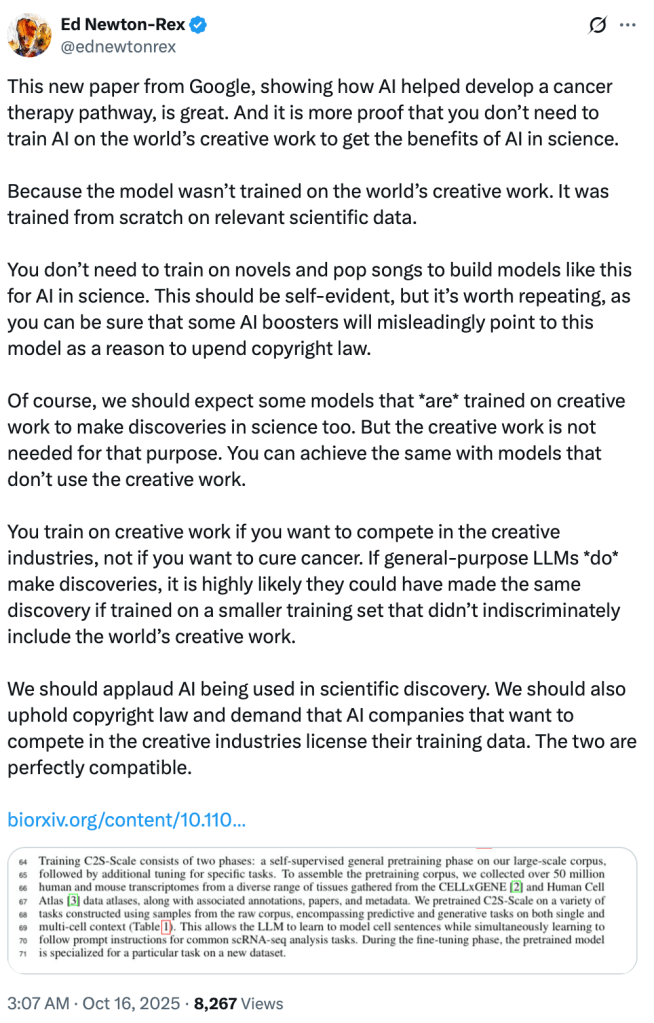
“You don’t need to train on novels and pop songs to get the benefits of AI in science” @ednewtonrex


You Don’t Need to Steal Art to Cure Cancer: Why Ed Newton-Rex Is Right About AI and Copyright

Ed Newton-Rex said the quiet truth out loud: you don’t need to scrape the world’s creative works to build AI that saves lives. Or even beat the Chinese Communist Party.

It’s a myth that AI “has to” ingest novels and pop lyrics to learn language. Models acquire syntax, semantics, and pragmatics from any large, diverse corpus of natural language. That includes transcribed speech, forums, technical manuals, government documents, Wikipedia, scientific papers, and licensed conversational data. Speech systems learn from audio–text pairs, not necessarily fiction; text models learn distributional patterns wherever language appears. Of course, literary works can enrich style, but they’re not necessary for competence: instruction tuning, dialogue data, and domain corpora yield fluent models without raiding copyrighted art. In short, creative literature is optional seasoning, not the core ingredient for teaching machines to “speak.”

Google’s new cancer-therapy paper proves the point. Their model wasn’t trained on novels, lyrics, or paintings. It was trained responsibly on scientific data. And yet it achieved real, measurable progress in biomedical research. That simple fact dismantles one of Silicon Valley’s most persistent myths: that copyright is somehow an obstacle to innovation.

You don’t need to train on Joni Mitchell to discover a new gene pathway. You don’t need to ingest John Coltrane to find a drug target. AI used for science can thrive within the guardrails of copyright because science itself already has its own open-data ecosystems—peer-reviewed, licensed, and transparent.

The companies like Anthropic and Meta insisting that “fair use” covers mass ingestion of stolen creative works aren’t curing diseases; they’re training entertainment engines. They’re ripping off artists’ livelihoods to make commercial chatbots, story generators, and synthetic-voice platforms designed to compete against the very creators whose works they exploited. That’s not innovation—it’s market capture through appropriation.

They do it for reasons old as time—they do it for the money.

The ethical divide is clear:

  • AI for discovery builds on licensed scientific data.
  • AI for mimicry plunders culture to sell imitation.

We should celebrate the first and regulate the second. Upholding copyright and requiring provenance disclosures doesn’t hinder progress—it restores integrity. The same society that applauds AI in medical breakthroughs can also insist that creative industries remain human-centered and law-abiding. Civil-military fusion doesn’t imply that there’s only two ingredients in the gumbo of life.

If Google can advance cancer research without stealing art, so can everyone else and so can Google keep different rules for the entertainment side of their business or investment portfolio. The choice isn’t between curing cancer and protecting artists—it’s between honesty and opportunism. The repeated whinging of AI labs about “because China” would be a lot more believable if they used their political influence to get the CCP to release Hong Kong activist Jimmy Lai from stir. We can join Jimmy and his amazingly brave son Sebastian and say “because China”, too. #FreeJimmyLai

Don’t forget tomorrow—Artist Rights Roundtable on AI and Copyright at American University in Washington DC

Artist Rights Roundtable on AI and Copyright: 
Coffee with Humans and the Machines     

Join the Artist Rights Institute (ARI) and American University’s Kogod’s Entertainment Business Program for a timely morning roundtable on AI and copyright from the artist’s perspective. We’ll explore how emerging artificial intelligence technologies challenge authorship, licensing, and the creative economy — and what courts, lawmakers, and creators are doing in response.

This roundtable is particularly timely because both the Bartz and Kadrey rulings expose gaps in author consent, provenance, and fair licensing, underscoring an urgent need for policy, identifiers, and enforceable frameworks to protect creators.

 🗓️ Date: September 18, 2025
🕗 Time: 8:00 a.m. – 12:00 noon
📍 Location: Butler Board Room, Bender Arena, American University, 4400 Massachusetts Ave NW, Washington D.C. 20016

🎟️ Admission: Free and open to the public. Registration required at Eventbrite. Seating is limited.

🅿️ Parking map is available here. Pay-As-You-Go parking is available in hourly or daily increments ($2/hour, or $16/day) using the pay stations in the elevator lobbies of Katzen Arts Center, East Campus Surface Lot, the Spring Valley Building, Washington College of Law, and the School of International Service

Hosted by the Artist Rights Institute & American University’s Kogod School of Business, Entertainment Business Program

🔹 Overview:

☕ Coffee served starting at 8:00 a.m.
🧠 Program begins at 8:50 a.m.
🕛 Concludes by 12:00 noon — you’ll be free to have lunch with your clone.

🗂️ Program:

8:00–8:50 a.m. – Registration and Coffee

8:50–9:00 a.m. – Introductory Remarks by KOGOD Dean David Marchick and ARI Director Chris Castle

9:00–10:00 a.m. – Topic 1: AI Provenance Is the Cornerstone of Legitimate AI Licensing:

Speakers:

  • Dr. Moiya McTier, Senior Advisor, Human Artistry Campaign
  • Ryan Lehnning, Assistant General Counsel, International at SoundExchange
  • The Chatbot

Moderator: Chris Castle, Artist Rights Institute

10:10–10:30 a.m. – Briefing: Current AI Litigation

  • Speaker: Kevin Madigan, Senior Vice President, Policy and Government Affairs, Copyright Alliance

10:30–11:30 a.m. – Topic 2: Ask the AI: Can Integrity and Innovation Survive Without Artist Consent?

Speakers:

  • Erin McAnally, Executive Director, Songwriters of North America
  • Jen Jacobsen, Executive Director, Artist Rights Alliance
  • Josh Hurvitz, Partner, NVG and Head of Advocacy for A2IM
  • Kevin Amer, Chief Legal Officer, The Authors Guild

Moderator: Linda Bloss-Baum, Director, Business and Entertainment Program, KOGOD School of Business

11:40–12:00 p.m. – Briefing: US and International AI Legislation

  • Speaker: George York, SVP, International Policy Recording Industry Association of America

🎟️ Admission:

Free and open to the public. Registration required at Eventbrite. Seating is limited.

🔗 Stay Updated:

Watch this space and visit Eventbrite for updates and speaker announcements.

Waterloo Records remastered: Iconic vinyl shop celebrates grand re-opening

We could not be happier for our friends at Waterloo Records in Austin on their reopening down the street. Read about it here. Support your local record store!

The famous record shop, which for decades sat at the corner of West Sixth Street and North Lamar Boulevard, finally lowered the needle on its new location Saturday; the soundtrack a mashup of excited shoppers, intermittent announcements about prizes and giveaways, and, of course, music. 

Waterloo’s grand re-opening party marked the culmination of months of collaboration and planning among former majority owner John T. Kunz and new co-owners and operators Caren Kelleher and Trey Watson.

хулиган: Love to Anastasia Dyudyaeva and Alexander Dotsenko

In July 2024, a military court in Saint Petersburg convicted Russian artists Anastasia Dyudyaeva and her husband Alexander Dotsenko on charges of “public calls for terrorism” after they placed anti-war messages—some in Ukrainian, one reading “Putin to the gallows”—on napkins or postcards in a Lenta supermarket. Dyudyaeva received a 3½-year sentence; Dotsenko, three years. They denied wrongdoing, asserting their creative expression was mischaracterized. Their home, which had hosted anti-war exhibitions, was searched, and they were added to Russia’s registry of “terrorists and extremists.” 

Read about it in the Art Newspaper

Fake Pics on Facebook

Who’s Really Fighting for Fans? Georgia Music Partners Comment in the DOJ/FTC Ticketing Consultation

The Department of Justice and Federal Trade Commission were directed by President Trump to conduct an investigation into ticket scalping pursuant to Executive Order 14254 “Combating Unfair Practices in the Live Entertainment Market.”

This led directly to both agencies inviting public comments on the state of the live event ticketing market—an industry riddled with speculation, opacity, and middlemen who seem to make money without ever attending a show. Over 4000 artists, fans, economists, state attorneys general, and industry veterans all weighed in. And the record reveals something important particularly regarding resellers: there’s a rising consensus that the resellers are engaged in some really shady practices designed for one purpose–to extract as much money as possible from fans and artists without regard to the damage it does to the entire artist-fan relationship.

Today we’re posting Georgia Music Partners’ comment that highlights how unchecked secondary ticketing practices—particularly speculative ticket listings, bot-driven price inflation, deceptive branding, and the resale of restricted tickets—are systematically dismantling the live music ecosystem. These practices strip artists of control, mislead fans, and commoditize the artist-fan relationship for the sole benefit of resellers. The comment urges the DOJ and FTC to treat these behaviors as unfair and deceptive trade practices, enforce the BOTS Act, and distinguish reseller abuse from the separate issues posed by Live Nation case, emphasizing that the artist’s intent and trust with fans must be protected.