The upshot of the Judges’ ruling rejecting the extension of the frozen rates is that both George Johnson as a participant and a host of commenters brought up many valid points about problems with the settlement. I suppose the next step will be for the Judges to either set rates themselves and let the parties react to them or ask the parties to resubmit a new proposal in line with the Judge’s ruling.
Either way, the settlement is rejected and we have to thank the Judges who listened thoughtfully, George Johnson who toils alone representing himself (and the independent songwriter’s view) as an actual participant in the proceeding, and all the songwriters, independent publishers, lawyers and songwriter groups who took the time to comment. And of course a huge thank you to all the Trichordist readers who supported fairness and justice and all the heartfelt comments against frozen mechanicals.
The wheels of justice turn slowly, but they do turn. Don’t forget it–the price of liberty is eternal vigilance.
Here is the Judges conclusion:
Rightsholders are free to choose their representation in these proceedings. Admittedly, individual songwriters and self-publishers have traditionally chosen not to expend the resources necessary to participate in these proceedings at the same level as trade organizations and major technology companies. Nonetheless, the outcomes of these proceedings can have a significant impact on the lives of the individual rightsholders. In this proceeding, the Judges received lengthy comments from SGA, which claims to represent thousands of songwriters. For SGA’s comments to have independent influence, however, SGA would have needed to join the proceeding as a participant. Nonetheless, with regard to the present proposed settlement, the comments of non-participants cumulatively served to amplify those of the objecting participant.
Pursuant to section 801(b)(7)(A)(ii), based on the totality of the present record—including the Judges’ application of the law to that record, as well as GEO’s objections, which, as noted supra, are consistent with the non-participant comments—the Judges find that the proposed settlement does not provide a reasonable basis for setting statutory rates and terms. Furthermore, the Judges find a paucity of evidence regarding the terms, conditions, and effects of the MOU. Based on the record, the Judges also find they are unable to determine the value of consideration offered and accepted by each side in the MOU. These unknown factors, as highlighted in the record comments, provide the Judges with additional cause to conclude that the proposed settlement does not provide a reasonable basis for setting statutory rates and terms.
The hearing on Groundhog Day (Feb. 2) for the American Music Fairness Act (or “AMFA”) was a fantastic opportunity for artists to be heard on the 100 year free ride the government has given broadcast radio. We know it went well because the National Association of Broadcasters sputtered like they do when they’ve got nothing to say.
But what’s really hysterical was how they talked out of both sides of their mouths in two different hearings–which makes you think that NAB president Curtis LeGeyt was doing his impression of Punxsutawney Phil. Yes, when it came to broadcasters getting paid by Big Tech, the broadcasters wanted their rights respected and to be paid fairly. But when the shoe was on the other foot, not so much. In the Senate, the NAB asked for more money for broadcasters in a hearing for the Journalism Competition and Preservation Act–to protect the mega radio broadcasters from the mega tech oligarchs. And if broadcasters don’t get more money, they want to be exempt from the antitrust laws so they can pull their content. Just like artists do to them…NOT.
Then the NAB comes over to the House Judiciary Committee–on the same day being Groundhog Day–and asks the government to continue their 100 year free ride. We call bullshit.
The AMFA witnesses didn’t ask for an antitrust exemption, like the broadcasters did. They simply asked that recording artists be granted similar copyrights as others.
They didn’t ask for more money, like the broadcasters did. They simply asked for at least some payment, since they now receive none when broadcast radio stations air their music.
They didn’t ask for special treatment, like the broadcasters did. Rather they asked that they be treated the same as all other artists around the world, and even the same as artists on virtually all other media platforms in the U.S.
And they didn’t ask for rigts to negotiate and withhold content, like the broadcasters did. Under AMFA, radio stations would still be allowed to play music as they please. Artist advocates simply asked that the biggest-of-the-big stations pay a modest royalty set according to market rates. Stations making less than $1.5 million per year would pay a flat, annual royalty of $500 (less than $1.40 per day) for as much music as they choose to air. And the smallest stations’ payments would drop all the way down to $10.
No station is going to go bankrupt over these royalties.
Huppe has a very strong point here. This legislation has been picked over for years. AMFA bends over backwards to protect community radio and small broadcasters and repects everyone’s contribution to radio’s success.
But that’s the point–it respects everyone‘s contribution.
We want Trichordist readers to now how much we appreciate your commitment to artist rights and especially your long-term support for the #IRespectMusic campaign. You were there early and your support has never wavered. But it’s time to step up once again!
It’s time to tell Congress we are still here and we still want them to make this happen. It’s fair and it’s the right thing to do. As Blake Morgan asked in a viral blog post in The Hill:
We musicians are used to fighting. For our livelihoods, our families, our dreams. In recent years we’ve fought battles we’ve neither sought nor provoked, against powerful corporate forces devaluing music’s worth. Streaming companies, music pirates, and AM/FM radio broadcasters who, in the United States, pay nothing––zero––to artists for radio airplay.
It’s shocking, but true: The United States is the only democratic country in the world where artists don’t get paid for radio airplay. Only Iran, North Korea, and China stand with the United States in this regard.
Broadcasters make billions of dollars each year off our music, and artists don’t earn a penny. This impacts not only the artist, but session musicians, recording engineers, songwriters. Virtually everyone in music’s economy.
Isn’t being paid fairly for one’s work a bedrock American value?
The super-consolidated U.S. broadcast radio monopolies represented by the National Association of Broadcasters shillery has fought fair treatment for all recording artists since the dawn of radio. Thanks to the voices of fans and artists from around the United States, fair pay for radio play has become a local issue, and Congress is responding.
In the mean time, please sign the petition at #IRespectMusic and let your Member of Congress know you support the bill and want to bend the arc of the moral universe to fight artist exploitation. Please tell your friends, share on your socials and with your fans!
You can read the bill here, and if you want to drill down, you can watch this in-depth video on the issues sponsored by Texas Accountants and Lawyers for the Arts, I Respect Music Austin, Austin Music Foundation, SoundExchange, Austin Texas Musicians and Artist Rights Watch.
[Trichordist says: The Copyright Royalty Board reopened the comments on frozen mechanical song royalties in Phonorecords IV rate setting and the filings are coming in, especially from songwriters! We will be posting the comments (or excerpts from the long ones. First up is a straight from the heart contribution from Chelsea Crowell, Erin McAnally and Abby North.]
Copyright Royalty Board 37 CFR Part 385 [Docket No. 21–CRB–0001–PR (2023–2027)] Determination of Rates and Terms for Making and Distributing Phonorecords (Phonorecords IV)
Interim Chief Copyright Royalty Judge Suzanne Barnett Copyright Royalty Judge Steven Ruwe Copyright Royalty Judge David R. Strickler US Copyright Royalty Board 101 Independence Ave SE Washington, DC 20024
SECOND REOPENING PERIOD COMMENTS OF ABBY NORTH, ERIN MCANALLY AND CHELSEA CROWELL
To Your Honors:
Thank you for the opportunity to submit additional comments, now that the details of the Memorandum of Understanding (MOU4) apparently related to the Subpart B mechanical rate settlement negotiated by the NMPA, NSAI and three major labels have been made available.
Only the NMPA’s 300 or so publishers are potential parties to the MOU, assuming the opt in terms are the same as those of MOU3 (http://nmpalatefeesettlement.com/mou3/faq.php). The publishers that opt in to the MOU4 settlement will receive money for their participation, and in exchange for this money, the NMPA Board members have agreed to freeze the Subpart B mechanical rate at the $.091 rate that’s been in place since 2006.
In this exchange, NMPA publishers have a stream of revenue (the MOU4 money) that offsets the negative effect of the lack of rate increase in the Subpart B mechanical.
Although foreign CMOs could opt into the current MOU3 settlement, rightsholders that are not NMPA members may not opt in and will not receive the buffer that the MOU4 money provides, yet they are subject to the frozen mechanical rate that is an apparent condition of the negotiation related to the proposed settlement of the Subpart B rates and terms.
Thousands, if not tens of thousands of songwriters in the world have songs published or administered by those NMPA publishers that are party to the rate freeze settlement, but neither these songwriters nor the vast number of songwriters around the globe were given a say in the decision to freeze the mechanical rate.
The concern we have is not that there is a settlement. The concern is that the settlement does not provide for a base rate greater than $.091, plus annual increases to adjust for inflation.
To quote the NMPA’s Supplemental Comments: “…mechanical royalties from Subpart B configurations now constitute only a small part of total mechanical royalty revenue in the U.S., and that share is expected to get smaller during the period covered by this proceeding.”
That concept only resonates with a corporation that aggregates thousands or millions of copyrights.
To an individual songwriter or a small rightsholder, it doesn’t matter if Subpart B mechanicals constitute 1% or 15% or 50% of total royalties. Why? Because every single penny counts.
When an individual is paying a mortgage, tuition or a car payment, every single penny counts. When a health crisis occurs, every penny counts. When existing off the very low streaming royalties generated by even a hit song, every penny counts.
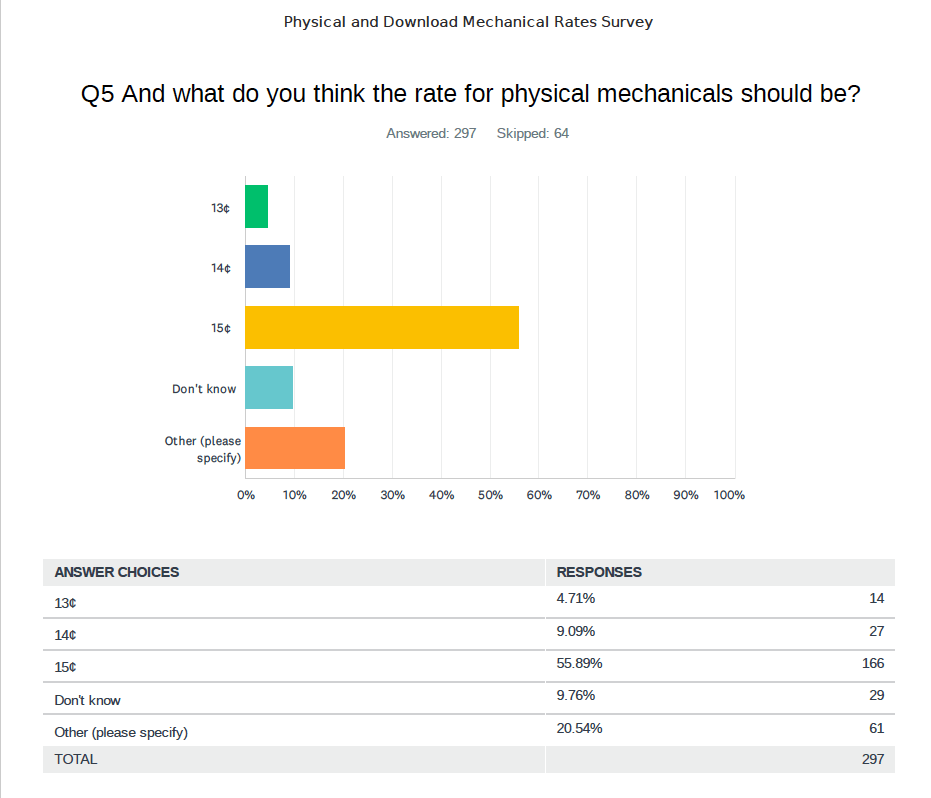
Physical and download mechanicals are still an extremely relevant revenue stream to individual songwriters and small publishers.
At the current retail price of $.99 for a download, the $.091 mechanical is 9.2%.
The streaming royalty pool for songs is roughly 10.5% of the total, possibly as much as 15.1%, per the CRB III hearing results (after all this time, still under appeal). The NMPA has suggested an increase of the streaming royalty rate to 20%. This would be an exceptional improvement.
How is the download royalty not at least the same percentage as the streaming royalty?
Why is the value of a downloaded song less than that of one that is streamed?
We suggest the Subpart B rate and the streaming mechanical rate (based on percentage) should be on no less than a most favored nations basis with one another.
To songwriters and most publishers, every royalty type and every revenue stream matters. The move from physical to digital, the unbundling of albums in favor of singles and the unlivable streaming royalty rates absolutely substantiate the need for an increase in Subpart B mechanicals, at least to reach the percentage paid on the streaming side, and with periodic adjustment for inflation. 3
We appreciate the opportunity to submit these additional comments, and we ask the Judges to recognize that songwriters and small publishers are individuals who do not have the luxury of collecting royalties from the aggregation of hundreds of thousands of works.
It is not fair that songwriters signed to the NMPA publishers have a frozen mechanical rate forced on them, and it is remarkably egregious that non-NMPA publishers and their writers are also forced into this horrible reality.
Respectfully,
Abby North, North Music Group LLC Chelsea Crowell, Songwriter Erin McAnally, Songwriter/Factory of Strange Tones
It is absolutely accurate that the streaming services are pushing for abysmal rates and terms in Phono IV. Some services like Amazon, Pandora and Spotify actually advocate to a return of the rates and terms from prior rate setting “wars” in Phono I (2006) and II (2011). Others, like Apple, suggest applying the rates and terms that are determined by the CRB in Phono III – which, mind you, covers 2018-22, and is being litigated simultaneously despite 2022 commencing in two months – because what an awesome system is this Copyright Royalty Board! Nevertheless, there is something that has been conveniently omitted from each of these media articles: “the why.” Why are the services proposing the “lowest rates in history?” What justification do the services provide for their positions? Unfortunately, the answer is not as simple as the streaming services playing the role of “the villains” in the “war” for songwriters’ livelihoods.
When you download the hundreds of pages of the services’ written direct testimony from the CRB, and wade through the arguments in the mire of heavily redacted passages, there is a surprising common theme used to bolster every last one of their positions: the proposed settlement by the NMPA, NSAI and the three major labels to freeze rates for physical product like vinyl and permanent downloads (the Subpart B configurations) (see here: https://app.crb.gov/document/download/25288).
Simply put, every service used the NMPA and NSAI proposed settlement for physical as a benchmark to support their abysmal rates on streaming. Surprised? Me, too. But for reference I’ve included some excerpts from the services’ filings at the end of this post.
For those in need of catching up to this point, TheTrichordist has chronicled this proposed settlement and the reactions thereto (i.e. “the Frozen Mechanicals Crisis” see here: https://thetrichordist.com/category/frozen-mechanicals/ ). Songwriters, music publishers, and songwriter advocates penned articles for The Trichordist and some wrote comments to the CRB objecting strongly to the NMPA and NSAI settlement. Some also wrote their representatives in Congress, expressing their dismay over this important revenue stream being frozen yet again for another five years due to a private settlement between “willing buyers” and “willing sellers” who are one and the same person at the corporate level. What’s more, Texas Congressman Lloyd Doggett submitted a letter to the Librarian of Congress and the Register of Copyrights inquiring about the matter (see here: https://thetrichordist.com/2021/07/18/letter-from-congressman-lloyd-doggett-about-frozen-mechanicals-to-librarian-of-congress-and-register-of-copyrights/).
Now that it is crystal clear the proposed settlement is being seized upon by the services as a way to benchmark and justify their lower-than-ever rate proposals (also called “hoist with your own petard”), it is time for the highly paid representatives of the copyright owners in this proceeding to truly rethink their strategies. This result was predictable – as I mentioned in my last post here: https://thetrichordist.com/2021/06/25/guest-post-by-sealeinthedeal-a-foreseeable-result-of-the-phonorecords-iv-private-settlement-opening-pandoras-box/ , “[i]t did not take a soothsayer to foresee this result; the private settlement opened Pandora’s box – begetting misery for every songwriter.”
More disturbing, they should have seen this coming a long way off because they got called out for doing essentially the same thing in Phonorecords III. For context, when there was a lull in the pace of Phono IV, I began delving through the filings in the Phono III remand. Much to my unsurprise, an expert witness for Pandora in that proceeding, Professor Michael Katz, foreshadowed the current debacle. Not only did he use the physical settlement to make the case that the streaming mechanicals rate in the 2012 settlement was a ’good benchmark,’ but also, even more disastrously, used this argument to rationalize the 2012 rate being too high in testimony filed on April 4, 2021. Chris Castle referred to this issue as the “Streaming Royalty Backfire:
“If you want to argue that there is an inherent value in songs as I do, I don’t think freezing any rates for 20 years gets you there. [Physical mechanical rates were first frozen at 9.1¢ in 2006.] Because there is no logical explanation for why the industry negotiators freeze the rates at 9.1¢ for another five years, the entire process for setting streaming mechanical rates starts to look transactional. In the transactional model, increased streaming mechanicals is ultimately justified by who is paying. When the labels are paying, they want the rate frozen, so why wouldn’t the services use the same argument on the streaming rates, gooses and ganders being what they are? If a song has inherent value—which I firmly believe—it has that value for everyone. Given the billions that are being made from music, songwriters deserve a bigger piece of that cash and an equal say about how it is divided.”
Chris Castle
The proposed settlement did not just open Pandora’s Box, it also opened Spotify’s, Google’s, Amazon’s and Apple’s boxes (don’t mind me, I’m Greek and enjoy every opportunity to make mythology references). So, when posed with the question, “why advocate for this settlement to freeze,” even following the filings of the services, the NMPA’s David Israelite provides the following commentary (heard most recently during last Wednesday’s Town Hall via zoom):
(1) he refers to folks who articulate this concern as professional critics who like to blog from their couches, and that there’s a lot of misinformation going around;
(2) the NMPA has previously (as far back as Phono I) tried to press for an increase to no avail after spending millions of dollars; and
(3) the NMPA wishes to focus efforts on the streaming services as they do not wish to fight multiple fights at once and potentially risk the labels proposing an even lower than 9.1 cent rate.
To respond to this commentary — first, it is difficult to believe the major labels would propose a lower than 9.1¢ rate if the publisher negotiators did not cave if for no other reason that the willing buyer and the willing seller standard ought to work the other way, too. However, if anyone has evidence to support this “labels will screw us” rationale, please reach out to me and I will immediately withdraw that premise. Notwithstanding, even in the hypothetical event that the labels counter with a lower than 9.1 cent rate, is it not the job of the prime representative of the “copyright owners” at the NMPA and NSAI to firmly state that this rate has been frozen for nearly 20 years and no longer will “we” (including their sister publishers) stand by this? In response to the other two points, I understand that I have spent no money in these proceedings and that I do not have the resources to do much more than write about this from the couch in my apartment in Austin, Texas. But, for what it is worth, I believe that an important part of advocacy is being open to critique, listening and learning – even if it is something that you do not wish to hear.
Speaking of, the buried lede is that the CRB has reopened the public comments on the proposed settlement to freeze physical mechanicals – the CRJs are at least willing to listen and learn. Maybe they don’t think we’re couch commenters.
Now, I do not believe in presenting a laundry-list of problems without proffering potential solutions, and luckily, there is a solution that is entirely within the control of the parties that settled: withdraw the proposed settlement to freeze the mechanical rates for Subpart B configurations. Go to the labels and negotiate a voluntary increase. Submit that increase proposal to the CRB. This act will not only bring the entire songwriter and music publisher communities together, but it will also serve to extinguish one of the services’ key benchmarks in their testimony.
While we’re on the topic of strategies, I want to end on one note. Now is not the time to pit what artists are earning from digital radio in relation to what songwriters are earning ( see here: https://variety.com/2021/digital/opinion/digital-radio-guest-column-david-israelite-nmpa-1235092330/ ). One of the great things about working with songwriters in Texas happens to be that many are also recording and performing songwriter/artists. Thus, they value the rates from digital radio that are applied to recording artists, and they welcome the victory achieved by SoundExchange in Web V (which resulted in a rate increase plus index of rates in accordance with inflation — which seems wiser by the day and winter is coming).
Instead, it is time for the focus to be on achieving the best possible results in Phono IV by expanding the revenue stream, not taking money from others which only benefits the services.
THE RECEIPTS: Petard-Hoisting Excerpts from the Services’ Testimony
(Note: PDD = “permanent digital downloads,” and WBWS = the “willing buyer willing seller” standard which the Copyright Royalty Judges (CRJs) are to use as the basis for determining rates in this proceeding, pursuant to the Music Modernization Act.)
The Copyright Royalty Board has announced its decision on webcasting rates under §114 for 2021-25 and it’s good news for non-featured artists, featured artists and sound recording copyright owners. The rates are set for 2021, paid retroactively to January 1.
Service
New Rate Per Performance 2021
Old Rate Per Performance 2020
Increase
Commercial Nonsubscription
$0.0021
$0.0018
+17%
Commercial Subscription
$0.0026
$0.0024
+8%
Noncommercial Webcaster (Non-educational)
$1000 per station or channel up to 159,140 Aggregate Tuning Hours/month Overage at $0.0021 per performance
$500 per station or channel up to 159,140 Aggregate Tuning Hours/month. Overage at $0.0018 per performance
Per-station: +100% Overage: +17%
After 2022, these rates are adjusted by the Consumer Price Index (CPI-U for the geeks).
The Copyright Royalty Judges shall adjust the royalty fees each year to reflect any changes occurring in the cost of living as determined by the most recent Consumer Price Index for All Urban Consumers (U.S. City Average, all items) (CPI-U) published by the Secretary of Labor before December 1 of the preceding year.
So it is clear that the CRB can come up with reasonable rates when they’re asked. It’s also a great example of the power of strong bargaining groups including SoundExchange, the unions, indie and major record companies, and a broad cross-section of music users.
Rates for noncommercial educational webcasters, satellite radio, audio for business establishments and some others — are decided in a different process. Their 2021 rates for these service are on the SoundExchange website.
The Ivors Academy joins the campaign against frozen mechanical royalties for songwriters by the Copyright Royalty Board in the US. Ivors is the UK’s independent professional association for music creators and is a community of diverse, talented songwriters and composers across all styles. Their talent creates the music that the world loves. The organization was formerly known as the British Academy of Songwriters, Composers and Authors, and is home to the Ivors Awards named after Ivor Novello. Ivors Academy are leading advocates for songwriters across Europe and are leading the #BrokenRecord and #PaySongwriters campaigns that have resulted in an inquiry into music streaming by the UK Parliament. Follow them at @IvorsAcademy.
If you’re not a lawyer, you may not be that familiar with law clerks. The title sounds very…well, clerical. But make no mistake, they are very powerful people who are largely unknown to clients but who are in the room with their judges, often every step of the way. As Wikipedia tells us:
A law clerk or a judicial clerk is an individual—generally an attorney—who provides direct assistance and counsel to a judge in making legal determinations and in writing opinions by researching issues before the court. Judicial clerks often play significant roles in the formation of case law through their influence upon judges’ decisions.
Yet, we know virtually nothing about them from the outside. If your case is heard, wouldn’t you want to know about everyone who was influencing the outcome of your case?
During your clerkship, you will provide valuable assistance as your judge resolves disputes that are of great importance to the parties, and often to the public. The parties and the public accept judges’ rulings because they trust the system to be fair and impartial. Maintaining this trust is crucial to the continued success of our courts. That’s why, although you have many responsibilities that demand your attention, you must never lose sight of your ethical obligations.
While that all sounds good, how would anyone ever know exactly what the story is with the clerks who are writing opinions with their judge or justice that directly affect the outcome of your case. As the ethical rules clearly state:
Although many of your obligations are the same as those of other federal judicial employees, certain restrictions are more stringent because of your special position in relation to the judge. Some obligations continue after your service to the court concludes.
But again–how would you ever know? If you go to the bible of the revolving door, Open Secrets, you’ll notice someone is missing…the entire judicial branch of our government.
Let’s take the easy one: Conflicts of interest. When does a law clerk have a conflict of interest? The rulebook tells us:
Canon 3F(1) of the Code of Conduct advises judicial employees, including law clerks, to avoid conflicts of interest. Conflicts arise when you—or your spouse or other close relative—might be so personally or financially affected by a matter that a reasonable person would question your impartiality.
Note the disjunct: “personally or financially affected.” Either can give rise to a conflict or a question as to the clerk’s impartiality.
Conflicts come in several flavors, but two biggies are actual conflicts and potential conflicts, very routine inquiries in any conflict check. The ethical rules for clerks give examples of each: For example, an actual conflict is “The firm where you plan to work after your clerkship serves as counsel in a matter before your judge”. “Firm” in this case presumably applies to the situation where a company where the clerk plans to work appears before the judge.
A potential conflict includes “An attorney you met and talked with at a social function appears to argue a motion before your judge.” It’s not a far reach to think that the example would include a former professor, amicus, or author of an amicus brief filed or to be filed in a case before your judge.
But the point is, how would the litigants ever know any of these situations were an issue. Who keeps track of who knows whom among the clerks cloistered away in the ivory tower?
Joshua Revesz (Yale 2017/Garland) will be clerking for Justice Kagan in OT 2020. If his distinctive surname rings a bell, perhaps you’ve heard of his famous father: Professor Richard “Ricky” Revesz, former Dean of NYU Law School, and a former Supreme Court clerk (OT 1984/Marshall).
Readers of ARW may also recognize the name from a different place: The deep and abiding controversy over the American Law Institute’s failing Restatement of Copyright project. Professor Revesz joined the ALI in 2014 right after the noted Lowery insulter, Spotify lawyer, Lessig mentee and all round anti-copyright advocate Christopher Jon Sprigman joined the NYU faculty in 2013, presumably under then-Dean Richard Revesz.
Somehow–we don’t know exactly how–of all the lawyers in all the world, how ALI Director Revesz chose Professor Sprigman to run the Restatement of Copyright project, an undertaking that by all reports is devoted to weakening copyright and expanding loopholes for Big Tech. How do we know this? Because Sprigman pitched Revesz on the idea very soon after Revesz took over at ALI.
And the rest is history with everyone from authors to the Congress criticizing the very idea of a Restatement of Copyright; indeed, Professor Peter Menell of the UC Berkeley law school and Professor Shyamkrishna Balganesh of Columbia law school wrote an extensive critique that “explains why perfunctory extension of the common law Restatement model to copyright law produces incoherent, misleading and seemingly biased results that risks undermining the legitimacy of the eventual product.” (“The Curious Case of the Restatement of Copyright“). In other words–it’s bad.
It will come as no surprise that I would go further–I think that is exactly the purpose of the Restatement (and Professor Samuelson’s Copyright Principles Project it descends from).
Hold on, you say–what does this have to do with Clerk Revesz and his judge, Supreme Court Justice Elena Kagan, the former Dean of Harvard Law School (whose remarks at the 10 year anniversary celebration of the Berkman Center are illuminating (home to both Lessig and poker aficionado and alleged counsel to copyright infringer Mr. Tennenbaum, Charles Nesson)). Maybe nothing.
But isn’t it the kind of thing you might want to know about someone who was in close contact with someone who was deciding the outcome of your case? Or was in close contact with other clerks who were deciding the outcome of your case? How would you ever know what contacts the clerks had with anyone who might be influencing their case or who had donated money to an institution that benefited the family member of someone who had influence over your case? Either directly, over cocktail party conversation or the dinner table? I am not implying any skulduggery here, it could all have been very innocent or appear so as conflicts often do.
While their judges are obligated to public financial disclosures, clerks do not have such obligations to litigants, much less to the public. Disposition of conflicts disclosed by clerks seem to be handled in chambers without consulting the litigants.
Given the number of clerks in chambers across the country, the possibility for conflicts are significant. When a lawyer has a conflict of interest that is waivable, she must give the client the option to waive the conflict with informed consent. But if the conflict is not waivable or the client refuses to waive, the lawyer must decline the representation.
Is there a corollary for law clerks? There definitely are rules and there definitely are processes. But are the litigants ever asked if they consent to a conflicted clerk working on their case?
I’ve never heard of it. Maybe there should be such a process.
Title I of the Music Modernization Act established a blanket mechanical royalty license, the mechanical licensing collective to create the musical works database and collect royalties, the Digital Licensee Coordinator (which represents the music users under the blanket license) and a system where the services pay for the millions evidently required to operate the MLC and create the musical works database (which may happen eventually but which currently is the Harry Fox Agency accessed via API).
Title I also established another first (to my knowledge): The United States became the first country in the world to charge music users a fee for availing themselves of a compulsory license. The way that works is that all users of the blanket license have to bear a share of the costs of operating the MLC and eventually establishing the musical works database (and whatever else is in the MLC’s budget like legal fees, executive pension contributions, bonuses, etc.). This is called the “administrative assessment” and is established by the Copyright Royalty Judges through a hearing that only the DLC and the MLC were (and probably are) allowed to attend, yet sets the rates for music users not present.
The initial administrative assessment is divided into two parts: The startup costs for developing the HFA API and the operating costs of the MLC. The startup costs for the API, vendor payments, etc., were assessed to be $33,500,000; that’s a pricey API. The first year MLC operating costs were assessed to be $28,500,000. Because it’s always groundhog day when it comes to music publishing proceedings before the Copyright Royalty Judges, the method of allocating these costs are a mind-numbing calculation that will require lawyers to interpret. With all respect, the poor CRJs must wonder how anything ever actually happens in the music business based on the distorted view that parades before them. You do have to ask yourself is this really the best we can do? Imagine that the industry elected to solve its startup problems by single combat with one songwriter and one entrepreneur staying in a room until they made a deal. Do you think that the best they could come up with is the system of compulsory licensing as it exists in the US? Maybe. Or maybe they’d come up with something simpler and less costly to administer in the absence of experts , lobbyists and lawyers.
My feeling is that the entire administrative assessment process is fraught with conflicts of interest, a view I made known in an op-ed and to the Senate Judiciary Committee staff at their request when the MMA was being drafted. The staff actually agreed, but said their hands were tied because of “the parties”–which of course means “the lobbyists” because the MMA looked like what they call a “Two Lexus” lobbying contract. Not for songwriters, of course.
Yet, the DLC appears to have reconsidered some of this tom foolery and should be praised for doing so. The good news is that the market’s gravitational pull has caused the allocation of the assessment on startups to come back to earth in a much more realistic methodology. Markets are funny that way, even markets for compulsory licenses. While still out of step with the rest of the world, at least the US precedent appears much less likely to have the counterproductive effects that were obvious before MMA was signed into law due to the statute’s anticompetitive lock in. And the DLC should be commended for having the courage and the energy to make the fairness-making changes. That’s a wow moment.
Hats off to the DLC for getting out ahead of the issue. I recommend reading the DLC filing supporting the revisions (technically a joint filing with MLC but it reads like it came from DLC with MLC signing off). It’s clearly written and I think the narrative will be understandable and informative to a layperson (once you get past the bizarre structure of the entire thing). The DLC tells us the reasons for revisiting the allocation:
Since the Judges adopted the initial administrative assessment regulations, the Parties [i.e., the DLC and MLC since no one else was allowed to participate even if they had a stake in the outcome] have gained a better understanding of the overall usage of sound recordings within the digital audio service industry, as well as the relative usage of various categories of services. This information has led the Parties to conclude that the allocation methodology could have significant impacts on smaller Licensees, and that the allocation methodology should be modified to better accommodate these Licensees, and that such is reasonable and appropriate. This is particularly the case as these Licensees transition to the new mechanical licensing system set forth in the Music Modernization Act (“MMA”) and navigate new reporting requirements, and further as the country continues to generally struggle through the economic and health effects of the ongoing COVID-19 pandemic. While the cost, reporting requirements, and impacts of the pandemic are experienced by all Licensees, the Parties believe that it is reasonable and appropriate to modify the administrative assessment to better address the situations of smaller Licensees.
The “old” allocation resulted in this payment structure for services buying into the blanket license (setting aside download stores for the moment):
It was that $60,000 plus an indeterminate share of operating costs that was the killer. The new allocation is more precise applicable to other than download stores:
The Judges should take into account that no startup has been present or able to negotiate the many burdens placed on them by this settlement. In particular, they have not been able to be heard by the Judges on the scope of these financial burdens that their competitors—some of the richest multinational corporations in history—have unilaterally decided to place on them with no push back.
This isn’t to say that any would be brave enough to come forward and challenge their betters if given a chance. But they should at least be given a chance.
There are some twists and turns to the new rule which was adopted by the CRJs as a final rule on January 8, 2021, and any startup should obviously get smart about the rules. But–these latest amendments have established two really great things: First, the DLC is paying attention. That is very good for the reasons David raises. The other is that the DLC is apparently actually talking to someone other than Google and Spotify and coming up with reasonable compromises. This is very, very good. Let’s hope it continues.
We’re starting to see a narrative emerging from the digital music services in reaction to artists chafing under the misery of streaming royalties. Streamers want lawmakers to focus attention on the allocation of current period revenue that they pay to creators and deflect attention from the company’s stock market valuation (or private company valuation). That’s a grand deflection and misdirection away from the true value of artists, songwriters and their recorded music to streaming companies like Spotify. But they can’t escape the embarrassment of riches by discounting the value of stock price through deflecting attention to loss-making revenues that companies like Spotify keep artificially low through a kind of Malthusian reverse pricing power to drive growth. It may be rational for investors, but it’s not sustainable for the creators of the company’s sole or primary product.
We saw this with Pandora–lawmakers were told how much of Pandora’s monthly revenue the company paid out in royalties as though revenue was the primary metric. The deflection worked until lawmakers started realizing that Tim Westergren was booking $1 million a month in stock sales. Then it rang pretty hollow. But the commoditizers are at it again.
No matter how much Big Tech tries to commoditize music, this is not about selling widgets at a deep discount–it’s about people’s lives.
“Get Big Fast”
Let’s be clear–companies like Spotify don’t get into business to eke out a profit. They get into business to get their snouts into the trough of IPO stock as fast as possible and share that wealth with as few people as possible. (And get out of corporate governance before the chickens come home to roost.) So looking at revenue allocation without the accretive boost of stock market valuation is simply a grand deflection. Abracadabra!
That deflection is particularly galling when the executives dip into current revenues to reward themselves like drunken sailors. This is the profit fallacy—I would go so far as to say that in Silicon Valley, “profit motive” is very 1980 and long ago was replaced by the motive of “get big fast.” These companies seek to capture public stock market valuation, and share price valuation implies a belief in top line earnings and market share growth–not current period profit or–God forbid–dividends to shareholders. And “get big fast” is working for Spotify.
There is also controversy about a perceived “allocation” of music royalties payable by the streaming services particularly between record companies and recording artists or PROs and songwriters (especially the PROs and authors’ societies that Silicon Valley would dearly like to replace). The allocation theory again focuses on revenue instead of the total value transfer. It goes something like this: Streaming services pay 69¢ of each dollar for royalties. When the artists or songwriters complain, it’s not because the saintly streaming services don’t pay enough, it’s because the greedy record companies or PROs take too much of that 69¢.
There is a lot that is not said with that fallacious allocation statement. I think a focus on revenue “allocation” is the wrong way to look at the royalty issue from a policy perspective. The “allocation” focus presupposes there is an aggregate payment for music that is somehow misallocated.
Pie-ism a la Mode
This allocation or “pie” fallacy is a very familiar argument in the U.S. It often comes from broadcasters fighting equitable remuneration for recording artists on terrestrial radio by attempting to limit their total payment for both sound recordings and songs to the amount that broadcasters historically have paid for songs only. Instead of acknowledging the value of sound recordings, the platforms confound song performance royalties with “music”. They say, “We pay $X for music, we don’t care how you allocate it between songs and recordings.” This is like comparing apples to oranges and producing a pomegranate.
I call this thinking the fallacy of the pie, a derivative of the fallacy of composition. It makes creative sectors fight each other in a kind of digital decimation.
There is nothing particularly sophisticated about this strategy. But the policy challenge for industrial strategists is to how to grow the pie, not to cut smaller pieces for everyone. Growing the pie is particularly relevant when the platform seeks to monetize its valuation in the public financial markets. At that point, focusing solely on the allocation of revenue to the exclusion of the total valuation transfer is simply a kind of cruel joke.
Here’s the sad reality broken down to current per-stream rates that are entirely based on service revenue:
This is front of mind as we see reports of Believe Digital (owner of the independent pre-pay distributor Tunecore) contemplating a €2 billion IPO drafting behind the reported COVID-fueled success of streaming and the Spotify public offering. Government may play a role in requiring a share of riches transferred from the public financial markets to be shared by those artists and songwriters who gave the issuer its valuation, particularly when the issuer did not invest in the creative community.
Get COVID Profitable Fast
If profit were really the target, one could make Spotify more profitable almost overnight by moving their U.S. headquarters to Syracuse, Cedar Rapids or even Austin rather than multiple floors of the World Trade Center in Manhattan. One could cut executive compensation, one could do many things to reduce their Selling, General and Administrative costs. But profit is not the issue for them. Valuation is the issue and valuation is driven by bets on future growth. In Spotify’s case, growth is often measured as subscriber growth and subscriber growth implies competing on price because Spotify offers more or less the same product as its competitors in a triumph of the commoditizer. Which in turn implies keeping retail prices down (and Monthly Service Revenue) in a race to the bottom on subscription price and to the top on share price. You may find that analyzing the economics of who wins in streaming is similar to who wins a gas war among price cutting petrol stations.
COVID has nearly destroyed the live music business that sustained the artists who previously tolerated their mils per stream Spotify royalties. Far from being harmed by COVID, COVID has been rocket fuel for Spotify which adds to the unfairness of the “big pool” revenue share royalty system. As the COVID Misery Index demonstrates, Spotify’s growth in valuation has outpaced its fellow oligopolists:
Given the urgency of the COVID crisis, it is important to understand the difference between the creator community and other workers affected by COVID. For example, restaurants are not failing while some other entity succeeds in extracting value from their customers. As the COVID Misery Index demonstrates, Spotify’s stock price has more than doubled since the onset of COVID.
Again, Spotify’s success is largely predicated on keeping both royalties and prices low and bargaining for special royalty treatment. I don’t object to the company’s pricing decisions so much as the complete failure of Spotify to share its success with independent artists who make up a significant amount of its offering but who are doomed to scrap at the decimal point in search of a positive integer.
Instead of launching billion-dollar stock buy-back programs to juice their share price, it would be a simple thing for Spotify to credit the royalty accounts of independent artists and songwriters with a cash infusion not connected to the revenue share deflection. They have a direct billing relationship with thousands of artists and songwriters and they could simply deposit some thousands in these accounts which overnight would help balance the inequities and also provide an alternative to government support payments. We have experienced government payments to creators in Austin, and one of the biggest problems was the mechanics of getting the money from the government’s account into the creator’s account.
Spotify could just do it today as a thank you for doubling the value of their company while artists and songwriters suffered. Or perhaps Daniel Ek could just pay it out of his own pocket since he loves creators so damn much.
Whether it’s driven by the embarrassment of riches or a guilty conscience, the commoditizer’s grand deflection is back. Don’t let them fool you twice.
You must be logged in to post a comment.