@digitalmusicnws Asks Is the MLC Putting Smaller Streaming Platforms Out of Business? — ArtistRightsWatch

By Editor Charlie

Dylan Smith at Digital Music News asks the question, “Is the MLC Putting Smaller Streaming Platforms out of Business?” We’ve raised this very question long, long ago, back in early 2018 when the Music Modernization Act was getting passed and the chorus of braying by MLC supporters was at a fever pitch. Everyone ignored the obvious flaws in the legislation, especially the anticompetitive nuances that Dylan has highlighted today. 

But understand–this issue is not new. We raised it in the blogs, and Chris raised it to Congressional staff directly–he said the response was a hangdog “I know, I know. It’s what the parties wanted.”

In other words, Congressional staff knew it was stupid, but were being railroaded into doing it anyway by “the parties” (plural) and there are so many hours in the day. When staff said “the parties” back in 2018 before there was an MLC, guess who they meant? One of those parties was the Digital Media Association which still runs the “Digital Licensee Coordinator” or the DLC–which is essentially the companies with trillion-dollar market caps who we think of as Big Tech. (The DLC’s membership application is here.)

And as you will see, it’s more like is the DLC putting smaller streaming platforms out of business. (See the DLC membership assessment fees “explainer” for DLC members.)

DLC Members

And since the DLC appears dominated by Google, Amazon and Spotify, maybe the real issue is that it’s Thursday, so of course Big Tech wants to keep competition weak and vulnerable to being shut down or acquired. And the MLC and its promoters did nothing to stop it because of the pact between the MLC and the DLC that they would each keep anyone out of the vicinity of the Copyright Royalty Judges who might get in their way. 

Of course the most ludicrous part of this is that these trillion-dollar companies don’t just eat the cost of running the DLC since by the time you get finished reading this post, they will have collectively grossed some sum well, well in excess of the annual operating costs.

But–as we will see, there may be some hope for brave startups to challenge the insider deal that penalizes them without giving them an opportunity to speak up for themselves.

As Dylan writes in DMN:

According to the document [establishing the insiders’ allocation of the fee structure], digital service providers have to cover the MLC’s startup fee ($33.5 million) via a “startup assessment,” or “the one-time administrative assessment for the startup phase of the Mechanical Licensing Collective.” This payment must be made alongside the first annual bill, which is due on February 15th, 2021; the second annual fee disclosure is due in November of the same year and must be paid by January of 2022, for a considerable overall obligation.

Total-wise, platforms “that have a Unique Sound Recordings Count” – or the average number of “royalty-bearing” works streamed or downloaded each month – of less than 5,000 will pay an annual minimum fee of $5,000, to a $60,000 annual minimum fee for those with over 5,000 such works. For DSPs that break the 5,000 threshold, it appears that 2021 will bring with it a low-end bill of $120,000.

Significantly, our source proceeded to indicate: “That’s just the minimum – the total assessment is dependent on market share, which is basically unpredictable at this point. And that’s on top of mechanical royalties for those who use the blanket license.”

This completely out of whack cost structure was obviously a major, major flaw in the Music Modernization Act–specifically the incredibly muddled and meandering Title I which established the Mechanical Licensing Collective and the DLC. The chickens are now coming home to roost.

As Chris wrote in Newsmax Finance on August 20, 2018:

[T]he problem [with the MMA] doesn’t come from songwriters. It comes from the real rule makers—Amazon, Apple, Facebook, Google and Spotify. And startups know which side butters their bread.

Public discussion of MMA has focused on the song collective and the compulsory blanket license for songs, but the mandated digital services collective is more troubling given the size of the players involved…Rule taker startups are governed by the rule maker DLC, but have no say in the DLC’s selection.

Like Microsoft’s anonymous amici, startups know their place —especially against Google, Amazon, and Facebook, whose monopoly bear hug on startups includes hosting, advertising and driving traffic.

The MMA authorizes these aggressive incumbents to effectively decide the price to startups for the “modernized” blanket license. Why? Because the MMA requires users of the license to pay for the lion’s share of the “administrative assessment,” the licensees’ collectivized administrative cost payment that the CBO estimates will be over $222 million for eight years….

Why should the government only permit one game in town? Rather than have the DLC run by the usual suspect monopolists, why not allow competition?

This is important–if startups can’t afford to buy-in to the license, it does them no good, and their biggest competitors decide the price of that license through the DLC.

“Modernization” should make licensing easier: level the playing field for startups and protect them from famously predatory competitor incumbents, as well as copyright infringement lawsuits from the rule takers.

These are all good reasons for the private market solution. Competition at least gives startups hope for the pursuit of fair treatment.

“The parties” and everyone else ignored this warning (and of course, since it wasn’t included in a press release, the trade press did no investigation). This is exactly what Dylan is focused on in DMN. It was only a matter of time until the invoice for startups came due. 

That invoice arrived as part of the “administrative assessment” hearing mandated by Congress in Title I. This is a curious procedure before the Copyright Royalty Judges that expressly excluded anyone from participating who might get in the way of the check that would reunite the Harry Fox Agency with its former owners. That order by the CRJs is the document that Dylan links to.

In a blog post at the time on MTP, Chris drilled down on the nuances of this settlement for the administrative assessment (which is what gives teeth to the mechanism to sandbag startups:

Notice two things:  First, the CRJs’ adopt the position of the MLC and the DLC that the only people who could object to the settlement were “participants”.  Who might that be?  Why the DLC and the MLC, of course.  There were other participants, most prominently the Songwriters Guild of America.  SGA was hounded out of the proceeding because the MLC apparently did not want to include SGA in the negotiation of a settlement.

I can understand the complexity of a three-way negotiation with those pesky songwriters about a matter that affects all the songwriters in the world who have ever written a song or that may ever write a song.  Those songwriters might really get in the way.  What I do not understand, however, is why the songwriters would not be afforded the opportunity to at least comment on the settlement that carries the awesome power of the Leviathan behind it.  I do understand how the rules came to be written the way they are, however.

And this leads to the other thing to observe about this ruling.  “Because there were no non-settling participants…the proposed settlement was unopposed.”  Rather tautological, right?  How can the settlement be opposed if those who might oppose it are not allowed to do so?

Let’s be clear what “opposition” means in this context.  You could just as easily say “improve” or “make fair”.  And lest you think that this is yet another example of sloppy legislative drafting in the mistake-prone Title I, this time I don’t think it’s a mistake.  I think it is exactly what the drafters intended.

This is all pretty darkly typical swampy behavior by the insiders and their lobbyists dedicated to lawyering their way to an unfair court order masquerading as a good thing for songwriters. Of course.

Here’s the ray of sunshine:

After the world “unopposed” the CRJs drop a footnote.  And it is this footnote that is probably the most important point to the unrepresented songwriters and startups who either couldn’t afford to participate or who were afraid of back alley retaliation if they did.

“The Judges have been advised by their staff that some members of the public sent emails to the Copyright Royalty Board seeking to comment on the proposed settlement agreement.Neither the Copyright Act, nor the regulations adopted thereunder, provide for submission or consideration of comments on a proposed settlement by non-participants in an administrative assessment proceeding. Consequently, as a matter of law, the Judges could not, and did not, consider these ex parte communications in deciding whether to approve the proposed settlement. Additionally, the Judges’ non-consideration of these ex parte communications does not: (i) imply any opinion by the Judges as to the substantive merits of any statements contained in such communications; or (ii) reflect any inability of the Judges to question, [on their own motion without a filing from a participant] whether good cause exists to adopt a settlement and to then utilize all express or reasonably implied statutory authority granted to them to make a determination as to the existence…of good cause [to reject the settlement now or in the future].

This footnote is very, very important.  I would interpret it to mean that the CRJs may anticipate that they are directly or indirectly appealed or their decision is examined by the Congress that has ultimate oversight. 

Note that the Judges clearly anticipate reviewing the assessment for “good cause” without a filling from the DLC or the MLC. It’s not clear exactly how that might happen, but it might be as simple as a startup complaining to the CRJs in an email.

So it seems to us that it’s only an MLC issue in that both the MLC and the DLC are each complicit in keeping outsiders away from the decisions about the administrative assessment and how it will be tagged to startups or smaller services. You know, “the parties” decided how the little people are to make do.

SoundExchange Comment on The MLC’s Public Database

[One of the problems that The MLC will encounter is matching songs to transaction data from the “safe harbor services” using the blanket licenses and enjoying the reach back safe harbor giveaway in the Music Modernization Act. There are different ways to do this, but it appears that The MLC wants to gather sound recording metadata (like the ISRC unique identifiers) and then map the songs to the sound recordings based on sound recording information from the services. This is hardly an authoritative basis to determine sound recordings, but that appears to be what The MLC intends to do. SoundExchange is the authoritative source for this information and they’ve been assembling that data for many, many years. This except from SoundExchange’s comment to the Copyright Office sheds light on the issues. Again, you’ll rarely find any of the issues in these Copyright Office comments discussed in the trade press unless someone like The MLC issues a press release. It’s also worth noting that The MLC has merely stated that The MLC “agrees that the data in the public MLC musical
works database is not owned by the MLC or its vendor.” First, “data” is not the same as a “database”. We want to find out if there is any difference between disclaiming ownership of individual data and claiming ownership of the database as a whole. But second, there’s no proof yet that The MLC’s current “data quality initiative” does not simply update the database of The MLC’s vendor, HFA.]

Read the entire SoundExchange comment here.

SoundExchange appreciates the inclusion in Section 210.31(h) of the Office’s proposed regulations the requirement that MLC Database include a “conspicuous” disclaimer that states that the database is not an authoritative source for sound recording information. It appears that the
MLC has decided to populate the MLC Database with sound recording identifying information sourced from usage data provided by digital music providers (rather than authoritative sources such as rights owners). SoundExchange believes this decision will result in the MLC Database being chock-full of redundant records variously misidentifying a large number of sound recordings.

Nonetheless, SoundExchange also recognizes that the MLC needs to launch its business on a tight timetable, and that the Office has sought to mitigate the issue through other provisions such as the requirement to provide data provenance. However, the MLC’s decision makes it critically important the MLC’s disclaimer concerning sound recording information be clear and prominent, and perhaps linked to a more detailed explanation of the issue, because this design decision carries a significant risk of confusing the public, which needs to understand what the MLC Database is and what it is not….

[I]t is critical that the MLC Database be easily accessible to all other
industry participants, so others can build on the MLC Database to create value-added resources for the industry. For example, while the MLC’s reluctance to include and organize its data around authoritative sound recording information may make sense given practical constraints, it represents a missed opportunity to develop a resource with authoritative linkages between sound recordings and musical works that would be of significantly greater value for participants in the ecosystem. Fortunately, the statutory requirement that the MLC make its data available to others provides an opportunity for third parties to fill that void. This kind of function depends on API access to the MLC Database.

Guest Post: The Supreme Court Should See Through Google’s Industrial-Strength Fair Use Charade

[This post first appeared on Morning Consult. The US Supreme Court will hear oral argument in the Google v. Oracle case on October 7]

Google’s appeal to the U.S. Supreme Court of two Federal Circuit decisions in Oracle’s favor is turning into the most consequential copyright case of the court’s term — if not the decade. The appeal turns in part on whether the Supreme Court will uphold the Federal Circuit’s definition of fair use for creators and reject Google’s dubious assertion of “industrial strength” fair use.

I co-wrote an amicus brief on the fair use question on behalf of independent songwriters supporting Oracle in the appeal. Our conclusion was that the Supreme Court should affirm the Federal Circuit’s extensive analysis and hold for Oracle because Google masks its monopoly commercial interest in industrial-strength fair use that actually violates fair use principles.

The story begins 15 years ago. Google had a strategic problem. The company had focused on dominating the desktop search market. Google needed an industrial-strength booster for its business because smartphones, especially the iPhone, were relentlessly eating its corporate lunch. Google bought Android Inc. in 2005 to extend its dominance over search — some might say its monopoly — to these mobile platforms. It worked — Android’s market share has hovered around 85 percent for many years, with well over 2 billion Android devices.

But how Google acquired that industrial boost for Android is the core issue in the Oracle case. After acquiring Android, Google tried to make a license deal for Sun Microsystems’ Java operating system (later acquired by Oracle). Google didn’t like Sun’s deal. So Google simply took a verbatim chunk of the Java declaring code, and walled off Android from Java. That’s why Google got sued and that’s why the case is before the court. Google has been making excuses for that industrial-strength taking ever since.

Why would a public company engage in an overt taking of Oracle’s code? The same reason Willie Sutton robbed banks. Because that’s where the money is. There are untold riches in running the Internet of Other People’s Things.

Google chose to take rather than innovate. Google’s supporters released a study of the self-described “fair use industries” — an Orwellian oxymoron, but one that Google firmly embraces. Google’s taking is not transformative but it is industrial strength.

We have seen this movie before. It’s called the value gap. It’s called a YouTube class-action brought by an independent composer. It’s called Google Books. It’s called 4 billion takedown notices for copyright infringement. It’s called selling advertising on pirate sites like Megaupload (as alleged in the Megaupload indictment). It’s called business as usual for Google by distorting exceptions to the rights of authors for Google’s enormous commercial benefit. Google now positions itself to the Supreme Court as a champion of innovation, but creators standing with Oracle know that for Google, “innovation” has become an empty vessel that it fills with whatever shibboleth it can carelessly manipulate to excuse its latest outrage.

Let’s remember that the core public policy justification for the fair use defense is to advance the public interest. As the leading fair use commentator Judge Pierre Leval teaches, that’s why fair use analysis is devoted to determining “whether, and how powerfully, a finding of fair use would serve or disserve the objectives of the copyright.” You can support robust fair use without supporting Google’s position.

Google would have the court believe that its fair use defense absolves it from liability for the industrial-strength taking of Oracle’s copyright — because somehow the public interest was furthered by “promoting software innovation,” often called “permissionless innovation” (a phrase straight out of Orwell’s Newspeak). Google would have the court conflate Google’s vast commercial private interest with the public objectives of copyright. Because the internet.

How the Supreme Court rules on Google’s fair use issue will have wide-ranging implications across all works of authorship if for no other reason than Google will dine out for years to come on a ruling in its favor. Photographers, authors, illustrators, documentarians — all will be on the menu.

Despite Google’s protestations that it is really just protecting innovation, what is good for Google is not synonymous with what is good for the public interest — any more than “what’s good for General Motors is good for America,” or more appropriately, “what’s good for General Bullmoose is good for the USA.”

Notes and Materials on TikTok from MusicBiz Conference

By Chris Castle

I was pleased to moderate a panel on TikTok’s situation for the Music Business Association with an all-star panel of experts on September 25. You can access our voluminous panel materials here including the panelists biographies.

The following is my opening statement followed by the panel outline with some page number cross references to the panel materials.

Opening Statement

TikTok has become a major marketing tool for artists in the music business.  It has also been accused of some pretty serious consumer issues as well as massive copyright infringement.  We care what happens to TikTok for many of the same reasons we cared about what happened to Napster—ideally we would bring TikTok into a professional business reality that is safe for fans and where artists and songwriters can be paid.  In other words, we come here to save TikTok, not to bury it.

It appears that a potential deal with TikTok could be unraveling.  See your materials at p. 92 for a summary of deal points.  It’s a bit cloudy to decipher the positions of the parties without pre and post money cap tables, but we try.  

What we know is that the Commerce Department has delayed the ban on downloading new versions of TikTok until midnight Sunday.  TikTok has asked a federal court to block the download ban, and DC District Court Judge Carl Nichols told the US Government yesterday that it has until 2:30 pm ET to show cause why they need the ban or the Court will hold a hearing Sunday morning.  TikTok’s official statement is a p. 91 in your materials. UPDATE: After the MusicBiz panel, Judge Nichols granted a preliminary injunction allowing TikTok to be downloaded and holding that TikTok’s operations fit in a loophole. Read the order here.

In China, the Chinese government recently changed its technology export controls to cover TikTok.  TikTok is required to obtain government approval of the deal by the Beijing Municipal Bureau of Commerce which it has not yet granted.  The Chinese Communist Party has “slammed the deal as ‘dirty and unfair’” and “modern piracy” according to the Wall Street Journal.   

So there’s that.

TikTok is the subject of a review by the Committee on Foreign Investment in the US (or “CFIUS”) which is a cabinet level group that reviews M&A activity from a national security perspective.  CFIUS was established by Congress in 1988 as an amendment to the Defense Production Act of 1950. (See p. 83 of the panel materials)

As a matter of process, CFIUS conducts a review of a covered transaction and makes a recommendation to the President about whether the transaction should be approved or unwound based on national security concerns, including data security.  

CFIUS review can be also be done before an acquisition, but Bytedance elected not to request a pre-acquisition review by CFIUS which created substantial investment risk for Bytedance shareholders as we have seen play out with TikTok.

CFIUS has required divestment of various acquisitions in the past decades, such as Aixtron, Ralls, Mamco, StayInTouch, Qualcomm, PatientsLikeMe, Grindr, and Moneygram.  

CFIUS review of Bytedance is based on the company’s 2017 acquisition of Musical.ly.  CFIUS concluded that the acquisition “threatens to impair the national security of the United States” and recommended divestiture.  The CFIUS review began November 1, 2019, which resulted in two executive orders requiring the divestiture of Musical.ly or substantial mitigation to satisfy CFIUS requirements (extensively covered in Sec. 2 of the August 14 Executive Order.  (p. 76 of materials).  

There has been some negotiation of a potential sale of TikTok which is premised on two opposing views:  The US will not permit TikTok to operate in the US unless it is controlled by 

Americans, all data is hosted in the U.S. meeting CFIUS inspections, and US companies have access to all TikTok’s technology.  The position of the government of the Chinese Communist Party is essentially the opposite of the U.S. view.

If a resolution cannot be reached, the President has the power to stop Americans from engaging in transactions of any kind with TikTok under the International Emergency Economic Powers Act which would apply to employees, vendors, advertisers and users.  (Cited in 8/14 Executive Order and discussed at p. 65)

And even if TikTok can get past the CFIUS problems, it still has to deal with its failure to license substantial numbers of copyrights, and that implicates a foreign infringer’s ability to use various safe harbors to copyright.  The copyright infringement issues will extend outside of the U.S. and we will discuss implications for Canadian artists and potential class actions against TikTok.

It must also be noted that there is currently a class action against TikTok in Illinois for child endangerment and violations of child privacy protections through TikTok’s biometric data collection.  Of course, TikTok already paid the largest fine in FTC history for violations of Children’s Online Privacy Protection Act.  We won’t discuss this topic today, but relevant documents are included in your materials at p. 177.

There’s also the potential for a TikTok IPO to be blocked because China refuses to comply with US public company accounting standards based on national security concerns (which essentially means any government contract).  This makes it impossible to compare Chinese and all other public companies, and opens the door to financial fraud such as with Luckin Coffee.  The Senate has passed the “Holding Foreign Companies Accountable Act” and the bill is sponsored in the House by Rep. Brad Sherman.  (At p 105 in the materials).  It is doubtful that the Chinese government would allow TikTok to comply with that US law either.

Closer to home, commenters have asked whether TikTok should be permitted to operate without implementing infringement controls at least as strong as YouTube’s Content ID and a transparent repeat infringer policy.  But first, we will discuss the functionality of TikTok and how we got to this place.

Panel Topics

1.  TikTok Data Functionality:  Trent Teyema and Chris (10 mins) (p. 83)

–What about TikTok creates a national security problem for a CFIUS review?

—What is the connection between Bytedance, TikTok and the Chinese government?

—How does China’s National Intelligence Law create requirements of TikTok executives to disclose user data?

—What is involved in a CFIUS pre-clearance?

2.  The TikTok Executive Orders:  Rick Lane and Chris (10 mins) (p. 75) (TikTok statement p. 91)

—What is the legal authority for the EO?

—Does the Oracle and Walmart investment solve TikTok’s data security problem?

—Has TikTok already engaged in or promoted election interference?

—What safe harbors does TikTok benefit from under US law?  Section 230 and DMCA

3.  Copyright Infringement on TikTok: Chris and Gwen Seale (10 mins) (p. 130)

—What is the functionality that creates copyright infringement on TikTok?

—Is TikTok eligible for the new blanket mechanical?

—Is TikTok eligible for DMCA protection?

—How does TikTok’s DMCA takedown process work?  

—How extensive are TikTok’s licenses?

—Should TikTok be allowed to continue operations without implementing a system at least as effective as YouTube’s Content ID and CMS?

—How does TikTok’s infringement problem compare to Napster? To Spotify class action?

4.  Copyright Infringement Class Actions in the US and Canada: Chris and David Sterns (10 mins) (p. 138)

—Compare US copyright infringement class action in Lowery v. Spotify to TikTok

—Discuss Canada’s UGC exception, non-commercial and moral rights issues

—Compare US vs. Canadian class actions for copyright infringement

5. Discussion:

—Impact of allowing foreign companies using safe harbors like 230 and DMCA in US.  US/UK bilateral US/EU bilateral.

—Can a US TikTok IPO be blocked based on accounting standards, see Public Company Accounting Oversight Board, SOX, and Holding Foreign Companies Accountable Act

Today: Music Biz Association Panel: Buyer Beware: What Does the Legal Future Hold for TikTok?

Chris Castle will moderate a panel entitled “Buyer Beware: What Does the Legal Future Hold for TikTok?” as part of the Music Business Association’s Entertainment & Technology Law Conference today at 1:35 pm ET.  Sign up here, registration fee is required.

The all-star panel has experts from inside and outside the music business:

  • Rick Lane, CEO, Iggy Ventures, LLC
  • Gwendolyn Seale, Attorney, Mike Tolleson & Associates
  • David Sterns, Partner, Sotos Class Actions
  • Trent Teyema, Principal, Global Threat Management

The panel will discuss the legal basis for the TikTok sale and potential ban as well as TikTok’s massive infringement problems.  The focus will be on understanding how we got here and what exposure TikTok will have even after a sale.

If you can’t make the panel, Chris has promised to make the panel materials available next week.

Crouching Tiger, Hidden Dragon: Broad and Antiquated CDA 230 Immunity for TikTok Could Aid China’s Secret Efforts to Undermine U.S. Cyber-Security: Guest Post by Rick Lane

I believe there are only two public policy issues that President Trump and Vice President Biden agree upon: The status quo of Section 230 of the 1996 Telecommunication Act is no longer acceptable; TikTok is a threat to our cyber and national security.

Interesting enough, these two issues are interlinked. Section 230 of the Communications Decency Act (CDA 230) gives free reign to Internet platforms operating in the United States to act with impunity as it relates to user generated content. Predictably, this has led to unintended and destructive consequences. But, left unsaid is what Big Tech doesn’t want anybody to realize – CDA 230 also unwittingly shields China as America’s top geopolitical adversary challenges U.S. national and economic security right here at home.

According to Bloomberg, Chinese-controlled “ByteDance/TikTok, led by Zhang Yiming, is becoming a viable rival to the dominant American online behemoths, Facebook Inc. and Alphabet Inc..” Last year, TikTok’s net profit was approximately $3 billion and the company estimates that it has about 80 million monthly active users in the United States, 60% of whom are female and 80% fall between the ages of 16 and 34. Of particular concern is that 60% of TikTok users are Gen Z, which is the largest generational cohort in American history and will include 74 million people next year.

As a champion of free markets, I would normally be among the first to applaud an upstart bringing a competitive “A” game to challenge dominant incumbent players no matter where they are based. But we have learned from experience that homegrown social networking companies like Facebook/Instagram, Google, and Twitter exert dominant and controversial influence in U.S. public policy debates – what sort of foreign influence should we expect TikTok to exert on this year’s election.

Lately, I’ve found myself asking should I really be concerned?

A recent article by Larry Magid was the tipping point for me in this debate. The headline of the article was, “How A 51-Year-Old Grandmother and Thousands of Teens Used TikTok to Derail A Trump Rally & Maybe Save Lives.” Magid lays out the series of events illustrating how attendance at a Trump rally was manipulated by a viral video of a grandmother from Iowa. It sounds innocent enough until you realize that the inflated numbers of expected attendees started when fans of K-pop, the popular Korean music genre, ordered free rally tickets from the Trump campaign with no intention of actually attending. Next, according to the article, the “grandmother from Iowa” posted a video on TikTok urging her mostly young viewers to “Google two phrases, ‘Juneteenth’ and ‘Black Wall Street,’” before also suggesting that they register for two free tickets to the Trump rally. Her video post went viral and motivated young TikTok users to request hundreds of thousands of tickets.

After reading this, I was left with a simple question: Whether Trump or Biden, doesn’t it bother anyone else that a Chinese-controlled social network was used to interfere with an American presidential campaign event at the same time that tensions between our two countries are escalating? Even Vice President Biden has banned TikTok from campaign phones and computers. As Mr. Magid’s article acknowledges, “(i)t’s long been known that social media can have a huge impact on politics. That’s why Russia tasked a state-run agency to flood social media with posts and ads to get Donald Trump elected.”

Two additional facts build on the story told by Magid. Another recent article, titled “Anonymous Hackers Target TikTok: ‘Delete This Chinese Spyware Now,” states that TikTok is “a data collection service that is thinly veiled as a social network. If there is an API to get information on you, your contacts, or your device, they’re using it.” The other fact to connect is that the key driver for algorithms and artificial intelligence, especially when dealing with human behavior, is vast data on human interaction. It is one of the main reasons that Microsoft is so interested in buying TikTok.

So now we are confronted with a Chinese based “social networking” site growing more rapidly than any homegrown US competitor and collecting more data on our youngest and most easily influenced demographic at the same time that China, Russia, and Iran are using social networks to undermine our democracy. Let’s not forget that this social networking site has been proven not to be secure and agreed to pay $5.7 million to settle Federal Trade Commission (FTC) allegations that it illegally collected personal information from children, the largest civil penalty ever obtained by the FTC in a children’s privacy case.

But most alarming is that TikTok is protected by CDA 230 and cannot be held accountable for the actions of its “users” even if those “users” happen to be foreign governments. For example, if the Chinese government is leveraging TikTok for its own strategic advantage, the US government has no recourse against TikTok for these activities. The impunity provided by CDA 230 to TikTok, as well as Chinese and other hostile governments, directly threatens our democratic process. Even more troubling is the fact that TikTok, along with Facebook and other social networking sites, cannot be held responsible for illegal conduct occurring on their platforms – even when they know about it.

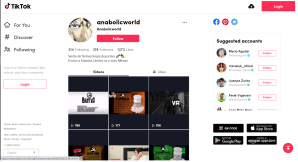
Besides the potential of interfering with our elections, TikTok also continues to facilitate the sale of illegal drugs. Below are three screenshots of illicit activity being perpetrated on TikTok. The first two images show illegal drug sales of opioids and the other shows illegal drug sales of steroids. Remember, TikTok’s core demographic and the intended audience for these posts consists primarily of members of Gen Z, those born between 1995 and 2012 –our children.  [Similar to Google’s near-indictment and $500,000,000 fine for violating the Controlled Substances Act.]

(Screenshots Provided by Eric Feinberg)

I will leave you with a quote from a recent speech at the Hudson Institute by FBI Director Christopher Wray. He stated:

“The Chinese government is engaged in a broad, diverse campaign of theft and malign influence, and it can execute that campaign with authoritarian efficiency. They’re calculating. They’re persistent. They’re patient. And they’re not subject to the righteous constraints of an open, democratic society or the rule of law… China, as led by the Chinese Communist Party, is going to continue to try to misappropriate our ideas, influence our policymakers, manipulate our public opinion, and steal our data. They will use an all-tools and all-sectors approach—and that demands our own all-tools and all-sectors approach in response.”

For addressing this clear and present danger, the United States must modify CDA 230 and ensure that we have all the tools necessary to hold TikTok accountable for criminal activity that occurs by “others” on their platform. Importantly, this includes illegal actions taken by the Chinese government to misappropriate the site, and the massive amounts of data it collects, in order to inflict harm on the US and its allies. Finally, we must avoid inadvertently making this problem worse by spreading the excessively broad and antiquated immunity of CDA 230 through trade agreements with other countries.

Rick Lane is the founder and CEO of IGGY Ventures. IGGY advises and invests in technology startups and public policy initiatives that can have a positive societal impact. Rick served for 15 years as the Senior Vice President of Government Affairs of 21st Century Fox. Before joining Fox, Rick was the Director of Congressional Affairs focusing on e-Commerce and Internet public policy issues for the United States Chamber of Commerce.

#ShowUsTheMoney: Bringing Eyesight to the Willfully Blind: @SGAWrites and Society of Composers & Lyricists @CopyrightOffice Proposal to Bring Transparency to Secret Deals — Artist Rights Watch

[Editor Charlie sez: Remember how the MLC was supposed to bring transparency to the vast black box? Remember how we were skeptical? Here’s an excerpt from the important joint comment by the Songwriters Guild and the Society of Composers & Lyricists to the Copyright Office about how to address the previously secret deals between digital music services and publishers (called the “Negotiated Agreements”. Read the full comment here.. The robbery in plain sight may have already begun.]

With potentially hundreds of millions of dollars in songwriter and composer royalties at stake now and in the future, and in light of the profound lack of transparency surrounding these issues, we believe that the following questions should be openly addressed, answered and acted upon by the USCO as expeditiously as possible: 

(i) What do these individual, Negotiated Agreements actually state? 

(ii) What efforts (global and US) were undertaken by the DSPs and/or the music publishers to identify the true owners of the musical compositions that were the source of the unclaimed/unmatched royalties purportedly being dealt with in the Negotiated Agreements? 

(iii) Were the sums received by music publishers under these Negotiated Agreements (whether purportedly associated with unclaimed/unmatched royalties or not) ever shared with music creators, and if so, how? Put another way, what efforts were made to determine how music creators should share in these revenues? and; 

(iv) How do the provisions of the MMA (such as those that require mandatory accrual and turnover by the DMPs to the MLC of ALL unclaimed/unmatched royalties so that they may be researched for matching –and failing that effort– distributed according to the statutory provisions that protect music creator rights) apply to these royalties and Negotiated Agreements. 

@SGAWrites and Society of Composers & Lyricists Proposal for Secret Deals — Artist Rights Watch–News for the Artist Rights Advocacy Community

Press Release: @SoundExchange Praises European Union Court Decision On Equal Treatment for Creators

Sep 08, 2020

In Affirming “National Treatment” Principle, European Court of Justice Rejects Unfair Treatment of Music Creators Based on Nationality

Washington, DC – September 8, 2020 – SoundExchange praised the European Court of Justice’s ruling ordering European Union countries to treat music creators equally regardless of their nationality, recognizing this as an important milestone in the fight to ensure music fairness.

The ECJ ruling stemmed from a case in Ireland regarding whether US music creators should be paid royalties when their music is played on Irish radio or in places such as restaurants or bars. Some countries deny foreign music creators royalties for the use of their work even though royalties are otherwise paid to artists who are nationals of those countries.

The ruling has broad implications for music creators around the world. By adopting the principle of “national treatment” – that a country should provide foreign entities the same benefits and protections as it would its own citizens – the ECJ is setting the stage for all artists to be paid royalties when their music is played on EU radio broadcasts and public performances.

“Today’s decision by the European Court of Justice reflects a growing global recognition that countries should treat all music creators the same, regardless of their nationality. The ECJ reaffirmed equal treatment as a fundamental principle of how nations engage with one another,” said SoundExchange President and CEO Michael Huppe.

“We appreciate the leadership of Ireland’s RAAP in advancing the cause of fairness within the global community of music creators. We urge EU member states to quickly follow suit so that ALL musicians and labels, from whatever territory, can be properly respected for the benefits they provide beyond their home country,” added Huppe.

The ruling comes as the United States and United Kingdom undertake negotiations on a post-Brexit trade agreement. A broad spectrum of organizations representing artists, publishers, musicians and managers have urged negotiators to insist that national treatment be included in the final US-UK trade agreement.

Unfair treatment denies US music creators an estimated $330 million in direct global royalty payments a year. For more information on the Fair Trade of Music campaign, please go to www.fairtradeofmusic.com.

Press Release: @SoundExchange Praises European Union Court Decision On Equal Treatment for Creators — Artist Rights Watch

YouTube is (Still) Loaded with White Nationalist and Neo-Nazi Music, But no Advertiser Boycott? #StopHateForProfit

By now you are probably aware of the campaign to get brands to stop advertising on Facebook because of the prevalence of hate speech. The campaign has been endorsed by a number of civil rights organizations including The NAACP and Anti-Defamation League.  The campaign owes much of it’s success to Sleeping Giants (twitter handle @slpng_giants) a largely anonymous social media activist group.  Sleeping Giants was the force behind successful advertiser boycotts of Breitbart and Fox News.  Facebook is now their biggest trophy.

Over the last decade, my fellow bloggers at the Trichordist have documented the prevalence of white nationalist and neo-nazi music on YouTube.  Here are just a few examples:

2013

https://thetrichordist.com/2013/11/07/ytma-artists-can-help-clean-up-youtube-an-open-letter-to-jason-schwartzman-lady-gaga-spike-jonze-m-i-a-arcade-fire-and-macklemore/

2014

https://thetrichordist.com/2014/04/15/youtube-still-serving-ads-on-hate-rock-videos/

https://thetrichordist.com/2014/11/13/will-the-new-youtube-streaming-service-feature-all-the-hate-rock-currently-featured-on-youtube/

2015

https://thetrichordist.com/2015/07/16/advertisers-how-is-youtube-any-different-than-reddit/

2017

https://thetrichordist.com/2017/02/15/forget-pewdiepie-here-are-100-hate-rock-bands-that-youtube-still-hosts/

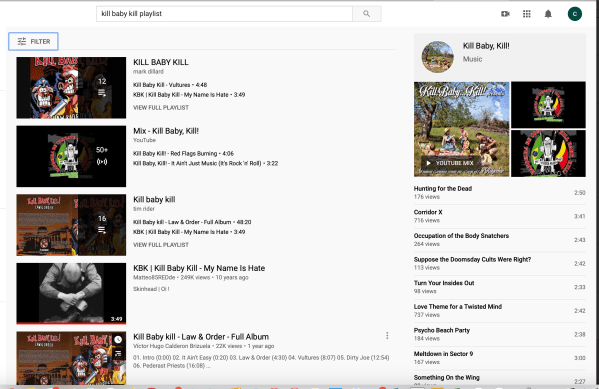
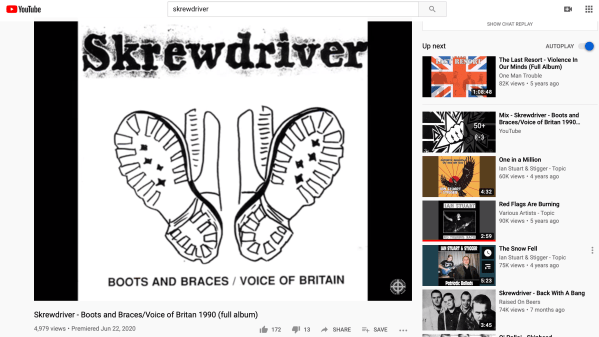
YouTube advertisers have periodically reacted to these reports by pulling advertising.  But YouTube continues to be loaded with hate rock.  You can verify this yourself by checking the Southern Poverty Law Center list of white nationalist bands and then searching on YouTube.  Here are some screenshots from my most recent search.

Fortress, Kill Baby Kill, The Bully Boys, Skrewdriver, Final War, etc.  The gang is ALL there!  And not all these videos were “user-generated content.” Many of these were official uploads by music distributors like CD Baby (Bully Boys).  And of course, many of these videos were monetized by YouTube.

So if advertisers are concerned that their ads will end up next to hate speech shouldn’t the #StopHateForProfit boycott also include YouTube? Then again maybe some advertisers just don’t care? (See below).


@ColinRushing of @SoundExchange: Congress Should Eliminate the Market Distortion of AM/FM Radio’s Free Ride on the Backs of Artists

[SoundExchange Chief Legal Officer Colin Rushing lays it down before Senate Judiciary]

Throughout the 80 years that the terrestrial radio performance right has been under discussion, broadcasters have argued in many ways that they are special and deserve different treatment than other business interests. Their arguments that their special status should result in them not paying performers– never valid – have now also been overtaken by events.

They say AM/FM radio is important because it is free, but they are no different than any other free ad-supported music platform available to consumers. They argue that providing public service announcements and news information is a reason to require music to subsidize their platform, and yet many music platforms provide these same services, not to mention that most digital music platforms are delivered over devices that provide local emergency notifications.

To the extent that AM/FM radio may be promotional, this is not a trait that sets them apart from other music services that compensate performers. Nor does it justify an uncompensated “taking” of musicians’ property. Rate-setting proceedings and licensing negotiations take promotional value into account as a matter of course, along with many other variables.

The potential for promotion exists in a lot of licensing arrangements. Television broadcast of a professional basketball game may promote a local team, but no one would suggest that the NBA should surrender the broadcast rights for free because of that “promotional value.” Why should music be any different?

Read his written testimony on the SoundExchange website.