
At Thinking Digital 2013, Aral Balkan delivered the most watched and favourited Thinking Digital talk of all time.
In 2014, Aral returned to Thinking Digital to deliver a blistering talk about the state of the Internet today. He argues that “free is a lie” and that we (via our personal data) are all being quietly farmed for profit by the superpowers of the Web.
Author: Trichordist Editor
Trichordist Editor
Why Spotify is not Netflix (But Maybe It Should Be)
From the “Let’s start talking solutions” file. If Spotify wants to have a conversation with musicians, this may be a starting point for an honest partnership. Let’s see more flexibility in the model.
If we are to explore the digital marketplace for both streaming and transactional downloads the music business might do well to look at what the film business is actually doing in the same space. We will quickly see that Spotify is not Netflix, but maybe it should be.
Readers will note the film business has not bought into the faulty logic that the only way to combat internet piracy is to make every film ever made, available instantly, on an all you can eat service for $9.99 a month. Some might argue that is what Netflix is, but people making that argument are obviously not current subscribers!
One thing that has struck us in the comparisons between Spotify and Netflix is that Netflix does not have every film, or even every current film, or even a large percentage of popular films. For the vast inventory that Netflix has, you also…
View original post 905 more words
We Got Trouble My Friends, Right Here in Music City: The Spotify Meltdown Tour Continues
I think we’re being run by maniacs for maniacal ends.
John Lennon
The Spotify “artist relations” team continued their swing West last night with a stop in Nashville at City Winery where a songwriter can grab a burger and a glass of red for a mere 350,000 plays–including tip! And don’t forget to take home a bottle of Tres Amigos, a disruptive little house blend of malbec, bonarda and cab for a modestly priced 400,000 plays.
Now here’s the problem–the Featured Artist Coalition spent a good deal of time putting together these meetings with the best of intentions. Although I was not present (I live in a flyover state, and you know how that can be), it appears to me that Spotify seems to think that these three events in New York, Nashville and Los Angeles are opportunities to sell their company by repeating their talking points as opposed to…
View original post 833 more words
Who will be the First Fired Label Execs over Spotify Fiasco & Cannibalization?
We don’t know if the rumors are true, but we’re hearing rumblings from the upper echelons of the music business that top management is very unhappy with the cannibalization of the transactional business that is being accelerated in a death spiral towards a $3b record industry.
Did you guys get this headline on the midyear sales figures, U.S. Music Revenues Down Nearly 5%, Says RIAA. Early end of year estimates are that 2014 could see a double digit year to year drop by as much as 12%. As we’ve said before (and others are catching up) it’s just math.
We’re also hearing panicked and desperate distribution executives wanting to double down on streaming by reducing the subscription fees to accelerate scale (not everything Apple says is good for you, remember?).
So we have to ask, are you kidding us? The only thing that is going to accelerate is how fast you lose your job as you kill what’s left of the transactional business.
If you own a calculator, let’s just do the math one more time, real slow and simple like…
1) Spotify and former uTorrent CEO Daniel Ek says Spotify only needs 40m paid subscribers for streaming to be sustainable for artists. But that math just doesn’t work.
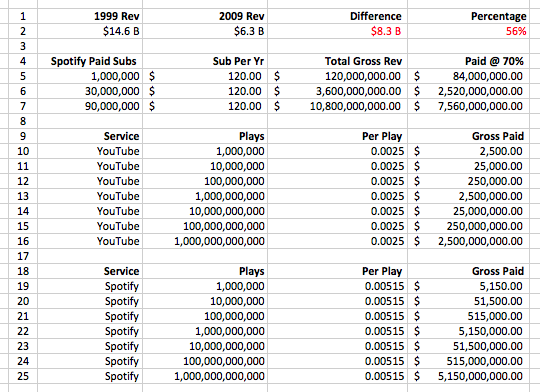
2) $10 per month subscription = $120 per year per subscriber
3) $120 per year, per subscriber paying out 70% of gross to rights holders equals $84 per subscriber, per year.
4) $84 per subscriber, per year x’s 40 million subscribers equals $3.4b per year in top line gross revenue to ALL rights holders. That’s $3.4b for labels, artists, publishers and songwriters combined.
5) $3.4b per year is HALF of the current revenue of $7b per year where the domestic business has been flat lined.
6) Assuming you could DOUBLE the subscription base to 80m PAID in the USA within two years by dropping the price in HALF to $5 per subscriber per month you still only gross (wait for it…) $3.4b a year in revenue.
We know this is shocking to the math impaired, but doubling scale (imagined as it is) while cutting the subscription fees in half, actually nets you the same amount of money. Shocking the things one can learn with a calculator or a spreadsheet.
Do you know how else you can achieve scale faster? Free. Free scales fast.
Free scaled fast for Napster.
Free scaled fast for Grockster.
Free scaled fast for Kazaa.
Free scaled fast for Limewire.
Free scaled fast for BitTorrent.
Free scaled fast for The Pirate Bay.
Free scaled fast for YouTube.
All of these have three things in common.
1) Infringement as a business.
2) Fast scale.
3) Subsidized by artists and rights holders who are not compensated.
The con men have been conned and the only way out is an exit strategy that is so disconnected from the monetization of music that there is literally no longer a connection between the artist and the revenue they create.
So how realistic is that magic number of 40m paid Spotify subscribers in the US?
Here’s what subscription based services look like right now. Netflix only has 36m subscribers in the US, no free tier, and massive limitations on available titles of both catalog and new releases. Sirius XM, 26.3m in the US as a non-interactive curated service installed in homes, cars and accessible online. Premium Cable has 56m subscribers in the US paying much more than $10 a month and also with many limitations. Spotify… 3m paid subscribers in the US after four years. Tell us again about this strategy of “waiting for scale.” Three Million Paid… Three…
* 3m Spotify Subs Screen Shot
* 26.3m Sirius XM Subs Screen Shot
* 36m Netflix Subs Screen Shot
* 56m Premium Cable Subs Screen Shot
* $7b Music Business Screen Shot
Given the above it’s not surprising that what we’re hearing is that the adults have let the children play with their Silicon Valley toys and they have been left alone along long enough to see the house burn down. And adding insult to injury, Spotify has been a complete artist relations disaster.
We’ve got bad news for digital distribution/ label folk. The Silicon Valley lifeboat doesn’t have that much room in it for ex-record company executives who are bad at simple math. We know five guys who are not concerned about the future of the record industry and their names are Jimmy, Dre, Trent, Ian and Dave… the rest of you are probably not going to be so lucky.
What is perhaps the greatest irony in all of this is that the great rock & roll swindle has been on the record industry instead of by the record industry, but that’s another post.
So who’s head is going to be on the block when the year end head count reductions start? Hmmm…
Remember kids, It’s just math…
RELATED:
Spotify Doesn’t Kill Music Sales like Smoking Doesn’t Cause Cancer…
Why Spotify is not Netflix (But Maybe It Should Be)
Spotify’s Daniel Ek is Really Bad At Simple Math, “Artists Will Make a Decent Living Off Streaming In Just a Few Years”
* BREAKING * Spotify Launches Secret ‘Information Tour’ to Convince Top Artists… | DMN
Breaking from Digital Music News:
Currently, we know of three confirmed dates in the US: October 6th (ie, today) at the Soho Club in New York, October 8th at City Winery in Nashville, and October 10th at a private residence in Los Angeles (complete details on these dates below). The US-based sessions that we know about are being coordinated through the Music Managers’ Forum (MMF), with the Featured Artists’ Coalition (FAC) potentially bringing serious, high-wattage superstars to the table.
TO ATTEND PLEASE RSVP TO: fiona@thefac.org

READ THE FULL POST AT:
http://www.digitalmusicnews.com/permalink/2014/10/06/spotify-launches-information-tour-convince-top-artists
RELATED:
Five Important Questions For Spotify from Artists and Managers
A Tale of Two Pirates? Daniel Ek (uTorrent) and Kim Dotcom (Megaupload)
Music Streaming Math, Can It All Add Up?
A Tale of Two Pirates? Daniel Ek (uTorrent) and Kim Dotcom (Megaupload)
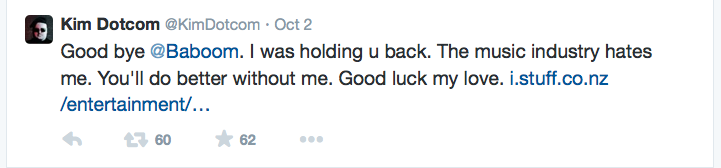
Perhaps it is ironic that Kim Dotcom is the arch nemesis of the record industry while Spotify CEO Daniel Ek is celebrated as the former Co-Founder and CEO of uTorrent. uTorrent is described as “the world’s most popular BitTorrent client with more than 100 million downloads” on Mr. Ek’s Wikipedia page.
This week the embattled Dotcom is said to have given up his stake (and shares) in his much ballyhooed digital music company Baboom.
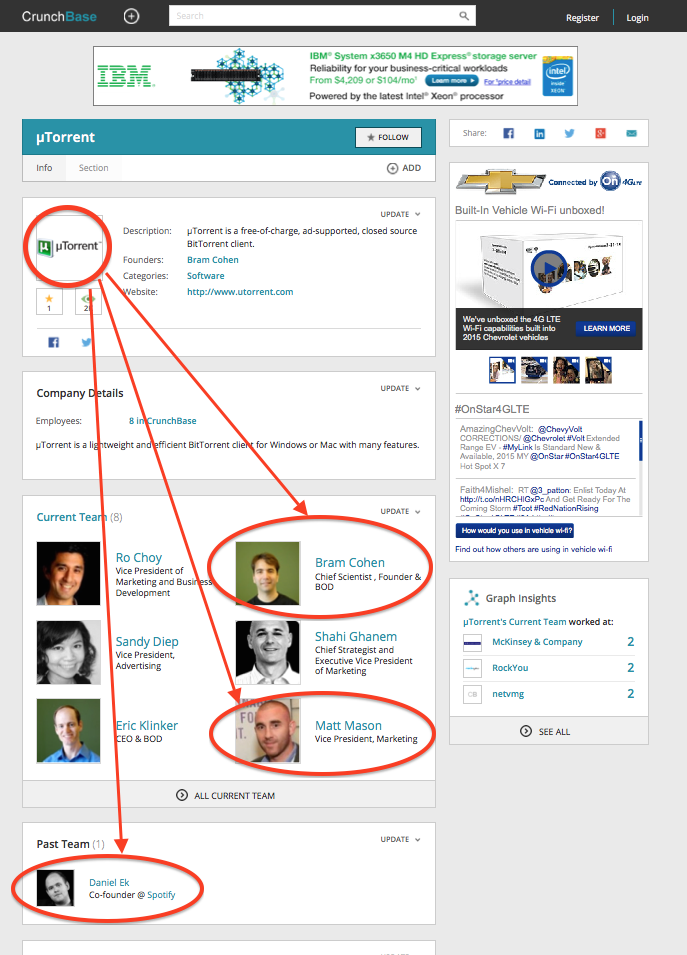
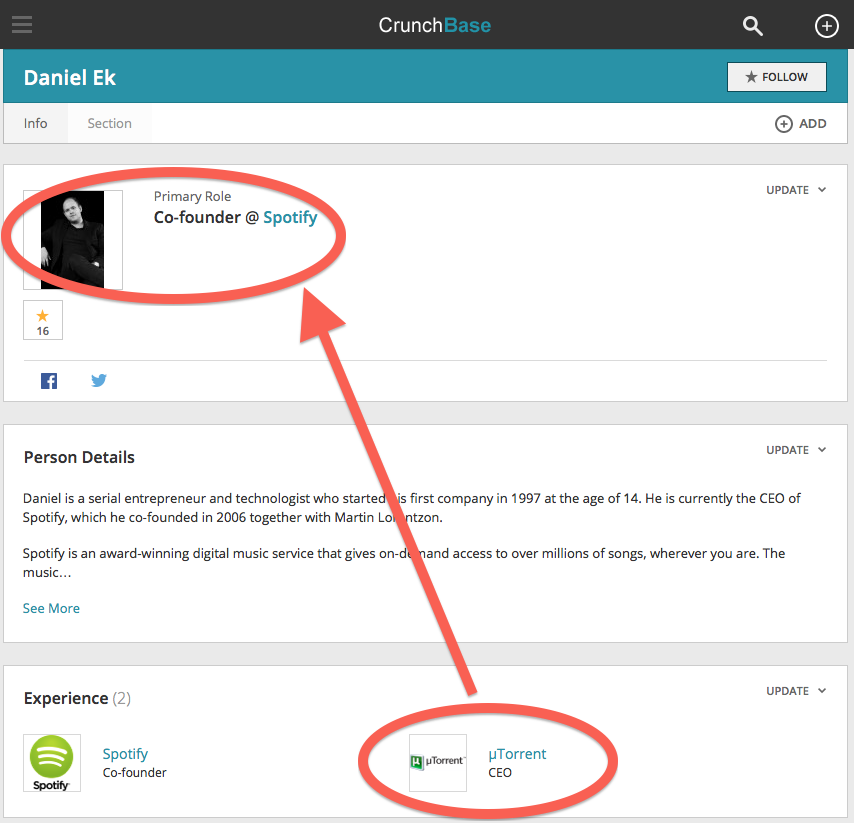
In the screen shot below from the TechCrunch, “CrunchBase” we see the BitTorrent cast of characters we’ve gotten to know so well sharing duties at uTorrent. Here we have Bram Cohen, Matt Mason and of course former uTorrent Co-Founder and CEO Daniel Ek (still prominently displayed).
In many ways both Ek and Dotcom represent the same devaluation and destruction of the arts by building personal fortunes as the result of monetizing the work of creators, without paying those creators for their work.
The cost of music is not in the distribution of music, the cost of music is in the creation of music.
Megaupload and uTorrent have monetized the mass scale distribution of infringing works for profit. In other words, infringement as a business model where the cost of goods goes unpaid and creators are uncompensated. uTorrent is self described as “a free-of-charge, ad-supported, closed source BitTorrent Client.” Megaupload and uTorrent have both relied heavily on advertising for revenue.
Mr. Ek like his previous cohorts Bram Cohen and Matt Mason would like to say that BitTorrent is not a piracy platform, however multiple independent studies have repeatedly concluded that 99% or more of the files being distributed via BitTorrent are in fact, infringing.
All of this of course points to the fact that Megaupload and BitTorrent have hidden behind the DMCA, which has failed at it’s intent to protect artists. It could be argued that uTorrent and Megaupload have participated in business models enabling one of the largest transfers of wealth in history from individual creators to Silicon Valley companies and operatives.
Daniel Ek is reported to have a net personal wealth valued at $400 Million Dollars. Kim Dotcom’s fortune has been recently estimated to be $200 Million Dollars.
“The main reason music streaming services are winning over millions of consumers is the fact that they require no payment unless the user desires to pay.” – Music Streaming vs. Music Piracy | Medium.Com
Right now there is little functional difference to most musicians between music streaming and music piracy. This realization should not come as a surprise to musicians when they learn that the CEO of the largest and most used on demand streaming company was both the Co-Founder and CEO of uTorrent, “the world’s most popular BitTorrent client with more than 100 million downloads.”
If Spotify wants musicians to take it seriously, perhaps it’s time for a CEO musicians can respect. The record industry might also want to reconsider who it chooses as friend and foe as well. More on that later…
#irespectmusic says There You Go Again: Pandora’s Spinmeister Hiding the Truth
Unbelievable. After the stunning Smackdown to Sirius last week on Pre-72 recordings, Pandora chooses to double down on it’s own bad behavior.
AVOID EXCUSES LIKE THE PLAGUE.
Reef Points
The Wall Street Journal reports Pandora’s side of Pandora’s latest artist relations debacle:
Pandora is confident in its legal position, said Pandora’s public affairs director, Dave Grimaldi, and is open to supporting federal legislation that would require all music services to pay performance royalties on pre-1972 sound recordings.
Here’s the ambiguity: “…federal legislation that would require all music services to pay performance royalties on pre-1972 sound recordings…” This depends on what the mean of “all” is.
First of all, Pandora doesn’t get to decide when they get to follow the law. If this is Pandora’s best argument for stiffing legacy artists, then why are they paying royalties to anyone at all?
The law only requires digital music services to pay performances for sound recordings, not allmusic services. So what is the deeply experienced Washington lobby boy Grimaldi actually saying? Pandora wants to…
View original post 589 more words
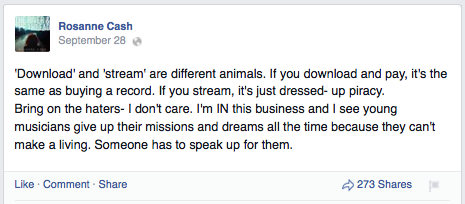
Music Streaming is “just dressed-up piracy” says Rosanne Cash| Hypebot
Hypebot noticed this Facebook post from Rosanne Cash which echoes the sentiments of many artists, that streaming in it’s current form and economics is pretty much legitimized piracy…
READ THE FULL POST AT HYPEBOT:
http://www.hypebot.com/hypebot/2014/10/streaming-is-just-dressed-up-piracy-says-rosanne-cash.html
RELATED:
Five Important Questions For Spotify from Artists and Managers
Music Streaming Math, Can It All Add Up?
Streaming Isn’t Saving the Music Industry After All, Data Shows…
Five Important Questions For Spotify from Artists and Managers
If artists and managers were to find themselves in a room in the coming weeks with representatives of Spotify there are some questions which should probably be asked and some issues which should probably be raised.
Spotify is working hard to convince musicians that they are not the enemy. We appreciate that the service is legally licensed. We also recognize that the major labels have a different relationship to Spotify than most artists ever will as it has been reported the major labels collectively have at least an 18% equity stake in the company.
What is particularly troubling about these equity positions (same for the Beats sale to Apple) is that we don’t know of any artists who benefit from their work being used as the leverage for the labels equity participation.
So with this in mind here are five questions artists and their managers could ask Spotify…
1) At what scale and price point is Spotify actually sustainable for artists?
Daniel Ek says it’s 40m paid subscribers, but that math just doesn’t work. 40m Subscribers x’s $84 per year = $3.3b in annual global revenue to artists and rights holders (assuming they really are paying out 70% of gross). Here’s the simple math* : 40,000,000 x’s $84 = $3,360,000,000
* 10 a month per subscriber, x’s 12 months = $120 per year per subscriber. $120 per year per subscriber paying 70% to rights holders is $84 per year per subscriber.
The current domestic record business is bottoming out at about $7b annually.
When confronted with this fact, “Investor and Artist In Residence” D.A. Wallach recently responded publicly that “Itunes has more than 40m users.” Ok, fine. We showed you our math, how about you show us yours. Once that’s out of the way, let’s ask the second question…
2) When do you think Spotify can realistically achieve a sustainable scale for artists?
Given that Netflix only has 36m subscribers in the USA and that there only 56m premium cable subscribers in the USA why does anyone really think Spotify will have more than that anytime soon? Spotify is reporting only 10m paid subscribers, and that’s for the entire world. Sirius XM as a mature business, which is installed in homes, cars and is also accessible via the internet only has 26.3m subscribers across all platforms.
Does anyone really think that Spotify is going to ramp up to over 80m paid subscribers in the USA alone anytime soon? We’ve detailed this math before, it’s not pretty and it’s right here.
3) Why not publicly show the full tables of equity participation’s and the distribution of payments, including the rate of pay to all stakeholders? If Spotify is really paying out 70% of revenues, let’s see where it is really going and who is getting what share.
We already know that majors (and possibly Merlin) are getting preferred rates. Say what you will about Apple but everyone knows that take a flat 30% across the board. It’s a transparent business. If Spotify wants to talk about transparency and openess, they should lead by fully disclosing this information.
4) Why should artist trust a business created by the same person who profited massively from the illegal distribution of artists work, without compensating them?
According to Wikipedia, Daniel Ek the CEO of Spotify was also “CEO of µTorrent, the world’s most popular BitTorrent client with more than 100 million downloads.” uTorrent makes its money the same way The Pirate Bay does, by monetizing the distribution of infringing works with advertising revenue.
5) Why not publicly and vocally join the fight against Ad Funded Piracy? Why not publicly endorse and support legislation (like SOPA) that would stop illegally operating businesses like uTorrent from destroying the lives of creators?
Well, this should be pretty obvious given that the CEO of uTorrent is now the CEO of Spotify. We all know there is a lot of money being made in the distribution of music online. Unfortunately that money is not being paid to artists in a meaningful and sustainable way. In the case of uTorrent artists don’t see a penny. Spotify paying fractions of a penny to artists per play is functionally of little difference to most artists.
The simple truth is that the fundamental problem with Spotify and other businesses like it, is that the cost of goods is grossly undervalued. In other words, the only way that streaming really works is to increase both the price of subscriptions and the number of paid subscribers. Of course we understand the appeal of having musicians subsidize their business, but in a word that is just unsustainable.
One last point… Stop with the misleading press and stories about Spotify growing the transactional business. It’s not. It’s not going to. Spotify is cannibalizing the transactional business into accelerated decline without replacing the revenue that is being lost. If this trend continues we’re knowingly pursuing a death spiral from a current $7b annual business in the US to a $3b annual business.
It’s not that complicated, it’s just math.
RELATED:
A Tale of Two Pirates? Daniel Ek (uTorrent) and Kim Dotcom (Megaupload)
A Detailed Explanation on Why Streaming Has Failed…
Streaming Isn’t Saving the Music Industry After All, Data Shows…
Sorry, Streaming Isn’t Saving the Music Industry In 2014…
The Hypocrisy Of BitTorrent Knows No Bounds… Matt Mason Speaks…
BitTorrent’s Matt Mason let this one loose…
““We’re not interested in streaming for the sake of lining the pockets of a few people at major labels. We’re interested in helping artists make money from their work in the long term… I’m not trying to bash the people at the labels, but it does seem like the senior executives at the majors have said ‘we give up, let’s just make some money on the Spotify IPO, then go home and let the next generation sort it out’.”
You’re kidding right? We can’t make this up. As if BitTorrent has done anything other than destroy the lives of creators to have a self empowered right to make their own choices with their own work… So in your mind Matt, BitTorrent are the good guys and Spotify are the bad guys?
What percentage of music is Spotify distributing illegally? What percentage of music on Spotify are artist not getting paid on? Ok, now ask the same questions of BitTorrent. Research finds that 99%+ of files distrbuted via BitTorrent are infringing (see the links below).
Wow, just wow.
And there’s this line from Matt’s interview with the Guardian UK:
“We’re a technology company, we’re really good at moving files. We’re not so great at being a label, a film studio or a book publisher.”
We know Matt because being a label, a film studio or a book publisher would mean you would actually pay the creators for the work you are distributing and investing in developing their careers through financial advances, marketing, promotion, pr, and other resources. Obviously things BitTorrent is loath to do for artists.
But let’s ask, how much money has BitTorrent invested into developing artists and helping them “make money from their work in the long term”… ah, that would be zero.
READ THE FULL POST AT MUSIC ALLY:
http://musically.com/2014/09/29/bittorrent-thom-yorke-spotify-u2/
 The Trichordist
You must be logged in to post a comment.