The Future Of Music According to Gene Simmons and Jaron Lanier…

Gene Simmons may not be the most sympathetic figure in conversations about artists rights in the digital age but there is something to be said when he and Jaron Lanier make essentially the same observations about the future of music and artist revenue streams.

Simmons is quoted in a new interview in Esquire Magazine, “Rock Is Finally Dead”:

“The masses do not recognize file-sharing and downloading as stealing because there’s a copy left behind for you — it’s not that copy that’s the problem, it’s the other one that someone received but didn’t pay for. The problem is that nobody will pay you for the 10,000 hours you put in to create what you created. I can only imagine the frustration of all that work, and having no one value it enough to pay you for it.

It’s very sad for new bands. My heart goes out to them. They just don’t have a chance. If you play guitar, it’s almost impossible. You’re better off not even learning how to play guitar or write songs, and just singing in the shower and auditioning for The X Factor. And I’m not slamming The X Factor, or pop singers. But where’s the next Bob Dylan? Where’s the next Beatles? Where are the songwriters? Where are the creators? Many of them now have to work behind the scenes, to prop up pop acts and write their stuff for them.”

Simmons goes on to state that music and culture have stagnated.  He asks what great bands and artists have emerged in the post internet era?

Jaron Lanier made essentially the same observation back in 2010 in an interview with The New York Times, “The Madness of Crowds and an Internet Delusion.

“…authors, journalists, musicians and artists are encouraged to treat the fruits of their intellects and imaginations as fragments to be given without pay to the hive mind. Reciprocity takes the form of self-promotion. Culture is to become precisely nothing but advertising.

It’s as if culture froze just before it became digitally open, and all we can do now is mine the past like salvagers picking over a garbage dump,” Mr. Lanier writes. Or, to use another of his grim metaphors: “Creative people — the new peasants — come to resemble animals converging on shrinking oases of old media in a depleted desert.”

It speaks volumes when two people of such different backgrounds and perspectives make the same observation.

Our Songs = Your Photos & Privacy : After a Week of “Whack-a-Mole” Reddit Bans Celebrity Photo Forums

So how’s that DMCA working now?

We’ve written about this before in our posts “My Songs = Your Instagram Photos” and “Two Simple Facts about Technology and Piracy : iTunes Vs. YouTube.” Now Reddit experiences what musicians have been dealing with directly for over a decade, the flawed arguments of ignoring consent online.

Reddit community manager Lisa Liebig, explains:

“We understand that the moderators did the best they could with the situation at hand, but having users purposefully try and circumvent the takedowns was starting to become a whack-a-mole game,” Liebig said, adding, “These factors led us to decide that the subreddit and many of its sister-subreddits were in violation of rule five of the site, ‘don’t…do anything that interferes with normal use of the site.’”

Make no mistake about it, this is about intent. Either we allow lawlessness as the norm, or we enforce the same rule of online as we do in the physical world. Consent is cornerstone of civilized society and mob rule should not be tolerated (not even for free music or celeb nudes).

The same mentality and arguments that make it acceptable to hack and post personal photos have been used as an excuse to ignore the massive, for profit, theft of personal copyrighted works for more than a decade. Neither is acceptable. As the future of music is tied to ad funded piracy, so is privacy tied to internet profits by the same lack of personal consent.

We applaud Reddit for not standing on a soapbox conflating personal rights, privacy and consent with some twisted notion of censorship and some nonsense about “breaking the internet.” Indeed, as we noted in our post “Principles for an Ethical and Sustainable Internet” technology may change but principles do not. It would seem that at least just for today, maybe the internet is growing up, just a little bit…

Read the Full Story at ReCode:
Reddit Bans Celebrity Photo Forums After a Week of “Whack-a-Mole”

David Lowery: Here’s how Pandora is destroying musicians | Salon

David Lowery has become both beloved and notorious over the last year as one of the musicians most critical of the ways musicians are paid in the digital era. The Camper van Beethoven and Cracker singer brings an artist’s rage and a quant’s detached rigor to his analysis of the music business.

He’s currently fired up about a federal lawsuit filed in New York in which several record labels have sued Pandora (and before that, Sirius FM) for neglecting to pay royalties for songs recorded before Feb. 15, 1972. Here’s how Billboard summarizes the suit: “The labels say both digital music services take advantage of a copyright loophole, since the master recording for copyright wasn’t created federally until 1972. … But the labels claim that their master recordings are protected by individual state copyright laws and therefore deserve royalty payments.”

Lowery thinks the loophole provides a way for Pandora to simply not pay older musicians for their work — while profiting from it themselves. The case could get bigger and change in strange ways, with broad implications.

READ THE FULL STORY AT SALON:
http://www.salon.com/2014/08/31/david_lowery_heres_how_pandora_is_destroying_musicians/

If the Internet is working for Musicians, Why aren’t more Musicians Working Professionally?

We keep hearing from web/tech gurus about how empowered artists are in the internet age, but yet, the numbers just don’t add up. It’s also ironic that tech bloggers like to promote the idea of  “touring and t-shirts” as a solution to the difficulties musicians are having online. But it really sounds to us, more like an admission that there is no money for artists online in the Exploitation Economy to develop new and sustainable professional creative careers.

This is why, an ethical internet for all citizens is so important. Sometimes, the facts are just so simple…

Ted Cohen: Breaking Through The Noise | | midemblogmidemblog

“The Internet was supposed to be the ultimate leveler, great music would be able to find its audience, the ‘big label’ gatekeepers would no longer control access to the masses.

It hasn’t exactly played out that way. According to my friend, Tommy Silverman/Tommy Boy Records and the co-founder of the New Music Seminar recently told me that he did the math and only 228 artists broke 10,000 units for the first time last year out of 105,000 albums.

That’s 2.17% but only 15 of those did it without the help of a real label.

That’s not very encouraging to the other ninety-eight percent. While tens of thousand of artists are self-releasing their music, their ability to get noticed in a meaningful way is stifled by the sheer volume of music that is arriving daily at iTunes, Amazon, Spotify, MySpace Music, Yahoo, Rhapsody, Pandora, iHeart and others. Ten years ago, there were roughly twenty-five thousand album releases a year.

In 2009, it is estimated that there will be over one hundred thousand albums put into digital distribution. That’s roughly a million new tracks a year, four million minutes of music, or almost three thousand days-worth of song. But, maybe, if I listen really, really fast, I could….nope!”

The numbers below are equally sobering. Not only did the volume of sales drop from 2009 to 2010, but also the number of new releases also dropped. Many promoting the exploitation of artists are also proposing that the new lower barriers for access to distribution will increase creative output, but that also appears to be false.

Business Matters: 75,000 Albums Released In U.S. In 2010 — Down 22% From 2009 | Billboard.biz

75,000 Albums Released In U.S. In 2010 — Down 22% From 2009

Not only were fewer albums released, but the weakest sellers took up a smaller share of new release sales. The 60,000 titles that sold from 1 to 100 units represented 0.7% of all sales from titles released in 2010. In 2009, 0.9% of sales came from the 80,000 titles that sold from 1 to 100 units.

So there were quite a few new albums that sold fewer than ten units.

Put another way, the 60,000 new releases that sold 100 or fewer units averaged just 13.3 units per title.

The statistics above do not support the assertion of the tech blogosphere that the internet has created more opportunities for professional creative careers, or expanded a working middle class of musicians. It’s actually very much so the opposite of their claim.

It’s clear from the numbers above (and continued below) that the democratization of production and distribution has not democratized talent. The most exploited music, is not surprisingly, the most popular. These are the artists and titles which are also developed and promoted by traditional media outlets.

Here’s another interesting stat reported by Digital Music News. Does this look like the empowerment of a new creative middle class to you?

99.9% of Tunecore Artists Make Less Than Minimum Wage…

99.875% – or nearly all – of Tunecore artists are making less than minimum wage through the platform, based on revenue figures recently shared by the company.

Despite this fact, some tech bloggers can’t even understand how the simplest mechanisms function in the recorded music business. In an attempt to discredit some of the reports above one tech blog let lose with this gem below, alleging that because Tunecore and CDBaby releases are not reported directly to Soundscan their releases are not counted in Soundscan stats creating a massive unreported pool of revenue being ignored by the industry.

TuneCore does not report results to Nielsen Soundscan and it puts out a hell of a lot of releases. Similarly, CDBaby/Disc Makers points out that Soundscan doesn’t count its releases either — which number around 50,000.

The problem with the above is not understanding that Tunecore and CDBaby can’t report to Soundscan, because Soundscan collects the data from the point of sale such as Itunes, Amazon, etc. So in fact, all Tunecore and CDBaby releases and sales are actually cataloged and reported by Soundscan afterall. So much for all that unreported sales and revenue.

But of all the numbers, this one is the bottom line. Salon recently reported stats from the Bureau of Labor Statistics that number of working professionals in the music industry are suffering a catastrophic decline. If these numbers were reported by any other industry it would make national headlines:

No Sympathy for the Creative Class

“Musical groups and artists” plummeted by 45.3 percent between August 2002 and August of 2011.”

This is also graphically represented here at Digital Music News:
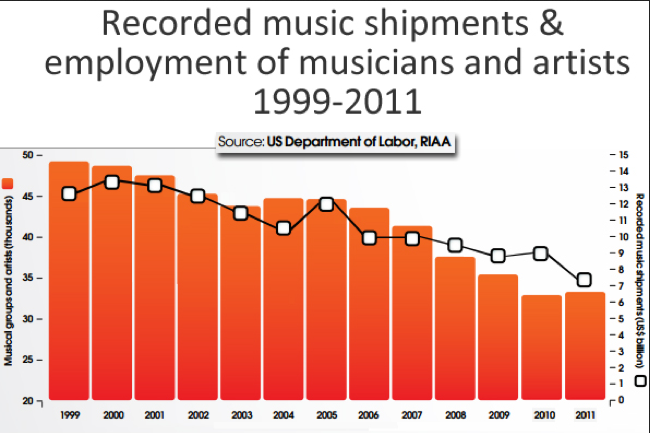
musiciansindecline

All of this gave us pause when we saw a report given by The Future Of Music Coalition (FOMC) in Digital Music News that artists earnings are benefiting from digital technologies? How? As opposed to what? I can see that some digital technologies may be helping artists, but “overall” is simply, statistically, not true given the information above. So it trouble’s us to see statements like the one below made in public by the organization’s Kristin Thomson at SF Music Tech in February of 2012.

 “Overall, digital technologies seem to be having a positive impact on musicians’ earnings capacity”

Really? Maybe it’s not surprising that FOMC is also aligned with Public Knowledge who held a joint workshop to help musicians understand that, “Copyright law is changing rapidly in the face of new technologies.” The only problem is, copyright law is not actually “changing rapidly,” but it appears that Public Knowledge would like it too! Make no mistake about it, Public Knowledge is advocating for less artists rights and protections.

So the real truth is this; if the internet is working for musicians, why aren’t more musicians working professionally?

###

The Trichordist

We keep hearing from web/tech gurus about how empowered artists are in the internet age, but yet, the numbers just don’t add up. It’s also ironic that tech bloggers like to promote the idea of  “touring and t-shirts” as a solution to the difficulties musicians are having online. But it really sounds to us, more like an admission that there is no money for artists online in the Exploitation Economy to develop new and sustainable professional creative careers.

This is why, an ethical internet for all citizens is so important. Sometimes, the facts are just so simple…

Ted Cohen: Breaking Through The Noise | | midemblogmidemblog

“The Internet was supposed to be the ultimate leveler, great music would be able to find its audience, the ‘big label’ gatekeepers would no longer control access to the masses.

It hasn’t exactly played out that way. According to my friend, Tommy Silverman/Tommy Boy…

View original post 918 more words

This is What Monopoly Looks Like When You Round Up to Zero: Google Play’s Tone Deaf Advertising Campaign “25 Million songs for the price of an album”

Music Technology Policy

Google PlayYouTube’s Director of Artist Relations Vivian Lewit appeared on a SXSW panel this year moderated by Tom Silverman.  I asked the panel a simple question from the audience as did a couple other audience members.  My question was how much per stream does your service pay to artists?  YouTube’s Ms. Lewit was the only one who dodged the question, but after a couple follow ups she confirmed it was less than a penny.  Given the NDA culture surrounding Google, I was amazed to get that much out of her in a public forum.

Now I understand why.

In case you were wondering why IMPALA filed a complaint with the European Commission on Google’s monopolist tactics in licensing the new YouTube service, the Google Play messaging says it all.  It’s a horrible deal for everyone except Google, just like YouTube.  But the real reason its not a bad deal for Google…

View original post 451 more words

4 Million DMCA Notices Don’t Stop the Google Piracy Machine: How Google Drives Traffic to Pirate Sites Through Google Alerts

The hits just keep un comin’…

Music Technology Policy

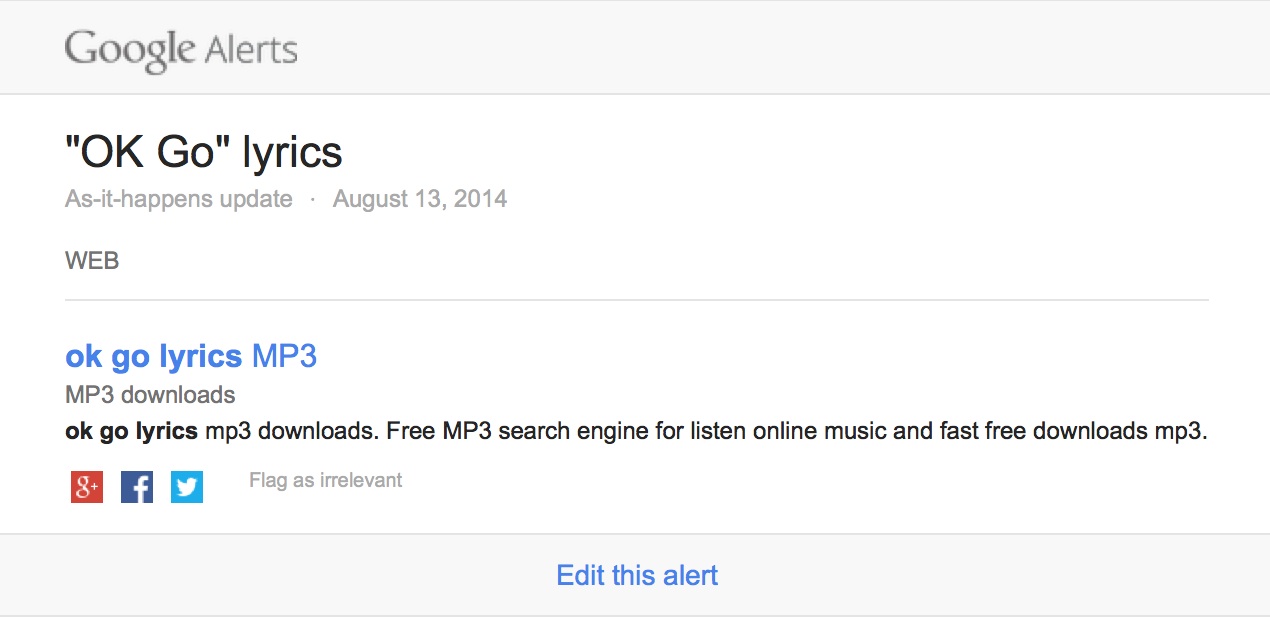
Google news alerts are emails sent to you by Google through the data analysis of its monopoly search engine.  Yes, the all seeing Google knows a lot of stuff and they are happy to share it with you so you can share it with others.  Google will send you a link that matches your news alert and will always have social media sharing links to Google Plus, Facebook and Twitter.  (I can’t imagine Google adding the Facebook and Twitter links without some kind of compensation, probably cold hard cash.)

Here’s an example:

Google Alert OK Go

This link goes to a site called myfreemp3.cc which takes you to this page:

OK Go Lyrics Link

In case you were wondering what myfreemp3.cc was all about, how would you know if this was a pirate site?  Or more precisely, how would Google know myfreemp3.cc was a pirate site?  It just looks sketchy, right?  But we all know that we can’t…

View original post 299 more words

Copyright Stifles Innovation And Creativity! (Says The Internet): It Doesn’t; And Here’s Why | Nova.Edu

By Stephen Carlisle, Nova Southeastern University

If you read the internet, copyright, and especially long copyright terms are an unfathomable evil. In their eyes copyright “hinders learning, destroys our cultural legacy, hurts innovation and the general public, but most importantly it impedes filmmakers, artists, DJ’s and other content creators that need to be able to build upon the work of others to create new content”. 1 There are lots of dire pronouncements, with lots of invective and insults hurled, particularly at the Walt Disney Company (quote “responsible for one of the greatest thefts in world history”) 2. Yet as typical with such cyberspace broadsides, there is very little explanation of precisely how this suppression of innovation occurs.

That’s because copyright doesn’t suppress either creativity or innovation. And here’s why:

READ THE FULL POST AT NOVA SOUTHEASTERN UNIVERSITY:
http://copyright.nova.edu/copyright-does-not-stifle-innovation-creativity/

How Copyright Encourages Creativity and Opportunity in Hollywood

The Trichordist

We hear a lot from the copyleft and opponents of Artist’s Rights that copyright stifles creativity, but this is simply not true. We’re not going to go down the tired road of the arguments about remixing, which can be read in this excellent article at Copyhype titled, “Remix Without Romance.

The truth is, the best ecosystem for creativity is the one where all stakeholders are compensated. This is why in the early 90s sample clearance statutes were defined, and as a result we’ve seen some of the most innovative music, in the history of recorded music. This creativity has been achieved legally by creating fair and balanced policy. Historically, that is how policy evolves, such as it did with phonographs and radio — when both were getting off the ground, the law eventually recognized that artists have a right to be compensated, and both eventually flourished, also benefiting all…

View original post 928 more words

“Fifteen years of utter bollocks”: how a generation’s freeloading has starved creativity | New Statesman

Arguments for digital piracy are drivel – it’s high time we steered away from this cultural cliff, argues author Chris Ruen.

Piracy may feel like victimless “free culture” to the user, but they are in fact participating in a digital black market. It’s not about information wanting to be free, but rather it’s about exploitative black marketeers and willfully blind tech companies wanting to get rich. They are simply capitalising on loopholes in the regulatory framework. In this sense, mass digital piracy is a symptom of underdevelopment. It’s the Internet Third World, with outdoor markets hawking counterfeit goods and purveyors bribing the local cops to look the other way.

Tech companies will go on skimming profits off the top of this black market until enlightened governments cooperate to squeeze out these illicit profiteers in an effective and transparent manner. As Google’s own Chief Economist Hal Varian has written, “all that is required is the political will to enforce intellectual property rights”.

READ THE FULL STORY AT THE NEW STATESMAN:
http://www.newstatesman.com/culture/2014/07/fifteen-years-utter-bollocks-how-generation-s-freeloading-has-starved-creativity

Here’s How Piracy Hurts Indie Film | IndieWire

The fact is: pirate sites don’t discriminate based on a movie’s budget. As long as they can generate revenue from advertising and credit card payments—while giving away your stolen content for free—pirate site operators have little reason to care if a film starts with an investment of $10,000 or $200 million. Whether you’re employed by a major studio or a do-it-yourself creator, if you’re involved in the making of TV or film, it’s safe to assume that piracy takes a big cut out of your business.

We know piracy won’t go away altogether, and we won’t always agree on the best way to go about disrupting it. But we can agree on a vision for a digital future that better serves audiences and artists alike, and that future depends on reducing piracy.

READ THE FULL POST AT INDIEWIRE:
http://www.indiewire.com/article/guest-post-heres-how-piracy-hurts-indie-film-20140711