Updates for Nov. 20 @ArtistRights Symposium at @AmericanU @KogodBiz in Washington DC

We are announcing the time schedule and speakers for the 4th annual Artist Rights Symposium on November 20. The symposium is supported by the Artist Rights Institute and was founded by Dr. David C. Lowery, Lecturer at the University of Georgia Terry College of Business.

This year the symposium is hosted in Washington, DC, by American University’s Kogod School of Business at American’s Constitution Hall, 4400 Massachusetts Avenue, NW, Washington, DC 20016.  We are also pleased to have a Kogod student presentation on speculative ticketing as part of the speaker lineup.

Admission is free, but please reserve a spot with Eventbrite, seating is limited!

The symposium starts at 8:30 am and ends with a reception at 4:30pm. The symposium will be recorded as an audiovisual presentation for distribution at a later date, but will not be live-streamed. If you attend, understand that you may be filmed in any audience shots, questions from the floor or still images. The symposium social media hashtag is #ArtistRightsKogod.

Schedule

8:30 — Doors open, networking coffee.

9:00-9:10 — Welcome remarks by David Marchick, Dean, Kogod School of Business

9:10-9:15 — Welcome remarks by Christian L. Castle, Esq., Director, Artist Rights Institute

9:15-10:15 — THE TROUBLE WITH TICKETS:  The Challenges of Ticket Resellers and Legislative Solutions:

Kevin Erickson, Director, Future of Music Coalition, Washington DC
Dr. David C. Lowery, Co-founder of Cracker and Camper Van Beethoven, University of Georgia
  Terry College of Business, Athens, Georgia
Stephen Parker, Executive Director, National Independent Venue Association, Washington DC
Mala Sharma, President, Georgia Music Partners, Atlanta, Georgia

Moderator:  Christian L. Castle, Esq., Director, Artist Rights Institute, Austin, Texas

10:15-10:30: NIVA Speculative Ticketing Project Presentation by Kogod students

10:30-10:45: Coffee break

10:45-11:00: OVERVIEW OF CURRENT ISSUES IN ARTIFICIAL INTELLIGENCE LITIGATION: Kevin Madigan, Vice President, Legal Policy and Copyright Counsel, Copyright Alliance

11:00-12 pm: SHOW ME THE CREATOR – Transparency Requirements for AI Technology:

Danielle Coffey, President & CEO, News Media Alliance, Arlington, Virginia
Dahvi Cohen, Legislative Assistant, U.S. Congressman Adam Schiff, Washington, DC
Ken Doroshow, Chief Legal Officer, Recording Industry Association of America, Washington DC 

Moderator: Linda Bloss-Baum, Director of the Kogod School of Business’s Business & Entertainment Program

12:00-12:30: Lunch break

12:30-1:30: Keynote: Graham Davies, President and CEO of the Digital Media Association, Washington DC.

1:30-1:45: Coffee break

1:45-2:45: CHICKEN AND EGG SANDWICH:  Bad Song Metadata, Unmatched Funds, KYC and What You Can Do About It

Richard James Burgess, MBE, President & CEO, American Association of Independent Music, New York
Helienne Lindvall, President, European Composer & Songwriter Alliance, London, England
Abby North, President, North Music Group, Los Angeles
Anjula Singh, Chief Financial Officer and Chief Operating Officer, SoundExchange, Washington DC

Moderator:  Christian L. Castle, Esq, Director, Artist Rights Institute, Austin, Texas

2:45-3:15: Reconvene across street to International Service Founders Room for concluding speakers and reception

3:15-3:30: OVERVIEW OF INTERNATIONAL ARTIFICIAL INTELLIGENCE LEGISLATION: George York, Senior Vice President International Policy from RIAA.

3:30-4:30: NAME, IMAGE AND LIKENESS RIGHTS IN THE AGE OF AI:  Current initiatives to protect creator rights and attribution

Jeffrey Bennett, General Counsel, SAG-AFTRA, Washington, DC
Jen Jacobsen, Executive Director, Artist Rights Alliance, Washington DC
Jalyce E. Mangum, Attorney-Advisor, U.S. Copyright Office, Washington DC

Moderator
John Simson, Program Director Emeritus, Business & Entertainment, Kogod School of Business, American University

4:30-5:30: Concluding remarks by Linda Bloss-Baum, Director of the Kogod School of Business’s Business & Entertainment Program and reception.

Now with added retroactive acrobatics: @DamianCollins calls on UK Prime Minister to stop Google’s “Text and Data Mining” Circus

By Chris Castle

Damian Collins (former chair of the UK Parliament’s Digital Culture Media and Sport Select Committee) warns of Google’s latest artificial intelligence shenanigans in a must-read opinion piece in the Daily Mail. Mr. Collins highlights Google’s attempt to lobby its way into what is essentially a retroactive safe harbor to protect Google and its confederates in the AI land grab. (Safe harbors aka pirate utopias.)

While Mr. Collins writes about Google’s efforts to rewrite the laws of the UK to free ride in his home country which is egregious bullying, the episode he documents is instructive for all of us. If Google & Co. will do it to the Mother of Parliaments, it’s only a matter of time until Google & Co. do the same everywhere or know the reason why. Their goal is to hoover up all the world’s culture that the AI platforms have not scraped already and–crucially–to get away with it. And as Austin songwriter Guy Forsyth says, “…nothing says freedom like getting away with it.”

The timeline of AI’s appropriation of all the world’s culture is a critical understanding to appreciate just how depraved Big Tech’s unbridled greed really is. The important thing to remember is that AI platforms like Google have been scraping the Internet to train their AI for some time now, possibly many years. This apparently includes social media platforms they control. My theory is that Google Books was an early effort at digitization for large language models to support products like corpus machine translation as a predecessor to Gemini (“your twin”) and other Google AI products. We should ask Ray Kurzweil.

There is starting to be increasing evidence that this is exactly what these people are up to. 

The New York Times Uncovers the Crimes

According to an extensive long-form report in the New York Times by a team of very highly respected journalists, it turns out that Google has been planning this “Text and Data Mining” land grab for some time. At the very moment YouTube was issuing press releases about their Music AI Incubator and their “partners”–Google was stealing anything that was not nailed down that anyone had hosted on their massive platforms, including Google Docs, Google Maps, and…YouTube. The Times tells us:

Google transcribed YouTube videos to harvest text for its A.I. models, five people with knowledge of the company’s practices said. That potentially violated the copyrights to the videos, which belong to their creators….Google said that its A.I. models “are trained on some YouTube content,” which was allowed under agreements with YouTube creators, and that the company did not use data from office apps outside of an experimental program. 

I find it hard to believe that YouTube was both allowed to transcribe and scrape under all its content deals, or that they parsed through all videos to find the unprotected ones that fall victim to Google’s interpretation of the YouTube terms of use. So as we say in Texas, that sounds like bullshit for starters. 

How does this relate to the Text and Data Mining exception that Mr. Collins warns of? Note that the NYT tells us “Google transcribed YouTube videos to harvest text.” That’s a clue.

As Mr. Collins tells us: 

Google [recently] published a policy paper entitled: Unlocking The UK’s AI Potential.

What’s not to like?, you might ask. Artificial intelligence has the potential to revolutionise our economy and we don’t want to be left behind as the rest of the world embraces its benefits.

But buried in Google’s report is a call for a ‘text and data mining’ (TDM) exception to copyright. 

This TDM exception would allow Google to scrape the entire history of human creativity from the internet without permission and without payment.

And, of course, Mr. Collins is exactly correct, it’s safe to assume that’s exactly what Google have in mind. 

The Conspiracy of Dunces and the YouTube Fraud

In fairness, it wasn’t just Google ripping us off, but Google didn’t do anything to stop it as far as I can tell. One thing to remember is that YouTube was, and I think still is, not very crawlable by outsiders. It is almost certainly the case that Google would know who was crawling youtube.com, such as Bingbot, DuckDuckBot, Yandex Bot, or Yahoo Slurp if for no other reason that those spiders were not googlebot. With that understanding, the Times also tells us:

OpenAI researchers created a speech recognition tool called Whisper. It could transcribe the audio from YouTube videos, yielding new conversational text that would make an A.I. system smarter.

Some OpenAI employees discussed how such a move might go against YouTube’s rules, three people with knowledge of the conversations said. YouTube, which is owned by Google, prohibits use of its videos for applications that are “independent” of the video platform. [Whatever “independent” means.]

Ultimately, an OpenAI team transcribed more than one million hours of YouTube videos, the people said. The team included Greg Brockman, OpenAI’s president, who personally helped collect the videos, two of the people said. The texts were then fed into a system called GPT-4, which was widely considered one of the world’s most powerful A.I. models and was the basis of the latest version of the ChatGPT chatbot….

OpenAI eventually made Whisper, the speech recognition tool, to transcribe YouTube videos and podcasts, six people said. But YouTube prohibits people from not only using its videos for “independent” applications, but also accessing its videos by “any automated means (such as robots, botnets or scrapers).” [And yet it happened…]

OpenAI employees knew they were wading into a legal gray area, the people said, but believed that training A.I. with the videos was fair use. [Or could they have paid for the privilege?]

And strangely enough, many of the AI platforms sued by creators raise “fair use” as a defense (if not all of the cases) which is strangely reminiscent of the kind of crap we have been hearing from these people since 1999.

Now why might Google have permitted OpenAI to crawl YouTube and transcribe videos (and who knows what else)? Probably because Google was doing the same thing. In fact, the Times tells us:

Some Google employees were aware that OpenAI had harvested YouTube videos for data, two people with knowledge of the companies said. But they didn’t stop OpenAI because Google had also used transcripts of YouTube videos to train its A.I. models, the people said. That practice may have violated the copyrights of YouTube creators. So if Google made a fuss about OpenAI, there might be a public outcry against its own methods, the people said.

So Google and its confederate OpenAI may well have conspired to commit massive copyright infringement against the owner of a valid copyright, did so willingly, and for purposes of commercial advantage and private financial gain. (Attempts to infringe are prohibited to the same extent as the completed act). The acts of these confederates vastly exceed the limits for criminal prosecution for both infringement and conspiracy.

But to Mr. Collins’ concern, the big AI platforms transcribed likely billions of hours of YouTube videos to manipulate text and data–you know, TDM.

The New Retroactive Safe HarborThe Flying Googles Bring their TDM Circus Act to the Big Tent With Retroactive Acrobatics

But also realize the effect of the new TDM exception that Google and their Big Tech confederates are trying to slip past the UK government (and our own for that matter). A lot of the discussion about AI rulemaking acts as if new rules would be for future AI data scraping. Au contraire mes amis–on the contrary, the bad acts have already happened and they happened on an unimaginable scale.

So what Google is actually trying to do is get the UK to pass a retroactive safe harbor that would deprive citizens of valuable property rights–and also pass a prospective safe harbor so they can keep doing the bad acts with impunity.

Fortunately for UK citizens, the UK Parliament has not passed idiotic retroactive safe harbor legislation like the U.S. Congress has. I am, of course, thinking of the vaunted Music Modernization Act (MMA) that drooled its way to a retroactive safe harbor for copyright infringement, a shining example of the triumph of corruption that has yet to be properly challenged in the US on Constitutional grounds. 

There’s nothing like the MMA absurdity in the UK, at least not yet. However, that retroactive safe harbor was not lost on Google, who benefited directly from it. They loved it. They hung it over the mantle next to their other Big Game trophy, the DMCA. And now they’d like to do it again for the triptych of legislative taxidermy.

Because make no mistake–a retroactive safe harbor would be exactly the effect of Google’s TDM exception. Not to mention it would also be a form of retroactive eminent domain, or what the UK analogously might call the compulsory purchase of property under the Compulsory Purchase of Property Act. Well…”purchase” might be too strong a word, more like “transfer” because these people don’t intend to pay for a thing.

The effect of passing Google’s TDM exception would be to take property rights and other personal rights from UK citizens without anything like the level of process or compensation required under the Compulsory Purchase of Property–even when the government requires the sale of private property to another private entity (such as a railroad right of way or a utility easement).

The government is on very shaky ground with a TDM exception imposed by the government for the benefit of a private company, indeed foreign private companies who can well afford to pay for it. It would be missing government oversight on a case-by-base basis, no proper valuation, and for entirely commercial purposes with no public benefit. In the US, it would likely violate the Takings Clause of our Constitution, among other things.

It’s Not Just the Artists

Mr. Collins also makes a very important point that might get lost among the stars–it’s not just the stars that AI is ripping off–it is everyone. As the New York Times story points out (and it seems that there’s more whistleblowers on this point every day), the AI platforms are hoovering up EVERYTHING that is on the Internet, especially on their affiliated platforms. That includes baby videos, influencers, everything.

This is why it is cultural appropriation on a grand scale, indeed a scale of depravity that we haven’t seen since the Nurenberg Trials. A TDM exception would harm all Britons in one massive offshoring of British culture.

[This post first appeared on MusicTech.Solutions]

CHICKEN AND EGG SANDWICH:  Bad Song Metadata, Unmatched Funds, KYC and What You Can Do About It: Speaker Update for Nov. 20 @ArtistRights Symposium at @AmericanU @KogodBiz in Washington DC

We’re pleased to announce additional speakers for the 4th annual Artist Rights Symposium on November 20, this year hosted in Washington, DC, by American University’s Kogod School of Business at American’s Constitution Hall, 4400 Massachusetts Avenue, NW, Washington, DC 20016.  The symposium is also supported by the Artist Rights Institute and was founded by Dr. David Lowery, Lecturer at the University of Georgia Terry College of Business.

The Symposium has four panels and a lunchtime keynote. Panels will begin at 8:30 am and end by 5 pm, with lunch and refreshments. More details to follow. Contact the Artist Rights Institute for any questions.

Admission is free, but please reserve a spot with Eventbrite, seating is limited! (Eventbrite works best with Firefox)

Keynote: Graham Davies, President and CEO of the Digital Media Association, Washington DC.  Graham will speak around lunchtime.

We have confirmed speakers for another topic! 

CHICKEN AND EGG SANDWICH:  Bad Song Metadata, Unmatched Funds, KYC and What You Can Do About It

Richard James Burgess, MBE, President & CEO, American Association of Independent Music, New York
Helienne Lindvall, President, European Composer & Songwriter Alliance, London, England
Abby North, President, North Music Group, Los Angeles
Anjula Singh, Chief Financial Officer and Chief Operating Officer, SoundExchange, Washington DC

Moderator:  Christian L. Castle, Esq, Director, Artist Rights Institute, Austin, Texas

Previously confirmed panelists are:

SHOW ME THE CREATOR – Transparency Requirements for AI Technology:

Danielle Coffey, President & CEO, News Media Alliance, Arlington, Virginia
Dahvi Cohen, Legislative Assistant, U.S. Congressman Adam Schiff, Washington, DC
Ken Doroshow, Chief Legal Officer, Recording Industry Association of America, Washington DC 

Moderator: Linda Bloss-Baum, Director of the Kogod School of Business’s Business & Entertainment Program

THE TROUBLE WITH TICKETS:  The Economics and Challenges of Ticket Resellers and Legislative Solutions:

Kevin Erickson, Director, Future of Music Coalition, Washington DC
Dr. David C. Lowery, Co-founder of Cracker and Camper Van Beethoven, University of Georgia
  Terry College of Business, Athens, Georgia
Stephen Parker, Executive Director, National Independent Venue Association, Washington DC
Mala Sharma, President, Georgia Music Partners, Atlanta, Georgia

Moderator:  Christian L. Castle, Esq., Director, Artist Rights Institute, Austin, Texas

SHOW ME THE CREATOR – Transparency Requirements for AI Technology: Speaker Update for Nov. 20 @ArtistRights Symposium at @AmericanU @KogodBiz in Washington DC

We’re pleased to announce more speakers for the 4th annual Artist Rights Symposium on November 20, this year hosted in Washington, DC, by American University’s Kogod School of Business at American’s Constitution Hall, 4400 Massachusetts Avenue, NW, Washington, DC 20016.  The symposium is also supported by the Artist Rights Institute and was founded by Dr. David Lowery, Lecturer at the University of Georgia Terry College of Business.

The four panels will begin at 8:30 am and end by 5 pm, with lunch and refreshments. More details to follow. Contact the Artist Rights Institute for any questions.

Admission is free, but please reserve a spot with Eventbrite, seating is limited! (Eventbrite works best with Firefox)

Keynote: Graham Davies, President and CEO of the Digital Media Association, Washington DC.  Graham will speak around lunchtime.

We have confirmed speakers for another topic! 

SHOW ME THE CREATOR – Transparency Requirements for AI Technology:

Danielle Coffey, President & CEO, News Media Alliance, Arlington, Virginia
Dahvi Cohen, Legislative Assistant, U.S. Congressman Adam Schiff, Washington, DC
Ken Doroshow, Chief Legal Officer, Recording Industry Association of America, Washington DC 

Moderator: Linda Bloss-Baum, Director of the Kogod School of Business’s Business & Entertainment Program

Previously announced:

THE TROUBLE WITH TICKETS:  The Economics and Challenges of Ticket Resellers and Legislative Solutions:

Kevin Erickson, Director, Future of Music Coalition, Washington DC
Dr. David C. Lowery, Co-founder of Cracker and Camper Van Beethoven, University of Georgia
  Terry College of Business, Athens, Georgia
Stephen Parker, Executive Director, National Independent Venue Association, Washington DC
Mala Sharma, President, Georgia Music Partners, Atlanta, Georgia

Moderator:  Christian L. Castle, Esq., Director, Artist Rights Institute, Austin, Texas

Are Your Hard Drives Turning to Bricks? Steve Harvey Takes Us Inside Iron Mountain

By Chris Castle

One day shortly after the sale to PolyGram, I got a call from Cheryl Engels with a problem she needed help with.  Cheryl at the time was A&M’s post-production director in mastering.  Among other things Cheryl supervised our audio assets storage room (which was mostly tape assets at the time) and also supervised mastering of new releases for other labels and artists such as U2.

Cheryl had received a call from some putz in PolyGram Special Markets demanding our best quality masters  be shipped to some place in New Jersey to be made into yet another stupid compilation record to be sold as God knows what kind of tchotchke.  In other words, our recordings were going to be used for the sole purpose of commoditizing music and being yet another place outside of A&M where our artist’s recordings could be purchased.

Cheryl had told this putz that he didn’t need our precious masters and that she’d be happy to run him off a DAT for his one track.  So why was she calling me?  Because of what he said next: “We’re the parent and you’re the child and the child doesn’t tell the parent what to do.”

I said just leave this with me.  I called the guy and said, “Hi, my name is Chris Castle.  You don’t know me but I’m calling to explain to you why you’re not getting what you want, Mr. SVP of Bullshit.  So first thing, I’ve been to your tape storage facility—are you going to store our masters by the broken water pipe or the space heaters?  Near the open window or in the car park?  And when would we get our tape back?”

After some back and forth, he accepted that this time it was different at least with A&M.  He apparently thought that Cheryl had been difficult with him.  I explained to him that he just needed to learn how things were done.  I explained to him that in Cheryl’s area the way things were done was the way Cheryl wanted them to be done—because she was correct.  I suggested to him that it worked for Herb Alpert, Bono, Sting and many other top artists and mastering engineers so maybe it could work for him, too.  And more importantly for him at that moment, it worked for me and I was backing Cheryl 100% with no daylight.

In signing off, I said, “and by the way, if we have a “parent” at A&M, his name is Jerry Moss and I’d be happy to transfer you to him right now if you have any questions.”

And as they say, that was that.  Another thing about Cheryl was that she kept track of the tape library which means that she knew where all of the original rolls and rolls and rolls of audio tape were that included outtakes, rough mixes, etc., etc., that are created as part of making a record, especially a high profile record.

Even with Cheryl Engels TLC, the media eventually wear out, whether it’s sticky shed syndrome for magnetic tape, or other degrading phenomenon for hard drives.

Steve Harvey writing in Mix Magazine has a very serious wakeup call coming our way:

[F]or the past 25 or more years, the music industry has been focused on its magnetic tape archives, and on the remediation, digitization and migration of assets to more accessible, reliable storage. Hard drives also became a focus of the industry during that period, ever since the emergence of the first DAWs in the late 1980s. But unlike tape, surely, all you need to do, decades later, is connect a drive and open the files. Well, not necessarily. And Iron Mountain would like to alert the music industry at large to the fact that, even though you may have followed recommended best practices at the time, those archived drives may now be no more easily playable than a 40-year-old reel of Ampex 456 tape.

This is why post production directors like Cheryl Engels were so insistent about quality control for the last 30 years.  The problem came up when we were working on a lot of 5.1 mixes in the 2002 era and it’s coming up again with immersive as Steve Harvey points out.  It will keep coming up as new mixing techniques required going back to the original multitracks. And 5.1 emulation is not the same as true 5.1.

Read Steve Harvey’s article—it’s very important to prepare for hard drive hell. Thankfully, Iron Mountain has some techniques up the sleeve to help, but trust me we are way past baking tapes in a hard drive reality.  For unlike a magnetic recording that at least might allow one pass over the tape heads to transfer it to a new storage medium, hard drives may end up just being bricks.  Assuming that tape wasn’t stored under a dripping water pipe in a basement, parents and children being what they are.

Read the post on Mix Magazine

[This post first appeared on Artist Rights Watch]

Astroturf Spotting: “The People’s Bid for TikTok”

We’ve had a pretty good track record over years of spotting astroturf operations from the European Copyright Directive to ad-supported piracy. Here’s what we believe is the latest–“the People’s Bid for TikTok,” pointed out to us by one of our favorite artists.

The first indication that something is fake–we call these “clues”–is in the premise of the campaign. Remember that the key asset of TikTok is the company’s algorithm. That algorithm is apparently responsible for curating the content users see on their feeds. This algorithm is highly sophisticated and is considered a key factor in TikTok’s success. The U.S. government has argued that the algorithm could be manipulated by the government of the People’s Republic of China to influence what messaging is promoted or suppressed.

In April, President Joe Biden signed a law requiring TikTok’s PRC-based parent company ByteDance to sell TikTok or face a ban in the U.S. by mid-January 2025. This law was the culmination of years of Congressional scrutiny and debate over the app’s potential risks.

At the core of President Biden’s concerns about TikTok is the algorithm. Not surprisingly, the People’s Republic of China has made it very clear that the algorithm is not for sale. This position was confirmed when TikTok itself admitted that the Chinese government would not allow the sale of its algorithm. China’s Commerce Minister Wang Wentao indicated that officials would seek to block any transfer of the app’s technology, stating that the country would “firmly oppose” a forced sale. That likely means that even if ByteDance were to sell TikTok–to “the people” or otherwise–the algorithm would remain under Chinese control, which undermines the U.S. government’s objective.

So–who is behind the “People’s Bid” since given that the “People’s Bid” seems to be making a proposal that will only be acceptable to the People’s Republic of China? We say that because of this FAQ on the People’s Bid site disclaiming any interest in acquiring the algorithm that PRC has essentially claimed as a state secret for some reason:

The People’s Bid has no interest in acquiring TikTok’s algorithm [which is nice since the algo is not for sale]. This is not an attempt to rinse and repeat the formula that has allowed Big Tech companies to reap enormous profits by scraping and exploiting user data. The People’s Bid will ensure that TikTok users control their data and experience by using the app on a rebuilt digital infrastructure that gives more power to users.

Oh no, The People’s Bid has no interest in that tacky algorithm which wasn’t for sale anyway. Good of them. So who is “them”? It appears, although it isn’t quite clear, that the entity doing the acquiring isn’t “The People’s Bid” at all, it’s something called “Project Liberty.”

The FAQ tells us a little bit about Project Liberty:

Project Liberty builds solutions that help people take back control of their digital lives. This means working to ensure that everyone has a voice, choice, and stake in the future of the Internet. Project Liberty has invested over half a billion dollars to develop infrastructure and alliances that will return power to the people.

They kind of just let that “half a billion dollars” drop in the dark of the FAQ. What that tells us is that somebody has a shit-ton of money who is interested in stopping the TikTok ban. So who is involved with this “Project Liberty”? The usual suspects, starting with Lawrence Lessig, Jonathan Zittrain and a slew of cronies from Berkman, Stanford, MIT, etc. Color us shocked, just shocked.

But these people never spend their own money and probably aren’t working for free, so who’s got the dough? Someone who doesn’t seem to care about acquiring the TikTok algorithm from the Chinese Communist Party?

Forbes tells us that this transaction is just a little bit different than what “The People’s Bid” or even the “Liberty Project” would have you believe if all you knew about it was from information on their website. The money seems to be coming in part, maybe in very large part, from one Frank McCourt whom you may remember as a former owner of the Los Angeles Dollars…sorry, Dodgers. In fairness, McCourt isn’t exactly making his plans a secret. He had his Project Liberty issue a press release as “The People’s Bid for TikTok”, which is actually Frank McCourt’s bid for TikTok as far as we can tell and as reported by Forbes:

Billionaire investor and entrepreneur Frank McCourt is organizing a bid to buy TikTok through Project Liberty, an organization to which he’s pledged $500 million that aims to fight for a safe, healthier internet where user data is owned by users themselves rather than by tech giants like TikTok parent ByteDance, Meta and Alphabet.

That’s more like it. We knew there was a sugar daddy in there somewhere. That’s much more in the Lessig style. Big favor, little bad mouth.

Of course, users owning their data is not the entire story by a long shot. Authors owned their books and Google still used the vast Google Books project to train AI.

Forbes adds this insight about Mr. McCourt:

Best known as the former owner of the Los Angeles Dodgers, McCourt spent most of the past decade focused on investing the approximately $850 million in proceeds from the team’s 2012 sale via his company McCourt Global. 

He sprinkled money into sports, real estate, technology, media and an investment firm focused on private credit. In January 2023, McCourt stepped down as CEO of McCourt Global to focus on Project Liberty but remains executive chairman and 100% owner. 

McCourt’s assets are worth an estimated $1.4 billion, landing him on Forbes’ billionaires list for the first time this year—though his wealth is a far cry from the estimated $220 billion valuation of ByteDance.

Which brings us to ByteDance. Is there another Silicon Valley money funnel with an interest in ByteDance? One is Sequoia Capital, which was also an original investor in Google which was an original investor in Professor Lessig and his various enterprises including Creative Commons. Sequoia’s ByteDance investment came in the form of one Neil Shen who runs Sequoia’s China operation recently spun off from the mothership. If you don’t recognize Neil Shen, he’s the former member (until 2023) of the Chinese People’s Political Consultative Conference, an arm of the Chinese Communist Party and its United Front Work operation. (According to a Congressional investigative report, The United Front operation is a strategic effort to influence and control various groups and individuals both within China and internationally. This strategy involves a mix of engagement, influence activities, and intelligence operations aimed at shaping political environments to favor the CCP’s interests. United front work includes “America Changle Association, which housed a secret PRC police station in New York City that was raided by the FBI in October 2022.”)

)

In plainer terms, it’s about the money. According to CNN:

McCourt said he is working with the investment firm Guggenheim Securities and the law firm Kirkland & Ellis to help assemble the bid, adding that the push is backed by Sir Tim Berners-Lee, the inventor of the World Wide Web [OMG, it must be legit!].

McCourt joins a host of other would-be suitors angling to pick up a platform used by 170 million Americans. Former Treasury Secretary Steven Mnuchin announced in March he’s assembling a bid, as well as Kevin O’Leary, the Canadian chairman of the private venture capital firm O’Leary Ventures.

TikTok, meanwhile, has indicated that it’s not for sale and the company has instead begun to mount a fight against the new law. The company sued to block the law earlier this month, saying that spinning off from its Chinese parent company is not feasible and that the legislation would lead to a ban of the app in the United States starting in January of next year.

But it’s the people‘s bid, right? Don’t be evil, ya’ll.

Let’s boil it down: TikTok would have been, up until President Biden signed the sell-or-ban bill into law, a HUGE IPO. It’s also a big chunk of ByteDance’s valuation, which means it’s a big chunk of Neil Shen’s carried interest in all likelihood. TikTok is no longer a huge IPO, in fact, it probably won’t be an IPO at all in its current configuration, particularly since the CCP has told the world that TikTok doesn’t own its core asset, the very algorithm that has so many people addicted (and addiction which is what a buyer is really buying).

So the astroturf is not the Liberty Project of the People’s Bid. Whatever “the People’s Bid” really is, it’s much more likely to be as the financial press has described it–Frank McCourt’s bid. But only for the most high-minded and pure-souled reasons.

It’s about the money. Stay tuned, we’ll be keeping an eye on this one.

Fired for Cause:  @RepFitzgerald Asks for Conditional Redesignation of the MLC

By Chris Castle

U.S. Representative Scott Fitzgerald joined in the MLC review currently underway and sent a letter to Register of Copyrights Shira Perlmutter on August 29 regarding operational and performance issues relating to the MLC.  The letter was in the context of the five year review for “redesignation” of The MLC, Inc. as the mechanical licensing collective.  (That may be confusing because of the choice of “The MLC” as the name of the operational entity that the government permits to run the mechanical licensing collective.  The main difference is that The MLC, Inc. is an entity that is “designated” or appointed to operationalize the statutory body.  The MLC, Inc. can be replaced.  The mechanical licensing collective (lower case) is the statutory body created by Title I of the Music Modernization Act) and it lasts as long as the MMA is not repealed or modified. Unlikely, but we live in hope.)

I would say that songwriters probably don’t have anything more important to do today in their business beyond reading and understanding Rep. Fitzgerald’s excellent letter.

Rep. Fitzgerald’s letter is important because he proposes that the MLC, Inc. be given a conditional redesignation, not an outright redesignation.  In a nutshell, that is because Rep. Fitzgerald raises many…let’s just say “issues”…that he would like to see fixed before committing to another five years for The MLC, Inc.  As a member of the House Judiciary Subcommittee on Courts, Intellectual Property, and the Internet, Rep. Fitzgerald’s point of view on this subject must be given added gravitas.

In case you’re not following along at home, the Copyright Office is currently conducting an operational and performance review of The MLC, Inc. to determine if it is deserving of being given another five years to operate the mechanical licensing collective.  (See Periodic Review of the Mechanical Licensing Collective and the Digital Licensee Coordinator (Docket 2024-1), available at https://www.copyright.gov/rulemaking/mma-designations/2024/.)

The redesignation process may not be quickly resolved.  It is important to realize that the Copyright Office is not obligated to redesignate The MLC, Inc. by any particular deadline or at all.  It is easy to understand that any redesignation might be contingent on The MLC, Inc. fixing certain…issues…because the redesignation rulemaking is itself an operational and performance review.  It is also easy to understand that the Copyright Office might need to bring in some technical and operational assistance in order to diligence its statutory review obligations.  This could take a while.

Let’s consider the broad strokes of Rep. Fitzgerald’s letter.

Budget Transparency

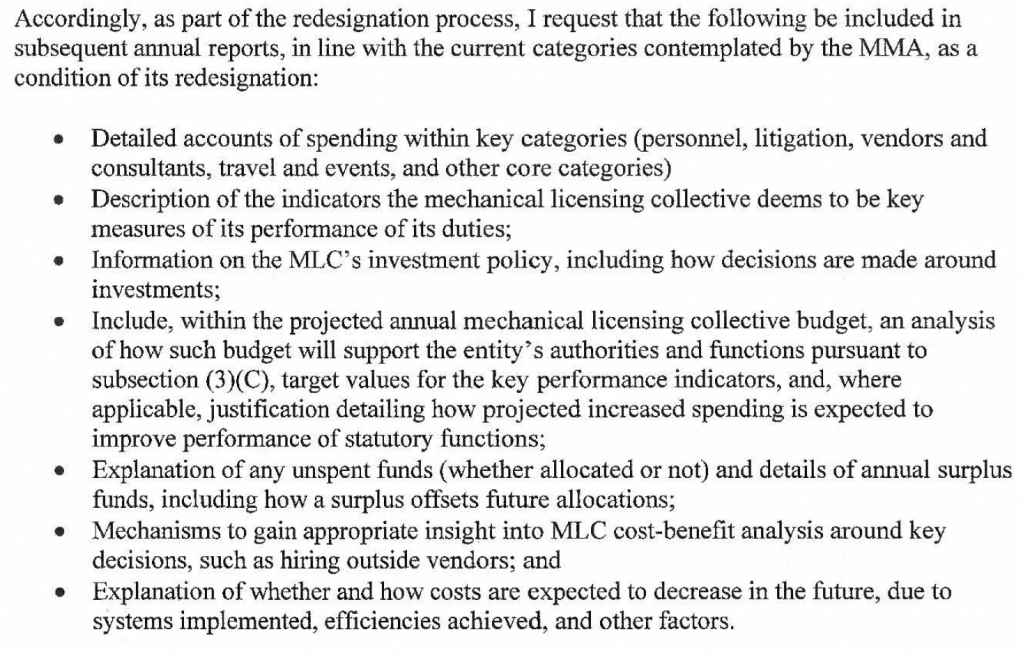
Rep. Fitzgerald is concerned with a lack of candor and transparency in The MLC, Inc.’s annual report among other things. If you’ve read the MLC’s annual reports, you may agree with me that the reports are long on cheerleading and short on financial facts.  It’s like The MLC, Inc. thought they were answering the question “How can you tolerate your own awesomeness?”   That question is not on the list.  Rep. Fitzgerald says “Unfortunately, the current annual report lacks key data necessary to examine the MLC’s ability to execute these authorities and functions.”  He then goes on to make recommendations for greater transparency in future annual reports.

I agree with Rep. Fitzgerald that these are all important points.  I disagree with him slightly about the timing of this disclosure.  These important disclosures need not be prospective–they could be both prospective and retroactive. I see no reason at all why The MLC, Inc. cannot be required to revise all of its four annual reports filed to date (https://www.themlc.com/governance) in line with this expanded criteria.  I am just guessing, but the kind of detail that Rep. Fitzgerald is focused on are really just data that any business would accumulate or require in the normal course of prudently operating its business.  That suggests to me that there is no additional work required in bringing The MLC, Inc. into compliance; it’s just a matter of disclosure.

There is nothing proprietary about that disclosure and there is no reason to keep secrets about how you handle other people’s money.  It is important to recognize that The MLC, Inc. only handles other people’s money.  It has no revenue because all of the money under its management comes from either royalties that belong to copyright owners or operating capital paid by the services that use the blanket license.  It should not be overlooked that the services rely on the MLC and it has a duty to everyone to properly handle the funds. The MLC, Inc. also operates at the pleasure of the government, so it should not be heard to be too precious about information flow, particularly information related to its own operational performance. Those duties flow in many directions.

Board Neutrality

The board composition of the mechanical licensing collective (and therefore The MLC, Inc.) is set by Congress in Title I.  It should come as no surprise to anyone that the major publishers and their lobbyists who created Title I wrote themselves a winning hand directly into the statute itself.  (And FYI, there is gambling at Rick’s American Café, too.)  As Rep. Fitzgerald says:  

Of the 14 voting members, ten are comprised of music publishers and four are songwriters. Publishers were given a majority of seats in order to assist with the collective’s primary task of matching and distributing royalties. However, the MMA did not provide this allocation in order to convert the MLC into an extension of the music publishers.

I would argue with him about that, too, because I believe that’s exactly what the MMA was intended to do by those who drafted it who also dictated who controlled the pen.  This is a rotten system and it was obviously on its way to putrefaction before the ink was dry.

For context, Section 8 of the Clayton Act, one of our principal antitrust laws, prohibits interlocking boards on competitor corporations.  I’m not saying that The MLC, Inc. has a Section 8 problem–yet–but rather that interlocking boards is a disfavored arrangement by way of understanding Rep. Fitzgerald’s issue with The MLC, Inc.’s form of governance:

Per the MMA, the MLC is required to maintain an independent board of directors. However, what we’ve seen since establishing the collective is anything but independent. For example, in both 2023 and 2024, all ten publishers represented by the voting members on the MLC Board of Directors were also members of the NMPA’s board.  This not only raises questions about the MLC’s ability to act as a “fair” administrator of the blanket license but, more importantly, raises concerns that the MLC is using its expenditures to advance arguments indistinguishable from those of the music publishers-including, at times, arguments contrary to the positions of songwriters and the digital streamers.

Said another way, Rep. Fitzgerald is concerned that The MLC, Inc. is acting very much like HFA did when it was owned by the NMPA.  That would be HFA, the principal vendor of The MLC, Inc. (and that dividing line is blurry, too).

It is important to realize that the gravamen of Rep. Fitzgerald’s complaint (as I understand it) is not solely with the statute, it is with the decisions about how to interpret the statute taken by The MLC, Inc. and not so far countermanded by the Copyright Office in its oversight role.  That’s the best news I’ve had all day.  This conflict and competition issue is easily solved by voluntary action which could be taken immediately (with or without changing the board composition).  In fact, given the sensitivity that large or dominant corporations have about such things, I’m kind of surprised that they walked right into that one.  The devil may be in the details, but God is in the little things.

Investment Policy

Rep. Fitzgerald is also concerned about The MLC, Inc.’s “investment policy.”  Readers will recall that I have been questioning both the provenance and wisdom of The MLC, Inc. unilaterally deciding that it can invest the hundreds of millions in the black box in the open market.  I personally cannot find any authority for such a momentous action in the statute or any regulation.  Rep. Fitzgerald also raises questions about the “investment policy”:

Further, questions remain regarding the MLC’s investment policy by which it may invest royalty and assessment funds. The MLC’s Investment Policy Statement provides little insight into how those funds are invested, their market risk, the revenue generated from those investments, and the percentage of revenue (minus fees) transferred to the copyright owner upon distribution of royalties. I would urge the Copyright Office to require more transparency into these investments as a condition of redesignation.

It should be obvious that The MLC, Inc.’s “investment policy” has taken on a renewed seriousness and can no longer be dodged.

Black Box

It should go without saying that fair distribution of unmatched funds starts with paying the right people.  Not “connect to collect” or “play your part” or any other sloganeering.  Tracking them down. Like orphan works, The MLC, Inc. needs to take active measures to find the people to whom they owe money, not wait for the people who don’t know they are owed to find out that they haven’t been paid.  

Although there are some reasonable boundaries on a cost/benefit analysis of just how much to spend on tracking down people owed small sums, it is important to realize that the extraordinary benefits conferred on digital services by the Music Modernization Act, safe harbors and all, justifies higher expectations of those same services in finding the people they owe money.  The MLC, Inc. is uniquely different than its counterparts in other countries for this reason.

I tried to raise the need for increased vigilance at the MLC during a Copyright Office roundtable on the MMA. I was startled that the then-head of DiMA (since moved on) had the brass to condescend to me as if he had ever paid a royalty or rendered a royalty statement.  I was pointing out that the MLC was different than any other collecting society in the world because the licensees pay the operating costs and received significant legal benefits in return. Those legal benefits took away songwriters’ fundamental rights to protect their interests through enforcing justifiable infringement actions which is not true in other countries. 

In countries where the operating cost of their collecting society is deducted from royalties, it is far more appropriate for that society to consider a more restrictive cost/benefit analysis when expending resources to track down the songwriters they owe. This is particularly true when no black box writer is granting nonmonetary consideration like a safe harbor whether they know it or not.

I got an earful from this person about how the services weren’t an open checkbook to track down people they owed money to (try that argument when failing to comply with Know Your Customer laws).  Grocers know more about ham sandwiches than digital services know about copyright owners. The general tone was that I should be grateful to Big Daddy and be more careful how I spend my lunch money. And yes I do resent this paternalistic response which I’m sorry to say was not challenged by the Copyright Office lawyer presiding who shortly thereafter went to work for Spotify.  Nobody ever asked for an open check.  I just asked that they make a greater effort than the effort that got Spotify sued a number of times resulting in over $50 million in settlements, a generous accommodation in my view. If anyone should be grateful, it is the services who should be grateful, not the songwriters.

And yet here we are again in the same place.  Except this time the services have a safe harbor against the entire world which I believe has value greater than the operating costs of the MLC.  I’d be perfectly happy to go back to the way it was before the services got everything they wanted and then some in Title I of the MMA, but I bet I won’t get any takers on that idea.

Instead, I have to congratulate Rep. Fitzgerald for truly excellent work product in his letter and for framing the issue exactly as it should be posed.  Failing to fix these major problems should result in no redesignation—fired for cause.

[This post first appeared in MusicTech.Solutions]

Press Release from @AmericanPublish: Appeals Court Affirms Decision Against Internet Archive for Copyright Infringement

[The defeat of Big Tech and the Internet Archive is one of the most important copyright cases in the last ten years. This press release is a good summary of the ruling from our allies at the Association of American Publishers.]

Today the United States Court of Appeals for the Second Circuit affirmed the District Court’s March 2023 opinion in favor of publishers Hachette Book Group, HarperCollins, John Wiley & Sons, and Penguin Random House, finding Internet Archive liable for copyright infringement and rejecting all four factors of Internet Archive’s fair use argument.

The Court squarely addressed the question of whether it is “fair use” for a nonprofit organization to scan copyright-protected print books in their entirety, and distribute those digital copies online, in full, for free, subject to an asserted one-to-one owned-to-loaned ratio between its print copies and the digital copies it makes available at any given time, without any authorization from the copyright owner.  In the Court’s words, “[a]pplying the relevant provisions of the Copyright Act, as well as binding Supreme Court and Second Circuit precedent, we conclude the answer is no.”

The following is a statement from Maria A. Pallante, President and CEO, Association of American Publishers:

“Today’s appellate decision upholds the rights of authors and publishers to license and be compensated for their books and other creative works and reminds us in no uncertain terms that infringement is both costly and antithetical to the public interest. Critically, the Court frontally rejects the defendant’s self-crafted theory of “controlled digital lending,” irrespective of whether the actor is commercial or noncommercial, noting that the ecosystem that makes books possible in fact depends on an enforceable Copyright Act.  If there was any doubt, the Court makes clear that under fair use jurisprudence there is nothing transformative about converting entire works into new formats without permission or appropriating the value of derivative works that are a key part of the author’s copyright bundle.”

Key Quotes the Court’s decision:

  • Within the framework of the Copyright Act, IA’s argument regarding the public interest is shortsighted. True, libraries and consumers may reap some short-term benefits from access to free digital books, but what are the long-term consequences?
  • If authors and creators knew that their original works could be copied and disseminated for free, there would be little motivation to produce new works. And a dearth of creative activity would undoubtedly negatively impact the public. It is this reality that the Copyright Act seeks to avoid.
  • Because IA’s Free Digital Library functions as a replacement for the originals, it is reasonable and logical to conclude not only that IA’s digital books currently function as a competing substitute for Publishers’ licensed editions of the Works, but also that, if IA’s practices were to become “unrestricted and widespread,” it would decimate Publishers’ markets for the Works in Suit across formats.
  • Were we to approve IA’s use of the Works, there would be little reason for consumers or libraries to pay Publishers for content they could access for free on IA’s website. . .Thus, we conclude it is ‘self-evident’ that if IA’s use were to become widespread, it would adversely affect Publishers’ markets for the Works in Suit.
  • IA does not perform the traditional functions of a library; it prepares derivatives of Publishers’ Works and delivers those derivatives to its users in full…Whether it delivers the copies on a one-to-one owned-to-loaned basis or not, IA’s recasting of the Works as digital books is not transformative.
  • [B]ecause IA’s Free Digital Library primarily supplants the original Works without adding meaningfully new or different features that avoid unduly impinging on Publishers’ rights to prepare derivative works, its use of the Works is not transformative.
  • Digitizing physical copies of written work is not transformative, because the act ‘merely transforms the material object embodying the intangible article that is the copyrighted original work.’
  • The Copyright Act protects authors’ works in whatever format they are produced.
  • IA’s Free Digital Library does not “improv[e] the efficiency of delivering content” without unreasonably encroaching on the rights of the copyright holder; it offers the same efficiencies as Publishers’ derivative works while greatly impinging on their exclusive right to prepare those works.
  • While IA claims that prohibiting its practices would harm consumers and researchers, allowing its practices would―and does―harm authors.

The full decision can be found here.

Save the Date:  4th Annual Artist Rights Symposium on Nov. 20 in Washington DC

We’re excited to announce that the 4th Annual Artist Rights Symposium will be held on November 20, this time in Washington DC.  We have some big surprises in store that will be announced soon with new partners and speaker lineups. 

The topics we plan on covering will be ticketing, song metadata and black box issues, creator rights of publicity and transparency for artificial intelligence.

Watch this space!