Fired for Cause:  @RepFitzgerald Asks for Conditional Redesignation of the MLC

By Chris Castle

U.S. Representative Scott Fitzgerald joined in the MLC review currently underway and sent a letter to Register of Copyrights Shira Perlmutter on August 29 regarding operational and performance issues relating to the MLC.  The letter was in the context of the five year review for “redesignation” of The MLC, Inc. as the mechanical licensing collective.  (That may be confusing because of the choice of “The MLC” as the name of the operational entity that the government permits to run the mechanical licensing collective.  The main difference is that The MLC, Inc. is an entity that is “designated” or appointed to operationalize the statutory body.  The MLC, Inc. can be replaced.  The mechanical licensing collective (lower case) is the statutory body created by Title I of the Music Modernization Act) and it lasts as long as the MMA is not repealed or modified. Unlikely, but we live in hope.)

I would say that songwriters probably don’t have anything more important to do today in their business beyond reading and understanding Rep. Fitzgerald’s excellent letter.

Rep. Fitzgerald’s letter is important because he proposes that the MLC, Inc. be given a conditional redesignation, not an outright redesignation.  In a nutshell, that is because Rep. Fitzgerald raises many…let’s just say “issues”…that he would like to see fixed before committing to another five years for The MLC, Inc.  As a member of the House Judiciary Subcommittee on Courts, Intellectual Property, and the Internet, Rep. Fitzgerald’s point of view on this subject must be given added gravitas.

In case you’re not following along at home, the Copyright Office is currently conducting an operational and performance review of The MLC, Inc. to determine if it is deserving of being given another five years to operate the mechanical licensing collective.  (See Periodic Review of the Mechanical Licensing Collective and the Digital Licensee Coordinator (Docket 2024-1), available at https://www.copyright.gov/rulemaking/mma-designations/2024/.)

The redesignation process may not be quickly resolved.  It is important to realize that the Copyright Office is not obligated to redesignate The MLC, Inc. by any particular deadline or at all.  It is easy to understand that any redesignation might be contingent on The MLC, Inc. fixing certain…issues…because the redesignation rulemaking is itself an operational and performance review.  It is also easy to understand that the Copyright Office might need to bring in some technical and operational assistance in order to diligence its statutory review obligations.  This could take a while.

Let’s consider the broad strokes of Rep. Fitzgerald’s letter.

Budget Transparency

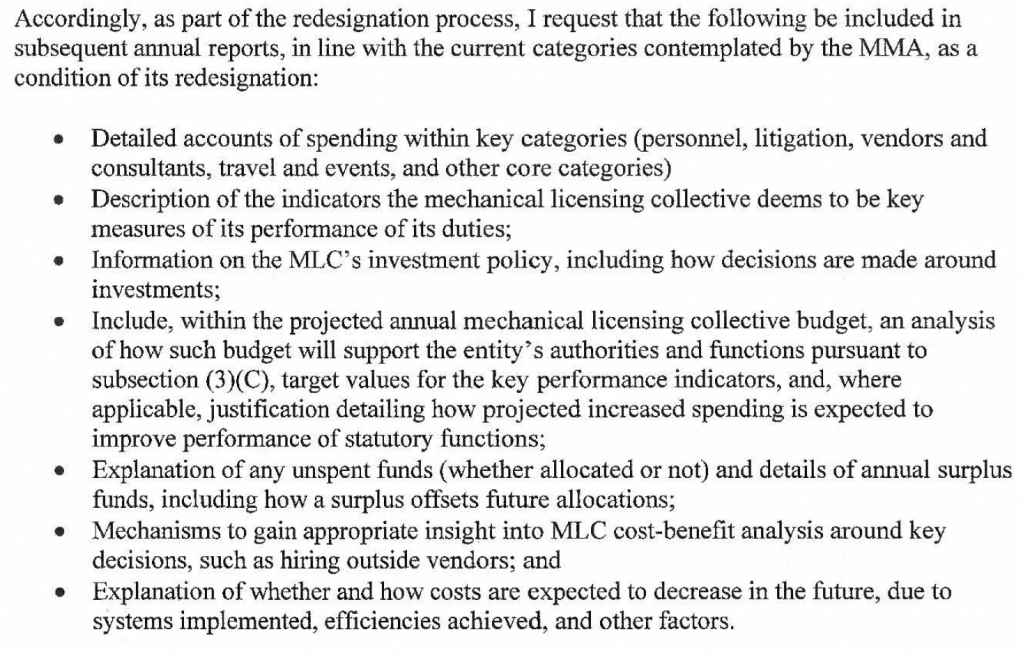
Rep. Fitzgerald is concerned with a lack of candor and transparency in The MLC, Inc.’s annual report among other things. If you’ve read the MLC’s annual reports, you may agree with me that the reports are long on cheerleading and short on financial facts.  It’s like The MLC, Inc. thought they were answering the question “How can you tolerate your own awesomeness?”   That question is not on the list.  Rep. Fitzgerald says “Unfortunately, the current annual report lacks key data necessary to examine the MLC’s ability to execute these authorities and functions.”  He then goes on to make recommendations for greater transparency in future annual reports.

I agree with Rep. Fitzgerald that these are all important points.  I disagree with him slightly about the timing of this disclosure.  These important disclosures need not be prospective–they could be both prospective and retroactive. I see no reason at all why The MLC, Inc. cannot be required to revise all of its four annual reports filed to date (https://www.themlc.com/governance) in line with this expanded criteria.  I am just guessing, but the kind of detail that Rep. Fitzgerald is focused on are really just data that any business would accumulate or require in the normal course of prudently operating its business.  That suggests to me that there is no additional work required in bringing The MLC, Inc. into compliance; it’s just a matter of disclosure.

There is nothing proprietary about that disclosure and there is no reason to keep secrets about how you handle other people’s money.  It is important to recognize that The MLC, Inc. only handles other people’s money.  It has no revenue because all of the money under its management comes from either royalties that belong to copyright owners or operating capital paid by the services that use the blanket license.  It should not be overlooked that the services rely on the MLC and it has a duty to everyone to properly handle the funds. The MLC, Inc. also operates at the pleasure of the government, so it should not be heard to be too precious about information flow, particularly information related to its own operational performance. Those duties flow in many directions.

Board Neutrality

The board composition of the mechanical licensing collective (and therefore The MLC, Inc.) is set by Congress in Title I.  It should come as no surprise to anyone that the major publishers and their lobbyists who created Title I wrote themselves a winning hand directly into the statute itself.  (And FYI, there is gambling at Rick’s American Café, too.)  As Rep. Fitzgerald says:  

Of the 14 voting members, ten are comprised of music publishers and four are songwriters. Publishers were given a majority of seats in order to assist with the collective’s primary task of matching and distributing royalties. However, the MMA did not provide this allocation in order to convert the MLC into an extension of the music publishers.

I would argue with him about that, too, because I believe that’s exactly what the MMA was intended to do by those who drafted it who also dictated who controlled the pen.  This is a rotten system and it was obviously on its way to putrefaction before the ink was dry.

For context, Section 8 of the Clayton Act, one of our principal antitrust laws, prohibits interlocking boards on competitor corporations.  I’m not saying that The MLC, Inc. has a Section 8 problem–yet–but rather that interlocking boards is a disfavored arrangement by way of understanding Rep. Fitzgerald’s issue with The MLC, Inc.’s form of governance:

Per the MMA, the MLC is required to maintain an independent board of directors. However, what we’ve seen since establishing the collective is anything but independent. For example, in both 2023 and 2024, all ten publishers represented by the voting members on the MLC Board of Directors were also members of the NMPA’s board.  This not only raises questions about the MLC’s ability to act as a “fair” administrator of the blanket license but, more importantly, raises concerns that the MLC is using its expenditures to advance arguments indistinguishable from those of the music publishers-including, at times, arguments contrary to the positions of songwriters and the digital streamers.

Said another way, Rep. Fitzgerald is concerned that The MLC, Inc. is acting very much like HFA did when it was owned by the NMPA.  That would be HFA, the principal vendor of The MLC, Inc. (and that dividing line is blurry, too).

It is important to realize that the gravamen of Rep. Fitzgerald’s complaint (as I understand it) is not solely with the statute, it is with the decisions about how to interpret the statute taken by The MLC, Inc. and not so far countermanded by the Copyright Office in its oversight role.  That’s the best news I’ve had all day.  This conflict and competition issue is easily solved by voluntary action which could be taken immediately (with or without changing the board composition).  In fact, given the sensitivity that large or dominant corporations have about such things, I’m kind of surprised that they walked right into that one.  The devil may be in the details, but God is in the little things.

Investment Policy

Rep. Fitzgerald is also concerned about The MLC, Inc.’s “investment policy.”  Readers will recall that I have been questioning both the provenance and wisdom of The MLC, Inc. unilaterally deciding that it can invest the hundreds of millions in the black box in the open market.  I personally cannot find any authority for such a momentous action in the statute or any regulation.  Rep. Fitzgerald also raises questions about the “investment policy”:

Further, questions remain regarding the MLC’s investment policy by which it may invest royalty and assessment funds. The MLC’s Investment Policy Statement provides little insight into how those funds are invested, their market risk, the revenue generated from those investments, and the percentage of revenue (minus fees) transferred to the copyright owner upon distribution of royalties. I would urge the Copyright Office to require more transparency into these investments as a condition of redesignation.

It should be obvious that The MLC, Inc.’s “investment policy” has taken on a renewed seriousness and can no longer be dodged.

Black Box

It should go without saying that fair distribution of unmatched funds starts with paying the right people.  Not “connect to collect” or “play your part” or any other sloganeering.  Tracking them down. Like orphan works, The MLC, Inc. needs to take active measures to find the people to whom they owe money, not wait for the people who don’t know they are owed to find out that they haven’t been paid.  

Although there are some reasonable boundaries on a cost/benefit analysis of just how much to spend on tracking down people owed small sums, it is important to realize that the extraordinary benefits conferred on digital services by the Music Modernization Act, safe harbors and all, justifies higher expectations of those same services in finding the people they owe money.  The MLC, Inc. is uniquely different than its counterparts in other countries for this reason.

I tried to raise the need for increased vigilance at the MLC during a Copyright Office roundtable on the MMA. I was startled that the then-head of DiMA (since moved on) had the brass to condescend to me as if he had ever paid a royalty or rendered a royalty statement.  I was pointing out that the MLC was different than any other collecting society in the world because the licensees pay the operating costs and received significant legal benefits in return. Those legal benefits took away songwriters’ fundamental rights to protect their interests through enforcing justifiable infringement actions which is not true in other countries. 

In countries where the operating cost of their collecting society is deducted from royalties, it is far more appropriate for that society to consider a more restrictive cost/benefit analysis when expending resources to track down the songwriters they owe. This is particularly true when no black box writer is granting nonmonetary consideration like a safe harbor whether they know it or not.

I got an earful from this person about how the services weren’t an open checkbook to track down people they owed money to (try that argument when failing to comply with Know Your Customer laws).  Grocers know more about ham sandwiches than digital services know about copyright owners. The general tone was that I should be grateful to Big Daddy and be more careful how I spend my lunch money. And yes I do resent this paternalistic response which I’m sorry to say was not challenged by the Copyright Office lawyer presiding who shortly thereafter went to work for Spotify.  Nobody ever asked for an open check.  I just asked that they make a greater effort than the effort that got Spotify sued a number of times resulting in over $50 million in settlements, a generous accommodation in my view. If anyone should be grateful, it is the services who should be grateful, not the songwriters.

And yet here we are again in the same place.  Except this time the services have a safe harbor against the entire world which I believe has value greater than the operating costs of the MLC.  I’d be perfectly happy to go back to the way it was before the services got everything they wanted and then some in Title I of the MMA, but I bet I won’t get any takers on that idea.

Instead, I have to congratulate Rep. Fitzgerald for truly excellent work product in his letter and for framing the issue exactly as it should be posed.  Failing to fix these major problems should result in no redesignation—fired for cause.

[This post first appeared in MusicTech.Solutions]

Press Release from @AmericanPublish: Appeals Court Affirms Decision Against Internet Archive for Copyright Infringement

[The defeat of Big Tech and the Internet Archive is one of the most important copyright cases in the last ten years. This press release is a good summary of the ruling from our allies at the Association of American Publishers.]

Today the United States Court of Appeals for the Second Circuit affirmed the District Court’s March 2023 opinion in favor of publishers Hachette Book Group, HarperCollins, John Wiley & Sons, and Penguin Random House, finding Internet Archive liable for copyright infringement and rejecting all four factors of Internet Archive’s fair use argument.

The Court squarely addressed the question of whether it is “fair use” for a nonprofit organization to scan copyright-protected print books in their entirety, and distribute those digital copies online, in full, for free, subject to an asserted one-to-one owned-to-loaned ratio between its print copies and the digital copies it makes available at any given time, without any authorization from the copyright owner.  In the Court’s words, “[a]pplying the relevant provisions of the Copyright Act, as well as binding Supreme Court and Second Circuit precedent, we conclude the answer is no.”

The following is a statement from Maria A. Pallante, President and CEO, Association of American Publishers:

“Today’s appellate decision upholds the rights of authors and publishers to license and be compensated for their books and other creative works and reminds us in no uncertain terms that infringement is both costly and antithetical to the public interest. Critically, the Court frontally rejects the defendant’s self-crafted theory of “controlled digital lending,” irrespective of whether the actor is commercial or noncommercial, noting that the ecosystem that makes books possible in fact depends on an enforceable Copyright Act.  If there was any doubt, the Court makes clear that under fair use jurisprudence there is nothing transformative about converting entire works into new formats without permission or appropriating the value of derivative works that are a key part of the author’s copyright bundle.”

Key Quotes the Court’s decision:

  • Within the framework of the Copyright Act, IA’s argument regarding the public interest is shortsighted. True, libraries and consumers may reap some short-term benefits from access to free digital books, but what are the long-term consequences?
  • If authors and creators knew that their original works could be copied and disseminated for free, there would be little motivation to produce new works. And a dearth of creative activity would undoubtedly negatively impact the public. It is this reality that the Copyright Act seeks to avoid.
  • Because IA’s Free Digital Library functions as a replacement for the originals, it is reasonable and logical to conclude not only that IA’s digital books currently function as a competing substitute for Publishers’ licensed editions of the Works, but also that, if IA’s practices were to become “unrestricted and widespread,” it would decimate Publishers’ markets for the Works in Suit across formats.
  • Were we to approve IA’s use of the Works, there would be little reason for consumers or libraries to pay Publishers for content they could access for free on IA’s website. . .Thus, we conclude it is ‘self-evident’ that if IA’s use were to become widespread, it would adversely affect Publishers’ markets for the Works in Suit.
  • IA does not perform the traditional functions of a library; it prepares derivatives of Publishers’ Works and delivers those derivatives to its users in full…Whether it delivers the copies on a one-to-one owned-to-loaned basis or not, IA’s recasting of the Works as digital books is not transformative.
  • [B]ecause IA’s Free Digital Library primarily supplants the original Works without adding meaningfully new or different features that avoid unduly impinging on Publishers’ rights to prepare derivative works, its use of the Works is not transformative.
  • Digitizing physical copies of written work is not transformative, because the act ‘merely transforms the material object embodying the intangible article that is the copyrighted original work.’
  • The Copyright Act protects authors’ works in whatever format they are produced.
  • IA’s Free Digital Library does not “improv[e] the efficiency of delivering content” without unreasonably encroaching on the rights of the copyright holder; it offers the same efficiencies as Publishers’ derivative works while greatly impinging on their exclusive right to prepare those works.
  • While IA claims that prohibiting its practices would harm consumers and researchers, allowing its practices would―and does―harm authors.

The full decision can be found here.

Save the Date:  4th Annual Artist Rights Symposium on Nov. 20 in Washington DC

We’re excited to announce that the 4th Annual Artist Rights Symposium will be held on November 20, this time in Washington DC.  We have some big surprises in store that will be announced soon with new partners and speaker lineups. 

The topics we plan on covering will be ticketing, song metadata and black box issues, creator rights of publicity and transparency for artificial intelligence.

Watch this space!

@wordsbykristin: Legal Fights, Transparency & Neutrality: DiMA’s CEO On Improvements Streamers Suggest for the MLC

Kristin Robinson makes another important contribution to the artist rights conversation with her interview of Graham Davies, the new head of the Digital Media Association. Graham comes to DiMA from a background in the artist rights movement at our friends the Ivors Academy in the UK. We have high hopes for Graham who brings his intellect to clean up a long, long line of mediocrity at the DiMA leadership who are from Washington and here to help.

Kristin’s interview highlights DiMA’s recent filings in The Reup–the redesignation of the MLC by the Copyright Office that we’ve highlighted on Trichordist. He also has some well thought out analysis on how the MLC is not HFA, however similar the two may seem in practice.

This is an important interview and you can find it on Billboard (subscription required).

Here’s an example of Graham’s insight:

Do you think a re-designation every five years is not enough on its own?

I think it’ll be interesting to see what the re-designation process brings forward from the Copyright Office. Maybe the Copyright Office leans in on governance and says, “We’ve heard enough, and we can come forward with ideas.” But the re-designation process is a different thing than a governance review, which would bring in a special team to actually dig into governance-related issues and bring forward recommendations and proposals that could then be implemented. It would be something more specific and something the MLC could just do. You wouldn’t need the Copyright Office to sponsor it, though they could if they wanted to.

Are You Better Off Today Than You Were Five Years Ago? Selected comments on the MLC Redesignation: Gwendolyn Seale

The Copyright Office solicited public comments about how things are going with the MLC to help the Office decide whether to permit The MLC, Inc. to continue to operate the Collective (see this post for more details on the “redesignation” requirement). We are impressed with the quality of many of the comments filed at the Copyright Office. While comments are now closed, you can read all the comments at this link.

For context, the “redesignation” is a process of review by the Copyright Office required every five years under the Music Modernization Act. Remember, the “mechanical licensing collective” is a statutory entity that requires someone to operate it. The MLC, Inc. is the current operator (which makes it confusing but there it is). If the Copyright Office finds the MLC, Inc. is not sufficiently fulfilling its role or is not up to the job of running the MLC, the head of the Copyright Office can “fire” the MLC, Inc. and find someone else to hopefully do a better job running the MLC. Given the millions upon millions that the music users have invested in the MLC, and the hundreds of millions of songwriter money held by the MLC in the black box, firing the MLC, Inc. will be a big deal. Given how many problems there are with the MLC, firing the MLC, Inc. that runs the collective

The next step in this important “redesignation” process is that The MLC, Inc. and the Digital Licensee Coordinator called “the DLC” (the MLC’s counterpart that represents the blanket license music users) will be making “reply comments” due on July 29. The Copyright Office will post these comments for the public shortly after the 29th. These reply comments will likely rebut previously filed public comments on the shortcomings of the MLC, Inc. or DLC (which were mostly directed at the MLC, Inc.) and expand upon comments each of the two orgs made in previous filings. If you’re interested in this drama, stay tuned, the Copyright Office will be posting them next week.

If you have been reading the comments we’ve posted on Trichordist (or if you have gone to the filings themselves which we recommend), you will see that there is a recurring theme with the comments. Many commenters say that they wish for The MLC, Inc. to be redesignated BUT…. They then list a number of items that they object to about the way the Collective has been managed by The MLC, Inc. usually accompanied by a request that the The MLC, Inc. change the way it operates.

That structure seems to be inconsistent with a blanket ask for redesignation. Rather, the commenters seem to be making an “if/then” proposal that if The MLC, Inc. improves its operations, including in some cases operating in an opposite manner to its current policies and practices, then The MLC, Inc. should be redesignated. Not wishing to speak for any commenter, let it just be said that this appears to be a conditional proposal for redesignation. Maybe that is not what the commenters were thinking, but it does appear to be what many of them are saying.

Today’s comment is by music lawyer Gwendolyn Seale who makes a number of excellent points in her filing including questioning whether the compulsory license itself is fit for purpose and what might happen if the MLC, Inc. is not redesignated. In particular, she addresses an alarming trend in the MLC, Inc.’s public messaging about the black box that has grown more cloudy as the size of the black box at the MLC has grown into the hundreds of millions.

For purposes of these posts, we may quote sections of comments out of sequence but in context. We recommend that you read the comments in their entirety. You can read Gwen Seale’s comment at this link.

Words Matter: The MLC Must Improve Its Presentation of Information

Confusion Regarding the Term, “Match Rate”

Upon reviewing the MLC’s 2021 Interim Annual Report in early 2022, I noticed reference to the
MLC having attained an 86% match rate. This metric seemed impressive, however, upon
learning the MLC’s definition of “match rate” (which I only learned by asking the MLC), I was
baffled. When the term, “match” is used alone, it refers to the matching of a sound recording
from a DSP report to a particular musical work. The Copyright Office’s NOI indicates the same
regarding the term, “match.”

Please describe how the Mechanical Licensing Collective has worked to improve automated and manual matching since the blanket license became available and plans to further enhance such matching over the next 5 years, including with respect to the matching of reported sound recordings to musical works as well as the matching of those musical works to identified and located copyright owners.

Being that a “match” constitutes pairing a sound recording with a particular musical work, it is
logical to deduce the “match rate” as being the percentage of sound recordings in DSP reports
which are matched to musical works registered at the MLC. However, that is not the case and
instead the term “match rate” as used by the MLC refers to the total amount of royalties matched
to musical works registered at the MLC over a given period. This definition was not provided to
the public so far as I can tell until June 30, 2022, in its final 2021 Annual Report.

As the most popular musical works are the ones generating the bulk of mechanical royalties over
a given month and are typically owned and/or controlled by the major music publishers with the
resources and capabilities to constantly monitor activities concerning their clients’ musical works
and engage in manual matching, the current definition of match rate (i.e., the royalty-based
definition) does not mean very much by itself. It would be useful for the MLC to also provide the
monthly match rate on a recordings-to-musical works-matched basis (hereinafter, “works-based
calculation”). Doing so would shine a light on the efficacy of the MLC’s and its vendors’
matching technology and would help to ensure the musical works of countless self-published
songwriters are being matched to reported sound recordings. I understand that there are issues
with catalog “fluff” and some sound recordings do not generate a single stream over a month’s
time. Thus, a works-based calculation could be tailored in a manner where recordings with less
than x streams per month or that generate less than x cents in mechanical royalties are omitted
from the calculation. Input from the Copyright Office regarding match rate terminology would
be helpful as well.

Historical Royalties: Eliminate  Illuminate = Obfuscate

The impetus behind establishing the MLC was to ensure that songwriters and publishers could
finally collect the nearly half billion dollars in historical royalties5 owed by the DSPs from the
early 2000s through the end of 2020. The task of the MLC was to eliminate the historical
royalties by ensuring that sound recordings could be matched to registered works in the MLC
database from this period. The MLC stated that eliminating these royalties was its goal:

The MLC cannot stress enough that its goal is to eliminate unclaimed accrued royalties, and that it has developed a realistic plan to pursue this goal.


Over time, the MLC shifted the language from eliminating to “illuminating” the historical royalties, beginning with the 2022 MLC Annual report:

Together, we will not only illuminate the “black box,” but also seek to eliminate it entirely!

At present, the MLC no longer references “elimination” of the historical royalties and purports
the job is done since the historical royalties have been “illuminated:”

Is there still a Black Box of Mechanical Royalties With The MLC?
No, the data on all unmatched uses is posted and available to be searched by Members. This includes all data for historical and blanket unmatched uses. All of these remaining unmatched uses are available to be searched by Members in The MLC’s Matching Tool. With this unprecedented transparency, The MLC has illuminated the so-called “black box” of streaming mechanical royalties for the first time.

The MLC started by moving the goalposts and concluded with eliminating them altogether. This
obfuscation of language is problematic. It misleads the public about the MLC’s performance and
gaslights those with knowledge about matching works and distributing royalties. Words matter.

This issue can be quickly solved by the MLC removing that particular FAQ above, and by providing monthly data regarding the total amount of unmatched, unclaimed, and on-hold
royalties (historical + blanket) in the MLC’s possession in a place that is easy to find on its
website.


.

Are You Better Off Today Than You Were Five Years Ago? Selected comments on the MLC Redesignation: Spirit Music Group

The Copyright Office is soliciting public comments about how things are going with the MLC to help the Office decide whether to permit The MLC, Inc. to continue to operate the Collective (see this post for more details on the “redesignation” requirement). We are impressed with the quality of many of the comments filed in the “Initial Comments” at the Copyright Office. As there will be an opportunity to comment again, including to comment on the comments, we will be posting selected Initial Comments to call to your attention. You can read all the comments at this link. If you are hearing about this for the first time, you have until June 28 to file a “reply comment” with the Copyright Office at this link.

You will see that there is a recurring theme with the comments. Many commenters say that they wish for The MLC, Inc. to be redesignated BUT…. They then list a number of items that they object to about the way the Collective has been managed by The MLC, Inc. usually accompanied by a request the The MLC, Inc. change the way it operates.

That structure seems to be inconsistent with a blanket ask for redesignation. Rather, the commenters seem to be making an “if/then” proposal that if The MLC, Inc. improves its operations, including in some cases operating in an opposite manner to its current policies and practices, then The MLC, Inc. should be redesignated. Not wishing to speak for any commenter, let it just be said that this appears to be a conditional proposal for redesignation. Maybe that is not what the commenters were thinking, but it does appear to be what many of them are saying. Perhaps this conditional aspect will be refined in the Reply Comments.

For purposes of these posts, we may quote sections of comments out of sequence but in context. We recommend that you read the comments in their entirety.

Today’s featured comment is from the well-regarded independent music publisher Spirit Music Group. Spirit makes a number of comments about important issues with the MLC, Inc.’s handling of metadata and other operational issues. If you are not immersed in metadata issues, it is easy to blow past these comments such as the MLC making data available in the common csv format (i.e., not only DDEX) is actually a serious complaint about a significant operational issue.

While you have to put Spirit down as an unambiguous supporter of redesignation, it is important to focus on how best to get the MLC, Inc. to implement the many commenters’ operational suggestions. We will see some of these comments confirmed with other commenters.

We would also point out a theme that will come up repeatedly–The MLC, Inc. knows who to take care of and who to respond to quickly. That is not the same thing as having methods and systems that take care of all members which the MLC can certainly afford given the tens of millions of dollars that the services spend on The MLC, Inc.

[T]he MLC has certainly met the minimum responsibilities under the MMA and has endeavored to provide additional functionality so rightsholders can receive their entitled royalties from DMS and has completed significant development in a short period. They are very receptive of our concerns and respond promptly and clearly. We look forward their continued development.

3:II.B. Member Tools
1. Development and Implementation of Tools and Functionality
The implementation of the Matching and Claiming tools and offering the bulk data (at a cost to the recipient) gives rightsholders the visibility to identify omissions in payments; These tools are the first offered by a CMO in the United States and should set an example to the others.

For publishers with large catalogs, who are not one of the majors like ourselves, have the greatest obstacles. We represent significant works by The Who, Chicago, Billy Squier, Salt N Peppa, and many others. While the Matching and Claiming tools are great for self-published writers and the bulk data for majors, indie publishers do not have the means to maximize the use of these resources. We hope the MLC offers improvements to extract data in csv format from the Matching and Claiming tools.

We would also like to see more details in Match History to understand why certain claims are rejected.

2. Matching Methodology
The MLC still uses the ISRC as the primary identify for matching. Expanding the identification process using song titles and CISAC codes, i.e., the IPI and ISWC can enhance matching, improve results, and reduce unmatched recordings.

Adjustments: The MLC’s adjustment policy does not allow for debits and credits of rightsholders in the event of an error. Additionally, credits to the entitled rightsholder are not delivered unless the funds are received from the party paid in error. CMOs around the world have policies in place to handle adjustments and the MLC should have similar procedures in place.

Criterion 3:IV. Investments in Resources and Vendor Engagement
3:IV.B. Subpplemental Matching Network

The USCO asks the MLC to “…provide additional information about these (Blokur, Jaxsta, Pex, Salt, SX Works) relationships, including the specific functions that they perform, or have been asked to perform, the vendors’ relevant experience with clients and projects involving similar scale and type, or their industry-specific knowledge.” The MLC only satisfies a portion of this request by providing details about each of these companies functions. However, it does not provide the tasks they have been asked to preform or how the MLC plans to use these companies to improve the royalties that will ultimately be paid to the rightsholders.

Read the entire comment at this link.

Are You Better off Today Than You Were Five Years Ago? Selected comments on the MLC Redesignation: Monica Corton

The Mechanical Licensing Collective has its operations and functions reviewed every five years by the Copyright Office. That review is required by Title I of the Music Modernization Act as written by the lobbyists. The Copyright Office noticed the first of these five year reviews on January 30.

The statutory purpose of the period review is so that Congress, in the person of the Copyright Office, can determine whether the operators of the Mechanical Licensing Collective who the Copyright Office appointed (or “designated”) should be permitted to continue for another five years. If the Copyright Office determines that the operators of the Collective will do a good job in the next five years, the head of the Office may reward them with the equivalent of a valuable new government contract or a “redesignation”.

The current operators of the Collective are The MLC, Inc., but there is nothing that requires the Office to allow The MLC, Inc. to continue being the mechanical licensing collective–the the Collective and The MLC, Inc. are not the same thing. Be clear that the entity that is being considered to be “redesignated” is The MLC, Inc., not the Collective. The Collective is a statutory entity and The MLC, Inc. is the organization that is permitted by the Copyright Office to operate as the Collective. (That’s confusing because someone allowed The MLC, Inc. to take the same corporate name as the statutory entity which was probably an oversight by the Delaware Secretary of State if not the Copyright Office itself.)

The five year review is important because it is the only chance for songwriters and publishers as well as the public to comment on whether they support rewarding The MLC, Inc. with another five years of operations and the tens and tens of millions of dollars in operating costs and high salaries paid for by the users of the blanket license–the services themselves–in the conflict ridden process imposed on songwriters and publishers by the government.

For reasons known only to them, the Copyright Office has chosen to conduct this five year review as though it were any other rulemaking rather than engaging independent experts to conduct a technology, financial, operational, and personnel audit of The MLC, Inc. from top to bottom. That choice is presumably based on some guidance from somewhere, but would seem to inevitably substitute opinions–however astute–for an empirical review using at least industry experts with the power to compel answers if not managerial science.

While this rulemaking approach has the benefit of allowing the public to comment, it fails to offer independent expert review of the very thing that the Office is being asked to approve. Instead, that “redesignation” decision will be based on whether or not the public caught the “right” issues, expressed them the “right” way, and were able to communicate their ideas persuasively. Assuming the public even knew of the opportunity in the first place.

It must be said that if we are going to solicit opinions, the first opinion we would be interested in hearing is from the Copyright Office itself. The Register, after all, is the one making the redesignation decision, not the MLC, the DLC, or any one commenter. It seems that comments would be more compelling if informed by the Copyright Offices own views, including the opportunity to comment on the Office’s methodology. It doesn’t look like we will know about that one until the next step in the rulemaking. A “proposed redesignation” does not seem particularly apt, so we will look forward to finding out after the fact how a large chunk of songwriter income is to be managed.

We are impressed with the quality of many of the comments filed in the “Initial Comments” at the Copyright Office. As there will be an opportunity to comment again, including to comment on the comments, we will be posting selected Initial Comments to call to your attention. You can read all the comments at this link. If you are hearing about this for the first time, you have until June 28 to file a “reply comment” with the Copyright Office at this link.

You will see that there is a recurring theme with the comments. Many commenters say that they wish for The MLC, Inc. to be redesignated BUT…. They then list a number of items that they object to about the way the Collective has been managed by The MLC, Inc. usually accompanied by a request the The MLC, Inc. change the way it operates.

That structure seems to be inconsistent with a blanket ask for redesignation. Rather, the commenters seem to be making an “if/then” proposal that if The MLC, Inc. improves its operations, including in some cases operating in an opposite manner to its current policies and practices, then The MLC, Inc. should be redesignated. Not wishing to speak for any commenter, let it just be said that this appears to be a conditional proposal for redesignation. Maybe that is not what the commenters were thinking, but it does appear to be what they are saying. Perhaps this conditional aspect will be refined in the Reply Comments.

For purposes of these posts, we may quote sections of comments out of sequence but in context. We recommend that you read the comments in their entirety.

The first comment is by Monica Corton, the highly experienced and respected publisher. You can read her comment at this link.

The Top Unmatched Recording List
While I believe this list exists, I have never received an email asking me to review such a list. I recently learned that you could ask for the list, but it comes in the DDEX format (like the unmatched songs list) and as an independent publisher, I do not have the capability to change this to a CSV format. As I explained before, it can easily be converted to a CSV file if you have the
right software. I think that conversion from the DDEX format to the CSV format should be a service done by The MLC. Otherwise, the only people who can benefit from the Top Unmatched Recording List are the largest companies with the resources to convert this list.

Investment Policy
Why isn’t the investment policy made public and fully transparent to the membership? It is our money that they are investing, and I’d like to know the details as would many other publishers. Why did the board decide to not make the policy documents regarding investments available to the public?

IPI Number Use Not Mandatory
The MLC doesn’t require publishers to use IPI numbers of songwriters in their registrations. As a result, there are a lot of duplicate registrations at The MLC/HFA that never get linked together because different registrants used different names for the same writer (e.g. Eminem, Marshall Mathers) which creates different registrations for the same song. If IPI numbers for songwriters
were mandatory, this would clear up this problem.

Royalty Adjustments at The MLC
The MLC will not credit or debit a publisher for an incorrect royalty payment due to a change in registration unless they are directly responsible for the error. If you missed the snapshot because The MLC didn’t process a Catalog Transfer Form on time, the new publisher will not be credited, and it is their responsibility to contact the old publisher and get the incorrect royalty
payment paid between them rather than through The MLC. The MLC doesn’t consider a bad registration at HFA as the cause of an incorrect payment even though it is the HFA data that caused the incorrect payment. Every other PRO and CMO does internal debits and credits for incorrect payments and adjustments, especially when there is a transfer of a new catalog. The
minute The MLC is served notice of via a Catalog Transfer Form, all royalties should be put on hold until the transfer is confirmed and set up by The MLC.