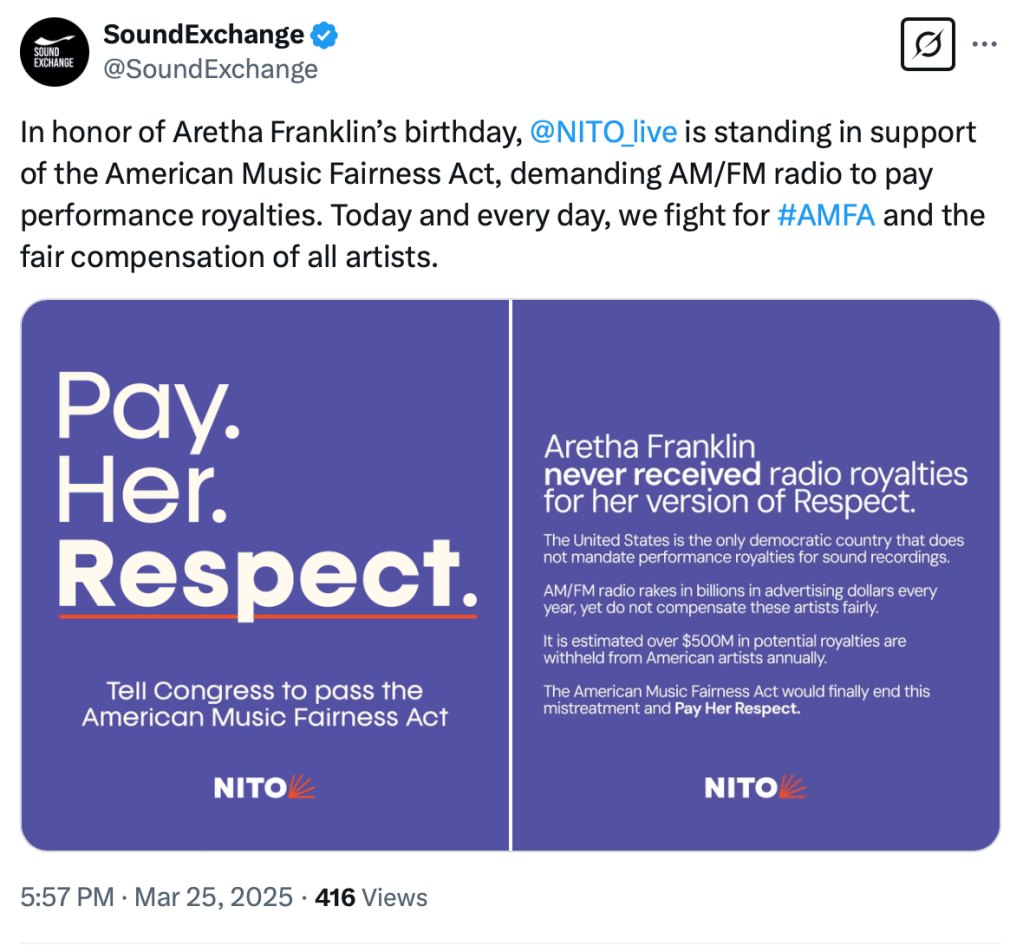
In honor of Aretha Franklin’s birthday, @NITO_live is standing in support of the American Music Fairness Act, demanding AM/FM radio to pay performance royalties. Today and every day, we fight for #AMFA and the fair compensation of all artists. pic.twitter.com/xFHnZjs5gN
We join our friends Blake Morgan, #IRespectMusic, SoundExchange, the National Independent Talent Organization (NITO) and many, many others in asking you to join the fight to support artist pay for radio play by passing the American Music Fairness Act. Find out how you can help here, or find your representative in Congress here.
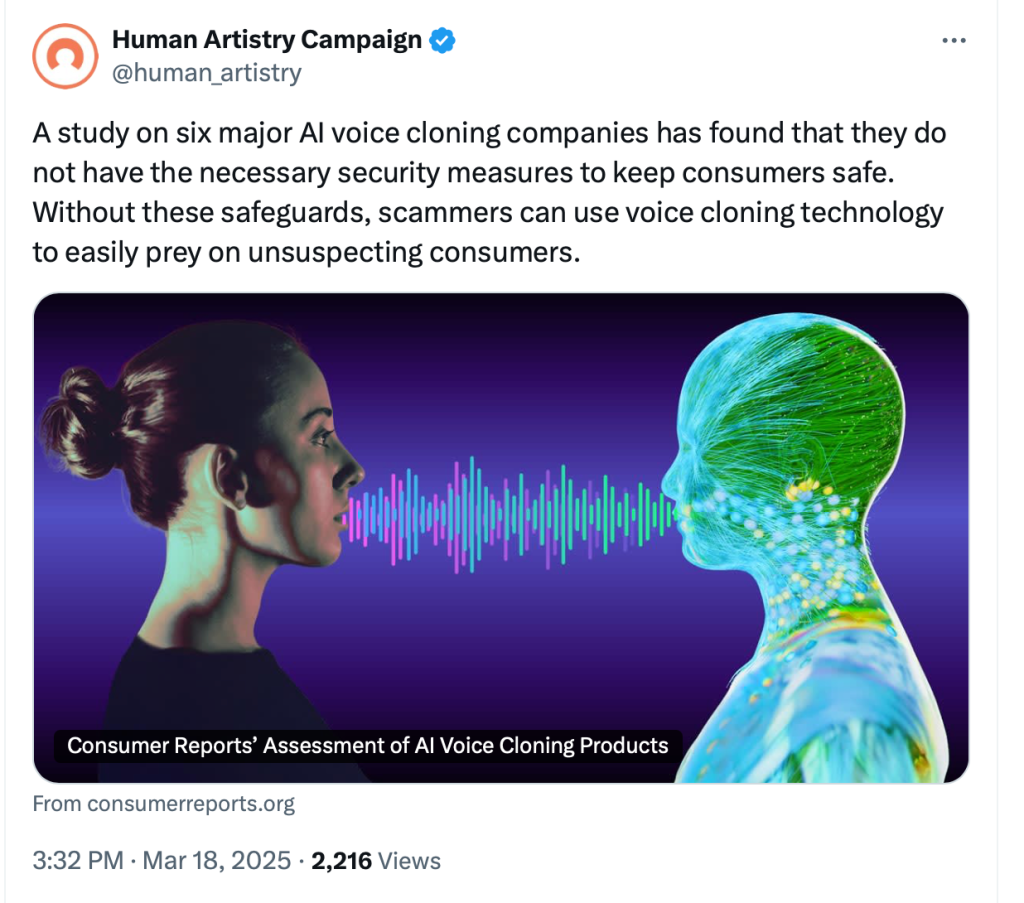
A study on six major AI voice cloning companies has found that they do not have the necessary security measures to keep consumers safe. Without these safeguards, scammers can use voice cloning technology to easily prey on unsuspecting consumers. https://t.co/5Oqb0Vk5vR
— Human Artistry Campaign (@human_artistry) March 18, 2025
Here’s just one reason why we can’t trust Big Tech for opt out (or really any other security that stops them from doing what they want to do)
More than 1,000 musicians have come together to release Is This What You Want?, an album protesting the UK government’s proposed changes to copyright law.
In late 2024, the UK government proposed changing copyright law to allow artificial intelligence companies to build their products using other people’s copyrighted work – music, artworks, text, and more – without a licence.
The musicians on this album came together to protest this. The album consists of recordings of empty studios and performance spaces, representing the impact we expect the government’s proposals would have on musicians’ livelihoods.
All profits from the album are being donated to the charity Help Musicians.
The Government has been defeated in the Lords over measures to protect creatives from having their copyrighted work used to train AI models without permission or remuneration. [The House of Lords is the “upper chamber” of the UK Parliament, similar to the US Senate.]
Peers [Members of the House of Lords] voted 145 to 126, majority 19, in favour of a package of amendments to the Data (Use and Access) Bill aiming to tackle the unauthorised use of intellectual property by big tech companies scraping data for AI.
Proposing the amendments, digital rights campaigner Baroness Kidron said they would help enforce existing property rights by improving transparency and laying out a redress procedure.
The measures would explicitly subject AI companies to UK copyright law, regardless of where they are based, reveal the names and owners of web crawlers that currently operate anonymously and allow copyright owners to know when, where and how their work is used.
Let’s be honest–it may look like things are getting weird with TikTok and Bytedance, but let me suggest things are maybe even weirder than they appear. New information has come to light.
First of all, I think it’s clear that at least as of January 19, the Protecting Americans from Foreign Adversary Controlled Applications Act will make it unlawful for companies in the United States to provide services to distribute, maintain, or update the social media platform TikTok, unless U. S. operation of the platform is severed from Chinese control which basically means owned by Bytedance. It’s potentially clear–although the situation is changing daily in Trump time–that the statute may also ban a number of other data-scraping apps owned and distributed by Bytedance that have problems and addictive properties similar to TikTok.
After TikTok’s faux shut down, President Trump immediately got into the act to “Save TikTok”. His first move was to post on social media that he would issue an executive order today “delaying” the effectiveness of the Act. Mr. Trump’s statements may have seemed a bit disjointed because from a statutory point of view, the President does not have the authority to “delay” the effectiveness of the Act. In fact, that is exactly what the Supreme Court just refused to do.
But “Saving TikTok” may not mean saving TikTok if you catch my drift. Saving it for whom exactly?
This may all seem rather bizarre, but if you read President Trump’s “Friend of the Court” brief filed during the Supreme Court’s review of TikTok’s request for a delay in enforcing the Act, it would all be clear–maybe–because that is exactly what he asked the Supreme Court to do–delay the effective date so the could apply Art of the Deal principles to the situation. This is, of course, not what the Supreme Court really is about, but it does reveal what was on his mind. The President says:
In light of this Court’s well-placed concerns about the “highly expedited” resolution of novel, difficult, and “very significant” constitutional questions…the Court should consider staying the statutory deadline for divestment and taking time to consider the merits in the ordinary course. Such an approach would allow this Court more breathing space to consider the merits, and it would also allow President Trump’s Administration the opportunity to pursue a negotiated resolution that, if successful, would obviate the need for this Court to decide these questions.
When a statute has been duly passed by Congress and signed into law by the then-sitting President (Biden) and upheld by the Supreme Court, the next President as chief magistrate must likely enforce the law under the “Take Care” clause of the Constitution (“take care that the laws be faithfully executed” in Article II, Section 3 for those reading along at home).
Of late there has, of course, been an unfortunate reliance on what I think is a misinterpretation of “prosecutorial discretion” that I personally find loathsome and flat out wrong. Prosecutorial discretion historically has been decisions based on resources and the strength of the evidence in particular cases; doing otherwise often results in the prosecutor getting unelected (see, e.g., Chesa Boudin and George Gascon). We’ll see if this dubious practice will continue.
Without getting into the entire history of executive orders that exceed presidential authority, there isn’t a clear precedent for a presidential executive order actually limiting the enforcement of an act of Congress that has been upheld by the Supreme Court (like the TikTok divestment). One notable and frequently cited case is Youngstown Sheet & Tube Co. v. Sawyer (1952), where the Supreme Court struck down then-President Harry Truman’s executive order to seize control of steel mills during the Korean War. The Court ruled that President Truman lacked the constitutional or statutory authority to issue such an order in a somewhat but not entirely similar situation to TikTok. In general, executive orders are subject to judicial review, and it is pretty old news that the Supreme Court has the power to strike down executive actions that exceed presidential authority or violate the Constitution. That principle of US law was established in 1803 by our first Chief Justice of the Supreme Court.
Having said that, I do understand why President Trump is trolling TikTok, or at least I think I do today. As he said in a speech to his supporters regarding a solution for TikTok’s problem (and has repeated a number of times since his inauguration):
So I said very simply, a joint venture. So, if TikTok is worth nothing, zero without an approval, you know you don’t approve, they’re out of business, they’re worth nothing.
If you do approve, they’re worth like a trillion dollars, they’re worth some crazy number. So I said, I’ll approve, but let the United States of America own 50% of TikTok. I’m approving on behalf of the United States.
So they’ll have a partner, the United States, and they’ll have a lot of bidders and the United States will do what we call a joint venture. And there’s no risk, we’re not putting up any money. All we’re doing is giving them the approval without which they don’t have anything.
As I’ve said before, President Trump has all the leverage that anyone could have in a situation where the Chinese Communist Party has their eye fixed on an IPO on the New York Stock Exchange. Not to be conspiratorial, but I do find it interesting that shortly before the Supreme Court decision, Softbank’s CEO committed to investing $100 billion in the US–Softbank being a major investor in TikTok and a beneficiary of that IPO and the same CEO just committed a portion of $500 billion to the Stargate AI infrastructure investment alongside Oracle and OpenAI.
I do think that someone might challenge any executive order that is inconsistent with the Truman precedent in the Youngstown Supreme Court case. The Supreme Court could probably strike down such an executive order. In the meantime, President Trump will likely be trying to close a deal to sell TikTok and destroy the CCP’s connection to user data. At some point, Congress may have to get involved again to bless whatever the final deal is.
So could Trump pull this off? Oh, yes, he could. It would be unusual, but not impossible in my judgement. Murky, yes. But when the dust settles, it looks like TikTok doesn’t have much of a choice. They will either hand over 50% of its company to the US (either in the form of voting power (like “golden shares“), stock or a financial interest), or they can shut down. And it may not just be TikTok–it may be all of the Bytedance companies that have a TikTok problem. Even though giving up a 50% share would essentially cut in half any ownership stake of Softbank, there may be some tolerance given that the alternative is zero–not just for TikTok, by the way, but potentially all of the Bytedance companies.
Is giving up 50% of your company because your lawyers and lobbyists failed a happy thing? Do you think Xi Jinping is in the habit of giving a hug when someone he’s paid a fortune to fails miserably? Not really. I would not want to be the food taster for TikTok’s head lobbyists.
Of course, the US should not take on any of TikTok’s obligations or litigation, such as the Multidistrict Social Media Addiction Litigation which potentially has massive liabilities for TikTok. TikTok’s benefit from social media addiction should not be lost on anyone given the user reaction that TikTok has riled up. Social media addiction is a real thing.
Stay tuned, we’ll see what happens. Whatever happens, it won’t change the fact that TikTok pays garbage royalties if they pay at all.
An important position paper from the Federal Trade Commission about AI:
You may have heard that “data is the new oil”—in other words, data is the critical raw material that drives innovation in tech and business, and like oil, it must be collected at a massive scale and then refined in order to be useful. And there is perhaps no data refinery as large-capacity and as data-hungry as AI.
Companies developing AI products, as we have noted, possess a continuous appetite for more and newer data, and they may find that the readiest source of crude data are their own userbases. But many of these companies also have privacy and data security policies in place to protect users’ information. These companies now face a potential conflict of interest: they have powerful business incentives to turn the abundant flow of user data into more fuel for their AI products, but they also have existing commitments to protect their users’ privacy….
It may be unfair or deceptive for a company to adopt more permissive data practices—for example, to start sharing consumers’ data with third parties or using that data for AI training—and to only inform consumers of this change through a surreptitious, retroactive amendment to its terms of service or privacy policy. (emphasis in original)…
The FTC will continue to bring actions against companies that engage in unfair or deceptive practices—including those that try to switch up the “rules of the game” on consumers by surreptitiously re-writing their privacy policies or terms of service to allow themselves free rein to use consumer data for product development. Ultimately, there’s nothing intelligent about obtaining artificial consent.
If you don’t know of Liz Pelly, I predict you soon will. I’ve been a fan for years but I really think that her latest work, Mood Machine: The Rise of Spotify and the Costs of the Perfect Playlist, coming in January by One Signal Publishers, an imprint of Atria Books at Simon & Schuster, will be one of those before and after books. Meaning the world you knew before reading the book was radically different than the world you know afterward. It is that insightful. And incriminating.
We are fortunate that Ms. Pelly has allowed Harper’s to excerpt Mood Machine in the current issue. I want to suggest that if you are a musician or care about musicians, or if you are at a record label or music publisher, or even if you are in the business of investing in music, you likely have nothing more important to do today than read this taste of the future.
The essence of what Ms. Pelly has identified is the intentional and abiding manipulation of Spotify’s corporate playlists. She explains what called her to write Mood Machine:
Spotify, the rumor had it, was filling its most popular playlists with stock music attributed to pseudonymous musicians—variously called ghost or fake artists—presumably in an effort to reduce its royalty payouts. Some even speculated that Spotify might be making the tracks itself. At a time when playlists created by the company were becoming crucial sources of revenue for independent artists and labels, this was a troubling allegation.
What you will marvel at is the elaborate means Ms. Pelly has discovered–through dogged reporting worthy of the great deadline artists–that Spotify undertook to deceive users into believing that playlists were organic. And, it must be said, to deceive investors, too. As she tells us:
For years, I referred to the names that would pop up on these playlists simply as “mystery viral artists.” Such artists often had millions of streams on Spotify and pride of place on the company’s own mood-themed playlists, which were compiled by a team of in-house curators. And they often had Spotify’s verified-artist badge. But they were clearly fake. Their “labels” were frequently listed as stock-music companies like Epidemic, and their profiles included generic, possibly AI-generated imagery, often with no artist biographies or links to websites. Google searches came up empty.
All this background manipulation–undisclosed and furtive manipulation by a global network of confederates–was happening while Spotify devoted substantial resources worthy of a state security operation into programming music in its own proprietary playlists. That programmed music not only was trivial and, to be kind, low brow, but also essentially at no cost to Spotify. It’s not just that it was free, it was free in a particular way. In Silicon Valley-speak, Ms. Pelly has discovered how Spotify disaggregated the musician from the value chain.
What she has uncovered has breathtaking implications, particularly with the concomitant rise of artificial intelligence and that assault on creators. The UK Parliament’s House of Commons Digital, Culture, Media & Sport Committee’s Inquiry into the Economics of Music Streaming quoted me as saying “If a highly trained soloist views getting included on a Spotify “Sleep” playlist as a career booster, something is really wrong.” That sentiment clearly resonated with the Committee, but was my feeble attempt at calling government’s attention to then-only-suspected playlist grift that was going on at Spotify. Ms. Pelly’s book is a solid indictment–there’s that word again–of Spotify’s wild-eyed, drooling greed and public deception.
Ms. Pelly’s work raises serious questions about streaming payola and its fellow-travelers in the annals of crime. The last time this happened in the music business was with Fred Dannen’s 1991 book called Hit Men that blew the lid off of radio payola. That book also sent record executives running to unfamiliar places called “book stores” but for a particular reason. They weren’t running to read the book. They already knew the story, sometimes all too well. They were running to see if their name was in the index.
Like the misguided iHeart and Pandora “steering agreements” that nobody ever investigated which preceded mainstream streaming manipulation, it’s worth investigating whether Spotify’s fakery actually rises to the level of a kind of payola or other prosecutable offense. As the noted broadcasting lawyer David Oxenford observed before the rise of Spotify:
The payola statute, 47 USC Section 508, applies to radio stations and their employees, so by its terms it does not apply to Internet radio (at least to the extent that Internet Radio is not transmitted by radio waves – we’ll ignore questions of whether Internet radio transmitted by wi-fi, WiMax or cellular technology might be considered a “radio” service for purposes of this statute). But that does not end the inquiry.Note that neither the prosecutions brought by Eliot Spitzer in New York state a few years ago nor the prosecution of legendary disc jockey Alan Fried in the 1950s were brought under the payola statute. Instead, both were based on state law commercial bribery statutes on the theory that improper payments were being received for a commercial advantage. Such statutes are in no way limited to radio, but can apply to any business. Thus, Internet radio stations would need to be concerned.
Ms. Pelly’s investigative work raises serious questions of its own about the corrosive effects of fake playlists on the music community including musicians and songwriters. She also raises equally serious questions about Spotify’s financial reporting obligations as a public company.
For example, I suspect that if Spotify were found to be using deception to boost certain recordings on its proprietary playlists without disclosing this to the public, it could potentially raise issues under securities laws, including the Sarbanes-Oxley Act (SOX). SOX requires companies to maintain accurate financial records and disclose material information that could affect investors’ decisions.
Deceptive practices that mislead investors about the company’s performance or business practices could be considered a violation of SOX. Additionally, such actions could lead to investigations by regulatory bodies like the Securities and Exchange Commission (SEC) and potential legal consequences.
Publicly traded companies like Spotify are required to disclose “risk factors” in their public filings which are potential events that could significantly impact Spotify’s business, financial condition, or operations. Ms. Pelly’s reporting raises issues that likely should be addressed in a risk factor. Imagine that risk factor in Spotify’s next SEC filing? It might read something like this:
Risk Factor: Potential Legal and Regulatory Actions
Spotify is currently under investigation for alleged deceptive practices related to the manipulation of Spotify’s proprietary playlists. If these allegations are substantiated, Spotify could face significant legal and regulatory actions, including fines, penalties, and enforcement actions by regulatory bodies such as the Securities and Exchange Commission (SEC) and the Federal Trade Commission (FTC). Such actions could result in substantial financial liabilities, damage to our reputation, and a loss of user trust, which could adversely affect our business operations and financial performance.
[A version of this post first appeared in MusicTech.Solutions]
Americans are freedom loving people, and nothing says freedom like getting away with it. Long Long Time, written by Guy Forsyth
Big Tech is jamming another safe harbor boondoggle through another government, this time for artificial intelligence. The defining feature of the DMCA scam is every artist in the known universe having to single-handedly monitor the entire Internet to catch each instance of theft in the act. Once caught, artists have to send a DMCA notice on a case by case basis, and then overcome what is 9 times out of 10 a BS counternotification. Then if they disagree with the BS counternotification, artists are faced with having to file a federal copyright infringement lawsuit which they don’t file because they can’t afford it.
And so it goes.
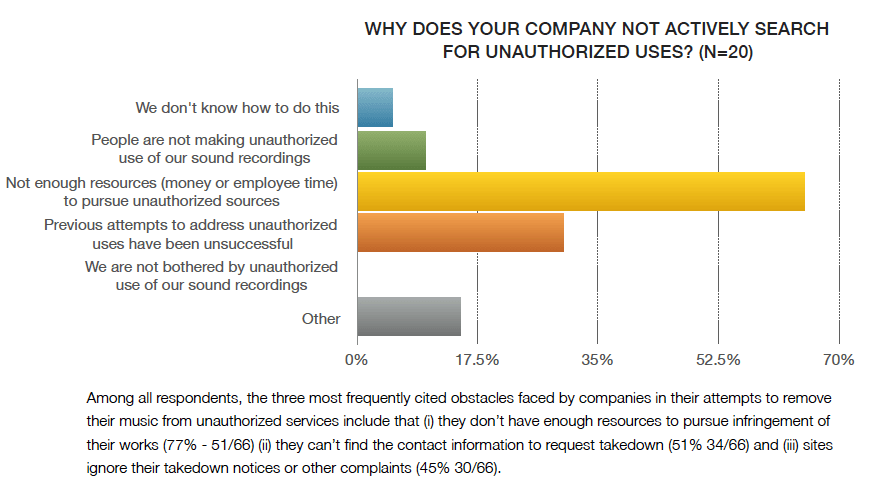
This is what an “opt-out” looks like. We have seen this movie before and we know how it ends–it’s called getting away with it. Let us be very clear with lawmakers: Notice and takedown and “opt out” is bullshit. It has never worked and has imposed a phenomenal cost on the artist community to the point that many if not most artists have just given up. The Future of Music Coalition and A2IM surveyed their members and determined that over half don’t even bother to look anymore because they can’t afford to run the search. The next largest group give up because they get no response from the notices.
Let’s understand–every time an artist gives up even looking for infringers, that’s a win for Big Tech. That’s why year after year, there are over a billion DMCA notices sent to a variety of infringers.
Ask yourself in all honesty, are you surprised? What head up the ass buffoon would ever think that an opt out would work? Unless the plan was to let Big Tech run wild and give both the biggest corporations in commercial history and the lawmakers a big fig leaf to cover up the theft?
That same approach is rearing its head again in both the US Congress and the UK. But this time it is being applied to artificial intelligence training and outputs. This is stark raving madness, drooling idiocy. At least with the DMCA an artist could look for an actual copy of their works that could be found by text-based search, audio fingerprints or just listening.
With AI, the whole point is to disguise the underlying work used to train the AI. The AI platform operator knows what works they used, which sites they scraped, or other ways to identify the infringed works. When sued, these operators have refused to disclose the training materials because they say that the sources of those materials are supposedly a trade secret and confidential.
Once a work is ingested into the AI, the output is also purposely distorted from the original. Again, impossible to conclusively identify. So what exactly are you opting out of? To whom do you send your little notice?
This entire opt-out idea is through the looking glass into the upside down world. Yet is is true.
The most current manifestation of this insanity is the UK government’s intention to pass legislation that would force artists to use an opt-out model, possibly on a work-by-work basis. And the worst part is that somehow they have been led to think that an opt-out is a protection for artists.
Orwellian.
Fortunately the UK government may seek public comment on this opt-out proposal. We will keep you posted on what the UK government actually proposes and how you can comment.
In the meantime, if you live in the UK, it’s not to early to contact your MP and ask them what the hell is going on. You may want to ask them why you can call the police when your car is being stolen but there’s nobody to call when your life’s work is being stolen. Particularly when the government protects the thieves.
It’s a damn good thing we never let another MTV build a business on our backs.
In case you were wondering, the founder of TikTok’s parent corporation Bytedance is now reportedly China’s richest man according to the Hurun Rich List at a net worth of US$49.3 billion. Is that because of “profits”? Ah, no. It’s due to his share of the Bytedance stock valuation. This is why any royalty deal with Big Tech that is based solely on a percentage of revenue rather than a dollar rate based on total value is severely lacking.
Revenue is a factor in determining stock valuation, of course. ByteDance’s first-half 2024 revenue increased to $73 billion, making Bytedance’s revenues almost as big as Facebook but potentially growing faster. (Meta/Facbook’s first half revenue increased about 25% to $75.5 billion.)
But where does TikTok’s revenue come from? ByteDance’s international revenue reached $17 billion in the first half of 2024, largely driven by TikTok. Non-China revenues for ByteDance rose by nearly 60% during this period. ByteDance continues to leverage TikTok to expand into international e-commerce, sustaining its global popularity. So the company is throwing off a pile of cash–yet they are unable to come up with a functioning royalty system.
Then what would a Bytedance IPO price at? We kind of have to guess because Bytedance is not publicly traded and doesn’t report its financials to the public (and even if they did, China-based companies got special beneficial treatment during the Obama Administration so PRC companies haven’t reported on the same basis as everyone else until recently). Continuing the Meta/Facebook comparison, Meta has a market capitalization of $1.4 trillion give or take, while ByteDance’s valuation on the secondary market for private stocks is about $250 billion, according to a CapLight subscriber.
That gap is not lost on our friends at mega-venture capital firm Sequoia China and other influential investors in Bytedance such as Susquehanna, SoftBank, and General Atlantic. And, of course, the Chinese Communist Party investing through its Cyberspace Administration of China censorship operation. The CCP’s CAC owns elite “golden shares” in Bytedance that allows it to name directors to the board. These cats did not put up cold hard cash for a distress asset sale of Bytedance’s principal operating unit aka TikTok.
Assuming a constant growth rate, Bytedance is trading at a paltry 1.7 times its 2024 revenues compared to Meta which is trading at about 8.7x its revenues. There are some differences between Meta and Bytedance, like operating profits: Meta has a 38% operating margin compared to Bytedance at about 25%. But we all know why Bytedance’s valuation is depressed—the TikTok divestment which seems to be on track to happen on or about January 19.
The Protecting Americans from Foreign Adversary Controlled Applications Act aka the TikTok Divestment Act, requires that Bytedance must sell TikTok. There’s a pretty good argument that the divestment is enforceable for a variety of reasons. The law applies not only to TikTok, but also to any entity controlled by China, Iran, North Korea or Russia that distributes an application in the United States. That’s a pretty significant barrier to IPO riches, or at least one major risk factor that could sour underwriters if not investors. How to get around it?
As we saw with the Music Modernization Act that solved Spotify’s IPO issues due to the company’s massive copyright infringement business model, if you spread enough cash around Capitol Hill, it’s astonishing what can happen with the vast number of people on the take. Whatever it costs, lobbyists and lawmakers are cheap dates compared to IPO riches. Even so, it doesn’t look like the US government is quite ready to allow one of the biggest foreign agent data harvesting and user profiling operations in history to get its snout in the public markets trough. At least not yet.
But an argument could be made that Bytedance is missing about $1 trillion in market cap. Greed and resentment are a powerful combination. To add insult to injury, even Triller managed to get to the public markets, so things could start to get weird while Mr. Tok watches his paper billions evaporate on January 19.





You must be logged in to post a comment.