But This Time We Mean It… Welcome To The Ad Tech Time Machine…

Welcome to the Interactive Advertising Time Machine… set the dial for 2010

“The Interactive Advertising Bureau (IAB) has pledged to work with content producers to make sure that ads don’t inadvertently end up on sites peddling unauthorized copyrighted material.”

That was back in 2010 when NPR aired the story, “Feeding Pirates: When Legit Companies Advertise On Shady Sites.” That’s right, 2010 when filmmaker Ellen Seidler brought the issue to light when she documented the piracy around the release of her indie film “And Then Came Lola.” Highly recommended reading is Ellen’s highly detailed blog, PopUpPirates.

Ok, so maybe not far enough back for you? Set your Interactive Advertising Time Machine to the year 2007...

Here’s  the case of easydownloadcenter.com which found Google caught red handed actually helping the site improve it’s SEO to maximize advertising revenue. This as reported by DailyTech at the time:

“The two men said in sworn statements that Google offered them credit as an easy start to advertise on Google’s search engine, and that the search company also suggested ad keywords such as “bootleg movie download,” “pirated,” and “download harry potter movie.” According to the report, Google received $809,000 for its advertisements.”

And this was Google’s response at the time (arguably the biggest member of the IAB):

“Google declined to comment on the specific clash over its ads, but did say that it is working on ways to screen out ads that violate the company’s policies.

A spokesman for Sony Pictures said, “Discussions with Google have been ongoing for a while, and there’s hope it can result in a mutually satisfactory arrangement whereby Google will not give support to pirate sites.”

Read that again. “Discussions with Google have been ongoing for a while,” that was in 2007 for activity that dates back to 2003.

So please forgive us if we are less than optimistic over the latest so-called “Best Practices” announced by the IAB. This is not a new or unknown issue and what’s worse is that actual knowledge by Google and other members of the IAB dates back at least to 2003, a decade ago.

Think we’re biased? Ok, fair enough but DigiDay calls the latest appeasement “Toothless” and it is a trade publication that reports on internet advertising that is owned by The Economist:

There are also plenty of built-in outs. The networks, for instance, can keep ads running on sites engaging in piracy if those sites have “substantial non-infringing uses.” Also, the agreement lets networks simply remove ads from pages engaging in piracy, while leaving ads running on the rest of the site. The agreement places the onus on the rights holder to notify the networks about pirated content, not requiring the networks to monitor the content themselves. The agreement “cannot, be used in any way as the basis for any legal liability.” The agreement excludes ad servers and ad exchanges.

The agreement may not be not much of an agreement at all.

Yeah, that’s pretty much what we think too. So, what does the creative community have to do to protect itself from the blatant exploitation of its products and labor from internet robber barons? Stay tuned…

YOU MAY ALSO BE INTERESTED IN READING:

The Ad Network Transparency Conspiracy

Tell Us Again “Streaming Is The Future” As Paid Downloads Are Down 2.3 Percent In the US…

Let’s see… maybe streaming services are cannibalizing transactional sales, maybe? Streaming Royalties are small but they can really grow? Really? Let us guess… the good news is streaming is reducing piracy? In Norway and Sweden

According to half-year stats shared by Nielsen Soundscan with Digital Music News this weekend, paid downloads are slumping 2.3 percent at the half-point, meaning the period from January 1st through June 30th.

All of this points to the same issue of streaming services paying too little, while illegally operating, infringing businesses pay absolutely nothing at all. So much for sustainability…

READ THE FULL POST AT DIGITAL MUSIC NEWS:
http://www.digitalmusicnews.com/permalink/2013/20130721downloads

The New Yorker : If You Care About Music, Should You Ditch Spotify?

The New Yorker weighs in on the controversy surrounding music streaming royalty rates…

The issue beneath all the complaints about micropayments is fundamental: What are recordings now? Are they an artistic expression that musicians cannot be compensated for but will create simply out of need? Are they promotional tools? What seems clear is that streaming arrangements, like those made with Spotify, are institutionalizing a marginal role for the recordings that were once major income streams for working musicians—which may explain the artist Damon Krukowski’s opinion that music should simply be given away, circumventing this entire system. But first, some words from Godrich, condensed and edited for clarity.

READ THE FULL STORY AT THE NEW YORKER:
http://www.newyorker.com/online/blogs/sashafrerejones/2013/07/spotify-boycott-new-artists-music-business-model.html

Pandora Prepares to Attack Artists… Again | DMN

Amazing the lengths Tim Westergren and Pandora are willing to go to, to attack artists…

Accordingly, Pandora is taking steps to have well-written, careful responses ready to go within 24 hours in places like Digital Music News.  Most importantly, the response needs to come from a source not affiliated with Pandora (or, so it seems…)

READ THE FULL STORY (AND EMAILS) AT DIGITAL MUSIC NEWS:
http://www.digitalmusicnews.com/permalink/2013/20130715pandora#QFlbW2t7XHEHic_7jx2vSg

Did Google Finally Admit They Pay Criminals? Will Big Evil Show Us What’s Behind the Curtain?

If you want to solve a problem, you have to acknowledge a problem actually exists… Read On…

Music Technology Policy

According to Searchengineland and Variety, Google Chairman Eric Schmidt tells us that he’s had enough of the DMCA notices, but with that extra special “Big Evil” spin:

Google’s Eric Schmidt says that the entertainment industry should focus on taking content pirates to court, rather than just trying to get Google (and other search engines) to remove pirate sites from search results.  [Schmidt says] “Our position is that somebody’s making money on this pirated content and it should be possible to identify those people and bring them to justice.

This latest dodge from Google’s Dodger in Chief is exceptionally absurd for a few reasons.  First,Schmidt is clearly trying to deflect, deflect, and then be sure you deflect attention away from Google and on to that bad guy behind the tree.  In Bulgaria.  Or China.  Or a Schmidt fav, North Korea.  Somewhere far away and difficult to prosecute.  And if someone…

View original post 1,017 more words

Aiding and Infringing : iPad Music Apps – A New Low

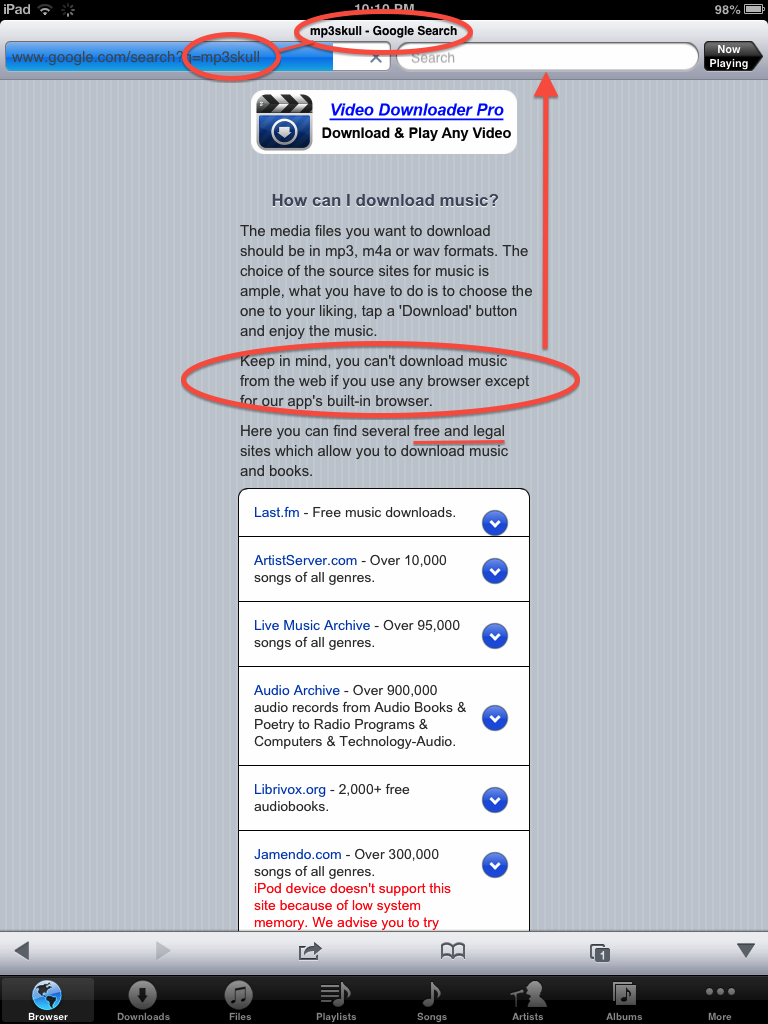
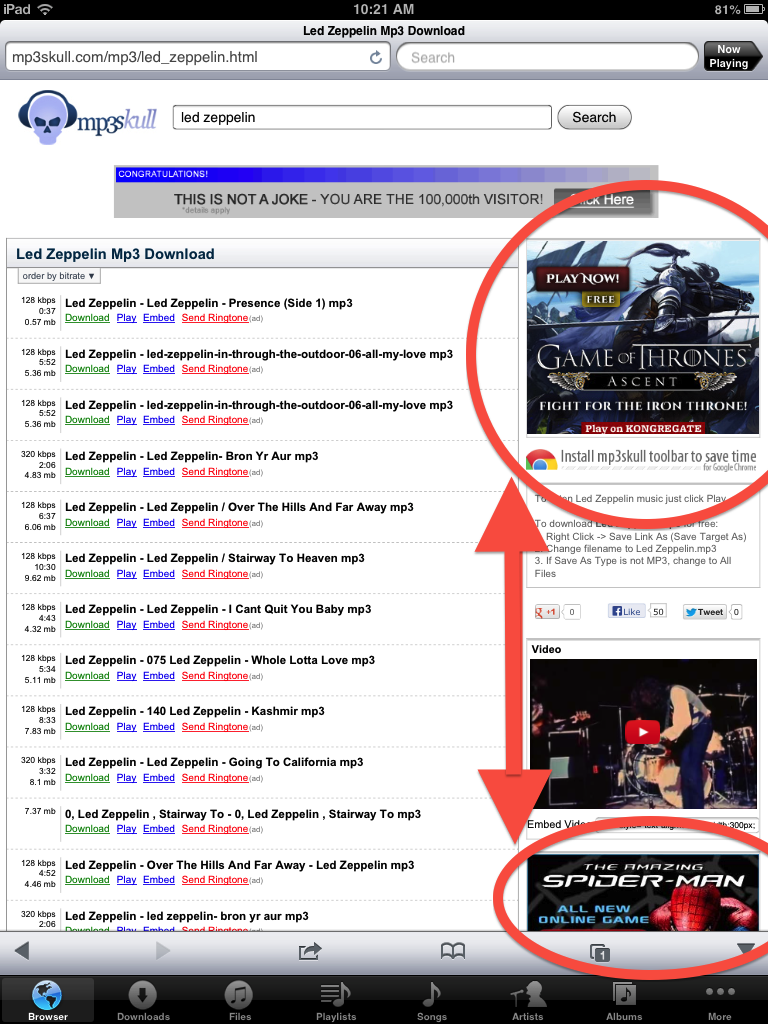
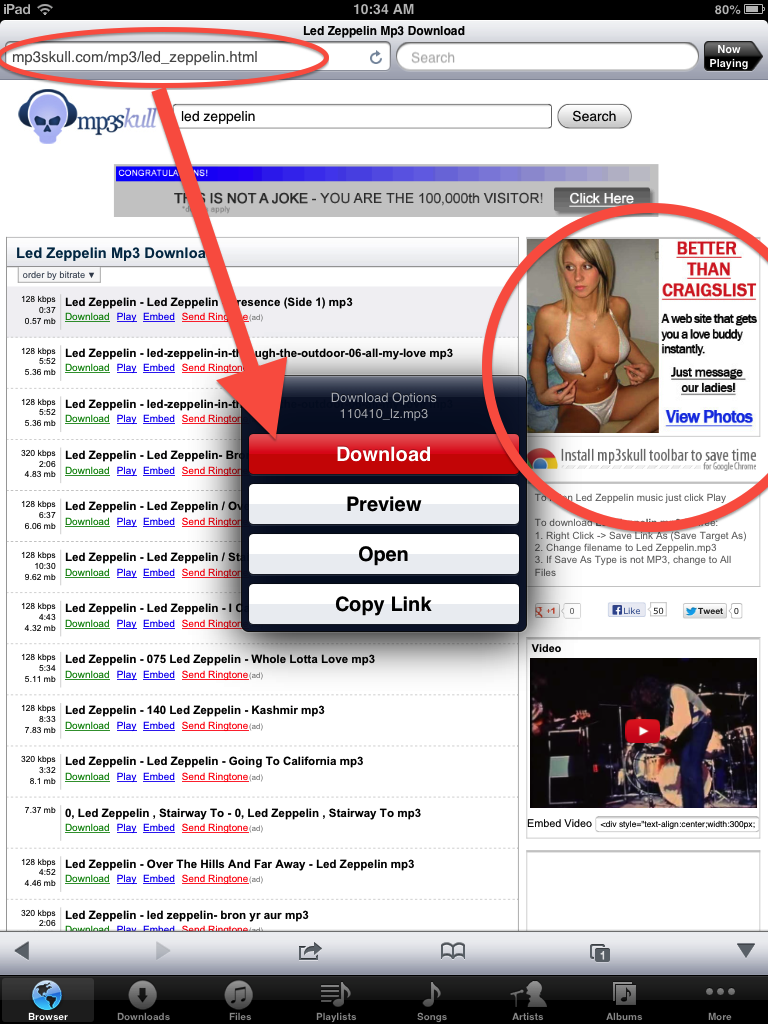
Advertisers need to capture the mobile market. The problem is the functionality of the some of the most frequented websites by the coveted youth demographic is disabled on iDevices (the inability to download content to the idevice). In other words, there is no draw to pirate websites (and to the advertising they serve) if the infringing music is no longer accessible. Worry no more, there’s an APP for that… note the top grossing and most popular music apps for the ipad…

IMG_0001

IMG_0002

IMG_0003

IMG_0004

adsforGAMES

lovebuddy

And uhm… let’s not worry that ads for Adult Services are being targeted to minors…

Artists Speak Out on Pandora’s Proposed Royalty Rate Cuts

We know that David Lowery’s post here at the Trichordist has re-ignited the debate over Pandora’s latest attempt to reduce royalty rates to songwriters, but David is not alone. During the last attempt by Pandora to screw songwriters and musicians we saw a number of artists speak out, amongst them was respected songwriter, musician and producer Jimmy Jam who testified on Capital Hill.

Here’s a look at some of the other songwriters and artists speaking out from different perspectives.

Songwriter Ellen Shipley in Digitial Music News, “My Song Was Played 3.1 Million Times on Pandora. My Check Was $39…

It is interesting and very disturbing that no one is addressing the SONGWRITER’s situation in this Pandora debacle.

Pandora wishes to REDUCE the amount of royalties that songwriters have already seen CUT in 2005. Let me give you an example of what Pandora is paying in royalties to SONGWRITERS–not the performers, but the people who write the songs–the foundation of the music world—

PANDORA —-“Heaven Is A Place On Earth” (co-written)

accounting period for 3 months—–3,112,300 streams

My Pandora royalty ……………..$39.61

Songwriter, Musician and Indie Label owner Blake Morgan in The Huffington Post, “Tim Westergren Emails Underscore Tension Between Pandora, Artists.

The AFL-CIO, NAACP, Americans for Tax Reform, the American Conservative Union, SoundExchange, and others all oppose this bill, and the supposition that Pandora should pay less to artists and songwriters in order to accomplish higher profitability.

The Songwriters and Musicians of the band Pink Floyd in USA TODAY, “Pink Floyd: Pandora’s Internet radio royalty ripoff.

Of course, this letter doesn’t say anything about an 85% artist pay cut. That would probably turn off most musicians who might consider signing on. All it says about royalties is “We are all fervent advocates for the fair treatment of artists.” And the only hint of Pandora’s real agenda is the innocent sounding line “We are also fervent supporters of internet radio and want more than anything for it to grow.” The petition doesn’t mention that Pandora is pushing the growth of its business directly at the expense of artists’ paychecks.

Even former Pandora employee (and  Camper Van Beethoven band member) Jonathan Segel has written about the situation on his blog, “Pandora Groupthink. (look it up).”

Several of my former workmates at Pandora seem to be drinking the Kool Aid. I’m seeing posts claiming that David Lowery and Pink Floyd are talking ‘trash’. Yes, I worked at Pandora. You can read all about that here. I also play in a band with David Lowery, it’s called Camper Van Beethoven (not the band with the song in question here.) He and I don’t necessarily agree on everything, but I’m totally backing him up on this one.

Let us also not forget that over 125 artists signed a letter to Congress opposing these rate cuts. Here they are again.

Ethical Fan Reports : EFF Agenda Theories

A fascinating look at the Electronic Frontier Foundation.

Rather than fighting for the rights of people who work to create content, EFF appears to fight for the rights of organized for-profit enterprises who appear to us to be breaking the law and appear to be profiting from illegally distributing digital goods with no intention of ever paying the owners or creators.

READ THE FULL POST AT ETHICAL FAN . COM:
http://ethicalfan.com/2012/04/eff-agenda/

RELATED:
EFF’s John Perry Barlow is Wrong, says Google’s Chief Economist

Facebook Communities For Artists Rights

The Trichordist links through to FarePlay on Facebook  from the blog and there are also these other communities. Please support all of these pages and let us know if there are more.

CONNECT!

FARE PLAY
https://www.facebook.com/FarePlay

COPY LIKE
https://www.facebook.com/copylike

RE-VALUE MUSIC
https://www.facebook.com/ReValueMusic

FIGHT FOR MUSIC
https://www.facebook.com/freefallfaithfirestor

MUSIC FIRST
https://www.facebook.com/musicFIRSTcoalition