
Hey @AmericanAir pretty uncool that you made me gate check my acoustic guitar when there was plenty of room in the overhead when I boarded (in defiance of federal guidelines – sec 403 of FAA Modernization act), but you let someone in 1st carry on their guitar. pic.twitter.com/hIYk617HI4
— Justin Roberts (@MusicianJustin) August 13, 2024
Author: Trichordist Editor
Trichordist Editor
@wordsbykristin: Legal Fights, Transparency & Neutrality: DiMA’s CEO On Improvements Streamers Suggest for the MLC
Kristin Robinson makes another important contribution to the artist rights conversation with her interview of Graham Davies, the new head of the Digital Media Association. Graham comes to DiMA from a background in the artist rights movement at our friends the Ivors Academy in the UK. We have high hopes for Graham who brings his intellect to clean up a long, long line of mediocrity at the DiMA leadership who are from Washington and here to help.
Kristin’s interview highlights DiMA’s recent filings in The Reup–the redesignation of the MLC by the Copyright Office that we’ve highlighted on Trichordist. He also has some well thought out analysis on how the MLC is not HFA, however similar the two may seem in practice.
This is an important interview and you can find it on Billboard (subscription required).
Here’s an example of Graham’s insight:
Do you think a re-designation every five years is not enough on its own?
I think it’ll be interesting to see what the re-designation process brings forward from the Copyright Office. Maybe the Copyright Office leans in on governance and says, “We’ve heard enough, and we can come forward with ideas.” But the re-designation process is a different thing than a governance review, which would bring in a special team to actually dig into governance-related issues and bring forward recommendations and proposals that could then be implemented. It would be something more specific and something the MLC could just do. You wouldn’t need the Copyright Office to sponsor it, though they could if they wanted to.
Are You Better Off Today Than You Were Five Years Ago? Selected comments on the MLC Redesignation: Gwendolyn Seale
The Copyright Office solicited public comments about how things are going with the MLC to help the Office decide whether to permit The MLC, Inc. to continue to operate the Collective (see this post for more details on the “redesignation” requirement). We are impressed with the quality of many of the comments filed at the Copyright Office. While comments are now closed, you can read all the comments at this link.
For context, the “redesignation” is a process of review by the Copyright Office required every five years under the Music Modernization Act. Remember, the “mechanical licensing collective” is a statutory entity that requires someone to operate it. The MLC, Inc. is the current operator (which makes it confusing but there it is). If the Copyright Office finds the MLC, Inc. is not sufficiently fulfilling its role or is not up to the job of running the MLC, the head of the Copyright Office can “fire” the MLC, Inc. and find someone else to hopefully do a better job running the MLC. Given the millions upon millions that the music users have invested in the MLC, and the hundreds of millions of songwriter money held by the MLC in the black box, firing the MLC, Inc. will be a big deal. Given how many problems there are with the MLC, firing the MLC, Inc. that runs the collective
The next step in this important “redesignation” process is that The MLC, Inc. and the Digital Licensee Coordinator called “the DLC” (the MLC’s counterpart that represents the blanket license music users) will be making “reply comments” due on July 29. The Copyright Office will post these comments for the public shortly after the 29th. These reply comments will likely rebut previously filed public comments on the shortcomings of the MLC, Inc. or DLC (which were mostly directed at the MLC, Inc.) and expand upon comments each of the two orgs made in previous filings. If you’re interested in this drama, stay tuned, the Copyright Office will be posting them next week.
If you have been reading the comments we’ve posted on Trichordist (or if you have gone to the filings themselves which we recommend), you will see that there is a recurring theme with the comments. Many commenters say that they wish for The MLC, Inc. to be redesignated BUT…. They then list a number of items that they object to about the way the Collective has been managed by The MLC, Inc. usually accompanied by a request that the The MLC, Inc. change the way it operates.
That structure seems to be inconsistent with a blanket ask for redesignation. Rather, the commenters seem to be making an “if/then” proposal that if The MLC, Inc. improves its operations, including in some cases operating in an opposite manner to its current policies and practices, then The MLC, Inc. should be redesignated. Not wishing to speak for any commenter, let it just be said that this appears to be a conditional proposal for redesignation. Maybe that is not what the commenters were thinking, but it does appear to be what many of them are saying.
Today’s comment is by music lawyer Gwendolyn Seale who makes a number of excellent points in her filing including questioning whether the compulsory license itself is fit for purpose and what might happen if the MLC, Inc. is not redesignated. In particular, she addresses an alarming trend in the MLC, Inc.’s public messaging about the black box that has grown more cloudy as the size of the black box at the MLC has grown into the hundreds of millions.
For purposes of these posts, we may quote sections of comments out of sequence but in context. We recommend that you read the comments in their entirety. You can read Gwen Seale’s comment at this link.
Words Matter: The MLC Must Improve Its Presentation of Information
Confusion Regarding the Term, “Match Rate”
Upon reviewing the MLC’s 2021 Interim Annual Report in early 2022, I noticed reference to the
MLC having attained an 86% match rate. This metric seemed impressive, however, upon
learning the MLC’s definition of “match rate” (which I only learned by asking the MLC), I was
baffled. When the term, “match” is used alone, it refers to the matching of a sound recording
from a DSP report to a particular musical work. The Copyright Office’s NOI indicates the same
regarding the term, “match.”
Please describe how the Mechanical Licensing Collective has worked to improve automated and manual matching since the blanket license became available and plans to further enhance such matching over the next 5 years, including with respect to the matching of reported sound recordings to musical works as well as the matching of those musical works to identified and located copyright owners.
Being that a “match” constitutes pairing a sound recording with a particular musical work, it is
logical to deduce the “match rate” as being the percentage of sound recordings in DSP reports
which are matched to musical works registered at the MLC. However, that is not the case and
instead the term “match rate” as used by the MLC refers to the total amount of royalties matched
to musical works registered at the MLC over a given period. This definition was not provided to
the public so far as I can tell until June 30, 2022, in its final 2021 Annual Report.
As the most popular musical works are the ones generating the bulk of mechanical royalties over
a given month and are typically owned and/or controlled by the major music publishers with the
resources and capabilities to constantly monitor activities concerning their clients’ musical works
and engage in manual matching, the current definition of match rate (i.e., the royalty-based
definition) does not mean very much by itself. It would be useful for the MLC to also provide the
monthly match rate on a recordings-to-musical works-matched basis (hereinafter, “works-based
calculation”). Doing so would shine a light on the efficacy of the MLC’s and its vendors’
matching technology and would help to ensure the musical works of countless self-published
songwriters are being matched to reported sound recordings. I understand that there are issues
with catalog “fluff” and some sound recordings do not generate a single stream over a month’s
time. Thus, a works-based calculation could be tailored in a manner where recordings with less
than x streams per month or that generate less than x cents in mechanical royalties are omitted
from the calculation. Input from the Copyright Office regarding match rate terminology would
be helpful as well.
Historical Royalties: Eliminate Illuminate = Obfuscate
The impetus behind establishing the MLC was to ensure that songwriters and publishers could
finally collect the nearly half billion dollars in historical royalties5 owed by the DSPs from the
early 2000s through the end of 2020. The task of the MLC was to eliminate the historical
royalties by ensuring that sound recordings could be matched to registered works in the MLC
database from this period. The MLC stated that eliminating these royalties was its goal:
The MLC cannot stress enough that its goal is to eliminate unclaimed accrued royalties, and that it has developed a realistic plan to pursue this goal.
Over time, the MLC shifted the language from eliminating to “illuminating” the historical royalties, beginning with the 2022 MLC Annual report:
Together, we will not only illuminate the “black box,” but also seek to eliminate it entirely!
At present, the MLC no longer references “elimination” of the historical royalties and purports
the job is done since the historical royalties have been “illuminated:”
Is there still a Black Box of Mechanical Royalties With The MLC?
No, the data on all unmatched uses is posted and available to be searched by Members. This includes all data for historical and blanket unmatched uses. All of these remaining unmatched uses are available to be searched by Members in The MLC’s Matching Tool. With this unprecedented transparency, The MLC has illuminated the so-called “black box” of streaming mechanical royalties for the first time.
The MLC started by moving the goalposts and concluded with eliminating them altogether. This
obfuscation of language is problematic. It misleads the public about the MLC’s performance and
gaslights those with knowledge about matching works and distributing royalties. Words matter.
This issue can be quickly solved by the MLC removing that particular FAQ above, and by providing monthly data regarding the total amount of unmatched, unclaimed, and on-hold
royalties (historical + blanket) in the MLC’s possession in a place that is easy to find on its
website.
.
Are You Better Off Today Than You Were Five Years Ago? Selected comments on the MLC Redesignation: Spirit Music Group
The Copyright Office is soliciting public comments about how things are going with the MLC to help the Office decide whether to permit The MLC, Inc. to continue to operate the Collective (see this post for more details on the “redesignation” requirement). We are impressed with the quality of many of the comments filed in the “Initial Comments” at the Copyright Office. As there will be an opportunity to comment again, including to comment on the comments, we will be posting selected Initial Comments to call to your attention. You can read all the comments at this link. If you are hearing about this for the first time, you have until June 28 to file a “reply comment” with the Copyright Office at this link.
You will see that there is a recurring theme with the comments. Many commenters say that they wish for The MLC, Inc. to be redesignated BUT…. They then list a number of items that they object to about the way the Collective has been managed by The MLC, Inc. usually accompanied by a request the The MLC, Inc. change the way it operates.
That structure seems to be inconsistent with a blanket ask for redesignation. Rather, the commenters seem to be making an “if/then” proposal that if The MLC, Inc. improves its operations, including in some cases operating in an opposite manner to its current policies and practices, then The MLC, Inc. should be redesignated. Not wishing to speak for any commenter, let it just be said that this appears to be a conditional proposal for redesignation. Maybe that is not what the commenters were thinking, but it does appear to be what many of them are saying. Perhaps this conditional aspect will be refined in the Reply Comments.
For purposes of these posts, we may quote sections of comments out of sequence but in context. We recommend that you read the comments in their entirety.
Today’s featured comment is from the well-regarded independent music publisher Spirit Music Group. Spirit makes a number of comments about important issues with the MLC, Inc.’s handling of metadata and other operational issues. If you are not immersed in metadata issues, it is easy to blow past these comments such as the MLC making data available in the common csv format (i.e., not only DDEX) is actually a serious complaint about a significant operational issue.
While you have to put Spirit down as an unambiguous supporter of redesignation, it is important to focus on how best to get the MLC, Inc. to implement the many commenters’ operational suggestions. We will see some of these comments confirmed with other commenters.
We would also point out a theme that will come up repeatedly–The MLC, Inc. knows who to take care of and who to respond to quickly. That is not the same thing as having methods and systems that take care of all members which the MLC can certainly afford given the tens of millions of dollars that the services spend on The MLC, Inc.
[T]he MLC has certainly met the minimum responsibilities under the MMA and has endeavored to provide additional functionality so rightsholders can receive their entitled royalties from DMS and has completed significant development in a short period. They are very receptive of our concerns and respond promptly and clearly. We look forward their continued development.
3:II.B. Member Tools
1. Development and Implementation of Tools and Functionality
The implementation of the Matching and Claiming tools and offering the bulk data (at a cost to the recipient) gives rightsholders the visibility to identify omissions in payments; These tools are the first offered by a CMO in the United States and should set an example to the others.
For publishers with large catalogs, who are not one of the majors like ourselves, have the greatest obstacles. We represent significant works by The Who, Chicago, Billy Squier, Salt N Peppa, and many others. While the Matching and Claiming tools are great for self-published writers and the bulk data for majors, indie publishers do not have the means to maximize the use of these resources. We hope the MLC offers improvements to extract data in csv format from the Matching and Claiming tools.
We would also like to see more details in Match History to understand why certain claims are rejected.2. Matching Methodology
The MLC still uses the ISRC as the primary identify for matching. Expanding the identification process using song titles and CISAC codes, i.e., the IPI and ISWC can enhance matching, improve results, and reduce unmatched recordings.Adjustments: The MLC’s adjustment policy does not allow for debits and credits of rightsholders in the event of an error. Additionally, credits to the entitled rightsholder are not delivered unless the funds are received from the party paid in error. CMOs around the world have policies in place to handle adjustments and the MLC should have similar procedures in place.
Criterion 3:IV. Investments in Resources and Vendor Engagement
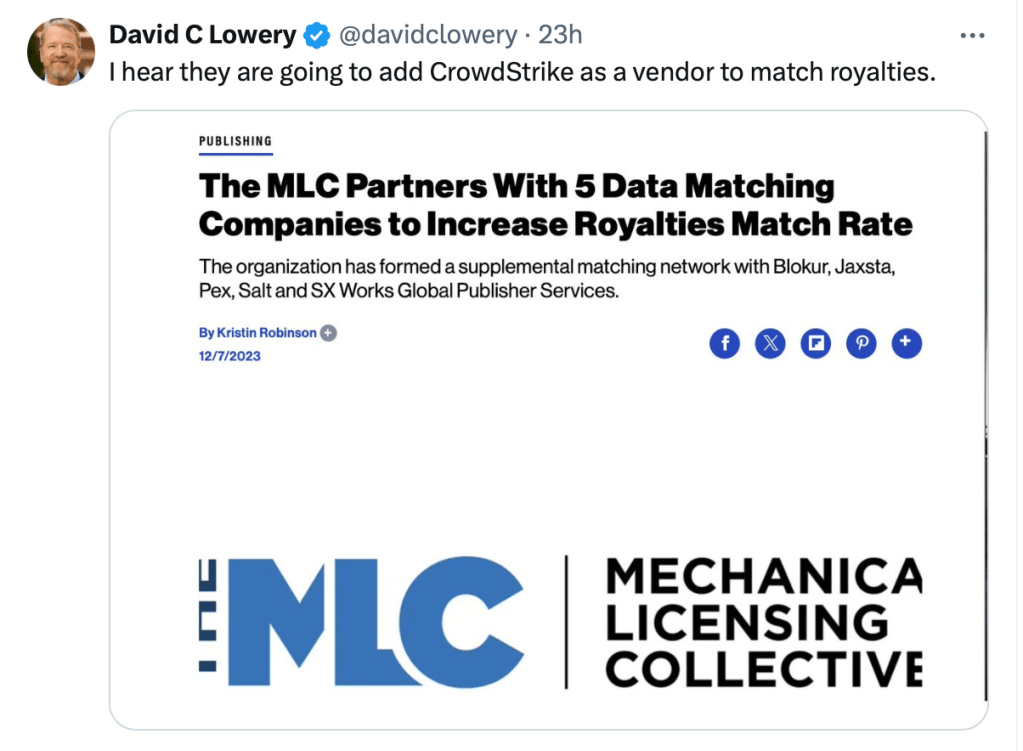
3:IV.B. Subpplemental Matching Network
The USCO asks the MLC to “…provide additional information about these (Blokur, Jaxsta, Pex, Salt, SX Works) relationships, including the specific functions that they perform, or have been asked to perform, the vendors’ relevant experience with clients and projects involving similar scale and type, or their industry-specific knowledge.” The MLC only satisfies a portion of this request by providing details about each of these companies functions. However, it does not provide the tasks they have been asked to preform or how the MLC plans to use these companies to improve the royalties that will ultimately be paid to the rightsholders.
Are You Better off Today Than You Were Five Years Ago? Selected comments on the MLC Redesignation: Monica Corton
The Mechanical Licensing Collective has its operations and functions reviewed every five years by the Copyright Office. That review is required by Title I of the Music Modernization Act as written by the lobbyists. The Copyright Office noticed the first of these five year reviews on January 30.
The statutory purpose of the period review is so that Congress, in the person of the Copyright Office, can determine whether the operators of the Mechanical Licensing Collective who the Copyright Office appointed (or “designated”) should be permitted to continue for another five years. If the Copyright Office determines that the operators of the Collective will do a good job in the next five years, the head of the Office may reward them with the equivalent of a valuable new government contract or a “redesignation”.
The current operators of the Collective are The MLC, Inc., but there is nothing that requires the Office to allow The MLC, Inc. to continue being the mechanical licensing collective–the the Collective and The MLC, Inc. are not the same thing. Be clear that the entity that is being considered to be “redesignated” is The MLC, Inc., not the Collective. The Collective is a statutory entity and The MLC, Inc. is the organization that is permitted by the Copyright Office to operate as the Collective. (That’s confusing because someone allowed The MLC, Inc. to take the same corporate name as the statutory entity which was probably an oversight by the Delaware Secretary of State if not the Copyright Office itself.)
The five year review is important because it is the only chance for songwriters and publishers as well as the public to comment on whether they support rewarding The MLC, Inc. with another five years of operations and the tens and tens of millions of dollars in operating costs and high salaries paid for by the users of the blanket license–the services themselves–in the conflict ridden process imposed on songwriters and publishers by the government.
For reasons known only to them, the Copyright Office has chosen to conduct this five year review as though it were any other rulemaking rather than engaging independent experts to conduct a technology, financial, operational, and personnel audit of The MLC, Inc. from top to bottom. That choice is presumably based on some guidance from somewhere, but would seem to inevitably substitute opinions–however astute–for an empirical review using at least industry experts with the power to compel answers if not managerial science.
While this rulemaking approach has the benefit of allowing the public to comment, it fails to offer independent expert review of the very thing that the Office is being asked to approve. Instead, that “redesignation” decision will be based on whether or not the public caught the “right” issues, expressed them the “right” way, and were able to communicate their ideas persuasively. Assuming the public even knew of the opportunity in the first place.
It must be said that if we are going to solicit opinions, the first opinion we would be interested in hearing is from the Copyright Office itself. The Register, after all, is the one making the redesignation decision, not the MLC, the DLC, or any one commenter. It seems that comments would be more compelling if informed by the Copyright Offices own views, including the opportunity to comment on the Office’s methodology. It doesn’t look like we will know about that one until the next step in the rulemaking. A “proposed redesignation” does not seem particularly apt, so we will look forward to finding out after the fact how a large chunk of songwriter income is to be managed.
We are impressed with the quality of many of the comments filed in the “Initial Comments” at the Copyright Office. As there will be an opportunity to comment again, including to comment on the comments, we will be posting selected Initial Comments to call to your attention. You can read all the comments at this link. If you are hearing about this for the first time, you have until June 28 to file a “reply comment” with the Copyright Office at this link.
You will see that there is a recurring theme with the comments. Many commenters say that they wish for The MLC, Inc. to be redesignated BUT…. They then list a number of items that they object to about the way the Collective has been managed by The MLC, Inc. usually accompanied by a request the The MLC, Inc. change the way it operates.
That structure seems to be inconsistent with a blanket ask for redesignation. Rather, the commenters seem to be making an “if/then” proposal that if The MLC, Inc. improves its operations, including in some cases operating in an opposite manner to its current policies and practices, then The MLC, Inc. should be redesignated. Not wishing to speak for any commenter, let it just be said that this appears to be a conditional proposal for redesignation. Maybe that is not what the commenters were thinking, but it does appear to be what they are saying. Perhaps this conditional aspect will be refined in the Reply Comments.
For purposes of these posts, we may quote sections of comments out of sequence but in context. We recommend that you read the comments in their entirety.
The first comment is by Monica Corton, the highly experienced and respected publisher. You can read her comment at this link.
The Top Unmatched Recording List
While I believe this list exists, I have never received an email asking me to review such a list. I recently learned that you could ask for the list, but it comes in the DDEX format (like the unmatched songs list) and as an independent publisher, I do not have the capability to change this to a CSV format. As I explained before, it can easily be converted to a CSV file if you have the
right software. I think that conversion from the DDEX format to the CSV format should be a service done by The MLC. Otherwise, the only people who can benefit from the Top Unmatched Recording List are the largest companies with the resources to convert this list.Investment Policy
Why isn’t the investment policy made public and fully transparent to the membership? It is our money that they are investing, and I’d like to know the details as would many other publishers. Why did the board decide to not make the policy documents regarding investments available to the public?IPI Number Use Not Mandatory
The MLC doesn’t require publishers to use IPI numbers of songwriters in their registrations. As a result, there are a lot of duplicate registrations at The MLC/HFA that never get linked together because different registrants used different names for the same writer (e.g. Eminem, Marshall Mathers) which creates different registrations for the same song. If IPI numbers for songwriters
were mandatory, this would clear up this problem.
Royalty Adjustments at The MLC
The MLC will not credit or debit a publisher for an incorrect royalty payment due to a change in registration unless they are directly responsible for the error. If you missed the snapshot because The MLC didn’t process a Catalog Transfer Form on time, the new publisher will not be credited, and it is their responsibility to contact the old publisher and get the incorrect royalty
payment paid between them rather than through The MLC. The MLC doesn’t consider a bad registration at HFA as the cause of an incorrect payment even though it is the HFA data that caused the incorrect payment. Every other PRO and CMO does internal debits and credits for incorrect payments and adjustments, especially when there is a transfer of a new catalog. The
minute The MLC is served notice of via a Catalog Transfer Form, all royalties should be put on hold until the transfer is confirmed and set up by The MLC.
The Consensus for Conditional Approval of The MLC, Inc. by the @CopyrightOffice
By Chris Castle
I am pleased to see that there is a consensus against more happy talk among commenters in The MLC, Inc.’s five year review of its operations at the Copyright Office. The consensus is an effort to actually fix the MLC’s data defects, rogue lawmaking and failure to pay “hundreds of millions of dollars” in black box royalties. But realize this is not just the songwriter groups you would expect to see raising objections (discussed in excellent Complete Music Update post). It’s also coming from some commenters who you would not expect to see criticizing The MLC who may not come right out and say it, but are essentially proposing a conditional redesignation.
When did Noah Build the Ark? The Two Arguments for Conditional Approval
There is a significant group, and sometimes from unexpected corners, who fall into two broad camps: One camp is “approve The MLC, Inc. with post-approval conditions” that may lead to being disapproved if not accomplished until the next five year review rolls around.
The other camp, which is the one I’m in if you’re interested, is to spend some time now getting very specific. The specifics are about crucial improvements The MLC, Inc. needs to put into effect and payments they need to make. This would be accomplished by bringing in advisory groups of publishing experts, especially from the independent community, roundtables, other customary tools for public consultations. But–the redesignation approval would occur only after The MLC, Inc. accomplished these goals.
Either way, the consensus is for conditions if not the timing. I’m not going to argue for one or the other today, but I have some thoughts about why delayed approval is more likely to accomplish the goals to make things better in the least disruptive way.
Remember, once The MLC, Inc. is approved, or “redsignated,” then all leverage to force change is lost. Why? Because if the last five years is any guide, exactly zero people will enforce the government’s oversight role and everyone knows it.
Putting operations-based obligations on The MLC, Inc. to be responsive to their members before they get the valuable approval preserves leverage and will force change one way or another, The reward for successfully accomplishing these goals is getting approved for another term (or the balance of their five year review). Noah built the Ark before the rain.
What if we fired them?
I’m actually pleased to see the consensus for conditional approval. Simply firing The MLC, Inc. would be disruptive (and they know it), mostly because the Copyright Office hasn’t gotten around to requiring that a succession plan be in place so that firing the MLC would not be disruptive. That’s a failure of oversight. You can’t expect the MLC to make it easy to fire themselves.
The simple solution to this pickle is for the Copyright Office to make any redesignation conditioned upon certain fixes being accomplished on an aggressive time frame. I say aggressive because they’ve had five years to think about this; it shoudln’t take long to at least implement some fixes. But if we don’t make it conditional the MLC will lack the incentive to actually fix the problems.
A conditional approval would simply say that if the MLC cleans up its act, say in the next 24 months, then they will be officially redesignated. If they don’t, it’s on to the next after that 24 month deadline.
Conditional Approval
I have to say I was encouraged by the number of commenters who said that The MLC, Inc. needs some very definite performance goals. Many commenters said that those goals needed to be met in order for The MLC, Inc. to get approved for another five years until the next review. I’m not quite sure how you approve them for another five years with performance goals unless you are really saying what some commenters came right out and said: Any approval should be conditional.
I think that means that the Copyright Office needs a plan with two broad elements: One, the plan identifies specific performance goals, and then two, establishes a performance timeline that The MLC, Inc. must meet in order for this current “redesignation” to become final.
That “conditional redesignation” would incentivize The MLC, Inc. to actually accomplish specific tasks like everyone else with a job. The timeline will likely vary based on the particular task concerned, but impliedly would be less than five years. There’s a very good reason to make the approval conditional; there’s just too much money involved. Other people’s money.
The Black Box
Every comment I read brings up the black box. Commenters raised different complaints about how The MLC, Inc. is managing or not managing the matching that is required for the black box distribution contemplated by Congress. They all were pretty freaked out about how big it is, how little we know about it, and the fact that the board of The MLC, Inc. is deeply conflicted because the lobbyists drafted an eventual market share distribution. Strangely enough, there’s every possibility that the market share distribution will happen, or could happen, right after the redesignation. Also known as losing on purpose in a fixed fight.
There’s an easy correction for that one–don’t do the market share distribution, maybe ever.
The harsh but near certain fact is if there is an announced market share distribution of the black box, the MLC (and everyone involved) will be sued before the actual distribution. It almost doesn’t matter how clean it is. So why do it at all? The MLC is supposed to set an example to the world, right? (And we know how much the world loves it when Americans say that kind of thing.) What if we said that the market share distribution was just bloodlust by the lobbyists salivating over a really big poker pot? On reflection, it should be put aside particularly because Congress may not have been told how big the black box really was if anyone knew at the time. Ahem….what did they know and when did they know it?
The Interest Penalty
This actually goes hand in hand with another interpretation of the black box provisions of Title I of the MMA which requires the payment of compound interest for black box money to be paid by The MLC, Inc. to the true copyright owner. That compound interest accrues at the “federal short term rate” in effect from time to time (that rate is adjusted monthly and is currently 5.01%). MLC’s interest obligation accrues in an account set up for the true copyright owner’s benefit, not for the recipients of the market share distribution.
Interest runs from the time the unmatched money is received by the MLC until it is matched and paid. There could easily be several different interest rates in effect if the unmatched royalties stay in the black box for months or particularly years. This concept is elaborated in a comment by the Artist Rights Institute. (And of course, why doesn’t the interest run from the time the black box is first held rather than the much later date that the unmatched is paid to the MLC?)
Title I requires this “penalty” the same way that it requires the statutory late fee which itself has been the subject of much negotiation. It is important to note that the word “penalty” does not appear in Section 115, but both the interest rate and the late fee are obviously “penalties” in plain English and in plain site. You don’t have to call it a thing a penalty in order for it to be a penalty. It doesn’t stop being a penalty just because the statute doesn’t define it as one, just like a large furry animal with big teeth, big claws, a loud roar and really bad breath who wants to eat you stops being a bear just because it doesn’t have a sign around its neck saying “BEAR”. Particularly when the furry animal has you by throat.
Align the Incentives
I have to imagine that a penalty of compound interest would incentivize both the MLC and the licensees who pay its bills to match that black box right quick. If a third party is paying the statutory interest penalty which is how it is now according to MLC CEO Kris Ahrend’s testimony to Congress (under oath), then there’s really no incentive for the MLC to pick up the pace on matching and there’s even less incentive for the licensees to make them do it.
It makes sense that the MLC is to maintain an account for each copyright owner (or maybe for each unmatched song since the copyright owner is not matched), so it only makes sense that these accounts and compound interest would be maintained on the ledger of the MLC rather than in a third party bank account, much less a mutual fund. It would be pretty dumb to just lump all the money into one account and run compound interest on the whole thing that would have to be disaggregated and paid out every time a song is matched. Assuming matching was the object of the exercise.
Plus, there’s nothing in Title I that says that black box money has to be put in a bank account that accrues interest so that the MLC doesn’t have to pay this penalty for being slow. Again, the word “bank” does not appear in Section 115. It definitely doesn’t say a federally insured bank account, a bank in the Federal Reserve system, or the like–because the statute does not require a bank. I would argue that if Congress meant for the money to be kept in a bank they would have said so.
Even so, I have to believe that if you want to an insurance company and said I will bring you the “hundreds of millions of dollars” if you write me a policy that will cover my interest expense and insure the corpus, somebody would take that business. If they can write derivatives contracts for fluctuations in natural gas futures in global energy markets, I bet they could write that policy or my name’s not Jeffrey Skilling.
William of Ockham Gets Into the Act
What makes a lot more sense and is a whole lot simpler is that Congress wanted to incentivize the MLC to match and pay black box royalties quickly. Congress established the compound interest penalty to add jet fuel to that call and response cycle following the jurisprudential theory of subsidiarity.
That penalty is part of the normal costs of operating the MLC therefore should be paid as part of the administrative assessment, i.e., by the services themselves. If the MLC sits on the money too long, the services can refuse to cover the interest costs beyond that point and the MLC can then pass the hat to the board members who allowed that to happen. Again, subsidiarity principles suggest that it is good government to create the incentive to fix a problem in the pocketbook of the one who is best positioned to actually get it fixed.
So everyone has a good incentive to clean out the black box. Brilliant lawmaking. I don’t think that’s such a bad deal for the services since they are the ones who sat on the money in the first place that produced the initial hundreds of millions of dollars for the black box. They got everything else they wanted in the MMA, why object to this little detail? Let’s try to hold down the hypocrisy, shall we?
There may be some arguments about that interpretation, but here’s what Congress definitely did not do and about which there should definitely not be an argument. Congress did not authorize the MLC to use the black box money as an investment portfolio. Nowhere in Title I is the MLC authorized to start an investment policy or to become a “control person” of mutual funds. Which they have done.
That investment policy also raises the question of who gets the upside and who bears the downside risk. If there’s a downturn, who makes the corpus whole? And, of course, when the ultimate market share distribution occurs, who gets the trading profits? Who gets the compound interest? Surely the smart people thought of this as part of their investment policy.
The Key Takeaway
You may disagree with the Institute’s analysis about what is and isn’t a penalty, and you may disagree about putting conditions on redesignation, but I think that there is broad agreement that there needs to be a discussion about forcing The MLC, Inc. to do a better job. I bet if you asked, the Congress clearly did not see the Copyright Office’s role as handing out participation trophies or pats on the head. And that should not be the community’s goal, either. This whole thing was cooked up by the lobbyists and they were not interested in any help. That obviously crashed and burned and now we need to help each other to save songwriters today and in future generations. If not us, then who; if not now, then when; if not here, then where?
[A version of this post first appeared on MusicTech.Solutions]
5/30/24: @davidclowery Panelist at @JusticeATR and @StanfordGSB Workshop on Promoting Competition in Artificial Intelligence: Updated
David will be a panelist on a day-long workshop at Stanford Graduate School of Business on competition and antitrust issues in artificial intelligence. The workshop is co-sponsored by the U.S. Department of Justice Antitrust Division and SGBS. You can live stream on YouTube.
David’s panel goes off at 3:35 pm PT, and you’ll see some old friends are also on the panel and we’re looking forward to hearing from the new friends.

David wrote a new paper for the workshop link is here, but here’s a teaser for you:
If inclusion in AI data sets becomes a lucrative new use for copyrighted music, potentially displacing other existing income streams, requiring these training uses to be licensed is critical to keep in the place the same positive incentives that encourage creation and recording of new music today. If a major future use becomes un-protected and un-monetizable, music creation itself would become destabilized and decay.
Strong copyright on the data side will also set in motion real competition for access to valuable works for datasets – putting market forces to work to set prices and terms for licensing these works that reward creators and steer rights and access to the developers and innovators who value them the most. Essentially, it puts real innovators and risk taking start-ups on equal footing with tech giants for access to valuable materials to use in creating new AI products – and while Microsoft and its ilk may assume that means the biggest firm will always win, basic economics tells us rights should end up with the bidder who has the best idea and highest value use.
@human_artistry: Scarlett Johansson calls for federal protections against generative AI
Reality is that this could happen to anyone, but like other online pirates they come for the famous people first to free ride on their brand.
Minnesota Bans Speculative Ticketing
There will be no pork bellies for StubHub in Prince Country. Minnesota Governor Tim Walz today will visit the iconic First Avenue venue in Prince Country to sign HF 1898, the state’s expansive new protection for fans, venues and artists against speculative ticketing abuse by the StubHubs of this world.
Readers will remember we have a big issue with speculative ticking (which we think is illegal securities trading like trading pork belly futures) so we are naturally quite pleased to see the Governor champion this legislation along with Minnesota Lieutenant Governor Peggy Flanagan plus State Senator Matt Klein and Representative Kelly Moller who co-authored the legislation. David and Mala Sharma testified against speculative ticketing in Georgia and Chris testified in Pennsylvania supporting that state’s proposed ban on the practice.
The key provisions of the new Minnesota law include prohibitions for:
- directly or indirectly employing another person to wait in line to purchase tickets for the purpose of reselling the tickets if the practice is prohibited or if the venue has posted a policy prohibiting the practice
- sell or offer to sell a ticket without first informing the person of the location of the venue and the ticket’s assigned seat, including but not limited to the seat number, row, and section number of the seat
- advertise, offer for sale, or contract for the sale of a ticket before the ticket has been made available to the public, including via presale, without first obtaining permission from the venue and having actual or constructive possession of the ticket, unless the ticket reseller owns the ticket pursuant to a season ticket package purchased by the ticket reseller.
- An operator, online ticket marketplace, or ticket reseller must not sell a ticket unless:
- the ticket is in the possession or constructive possession of the operator, online ticket marketplace, or ticket reseller; or
- the operator, online ticket marketplace, or ticket reseller has a written contract with the place of entertainment to obtain the ticket.
Good stuff, another step forward for the good guys.


You must be logged in to post a comment.