IsoHunt Court Ruling Notes “Ad Sponsored Piracy”: Exploitation is not Innovation

The 9th Circuit delivers a substantial win for creators in its IsoHunt ruling, as The Copyright Alliance notes in it’s summary which quotes this from the court directly,

“Fung promoted advertising by pointing to infringing activity; obtained advertising revenue that depended on the number of visitors to his sites; attracted primarily visitors who were seeking to engage in infringing activity, as that is mostly what occurred on his sites; and encouraged that infringing activity. Given this confluence of circumstances, Fung’s revenue stream was tied directly to the infringing activity involving his websites, both as to his ability to attract advertisers and as to the amount of revenue he received.”

It would appear that the motives of these for profit businesses are being seen for what they are, nothing more than than the blatant exploitation of artists and creators. It should be recognized that this practice is not unknown within the online advertising/tech business either, as reported by Jack Marshall’s post titled “Why is Ad Tech Still Funding Piracy?” in DigiDay,

Visit the top torrent search engines, and you’ll find ad calls from Yahoo, Google, Turn, Zedo, RocketFuel, AdRoll, CPX Interactive and others. These sites exist to connect people with illegal downloads of intellectual property, a practice that’s estimated to cost the U.S. economy $20 billion in the movie industry alone. No matter your feelings about U.S. copyright laws, they are laws, and there’s no doubt these sites facilitate illegal behavior, even if they don’t house the content themselves. The oxygen that sustains many of these sites is advertising, delivered by the vast archipelago of the ad tech industry.

According to AppNexus CEO Brian O’Kelley, it’s an easy problem to fix, but ad companies are attracted by the revenue torrent sites can generate for them. Kelley said his company refuses to serve ads to torrent sites and other sites facilitating the distribution of pirated content. It’s easy to do technically, he said, but others refuse to do it.

“We want everyone to technically stop their customers from advertising on these sites, but there’s a financial incentive to keep doing so,” he said. “Companies that aren’t taking a stand against this are making a lot of money.”

If you want to see more examples of Ad Sponsored Piracy in action, see our post, “Over 50 Major Brands Supporting Music Piracy, It’s Big Business!” Mainstream awareness of the subject has been growing due in part  by the work being done by the Annenberg Innovation Lab which has been reported in the Los Angeles Times and The New York Times earlier this year. And The Wall Street Journal also reported on the role of advertising in its reporting of wider ranging issues facing creators battling online piracy,

Another focus is online-ad networks, which media companies say help finance piracy by placing ads on sites that traffic in unauthorized content. A study last summer, commissioned in part by Google, found that 86% of peer-to-peer sharing sites are dependent on advertising for income.

As more awareness builds, the truth becomes plain to see and painfully obvious. Unfortunately there are still those in the tech blogosphere who like to defend businesses exploiting artists and claiming that this is a non-issue making statements like, “internet display ads pay next to nothing.” This remark seems to be a direct contradiction with the statement by the very knowledgeable AppNexus CEO Brian O’Kelley, who above stated, “Companies that aren’t taking a stand against this are making a lot of money.”

Bottom Line: Exploitation is not Innovation.

Ad Sponsored Piracy is a land grab by internet BUSINESSES to steal money from musicians, artists, photographers, authors and other creators. It’s about money.

Music Technology Policy

I’ve had enough questions lately about why I started focusing on brand sponsored piracy that I thought it important enough to give credit where it’s due.  It all started with this quotation from Professor Eric Goldman, commenting on the dip in Google’s stock price after the announcement that it had dodged a career-ending indictment for promoting the sale of illegal drugs when the Department of Justice allowed the company’s executives to pay a fine with $500,000,000 of the stockholders money.

The Google drug dealing case was followed by a still-ongoing shareholder lawsuit that named, among others, the entire Google board of directors and certain executives including Larry Page and Sheryl Sandberg.  Yes, that Sheryl Sandberg.

Shareholder Suite

Here’s Professor Goldman’s money quote, so to speak from the New York Times:

“Web companies can be held liable for advertising on their sites that breaks federal criminal law, and Google and…

View original post 344 more words

Band Quiet Company says Internet Has Made Things Worse for Artists “New Boss is Worse Than Old Boss”

A decade into the snake oil and lies of the empowered internet musician the truth bares itself out over and over again. In a recent case study the band Quiet Company said of their promotional experiment with Grooveshark in an interview with Digital Trends,

“I think for years now, as far as back as [Quiet Company] has been together, people have been talking about how different the music industry is and how the Internet has changed everything and how we’re all looking for a new model.”

“After everything, I’m not sure there is a new model. The old model is still the model, it’s just that the Internet made it way worse.”

We’re not surprised in the least as we’ve previously noted how Grooveshark’s infringement based business model could easily be described as “Notice and Shakedown.” Even tech progressive artists such as Zoë Keating have struggled with the service. Zoë could not get her music removed from the site after issuing at least six DMCA notices to Grooveshark.

So it’s strange to us despite there being near universal agreement on just how bad this service is for artists that some people still don’t get it. Of course these always seem to be the same people that defend every other service that rips off musicians and pays them nothing like The Pirate Bay.

One tech blog actually said after the Pirate Bay verdict, “The folks this will hurt the most are those content creators who actually do value The Pirate Bay.” But we doubt that as it’s not like there aren’t tons opportunities for artists to give away their work willing, with consent, should they so chose. What we find most disturbing is why the choice of consent to give away one’s work should be forcefully take from them by companies who are profiting from advertising revenue?

It’s all pretty simple. Artists need to get paid and so many of these so called “new models” seem to be built on the “new model” of not paying artists anything at all, or next to nothing at all. Again, from Digital Trends,

But now the contract is up and not being renewed, because – you guessed it – a monetization strategy couldn’t be found for Grooveshark. “We were the test monkeys,” says Osbon.

Once again we see that The New Boss is Worse Than The Old Boss, indeed. We’re not surprised, we know there’s a lot of money being made on the internet in music distribution, it’s just not being “shared” with musicians. So once again we ask where are all of these self empowered, independent new middle class musicians? The answer is, like most things where the truth is self evident, they just don’t exist.

So Much For Innovation, YouTuber’s Meet The New Boss…

The persistent myth that artists and creators neither want or need partners in the self empowered digital age seems to have hit a wall. The LA Weekly recently reported on a number of high profile YouTube Artists who have found themselves on the bad end of bad deals with YouTube Producers. Get that. Artists have found themselves on the bad end of deals with business people exploiting them.

Ben Vacas, the creator of Braindeadly posted a video on his YouTube channel explaining the situation to his fans and audience,

“I woke up today hoping to make a video, but I went into a call with Machinima this evening and they said that my contract is completely enforceable. I can’t get out of it,” Vacas tells the camera. “They said I am with them for the rest of my life — that I am with them forever.

How could this happen in this digital age when no one should ever need any help or support from anyone else? So many in the tech blogosphere are constantly on the bullhorn bemouning the evils of record labels and movie studios, so the hypocrisy and irony of this new generation of creators falling prey to the same old types of exploitation is telling.

What’s worse is these artists appear to have entered into the types of agreements that the traditional record and film businesses have long since left behind as those industries matured and the rights of artists have been won in long hard fought battles.

As Chris Castle of Music Tech Policy commented in his post, It’s Called A Union, Numbnuts he sadly points out the obvious that the more things change the more they stay the same. Artists and creators are still prey for those seeking opportunistic exploitation of the creative class.

Well kids, welcome to the new boss. There is a reason why talent and craft unions exist and it’s not to “stifle innovation” of filmmakers any more than copyright exists to “stifle innovation” of musicians, artists, photographers, writers, authors, filmmakers and other creators.

But perhaps it is this more recent story that is more revealing. All Things D wrote this in “YouTube’s Show-Me-The-Money Problem“,

“It’s hard, given YouTube’s low [revenue-sharing] numbers and lack of marketing infrastructure to make the unit economics for premium programming work,” says Steve Raymond, who runs Big Frame, a YouTube network/programmer that says it has generated 3.2 billion views.

So let’s do the math on this. YouTube, which is the great white hope of, and often cited embodiment of the independent new digital culture for creators has bred an environment of draconian contracts for individual creators and at the same time it can not generate enough revenue for it’s most successful producers to maintain a sustainable business model.

How is this “innovation and progress”? Answer, it’s not. Of course readers of this blog will be familiar with David Lowery’s insightful and accurate analysis of the music business “Meet The New Boss, Worse Than The Old Boss” and now we can see that the same forces are also shaping the new reality for more artists and creators than just musicians.

For all of the hype, it’s really funny what happens when you actually just look at the math. What’s more funny is when some tech blogs make statements like, “First of all, YouTube revenue is incremental revenue on top of other revenue.” Well apparently they haven’t spoken to Big Frame about that, unless of course they are suggesting that Big Frame’s primary business (and the creators that work for them) should have day jobs to supplement their revenue from YouTube. You know, jobs like selling t-shirts and touring…

Artists Rights Watch – Monday March 18, 2013

DIGI DAY:
* Why is Ad Tech Still Funding Piracy?

Visit the top torrent search engines, and you’ll find ad calls from Yahoo, Google, Turn, Zedo, RocketFuel, AdRoll, CPX Interactive and others. These sites exist to connect people with illegal downloads of intellectual property, a practice that’s estimated to cost the U.S. economy $20 billion in the movie industry alone. No matter your feelings about U.S. copyright laws, they are laws, and there’s no doubt these sites facilitate illegal behavior, even if they don’t house the content themselves. The oxygen that sustains many of these sites is advertising, delivered by the vast archipelago of the ad tech industry.

According to AppNexus CEO Brian O’Kelley, it’s an easy problem to fix, but ad companies are attracted by the revenue torrent sites can generate for them. Kelley said his company refuses to serve ads to torrent sites and other sites facilitating the distribution of pirated content. It’s easy to do technically, he said, but others refuse to do it.

“We want everyone to technically stop their customers from advertising on these sites, but there’s a financial incentive to keep doing so,” he said. “Companies that aren’t taking a stand against this are making a lot of money.”

JUNKEE:
* The Case Against Free

What is the difference between the writer who can’t sustain a career because of publishers who are unwilling to pay them because the next person will do it for free, and the musician who can’t afford to play in their band because taking time off work to play some shows makes their vocation unsustainable?

THE ONION (Thanks CopyHype!):
* Word ‘Innovate’ Said 650,000 Times At SXSW So Far

Bryant additionally confirmed the absence of the less common phrases “investment model,” “practical business strategy,” and “economic realities,” which together have been mentioned a total of zero times.

LIFE HACKER:
* Why I Stopped Pirating and Started Paying for Media

For a period I pirated everything I could. As technology pushed forward, it became less necessary, and now I don’t even bother. Here’s why.

Piracy affects pretty much every part of the entertainment industry from big corporations to independent creators. While pirating isn’t always immoral (say you already own the movie), it is illegal, and while many pirates buy more, that doesn’t mean they buy everything they pirate—and that hurts the industry in question, particularly when you’re talking about independent creators.

THE CHICAGO TRIBUNE:
* For Amanda Palmer, it takes a village

she also fretted that not every artist — PJ Harvey, Jeff Mangum, Elliot Smith, to name just a few — can be or wants to be as “hyper-social” as she is. “It’s our collective responsibility to help them because they’re not as loud,” she said.

THE WASHINGTON POST:
* Hey Internet, where’s the outrage?

Given CISPA’s legal benefits to private companies such as Google and Facebook, it’s easier to see why the corporate pillars of the Internet haven’t jumped on the outrage bandwagon.

However, it’s not as clear why other major Internet players, such as Craigslist or Wikipedia, who participated in SOPA protests aren’t being as vocal now.

COPYHYPE:
* “Manifestly ill-founded”: Pirate Bay Free Speech Argument Tossed

a unanimous chamber at the European Court of Human Rights held that the massive infringement the site enabled justified any interference with the site founders’ free expression rights. The Court, in fact, said that the founders’ appeal on free speech grounds was “manifestly ill-founded.”

MUSIC WEEK:
* More music pirated than TV, film and games combined – new Ofcom report

Ofcom has published a new report tracking online copyright infringement during Q3 2012, with music seeing far higher volumes of piracy than TV, film, video games, software and e-books combined.

PRECURSOR:
* Cellphone Unlocking Effort a Trojan Horse to Gut DMCA Digital-Locks Copyright Enforcement

Remember, this new Fix-the-DMCA coalition is just a new PR face for the old Free Culture/Free Software movement that does not believe software and digital information should be copyrightable, patentable or proprietary. It can’t be said enough that their definition of a “free and open Internet” is where “free” means no payment or permission required and “open” means no property respected.

Amazingly this movement opposes the principle of digital “locks.” In our society most people lock their house, yard, room, car, bike, money, etc. Locks are our friend and our protector. Locks are only the enemy to those who seek to take something from someone without their permission. We lock what has value and what we want to protect or control.

TECH LIBERATION:
* Who Really Believes in “Permissionless Innovation”?

That’s a great question, but let’s ponder an even more fundamental one: Does anyone really believe in the ideal of “permissionless innovation”? Is there anyone out there who makes a consistent case for permissionless innovation across the technological landscape, or is it the case that a fair degree of selective morality is at work here? That is, people love the idea of “permissionless innovation” until they find reasons to hate it — namely, when it somehow conflicts with certain values they hold dear.

NEW YORK TIMES:
* Google Concedes That Drive-By Prying Violated Privacy

Google on Tuesday acknowledged to state officials that it had violated people’s privacy during its Street View mapping project when it casually scooped up passwords, e-mail and other personal information from unsuspecting computer users.

LA TIMES:
* SXSW 2013: Spotify predicts a ‘decent living’ for artists

“My goal is to not just convert the 24 million into buying [a subscription],” Ek said. “My goal is to get  1 billion using streaming services rather than a piracy service.”

DIGITAL MUSIC NEWS:
* Because as Long as Fans Aren’t Stealing, It Must Be Okay…
* The European Court of Human Rights Rejects an Appeal of The Pirate Bay Verdict…
* Why Those Who Claim Copyright Enforcement Stifles Innovation Are Wrong.

If, as anti-copyright campaigners claim, copyright stifles innovation, then how come the interfaces of pirate websites are so unimaginative and, let’s face it, crap?

DIGITAL TRENDS:
* Indie band Quiet Company and the terrifying, murky waters of streaming sites and social networks

“After everything, I’m not sure there is a new model. The old model is still the model, it’s just that the Internet made it way worse.”

HYPEBOT:
* On Gaining Visibility Through Grooveshark: Mike Masnick vs. Bruce Houghton

But there has to be a line that we don’t cross. If I told Quiet Company that they could build their fanbase by working with a company that stole musical instruments from working musicians, would that be an acceptable path to success?

TORRENT FREAK:
* Kim Dotcom: “I Will Never be in a U.S. Prison”

BRETT DANAHER:
* Explanation of Megaupload Study (or: Econometrics 101)

Perhaps lots of invisible fairies *just happened to appear in January 2012* in countries with high Megaupload use and told consumers to start buying more movies.  And some fairies appeared in medium Megaupload countries and told consumers to start buying a few more movies.  And no such fairies appeared in low Megaupload countries.  But how likely is this counter-explanation?

ARL POLICY NOTES:
* Notes from Register Pallante’s “The Next Great Copyright Act”

Stronger Enforcement

—The new law must respect the integrity of the internet, including free speech

—There needs to be, however, a mix of legislative and voluntary efforts to combat infringement online

—On solution may be to increase criminal penalties for streaming, or at least bring them in line with the penalties for distribution through downloads

DOTTED MUSIC:
* Music Industry Plagued By Retitling Of Songs #Infographic

A new infographic report “State of the Music Licensing Industry: 2013” just published by The Music Licensing Directory provides alarming new data that shows an increasingly problematic music licensing landscape for recording artists, labels and publishers.

MUSIC TECH POLICY:
* Best SXSW Panel: Recording Academy’s Artist Rights Panel Includes…Artists! @nakia, @davidclowery and @eastbayray1
* Pandora Promo Campaigns: Disinformation by Internet Radio Fairness Coalition?
* SXSW: The Governor’s Salute to Texas Music (Don’t Tell the Broadcasters)

For a Complete Archive of all Weekly News and Updates [CLICK HERE].

It’s about money. It’s about education of musicians and creators that the money is out there, it’s just not being “shared” with musicians.

Music Technology Policy

It’s been a pretty surprising SXSW so far–on the conference side it has become very similar to the Consumer Electronics Show.  Lots of panels about copyright and artist rights, but no artists.  Lots of suits–consultants, lawyers, some consultants who are lawyers, lawyers who are consultants and even journalists who are lawyers.  Lots of organizations on the Google Shill List–but no artists.  And don’t forget–every consultant has a client.  As one of these wanna-be shill listers said, “Sorry for the tirade, but my boss was in the audience.”

To the very great credit of the Recording Academy, today marked the first panel in a week that actually included artists.  Three of them, in fact: Nakia, David Lowery and East Bay Ray along with Daryl Friedman of the Academy.

A few observations–Nakia is of the generation of artists that came up in a post-Napster world.  He mentioned several times that he gave…

View original post 184 more words

Derek Khanna & Co. Continue Attack on Artists Rights at SXSWi Panel

The recent SXSW Interactive panel titled “Copyright & Disruptive Technologies” was merely another single point of view attack on artists, musicians and creators as artists rights are copyrights. It’s interesting that this panel offered no differing perspective from the view point of the artists and creators whose work is actually being exploited, without permission (or compensation).

On the panel were those who are advocating for “Permissionless Innovation” including Andrew Bridges, partner at Fenwick & West LLP, Ben Huh, CEO of the Cheezburger Network as well as a trio from Yale Law School’s Information Society Project including Wendy Seltzer, Margot Kaminski and Derek Khanna.

Glen Peoples at Billboard reported on the ongoing unilog of the copyleft attack on artists rights. The panel presented the usual anti-artist, anti-creator maximalist talking points which don’t believe in the artists right to grant consent for the exploitation of their work (and in many cases don’t believe in granting the creator compensation as well).

We’ve previously pointed out in some detail that Derek Khanna is wrong while highlighting all of the obvious fallacies and self created myths in his disavowed RSC “memo” on copyright. Now it appears that Derek himself is confused over the who may have even requested the memo. As our reader Jonathan Bailey (@plagiarismtoday) noted,

“Right now, we know who wrote the paper, but not who requested it, what supervision it was under and who, if anyone, approved its publication. This is not an acceptable way to interject a work into the public discourse.”

The persistent use of the meme “permissionless innovation” might just as well be called what they want it to really be, “permission to steal, and profit with immunity.” There is nothing innovative about stealing from or exploiting artists. In fact it’s a very, very old narrative sadly.

Panelist, Ben Huh complained that it might actually cost him money to track down rights holders whose work he is profiting from, how unfair right? Ben says…

“The cost of tracking down the rights owner is a minimum of $300 to $500 [per image]– if you’re successful.

Of course Mr. Huh went on to illustrate his problem in not paying creators in greater detail stating,

I have 23 million images, and I’m one of the smaller [online businesses] out there.

Yeah, what a drag to actually compensate the creators! So in simple math 23 Million multiplied by $500 equals $11.5 trillion dollars. One might determine that perhaps this is not a well thought out business model that requires such vast capital to support it’s inventory, if the cost of that inventory actually requires payment to the creators. Here again we see another internet business supported by advertising that earns revenue on marginal costs, but refuses to pay the creators fair compensation for their labor.

Of course, the site does provide a DMCA link, but we have to wonder how many rights holders are actually using it.

cheezburgeDMCA

What is clear is that the war on artists and creators which is now over a decade old continues to rage on by those who are profiting. Let’s once again be clear that this discussion is about money. It is about mass scale, enterprise level, commercial businesses profiting from the illegal exploitation of works by artists, photographers, musicians, filmmakers, authors and other creators.

Just for fun, we went over to Mr.Huh’s website Cheezeburger dot com to see why he would be so invested in the battle against artists rights. Well, as it turns out the first two items we saw were the products of well known and beloved mainstream creators (you know, the companies the copyleft hates but can’t seem to live without).

In this first screenshot below we see images from Fox Tv’s “King Of The Hill” show. What we also see is that Toyota, one of the already identified 50 Brands Supporting Music Piracy paying the bills to Mr.Huh. Good work if you can get it, being able to monetize content of a major TV network without the pesky need to ask permission or to share in that advertising revenue.

chezburgerKingOfTheHillToyota

And, the second post we noticed were images from the Disney Pictures film “Up.” This time with advertising courtesy of Google and AT&T, also previously identified as two more of the 50 Brands Supporting Music Piracy.

cheezburgerDISNEYUP

And here’s the kicker from the man who doesn’t want to ask permission to monetize creators content for profit… hmmm… hypocrisy much?

http://corp.cheezburger.com/legal/api-terms-of-service/

(d) Pre-Approval Required. The license described in 1.1(a) above is contingent on you submitting all application-related materials that are requested by the Company and the Company subsequently approving your application. The Company may approve or reject your application in its sole discretion. The approval of your application by the Company shall not constitute an endorsement or legal review of your application.

But wait there’s more…

http://corp.cheezburger.com/legal/terms-of-service/

3. General Use of the Websites — Permissions and Restrictions
Cheezburger hereby grants you a revocable, non-transferable, and non-exclusive permission to access and use the Websites as set forth in these Terms of Service, provided that:
A. You agree not to distribute in any medium any part of the Websites, including but not limited to Content and User Submissions (each as defined below), without Cheezburger’s prior written authorization.
B. You agree not to alter or modify any part of the Websites, including but not limited to Cheezburger’s technologies.
C. You agree not to access User Submissions (defined below) or Content through any technology or means other than any as authorized by this Terms of Service or a written agreement between you and Cheezburger.
D. You agree not to use the Websites for any commercial use without the prior written authorization of Cheezburger. Prohibited commercial uses include, but are not limited to, any of the following actions taken without Cheezburger’s express approval:
1. Sale of access to the Websites, Content or services via another website or medium (such as a mobile application);
2. Use of the Websites, Content or services for the purpose of gaining advertising or subscription revenue;
3. The sale of advertising, on the Websites or any third-party website, targeted to the content of specific User Submissions or the Content;
4. Any use of the Websites, Content, User Submissions or services that Cheezburger finds, in its sole discretion, has the effect of competing with or displacing the market for the Websites, Content or User Submissions.

And it continues to go on from there into another set of rights, and restrictions. Wow. Ok then… well, so much for permissionless innovation afterall…

Artists Rights Watch – Monday March 4, 2013

A Weekly Review of Artists Rights, Copyright and Technology News for Creators from Around The Web.

BILLBOARD:
* ASCAP President Paul Williams, Songwriters Josh Kear, Dan Wilson Make Royalty Case to Congress

As songwriters, we need to ensure that Congress hears our side of the story as they review how digital music royalties are paid. The way it works now, songwriters are being forced to become unwitting investors in unsustainable businesses that undervalue our music.

* Inside the IFPI’s Digital Music Report 2013
* House Representatives Form Creative Rights Caucus

“A number of key Hill leaders are taking an interest in creators’ rights and we hope they will help influence new members about the importance of protecting copyright.”

MUSIC TECH POLICY:
* The Fallacy of “Incremental Revenue” Part 1
* Shocker: Ad Networks Profit from Piracy
* Thom Yorke on Google the Commoditizer
* Sharing is Caring: What is Google’s Position on Data Sharing with Artists?

THE GUARDIAN:
* Thom Yorke: ‘If I can’t enjoy this now, when do I start?’

…the band seemed like evangelists for the revolutionary possibilities of a digital world, self-releasing 2007’s In Rainbows on a pay-what-you-want download. Yorke is a bit more sceptical about all that now.

Having thought they were subverting the corporate music industry with In Rainbows, he now fears they were inadvertently playing into the hands of Apple and Google and the rest. “They have to keep commodifying things to keep the share price up, but in doing so they have made all content, including music and newspapers, worthless, in order to make their billions. And this is what we want? I still think it will be undermined in some way. It doesn’t make sense to me.

DIGITAL MUSIC NEWS:
* An Open Letter to the CEOs of Brands Advertising on Infringing Sites…
* ‘Have Music Sales Finally Hit Bottom?’ (Billboard Asks In 2004…)
* The Industry Isn’t Good at Paying Artists. So I Invented ‘Copper…’
* Citing Burdensome Royalty Costs, Pandora Caps Its Listening Hours…

THE HUFFINGTON POST:
* On Empowering Artists

It is not surprising that the companies (and their surrogates), whose business model largely consists of monetizing the stolen intellectual property of creators, are also proselytizing the virtues of “reforming” copyright. And of course it would be just these websites, ad networks, and search engines that would profit most from the types of “reforms” they suggest.

AD EXCHANGER:
* New Pressure For Networks And Exchanges To Shun Piracy Sites

“It’s difficult to advertise online at scale and not wind up on pirated content, at some point, as you’re buying through various exchange and remnant inventory sources,” Luttrell said.

DAILY PAUL:
* Libertarians Must Stand Together on Copyright

I am a passionate member of the liberty movement. But I do think many libertarians are wrong (the ones I have spoken with), when they A) Believe in market-based capitalism and principles, but B) believe all music, journalism, artistic work, and similar creative content should be “free”, no matter how much time, money, or talent went into them. This is an enormous contradiction, and many do not understand just how far the rabbit hole goes.

HYPEBOT:
* Shazam Drives $300 Million A Year In iTunes, AmazonMP3 Sales

POLITICO:
* Pandora turns up volume on royalties debate

ANDREW ORLOWSKI:
* “The price of nothing”

“All these businesses do is take something digital and reduce the value of it to the value of storage. That’s not particularly smart. Imagine, perhaps, a food market where everything cost a dollar a kilo. Suppliers would soon learn that they needed to produce at 50 cents, or find another way to do business.”

THE ATLANTIC:
* The Enduring Myth of the ‘Free’ Internet

Yes, it is certainly the case that the devices that connect us to search engines, countless websites, social media, and e-mail bring us vast amounts of content for which we do not pay separately. But access to this “free” information on the Internet, as everyone acknowledges as soon as it is pointed out, is not gratis. Monthly charges for broadband Internet service, plus cable television fees and smartphone bills that together comprise the range of household pleasures and obligations as well as work-related communication that are so embedded in our lives amount to hefty sums.

MUSIC WEEK:
* Google streaming could provide ‘biggest route to legal music consumption’

PANDO DAILY:
* What’s good for Silicon Valley might not be good for America

While Silicon Valley hasn’t directly taken away jobs from the media industry in the same way it has from the retail sector, the disruption created by Internet distribution has still resulted in declining financial performance and massive job losses in journalism, television, motion pictures, and the music industry. The tech sector will of course argue that the developments have been beneficial to consumers, but even if we accept that position without debate, it still doesn’t change the fact that a lot of people in the press, media, and entertainment industry have been hurt by Silicon Valley’s success.

TORRENT FREAK:
* U.S. Government Wins Appeal in Kim Dotcom Extradition Battle
* Cablevision Disconnects Persistent Pirates for 24 Hours
* High Court Orders UK ISPs to Block Kickass Torrents, H33T and Fenopy
* Japanese Police Arrest 27 File-Sharers in Nationwide Show of Force
* Comcast Punishes BitTorrent Pirates With Browser Hijack

Music Technology Policy

Now here’s an interesting article in AdExchanger, a site apparently targeting the ad network trade.  (Lest we be accused of speaking of that which we do not have direct knowledge, it’s perhaps best to seek confirmation from a knowledgeable source.)  It is quite remarkable in the blitheness with which it acknowledges that big brands are funding pirates (or what used to be called “rogue sites,” if you remember that one).  To wit:

A big factor in play is that these categories [that is, the piracy categories] toward lead gen[eration] and other performance driven metrics. In other words, they’re inherently less focused on adjacency issues.

Ah, “adjacency issues.”  Of course.  Sounds so insignificant, doesn’t it?  What exactly would constitute focusing on “adjacency issues”?

“I would guess that the CMOs of many companies do not actually understand that they are appearing on some of these sites to the extent that they…

View original post 592 more words

How Musicians Are (Not) Making Money, and who is… @SFMusicTech w/ East Bay Ray

SF Music Tech is always a great place to get the temperature of the current ideology and trends relating to music and technology. Brian Zisk does a great job of creating an environment for the tech community to explore it’s relationship to music and musicians.

Respect Musicians Choices. Musicians need to get Paid.

Artists should have creative control over their work, their careers and they should be paid fairly. We couldn’t agree more. This sentiment was echoed by Emily White of Whitesmith Entertainment on one panel and was ofter heard repeated during the day. Whenever there was a “shout out” to give props to musicians it was almost always met with universal applause from the audience regardless of the panel topic.

During the day the mantra of how artists deserved respect and payment was heard over and over. Everyone loves musicians. Musicians need to be paid. But some struggled to truly accept this as a universal concept that extended to businesses operating on the internet as well.

We’ve all heard the stories of musicians being exploited by record labels, music publishers, band managers, booking agents, etc. These tales are almost universally met with disgust, as they should be. But when artist exploitation takes the form corporate profiteering on the internet the tech community often recoils into a bit of selective reasoning and double standards.

So let us say this loud and clear about people throwing stones inside of glass houses… any wrong doing of illegally exploiting musicians for corporate profiteering should be unacceptable even it is happening on the internet.

How Musicians Are (Not) Making Money

Kristin Thompson from the Future OF Music Coalition noted that even though there may be many new revenue streams available to musicians, many of them only pay “micro pennies.” The consensus was clear and perhaps best summed up by Incubus manager Steve Rennie who essentially said, “eventually this should all work it self out where musicians can earn professional careers again, but the timing might just be really bad for this generation of musicians, and that’s the luck of the draw in life.” We actually don’t find that to be encouraging.

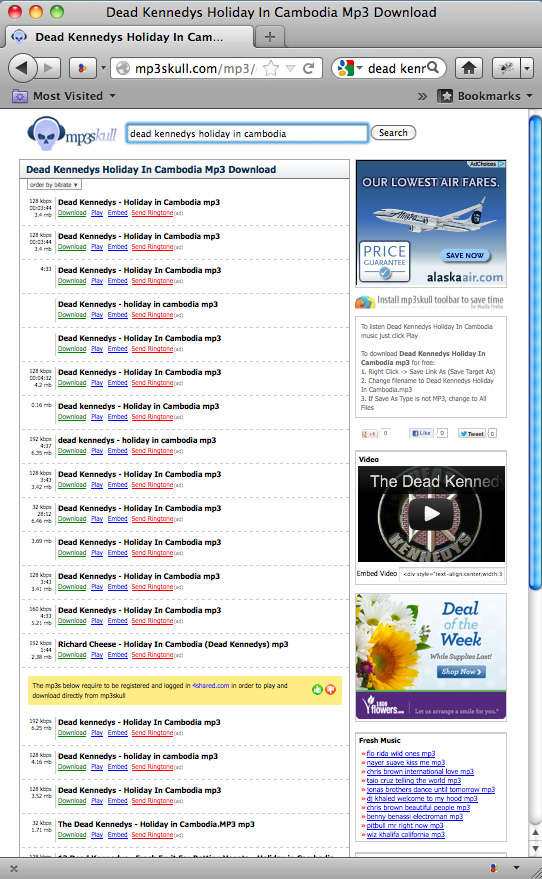
The irony and the disconnect didn’t take long to surface when East Bay Ray from the Dead Kennedy’s pointed out how exactly musicians don’t get paid from corporately funded music piracy sites when he showed a screenshot from mp3skull providing free downloads of his bands music financed by 1-800 Flowers and Alaska Airlines.

Willful Blindness

Of course those who believe in the exploitation of musicians for the profit of internet businesses had no problem rapidly resorting to name calling when it would be a lot more productive to acknowledge the problem as a detriment to the livelihood of musicians, and seek to work towards a cooperative solution to help musicians get paid.

What about Transparency, Being Open and More Human?

Ray went on to note how the negative effects of these sites create an environment that allows companies like YouTube to operate as an opaque black box. Using the best publicly available information he quickly calculated that YouTube’s 35% payment to artists (versus Itunes and Spotify’s 70%) could be a contributing factor to the 45% decline in professional musicians in the last decade. By Ray’s calculations (here at Digital Music News) the numbers may create a loss of 12,000 middle class musicians.

The Elephant In The Room

Some would like to argue that the revenue these sites are generating is inconsequential. These people seem to have difficulty understanding that if brand sponsored piracy can support 200,000 infringing domians that Google is tracking in it’s transparency report, then there is clearly enough there that musicians should be getting paid.

The real point is that there appears to be plenty of money being made online from the distribution of music, it’s just that the money is not being “shared” with musicians.

200kDomainsTracked

Any honest conversation about compensation to musicians has to address the single largest detriment to the revenue of artists at any level, which are the ad network financed music piracy sites. Ignoring these sites leaves out the most critical variable in evaluating fair and ethical compensation models when over 200,000 sites pay nothing at all to musicians with unlimited access to illegally free inventory. These sites profit from exploiting musicians and paying the musicians nothing.

Any legally licensed, legitimate music tech start up also has to acknowledge that mass scale, enterprise level, commercial infringement of music does NOT create a better environment for innovative entrepreneurs but rather a much more difficult one.

The truth is, there is no new professional middle class of musicians. The grand experiment of the digital utopia has been a massive failure for musicans and everyone at SF Music Tech now knows it. The soft back peddling by most on old hard line positions shows clearly that the reality for professional musicians has gotten worse, not better.

One of the most overheard phrases of the conference was, “we have to do better to get musicians paid.” Indeed, as we have noted here the truth is self evident, if the Internet is working for musicians, why aren’t more musicians working professionally? Not everyone aspires to work a day job, make music as a hobby and allow internet corporations to profit from their labor, illegally.

“Here we are, stuck with all these people who want music for free,” said Dave Allen, founding member of Gang of Four and interactive strategist at the branding agency North. “We have to find a way for musicians to make a living.”

If the tech and internet community are truly interested in getting musicians paid wouldn’t it make sense to start where money is already being made?