Artists Rights Watch – Sunday Jan 6, 2013

Happy New Year! Grab the coffee!

Recent posts from The Trichordist:
* First USC-Annenberg Brand Supported Piracy Report and Google Response
* Trojan Horse: Orphan Works and the War on Authors by Brad Holland, Part 2
* Trojan Horse: Orphan Works and the War on Authors by Brad Holland, Part 3
* Trojan Horse: Orphan Works and the War on Authors by Brad Holland, Part 4
* What the FTC Should Know About Brand Sponsored Piracy and Google’s “Pinto Problem”

FROM AROUND THE WEB:

THE SMITHSONIAN :
* What Turned Jaron Lanier Against the Web?

“I’d had a career as a professional musician and what I started to see is that once we made information free, it wasn’t that we consigned all the big stars to the bread lines.” (They still had mega-concert tour profits.)

“Instead, it was the middle-class people who were consigned to the bread lines. And that was a very large body of people. And all of a sudden there was this weekly ritual, sometimes even daily: ‘Oh, we need to organize a benefit because so and so who’d been a manager of this big studio that closed its doors has cancer and doesn’t have insurance. We need to raise money so he can have his operation.’

“And I realized this was a hopeless, stupid design of society and that it was our fault. It really hit on a personal level—this isn’t working. And I think you can draw an analogy to what happened with communism, where at some point you just have to say there’s too much wrong with these experiments.”

THE NEW YORK TIMES:
* Copyright Rules and the Art They Inspire

PITCHFORK:
* The Year in News 2012

THE REGISTER UK:
* The ‘Digital Economy’ in 2012: A big noisy hole where money should be

“Privacy and copyright are two things nobody cares about,” Mark Bide told us, “unless it’s their own privacy, and their own copyright.” How true.”

THE LOS ANGELES TIMES:
* Report links Google, Yahoo to Internet piracy sites

COPYRIGHT ALLIANCE:
* Instagram Still Has the Right to Commercialize Your Work (or Why You Should Read Terms of Service Carefully)

CNET:
* Google, Yahoo accused of funding piracy

TECHCRUNCH:
* Keen On… Piracy: How Online Ad Networks Are Supporting The Major Pirate Movie And Music Sites [TCTV]

Annenberg’s Advertising Transparency Report should be seen as a wake-up call to brands to invest their advertising dollars in legal networks like Spotify or YouTube rather than pirate sites. Pretty simple, eh? Let’s hope that Madison Avenue wakes up to the troubling implications of Taplin’s report and shifts all its online advertising dollars to movie and music sites which actually pay artists for their content.

VOX INDIE:
* More Evidence Ad Dollars Fuel Web Piracy

HUFFINGTON POST:
* Towards a Bill of Rights for Online Advertisers

THE MUSICAL DISCONNECT:
* The Takedown-Why the DMCA has failed

AD LAND:
* David Lowery makes list of people who changed the music industry.
* Collateral Damage: How Free Culture destroys advertising.

STOP FILE LOCKERS:
* Crocko.com lose Paypal. Resellers to follow.
* UltraMegaBit: A Crime Committed on American Soil
* Avangate forced to drop file sharing sites. More sites poised to lose Avangate payment processing.

DIGITAL MUSIC NEWS:
* Abject Looting Continues at Pandora…
* In France, 92% of Pirates Never Receive a Second Warning Letter…
* Growth of Paid Downloads vs. Streaming, 2012 vs. 2011…

TORRENT FREAK:
* Top 10 Most Popular Torrent Sites of 2013
* Music Biz Wants To Block Pirate Bay….Plus 260 Additional Sites
* IMAGiNE BitTorrent Group Leader Sentenced To Five Years in Prison
* Identifying Pirates Now Easier Following Swedish Supreme Court Decisions

COPYHYPE:
* A look ahead to 2013

BARRY SOOKMAN:
* Most popular intellectual property and technology law blogs

Final Recap, News and Last Links of 2012…

Grab the coffee!

Recent Posts:
* What Can Songwriters Do: Copyright Office Comment Period Ends Today for Mechanical Royalty Statements of Account
* The Return of Orphan Works: A Review of the 2008 Shawn Bentley Orphan Works Act Part 1
* Ending Decade Old Arguments : How the Promise of the Internet has Failed Artists and Musicians…
* Billy Corgan Exploited By… Citi Bank, AT&T, Target, Virgin Atlantic, Mazda, Neiman Marcus, Musicians Friend, Hertz, BMW, Audi, Boston Market, Urban Outfitters, Williams Sonoma
* Songwriter comments on Section 115 Rulemaking
* FTC Treats Google With Kid Gloves and No Transparency
* Fair Pay for Air Play, Terrestrial Radio Performance Royalties for Musicians
* The Piracy-Pandora Connection: Can the Super Bowl, Oscars and Grammys Move the Needle on Brand Supported Piracy?
* The Return of Orphan Works: Trojan Horse: Orphan Works and the War on Authors by Brad Holland

FROM AROUND THE WEB

Seattle Weekly:
* It’s Time for Artists to Fight Piracy as Vigorously as They’ve Challenged Pandora

“…it’s time for artists to band together to set the story straight. Don’t leave it to the few brave enough to speak strongly on the matter. There needs to be a large, coordinated effort by bands big and small to tell their story–to sign a letter to fans explaining how devastating piracy is to their ability to make music for a living (or at all).”

Vox Indie:
* IP and Instagram–a Teaching Moment Perhaps?
* Should More Artists Speak Out Against Piracy?
* Creative Commons Celebrates 10 Years

CNN Money:
* Instagram can now sell your photos for ads
* Instagram says it won’t sell your photos to advertisers

Copyhype:
* Freeloading: How Our Insatiable Hunger for Free Content Starves Creativity, by Chris Ruen

The Guardian UK:
* Intellectual property crime unit to be set up by City police

Torrent Freak:
* U.S. and Russia Announce Online Piracy Crackdown Agreement
* Anti-Piracy Chief Patents “Pay Up or Disconnect” Scheme

Mashable:
* “T-Shirts and Touring” as Revenue for Artists just took a left Turn (YOLO)

Brian Pickings:
* The Best Music Books of 2012

Digital Music News:
* 10 People That Totally Changed the Industry In 2012…

(11) Oh, there’s one more guy…In one fiery and insanely-viral post, performer and professor David Lowery somehow managed to reframe the entire debate over technology, piracy, and the plight of the artist. And, draw attention from seemingly every corner of both the tech and creative communities. It was the biggest post of the year for the music industry, and potentially, the start of a very different type of discussion in 2013.

* Major Label Lobbying vs. Google Lobbying, 2012…
* The State of Music Subscription, December, 2012…
* USC Is Now Researching the Amount of Advertising Flowing Into Pirate Sites…
* Google Exec: If You Really Want to Kill Piracy, Then Kill the Advertisers Who Support It…

Ad Land:
* Senate passes a resolution asking Backpage.com to drop adult classifieds
* Adland booted from Google Adsense due to PETA’s misogynist ads

Copyright Alliance:
* Capitalist Copyrights: A Republican Reply to “Three Myths about Copyright”
* MUSIC Act introduced
* YouTube Moves for Safe Harbor Against Viacom

Daily Dot:
* YouTube strips Universal and Sony of 2 billion fake views

The Cynical Musician:
* Copyright and Scarcity

Zoë Keating’s Request for Internet Transparency met w/ usual Hypocrisy

We’ve been following Zoë Keating’s blog for a while. Zoë represents (figuratively, not literally) a new generation of musicians whose careers have only really existed in the post-internet, pro-piracy environment. As such, the perspective of these artists who have little experience in the world prior to optional payment and virtually no artist control over the distribution of their work is somewhat different from those who have inhabited both environments.

We celebrate the Zoë Keatings of the world for their undying tenacity in their efforts to navigate the current music industry without having had the benefit of the pre-piracy era. Zoë’s made a few excellent observations and suggestions. One recent post has been to ponder the creation of a new artists rights coalition to represent the needs of contemporary indie and DIY artists. Another post has been soul searching on what might be the fair way to set appropriate royalty rates across the various terrestrial, satellite and internet streaming radio platforms.

But it is one of Zoë’s most recent posts which has really caught our attention, as Zoë has been “slashdotted” just for asking for transparency and data sharing from the internet companies profiting from the artists work.

In the case of a service like Pandora, when someone has taken the time to create a station around my music or given my songs a “thumbs up”… I’d rather know where in the world those particular listeners are than be paid the $0.0011 per play that is currently required by law. That was my point.

Now, we don’t think this should have to be a choice, and we think Zoë has an excellent point, especially given that the Declaration Of Internet Freedom specifically states transparency as one if it’s principles.

Declaration of Internet Freedom

We stand for a free and open Internet.

We support transparent and participatory processes for making Internet policy and the establishment of five basic principles:

Expression: Don’t censor the Internet.

Access: Promote universal access to fast and affordable networks.

Openness: Keep the Internet an open network where everyone is free to connect, communicate, write, read, watch, speak, listen, learn, create and innovate.

Innovation: Protect the freedom to innovate and create without permission. Don’t block new technologies, and don’t punish innovators for their users’ actions.

Privacy: Protect privacy and defend everyone’s ability to control how their data and devices are used.

As with many things we’ve seen from the tech sector, there always seems to be selective reasoning when it comes to them actually adhering to their own principles. This from the same people who want permissionless innovation, up and until, you are not asking them for permission as Google is illustrating with Doogle.

Of course the double standard and irrationality of the freehadist hive mind doesn’t stop there. Among the comments posted, this one is indicative of the faulty logic and thinking expressed by so many of the anti-artist maximalists.

“She got money, I got music. There was no agreement to get my data. 0% is hers.”

The point that should be emphasized is that there was no agreement period. Pandora gets a compulsory license. It gets the benefit of a “one-stop shop” for all sound recordings so long as it pays the rates, no questions asked. Congress took away from Zoe Keating the choice to make that agreement. So it’s also perfectly valid to say that Pandora should also turn over some data to artists in exchange for that – especially if the consumer is (and should be) given the choice to opt-in.

We are pro-choice and respect consent, and we believe that the internet and tech community should also as well.

Lars Was First And Lars Was Right

Charlie Rose featured guests Lars Ulrich of Metallica and Chuck D from Public Enemy in 2000 to discuss Napster, the internet and the future of the music industry. In stunning clarity, Lars saw the grim future that would disenfranchise millions of artists, musicians, photographers, authors, writers and other creators who would have their living illegally appropriated by internet robber barons.

“if the record labels are not making the money, than the internet companies will be, and if they are not paying the artists, they are profiting illegally.” -Lars Ulrich

Nearly thirteen years later every statement Lars made in this interview has come to pass as truth. The new gatekeepers of the internet profit from the illegal distribution of  artists’ work while paying the artists nothing, nadda, zero, zip.

Meanwhile Chuck D’s prediction definitely did not come true:

“I think there’s going to be more music sold than ever,” – Chuck D May 2000 Washington DC

But Lars is still treated like a pariah.  Especially by those in the tech blogosphere who were wrong then and continue to be wrong now!

CNN: Music’s lost decade: Sales cut in half

And despite the predictions of legions of corporate false prophets there has been no emergence of a new independent professional middle class of musicians. In fact, the complete opposite has happened, there are 45% less professional musicians (according to the Bureau of Labor Statistics) from 20022011.

Lars was right on the money, literally.

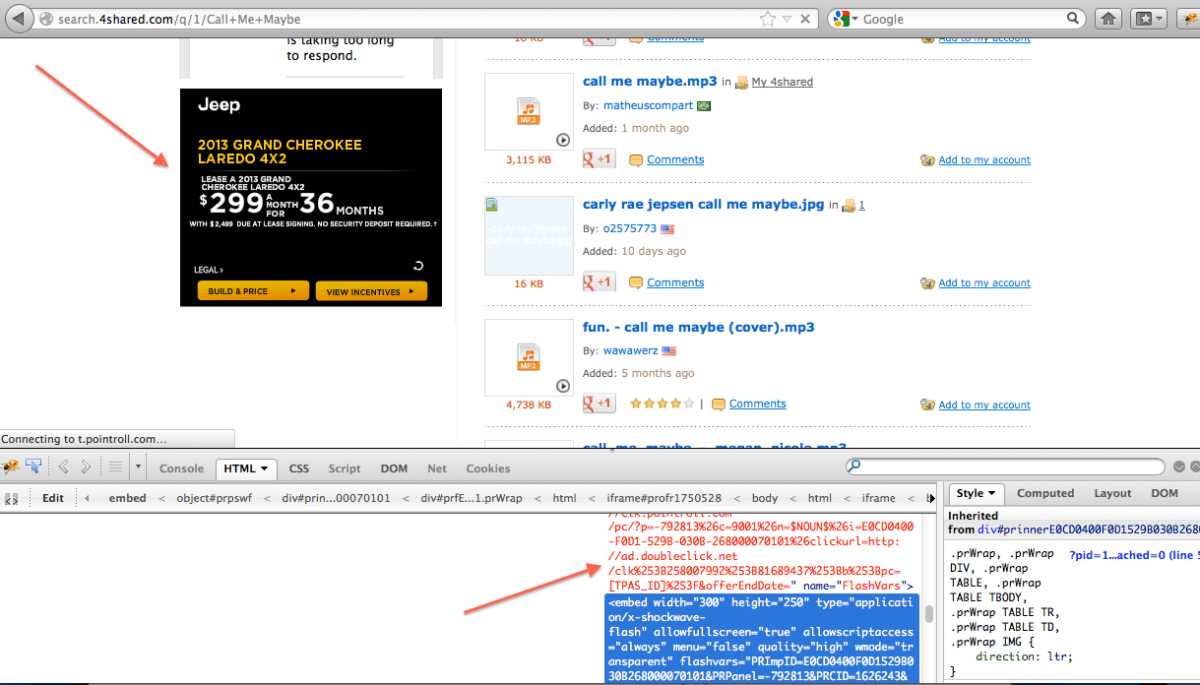
This was never about art, music or freedom.  It is simply a new set of even more ruthless artist-exploiting corporations taking over for the old ones. For example,  in the image below Jeep is advertising on one of the top known pirate sites 4Shared via Google’s Doubleclick ad network. Google alone is estimated to make almost $35 billion dollars annually,  95% of that revenue coming from it’s advertising sales. Google is not sharing ANY of this money with artists that it is exploiting. At least in the 1950’s music business you got a Cadillac every once in a while.

As Lars predicted The New Boss is Worse Than The Old Boss.