Microsoft Does the Right Thing In Songwriter Class Actions But Where is the Government?

Music Technology Policy

You’ll probably have read a lot about how the Lowery, Ferrick and Yesh Music cases against digital services show how “broken” the music licensing practice is in the U.S.   As usual, instead of focusing on protecting songwriters and helping them actually get paid, the government is focusing on more bureaucracy and making life easy for tech companies.  Because that’s what bureaucracies do–after all, why does the Navy’s Army need an Air Force?

The U.S. Copyright Act produces no incentive for anyone to actually pay royalties–mostly because there is virtually no chance that anything bad will happen to a scoff law who just ignores their obligations under the Copyright Act.  Why?  Because the government puts the enforcement burden on songwriter who can ill afford to bring a copyright infringement case on their own.  And, of course, anyone who does is mocked in the tech press as a “copyright troll” as…

View original post 968 more words
Artist Representatives Embarrass Themselves Again By Not Signing Their Clients for SoundExchange Royalties

Music Technology Policy

There’s another list circulating of some well-known artists who are not signed up for SoundExchange.  There’s always an implication somehow that this is the fault of SoundExchange as opposed to a failure on the part of the artist’s managers, business managers, accountants or lawyers.

Newsflash: SoundExchange can’t force anyone to sign up as a featured artist.  It is the role of the artist representatives to encourage their clients to get this done.

Newsflash:  It’s EASY to sign up.  In fact, it’s never been easier.

Newsflash:  Joining SoundExchange is one of the only ways a US artist can collect foreign performance royalties for sound recordings.

Affiliating with SoundExchange should be on the top of every representative’s new client checklist–right next to affiliating with ASCAP, BMI or SESAC.  If the manager failed to get their artist/songwriter client affiliated with a PRO, or let a PRO just sit on money they’d collected it…

View original post 29 more words

Spotify’s Reply To @DavidCLowery: When the going gets tough, the tough get fancy

Music Technology Policy

“And if they could talk to one another, don’t you think they’d suppose that the names they used applied to the things they see passing before them?”

The Allegory of the Cave by Plato, line 515b2.

David Lowery is leading a class action lawsuit against Spotify for failing on what appears to be a massive scale to do three crucial things: license rights, pay reproduction or “mechanical” royalties for songs it exploits, and fix Spotify’s deeply flawed song licensing and essentially nonexistent mechanical royalty accounting systems for the future.  Songwriter and recording artist Melissa Ferrick has separately brought a similar class action.

It’s A Mystery

We now have a legal response from Spotify to give us some idea of how Spotify wishes the world to view its excuse for its massively flawed song licensing practices.  And here is what it boils down to–because there has never been a “global rights…

View original post 1,301 more words

#freeKesha

It’s hard to believe that an artist has to go through what Kesha has been through, but there it is.  We’ll have more on this in coming days, but this post by @morayati is one of the better ones that summarizes the problems with the case.

One of the problems with the “savior” approach to A&R is that people lose sight of the reality that regardless of how effective the producer is, regardless of how great the songs are, hit records are a product of hundreds of people working their fingers to the bone to make something happen–starting with the artist.  That includes everyone at the record company, the managers, booking agents, the entire team.  And the producer.  If you have that team and those resources behind a great artist, that producer may prove himself to be not that critical a component to the artist’s career after all.

Why Sony is allowing this to happen at all, but especially when the public is on a collision course with Sony Corp  (aka “Big Sony”) is a mystery.  They could do the right thing now or wait until Tokyo tells them to.

Even looking at it from that cold-blooded commercial point of view, it’s certainly not worth compromising your personal ethics over the A&R savior-du-jour.

Some reporting questions for the Kesha court case

The key quote from the Kesha/Dr. Luke court battle, which has just taken a dispiriting turn, is this, by judge Shirley Kornreich: “My instinct is to do the commercially reasonable thing.” A lot has been written, rightly, about what a chilling statement this is, and there’s been a lot of talk about how best to support Kesha.

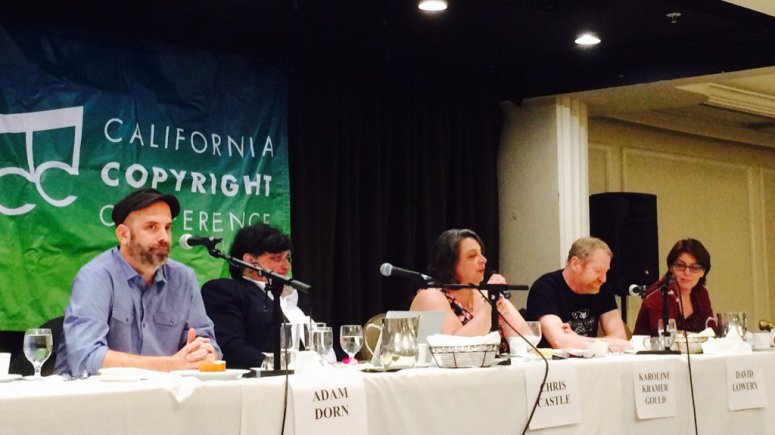
Remarks at the California Copyright Conference #irespectmusic Grassroots Advocacy Panel with Adam Dorn, Karoline Kramer Gould, David Lowery and Blake Morgan

Music Technology Policy

Ca5c9v2VIAE3V5f.jpg-large Photo courtesy @amyraasch

What a great way to start Grammy Week!  Last night Adam Dorn, Karoline Kramer Gould, David Lowery and Blake Morgan came together to tell their personal stories and they let me moderate.  Each of them has an inspiring story of how they came to their personal epiphany, their inspiration to turn to advocacy as part of their lives.

And in case it wasn’t clear–we were recruiting!  Follow them on Twitter through the ‪#‎irespectmusic‬ and @theblakemorgan, @radioclevekkg @davidclowery @moceanworker and @musictechpolicy.

The following are my introductory remarks to the panel:

Successful advocacy sits on a three legged stool whether we like it or not—lobbyists, campaign contributions and individual action.  The music industry and the larger entertainment industry has largely failed to achieve successful advocacy.  We still have essentially the same problems today that we had 15 years ago and the industry is at least half its former…

View original post 543 more words

#irespectmusic: Tish Hinojosa Speaks Out on Fair Pay for Musicians at Live Music Venues

The great artist Tish Hinojosa wrote a must-read opinion piece for her home town paper, the Austin American-Statesman, about the realities of gigging in a “no cover”/”tip jar” reality that is all too common at live music venues across the country.

In her post “Austin venues, patrons can do more to pay musicians fairly,” Tish lays bare the ugly truth that we experience every day–wage stagnation for musicians produces the “you’re lucky to have a job” mentality with many venues:

I am finding that even Austin’s best-known and talented support — aka “side” — musicians and singer-songwriters are playing for peanuts, meaning, for the same or less than we were earning in the 1980s. In the meantime, the cost of living in this city has grown tremendously — and so has the city’s pocketbook. That Austin’s reliable, hard-working, talented and diligent musicians can’t even afford to live in the city is a shame, especially considering that they are the backbone of the “Live Music Capitol Of The World.”

Too many Austin venues are taking advantage of good musicians who just need to work and are offering those artists “this or nothing deals” like: “Do you know how many of you would be happy just to say they play here?”

Tish’s post links to another Statesman story about the findings of the 2015 Austin Music Census which confirmed Tish’s concerns about the music community.  The City of Austin commissioned the Austin Music Census, the only study of its kind, that surveyed 4,000 members of the Austin music community and identified the “no cover” issue as a major problem that needs to be addressed.

In her must-read post, Tish gives the human side from an artist’s perspective on the ground.  Wherever you live, we believe that you’ve probably experienced the exact same take-it-or-leave-it deals that amount to “pay to play” enforced the old fashioned way–by intimidation.

Thanks to Tish for speaking out.

@theblakemorgan Looking For #irespectmusic Results from Government

Music Technology Policy

Blake Shumer

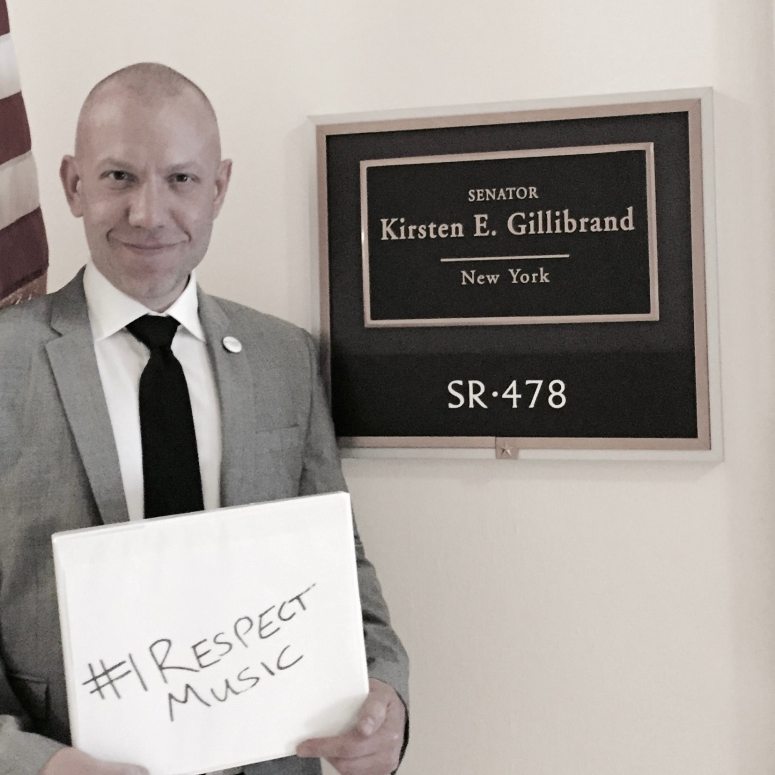
Blake Morgan took the #irespectmusic campaign to Capitol Hill again last week, this time in support of the Songwriter Equity Act (bill numbers HR 1283 and S662) with staff in the U.S. Senate.  His meetings included his own New York Senators Chuck Schumer and Kirstin Gellibrand.

Blake Gillibrand

One of the cornerstone principles of the #irespectmusic campaign is to support the ideal of fair treatment for all creators and is not limited to specific legislation.  Here’s an example.  Principle: Artist pay for radio play.  Bill: Fair Play, Fair Pay.  Principle:  Songwriters should be fairly compensated.  Bill: Songwriter Equity Act.

Blake Leahy

Blake’s trip to Washington coincided with the second anniversary of the #irespectmusic petition.  The movement is now in its second session of Congress–it started in the second year of the last session (the 113th) and is now working on the current session of Congress (the 114th).

mikulski blake

Blake wrote this insightful post that…

View original post 185 more words

A Burger Today: Spotify’s Bridge Loan to Nowhere is All the Rage

If Spotify runs out of money and files for bankruptcy, what happens to the money they have supposedly “set aside” for songwriter payments?

Music Technology Policy

“D” is for “desperate.”  And “debt.”  According to the Wall Street Journal:

Swedish music-streaming company Spotify AB has scheduled a series of investor meetings in an effort to raise about half a billion dollars through a convertible bond issue, a person familiar with the matter said Wednesday.

Spotify is eager to have financial firepower at hand should consolidation opportunities arise in the industry, according to the person. The issue won’t necessarily be a prelude to a stock-market listing of the privately held company, the person said.

The Financial Times tell us:

Swedish newspaper Svenska Dagbladet, which first reported the planned funding round, said that the loans would pay an annual interest rate of 4 per cent. In addition, they would convert into equity at a 17.5 per cent discount to Spotify’s share price if the company goes public in the next year.

This financial structure would guarantee lenders hefty…

View original post 1,421 more words

Blake Morgan Takes #irespectmusic Campaign to U.S. Senate Supporting Songwriters Equity Act

Music Technology Policy

Blake Morgan posted this on his Facebook page today:

blake senate 1

So…today is the day. For the first time, I’ll be bringing the #IRespectMusic campaign to the United States Senate. Over the next two days, I’ll be in Senate offices for discussions on fair market value specifically for American songwriters. The Songwriter Equity Act, like the Fair Play Fair Pay Act, is a crucial piece of legislation supported by both parties that American music makers want, need, and deserve. #IRespectMusic began as a spontaneous online grassroots uprising, and now look at where we’ve brought it, together. I’m saddled up. Game on.

Once again, Blake demonstrates the power of grassroots!  We’ll keep you posted on his journey.

If you’re going to be in Los Angeles for Grammy Week, don’t forget that the California Copyright Conference is hosting a panel on #irespectmusic on February 9, click here for details.

View original post

Save the Date: Feb. 9 California Copyright Conference Panel on #irespectmusic

If you’re going to Los Angeles for Grammy Week, check out this awesome artist rights panel!

Music Technology Policy

The California Copyright Conference will be hosting a panel entitled “The I Respect Music Campaign and the New Grassroots Artist Rights Advocacy” on February 9 from 6-9:30ish at the Sportsman’s Lodge in Los Angeles.  We will be having a wonderful group of panelists in Adam Dorn pka Mocean Worker, Karoline Kramer-Gould, David Lowery and Blake Morgan.

CCC Members and College Students $45 per person | Non-members $55 per person
Students must show College ID at the door, if paying at the member rate

Click here for details and reservations!

The I Respect Music Campaign and the New Grassroots Artist Rights Advocacy

Blake Morgan founded the #irespectmusic campaign to support fair treatment for creators, starting with over 13,000 signers of a petition calling on Congress to support artist pay for radio play.   After Reps. Jerry Nadler and Marsha Blackburn introduced the Fair Play, Fair Pay Act, #irespectmusic supporter and…

View original post 219 more words