Hello, European Commission: Spotify admits to dominating global music subscriptions

Spotify’s A Dominant Player in the Relevant Market

There’s all kinds of rumors going around about the European Commission investigating whether major labels have somehow conspired with Apple to hurt Spotify and YouTube (owned by Spotify board member Google).  How?  By offering a music service without a free service based on the crack model.  This theory has to do with Apple and the major labels having dominant market positions, and the EC’s alleged desire to protect Sweden-based Spotify.

Or so the narrative goes.  There’s scant documentation of any such “probe” aside from a couple unattributed news reports based on “people familiar with the case“.

But if the European Commission is looking into Apple to protect Spotify, maybe they should be looking at Spotify itself.  According to a Billboard report, a Spotify executive told the Google-dominated Music Biz Association (formerly NARM) that Spotify has 50% of the global music subscription market:

[Spotify executive Will] Page also pointed out that Spotify is half of the $1.5 billion global subscription streaming market. In the U.S. market, Spotify made up approximately 90 percent of last year’s growth in subscription revenue, according to Page.

Isn’t that special?  So Spotify is at least a dominant company if not a monopolist in a very relevant market to the EC’s rumored investigations.  Maybe while the EC is looking into the major label deals with Apple they could also look at Spotify’s behavior toward independent artists and control over the trickle of royalties from subscription?

And before Spotify tries to change the subject–we’re not talking about royalties paid by labels, we’re talking about royalties paid by Spotify to independent artists with no label.  And if the royalties suck for independent artists, they must really bite for signed artists who have to share the revenue with their labels.

Why Do We Want Out of the Ad Supported Tier?

Here’s an alternative and non-conspiratorial explanation of why people want out of the free streaming tier–maybe it just sucks.  How about that?  And who is hurt by cutting out an ad supported tier?  Advertising networks serving ads to Spotify, like, oh say Google Adsense.  You know–Google, the Spotify board member.

The Google connection is actually very interesting.  For all the bitching and moaning that Spotify does about YouTube, why would they put Google on their board of directors?  A “freemium frenemy” perhaps?  Maybe because Google has a strong interest in seeing that Spotify stays an ad supported business for a long time?

The reaction against the free tier is not just a reaction to Spotify, it’s also a reaction to YouTube and it’s mainly a reaction against ad supported streaming, a business model that is supposed to be a defense to ad supported piracy.  You know, the ad supported sites that Google drives traffic to.  Remember 350 million take down notices to Google search last year?

Frenemies Creating Another Compulsory “License”

Maybe the Spotify narrative is wrong.  Maybe the real story is that the fight is between those who profit from the advertising model through a bunch of crappy deals with Spotify and YouTube that should never have gotten done in the first place.  Maybe everyone is realizing that now and want out.  Maybe Apple is taking advantage of that realization and is innovating and competing.  Maybe Spotify is trying to use its dominant position in music subscription to throw its weight around in its “freemium” business and its “frenemy” and board member Google is in the background doing what Google does best:  jacking artists around.

What is troubling about Spotify’s antics is that they don’t get a compulsory license for recordings, so they can’t quite screw us as hard as Pandora or SiriusXM do with the power of the federal government behind them.

But if Spotify can force the major labels to license to them for the free tier by manipulating the antitrust law, that means that Taylor Swift will not be able to withdraw from either Spotify or YouTube.  And we suspect that’s the object of the exercise.

Don’t regulate the Internet except for the artists and the songwriters.

#howgoogleworks: Must Read Buzzfeed Story on Google’s Sleazy Relationship with FTC

Imagine if this were the Copyright Office?

Music Technology Policy

A must read Buzzfeed article gives you one of those rare insights into how Google actually works at the highest levels of government with merely the flick of an email at a huge Federal bureaucracy–the Federal Trade Commission.  Remember them?  The FTC are the ones that punted on their antitrust investigation of Google for mysterious reasons.

Courageous Wall Street Journal reporter Brody Mullins & team came up with an internal FTC staff report proving that the unanimous decision of the FTC’s political appointees not to prosecute Google for antitrust violations was expressly taken against the advice of the professional legal staff.  Mullins’ reporting called into question an entire series of decisions by the U.S. Government not to look too hard at Google’s high handed business practices or its monopoly behaviors.  The Wall Street Journal team put that story in context by publishing another expose of Google’s influence peddling in Washington.

View original post 738 more words

#irespectmusic and Follow the Money: Ask WNYC how did NPR afford the membership fees for the McCoalition?

As we were told last week by a whistleblower, National Public Radio’s in-house lobby shop decided that it was in NPRs best interests to align themselves with the so-called “Mic Coalition” (or as some call it, the “McCoalition”).

Screen Shot 2015-04-29 at 9.38.43 AM

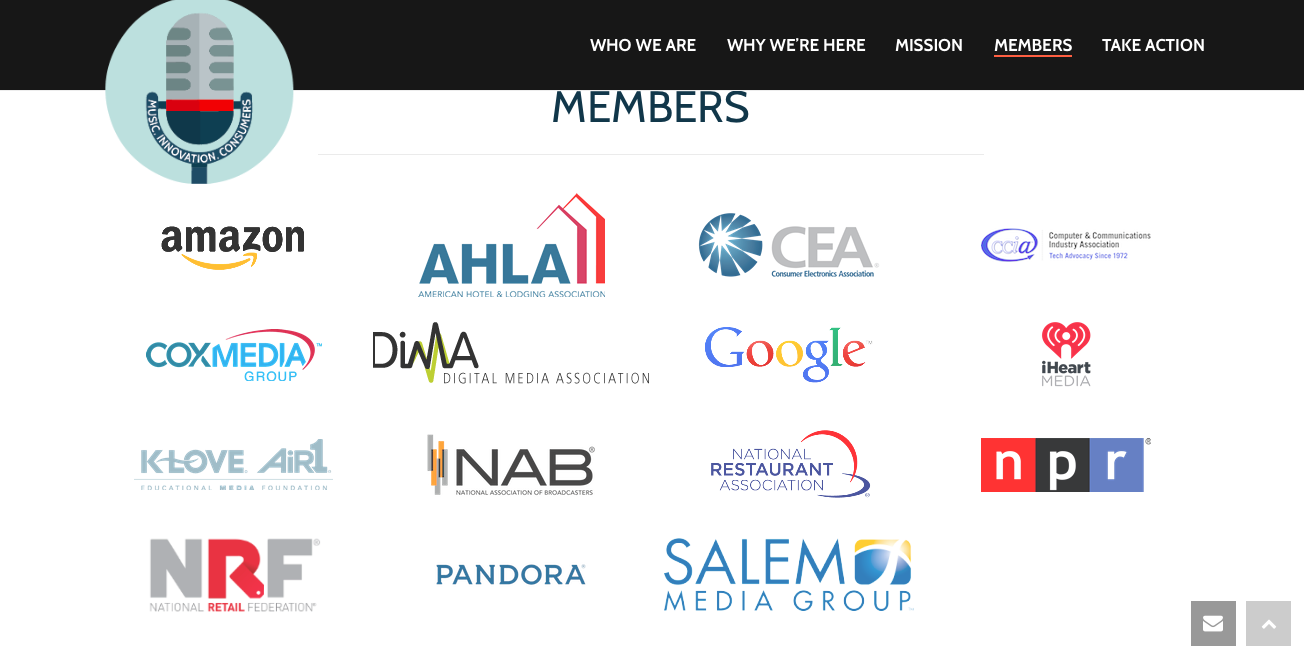
The McCoalition is not only National Public Radio, but also includes the National Association of Broadcasters–an extraordinarily powerful special interest group long devoted to protecting crony capitalism and the Clear Channel no-royalty loophole.  Yes, in a move worthy of Pandora’s Chris Harrison (aka “Mr. $50 Handshake”), the McCoalition also includes a couple other trillion-dollar babies: Google, Amazon, Pandora, the Digital Media Association (of which Google/YouTube, Amazon and Pandora are members), the Computer & Communications Industry Association (of which Google, Amazon, Pandora are members) Cox Media Group, iHeartMedia (formerly Clear Channel), Salem Media Group, the National Association of Broadcasters (of which Cox, iHeart, Salem and Pandora are members), the Music Licensing Committee (of which Cox and Clear Channel are members), the Consumer Electronics Association (of which Amazon, Google and Pandora are members), the National Restaurant Association (which fought the performance royalty for songwriters whose music is performed in restaurants), the American Hotel and Lodging Association (which also fought the performance royalty for songwriters).

As the leaked email told NPR stations:

NPR is participating in the Music, Innovation & Consumers (MIC) Coalition to ensure that public radio’s voice is heard in future policy decisions involving copyright law. Changes to copyright law may have a direct impact on public radio stations’ abilities to bring music to listeners nationwide.

Our participation in this coalition is not an endorsement of the business plans or activities of other members.

Really?  What is it then?  Pandora has spent millions trying to screw legacy artists who recorded prior to 1972.  The NAB has spent millions lobbying against artists to continue getting a free ride on the music they broadcast, something they’ve fought for decades.  The rest of the world accepts artist pay for radio play–just not the National Association of Broadcasters, North Korea and Iran.

And NPR.

Google, the CCIA and the CEA routinely try to screw artists for a host of reasons and are some of the principal sources of propaganda and lobbying hustle to hurt all of us.  If you include songwriters–all of the above, plus the National Restaurant Association.  The National Restaurant Association is so greedy they managed to get the U.S. taxpayer to subsidize their last play at crony capitalism called the Fairness in Music Licensing Act.   That special interest legislation violated international law and wound up in an international trade arbitration that cost the U.S. taxpayer $3.8 million in fines and potentially more to come.  Maybe the restaurateurs would like to cut the taxpayer a check?

Yes, that’s right.  The U.S. taxpayer is subsidizing music in U.S. restaurants–not for American songwriters, because we don’t have a right to that money.  The restaurants outsourced their royalty payments to the World Trade Organization.

And there is NPR.  And the suits in the NPR lobby shop think this is all OK because NPR doesn’t “endorse the business plans or activities of other members.”

This is pretty pricey company for NPR–poor old public radio that always seems to be strapped for cash.  These “coalitions” usually charge membership fees–big ones.  Here’s the problem:  Is the McCoalition being sponsored by “listeners like you”?  Or by “taxpayers like you”?  Or is it just plain old corporate sponsorship?  Or is it a “free membership”?  Because to paraphrase John Perry Barlow, just like information, loyalty wants to be free, too.

The problem is that when NPR lies down with these dogs, those fleas don’t come off.

If you call in for WNYC’s current pledge drive, you might ask them how that mange treatment is coming along.

Uber Hires Googler Rachel Whetstone to Bully Teamsters

Music Technology Policy

‘Did you torture him?’

Captain Segura laughed. ‘No. He doesn’t belong to the torturable class.’

‘I didn’t know there were class-distinctions in torture.’

‘Dear Mr Wormold, surely you realize there are people who expect to be tortured and others who would be outraged by the idea. One never tortures except by a kind of mutual agreement.’
‘There’s torture and torture.’

Our Man in Havana, by Graham Greene

Remember Rachel Whetstone?  She was the Senior Vice President of Communications and Public Policy at Google until this week when she took a comparable job at Uber, replacing former Obama 2008 campaign manager, David Plouffe.  She also coined the “crying baby” gif for a now-forgotten post she wrote excoriating Rupert Murdoch.

Another fun fact–it typical Google style, influence peddling begins at home.  Rachel Whetstone is married to Steve Hilton, a close advisor of recently reelected UK Prime Minister David Cameron.  According to Wikipedia…

View original post 108 more words

BREAKING–Leaked internal email from NPR’s Policy and Representation Division Explaining NPR Membership on McCoalition

We were sent this internal email from inside National Public Radio by a whistleblower.  The internal email was apparently in response to the criticism of NPR coming from independent artists online.  As we suspected, it appears that NPR’s participation in the controversial “Mic Coalition” (or as we call it the “McCoalition”) was a decision taken by NPR’s Policy and Representation division (aka “suits”) without consulting with any of the music or news workers or any of the NPR member stations.

NPR is participating in the Music, Innovation & Consumers (MIC) Coalition to ensure that public radio’s voice is heard in future policy decisions involving copyright law. Changes to copyright law may have a direct impact on public radio stations’ abilities to bring music to listeners nationwide.

Our participation in this coalition is not an endorsement of the business plans or activities of other members.

The coalition has not yet made specific legislative or regulatory proposals. We will reassess our participation in the coalition as such proposals are drafted.

We have joined the MIC Coalition through NPR’s Policy and Representation division, which is charged with representing the needs and interests of NPR Member Stations before federal legislative and regulatory bodies. This role is stipulated in NPR’s charter which provides that it is part of NPR’s mission to represent our members in matters of mutual interest.

Our participation in the coalition is completely separate from NPR’s newsroom. NPR journalists and music curators have absolutely no role or involvement in the coalition.

Who Did NPR Get Into Bed With?

What’s different about the McCoalition is that we now see who our enemies are.  Not only does the McCoalition include the NAB–an extraordinarily powerful special interest group long devoted to protecting crony capitalism and the broadcaster loophole–it also includes Google, Amazon, Pandora, the Digital Media Association (of which Google/YouTube, Amazon and Pandora are members), the Computer & Communications Industry Association (of which Google, Amazon, Pandora are members) Cox Media Group, iHeartMedia (formerly Clear Channel), Salem Media Group, the National Association of Broadcasters (of which Cox, iHeart, Salem and Pandora are members), the Music Licensing Committee (of which Cox and Clear Channel are members), the Consumer Electronics Association (of which Amazon, Google and Pandora are members), the National Restaurant Association (which fought the performance royalty for songwriters whose music is performed in restaurants), the American Hotel and Lodging Association (which also fought the performance royalty for songwriters).  And then there are the human shields at the Educational Media Foundation and, as David has pointed out, National Public Radio.

Crony capitalists with a combined market cap in excess of $2 trillion seeking protection for the special interests and aligned against artists and songwriters.

The restaurants have a particularly unsavory history on this point–their last effort to screw songwriters was with the highly controversial 1998 special interest legislation, the Fairness in Music Licensing Act.  That debacle ended in a ruling against the United States in arbitration at the WTO that ruled that the restaurant special interest legislation violated a number of international laws as was predicted by then-Register of Copyright Marybeth Peters but ignored by the lobbyists and the Congress.  The U.S. taxpayer has to pay $3.3 million in fines ordered by the tribunal and paid to European rights holders.  So thanks to the restaurants, the Congress passed an illegal law requiring U.S. taxpayers to pay for foreign songwriters–millions and millions of taxpayer dollars.  Would you like fries with that?

And if that dark history wasn’t enough, the whole group is organized by the Washington, DC shillery, Twin Logic Strategies–the brainpower behind the Internet Radio Fairness Act.  This is “astroturf” in every sense of the word–a manufactured alliance to taint the Congress no doubt with threats and intimidation for anyone who would dare consider supporting the Fair Play Fair Pay Act.  The Act accomplishes two main goals:  pay artists in line with the rest of the world and stop Pandora and SiriusXM from screwing legacy artists with the pre-72 loophole.  In other words, doing what all these companies and their lobbyists stand for–screwing artists and especially songwriters.

So we understand exactly what the unifying principle is behind this McCoalition–they don’t want to pay for music.  And neither do the NPR stations that ask us to play for free as David has pointed out.  Unfortunately, NPR’s “Policy and Representation division” doesn’t understand that when our friends at NPR ask us for freebies we’re happy to help because it is NPR doing the asking.  Now that NPR has aligned itself with millionaires and billionaires, not to mention companies with trillions in market cap, NPR has made anyone who gives the freebies into a chump.

We all know that our friends at NPR are better than that.  That’s why whistleblowers come to us.  But as long as our friends at NPR aren’t allowed to publicly reject the suits, it does make you wonder what’s going on.

But now that the suits forced NPR to join the McCoalition–how much does that McCoaltion membership cost?  And who paid it?

Pandora Is in a Rate Class By Itself: The Near Interactive Rate

If you’ve followed the history of Pandora in the webcasting rate setting proceedings, you will remember the extraordinary sanctimony with which they approached artists.  We were told, you have to save our business, you’re too greedy, etc.  Sound familiar?

The one aspect of Pandora’s functionality we were always steered away from was its interactivity.  Why?  Two reasons.

If Pandora were found to be interactive, the Copyright Act would require Pandora to negotiate direct licenses with copyright owners large and small.  That would be a real headache for Pandora compared to the ease of the statutory webcasting license. Imagine the savings in transaction costs conferred on Pandora through the statutory license.  Not to mention the fact that Pandora would have to pay advances, which they don’t have to pay under the statutory license, and Pandora would also probably be faced with some of the same demands that Spotify and YouTube saw with demands for equity from major labels and the Merlin group of labels.  (Although strangely enough, this was never an issue with Apple…gee, would that be?)

The other reason is that artists get paid directly by SoundExchange regardless of whether they are recouped under their record deals.  This is a big damn deal, because it keeps the record companies’ paws off of the artist share of statutory licensing revenue.  SoundExchange fights hard to keep this structure and we should all be grateful for it.  In this way, SoundExchange is very much like ASCAP, BMI and SESAC.

Not only does SoundExchange pay the artist’s share directly to the artists, there are other benefits of collective licensing such as the right to conduct a royalty examination of companies like Pandora that we get from the statutory license as administered by SoundExchange.  In fact, SoundExchange announced it is conducting an “audit” of Pandora right now.  Any recovery under those audits will also get paid to the artists based on their share of the recovery.  (And if you believe Pandora has accounted perfectly to artists and songwriters, surely you jest.)

Yet as David has shown, Pandora is pretty close to being interactive, which would take them out of the statute, but Pandora clearly is not truly interactive, or “on demand” the same way Spotify is.  On the other hand, Pandora is not really a “webcaster” either because of their thumbs–not the thumb of the nose they give to artists and songwriters, but the ones they use to create their “near interactive” service.

So what do do about this?  There is no way on earth that artists should give up their right to be paid through SoundExchange and there’s no reason to encourage direct deals.  Pandora would be more than happy to do more direct deals because those only weaken collective licensing which is at least Chris Harrison’s apparent motivation in life dating back nearly 10 years from his time at DMX.  (Harrison is Pandora’s lawyer who has taken point on destroying collective licensing for ASCAP and BMI songwriters.  See Billboard’s expose on Harrison’s anti-creator shenanigans at DMX, now Mood Music that he brought with him to Pandora.)

On the other hand, it seems to be a historical loophole that sustains the perception of Pandora as a non-interactive service.  It also shows what happens when you cut these Silicon Valley companies a break as we did years ago by looking the other way on the issue of interactivity with Pandora.  Not to mention a very questionable ruling in the Launchcast case that cherry picked law and facts as David has demonstrated.

We think that Pandora should get to keep the statutory license, not be encouraged to do direct deals, but pay more to artists (and to songwriters, for that matter).  This could be accomplished by establishing a “near interactive” tier of royalties for companies like Pandora that purposefully dance around the interactive threshold but don’t cross it, or at least don’t cross it all the time.

A “near interactive” tier is something akin to the “near video on demand” concept in the movie world–something that is almost a functionality requiring a higher royalty but with a nod to the fact that it’s not quite that higher priced thing, or isn’t quite yet.

Because if there is one thing we have learned from Silicon Valley companies it is that as soon as they give their word in an agreement they start backsliding to find a way around it while they pretend not to be doing that exact thing.  This is what you call the “near asshole” tier.

Pandora will no doubt bitch about this idea and will also no doubt spend more money on legal fees and lobbyists than it would ever cost them if they just paid the damn royalty–just like they’re doing on pre-72.  But as David’s research has shown, it’s clearly the right way to go.  A “near interactive” tier lets us avoid direct licensing like the plague, support collective licensing through SoundExchange as our best defense against efforts like the McCoalition, audit all these services early and often, and make Pandora pay for the real value we confer on them.

And then we can talk about the use of artists names to build channels–a practice their business is built on that is totally uncompensated.

Blake Morgan Takes the NAB to School: Why the McCoalition Should Say #irespectmusic

image

The U.S. Copyright Office recently released its comprehensive Music Licensing Study, a roadmap for potential revisions to the Copyright Act.  The Copyright Office hosted a series of invitation-only roundtables to hear testimony from a variety of stakeholders.  The New York roundtable was held on June 23, 2014 and included Paul Fakler representing the National Association of Broadcasters and Blake Morgan, an artist, songwriter and label owner involved with the #irespectmusic movement.

The National Association of Broadcasters (“NAB”) is the principle lobbying group representing largely the commercial radio stations in the United States.  Broadcasters are an extremely powerful lobbying group that has stopped artists  from being paid a broadcast royalty in the U.S. for nearly 100 years–even though artists are paid for broadcasting in every other democracy and major economy around the world except for countries like North Korea, Iran and Rwanda.

The Copyright Office released transcripts of these hearings that are readily available but the transcripts are like open secrets–read by those in the know, but most journalists don’t bother reading them.

The Artist Rights Watch team read them–of course–and remembered an exchange between Blake and the NAB representative which we excepted below.  Two events happened last week that make this particularly relevant.  First was Congressional testimony last week by the head of the Copyright Office, Register of Copyright Maria Pallante where she gave her unequivocal support to the Fair Play Fair Pay Act introduced in Congress by Rep. Jerry Nadler (D-NY).

The other was the formation of the “Mic Coalition” (or as a commenter said, the “McCoalition”) with it’s announced goal of making a happy meal of the Fair Play Fair Pay Act and artist pay for radio play.

What’s different about the McCoalition is that we now see who our enemies are.  Not only does the McCoalition include the NAB–an extraordinarily powerful special interest group long devoted to protecting crony capitalism and the broadcaster loophole–it also includes Google, Amazon, Pandora, the Digital Media Association (of which Google/YouTube, Amazon and Pandora are members), the Computer & Communications Industry Association (of which Google, Amazon, Pandora are members) Cox Media Group, iHeartMedia (formerly Clear Channel), Salem Media Group, the National Association of Broadcasters (of which Cox, iHeart, Salem and Pandora are members), the Music Licensing Committee (of which Cox and Clear Channel are members), the Consumer Electronics Association (of which Amazon, Google and Pandora are members), the National Restaurant Association (which fought the performance royalty for songwriters whose music is performed in restaurants), the American Hotel and Lodging Association (which also fought the performance royalty for songwriters).  And then there are the human shields at the Educational Media Foundation and, as David has pointed out, National Public Radio.

A combined market cap in excess of $2 trillion aligned against artists and songwriters.

And if that wasn’t enough, the whole group is organized by the Washington, DC shillery, Twin Logic Strategies–the brainpower behind the Internet Radio Fairness Act.  This is “astroturf” in every sense of the word–a manufactured alliance to taint the Congress no doubt with threats and intimidation for anyone who would dare consider supporting the Fair Play Fair Pay Act.  The Act accomplishes two main goals:  pay artists in line with the rest of the world and stop Pandora and SiriusXM from screwing legacy artists with the pre-72 loophole.  That’s what all these companies and their lobbyists stand for.

While the McCoalition has so far come up with platitudes and glittering generalities about their motives, make no mistake–these people are out to stop artist pay for radio play and probably go much, much farther to roll back other artist rights–or else why are the restaurants and hotels in the group?  Why is NPR in the group?

In other words–if you ever doubted before, the McCoalition should provide you with all the evidence you need.  Companies with trillions of dollars of market cap and hundreds of millions of lobbying power and political contributions are out to nail artists and songwriters to the wall.

And at the roundtables, the goals of this group were articulated by Mr. Fakler in this exchange with Blake, moderated by Jacqueline Charlesworth, General Counsel and Associate Register of Copyrights, U.S. Copyright Office.

MR. MORGAN: My name is Blake Morgan, I’m a recording artist, and a songwriter, and a label owner here in New York City––in fact––right up the block. And in January, I started something called “I Respect Music,” which began as a petition to Congress, urging Congress to support artists pay for radio play. And many, many thousands of signatures later, it’s grown into a grass roots movement with people holding up signs on Twitter, and Facebook, and Instagram, and covered by major national press, and all sorts of terrific things. It’s about a simple idea: that artists should be paid for their work. When it comes to radio air play, we are the only democratic country in the world that does not pay artists for radio play….

MR. FAKLER: Between the pre-existing service issue, and the radio issue––since I’m the one at the table with everybody’s arrows in my back––it may take me a little bit longer to respond to all of the various things. Let me start out with some general points here, because this has been a problem endemic to this discussion….

You know with respect to radio, and the promotional value of terrestrial radio, all I can say is that all of the studies still always showed radio as the number one discovery vehicle for sound recordings, and driver purchases. That hasn’t changed….

MR. MORGAN: With all due respect––and I can imagine how you feel here––but these aren’t arrows in your back, they are questions to your face. And the question for artists and musicians is: how is it possible that anyone can agree with a group of countries that don’t pay artists for radio play. A small group of countries that includes North Korea, Iran, and Rwanda. And to hear––you are actually the first person I have ever met face to face who I presume believes that we should not have this performance right in this country. And Kim Jong Un agrees with you, and it’s hard to believe. This —

MR. FAKLER: Really?

MR. MORGAN: Really, sir. There are many, many complicated issues here, but this part of it isn’t. This country is an idea. It is one that has lit the world for two centuries. And the idea is: we can do better. We’re here to form a more perfect union. We fix injustices, large and small. Sometimes it takes us a lot longer than it should, but we do it. And in the last century alone we’ve been able to split the atom. And put a man on the moon. And splice the gene. And I think artists and musicians are saying, “Can we please––can we pay Aretha Franklin when ‘Respect’ is on the radio?” That is the question.

MS. CHARLESWORTH: You have 30 seconds to respond and then we will continue, since there is a direct question.

MR. FAKLER: Well, I mean, I don’t know how one responds to these ad hominem. You know, the Kim Jong Un thing, it is––that is not, you know, an ad hominem is a great substitute for a policy argument. It is, sort of like the MPAA with the VCR and the Boston Strangler, and all of that. It makes for a good sound bite. But the point is, the promotional value is received. It’s something that has been a mutually beneficial arrangement for many years. It has been recognized by Congress. And to ignore that promotional value, and to minimize it, we just have a disagreement. But I don’t have to call you, you know, a name, or —

MR. MORGAN: I’m not calling you a name, sir. I’m simply reminding you that the rest of the democratic world sees value, and awareness, and promotion on the radio, and also says our work should be paid for. The only group of countries that does not agree with that is a “bad” group of countries. And it’s embarrassing I think––as the United States of America––when blues, and rock-n-roll, and hip hop, and Jazz, etcetera, are American innovations and American birthrights, and we don’t show the same amount of respect––pardon the overuse of the word––to those artists. So I’m not attacking you personally, or in any way. I’m really asking what is a very reasonable question to the music maker and music lover public. Which is: it is incomprehensible that we don’t have this right in this country when we are the ones, together, who came up with these art forms. And Belgium is able to do this, but we are not?

MR. FAKLER: And yet the American recorded music industry is the biggest, best, and envied throughout the world. And it has lived with this system for close to 100 years.

MR. MORGAN: We live with a lot of things for a long time–

MR. FAKLER: Not to mention the fact––

MR. MORGAN: — until we fix them.

MR. FAKLER: — that all of these other countries that you are discussing have very different legal regimes as relating to sound recordings in particular.

MS. CHARLESWORTH: Okay. I think both sides have made their points, and we are going to move on…I think Mr. Morgan is going to bring us home.

MR.MORGAN: Just very quickly. So this is-–you’re conducting a music licensing study about these issues, and in some of this stuff we do get lost in the tall weeds because it’s complicated. And, Mr. Fakler, you do have a tough gig here today, and I appreciate you coming here and being the standard bearer for that particular position. I guess as part of the study what did seem very simple to me––I didn’t hear anybody else and I’m just curious––is there anyone else at this roundtable that’s against a performance royalty at terrestrial radio?

[NO ONE RAISES THEIR HANDS]

So everyone here at this table except Mr. Fakler believes that there should be a performance royalty at terrestrial radio? Okay, thanks.

MR. FAKLER: Would anybody else’s clients actually have to pay the royalty?

[LAUGHTER]

MR. MORGAN: And actually, with a little comedy we can end with a little comedy. I appreciate that wherever I go, when I travel and I talk about this issue, I say that I understand the NAB’s position. It’s legitimate, and it’s one that we should pay attention to because it is serious, and it is valid. And the valid position is, “We don’t want it.” “We don’t want to pay for it.” And I get it. But, other than, “We don’t want to pay for it,” I have yet to hear an argument that is solid.

MS. CHARLESWORTH: Okay. Well, thank you, I’m glad we had a little bit of humor at the end….

The head of the Copyright Office echoed Blake’s feelings when she told Congress last week “it’s indefensible as a matter of law and frankly embarrassing as a matter of policy that the United States does not pay public performance royalties to the creators of music.  We are out of step with the rest of the world.”

And that’s a good place to leave it with the McCoalition:  They are frankly an embarrassment.

Blake will be taking the #irespectmusic message to Canadian Music Week in Toronto on Friday along with Zoë Keating.

Why NPR Should Stand With #irespectmusic

National Public Radio stations around the U.S. have long been great friends and allies of artists.  Artists have long been great friends and allies of National Public Radio stations.  The friendship has been based on a bona fide mutual admiration.  The stations are tastemakers and the artists give the stations something to make taste about.

Make no mistake–this is what makes NPR different from Clear Channel, Pandora and Google.  We know that there are real music people at NPR stations and we are willing to do things for NPR that we would never do for the others.  Including work for free as David has said.  Including fight with our labels to let us work for free because NPR stations actually play new music.  We cut NPR stations a tremendous amount of slack and they return the favor by playing new music.  They are cool people.

This is why it seems so idiotic for NPR to take a side against artist pay for radio play by agreeing to be a human shield for “Mic Coalition” featuring Amazon, Google, Pandora, Clear Channel (iHeartMedia) and the lobbying groups Computer & Communications Industry Association, Consumer Electronics Association, the National Association of Broadcasters and the Digital Media Association.  Yes, NPR is leading the way to stand with North Korea, Iran and Rwanda and continue to deny fair compensation to artists for radio airplay.

Clear Channel, Pandora, Amazon, Google, CEA, CCIA, DIMA–we know who these people  are.  While they may not overtly loathe us, we are just a commodity to them.  We could just as well be soap.  If Clear Channel could get away with never playing a new record they’d do it.  Amazon owes its start to authors and artists, and all they’ve done is try to screw us ever since.  Pandora’s shenanigans are well known–especially since they recruited songwriter enemy #1 Chris Harrison–and Google’s indifference to artists rights was appallingly crystalized with their mistreatment of Zoë Keating.  These are not and never will be cool people.  They stab us in the back all the time, so we’re used to that treatment from them.  And after all–Clear Channel’s biggest threat is to continue not playing our records.  NPR is different, though.

So you have to ask what is sadder than someone who used to be cool.  Maybe someone who wants to stand with North Korea.  Maybe someone who wants to make sure that artists don’t get paid for radio play now or ever.

We notice when these people stab us in the back.  We thought they were our friends.  That’s why they got the freebies.  Maybe if they’re going to act like Clear Channel they should get treated like Clear Channel?

But here’s the thing about it–we’re not quite ready to believe yet that these people who are so committed to music have thrown us under the bus.  Here’s what we know–unlike Tim Westergren, they’re not sitting around thinking about it in a 13 bathroom house.

We’re also not ready to believe that NPR’s reporters are ready to abandon their journalistic principles either.  Because make no mistake–they can’t hold their heads up and report on this story when they are part of the story.  They’re not objective.  They’ve been coopted and corporatized.  And we bet nobody in the NPR powers that be bothered to ask them.

No, what we have to believe has happened here is that some suits inside the NPR organization have decided to throw their entire music and news teams under the bus.  These dimwitted suits have been lured into this “coalition” by some of the richest companies in the history of commerce that have no cultural connection to NPR whatsoever.  And make no mistake about this, either–the currency they used to buy their way into this “coalition” is the goodwill of NPR’s music and news divisions.  That’s right–our friends in music and news have been commoditized every bit as much as Pandora & Co. want to commoditize us and they’ve been sold down the river, too.

We think that’s exactly what happened and that, dear readers, is some real inside the Beltway skullduggery.  That is some low down bullshit.

So we hold out a hand to our friends and say join us in this fight.  Join us tonight.  Our cause is just and the time is now.  We would be proud to stand with you if you would have us.

Breaking: Pandora’s IRFA Lobbyists Return for the Astroturf Reheat in NPR Alliance Against Artist Rights

More to follow:

Attention Bands and Bloggers: Link to Your Local Indie Retailers and Be Good to Them When It’s NOT Record Store Day

#linklocalbuylocal!

Music Technology Policy

There’s an inclination on the part of bands and bloggers to use links to Amazon or Apple for fans to buy your records.  Here’s a thought:  Try linking to someone who gives a shit whether you suck air and who doesn’t spend tens of millions of dollars trying to fuck you in Washington?  Think that might be a better idea long term?  (And as we’re seeing play out in Canada, not just Washington, but Ottawa, London, Brussels and indeed around the world.)

I link it to Waterloo Records, my local indie record store which has a good online ordering operation.  I bet you have an indie record store, too.  Why don’t you link to them on your website?  When was the last time you did an in-store at Amazon?

And if you don’t have an indie store in your area, feel free to use Waterloo.  Texas wants you anyway.  But…

View original post 79 more words