@andreworlowski’s Must Read Post at @theregister Exposes Google’s Astroturf Attack on the Truth

Another must-read exposé from Andrew Orlowski at The Register on Google’s desperate attempt to deflect attention from potentially criminal acts by their senior executives–it’s just plain vanilla astroturfing by another multinational in the worst traditions of British Petroleum, Enron, Halliburton, Reynold’s Tobacco and United Fruit.  Just another day at the white collar no-honor farm.

Blind justice: Google lawsuit silences elected state prosecutor

Mountain View moneybags tip the scales

Google’s success in “assassinating” a democratically-elected legal opponent last week raises troubling questions about corporate power and accountability. The feisty attorney for the USA’s poorest state is now trying to make peace, after being on the receiving end of a highly unusual lawsuit from Google.

Even if you will have no truck with the pigopolists of Hollywood, you should know the facts. A global corporation which is expected to bank $60bn in revenue this year and which is worth $382bn, has silenced an elected prosecutor.

Google’s income is 30 times that of the General Fund in Mississippi; its market valuation is four times the entire state’s GDP. What did Jim Hood do to make himself Google’s enemy? You may be surprised by the answer, which, it turns out, has nothing to do with Hollywood.

Let’s examine what happened to him – and what questions it raises.

Read it on The Register

A Royale With Cheese: How Google Taught the U.S. Congress to Lead With Their Chins

More Google lobbyist shenanigans!

Music Technology Policy

l’Arc de Triomphe de l’Étoile

VINCENT

But you know what the funniest thing about Europe is?

JULES

What?

VINCENT

It’s the little differences.  A lotta the same shit we got here, they got there, but there they’re a little different.

JULES

Examples?

VINCENT

In Paris, you can buy a beer at McDonald’s.  Also, you know what they call a Quarter Pounder with Cheese in Paris?

JULES
They don’t call it a Quarter Pounder with Cheese?

VINCENT

No, they got the metric system there, they wouldn’t know what the fuck a Quarter Pounder is.

Pulp Fiction, by Quentin Tarantino & Roger Avary

Google is in the middle of a knock-down drag out fight with the European Commission’s antitrust authority over a very simple issue:  Google has nearly 100% market share in Europe over search (including video search through its YouTube platform), much, much higher than Google’s US market share.  Google…

View original post 2,744 more words

@sydell Raises the Issue of Pandora and Payola Platform Parity

“Do not turn to mediums or necromancers; do not seek them out, and so make yourselves unclean by them.”

Leviticus 19:31

National Public Radio reporter Laura Sydell has raised a very interesting question about the “new boss” direct license agreements that Pandora is making with record companies: the return of payola (“Pandora’s New Deal: Different Pay, Different Play“).  She notes correctly that at least one direct license contains a “steering” clause that promotes airplay in consideration of a lower royalty payment.

It’s not too much of a stretch to think that the timing of Pandora’s desire to make these deals did not just happen by accident or through market forces.  Our bet is that Pandora makes these direct deals to manufacture evidence of “willing buyer willing seller” royalty rates for the rate setting proceeding currently underway before the Copyright Royalty Board in Washington, DC (“CRB”).

Ms. Sydell calls out a serious question that goes to the heart of the very direct licenses that Pandora is trying to use as evidence to lower webcasting rates for everyone.  We have to ask if these licenses ought to be considered for rate setting before they are determined to be lawful in the first place.  As Ms. Sydell reports, there’s every possibility that “steering” clauses are illegal.

Here’s the point:  If anyone says they know whether steering clauses are legal, they have as much claim on predicting the future as a medium has of talking to souls in the afterlife.  And you know why they say about that.

Steering or Payola?

Under its steering clause, at least as far as we can tell, Pandora promises to play more of the artists licensed to a label if the label does the direct deal.  And that’s where the payola issue comes up.  (An interesting question is whether the artists who are not featured take a royalty cut regardless, subsidizing those who are featured.)

As Ms. Sydell reports:

An Uneven Playing Field

Pandora recently signed a deal with a company called Merlin, a consortium of independent record labels that’s adding another factor to the algorithm: money.

Performers get paid a small royalty each time one of their songs is played on Internet radio, at a rate set by a Royalty Court at the Library of Congress. But Internet radio and labels can strike individual deals, as Pandora did with Merlin. The Internet service will recommend Merlin artists over those not affiliated with the consortium in exchange for paying Merlin’s musicians a lower royalty rate.

Merlin artists get more spins, and Pandora winds up paying less in royalties than it would if were giving those same spins to non-Merlin artists. Plus, consortium labels will get to suggest favorite tracks.

This particular deal happens to be with Merlin, the indie label licensing organization (although Pandora refuses to say how many of the Merlin labels have opted in to the deal).  Merlin has a long history of being committed to maintaining the value of music, so this payola issue should not blow back on Merlin no matter how hard Pandora tries.  (Note that Pandora refuses to clearly state how many of the “thousands” of Merlin labels have opted in to Pandora’s agreement.  On a November 28, 2014 conference call, Pandora’s CFO dodged the question by saying that Pandora had opt-in from over 90% of Merlin members who were part of the original pool that Pandora targeted with the agreement–whatever that means.  This has been misreported as 90% of all Merlin labels, which is not at all what he said.)

But Pandora is in the middle of a rate hearing before the CRB that will set the rates for all webcasters and simulcasters–and all featured artists, session players and singers and recording owners.  Pandora is using the Merlin agreement as evidence of a market rate deal–presumably to reduce the rates that Pandora pays everyone else.  Because the “steering” component is consideration that only applies to Merlin labels at the moment, Pandora will have to get the CRB to ignore what may be the payola component and only focus on the lower rates.  (This is also known as a “Chris Harrison Special” and is very similar to the screwing that Pandora lawyer Harrison did to songwriters when he worked at DMX–and he did such a good job of sticking it to songwriters, that may have commended him for the Pandora job.)

While Pandora filed a copy of their Merlin contract with the CRB, it’s so heavily blacked out FBI-style that no artist can find out what the terms are.

Is it Payola?

Here’s what the FCC says about its payola rules:

What the Rules Say 

The Communications Act and the FCC’s rules require that:

When a broadcast licensee has received or been promised payment for the airing of program material, then, at the time of the airing, the station must disclose that fact and identify who paid for or promised to pay for the material. All sponsored material must be explicitly identified at the time of broadcast as paid for and by whom, except when it is clear that the mention of a product or service constitutes sponsorship identification;

Any broadcast station employee who has accepted or agreed to accept payment for the airing of program material, and the person making or promising to make the payment, must disclose this information to the station prior to the airing of the program;

Any person involved in the supply, production or preparation of a program who receives or agrees to receive, or makes or promises to make payment for the airing of program material, or knows of such arrangements, must disclose this information prior to the airing of the program. Broadcast licensees must make reasonable efforts to obtain from their employees and others they deal with for program material the information necessary to make the required sponsorship identification announcements;

The information must be provided up the chain of production and distribution before the time of broadcast, so the station can air the required disclosure; and

These rules apply to all kinds of program material aired over broadcast radio and television stations. Some of the rules also may apply to cablecasts.

Does the payola law apply to Internet radio?  Here’s a helpful 2008 article from a very important Internet radio lawyer, David Oxenford of Washington, DC who has represented Pandora.  Mr. Oxenford is a powerful lawyer and has been a major player who influenced the current artist royalty rates in and out of the back rooms of Washington, so we should pay close attention to what he has to say on the subject:

[A] pay for play scheme would limit royalties that a digital music service would pay – as it is likely that any service that is getting paid to play songs would also get a waiver of the royalties for those songs (see our post on waivers here).  When confronted with a proposal where artist would waive royalties in exchange for airplay [including a label waiving part of their artist’s royalties?], artist groups [including the Recording Artist Coalition] complained that the waiver of royalties without disclosure, in and of itself, constituted consideration for airplay and would be “payola” if not disclosed.  We’ll save discussion of that issue for another day, but disclosure solves any issue that may exist.

Remember, the “disclosure” that Mr. Oxenford describes must occur at the time the song is played on Pandora.  This could get tricky given Pandora’s business model.  It’s hard to imagine how they would comply, but surely the Silicon Valley can produce a transparent solution to that disruption to offer a lawful consumer experience to users.

If “Pandora Is Radio,” Is “Steering” Payola?

Is the “steering” clause unlawful payola?  Until the FCC rules on the issue, we won’t know.  But until we know, how can the CRB take notice of a potentially illegal contract as evidence of anything?

As Ms. Sydell reports:

Jim Burger, a copyright lawyer and adjunct professor at Georgetown University, says [steering clauses] would receive legal scrutiny if it were taking place on old-fashioned radio.

“If they were a terrestrial radio station and they were getting a discount on certain music as long as they played it more than other music, that would be considered illegal,” Burger says, adding that stations would have to announce such an arrangement upfront….

Pandora CEO Brian McAndrews says there’s no comparison between that and what his company is doing.

“Payola is where record labels pay radio stations to get airplay,” McAndrews says, “and the opposite is what happens today. As Pandora, we pay the record labels and the artist to allow airplay. So it’s completely different.”

Wrong again, Brian.  The payola laws put the disclosure responsibility on the FCC licensed broadcasters.  Not the labels.  In fact, we have to believe that Merlin got promises from Pandora that the contract is in fact legal.  So if there’s a payola problem with the Merlin deal, it’s not Merlin’s fault or Merlin’s problem.  It’s Pandora’s problem.

Does McAndrews really want to stand in the witness box with right hand to God and try to convince a judge that Pandora didn’t get paid to play, they just paid less to play more of certain artists?  You know, less is more your honor.

You may be thinking that Internet radio doesn’t require an FCC license so how can the payola rules apply to webcasters?  A good point.  We’re not saying that the payola rules apply to all webcasters (although Mr. Oxenford mused that payola might apply to Internet radio, and we agree with Mr. Oxenford.  Given the current power of Internet radio and Pandora’s  near-obssessive desire for a level playing field, it probably should).

But–Pandora is desperately trying to acquire an FCC licensed radio station in South Dakota in an attempt to make an end run around songwriters and characterize themselves as radio station.  And as Pandora will tell you, “Pandora Is Radio”.   So if Pandora is radio, and if Pandora acquires an FCC broadcast license, why shouldn’t Pandora be subject to the same payola rules as any other radio station and on all their platforms?

As Pandora lawyer Mr. Oxenford tells us:

The payola statute, 47 USC Section 508, applies to radio stations and their employees, so by its terms it does not apply to Internet radio (at least to the extent that Internet Radio is not transmitted by radio waves – we’ll ignore questions of whether Internet radio transmitted by wi-fi, WiMax or cellular technology might be considered a “radio” service for purposes of this statute).  But that does not end the inquiry.  Note that neither the prosecutions brought by Eliot Spitzer in New York state a few years ago nor the prosecution of legendary disc jockey Alan Fried in the 1950s were brought under the payola statute.  Instead, both were based on state law commercial bribery statutes on the theory that improper payments were being received for a commercial advantage.  Such statutes are in no way limited to radio, but can apply to any business.  Thus, Internet radio stations would need to be concerned.

So as Pandora’s lawyer tells us, if the FCC can’t get  jurisdiction over pureplay webcasters, state attorneys general may be able to under applicable state law commercial bribery statutes.  That’s potentially what’s called a 51 jurisdiction issue (50 states plus federal law).

Presciently, Mr. Oxenford also warned of potential jurisdiction of the Federal Trade Commission:

[T]he FTC has in the last few years expressed concerns about viral marketing and other advertising schemes where the consumer is not aware that he or she is being subjected to advertising.  Whether it be the stranger in the bar who is paid to brag about the taste of some brand of beer or the chain email that endorses some product without revealing that the testimonial was bought and paid for, the FTC has been concerned that these techniques are false and deceptive trade practices.  Again, an all-payola channel would seem to trigger these concerns.

But of course the real question is whether an FCC licensee like Pandora wants to be would have to comply with the payola statutes on its Pureplay webcasting affiliate.  We agree with Mr. Oxenford that there definitely seems to be an issue.

It’s such a big issue that it’s hard to understand how the CRB should accept a “steering” deal as evidence of anything for Pandora’s rates.  It seems that the CRB would be well-advised to at least delay consideration of the agreement until the FCC rules on the sale of KXMZ to Pandora and if the license is granted, also wait until the FCC further rules on whether Pandora is subject to the payola statutes as an FCC licensed broadcaster.  Not even a necromancer can predict how that ruling would turn out.

That ruling would answer the question of whether and why an Internet radio company like Pandora should be treated differently than a broadcaster, especially if Pandora turns out to be both.

You know–platform parity and all.

The Return of Brand Sponsored Piracy: Google’s Artist Shakedown Continues But This Time They Really, Really, Really Mean It

Trichordist readers will recall our many posts about how Google uses search to drive traffic to unlicensed sites where Google Adsense or Doubleclick serves the advertising that keeps the illegal site operating.  And turns a nice profit for Google.  This is the principal way Google profits from piracy as far as we can tell.

Today there’s a story in the BBC about Google’s latest charm offensive to try to demonstrate to the world–or at least to the European Commission antitrust regulators–that far from profiting from piracy, Google actually fights piracy.

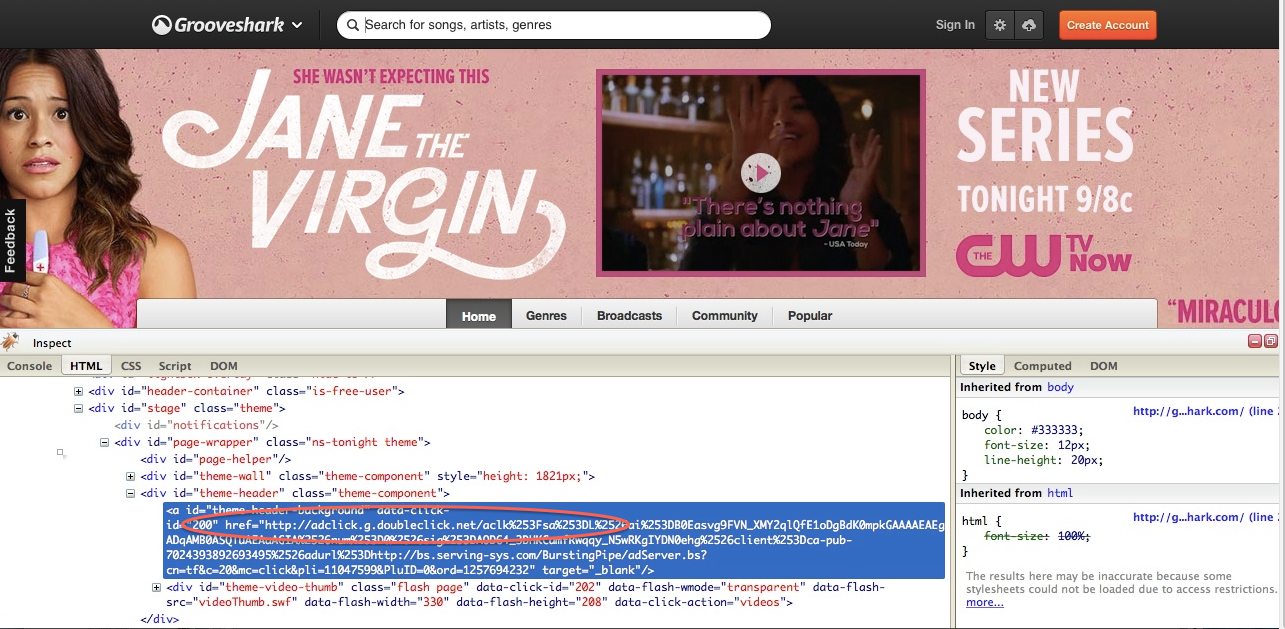
This is, of course, utter bullshit.  We’re not going to go through the whole song and dance again, but take a look at this screen shot showing Google’s Doubleclick serving an ad to Grooveshark.  That would be the adjudicated infringer Grooveshark:

Google Screen Shot 2014-10-20 at 9.37.22 AM

Here’s what Google told the BBC:

Google has announced changes to its search engine in an attempt to curb online piracy.

The company has long been criticised for enabling people to find sites to download entertainment illegally.

The entertainment industry has argued that illegal sites should be “demoted” in search results.

The new measures, mostly welcomed by music trade group the BPI, will instead point users towards legal alternatives such as Spotify [Google is on the Spotify board so presumably owns shares in Spotify] and Google Play [aka the Genco Pura Olive Oil Company 2.0].

Google will now list these legal services in a box at the top of the search results, as well as in a box on the right-hand side of the page.

Crucially, however, these will be adverts – meaning if legal sites want to appear there, they will need to pay Google for the placement.

The BPI said that while it was “broadly” pleased with Google’s changes, it did not think sites should have to pay.

“There should be no cost when it comes to serving consumers with results for legal services,” a spokesman told the BBC.

Well, allow us to retort:

This is a motherfucking shakedown.

We suspect that’s a more accurate assessment of what the BPI was probably thinking but felt constrained to say.

Combine this with thursdays Digital Music News story and we can only conclude:

Google drives traffic to illegal sites while forcing legitimate sites to pay!  How is this good news?


Are Pandora’s Disclosures Deficient Regarding pre-72 Exposure to a Music Genome Shut Off?

Some readers noticed that we spotted an interesting defect in Pandora’s most recent quarterly filing with the Securities and Exchange Commission and asked how big a deal is this defect.  Our understanding is that Pandora has been paying royalties on pre-72 recordings since its inception, but recently stopped, following which they were sued in NY state court by a group of record companies.  (Remember The Turtles are suing Sirius for much the same reasons.)

The pre-72 lawsuit challenges Pandora’s use of pre-72 recordings without compensation or a license.  (If you are unfamiliar with the “pre-72” issue, it is essentially that federal copyright protection only covers sound recordings released after 1972.  Based on Pandora’s use of these recordings in its service without a license or compensation, you might get the impression that the pre-72 recordings had fallen into the pubic domain.  Nothing is further from the truth as the recordings are protected by common law copyright and a variety of state unfair competition statutes.)

Not only is Pandora using these recordings as part of its service in violation of the copyright owners’ exclusive reproduction right and public performance right, there is a question as to whether the music genome itself misappropriates each featured artist’s right of publicity by marketing the Pandora service based on channels created using the artist’s name, an issue that recently came up in the lawsuit brought by Goldieblox against the Beastie Boys and by the Ministry of Sound against Spotify in the UK.  Not unlike a fingerprint, the music genome is a copy of the underlying sound recording in a mathematical expression as we understand it, and to our knowledge no aspect of the music genome has ever been licensed.  It certainly is not covered by the compulsory license in 17 USC Sec. 114 (the webcasting compulsory license).

So the pre-72 litigation against Pandora is important not only because of the alleged violations of state law, common law copyright and unfair competition statutes, but also because it could draw attention to potential artist-related violations may go to the heart of Pandora’s business for both pre 72 and post 72 recordings.

What Are Pandora’s Disclosure Obligations under SEC Regulations?

A public company such as Pandora is required to make a variety of filings with the Securities and Exchange Commission so that the Commission, the company’s stockholders and the public (including the financial press) can have an idea of how the company is doing and how to assess the risk of owning the company’s shares.  The way that this assessment is communicated to the company, at least in part, is in the company’s share price.  If stockholders rely on the company to properly disclose risk, especially downside risk, then they may not look beyond these disclosures such as finding a copy of the copyright owners’ complaint.

Relying solely on these disclosures instead of doing your own research is not something we would recommend for reasons that will become apparent.  Pandora is a good example of why it’s good to drill down on the company’s disclosures (and in the case of the SEC, we’re a bit surprised that the examiners at the Commission didn’t catch this).

One of the risk factors that the SEC requires public companies to disclose is pending litigation brought against the company.  This should come as no surprise, as litigation can be an existential threat to a company and to the value of stockholder’s investment.  The SEC has very specific requirements about what is to be disclosed about litigation, and those requirements can be found in Regulation S-K (17 CFR Sec. 229.103):

§ 229.103 (Item 103) Legal proceedings.

Describe briefly any material pending legal proceedings, other than ordinary routine litigation incidental to the business, to which the registrant or any of its subsidiaries is a party or of which any of their property is the subject. Include the name of the court or agency in which the proceedings are pending, the date instituted, the principal parties thereto, a description of the factual basis alleged to underlie the proceeding and the relief sought. Include similar information as to any such proceedings known to be contemplated by governmental authorities.

The “Instructions” for Item 103 provide guidance for materiality regarding legal disclosures:

2. No information need be given with respect to any proceeding that involves primarily a claim for damages if the amount involved, exclusive of interest and costs, does not exceed 10 percent of the current assets of the registrant and its subsidiaries on a consolidated basis. However, if any proceeding presents in large degree the same legal and factual issues as other proceedings pending or known to be contemplated, the amount involved in such other proceedings shall be included in computing such percentage.

Given the scope of the pre-72 litigation, it is easy to understand why Pandora would have an obligation to disclose the claim based on materiality alone.  Then the question is did they?

Did Pandora’s Disclosure Comply With Its SEC Disclosure Obligations?

Here’s Pandora’s disclosure in its 10Q:

On April 17, 2014, UMG Recordings, Inc., Sony Music Entertainment, Capitol Records, LLC, Warner Music Group Corp., and ABKCO Music and Records, Inc. filed suit against Pandora Media Inc. in the Supreme Court of the State of New York. The complaint claims common law copyright infringement and unfair competition arising from allegations that Pandora owes royalties for the performance of sound recordings recorded prior to February 15, 1972.

Pandora’s disclosure does not seem to comply with the requirements of Regulation S-K because the company does not disclose, or does not disclose fully, “the relief sought” in the lawsuit.  There is a claim for money–“allegations that Pandora owes royalties”–and also a request for injunctive relief–not addressed in Pandora’s disclosure at all.  The injunction would order Pandora to stop using the pre-72 recordings.  The claim for money relates to both the public performance of sound recordings–“for the public performance of sound recordings recorded prior to February 15, 1972”–and also to the reproduction of those sound recordings as part of Pandora’s operations–not addressed in Pandora’s disclosure at all.

Pandora makes only a minimal disclosure of “the factual basis alleged to underlie the proceeding,” some might say a flimsy and self consciously limited disclosure.  Given the historic nature of this litigation, one would think that Pandora would spend time getting a little closer to the requirements of Regulation S-K and erring on the side of more disclosure than less.

So–Pandora seems to be treading in the grey area of its disclosure requirements at a minimum.  One can be ambivalent about whether Pandora met its obligations for discussion of the facts.  But what is clear is that Pandora did not disclose the copyright owners’ request for injunctive relief and a court order blocking Pandora’s use of the recordings.  One could read the disclosure and come away thinking that it’s just a dispute about money.  It certainly is that, but it’s not only that.

Maybe Pandora’s senior management team (including their CFO as CFOs are very involved with SEC filings) didn’t think there was anything material about the injunctive relief.  If successful, an injunction could have some obvious and not so obvious effects on Pandora’s business.  We view the injunction as the relief that is most likely to succeed because of Pandora’s untenable position that it does not have to pay royalties but gets to keep reproducing and performing the pre-72 recordings.  Even if you believe that there’s no performance right in pre-72 sound recordings, there’s a serious question of whether Pandora is reselling unauthorized reproductions.

Shutting off pre-72 recordings would have the obvious result of blocking Pandora’s use of the recordings. Given that Pandora’s music genome relies on looking up music that sounds like other music to build their barely compliant channels, if Pandora suddenly lost the ability to use all music genomes for pre-72 recordings that might seriously affect its business.  No mention of that, either.

Why Didn’t Pandora Fully Disclose?

You can attribute any manner of motives to Pandora for treating their filing obligations like a press release that they can shade and spin the way they do so many other communications.  You can also wonder about what the senior management team was thinking when they approved the risk factor.  One thing seems clear though–they wrote it they way they wrote because they thought they would get away with it.

Pre-72 Red Herrings from Pandora’s Chris Harrison (and that’s not the IPO kind)

Pandora executives are still prancing around cashing out stock options while telling their stockholders that they are intentionally stiffing American artists on recordings released after 1972–well…sort of telling their stockholders.  If their stockholders are also copyright experts.  Because what Pandora doesn’t tell their stockholders is that not only is Pandora not paying royalties, Pandora’s position actually acknowledges that Pandora is still exploiting these pre-72 recordings without any rights.  This is exceptionally bizarre because if Pandora just paid the statutory webcasting royalties under the U.S. Copyright Act, they would at least have a fig leaf that they actually had some kind of license.  

By saying that the recordings are not subject to the compulsory license like all the other recordings Pandora exploits, they essentially have no license for the pre-72 recordings (but do have the compulsory license for the post-72 recordings).  So then they have to prove that when the Congress created the statutory license for webcasting and the royalty system for royalty payments, the Congress actually intended to exclude all sound recordings before 1972.  (The magic of 1972 is that is the year that the Congress first included sound recordings in the federal Copyright Act–sound recordings previously were covered by “common law copyright” not no copyright.)

According to Pandora’s latest Form 10-Q:

On April 17, 2014, UMG Recordings, Inc., Sony Music Entertainment, Capitol Records, LLC, Warner Music Group Corp., and ABKCO Music and Records, Inc. filed suit against Pandora Media Inc. in the Supreme Court of the State of New York. The complaint claims common law copyright infringement and unfair competition arising from allegations that Pandora owes royalties for the performance of sound recordings recorded prior to February 15, 1972.

The outcome of any litigation is inherently uncertain. Based on our current knowledge we believe that the final outcome of the matters discussed above will not likely, individually or in the aggregate, have a material adverse effect on our business, financial position, results of operations or cash flows; however, in light of the uncertainties involved in such matters, there can be no assurance that the outcome of each case or the costs of litigation, regardless of outcome, will not have a material adverse effect on our business. In particular, rate court proceedings could take years to complete, could be very costly and may result in royalty rates that are materially less favorable than rates we currently pay.

This risk factor is actually misleading–not only is Pandora being sued for money, the lawsuit also asks for the court to order Pandora to stop exploiting the pre-72 recordings altogether:

A preliminary and permanent injunction preventing, enjoining, and restraining Pandora and its respective agents, servants, directors, officers, principals, employees, representatives, subsidiaries and affiliated companies, successors, assigns, and those acting in concert with them or at their direction, from directly or indirectly infringing in any manner any right in any and all Pre-72 Recordings in which any Plaintiff owns or controls an exclusive right under statutory or common law, including without limitation by directly or indirectly reproducing and digitally publicly performing any of Plaintiffs’ Pre-72 Recordings….

Don’t you think that Pandora should have told their stockholders that they might actually lose the right to use pre-72 recordings altogether?

Now what is interesting about this is that Pandora chooses to take a position that hurts artists (and union players and singers) whose performances are on pre-72 recordings based on this arbitrary cut off date.  Somehow they seem to think that a recent Copyright Office study supports Pandora’s decision to screw artists.  Here’s what the Copyright Office actually said (on p. 129-130):

In reviewing the potential application of section 114 [Pandora’s compulsory license] to pre-1972 sound recordings, the [Copyright] Office believes that section 114’s statutory royalty requirements should apply to nonexempt, noninteractive digital transmissions of those recordings [meaning Pandora], thereby providing an additional revenue stream for older artists and works….The [Copyright] Office thinks it is unreasonable for the age of a sound recording to dictate whether royalties are paid on public performances by means of digital audio transmissions, so long as copyright subsists in that sound recording. Bringing pre-1972 sound recordings within the scope of federal protection would subject them to the statutory license and provide online music services with an easy means to offer lawful public performances of those recordings while offering copyright owners and performers a reliable new source of income.

What Pandora’s Chris Harrison (or “Artist Enemy Number 1” as he is known around the Trichordist) says about the lawsuit is that Pandora favors something called “full federalization” of the pre-72 sound recordings (or “the entire history of recorded music” as it is known around the Trichordist).

Harrison says that Congress made the decision not to include pre-72 recordings when it created the digital performance right for sound recordings in 1995.  We think this is actually false–many of the members of Congress who were on the House Judiciary Committee in 1995 are still on the committee, and none of them have acknowledged that it was a conscious decision of the Congress to exclude pre-72 recordings.  However, we’re looking forward to the conga line of congressmen linking up to take ownership of the decision to stiff old guys and dead cats and their heirs from webcasting royalties like Harrison wants to do.

Because…think about it.  Even if you were the man who fell to freaking Earth, would anyone in their right mind think that American elected officials would create a legal goodie in the form of a statutory royalty–which is actually fair compensation for rights the law takes away from artists and copyright owners in the compulsory license that is necessary to avoid a “taking” under the 5th Amendment–but these American officials would say but not for thee?  You American artists who gave the world the rich history of blues, jazz, rock, R&B before 1972, nothing for you, sorry.  That’s not only insane, it explains why there’s no legislative history evidence supporting Pandora’s position.

Harrison also equivocates when it comes to acknowledging this thievery:  “We’ll still pay the songwriter”.  Not the question being asked.  But Harrison tells us that the loophole is Congress’s fault.  No, it’s actually Pandora’s fault–they were paying until Harrison arrived on the scene.  We wonder what the confluence of these two events have to do with each other.  The reason that the RESPECT Act was introduced–which Pandora opposes–was to clarify this loophole, or the “Pandora loophole” as it’s known.  The RESPECT Act is really just a technical amendment and shouldn’t be opposed by anyone.

Yet Pandora rejects the RESPECT Act in favor of “full federalization” of sound recordings.  Why is this?  We think that this is one of those ice in winter situations where somebody dreams up a problem that they try to convince you that you somehow have, then wants you to give up something real in order to get them to relent.  Bullies are exceptionally good at this when they are holding on to your lunch money.  All you have to do is lick their boots and they promise to give your lunch money right back to you because they’re really only thinking of your nutritional well being.

The reasons Harrison gives for Pandora’s position start with the RESPECT Act unfairly targeting Internet radio, because Internet radio is the only one who would pay more.  If the RESPECT Act just included terrestrial radio, then that would be all better.  (That’s using the term “reason” rather loosely.)

This, of course, is the usual fallacious crap we hear from Harrison and Pandora.  The point of the RESPECT Act as told by the bill’s author Rep. Holding is a “rifle shot” solution to fix the the problem with the digital performance royalty that Pandora has created–to fix the Pandora loophole.  It has nothing to do with terrestrial radio–just like the 1995 change that created the digital performance right had nothing to do with terrestrial radio.

That’s the point.  So for Harrison to say that the problem is that the RESPECT Act only deals with Internet radio is like saying the antibiotic your doctor prescribed only dealt with the infection you have today, not the limp from the broken leg you got 10 years ago.

Harrison says that Pandora wants this full-federalization thingy for the protections built into the Copyright Act for copyright users like fair use, the ability of libraries to keep archival copies, rights of termination of transfers for artists–and of course the DMCA safe harbors.

The only problem with this list of supposedly high minded and pure souled desires of Pandora is that none of the issues Harrison identifies have anything to do with Pandora.  Pandora doesn’t rely on fair use because they get a statutory license, they’re not a library, they have proven quite unequivocally that they don’t give a rats ass about artists and songwriters, and they don’t rely on the DMCA.

Which is the revealing part–because you know who does care about most of that list?

Google cares.  This is why Pandora’s position on “full federalization” makes more sense as the position of the Digital Media Association.  Pandora’s “full federalization” position requires Pandora to take on considerable risk that is not in the interest of Pandora’s stockholders, especially compared to the ill-will, lawsuits and infringement exposure for Pandora stockholders from the decision by Harrison to stiff the old guys and the dead cats and their heirs–like Duke Ellington, The Beatles, Louis Armstrong, Roy Orbison, Johnny Winter and The McCoys.  The dominant member of the DiMA is–Google.  And Google robs artists every day with ad-sponsored piracy alone.  Not to mention the incompetent CMS and Content ID.  This smells like inside Washington back scratching to us.

And Google controls all the advertising on Pandora through DoubleClick thanks to the Antitrust Division of the Department of Justice that permitted the Google’s acquisition of DoubleClick–which gives Google such leverage over Pandora that Doubleclick has its own risk factor in Pandora’s SEC filings:

 We rely upon an agreement with DoubleClick, which is owned by Google, for delivering and monitoring our ads. Failure to renew the agreement on favorable terms, or termination of the agreement, could adversely affect our business.

We use DoubleClick’s ad-serving platform to deliver and monitor ads for our service. There can be no assurance that our agreement with DoubleClick, which is owned by Google, will be extended or renewed upon expiration, that we will be able to extend or renew our agreement with DoubleClick on terms and conditions favorable to us or that we could identify another alternative vendor to take its place. Our agreement with DoubleClick also allows DoubleClick to terminate our relationship before the expiration of the agreement on the occurrence of certain events, including material breach of the agreement by us, and to suspend provision of the services if DoubleClick determines that our use of its service violates certain security, technology or content standards.

If we’re wrong about this, we are looking forward to Chris Harrison’s explanation of exactly why all these “full federalization” issues are in the best interests of Pandora stockholders, particularly when compared to the potential downside of being found an intentional infringer under common law copyright, unfair competition and possibly some state criminal statutes.

But he can leave out his hearts and roses serenade about how much he cares about artists and songwriters getting the termination right for common law copyrights.  We can take care of ourselves without his “help” thank you very much.

Blake Morgan on How Google Alerts Drive Traffic to Pirates and Hurt Indie Artists and Labels

Music Technology Policy

After our post yesterday about how Google drives traffic to pirate sites through Google Alerts (also supported by Facebook and Twitter), I got a chance to speak to Blake Morgan of ECR Music Group.  (MTP readers will remember Blake from the #IRespectMusic campaign, still going strong.)

Blake had the same experience with his label mate Janita (whom we interviewed about her experiences in Washington, DC supporting the #IRespectMusic campaign).

nadler(L-R Tommy Merrill, Rep. Jerry Nadler (D-NY), Blake Morgan and Janita)

The point of this is that Google knows how many DMCA takedown notices it has received for certain sites.  Janita’s record was also pirated by myfreemp3 a site for which Google has received over 4,000,000 takedown notices just for Google search links.  How do we know this?  Google publishes the information in its “Transparency Report” (and for those who read this slide yesterday…

View original post 498 more words

Thank you @jannarden: AMP Radio hears artist voices, does the right thing and drops the QuickHitz format! #irespectmusic

The artists, united, will never be defeated!

Music Technology Policy

MTP readers will recall Jann Arden and the many artists who stood up to the challenge to artist rights from the “QuickHitz” radio format at a Calgary radio station.  “QuickHitz” advertises itself as broadcasting “Twice the Music”–and gets over the space-time continuum by cutting in half the already short singles edits of popular music.  (Full disclosure:  I got to know and respect Jann Arden when I worked at A&M Records in Hollywood back in the day.  Jann’s a real treasure and makes compelling records.)

That’s right–AMP plays more music by playing less.  Dare I say it:  Less is More.  But let’s not rub it in–the station has seen the light after Canadian and American artists rallied behind Jann Arden to make their voices heard.  It’s important to understand just how much chutzpa this takes–the stick that broadcasters have held over artists challenging radio for decades has been that silent threat…

View original post 337 more words

@jannarden is Banned on Newcap Stations Through Patented QuickHitz Infringement Machine

Music Technology Policy

As you know, Canadian artist Jann Aden spoke out against the vile “QuickHitz” radio format that cuts songs in half to sell more advertising.  Jann singled out the AMP radio station in Calgary, which is one of 100 or so stations owned by the Newcap Radio chain in Canada.  Jann indicated in a slightly obscure tweet last week that she’d been banned from the station by “Steve Jones”.

I find it hard to believe that jocks on a station would actually believe that slicing and dicing songs without artist consent was a good idea.  But radio is a tough business and I don’t blame them for wanting to keep their jobs.  However, this is exactly the kind of market power abuse we expect from the National Association of Broadcasters (who at the moment strives to keep the U.S. government’s boot on the throats of songwriters.  Why?  Because “this…

View original post 325 more words