The orphan works issue is back and being
jammed through the UK Parliament right now

Music Technology Policy

[Editor Charlie sez:  Given that the Google Party in Europe is jamming a new orphan works on steriods bill through the UK and EU Parliaments, this is a good time to repost this history of orphan works from last year.  See “UK’s Brazen Copyright Landgrab Sneaked Into Enterprise Bill” and Photography Organisations Raise Objections to EU Orphan Works Law]

In the aftermath of the Google Books debacle, we are starting to hear noises that Google will back a new orphan works bill in this Congress.  There are some commentators—truly misguided in my view—who are calling for Congress to bring back the failed legislation from 2008 known as the “Shawn Bentley Orphan Works Act”.  (The late Shawn Bentley was a tech industry lobbyist and former Senate Judiciary staff counsel.)  Let’s review that legislation in light of what we now know.  (For a more detailed account, see Unhand That…

View original post 1,631 more words

Musician’s POV: Five Things Spotify (and others) Could Do Today to Level the Playing Field for Independent Artists

Guest post by Chris Castle

We’ve talked about piracy, but now let’s change that conversation to talk about the “New Boss” licensed services.  One of the problems for artists selling their music, films or books in the legitimate digital space is getting a fair deal from the New Boss distributors.  And that is exactly what they are–digital distribution requires artists and labels to outsource what are essentially manufacturing and distribution functions.

That’s fine if it creates efficiencies, but what it also has done is create a huge dodge for the “New Boss” who tries to say that any problems that artists have with them is a problem with the “Old Boss” who made the deal the artists don’t like.

That gloss doesn’t work for independent artists, though, because there is no “Old Boss” to point the finger at.  Even if there were, the Old Boss is usually a union signatory under a collective bargaining agreement that allows a negotiation team to air grievances directly with the labels.  That doesn’t happen with the New Boss.  There’s a reason why Senator Rockefeller said that the big tech companies (pretty clearly meaning you know who) were worse than the monopolist Standard Oil (which was run by John D. Rockefeller, Senator Rockefeller’s great grandfather).

As far as we know, there is no New Boss who is a union signatory.  In fact, the old joke goes that tech companies know so little about unions that they think collective bargaining is venture capitalists setting a target’s valuation.   For example–YouTube refuses to be audited by independent publishers.  That would never happen at a record company–they might take an edge in other ways, but if they ever denied an audit right there would be a revolt.  In fact, the New York Attorney General sued major labels over “unclaimed” royalties and California has laws about transparency in record company statements thanks to Don Henley.  The sheer indifference and arrogance from the New Boss companies is startling and leads to one answer–they do it because they can get away with it.  And nothing says Internet Freedom like getting away with it, right?

Nowhere is this indifference to artists more apparent than in subscription services.  (We have some thoughts on a la carte download services, too, but that’s a subject for another day.)

We tried to think of five things that Spotify (and their competitors in the subscription business) could do today to level the playing field for independent artists.  These are things that wouldn’t cost them much, but that would be very helpful to artists making less than say $2500 a year from the service.  Leave a comment if you have other ideas or if you disagree.  (And you’re welcome, Spotify, Rhapsody, Napster, Google this is free market research for you.)

1.  Remember, nobody ever negotiated royalty terms with independent artists, it was just presented as take it or leave it.  Make the royalty rate more fair and transparent in two ways:  First, stop deducting out of pocket costs for advertising sales commissions (and all other advertising-related costs) off the top from independent artists.  Spotify and the others shoud eat those costs out of their revenue share rather than making independent artists bear 50% of these costs.  Second, pay artists a per-stream minimum across all your products.

2.  Spotify can start linking from Spotify’s internal artist profile page to places that actually might help the artist, like artist websites or tour information.  As Zoë Keating said “I wish Spotify would do more to facilitate the connection between listeners and artists — i.e show that the artist is playing nearby, or add links to buy music.”  We think she’s got a great point and we’re sure that most artists would be happy to reciprocate with a link to Spotify.

3.  Promise to pay each independent artist on the service a fixed amount of money as a bonus if Spotify goes public or is sold.  $5,000 each sounds good to us, and if Spotify has a $1 billion valuation now…. They will certainly be able to afford it if their valuation is high enough for a firm commitment underwriting (aka IPO).  This promise will not cost Spotify anything right now and won’t slow down its growth–which seems to be the most important thing to Daniel Ek.   Spotify would only pay it at the liquidity event, i.e., when they have the money.  Remember–sharing is caring.

4.  Let independent artists sign up for Spotify for free.  Either give the artists access to upload their music, or cover the costs of forcing artists to use an aggregator by grossing up their royalty split.  Please don’t charge us to make you rich.

5.  Contribute something to music education foundations, like Instruments A Comin’ (Tipitina’s Foundation) or to a musicians health care organization like the Health Alliance for Austin Musicians.  Would this really be so hard?  Start with 1% of revenue, even 1/2% of revenues.  And please don’t set up your own charity so you can have parties and give yourselves awards every year.  We already have those.  Save the money on the back patting and give it to people who are already doing the good works.  It would make a big difference in the lives of the next generation of artists and to families.  Good PR for Spotify, too, you could use some.

It feels good to do some good.  If that’s not enough reason, think of it as preserving your supply chain.

The Wall of Shame Continues: Tell Them If You Do Not Want Your Records and Tours Advertised on Pirate Sites–no @mcdonalds for you

We’ve been posting about advertising on illegal lyric sites and it has become apparent that these sites are pretty clearly direct infringers–meaning they don’t get safe harbors.  This is because all seem to directly copy the lyrics themselves.

It’s also very apparent that the sites are based in China and other locations outside of US law.  Yet–of course–they all prattle on about how they respect the “DMCA” as though US law applied to them wherever they are located and that they are entitled to the “DMCA” safe harbors, which they pretty clearly are not.

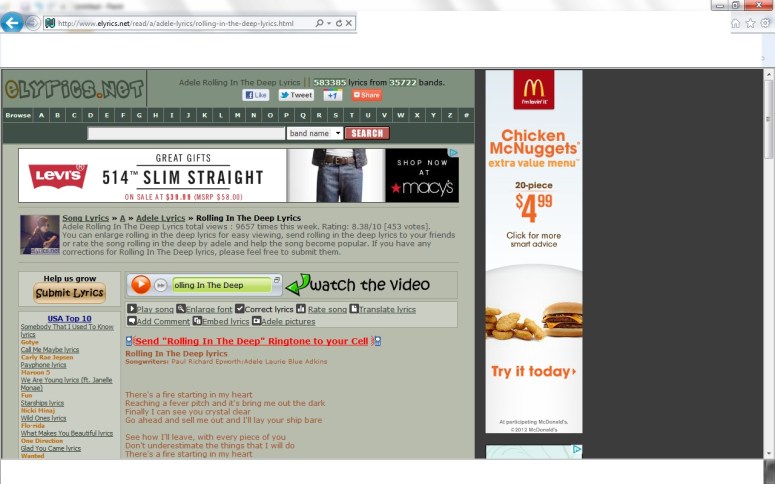
Plus, these sites sell a ton of advertising, have referrals for spyware and illegal ring tones, link to artist videos on YouTube,and both the sites and the advertisers free ride off of the brand identity of artists and songwriters whose lyrics are stolen.  This advertising is not only from US companies, but is mostly from Fortune 500 companies like McDonalds, Macy’s, Levi’s and CVS Pharmacies.  Do these companies care so little about artists and songwriters that they are willing to associate their brands with unlicensed lyric sites?

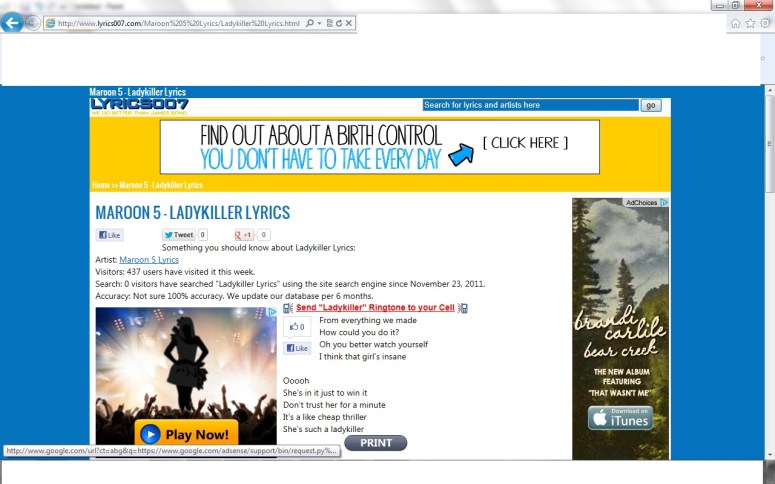
Unfortunately, we have also seen several instances of legitimate artist ads being served to pirate sites such as this Brandi Carlisle ad (below on the right) served to an the Lyrics007.com illegal lyric site.  This ad for Brandi Carlisle’s new album is served next to Maroon 5 lyrics and a click through ad to a spyware toolbar that attracts users with the hope of acquiring more “free” mp3s–and we all know what “free” means.

The Brandi Carlisle ad is served by Google’s “AdChoices” adserving network and we saw many that were served by Doubleclick.  (In case you missed it, “AdChoices” used to be called “Ads by Google” but was changed during the SOPA debate for some unknown reason.)

And the answer to how in the world does a record company’s ad show up on an illegal lyric site probably lies with the adserving network.  That ad network–Google in this case–knows where the ad inventory exists, but won’t tell the advertiser where their brand is being promoted.  So you get these incongruous pairings.

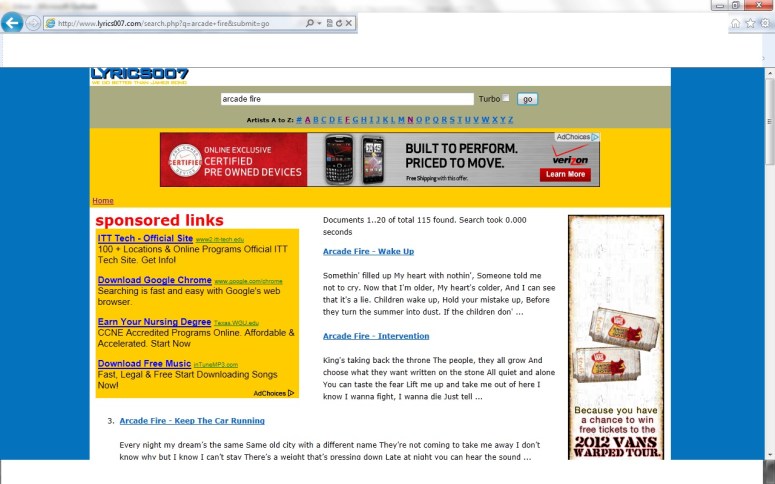
And then there is another legitimate ad for the Warped Tour served next to illegal lyrics for Arcade Fire as well as Google AdChoices sponsored links for Google Chrome and what appears to be a pirate mp3 download application (more likely spyware but we didn’t want to find out) as well as some other bogus looking stuff.

So what can you do as the artist or the artist’s negotiator?  Tell your lawyer or manager that you require in your record deal or tour contract that your name and brand cannot be used in advertising served to illegal sites.  You can even list examples of the sites.  In your tour contract, require that the tour not advertise on pirate sites and give examples.  There may be some advertising networks that are so corrupt that they shouldn’t be used at all.

Don’t stop there–also require that the tour obligate sponsors (or their ad agencies) to not advertise on pirate sites.

Before you throw up your hands and say “forget it, they’ll never agree to that” remember–artists didn’t used to get approval over singles, approval over the use of their music in commercials, or in political ads.   Now it’s pretty routine.

You don’t get if you don’t ask.

[ WHY ARENT MORE MUSICIANS WORKING ] [ ARTISTS FOR AN ETHICAL INTERNET ]

The Human Rights of Artists

By Chris Castle

Given the plight of Chinese poet Zhu Yufu today is a good day to think about the human rights of artists. The human rights of artists is a different concept from intellectual property rights, such as copyright. Intellectual property rights are created by national laws, and the human rights of artists are recognized as the fundamental rights of all persons by all of the central human rights documents to which hundreds of countries have agreed.

These rights resonate in a number of international and national documents, but a good international agreement to consider first is the International Covenant on Economic, Social and Cultural Rights that was ratified by the United Nations General Assembly on December 16, 1966. It is important to remember that human rights are fundamental, inalienable and universal entitlements belonging to individuals, individual artists in our case. As a legal matter, human rights can be distinguished from intellectual property rights as intellectual property rights are arguably subordinate to human rights and actually implement at the national level the human rights recognized as transcending international and national intellectual property laws.

The Covenant recognizes everyone’s right—as a human right–to the protection and the benefits from the protection of the moral and material interests derived from any scientific, literary or artistic production of which he or she is the author. This human right itself derives from the inherent dignity and worth of all persons. The Covenant recognizes these rights of artists (in article 15, paragraph 1 (c):“The right of everyone to benefit from the protection of the moral and material interests resulting from any scientific, literary or artistic production of which he or she is the author.”

These human rights are transcendent and timeless expressions of fundamental entitlements of humanity that safeguards the personal link between authors and their creations as well as their basic material interests. These rights are personal to the authors and artists concerned and are arguably of broader scope than the rights that can be enforced under particular national intellectual property regimes.

The human rights of authors are recognized in a multitude of international agreements, including article 27, paragraph 2, of the Universal Declaration of Human Rights: (“Everyone has the right to the protection of the moral and material interests resulting from any scientific, literary or artistic production of which he is the author”); article 13, paragraph 2, of the American Declaration of the Rights and Duties of Man of 1948 (“Every person has the right…to the protection of his moral and material interests as regards his inventions or any literary, scientific or artistic works of which he is the author”); ; article 14, paragraph 1 (c), of the Additional Protocol to the American Convention on Human Rights in the Area of Economic, Social and Cultural Rights of 1988 (the Protocol of San Salvador) (“The States Parties to this Protocol recognize the right of everyone…[t]o benefit from the protection of moral and material interests deriving from any scientific, literary or artistic production of which he is the author”); and article 1 of Protocol No. 1 to the Convention for the Protection of Human Rights and Fundamental Freedoms of 1952 (the European Convention on Human Rights) (“Every natural or legal person is entitled to the peaceful enjoyment of his possessions. No one shall be deprived of his possessions except in the public interest and subject to the conditions provided for by law and by the general principles of international law”).

These precedents clearly enunciate the goals of the international community. The Covenant is closely linked with the right to own property (recognized in article 17 of the Universal Declaration of Human Rights) and workers’ rights to adequate remuneration. The “material interests” protected by the Covenant are protected under the right to an adequate standard of living.

These moral rights include the right of authors to be recognized as creators of their works and to object to any modification of their works that would be “prejudicial to their honor and reputation.” The protected interests of artists include the right to just remuneration for their labor as well as the moral right to the “intrinsically personal and durable link” between creators and their creations that survives even after the passing of the work into the public domain. This rule will no doubt come as a shock to those wishing to sell consumer electronics devices to the “remix culture” bent on perpetuating regurgitative “art.”

And what bothers me the most about the massive, worldwide infringement of artist human rights is not just that major multinational corporations like Google are knee-deep in perpetuating this exploitation economy. It is that the governments of the world have—until last year—done very little or nothing to stop it. And in that regard, these governments have failed to protect the human rights of artists.

If there seems to be a coordinated effort in many countries to oppose the rights of creators, that’s because there is—a complex effort very well described in the book Winning the Web, written by the former head of the Open Rights Group and sponsored by the Open Society Institute (www.soros.org). (The Open Rights Group (or “ORG”) is essentially the UK version of the Electronic Frontier Foundation and is a voice in the opposition to artist rights protection under the UK Digital Economy Act.)

But these coordinated attacks on artists’ rights also extend to some unlikely places—such as the United Nations Human Rights Council. This is not surprising because there has been a sustained effort to define away an artist’s ability to protect these transcendent rights (“it’s not really theft”)–the success of the anti-copyright crowd in destroying artists is in part dependent on getting over this issue. If the ORG, EFF and Google can define away an artist’s right to protect their rights through ridicule (such as Lessig’s obliging piece “The Starving Artist Canard“) , or by making them small as Lessig said on a Pirate Party UK video, “we” should not “break the Internet” to protect a “tiny industry” such as the hated “Hollywood”, then it will be easier for Google to roll over artists. Then it is easier to define an artist’s human rights out of existence altogether. And doesn’t that just sound like a human rights violation? Their reach is deep–I find it very strange that the Special Rapporteur for the UN Human Rights Commission fails to address the human rights of artists even once. The Special Rapporteur’s conclusions would impose grave burdens on artists, yet bends over backwards to protect the rights of corporate intermediaries online–and specifically mentions Google.

Of course it is not enough that the States of the General Assembly merely recognize these rights of artists in a number of international agreements—the States also have undertaken the affirmative obligation to protect these rights of authors. Those protections include adequate legislation and regulations, as well as making effective administrative, judicial or other appropriate remedies available to authors within each jurisdiction. Access to such remedies must be affordable, or as I have said in the past—violations of moral rights cannot be remedied only if the rich seek to enforce their rights.

Anyone who takes seriously the international human rights of artists will find “Big Tech’s” dismissive use of “moral panic” to be deeply offensive to professional creators. It is Orwellian to describe as a “moral panic” an allegation of immorality being associated with massive illegal downloading that deprives creators of their ability to pursue work which they freely chose and remuneration for that work enabling them to achieve an adequate standard of living.

Google’s Patry has, in fact, travelled the world speaking to NGOs and universities trying to make his case that using the language of morality to describe massive online theft is somehow insidious and that it should stop immediately. Or, as his employer Google might say, “Don’t be moral.” This “don’t be moral” admonition obscures much more than mere lusting for commercial gain on the part of Google and the Pirate Bay. The protection of artist rights—many of the rights of the professional creative class—are entitled to protection as human rights.

The human rights of artists have nothing to do with intellectual property laws that apply to corporations, or “Big Music”, or the even bigger “Big Tech”, it has nothing to do with superstars. A national artist in the smallest country has equal protection with the global superstar under the U.N. human rights treaties.

This is a complex topic that is well worth studying further.

###

[ THE 101 ] [NEW BOSS / OLD BOSS ] [ SPOTIFY ] [GROOVESHARK ] [ LARRY LESSIG ]
[ JOHN PERRY BARLOW ] [ HUMAN RIGHTS OF ARTISTS ] [ INFRINGEMENT IS THEFT ]
[ THE SKY IS RISING : MAGIC BEAVER EDITION ] [SF GATE BLUNDERS PIRACY FACTS ]
[ WHY ARENT MORE MUSICIANS WORKING ] [ ARTISTS FOR AN ETHICAL INTERNET ]

Musicians POV: Spotify Isn’t Good For You (Part 5 of 5)

This is Part 5 of a 5 part post read Part 1 here, Part 2 here , Part 3 here and Part 4 here.

See also “Streaming Price Index: Pay Rates as of 12/31/11″

Since it is unlikely that Spotify will give what we have seen will inevitably an unexciting stock opportunity or board seat to an artist, and since the hold back negotiations will likely take a while to get through the deal process to become the standard that the record club holdback became, what can we do right now to affect behavior at Spotify?

1.  True-up payment:  Given that Spotify has gotten to the point that it can raise more money than it needs and intends to continue on a growth juggernaut based entirely on the value of its artists, Spotify needs to distribute out a kind of dividend to the participating artists.

This should be a significant payment, hundreds of millions.  It would acknowledge that Spotify knows that its valuation is based on artists, producers and songwriters and not based on tech oligarchs.

Labels and publishers should allow this payment to flow directly to their artists and writers, i.e., not apply it against unrecouped balances.

2.  Increase the royalty rates

Since Spotify is raising money it doesn’t need, Spotify can afford to establish a fair royalty for artists—even something like 1¢ per stream for artists and 1¢ for songwriters.  This would reflect the co-equal copyrights of songwriters and artists.

Spotify should also gross up its royalty payments to pay pension, health and welfare to AFTRA and AFM in the US and comparable unions in each territory where it operates.

3.  Transparent Royalty Accounting

Spotify should make all of the royalty accounting back up available to each artist and label online.  This will make auditing easier for both the labels and publishers auditing Spotify and the artists and songwriters auditing their respective label and publisher.

4.  Give Us a Kiss

We like a little affection when we’re getting screwed.

Musicians POV: Spotify Isn’t Good for You (Part 4 of 5)

This is Part 4 of a 5 part post read Part 1 here, Part 2 here and Part 3 here

See also “Streaming Price Index: Pay Rates as of 12/31/11″

Fair Play for Artists

Spotify’s business model is actually the kind of extraordinarily short sighted economics that you see from people who don’t understand the business they are in.  Take Walmart for example.  They drive a hard bargain, but they are not trying to leverage themselves off the back of thieves.

Walmart doesn’t say to its suppliers that Walmart is better than the alternative of being robbed blind, but will only make the benefit so incrementally tiny that the supplier will go out of business at that rate.  This is the commoditization rate, or what we call “less than zero” pricing.  This sounds just fine to someone whose salary is guaranteed by venture capitalists, but makes no sense for the artists—and they are leaving Spotify in droves.

Walmart knows that they succeed when their suppliers succeed and the consumer succeeds.  The pricing that Walmart pays to suppliers is based on buying power and a mission of offering consumers low prices, meaning that everyone in the chain takes a little less and truly does make it up on volume.  That method is not for everyone, which is why you don’t see just every brand in Walmart.

Spotify’s valuation is based on a business model that is inherently unfair to artists, producers and songwriters.  This accounts for its low conversion ratio—it’s a couple points away from a pure pirate service and has failed miserably in the one thing it had to do to justify its existence: convert free to paid customers.

And even if it did succeed, that would be the worst possible world for artists, because there is little difference in the functionality of a top tier Spotify service and buying a download from iTunes–aside from the price paid to the artists, producers and songwriters, of course.  There is even some evidence that suggests that fans who were buying downloads are shifting to Spotify’s free service and substituting away from paying for downloads legally to a free legal service–the exact opposite of how Spotify has sold its service to artists as the “piracy buster”.

Next: Part 5

See Part 1 here, Part 2 here and Part 3 here

Musicians POV: Spotify Isn’t Good for You (Part 3 of 5) –

This is Part 3 of a 5 part post–read Part 1 here and Part 2 here

See also “Streaming Price Index: Pay Rates as of 12/31/11″

How to Enforce Windowing

Spotify is actually very similar to the old record club model—the labels owned the company and they made significant revenues on hit product sold through the record club at a reduced royalty rate for both artist royalties and a ¾ of ¾ royalty rate for mechanical royalties.

It was common for record companies to agree to give a 90 day hold back on record club sales, meaning 90 days from the U.S. release, and in some cases that date could be pushed out as far as 12 months, or in some cases a “reasonable time”.

There really is very little difference between the functional issue that gave rise to the record club holdback.  The record company wanted to sell the artist’s recordings in a way that profited the record company more but paid the artist less, and the way the artist protected themselves from this arbitrage was to create a window where the record company could not cannibalize front line sales.

An artist could also ask for downside protection on streaming services that would require a minimum payment of a penny rate to the artist.  This is in part because it is very difficult to get record companies to give the artist the digital service accountings on audit, so at least if there were a per-play minimum, the artist could essentially handle the streaming service in a simple desktop audit of penny rate multiplied by number of reported streams (assuming the artist can even extract that information).

This is, to be clear, an issue for artists negotiating with a label or a distributor, less so for an artist with a digital aggregator.

For example, an artist could ask for a ad-supported service holdback of 12 months from the U.S. release date, and a per play royalty of a minimum of 1¢, going to 2¢ or more if the holdback was violated.  This would mean that if the label violated the holdback and allowed the ad-supported service to stream the title during the 12 month holdback, then it would cost the label a penalty.

This of course is something that will only be discovered on audit, so be sure to draft your contracts so that your business manager or accountant can call up the label after receiving an incorrect statement and ask for an adjustment based on unequivocal contract language.  (And good luck with that.)

____________________________

Next: Part 4

See: Part 1, Part 2,

Musicians POV: Spotify Isn’t Good for You (Part 2 of 5)

This is Part 2 of a 5 part post on Spotify–read Part 1 here

See also “Streaming Price Index: Pay Rates as of 12/31/11″

A Billion is Cool

To be clear—no one artist would own any of the shares, but by signing up for Spotify they would have a right to the proceeds from the sale of these shares based on being a participating artist.  This is because each artist—particularly new artists—on an ownership basis is as important as any other artist.  The artist stockholders would then have a say about royalty rates based on their board seat, a minority voice to be sure, but a voice nonetheless.  A seat, by the way, that should be held by an artist, not a manager or lawyer as the “artist representative” but a bona fide artist.

Here’s an example:

Daniel Ek transfers a number of shares equal to 18% of the outstanding shares of the company into an escrow account.  The sole purpose of the escrow account is to sell the shares on a liquidity event.  When the liquidity even occurs, the proceeds of the sale are received by the escrow agent (such as an unrelated bank) and are distributed to each artist whose tracks were continuously available on Spotify after the date the escrow was created through the date of sale.  If artists removed their tracks during the period, they’d lose their right to the escrow funds.  All these payments would be made to the artists directly but the artists could not force a sale prior to the liquidity event.  (That would likely be too complex from a securities law point of view.)

So if 18% is worth $720,000,000 and the sale occurred today, and assuming there are 200,000 qualifying artists on Spotify, then each artist would be entitled to $3,600 (less some administration fee for the true transaction costs).  Even though this money would be paid off contract (a meaningful concept to unrecouped major label artists), it still does not amount to much.

Now—this is not a particularly exciting number.  Even if you allocated these funds based on aggregate streams by artist, you would essentially be letting the major labels off the hook with their own artists to share any of these proceeds with them, and even then it is unlikely that this calculation would result in a life-changing amount of money comparable to the return to the venture investors.

So another way that Spotify could do this is to agree to pay out a certain amount of money to each participating artist that would be something in the range of $25,000 to $50,000 each.

Because you know what’s cool?  A billion is cool.

_________________________

Next: Part 3

See also: Part 1

Musicians POV: Give it to Mikey, he’ll eat anything! Spotify is (NOT) Good for You, Yum Yum! (Part 1 of 5)

Mikey’s Not Here

If you remember the old “Life” cereal ads, they featured kids who didn’t want to eat Life cereal because it was “good for you” so who would like that?  Test it out on “Mikey”, the hyper critical eater—”Give it to Mikey, he hates everyhing!”  And surprise, surprise, Mikey likes it.

So it is with Spotify.  Mikey may eat it, Mikey may even proselytize about its wonders of valuation, but Spotify is not only not good for you, it’s actually bad for you.  The good news is (maybe) there’s something every artist can do about it.  Unless, of course, they listen to “Mikey”.

Here’s the proposition:  From a financial point of view, Spotify’s payable royalties are neglibible–marginally better than a pirate site.   (See “Streaming Price Index“) Spotify is, of course, a licensed service and it is encouraging to see investment pouring in to its coffers.  Make no mistake–we’re happy it exists.  The unfortunate thing is that Spotify is another example of reacting to massive piracy with a business model that in the long-term is nearly–although not quite–as unsupportable as the piracy it promised to help fix.

Spotify”s model is essentially a variation on Web 2.0, or as we say around the Trichordist, The Man 2.0.  With the usual Web 2.0 company the users provide all the content and the tech oligarchs (or wanna be oligarchs) get all the money.  (Like with Facebook, Flickr, YouTube, Google, Wikipedia, Instagram in no particular order.)

Except with Spotify it is the artists (and not the users) who create all the value and get none of the profits.  Like other Web 2.0 darlings, the tech oligarchs build the platform, create none of the content and will get the lion’s share of the profits on Liquidity Day.  Spotify is just a couple compass points away from oligarch status—call them mini oligarchs.  In the meantime, Spotify profits from the artists and pay a laughable royalty in return.

So in the words of a famous revolutionary, what is to be done?

First, consider whether there is any benefit from being a Spotify stockholder.  We think we will see that there is not much financial benefit.  Then we consider how you can keep your music off of Spotify, even if you are a major label artist.  Then we consider how you can force the company to pay a fair rate.

What if Artists Were Stockholders?

So who makes money?  First and foremost—Spotify employees starting with Daniel Ek.  These guys get a steady paycheck and have equity in a dark future for artists.

Next, venture capitalists who are the 1% of the 1% don’t forget.  These VCs, especially Silicon Valley VCs, are some of the richest people in America who nearly single handedly brought you the stock market crash of 2000 when the last tech bubble popped in a frenzy of irrational exuberance.

It is pretty common stuff for these people to personify the long simmering rivalry (largely one-way) between Northern and Southern California.  The Internet was a force multiplier that weaponized that hatred.  This, of course, results in screwing artists.  (See the embarrassing post “Kill Hollywood” by elite VC Paul Graham of Y Combinator, the home of digital chickenfeed: “How do you kill the movie and TV industries? Or more precisely (since at this level, technological progress is probably predetermined) what is going to kill them?”  Search for the word “artist”—no matches found.)

And of course, another group of Spotify stockholders are the major labels who extracted equity ownership in the company in return for licensing catalog at ridiculously low royalty rates.  The fairly consistent rumor is that the labels own 18% of Spotify, which at its most recent valuation of $4 billion is worth $720,000,000.

Here’s the twist—because the deal with Spotify is for the entire catalog of each label and not of any particular artist, it is doubtful that any artist will ever participate in that 18% equity.  If you think of that 18% as being subject to the 50/50 net receipts allocation (the issue in the Eminem case), there’s a very easy fix to this.

Spotify can allocate another 18% of its equity to an artist stock pool.  Artists would not need to own that pool, but it could be held in trust for all artists who ever have participated in Spotify and all artists who will participate in Spotify before the “liquidity event” that would turn that stock into cash—an IPO or acquisition, typically.  All other terms of stock ownership could be on the same terms as the labels.  And, of course—an artist would be appointed to the Spotify board with full voting rights to vote the full 18% block of shares.

These don’t have to be new shares—Daniel Ek and Spotify can hand them over from previously issued stock to give to Spotify’s artist “partners” an incentive to stay with the company.

___________________________________

Next: Part 2 Could Artists be Stockholders?
Fake Fridays: The Google Diaries: Fake Larry Does Seattle Human Trafficking Protests Against Google

Secret Diary of Fake Eric Schmidt, April 6, 2012

[Deleted]

Secret Diary of Fake Larry Page, April 6, 2012

Since Eric and Fred told me I can’t archive my Gmail anymore, I guess I have to write this diary.  I can’t believe these people are using a petition on Change.org against Google!  We gave these people so much money!  I mean, this is Larry’s thing, right?   How dare they use Change for petitions against us!  Maybe Chilling Effects can get involved?  What do we have it for? Note to self, ask Fred about Chilling Effect and Change.org.

Why do we get accused of all these bad things that nobody has ever told us to stop doing?  And how do we know these so-called “pimps” are doing anything illegal or even bad!  These are our users, we don’t sue our users just cuz some whacko actress says one of them is a so-called “pimp”!  That’s censorship! I mean how do I know that Googlers do anything bad if nobody tells me!!  Just because we sold one ad for one pharmacy one time, what does that even mean!  Eric said we were sorry!  We’re always sorry, why isn’t that enough?  We’re not censors!  We’re not responsible for anything, we just give users convenient ways to find things.

The flacks started talking to me today about trafficking, I mean that’s our business, right?  If we can’t do trafficking, then there’s no Google.  The record label music companies think we should be going after these so-called pimps who pay for these ad.  No, wait, not the music company label records, its someother censorship facists who want us to stop selling advertising.  Traffic, Google, interchangeable, right?  But they were talking about human trafficking, what does that even mean?  We sell traffic, nobody knows what the machines talk about, that’s between them.  How do they get human traffic out of machine traffic?  It’s all so confusing sometimes.

I have to call Mike and get him to go after whoever is saying these bad things, put their names on the list.  He had that great quote from Teddy Roosevelt, “the man in the arena whose face is marred by dust and sweat and blood, who strives valiantly”.  Boy, that’s me, that’s us.  They just don’t realize how much they need us to make everything scaleable and convenient.  Well, one day they won’t have Google to kick around anymore.

That’s what it is, these protesters just don’t understand how cool it is for things to be convenient!  When everything is convenient, then you don’t ever have to complain about anything.  Except…you know, when you forget the refill.

Convenient is cool.  Google is cool.  Google means convenience.  Google means no complaining.  We know what users are thinking before they do anyway so what are they complaining about?  And so what if our customers are these so-called pimps!  We’re not going to become sex cops for the government censors!  Don’t they appreciate all the cool products we give away for free?