MTP Interview with Blake Morgan on the First 30 Days of #irespectmusic

Music Technology Policy

MTP:  How was the audience reaction for your first 30 days on the I Respect Music petition campaign? 

Blake Morgan: It’s honestly––and very happily––been above and beyond anything we could have estimated or ever hoped for. If you ask anyone who’s been working with me on this, they’ll tell you that the goal I’d set for us was to try to get 1,000 signatures in our first 30 days. A daunting number to try and reach for a petition to Congress about paying artists for radio airplay. But, it turns out that after 30 days we’re actually at 10,000 signatures.

A Huffington Post Op-ed of mine in December [“Art and Music Are Professions Worth Fighting For“] garnered a huge reaction going viral with over 44,000 likes and over 8,000 Facebook shares. That was the piece where I first wrote the words “I Respect Music.” So I knew there…

View original post 630 more words

GEMA wins against YouTube In Germany on “Blocking Screens” | Media Biz

A German court found that YouTube has to stop misleading the public by blocking certain content and publicly shaming GEMA for it (the German association of composers, lyricists and music publishers.) A first step in the right direction.

Heker referred to the decision as “an important and positive signal to the music authors,” because: “It is not the GEMA, which prevents music on the internet you only want to license YouTube, like all other music portals..” Heker sweeps out: “Our concern is that the authors participate in the economic exploitation of their works and can earn their livelihood in the future.”

READ THE FULL POST MEDIA BIZ (GERMAN):
http://www.mediabiz.de/musik/news/gema-feiert-im-streit-um-sperrtafeln-erfolg-gegen-youtube/344107?Nnr=344107&NL=MWBlitz&uid=8514

IN ENGLISH VIA GOOGLE TRANSLATE:
http://bit.ly/1gzOCkT

Musicians Sing for a Cause That’s Their Own | The New York Times

In the latest example, a group of artists including David Byrne, Mike Mills of R.E.M., John McCrea of Cake and the guitarist Marc Ribot are putting on a free concert on Tuesday at Le Poisson Rouge in Greenwich Village to protest the way radio stations pay royalties, and to introduce a new advocacy group, the Content Creators Coalition.

“This is possible now because musicians and artists are fed up,” said Mr. Ribot, who is renowned for his work with musicians including Tom Waits, another coalition member. “It takes a lot to get a musician to go to a meeting, serve on a committee. It’s not what we do; we play music. But the way things are now, many of us feel that our backs are to the wall.”

READ THE FULL STORY AT THE NEW YORK TIMES:
http://www.nytimes.com/2014/02/25/arts/music/musicians-sing-for-a-cause-thats-their-own.html?_r=1

Digital albums overtake CDs in the US, but iTunes music revenues down | Music Ally

We’re more interested in its estimates for the revenue growth in 2013 of the various content categories in iTunes: apps up 105%, video up 19%, but music downloads down 14% of the year.

Streaming music’s impact isn’t a surprise, but it’s good to have more data to quantify what’s happening – albeit without the corresponding global increase in revenues from streaming services.

READ THE FULL STORY AT MUSIC ALLY:
http://musically.com/2014/02/12/digital-albums-overtake-cds-in-the-us-but-itunes-music-revenues-down/

Pandora Suit May Upend Century-Old Royalty Plan | NY Times

After federal antitrust investigations, both groups agreed to government supervision in 1941.

This system has hummed along for decades. But with the rise of Internet radio, publishers have complained that the rules are antiquated and unfair. They point to the disparity in the way Pandora compensates the two sides of the music business: Last year, Pandora paid 49 percent of its revenue, or about $313 million, to record companies, but only 4 percent, or about $26 million, to publishers.

“It’s a godawful system that just doesn’t work,” said Martin N. Bandier, the chairman of Sony/ATV, the world’s largest music publisher.

The wider music world has been galvanized by the issue of low royalties from fast-growing streaming companies.

For songwriters, Ascap and BMI have also been among the most reliable institutions in the music industry, and few want to see them go. But Rick Carnes, a Nashville songwriter and president of the Songwriters Guild of America, said that while these organizations had served him and his colleagues well, the Justice Department agreements that govern them were outdated and must be changed.

“This is a horse-and-buggy consent decree in a digital environment,” Mr. Carnes said. “There’s no way that works now.”

READ THE FULL STORY AT THE NEW YORK TIMES:
http://www.nytimes.com/2014/02/14/business/media/pandora-suit-may-upend-century-old-royalty-plan.html?

The “Bad Romance” of Musicians and Silicon Valley : Happy Valentines Day

You’ve heard this story before, or actually – you’ve seen the movie. This is like a John Hughes film the 80s. You know the ones about High School Romance. The plot lines from these movies remind us a lot of the bad romance between Silicon Valley and Musicians over the last decade or so.

You’ve heard this one before…Before the internet musicians had a largely dysfunctional but not entirely bad relationship with record labels, like the self obsessed jock. Labels would wine and dine artists, buy them gifts, lure them back to the fancy label HQ and fawn all over them. This love affair would usually continue through the making of the record and up and until the album was released. After that, the honeymoon period would be over and disagreements over money and creative issues would start to surface. Eventually, artists would become increasingly dissatisfied with their partner and the dirty laundry would become public. Labels would be accused of taking the artist for granted, not giving them enough attention and be unresponsive to their needs.

Then one day, the Silicon Valley drives up the school in a shiny new Ferrari convertible, music blasting, well dressed and charming. Silicon Valley says all the right things to artists, “labels are bad news, they don’t appreciate you.” Artists are wooed by the possibilities of their wind blowing in the air in the passenger seat of the Ferrari on their way to a better future. Silicon Valley tells the artists that not only do they not need the labels, but Silicon Valley will empower the artist to be truly independent. The artist, enamored with this world of possibility and opportunity joins hand in hand with Silicon Valley. And all seems well, for a while…

Over time the artist seems to notice that things are not really getting better. Silicon Valley becomes less available to the artist and less responsive than the label. Making maters worse, Silicon Valley insists the artists path to freedom is self reliance, and Silicon Valley refuses to support the artist unless the artist is willing to do more work from themselves.

The artist starts to reflect on the relationship with the label. The label paid for dinners, bought them gifts, and offered support. Silicon Valley made a lot of promises but never actually delivered. Silicon Valley had become more demanding, and refuses to communicate with the artist in any way other than barking orders and suggesting that the artist use their primary asset to make money on their own, unless they want to give up their new found freedom.

As the plot develops we see that Silicon Valley’s wealth has been earned by going from town to town and helping artists join the worlds oldest profession for “personal empowerment.” Of course, Silicon Valley connects the artists to customers and controls the flow of revenue to the artist. If the artist protests, Silicon Valley gets very angry and berates and bullies the artists with insults and threats of poverty.

The artist reflects on what Silicon Valley “freedom” really is and decides to speak up and speak out to help other artists break free of the exploitation they have experienced. As the Prom approaches the label and the artist make fleeting eye contact passing in the hallway. In the end the artist, having had the experience of being with both the label and Silicon Valley arrives at the prom empowered, with other artists, and hopeful for a better future.

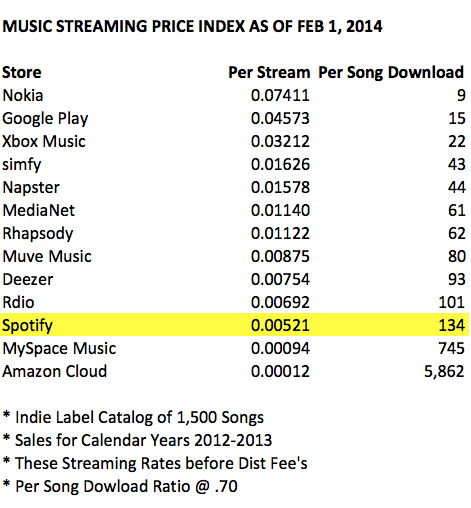
If Spotify is saving Swedish music sales, why aren’t indies celebrating? | The Guardian UK

It’s often hailed as a model for the future of digital music, but the reality is that many smaller labels can’t survive on streaming

When Swedish independent artist/producer/songwriter and label owner David Elfström Lilja checked his admin page on Phonofile, his distributor, the other day to find out how much he had made from his latest single Worlds Collide in its first few weeks of release, his heart sank. For 18,035 streams he had received 8.70 SEK (£0.80). Meanwhile it had sold two copies on iTunes, for which he received 36.37 SEK (£3).

“No one can say that streams don’t cannibalise sales, cause I can’t imagine those streams wouldn’t have generated at least a few sales [if people couldn’t stream it unlimited times],” he reflects.

It’s worth noting that 2013’s 5% rise of music sales in Sweden represents a slowdown, as sales rose by 13.8% in 2012. You’d be hard pressed to find anyone in Sweden that doesn’t know about Spotify by now, so perhaps we’re getting closer to the point where the market is saturated, when all those willing to pay for it are already paying (the company recently dropping listening limits for free users is not exactly helping to push people towards paid subscriptions). And yet revenue levels are nowhere close to where they were in the early noughties.

READ THE FULL STORY AT THE GUARDIAN:
http://www.theguardian.com/media/media-blog/2014/jan/30/spotify-swedish-music-deles-streaming?

Please sign the petition at Irespectmusic.org to support artist pay for radio play

Music Technology Policy

As you may know, the US is one of the few countries in the world that doesn’t respect artists, musicians and vocalists enough to pay them when their songs are played on the radio.  That’s right, when you hear “Gimmie Shelter” on the radio, Jagger and Richards get paid for the song but Merry Clayton does not.  Even on her own version of the song.

And when you hear “R-E-S-P-E-C-T” performed by Aretha Franklin, the songwriter Otis Redding gets paid a royalty, but Aretha does not.  (And neither do the players or background singers).

This sucks.

If you haven’t heard about it, there is a spontaneous petition that Blake Morgan put up at irespectmusic.org that Blake discusses in his MTP interview to tell the U.S. Congress that you respect music (#irespectmusic) and want our artists to be paid for radio airplay.

View original post

MTP Monthly is Coming Tomorrow with Exclusive Interview with @theblakemorgan on I Respect Music.org campaign and more

Music Technology Policy

Our friend Blake Morgan (@theblakemorgan on Twitter) has started a movement with his Huffington Post article Art and Music Are Professions Worth Fighting for.

Given the 40,000 or so likes the HuffPo piece got, Blake has taken it to the next level and offered the “#IRespectMusic” hashtag on Twitter, which has brought a huge turnout, including Sir Patrick Stewart and Sunny Ozell:

patrick stewart

In an exclusive interview, Blake tells us about his inspiration for the campaign to help get a performance royalty for artists–the Artist Pay for Radio Play campaign.  A fascinating exclusive in MTP Monthly.  It’s free to subscribe in the sign up box on musictechpolicy.com.

We’ll also have a reprint of Blake’s HuffPo post and my story about how Google demoted Rap Genius.

Sign up for all the goods on #IRespectMusic and the first edition of our 5th year of operating the newsletter starting tomorrow!

View original post